Crypto Privacy vs Regulation: 2026 Compliance Tensions Guide
Crypto privacy vs regulation: 2026 compliance tensions guide
In a nutshell: crypto privacy vs regulation in 2026
Crypto privacy vs regulation is the tension between a user's ability to transact without unnecessary exposure and a regulator's duty to keep financial flows traceable for anti-money-laundering, sanctions and market-integrity enforcement. In 2026, the debate is less about banning privacy and more about deciding who must disclose what, to whom and when.
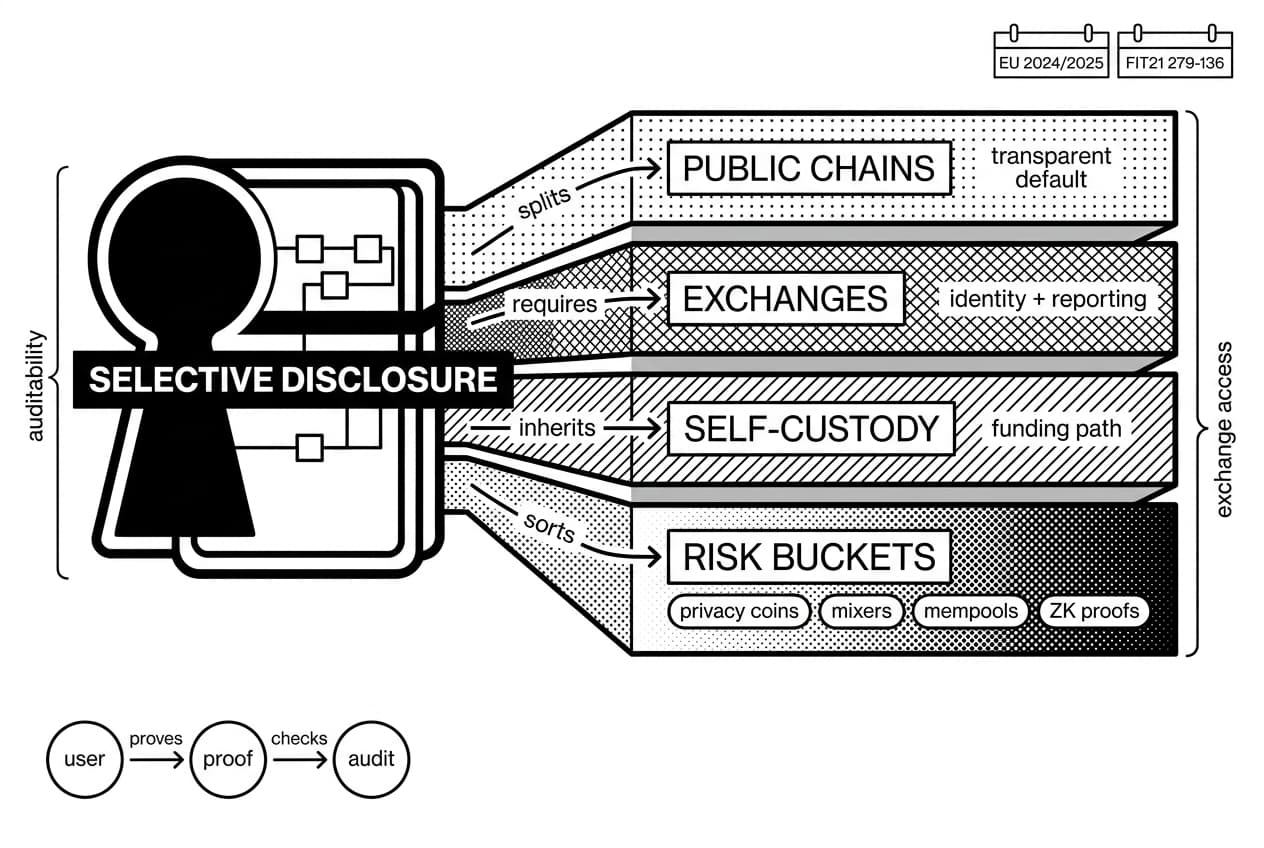
The key finding: crypto privacy is not disappearing. It is being split into layers. Public blockchains remain transparent by default. Centralized exchanges and licensed custodians carry the heaviest identity and reporting duties. Self-custody wallets keep user control but inherit traceability from the funding path. Privacy coins, mixers, private mempools and zero-knowledge proofs sit in separate risk buckets, not one single privacy category.
That segmentation matters for investors because liquidity, exchange access and enforcement risk now depend on the compliance design of each asset or service. The EU's crypto asset rulebook became applicable for most service-provider obligations by late 2024 and early 2025 (ESMA, Jan. 2025). US market-structure law was still unsettled after FIT21 passed the House by 279-136 (Congress.gov, May 2024). The result is a patchwork market where privacy survives only where it can be reconciled with auditability.
Key finding for investors
The market is moving from default pseudonymity toward selective disclosure. Selective disclosure means a user, exchange or protocol can prove a required fact, such as sanctions screening, residency, age, accredited status or proof of reserves, without exposing every transaction detail to the public or to every counterparty. That is the practical middle ground between total anonymity and total surveillance.
Who this matters for
- Retail investors face more identity checks at fiat on-ramps and off-ramps, but wallet-to-wallet activity remains technically possible outside hosted platforms.
- Self-custody users gain control of private keys, yet their wallets may already be linked to identity if funded from a verified exchange account.
- Exchanges must balance user privacy with travel rule duties, sanctions screening and local licensing. Brian Armstrong, co-founder and CEO at Coinbase, has argued publicly that financial privacy is a civil-liberties issue while Coinbase still operates a full identity-check model.
- Builders need privacy-by-design systems that collect less data, protect what they collect and support lawful attestations where required.
- Institutions need confidentiality for trading strategy, treasury movements and counterparties, but cannot ignore AML controls.
- Privacy-asset holders face the sharpest exchange-access risk because mandatory privacy features are harder for regulated venues to support.
By the numbers: the data behind the privacy crackdown
The compliance push is not just a policy mood. It shows up in illicit-finance estimates, licensing deadlines, exchange listing decisions and venture funding for analytics tools. The numbers also cut against simple narratives. Illicit crypto activity is material, but it is not most on-chain activity. Compliance adoption is rising, but it is still uneven across jurisdictions.
Key data points
metric | latest figure | timeframe | source | why it matters |
|---|---|---|---|---|
Illicit on-chain volume, initial estimate | $40.9 billion | Full year 2024 | Chainalysis, Feb. 2025 | Sets the policy baseline for AML arguments; the issuer warns that later attribution can revise totals upward. |
House vote on FIT21 | 279-136 | May 2024 | Congress.gov, May 2024 | Shows bipartisan demand for clearer US market-structure rules, even though final law remained unresolved as of July 2026. |
EU unhosted-wallet threshold | €1,000 | Rule published May 2023; obligations phased from 2025 | EUR-Lex, May 2023 | Creates a concrete privacy trigger for hosted providers dealing with self-custody wallets. |
FATF implementation gap | About three-quarters of surveyed jurisdictions were not fully compliant with virtual-asset standards | Targeted update, June 2024 | FATF, June 2024 | Explains why cross-border transfers still face inconsistent data-sharing rules. |
Analytics funding signal | $70 million series B | Nov. 2022 | TRM, Nov. 2022 | Private capital treated blockchain monitoring as durable compliance infrastructure before many rules were finalized. |
Editorial exchange check | 20 of 20 top spot venues required identity checks for full account functions | Desk review using CoinGecko rankings, July 2026 | Source ranking plus exchange onboarding pages checked July 2026 | Shows that pseudonymous trading has largely exited the centralized-exchange layer. |
How to read the data
Fact: public-chain tracing has become a standard part of exchange compliance. Interpretation: that does not mean every privacy tool is treated equally. The strongest regulatory pressure falls on tools that break transaction graphs without a lawful disclosure path. The lighter pressure falls on confidentiality tools that preserve auditability, such as view keys, proof-of-reserves attestations and zero-knowledge eligibility proofs.
Our editorial dataset for this article scored six privacy categories across three factors as of July 2026: exchange access, legal exposure and disclosure capability. Mandatory privacy coins and sanctioned mixers scored highest risk. Self-custody with clean recordkeeping scored medium risk. Zero-knowledge compliance credentials scored the lowest regulatory-friction risk because their design goal is selective proof rather than total opacity.
How we got here: from cypherpunk privacy to regulated digital assets
Crypto did not move from privacy to compliance overnight. Each enforcement cycle left behind new infrastructure: identity checks, wallet screening, sanctions filters, proof-of-reserves expectations and travel rule messaging. By 2026, those layers form the market structure that investors now trade inside.
Bitcoin was pseudonymous, not anonymous
The original public-chain model made every transaction visible. Addresses do not reveal legal names by themselves, but the graph is permanent. Once an address is linked to a person through an exchange withdrawal, donation page, social profile or court filing, the surrounding transaction history becomes easier to map. That is why the blockchain pseudonymity vs anonymity distinction is not semantic. Pseudonymity is conditional privacy.
Why regulators escalated
Regulators responded to specific failures: unregistered token offerings, exchange collapses, ransomware flows, sanctions exposure and weak custody controls. The tornado cash sanctions action in August 2022 (Treasury press release, Aug. 2022) showed that privacy infrastructure itself could become an enforcement target when officials believed it enabled sanctioned flows. Post-FTX, consumer-protection and systemic-risk arguments gave supervisors more political room to demand reporting and segregation of duties.
The compliance stack emerged
Centralized venues added identity checks, address screening and transaction monitoring. Custodians built audit trails. Institutions added counterparty-risk scoring. Analytics vendors became part of normal due diligence, which is why understanding how blockchain surveillance works is now baseline knowledge for serious market participants. Tyler Winklevoss, co-founder at Gemini, has publicly framed regulated exchange infrastructure as a condition for institutional adoption. That view helps explain why compliance rails were built before many crypto-native privacy tools had legal clarity.
The contrarian point is simple: regulators have not erased privacy. They have moved privacy decisions to chokepoints. Exchanges, frontends, stablecoin issuers and custodians are the points where identity obligations attach. Base-layer contracts and self-custody wallets remain harder to regulate directly, but they are surrounded by increasingly monitored access layers.
What crypto privacy actually means
Privacy is not one feature. It is a stack of properties: identity privacy, transaction confidentiality, graph resistance, metadata protection and selective disclosure. Confusing those layers leads to bad risk analysis. A wallet can be non-custodial and still highly traceable. A private mempool can reduce trading exposure without hiding final settlement. A zero-knowledge credential can protect data while still proving compliance.
Privacy is a spectrum
privacy mechanism | amounts hidden | addresses hidden | graph resistance | regulatory posture in 2026 |
|---|---|---|---|---|
Transparent chain such as bitcoin or ether | No | No | Low | Accepted, but monitored through service providers |
Pseudonymous wallet | No | Partial | Low to medium | Accepted, with exchange-linkage risk |
Shielded transaction system | Yes | Yes | Medium to high | Restricted by some venues, easier if view keys exist |
Mandatory privacy coin | Yes | Yes | High | High delisting risk at regulated venues |
Mixer or coinjoin service | Usually no | Partial | Medium to high | High legal risk if linked to sanctions or illicit flows |
Private mempool | No | No | Low | Generally accepted as execution protection |
Permissioned institutional network | Yes | Yes | Not public | Accepted when participants are vetted |
Anonymity, pseudonymity and confidentiality
Anonymity means no practical link between an action and an identity. Pseudonymity means actions attach to an identifier, such as a wallet address, that may later be tied to a real person. Confidentiality means transaction details are hidden from third parties even when the parties know each other. Most crypto activity is pseudonymous, not anonymous.
Erik Voorhees, founder of ShapeShift, has long argued that ordinary self-custody should not be treated as suspicious merely because a user controls the keys. That argument is stronger when users maintain lawful records, avoid sanctioned services and do not misrepresent counterparties. It is weaker when privacy tools are used to defeat reporting, sanctions or tax obligations.
The overlooked metadata problem
The public ledger is only one privacy leak. RPC providers can see wallet queries. Wallet apps can reveal device or browser signals. Exchanges retain withdrawal records. Social handles tied to public addresses can complete the identity link without a subpoena. In practice, metadata often exposes users faster than chain analysis alone.
The EU transfer-of-funds regulation requires crypto service providers to collect payer and payee information for transfers, with specific treatment for self-custody interactions above the €1,000 threshold (EUR-Lex, May 2023). That means privacy depends not only on cryptography, but also on data retention, vendor access and operational hygiene.
The 2026 regulatory map: US, EU, FATF and beyond
Crypto's compliance map in 2026 is a patchwork. No single rule governs all privacy tools. Exchanges face licensing and reporting. Hosted wallets face identity duties. Self-custody remains legal in major markets, but transfers to and from hosted platforms create more verification events. DeFi frontends face sanctions and consumer-protection pressure even when contracts remain open.
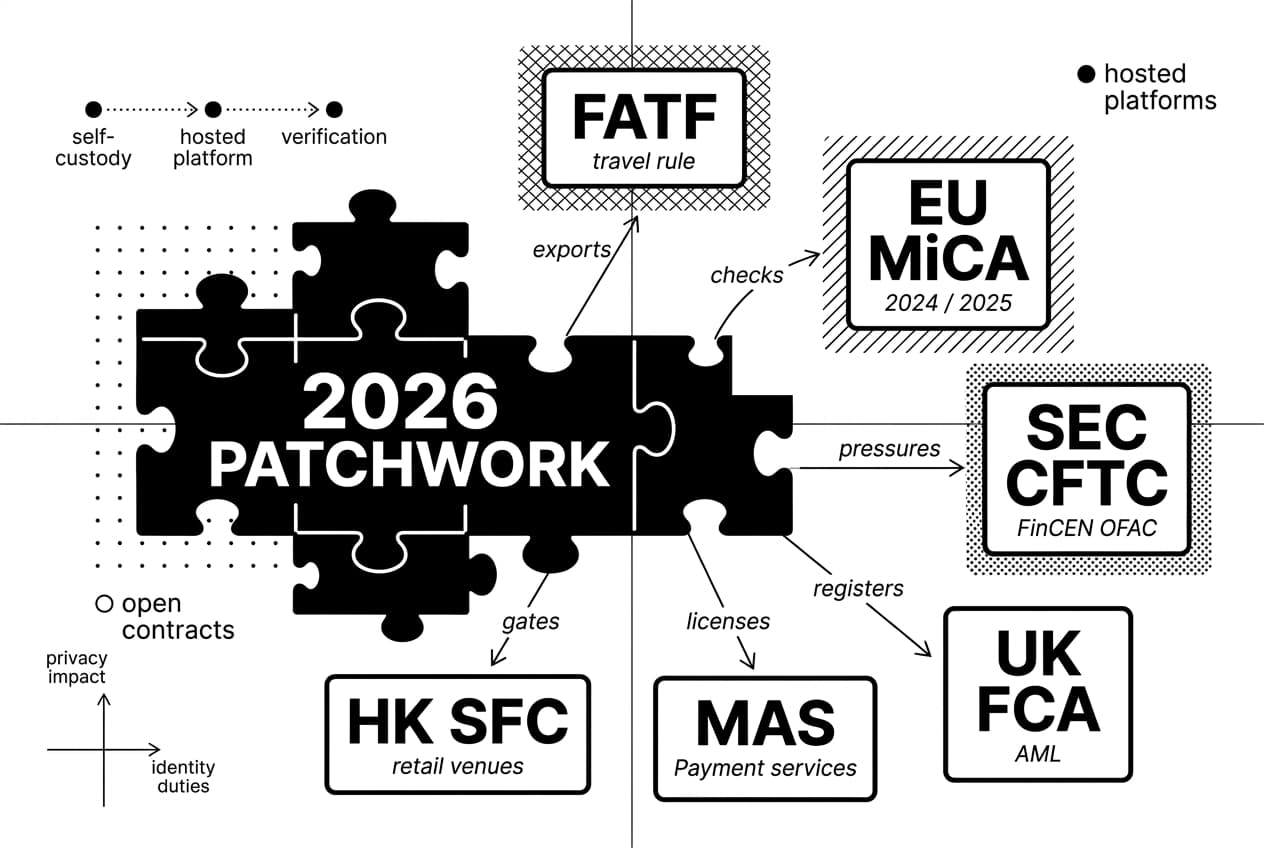
jurisdiction | rule or regulator | who is affected | privacy impact | July 2026 status |
|---|---|---|---|---|
Global | FATF travel rule | Virtual-asset service providers | High; originator and beneficiary data can travel with transfers | Active, with uneven national implementation |
EU | MiCA plus transfer-of-funds rules | Crypto asset service providers and some self-custody interactions | High at hosted platforms; threshold checks affect self-custody flows | MiCA applicable from 2024 and 2025 phases |
US | SEC, CFTC, FinCEN and OFAC | Exchanges, brokers, money transmitters, stablecoin firms and frontends | Medium to high; sanctions and reporting duties are the main privacy constraints | Market-structure law still unsettled after FIT21 House passage |
UK | FCA registration and AML rules | Registered crypto businesses | Medium; identity checks and travel rule duties apply | Active, with staged rule updates |
Singapore | Payment services act and MAS licensing | Digital payment token services | Medium; licensed providers must run AML controls | Active after 2024 amendments |
HK | SFC licensing | Centralized venues serving retail users | Medium; access is tied to licensed intermediaries | Mandatory licensing live from 2024 |
Japan | FSA oversight and exchange self-regulation | Registered exchanges | Medium to high for privacy assets | Privacy-coin restrictions have been in place for years |
UAE | Virtual-asset licensing in Dubai and related zones | Licensed service providers | Medium; AML controls apply, but licensing may be more commercially flexible | Active, with continuing supervisory updates |
FATF and the travel rule
FATF standards require service providers to collect and transmit originator and beneficiary information for covered transfers. The technical problem is not just collection. It is interoperability. A compliant exchange sending funds to a venue in a slower-moving jurisdiction may not have a reliable counterparty-data channel. FATF's June 2024 update said about three-quarters of surveyed jurisdictions were still not fully compliant with its virtual-asset standards (FATF, June 2024).
EU rules: MiCA, funds-transfer data and AML supervision
MiCA creates a licensing system for crypto asset service providers across 27 member states (ESMA, Jan. 2025). The main privacy pressure comes from transfer data, not from the licensing rule alone. Providers must know customers, monitor transactions and handle self-custody transfers differently when thresholds or risk indicators apply.
Interpretation: the EU approach is strict, but it may create room for selective-disclosure tools because the law often focuses on what must be proved rather than requiring every detail to be public. That is the opening for zero-knowledge credentials, view keys and privacy-preserving audits.
US rules: agency overlap and market-structure uncertainty
The US remains the least tidy major market. Securities law, commodities law, money-transmission rules and sanctions law overlap. FIT21 passed the House by 279-136 in May 2024 (Congress.gov, May 2024), but final federal market-structure clarity was still unresolved as of July 2026. For background on classification risk, see our guide to how SEC rules apply to crypto.
Brian Armstrong has argued through Coinbase that unclear US rules push compliant firms offshore (Coinbase). That claim is a business argument, but it matches a visible pattern: firms can build faster where licensing expectations are known, even when the rules are strict.
Other major markets
Outside the US and EU, the privacy outcome depends on licensing style. Singapore and Japan rely on tightly supervised intermediaries. HK uses exchange licensing to control retail access. The UAE competes for global firms while still applying AML duties. The practical investor read is that privacy assets may remain tradable somewhere, but deep regulated liquidity tends to migrate toward venues that can explain their controls to supervisors.
Where compliance hits: exchanges, wallets and self-custody
Compliance pressure lands at chokepoints, not evenly across the stack. The main chokepoints are fiat rails, hosted exchanges, custodians, stablecoin issuers, frontends and analytics-linked withdrawal systems. Self-custody reduces platform control, but it does not erase the history of how a wallet was funded.
Centralized exchanges as compliance chokepoints
Centralized exchanges now act as identity gateways. Under travel rule standards, many venues must attach originator and beneficiary data to covered transfers above thresholds such as $1,000 or €1,000, depending on jurisdiction (FATF virtual assets page, 2024 update). That means privacy at the exchange layer is mainly data-governance privacy, not anonymity.
Address screening also affects withdrawals. Exchanges compare destination addresses against sanctions lists and analytics risk scores. If a wallet is linked to theft, ransomware, sanctioned actors or high-risk mixing, withdrawals may be delayed, reviewed or blocked. This is why self-custody wallet rules matter even for users who never intend to use a privacy coin.
Are self-custody wallets still private?
Self-custody is private in one sense: the user, not a custodian, controls the keys. It is not private in every sense. If the wallet received funds from a verified exchange account, that address may be labeled in the exchange's records. If the same address is reused, future activity becomes easier to map.
Operational choices change the outcome. Users who separate wallets by purpose, avoid address reuse, keep records and understand RPC metadata reduce unnecessary exposure. Users who route every transaction through one exchange-funded address create a durable identity graph. That is not a legal judgment; it is how public ledgers and exchange records interact.
Hardware wallets versus hosted wallets
custody type | KYC required | on-chain linkage risk | platform data collection | asset seizure risk |
|---|---|---|---|---|
Hosted exchange wallet | Yes | High | Full account and transaction records | Higher because custodian controls access |
Mobile self-custody wallet | No at wallet level | Medium if exchange-funded | App, RPC and device metadata can matter | Lower because user controls keys |
Browser wallet | No at wallet level | Medium to high if reused | RPC and browser signals can matter | Lower because user controls keys |
Hardware wallet | No at device level | Low to medium depending on funding path | Lowest when paired with careful node or RPC setup | Lowest for remote platform freezes |
Hardware wallets improve signing security and can reduce metadata exposure if paired with careful infrastructure, but they do not erase prior exchange links. For custody tradeoffs, see hardware wallet vs exchange custody.
Privacy coins, mixers, DeFi and ZK: what still works?
Privacy technologies face different risk profiles. Mandatory privacy coins, optional shielded systems, mixers, DeFi protocols and zero-knowledge credentials should not be grouped together. The policy question is whether a tool can support lawful selective disclosure without turning every transaction into public data.
What happens to privacy coins?
Monero and Zcash show the split. Monero uses privacy by default. Zcash supports shielded transactions but also allows transparent use and view-key disclosure. That difference affects exchange comfort. Binance announced Monero delisting in 2024, OKX also removed several privacy tokens in 2024, and Kraken had already restricted Monero for UK users in 2021. The result is not disappearance; it is fragmented liquidity and higher venue risk.
The technical debate around whether Monero is traceable remains contested. For investors, the more immediate issue is simpler: if regulated venues cannot satisfy their monitoring obligations, they are more likely to delist or restrict access regardless of the coin's cryptographic strength.
Mixers and sanctions risk
Mixers are legally sensitive because they are designed to break the transaction graph that AML programs use. The US sanctions action against the tornado cash protocol in August 2022 (Treasury press release, Aug. 2022) remains the reference point. For users subject to US jurisdiction, interacting with sanctioned addresses can create legal risk regardless of personal intent.
Erik Voorhees has argued that sanctioning open-source tools can confuse software with user conduct (ShapeShift). That civil-liberties argument is real, but it does not remove user obligations under sanctions law.
Can DeFi escape regulation?
The contract layer is harder to regulate than the people and interfaces around it. Enforcement pressure is more likely to hit frontends, relayers, hosted interfaces, treasury signers, fiat gateways and identifiable operators. Hayden Adams, founder at Uniswap, has distinguished between protocol-level access and frontend policy choices. That distinction is becoming central to DeFi compliance.
Investors should separate protocol survivability from token liquidity. A contract may keep running while frontends block regions, stablecoin issuers freeze addresses or exchanges restrict deposits. That is why crypto business license compliance is now relevant even to teams that call themselves decentralized.
Zero-knowledge compliance and selective disclosure
Zero-knowledge proofs offer the strongest technical case for reconciling crypto privacy vs regulation. They can let a user prove a required fact without publishing the underlying data. Examples include proof of non-sanctioned status, proof of age, proof of residency, proof of solvency or proof that a user passed checks at a qualified issuer.
The tradeoff is issuer trust. A zero-knowledge credential protects data from broad disclosure, but someone still has to issue, revoke and audit the credential. That moves trust from public-chain transparency to the credentialing layer. Privacy-native users should scrutinize that layer, while institutions may accept it because it creates an audit trail.
technology | technical privacy | legal risk in major markets | exchange access | compliance path |
|---|---|---|---|---|
Monero | High | High | Limited at regulated venues | No broadly accepted disclosure path |
Zcash | Medium to high | Medium | Varies by jurisdiction | View keys and optional disclosure |
Sanctioned mixer addresses | High | Very high | None at compliant venues | No practical path for ordinary users |
Immutable DeFi contracts | Pseudonymous | Lower at contract level, higher at interface level | Depends on frontends and stablecoins | Frontend screening and disclosures |
Zero-knowledge credentials | Medium to high | Lower if accepted by supervisors | Improving, but early | Selective proof and issuer audits |
How users and builders can protect privacy legally
Legal privacy work is not about hiding from lawful obligations. It is about reducing unnecessary data exposure while keeping records, avoiding sanctioned services and meeting tax, AML and reporting duties. This section is informational only and does not replace legal advice.
Legal privacy basics for users
- Separate wallet purposes so long-term holdings, DeFi activity, public donations and exchange withdrawals do not all share one address.
- Avoid address reuse where the wallet software supports fresh receiving addresses, because reuse makes graph analysis easier.
- Review exchange policies before depositing funds, with attention to analytics vendors, retention periods and data-sharing terms.
- Keep tax records with cost basis, dates, wallet labels and transaction hashes, because privacy does not remove reporting obligations.
- Check sanctions lists through official sources before interacting with unfamiliar protocols or counterparties.
- Use self-custody carefully for funds that do not need exchange liquidity, while recognizing that funding history may remain visible.
- Limit identity spread by maintaining verified accounts only where needed instead of sending documents to many platforms.
- Protect metadata through reputable wallet settings, careful RPC choices and avoidance of public address posting tied to personal profiles.
Privacy-by-design for crypto businesses
Businesses should collect the minimum data needed for a risk-based compliance program, protect that data with strict access controls and document why each data field is necessary. The common failure is overcollection: teams gather more personal information than their program requires, then create a larger breach target.
Practical controls include role-based access, encryption at rest, short retention where law permits, immutable audit logs for compliance decisions and vendor reviews for analytics or identity providers. Zero-knowledge checks can reduce raw data sharing if supervisors and banking partners accept the model. Hayden Adams has argued that frontend rules can be separated from core protocol design (Uniswap), which is a useful architecture pattern for teams that want compliance without embedding surveillance into base contracts.
When to get professional advice
Get qualified counsel before launching a token, operating a privacy tool, listing assets, touching sanctions-sensitive flows, handling customer funds or expanding across borders. Product decisions that change how identity data or customer funds move should be reviewed before launch. For selection criteria, see when to hire a crypto lawyer.
This article is for informational purposes only and does not constitute legal, tax, financial or compliance advice. Consult a qualified professional for advice specific to your facts and jurisdiction.
Frequently Asked Questions
- Is regulation good or bad for crypto?
- Regulation is genuinely both. Well-designed rules reduce fraud, build institutional confidence and clarify market boundaries. Poorly designed rules increase surveillance, raise compliance costs and restrict access. The real question is whether regulations are proportionate, technology-neutral and consistently enforced — those factors determine whether the net effect is harmful or helpful.
- Is XRP a privacy coin?
- No. XRP is not a privacy coin. The XRP Ledger is a public, transparent blockchain where transactions are visible to anyone, though addresses are pseudonymous rather than identity-linked by default. This is fundamentally different from privacy-focused assets like Monero or systems that use shielded transactions to obscure sender, receiver and amount data.
- What is the 2026 crypto legislation update?
- By mid-2026, the EU's MiCA framework is in full effect, and FATF Travel Rule implementation is advancing across member jurisdictions. The US has seen active rulemaking from the SEC and CFTC, alongside ongoing stablecoin and market-structure legislation. Specifics vary by jurisdiction and implementation stage, so always verify current obligations through official regulatory sources.
- What does regulation mean for crypto?
- Crypto regulation establishes legal obligations for exchanges, issuers, custodians, brokers and increasingly DeFi interfaces. It typically covers AML and KYC requirements, sanctions compliance, consumer protection, tax reporting and market integrity standards. Privacy implications vary significantly depending on which service you use, where you're located and what activity triggers regulatory oversight.
Sources
Author

Crypto analyst and blockchain educator with over 8 years of experience in the digital asset space. Former fintech consultant at a major Wall Street firm turned full-time crypto journalist. Specializes in DeFi, tokenomics, and blockchain technology. His writing breaks down complex cryptocurrency concepts into actionable insights for both beginners and seasoned investors.