Quantum Computing Crypto Threat: Is Blockchain Safe in 2026

Key finding: is crypto safe from quantum computing in 2026?
Quantum computing crypto risk is real, but no major blockchain is broadly breakable in 2026. The bigger issue is uneven exposure: reused addresses, revealed public keys, bridges, custodians, and slow post-quantum migration create long-term risk well before a full cryptographic break becomes practical.
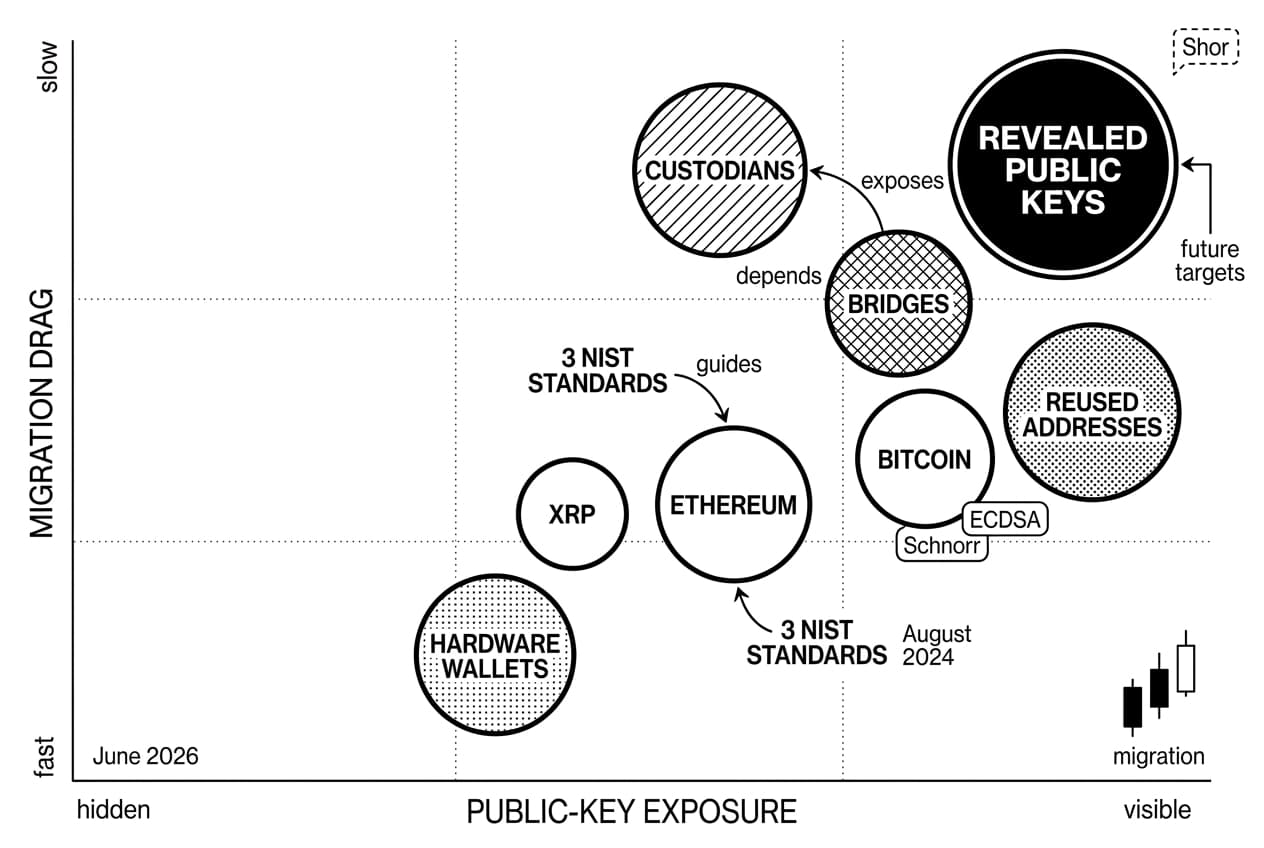
Our base case is not a sudden market-wide failure. It is a staggered migration problem. Bitcoin, Ethereum, XRP, hardware wallets, bridges, and custodians do not expose public keys in the same way and will not upgrade at the same speed. That unevenness is the core quantum threat blockchain investors should track.
The short answer for investors
As of June 2026, the practical threat is not that a quantum computer can steal ordinary crypto balances today. It is that some balances are already identifiable as future targets because their public keys are visible on-chain. The NIST release of 3 finalized post-quantum standards in August 2024 gave blockchains a reference point, but it did not automatically migrate any live chain, wallet, custodian, or bridge.
What would have to be true for a real key-theft attack?
A direct attack on ECDSA or Schnorr signatures needs three conditions at the same time. First, a fault-tolerant quantum computer must run enough reliable logical qubits, not just noisy physical qubits. Second, it must execute a deep Shor-style circuit without losing coherence. Third, the attacker must have access to the target’s public key before the owner moves funds.
Andreas Antonopoulos, author and educator, has repeatedly framed address reuse and operational key exposure as security problems even before quantum computers enter the picture. That framing matters here: quantum risk starts with exposed key material, not with a coin’s brand name.
Interpretation: the 2026 risk is low for fresh, non-reused addresses and higher for legacy outputs, reused addresses, account-model wallets after first spend, bridge signers, and custodial hot-wallet systems. This article is analysis, not financial advice.
By the numbers: quantum computing crypto risk in context
Raw qubit headlines are a poor proxy for cryptographic risk. Investors need to separate physical qubits, logical qubits, circuit depth, error correction, and exposed public keys. These are the data points that anchor our 2026 exposure map.
Key data points
- 105 physical qubits: Google reported its Willow processor with 105 qubits in December 2024. That was an error-correction milestone, not a blockchain-breaking system.
- 1,121 physical qubits: IBM announced the Condor processor at 1,121 qubits in its December 2023 quantum roadmap update. Physical qubits are not the same as reliable logical qubits.
- 317 million physical qubits: A resource estimate in AVS Quantum Science, January 2022 estimated roughly 317 million physical qubits to break a 256-bit elliptic-curve key in about 1 hour under its assumptions.
- 25% of circulating bitcoin: Deloitte estimated that about 25% of bitcoin in circulation had exposed public keys in March 2020, mainly through old output types and address reuse.
- 3 finalized standards: NIST finalized 3 post-quantum cryptography standards in August 2024, including ML-KEM and ML-DSA.
- 11 spot bitcoin exchange-traded products: The SEC approved listings for 11 spot bitcoin products on January 10, 2024, increasing institutional sensitivity to custody and cryptographic-risk disclosures.
What the numbers prove, and what they do not
The data does not prove that crypto is safe forever. It proves that the gap between public quantum hardware and a practical secp256k1 attack remains large in 2026. A system with hundreds or even thousands of noisy physical qubits is not equivalent to millions of error-corrected qubits running a sustained cryptanalytic circuit.
The more actionable finding is that exposed public keys are measurable today. If a chain has many old outputs, reused addresses, or static high-value signers, its future quantum exposure is larger even if its current consensus remains secure. That is why our analysis treats quantum risk as an exposure-management problem before it becomes a break-the-curve problem.
Why quantum computing threatens blockchain cryptography
Blockchain security relies on several cryptographic primitives. Quantum computers do not affect all of them equally. Signature schemes are the main concern; hash functions are less exposed because the best-known quantum speedup is much weaker.
Public key, private key, and address exposure
A private key authorizes spending. A public key lets the network verify signatures. An address is usually a hash or encoded representation derived from public-key material. On many chains, receiving funds does not always reveal the full public key. Spending often does.
That distinction is central to how blockchain pseudonymity works. Once a public key appears on-chain, it stays available to every future attacker. Under today’s classical assumptions that is acceptable. Under a future fault-tolerant quantum model, it becomes the data needed for key recovery.
Shor-style attacks and signature risk
ECDSA, Schnorr, and EdDSA depend on the hardness of elliptic-curve discrete logarithm problems. A sufficiently capable quantum computer running Shor-style algorithms could, in principle, derive a private key from an exposed public key. Vitalik Buterin, co-founder linked with ethereum.org, has publicly discussed post-quantum recovery paths for Ethereum because this class of risk is known, not speculative.
The key qualifier is capability. Current public systems do not have the logical qubit count, error rates, or circuit depth needed for that attack against production blockchain keys. The risk is therefore long-term but not imaginary.
Grover-style attacks and hash risk
Hash functions face a different quantum profile. Grover-style search gives a quadratic speedup, which roughly halves the effective security level of a hash. For SHA-256, that leaves an estimated 128-bit security level, still beyond practical brute force under foreseeable public hardware assumptions.
Investor takeaway: monitor public-key exposure and signature migration first. Hash mining headlines matter less unless they are paired with error-corrected quantum hardware capable of sustained, large-scale search.
Three types of quantum attack on blockchains
The quantum threat blockchain analysts discuss is not one attack. It is at least three different attack surfaces with different timing, targets, and defenses.
Attack 1: deriving a private key from an exposed public key
This is the main cryptographic break scenario. If an attacker can see a public key and has a large enough fault-tolerant quantum computer, they could attempt to compute the corresponding private key and sign a theft transaction.
The most exposed targets are old bitcoin public-key outputs, reused addresses, account-model wallets after their first outbound transaction, multisig scripts that reveal participant keys, and bridge or custodian systems that keep high-value signing keys active. The January 2022 AVS estimate of roughly 317 million physical qubits for a 1-hour elliptic-curve attack shows why this is not a 2026 operational attack, but it also shows why exposed key inventories should start before the hardware exists.
Attack 2: mempool race against pending transactions
A mempool-race attack targets the time between broadcast and confirmation. When a transaction reveals a public key, an attacker would need to derive the private key fast enough to submit a competing transaction before finality.
Bitcoin targets roughly 10-minute blocks, according to the bitcoin developer guide. Ethereum targets roughly 12-second slots, according to ethereum.org documentation. Shorter confirmation windows reduce this attack’s timing window, but they do not remove the underlying signature exposure.
Attack 3: dormant coins, reused addresses, and static signers
This is the most important structural category. Dormant outputs with already revealed public keys give a future attacker unlimited time to run the calculation once capable hardware exists. The owner may be inactive, deceased, unable to migrate, or unaware of the risk.
The same concern applies beyond individual wallets. Bridges and custodians often concentrate value behind long-lived signing policies. Even if their private keys never leave controlled systems, the signature schemes can still become obsolete. Operational readiness therefore matters as much as cryptographic design.
Which cryptos and wallets are most exposed?
Exposure depends on signature scheme, public-key visibility, governance speed, and wallet support. The table below is our 2026 exposure map. It is a risk model, not a prediction of imminent compromise.
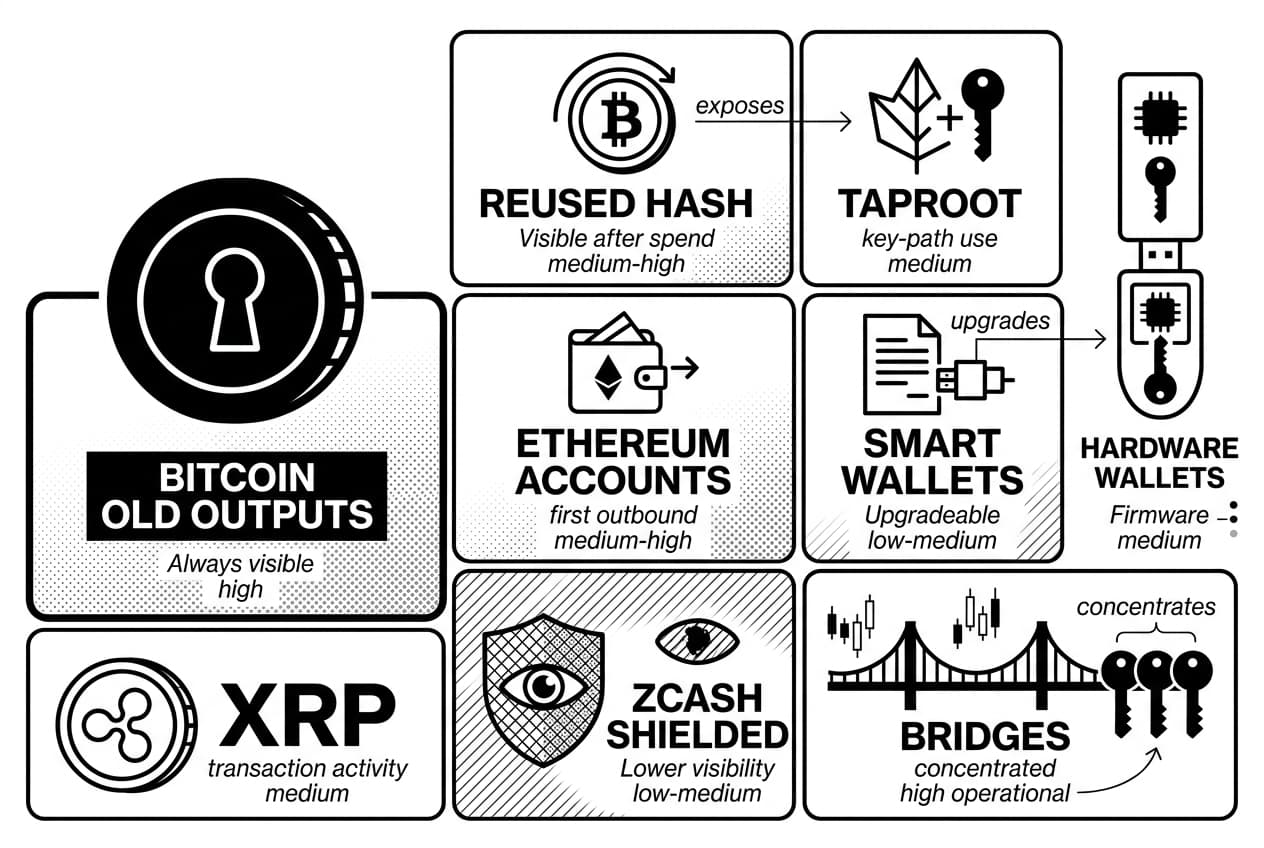
Asset or network | Signature or key model | Public-key exposure | Upgrade path | Quantum-risk level |
|---|---|---|---|---|
Bitcoin old public-key outputs | ECDSA secp256k1 | Always visible | Consensus change likely needed | high for legacy coins |
Bitcoin reused hash-address outputs | ECDSA secp256k1 | Visible after spend | User migration plus protocol debate | medium-high |
Bitcoin taproot key-path spends | Schnorr secp256k1 | Visible in key-path use | Future soft-fork discussion | medium |
Ethereum standard accounts | ECDSA secp256k1 | Visible after first outbound transaction | Account abstraction and hard-fork options | medium-high |
Ethereum smart wallets | Configurable signer | Depends on implementation | Upgradeable contract logic | low-medium if post-quantum signer is added |
XRP accounts | ECDSA or Ed25519 | Visible after transaction activity | Amendment process | medium |
Zcash shielded use | Shielded proving system plus signatures | Lower public-key visibility for shielded transfers | Protocol upgrade process | low-medium |
Cross-chain bridges | Multisig or threshold signing | Often concentrated and repeated | Project-specific | high operational target |
Hardware wallets | Device-side ECDSA or Schnorr | Private key protected locally | Firmware, app, and chip support | medium |
Bitcoin: old outputs, reused addresses, and migration timing
Bitcoin has the most layered exposure profile because older output types and address reuse can reveal public keys permanently. Deloitte’s March 2020 estimate that about 25% of circulating bitcoin had exposed public keys remains a useful warning, even though the exact percentage changes over time as coins move.
The governance bottleneck is just as important as the cryptography. Bitcoin can change, but changes require broad social and technical agreement. For a focused timeline analysis, see the quantum computing bitcoin threat timeline.
Ethereum and account-based chains
Ethereum standard accounts expose public-key material after transaction activity. The chain also has a more flexible migration route than bitcoin because smart wallets and account abstraction can change signing logic at the wallet layer. EIP-7702 was included with Pectra and is documented in the Ethereum improvement proposal repository, May 2025.
The caveat is deployment. A theoretical upgrade path does not protect users who remain in standard accounts, custodial accounts, or contracts built around old assumptions. In our model, Ethereum’s advantage is migration optionality; its risk is the size of the installed legacy base.
XRP, Zcash, and bridge systems
XRP faces the same broad elliptic-curve issue as other signature-based networks. Its advantage is that amendment-based governance can move faster than slower consensus cultures if the community agrees on a post-quantum path. Zcash has a different exposure profile because shielded use reduces public-key visibility, but that does not make the whole system quantum-proof.
Bridge systems may be the highest near-term operational concern. They often hold large balances behind repeated signing workflows and project-specific security processes. A quantum break is not needed for a bridge incident; poor key management, weak vendor controls, and signer concentration are already known failure modes.
How blockchains are preparing for post-quantum security
Post-quantum preparation is no longer abstract. Standards exist, test implementations exist, and some projects market quantum-resistant designs. The hard part is production migration on systems that secure live value every second.
NIST post-quantum standards and what they mean for crypto
NIST finalized ML-KEM, ML-DSA, and SLH-DSA in August 2024. ML-DSA is the most relevant to blockchain signatures, while ML-KEM applies more directly to key establishment. For blockchains, standardization is a floor. Wallet derivation paths, transaction formats, fee markets, node verification costs, and user migration flows still need separate design.
Quantum-resistant blockchains and upgrade strategies
Some quantum-resistant crypto projects use hash-based or lattice-based signatures. The key due-diligence question is not whether a website says quantum-resistant. It is whether the exact implementation has independent audits, active maintenance, usable wallets, and enough liquidity to matter.
For larger networks, hybrid migration is more likely than a single switch. A chain may accept both current and post-quantum signatures for a period, then phase out exposed or inactive formats. Vitalik Buterin has discussed emergency migration logic for Ethereum, but any such response would still require social coordination, client releases, wallet support, and exchange readiness.
The tradeoff competitors often miss
Post-quantum signatures are larger. The FIPS 204 final standard, August 2024 lists ML-DSA signature sizes of 2,420 bytes, 3,309 bytes, and 4,627 bytes depending on the parameter set. A typical secp256k1 signature is about 64 bytes before encoding overhead. That size gap affects fees, block space, bandwidth, and verification load.
Hash-based signatures can be larger still. The FIPS 205 final standard, August 2024 lists SLH-DSA signature sizes that range from 7,856 bytes to 49,856 bytes depending on parameters. That does not make post-quantum migration impossible, but it rules out lazy assumptions that signatures can be swapped without economic effects.
The intersection of zero-knowledge encryption and private compute may eventually help with verification or compression designs, but production-grade post-quantum and zero-knowledge hybrids remain early. Treat roadmap claims as forward-looking until audited code and mainnet usage prove otherwise.
Our named framework is the three-layer migration test: protocol support, wallet and key-management tooling, and user migration incentives. A chain that passes only one layer still leaves real balances exposed. The migration has to work technically, economically, and behaviorally.
What bitcoin and crypto users can do now
The current hardware gap gives users time to improve hygiene. These steps are useful even if cryptographically relevant quantum computers take longer than expected.
For individual holders
Avoid address reuse. For bitcoin, use modern wallet software that generates a fresh receive address and do not send funds back to an address that has already spent. Keep firmware current and understand your recovery process before an emergency. Baseline checks still matter more than quantum speculation: review how to set up a Ledger wallet securely, compare hardware wallet security options, and learn how to check if a wallet is compromised.
For institutions and custodians
Use the four-layer exposure inventory. First, list every signing key by algorithm: ECDSA, Schnorr, EdDSA, or other. Second, flag every address or signer whose public key is already visible. Third, map vendor, HSM, wallet, and recovery dependencies. Fourth, link each exposure to a chain-specific migration path and a decision owner.
Andreas Antonopoulos has long emphasized that operational security failures usually arrive before exotic cryptographic failures. That remains true in 2026. A custodian that cannot inventory exposed keys today is unlikely to execute a calm post-quantum migration later.
Signals to monitor in 2026 and beyond
Signal | Why it matters | Status as of June 2026 |
|---|---|---|
Logical qubit progress | Logical qubits, not press-release physical qubits, drive attack feasibility | No public system has shown a blockchain key break |
NIST algorithm adoption | Shows standards moving into production libraries | 3 standards finalized in August 2024 |
Wallet support | User migration fails without signer support | Fragmented; no dominant post-quantum retail-wallet standard |
Protocol proposals | Consensus changes need long lead times | Research stage for most major networks |
Custody disclosures | Institutional policy changes can move markets before attacks occur | Worth monitoring in ETF and exchange risk language |
The practical rule: do not react to qubit-count headlines alone. React when logical-qubit milestones, wallet adoption, and custody disclosures move together.
Scenario analysis: when does the quantum threat become urgent?
No public dataset can predict the exact date of a cryptographically relevant quantum computer. A useful investor model is conditional: if hardware and migration signals move together, risk rises; if hardware progress remains noisy and governance improves, risk stays manageable.
Base case: gradual post-quantum migration
In the base case, standards mature before practical key-breaking hardware arrives. Major wallets test post-quantum schemes, institutions build exposed-key inventories, and chains add migration paths over several upgrade cycles. This scenario is disruptive but manageable. It requires years of coordination, not panic.
Risk case: capability arrives before coordination
The risk case is a hardware or algorithmic jump that compresses timelines while major chains remain divided on migration. Exposed public keys would become the first triage category. Dormant old outputs, reused addresses, bridge signers, and custodial hot wallets would face the highest pressure.
This scenario is not our 2026 base case, but it is the reason slow governance is an investment risk. A chain can be cryptographically sound today and still have a poor migration profile if its community cannot agree when the threat window narrows.
Market case: fear prices in before technical risk arrives
Markets may reprice quantum risk before a real attack is possible. The SEC’s January 2024 approval of 11 spot bitcoin products expanded the audience for formal risk disclosures. If large custodians, ETF issuers, or insurers change language around quantum exposure, volatility could rise even without a working key-recovery machine.
Scenario | Trigger signal | Possible timing | Main risk |
|---|---|---|---|
Base case | Wallets add tested post-quantum signing | 2026-2034 | Slow but orderly migration |
Risk case | Verified fault-tolerant scaling beyond public expectations | Low probability before 2030 | Exposed-key scramble |
Market case | Custody or ETF disclosures change | Any time | Narrative-driven volatility |
Investor monitoring framework, the three-signal check: track peer-reviewed logical-qubit milestones, post-quantum wallet adoption across major providers, and custody or ETF risk-language changes. If any 2 of the 3 move within the same quarter, reassess exposure to reused addresses, old outputs, bridge assets, and long-term cold storage.
Frequently Asked Questions
- Is there a quantum crypto?
- Yes, though the term covers different things. "Quantum crypto" can refer to quantum key distribution, post-quantum cryptography, or blockchain tokens marketed around quantum themes. In the blockchain context, what matters most is post-quantum signatures — cryptographic schemes designed to withstand attacks from future fault-tolerant quantum computers.
- Which crypto is linked to quantum computing?
- Several projects claim quantum-resistant designs, and major networks like Bitcoin and Ethereum are actively researching migration strategies. Rather than chasing quantum branding, evaluate whether a project's cryptography has been independently audited, how strong developer adoption is, and whether governance supports timely security upgrades.
- Can quantum computing break XRP?
- Potentially, yes — but not today. A sufficiently powerful fault-tolerant quantum computer could threaten the public-key signature schemes used across many blockchains, including XRP. The actual risk depends on how keys are exposed, which signature schemes the network uses, when quantum hardware matures, and whether the network upgrades in time.
- Is quantum crypto a good investment?
- Quantum resistance may become a meaningful security advantage, but that alone doesn't make a token a sound investment. A credible case also requires real adoption, strong liquidity, transparent governance, a sustainable revenue model, solid tokenomics, and independently verified post-quantum cryptography — not just marketing language around quantum computing.
Sources
Author

Crypto analyst and blockchain educator with over 8 years of experience in the digital asset space. Former fintech consultant at a major Wall Street firm turned full-time crypto journalist. Specializes in DeFi, tokenomics, and blockchain technology. His writing breaks down complex cryptocurrency concepts into actionable insights for both beginners and seasoned investors.