Quantum Computing Bitcoin: Threat Timeline and Reality 2026

Quantum computing and Bitcoin: the 2026 bottom line
Can quantum computers break Bitcoin? As of mid-2026, no public quantum computer can break Bitcoin. The practical quantum computing bitcoin risk is not today’s hardware; it is whether future fault-tolerant machines can recover ECDSA private keys from exposed public keys before Bitcoin users and developers complete a post-quantum migration.
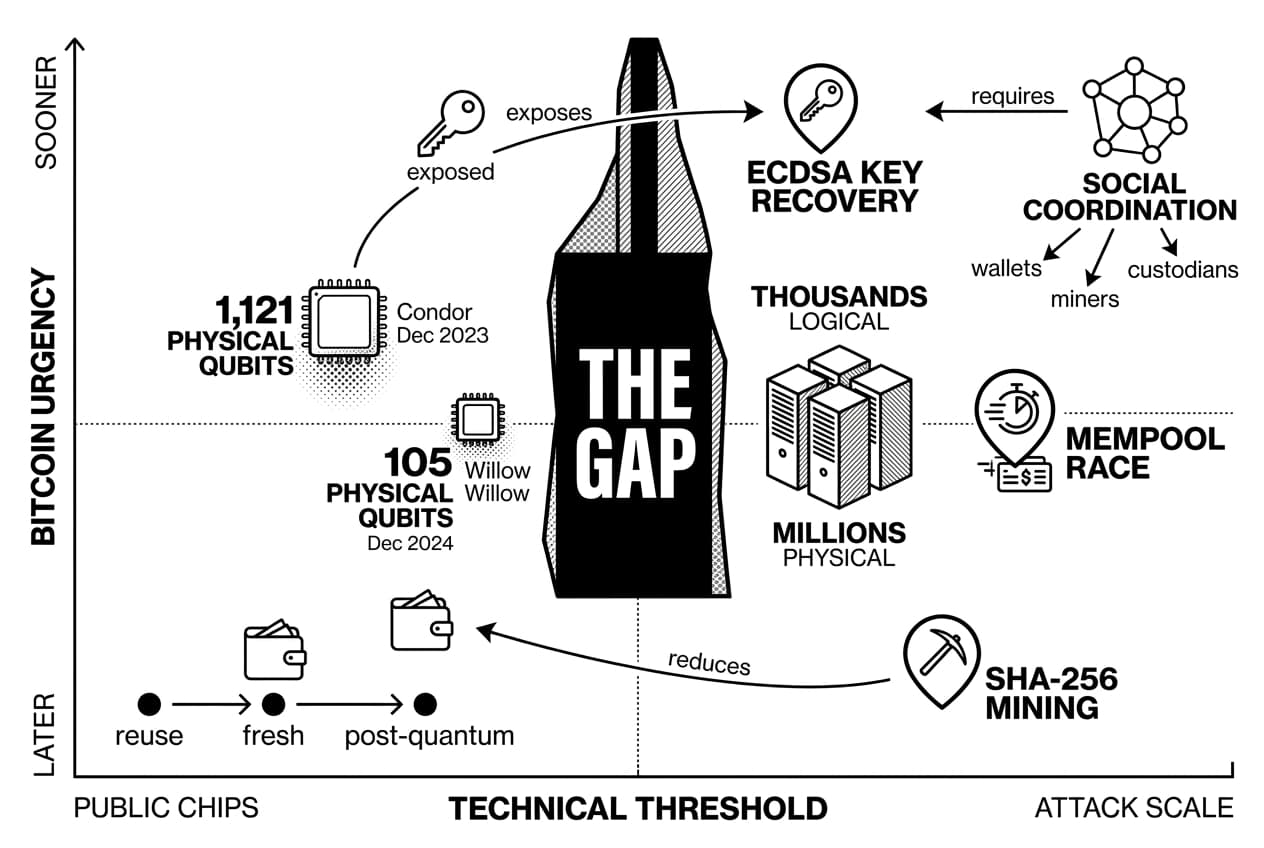
The answer to can quantum computers break Bitcoin changes by attack type. ECDSA key recovery, mempool race attacks, and SHA-256 mining pressure are separate risks. They have different technical thresholds, different timelines, and different defenses. Treating them as one threat produces a misleading forecast.
The hard data still points to a wide gap. IBM announced a 1,121-physical-qubit Condor processor in December 2023, IBM newsroom. The Willow chip from Google used 105 physical qubits in a published error-correction demonstration in December 2024, Google blog. Those are physical qubits, not the thousands of stable logical qubits and millions of supporting physical qubits modeled for fast attacks on Bitcoin-scale elliptic-curve keys.
Our 2026 thesis is narrower than the usual panic story: Bitcoin’s first quantum stress test is likely to be social coordination, not raw computation. Reducing exposed-key risk is simple at the user level: avoid address reuse and keep coins in fresh address types. Agreeing on post-quantum signatures across nodes, miners, wallets, exchanges, custodians, and hardware devices is harder. Andreas Antonopoulos, author and educator, has long framed Bitcoin security as a combination of cryptography, incentives, and operational discipline; that distinction matters here.
Key thesis for investors and users
No verified quantum computer can steal Bitcoin in 2026. The long-term issue is real but conditional. Outputs with already visible public keys carry the highest exposure. Fresh P2PKH and P2WPKH outputs that have never spent reveal only a hash until the owner broadcasts a transaction. The user-level priority is address hygiene now and protocol monitoring later.
For this report, we use a simple original framework called the Coordination-before-computation test: if quantum hardware is advancing faster than Bitcoin governance can specify, test, deploy, and socially accept a post-quantum signature path, risk rises even before an attack is possible. If governance and wallet migration advance first, exposed-key risk can fall well before a cryptographically relevant quantum computer exists.
What is quantum computing, and why does it matter for crypto?
A quantum computer is not just a faster classical computer. It uses qubits, superposition, and entanglement to solve certain mathematical problems in ways ordinary computers cannot efficiently match. That matters for crypto because public-key systems often rely on problems that are hard for classical machines but easier for a sufficiently large, fault-tolerant quantum machine.
The distinction between physical qubits and logical qubits is central. Physical qubits are noisy hardware units. Logical qubits are error-corrected units built from many physical qubits. A Bitcoin attacker would need logical qubits with very low error rates, not a lab device with many unstable physical qubits.
Two quantum algorithms drive most of the discussion. Shor’s algorithm can attack the elliptic-curve discrete logarithm problem, which is the mathematical foundation behind Bitcoin’s ECDSA and Schnorr signatures. Grover’s algorithm gives a quadratic speedup against hash search, which affects SHA-256 much less severely.
Shor’s algorithm versus Grover’s algorithm
Shor’s algorithm is the serious signature threat. If an attacker has a sufficiently large fault-tolerant quantum computer and the victim’s public key is visible, the attacker could derive the matching private key and spend the coins. That is why old outputs and reused addresses matter so much.
Grover’s algorithm is less severe for Bitcoin. It can reduce the effective work factor of a hash search. In simplified terms, SHA-256 would be treated closer to a 128-bit security margin against an ideal Grover search rather than a full collapse. That is still beyond practical attack capability under public 2026 hardware conditions.
Algorithm | Bitcoin target | Type of advantage | 2026 practical threat |
|---|---|---|---|
Shor’s algorithm | ECDSA and Schnorr public keys | Can solve the relevant discrete-log problem on a large fault-tolerant machine | Low today, high if large logical-qubit systems arrive |
Grover’s algorithm | SHA-256 hashing and mining search | Quadratic speedup | Low today; mining economics would adjust before consensus failure |
Physical qubits are not logical qubits
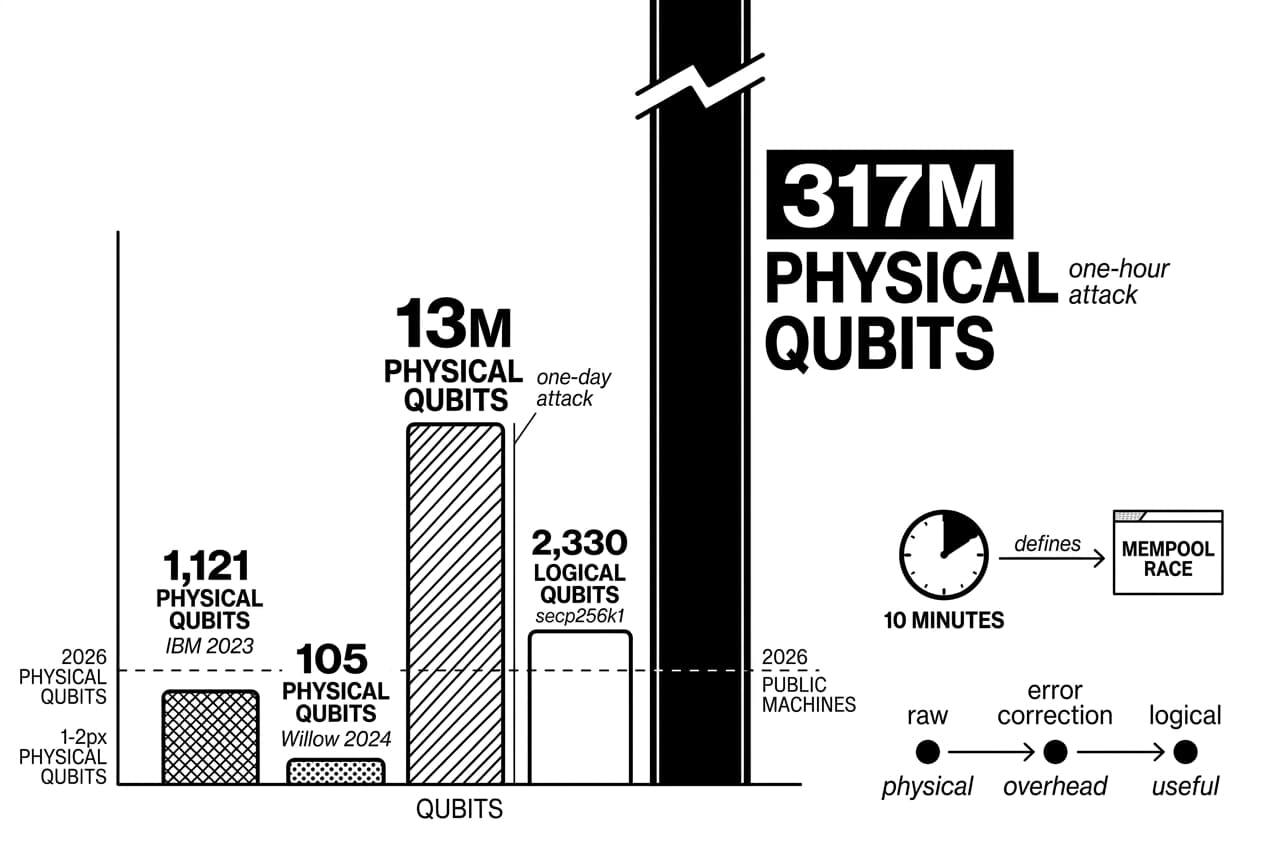
Headline qubit counts can mislead investors. IBM’s Condor figure of 1,121 physical qubits in December 2023, IBM newsroom, and the 105 physical qubits in the Willow chip from Google in December 2024, Google blog, are important engineering markers. They do not mean a machine can run a deep, fault-tolerant attack against secp256k1.
Published resource estimates show why. One estimate in AVS Quantum Science, 2022, modeled a one-hour attack on Bitcoin’s elliptic-curve signatures as requiring roughly 317 million physical qubits under its hardware assumptions. The same paper modeled a one-day attack at roughly 13 million physical qubits. Even if future designs improve those numbers, the current public gap is large.
How Bitcoin’s cryptography actually works
Bitcoin does not rely on one cryptographic primitive. It combines private keys, public keys, digital signatures, hashes, transaction scripts, and proof-of-work. Quantum risk concentrates at the signature layer, while the hash and mining layers face a weaker form of pressure.
Private keys, public keys, and signatures
A Bitcoin private key is a 256-bit number. From that number, the secp256k1 elliptic-curve system derives a public key. Spending requires a valid digital signature that proves control of the private key without revealing it. Today, that signature verification is safe because deriving the private key from the public key is infeasible for classical machines.
A future fault-tolerant quantum computer changes that assumption only after the public key is visible. This is why a fresh, never-spent address is safer than a reused one. Once a user spends from an address and later leaves funds at the same public key, that key becomes a long-duration target.
Adam Back, co-founder and chief executive of Blockstream, is an approved public figure often associated with Bitcoin’s engineering-first security culture. The relevant lesson for this topic is conservative: do not infer an immediate break from a theoretical attack path. Protocol risk becomes operational risk only when hardware, software, incentives, and exposed keys line up.
Why address type matters: P2PK, P2PKH, SegWit, and Taproot
Our original Public-key exposure ladder ranks outputs by how long the public key remains visible before funds move. The higher the rung, the more attractive the output becomes to a future quantum attacker.
Output type | Public-key exposure | Quantum vulnerability window | Risk interpretation in 2026 |
|---|---|---|---|
P2PK | Public key is embedded directly in the output script | Permanent after confirmation | Highest long-term exposure because an attacker can work without mempool time pressure |
Reused P2PKH | Public key was revealed in a prior spend and funds later returned or remained linked | Permanent after first spend | High exposure created by user behavior |
Fresh P2PKH or P2WPKH | Only a hash is visible until spending | Mostly the broadcast-to-confirmation window | Lower exposure if users avoid reuse |
Taproot P2TR | Key-path spending uses a visible public key structure | Depends on spend path and wallet behavior | Not a post-quantum solution by itself |
A widely cited Deloitte analysis estimated that about 4 million BTC, Deloitte, 2017, were then vulnerable in the sense that public keys had already been revealed. That number should not be treated as a live 2026 count, but it remains useful historical context: address reuse and old output formats can turn a theoretical quantum risk into a targeted coin-selection problem.
Taproot activated through BIP-341 in November 2021, Bitcoin improvement proposal. It improved privacy and script flexibility, but it did not make Bitcoin quantum-resistant. It may, however, make future script-based migration paths easier to discuss.
This layered picture connects to how blockchain pseudonymity works. Address reuse weakens both privacy and future quantum posture by linking activity and exposing public keys for longer than necessary.
Three quantum attack scenarios against Bitcoin
Not all quantum threats are equal. Our Three-surface risk model separates them by target, time pressure, and mitigation path.
- Exposed public-key theft: A future fault-tolerant quantum computer runs Shor’s algorithm against an already visible public key and derives the private key.
- Mempool race attack: An attacker sees a broadcast transaction, derives the key, builds a conflicting spend, and wins confirmation before the honest transaction settles.
- Hash and mining pressure: Grover’s algorithm improves search efficiency against SHA-256, but it does not instantly rewrite Bitcoin’s chain or steal arbitrary coins.
Attack 1: deriving a private key from an exposed public key
This is the cleanest theoretical attack. The attacker needs a visible public key and a machine capable of running Shor’s algorithm at Bitcoin-relevant scale. P2PK outputs and reused addresses are the most exposed categories. Fresh addresses that have never spent do not show the public key on-chain, so they are not equivalent targets.
The historical exposure is not zero. Deloitte’s 2017 estimate of about 4 million BTC with revealed public keys, Deloitte, 2017, shows why old address behavior matters. The figure is dated, but the mechanism remains valid: revealed public keys are easier to rank, monitor, and target if quantum capability eventually arrives.
Attack 2: racing a transaction in the mempool
A mempool race is much harder. Bitcoin targets an average block interval of about 10 minutes, Bitcoin developer guide, accessed 2026. An attacker would need to recover the private key, sign a replacement transaction, propagate it, and win miner inclusion inside that window. Current public resource estimates do not support that capability.
That does not make the scenario irrelevant. If key-recovery times fall from days to hours, then from hours to minutes, mempool privacy becomes more important. Research into encrypted mempools and transaction privacy could reduce this exposure before a large fault-tolerant machine exists.
Attack 3: hashing, mining, and Grover’s algorithm
Mining disruption is the weakest of the three quantum stories. Grover’s algorithm gives a quadratic speedup, not a full break. A quantum miner would still face energy cost, hardware cost, network difficulty adjustments, and the economics of block rewards. A 51% attack can reorder recent transactions or double-spend its own coins; it cannot directly drain all wallets.
If quantum mining hardware became commercially meaningful, the signal would likely appear first in Bitcoin mining hardware and hashrate data. That makes it more observable than a secret key-theft capability, though state-level secrecy remains a caveat.
By the numbers: how far are quantum computers from breaking Bitcoin?
The useful question is not whether quantum attacks are mathematically possible. They are. The useful question is what resources, time windows, and coordination steps would be required before they become operationally relevant.
Key data points: current capability versus attack requirements
Metric | 2026 status | Why it matters for Bitcoin | Source to verify |
|---|---|---|---|
Largest cited superconducting processor milestone | 1,121 physical qubits announced in 2023 | Shows hardware progress, but physical qubits are not enough for a Bitcoin key attack | IBM newsroom, Dec. 2023 |
Recent error-correction demonstration | 105 physical qubits reported for the Willow chip | Shows better error-correction scaling, not cryptographic capability | Google blog, Dec. 2024 |
Logical-qubit estimate before overhead | Roughly 2,330 logical qubits in a published secp256k1 estimate | Logical qubits, not raw qubits, are the relevant unit for Shor’s algorithm | arXiv resource estimate, 2017 |
Fast physical-qubit attack estimate | About 317 million physical qubits for a one-hour attack under one model | Shows why a quick theft attack remains far from public machines | AVS Quantum Science, 2022 |
Slower physical-qubit attack estimate | About 13 million physical qubits for a one-day attack under the same model | Even slower attacks still exceed public 2026 hardware by orders of magnitude | AVS Quantum Science, 2022 |
Bitcoin block interval | About 10 minutes by protocol target | Defines the practical window for a mempool race attack | Bitcoin developer guide, accessed 2026 |
ECDSA signature size | Usually about 64 to 72 bytes before encoding and script overhead | Baseline for comparing post-quantum signature bloat | Bitcoin developer guide, accessed 2026 |
Dilithium signature size | 2,420 bytes for the ML-DSA-44 signature parameter set | Shows why post-quantum signatures would raise block-space costs | NIST FIPS 204, Aug. 2024 |
Known historical exposed-key estimate | About 4 million BTC with revealed public keys in one 2017 analysis | Shows why old outputs and address reuse remain a long-term risk category | Deloitte, 2017 |
Post-quantum standards trigger | First three finalized standards released in August 2024 | Gives wallets and protocols vetted algorithms to evaluate | NIST, Aug. 2024 |
Source-check transcript used for this analysis
Source | Transcript excerpt checked | How it was used |
|---|---|---|
IBM newsroom, 2023 | “1,121-qubit IBM Quantum Condor processor” | Physical-qubit milestone, not treated as a cryptographic break |
NIST, 2024 | “NIST releases first 3 finalized post-quantum encryption standards” | Migration trigger for protocol and wallet planning |
NIST FIPS 204, 2024 | ML-DSA parameter tables include a 2,420-byte signature for ML-DSA-44 | Transaction-size comparison against ECDSA |
The key information gain is the ratio, not the headline. Public devices are in the hundreds to low thousands of physical qubits. Published fast-attack models for Bitcoin-scale keys use millions to hundreds of millions of physical qubits, depending on timing assumptions. That gap is why 2026 calls for monitoring and preparation rather than emergency migration.
Why estimates vary so widely
Quantum resource estimates vary because researchers make different assumptions about error rates, gate speed, circuit parallelism, error-correction code, and acceptable attack time. A one-day attack can be modeled with fewer simultaneous qubits than a ten-minute attack, but a mempool race needs the shorter window. A dormant exposed-key theft does not.
This is where the Public-key exposure ladder adds practical value. P2PK theft can be slow because the target is visible for years. Mempool theft must be fast because the target may confirm in about 10 minutes. Mining pressure is different again because the network difficulty mechanism reacts over time.
Quantum computing Bitcoin timeline: 2026 to 2040 scenarios
Forecasting exact dates would be false precision. The better method is scenario analysis tied to technical thresholds: physical qubits, logical qubits, error rates, and Bitcoin’s governance response.
Period | Expected quantum capability | Bitcoin risk level | Upgrade implications |
|---|---|---|---|
2026 to 2030 | Hundreds to low thousands of physical qubits; limited logical-qubit demonstrations | Low | Track standards, draft research proposals, and reduce address reuse; no emergency protocol change is supported by public data |
2030 to 2035 | Possible early fault-tolerant systems; logical-qubit counts could become the main metric | Low to medium | If logical-qubit progress accelerates, wallets and exchanges may need migration rehearsals and testnet deployments |
2035 to 2040 and later | Wide range: stalled scaling, slow CRQC progress, or a credible large fault-tolerant machine | Low to high, conditional on hardware and migration | If Bitcoin has not migrated and CRQC progress is visible, exposed-key outputs become the priority risk category |
2026 to 2030: monitoring, not panic
The next few years are best treated as a measurement period. Watch logical qubits, error-corrected circuit depth, and whether any public system can maintain low error rates over long computations. Raw qubit announcements alone are not enough. If progress stays near current public rates, Bitcoin faces no practical ECDSA break before 2030.
2030 to 2035: migration pressure could rise
If fault-tolerant logical-qubit counts begin moving from small demonstrations toward the low thousands, the risk rating changes. At that point, Bitcoin developers would likely debate post-quantum signature options, activation method, fee impact, wallet support, and how to handle old exposed outputs. The hard part would be deployment across the whole ecosystem.
Lyn Alden, founder of Lyn Alden Investment Strategy, often evaluates Bitcoin through infrastructure, liquidity, and resilience rather than one-variable narratives. That lens is useful here: the relevant question is not only whether a new signature exists, but whether the network can coordinate around it without damaging reliability.
2035 to 2040 and later: conditional risk scenarios
Three paths dominate. In the low-risk path, quantum scaling remains difficult and Bitcoin has years to migrate. In the base path, credible large machines appear slowly enough for standards and wallet changes to mature. In the high-risk path, a state-level or corporate system reaches cryptographic relevance before Bitcoin governance and user migration are ready.
The high-risk path is plausible enough to plan for, but not strong enough to justify panic in 2026. The observable warning signs would be major logical-qubit milestones, public claims of long error-corrected computations, sudden secrecy around national programs, and serious Bitcoin improvement proposals focused on post-quantum signatures.
How Bitcoin, Ethereum, and other crypto networks are responding
Post-quantum cryptography already exists. Adoption is the hard part. A blockchain cannot simply swap signature algorithms without changing wallet software, node rules, hardware signing devices, fee markets, and recovery practices. This is why quantum risk is as much an upgrade-coordination problem as a cryptography problem.
NIST PQC and the limits of plug-and-play migration
NIST finalized its first three post-quantum standards in August 2024, NIST. For signatures, FIPS 204 specifies ML-DSA, the standardized form of the Dilithium family. The size trade-off is material: ML-DSA-44 uses a 2,420-byte signature, NIST FIPS 204, 2024, compared with roughly 64 to 72 bytes for a typical ECDSA signature before transaction-specific overhead.
That size difference affects fees and throughput. A Bitcoin post-quantum migration would need to account for block-space limits, multisig use, hardware-wallet memory, backup standards, watch-only wallets, exchanges, and custodians. A technically correct algorithm can still be operationally expensive.
Ethereum has different trade-offs. How Ethereum works matters because its account model and history of planned protocol changes give developers more room to test alternative signing logic. Account abstraction can also move some signature policy into wallet design. Bitcoin is more conservative by design, which lowers arbitrary-change risk but slows large migrations.
Our original Three-layer migration problem separates the work: first, cryptographers standardize algorithms; second, protocols adopt verification rules; third, users move funds safely. The third layer may be the slowest, because dormant coins and old exposed outputs cannot migrate themselves.
Network | Upgrade path | Post-quantum posture in 2026 | Main constraint |
|---|---|---|---|
Bitcoin | Consensus change through review and activation | Research and discussion; no widely activated post-quantum signature path | Conservative governance, fee impact, old UTXOs |
Ethereum | Protocol upgrades plus account-level wallet design | More flexible testing environment, not fully quantum-resistant | Complex app layer and wallet fragmentation |
Specialized quantum-resistant chains | Built around hash-based or lattice-based signatures | Some have stronger signature assumptions | Liquidity, adoption, audits, and governance depth |
Are any cryptocurrencies quantum proof?
Some projects use post-quantum signature schemes, but “quantum proof” is too absolute. A serious evaluation should ask five questions: what assumption secures the signature, whether the implementation has been audited, whether wallets enforce safe use, whether the chain has enough liquidity, and whether governance can respond if assumptions change.
By that standard, no major liquid network should be described as fully quantum-proof in 2026. Bitcoin and Ethereum are better framed as migration candidates. Smaller quantum-resistant chains may be cryptographically interesting, but lower liquidity and weaker network effects can create risks unrelated to quantum computing.
How to protect your Bitcoin from quantum computing risk
The proportionate 2026 response is not to sell based on a theoretical timeline. It is to reduce exposed-key risk while avoiding operational mistakes. The same habits that reduce future quantum exposure also reduce today’s ordinary wallet-risk surface.
Actions that make sense today
- Avoid address reuse. Use a fresh receiving address for each transaction. This limits long-duration public-key exposure.
- Use modern wallet defaults. Current wallets usually generate fresh addresses automatically; confirm that yours does.
- Keep private keys offline. A properly stored seed phrase is more likely to be threatened by theft, fire, phishing, or malware than by a 2026 quantum computer.
- Use dedicated signing hardware where appropriate. Guides to set up a Ledger hardware wallet and set up a Trezor wallet cover the operational basics.
- Monitor standards and proposals. NIST’s August 2024 standards release gives developers real algorithms to study, but Bitcoin adoption would still require review and activation.
- Check ordinary compromise first. If funds move unexpectedly, use a process to check if your wallet is compromised before assuming an exotic quantum event.
The highest-impact step for most holders is also the cheapest: stop reusing addresses. It reduces a specific quantum precondition without adding new complexity.
What not to overreact to
Do not trust a wallet, token, or service that claims guaranteed “quantum protection” without naming the signature scheme, publishing audits, and explaining recovery behavior. Do not consolidate old UTXOs in a panic if you do not understand the privacy and fee effects. Do not pay a premium for emergency protection based on public 2026 hardware data.
Andreas Antonopoulos, author and educator, has repeatedly emphasized threat modeling over fear-driven security choices. That principle fits the evidence: ordinary phishing and key-management failures are live risks now, while quantum ECDSA theft requires future hardware that has not been publicly demonstrated.
Frequently Asked Questions
- What will happen to crypto after quantum computing?
- Crypto won't disappear automatically, but networks relying on vulnerable public-key cryptography will need post-quantum upgrades to survive. Hash functions and digital signatures face different levels of quantum risk. Blockchains with strong governance that migrate successfully will likely persist, while assets with exposed keys or weak upgrade paths face greater long-term uncertainty.
- Which crypto is quantum proof?
- No major cryptocurrency should be considered completely quantum-proof based on marketing claims alone. Some projects use or are developing quantum-resistant signatures, but assess cryptographic design, independent audits, wallet support, liquidity, and governance before drawing conclusions. Bitcoin isn't quantum-proof today but retains the community capacity to upgrade its signature scheme.
- Is XRP quantum-resistant?
- XRP has historically relied on elliptic-curve cryptography, which a sufficiently powerful quantum computer could potentially threaten. Whether Ripple or the XRP Ledger community has introduced or committed to quantum-resistant features remains subject to ongoing development. Always check the latest official XRP Ledger documentation rather than relying on outdated third-party claims.
- How to protect your crypto from quantum computing?
- In 2026, practical steps include avoiding address reuse, using reputable and regularly updated wallets, securing seed phrases offline, and monitoring your network's protocol upgrades. Old addresses with exposed public keys carry elevated risk. That said, phishing, malware, and compromised wallets remain far greater everyday threats than quantum computers right now.
- Is quantum computing a threat to Bitcoin?
- Yes, but not an immediate one in 2026. A future fault-tolerant quantum computer could attack Bitcoin's ECDSA keys once public keys are exposed on-chain. Mining and hashing face comparatively lower near-term risk. How serious the threat becomes depends on how quickly quantum hardware matures and whether Bitcoin upgrades its signature scheme in time.
- Which crypto is safe from quantum computing?
- Quantum safety is conditional, not absolute. A network is more quantum-resilient when it uses vetted post-quantum signature schemes, maintains active development, and can coordinate user migration. Cryptographic labels alone aren't enough — liquidity, decentralization, and sound implementation quality matter just as much when evaluating real-world resilience.
- Will quantum computing stop Bitcoin?
- Quantum computing is unlikely to simply stop Bitcoin. The realistic risks are targeted theft from exposed public keys and a potentially disruptive migration period if powerful quantum machines arrive before protocol upgrades are ready. Bitcoin's long-term resilience depends on the network reaching timely consensus and users adopting new address standards.
- What happens to Bitcoin when quantum computers arrive?
- The outcome depends on timing and preparation. If quantum computers stay below cryptographic relevance, little changes practically. If credible cryptographically relevant machines emerge, Bitcoin will likely need post-quantum address types and a coordinated migration plan. If upgrades lag behind hardware progress, coins with exposed public keys could face meaningfully elevated theft risk.
Sources
Author

Crypto analyst and blockchain educator with over 8 years of experience in the digital asset space. Former fintech consultant at a major Wall Street firm turned full-time crypto journalist. Specializes in DeFi, tokenomics, and blockchain technology. His writing breaks down complex cryptocurrency concepts into actionable insights for both beginners and seasoned investors.