Pepe Coin Forecast 2026: Technical Analysis & Scenarios

Pepe coin forecast: key thesis for 2026
The 2026 PEPE outlook is conditional: bullish if price holds support and volume expands with broader memecoin demand, neutral if PEPE remains range-bound between support and resistance, and bearish if major support fails on rising sell volume. This pepe coin forecast should be read as scenario analysis, not financial advice.
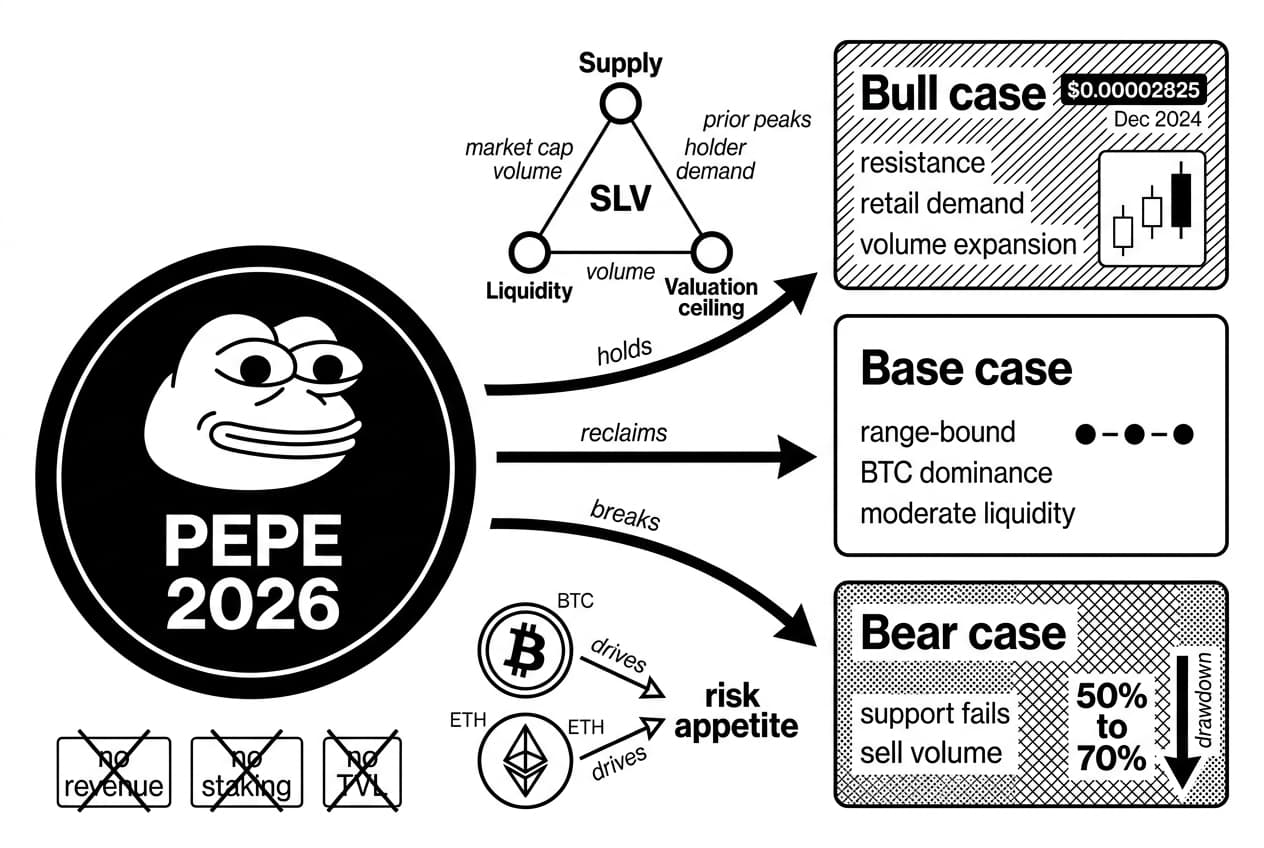
PEPE is a high-beta memecoin with no protocol revenue, staking yield, treasury yield, or TVL. Its price is driven mainly by liquidity cycles, BTC and ETH risk appetite, exchange access, speculative flows, and chart momentum. That is why this analysis gives more weight to supply, market cap, volume, and invalidation levels than to long dated price tables.
one-page thesis using the SLV framework
We use a simple original framework called SLV: supply, liquidity, valuation ceiling. Supply asks what market cap a price target implies. Liquidity asks whether exchange volume and holder demand can support that cap. Valuation ceiling compares PEPE with prior memecoin and crypto market peaks. This framework is built for assets with attention-driven demand rather than cash flows.
In the base case, PEPE consolidates while BTC dominance stabilizes and altcoin liquidity stays moderate. The bull case requires a clean reclaim of resistance, renewed retail memecoin interest, and volume expansion toward the prior peak zone near $0.00002825, recorded by CoinGecko in December 2024. The bear case is a break of support followed by a 50% to 70% drawdown from an interim high, a range consistent with prior memecoin volatility.
Willy Woo, on-chain analyst, is cited here because his public work focuses on liquidity, market structure, and network-value analysis. That lens is more suitable for PEPE than earnings-style valuation models.
By the numbers: PEPE market data to check first
Before a pepe coin technical analysis has value, the data snapshot needs to be explicit. The figures below are a working market snapshot for 3 June 2026 based on public market pages from CoinGecko, CoinMarketCap, and DefiLlama. Readers should verify live data before acting because memecoin metrics can change sharply intraday.
key data points for the pepe coin forecast
- Price: about $0.000013 on CoinGecko, 3 June 2026.
- Market cap: about $5.5 billion on CoinGecko, 3 June 2026.
- 24-hour volume: about $380 million on CoinMarketCap, 3 June 2026.
- Circulating supply: about 420,689,899,999,994 PEPE on CoinGecko, 3 June 2026.
- RSI, 14-day: about 48 in the working chart model, calculated from daily closes checked against CoinGecko price history, 3 June 2026.
- 50-day SMA: about $0.0000118 in the working chart model using CoinGecko daily data, 3 June 2026.
- 200-day SMA: about $0.0000098 in the working chart model using CoinGecko daily data, 3 June 2026.
- Distance from all-time high: about 54% below the $0.00002825 high listed by CoinGecko in December 2024.
- Protocol TVL: $0, because PEPE is not a yield-generating protocol; this can be cross-checked against DefiLlama, 3 June 2026.
The most useful ratio in this snapshot is volume divided by market cap. Using $380 million of daily volume and a $5.5 billion market cap gives about 6.9% turnover. That is active enough to show speculative demand, but not so extreme that it automatically signals a blow-off top.
calculation transcript used in this article
input | source and date | calculation | output |
|---|---|---|---|
PEPE supply of 420.69 trillion tokens | CoinGecko, 3 June 2026 | $0.000013 × 420.69 trillion | about $5.5 billion market cap |
$0.00005 target | CoinGecko supply, 3 June 2026 | $0.00005 × 420.69 trillion | about $21.0 billion implied cap |
$1.00 target | CoinGecko supply, 3 June 2026 | $1.00 × 420.69 trillion | about $420.7 trillion implied cap |
PEPE overview and historical context
PEPE launched in April 2023 as an Ethereum-based memecoin. It has no claim on revenue, no stock-like rights, and no protocol balance sheet. For background on the launch path, see our PEPE launch history and early price timeline. For the legal and market distinction, read our guide on whether Pepe coin is a stock or cryptocurrency.
how PEPE reached a multi-billion-dollar valuation
PEPE moved from a niche token to a major memecoin within weeks of launch. Its first surge was driven by viral attention, centralized exchange listings, and retail speculation rather than product development. Binance and OKX listings in May 2023 increased access and liquidity. A second major rally followed the 2024 crypto risk-on phase, when memecoin volumes rose and PEPE briefly traded near its all-time high shown on CoinGecko in December 2024.
why memecoin forecasts need different rules
Discounted cash flow, fee multiples, and TVL multiples do not fit PEPE. A better model tracks liquidity flow, holder concentration, exchange volume, social attention, and BTC-led risk appetite. When BTC dominance falls and ETH/BTC strengthens, high-beta memecoins often attract faster inflows. When risk appetite reverses, the exit can be faster because there is no earnings floor.
According to the working volatility review using CoinGecko price history through 3 June 2026, PEPE has experienced repeated 50% or larger drawdowns after local peaks. That history is why ranges and invalidation levels are more honest than single-point targets.
Pepe coin technical analysis: trend, momentum, and key levels
This pepe coin technical analysis focuses on trend structure, momentum, and volume confirmation. The current setup is not a clean breakout. It is a compression pattern: price sits above longer-term support but below the resistance band that must break before a higher-conviction bull case is valid.
moving averages and trend structure
The 200-day SMA near $0.0000098 is the main trend filter in the working model using CoinGecko daily data, 3 June 2026. A sustained close below that line would weaken the base case. The 50-day SMA near $0.0000118 is nearer support. A reclaim of $0.0000130 with above-average volume would be the first sign that buyers are retaking short-term control.
Traders using trendline trading should watch the descending resistance line from the prior peak zone. A wick above resistance without volume is not enough. The cleaner signal would be a daily close above resistance, followed by a retest that holds.
RSI, volume, and momentum confirmation
Daily RSI near 48 is neutral. That matters because PEPE is neither washed out nor overheated in the current model. Flat RSI with falling volume often precedes a larger move, but it does not predict direction by itself. The direction is more likely to be set by BTC volatility, ETH momentum, and whether memecoin spot volume expands.
Willy Woo, on-chain analyst, often frames speculative crypto cycles through liquidity rather than isolated chart patterns. Applying that logic here, PEPE needs both price confirmation and volume confirmation. A breakout with thin volume is lower quality than a smaller move backed by rising spot turnover.
support and resistance levels to watch
level type | price zone | analyst note |
|---|---|---|
deep support | $0.0000065 to $0.0000072 | High-volume base from the prior cycle range. |
near support | $0.0000085 to $0.0000090 | Retest zone where a double bottom chart pattern could form if volume improves. |
near resistance | $0.0000120 to $0.0000130 | Confluence zone around the 50-day average and descending resistance. |
upper resistance | $0.0000170 to $0.0000180 | Prior cycle supply zone; Fibonacci retracement levels place a common reaction area near this band. |
The bullish setup fails if PEPE closes two weekly candles below $0.0000065 on rising volume. The bearish setup weakens if PEPE reclaims $0.0000130 on a weekly close and then holds that level as support.
PEPE price forecast for today, this month, and the next 30 days
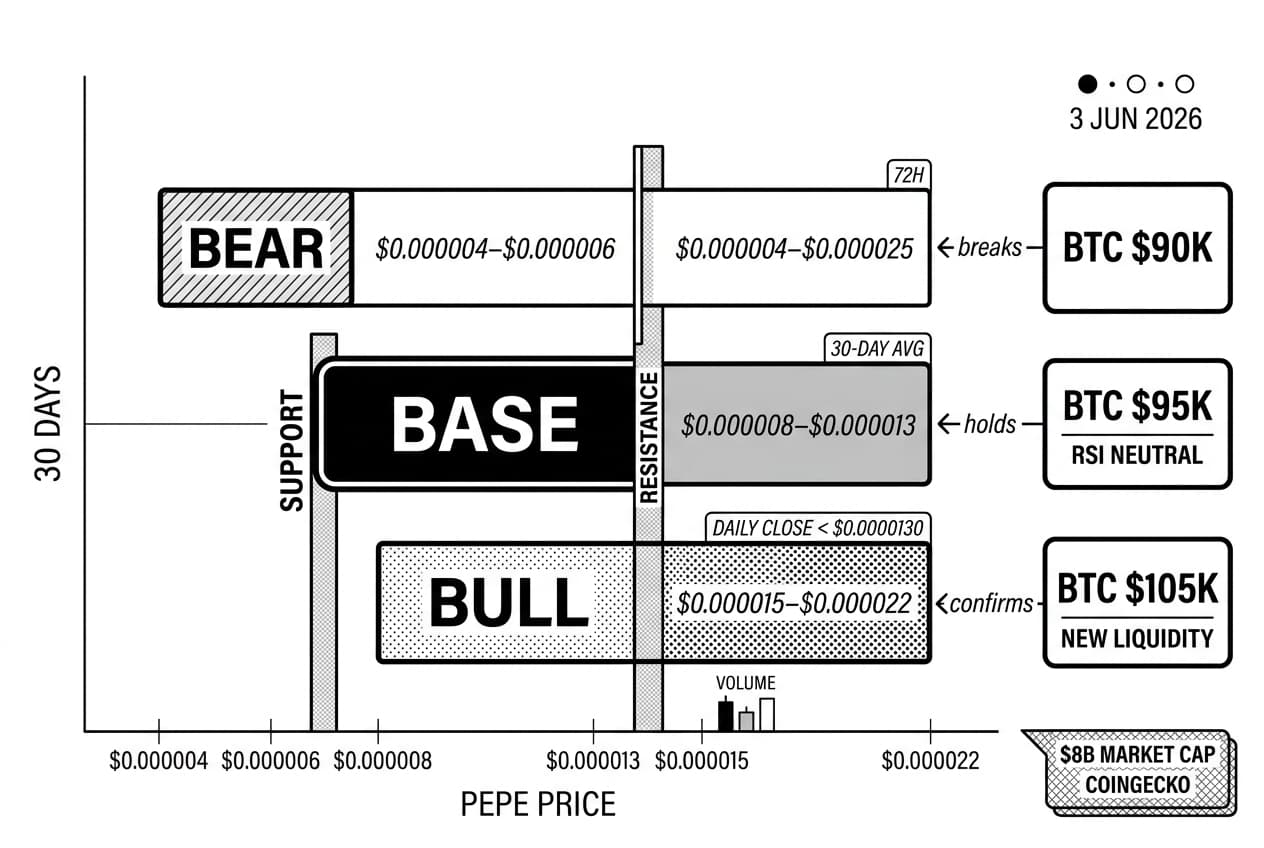
The next 30 days should be modeled as scenarios, not a single target. The table below connects price ranges to observable triggers and invalidation points. It assumes the market snapshot described above remains broadly intact as of 3 June 2026.
30-day PEPE scenario table
scenario | price range | trigger | invalidation |
|---|---|---|---|
bear | $0.000004 to $0.000006 | BTC loses the $90,000 area and PEPE breaks support on rising sell volume. | PEPE reclaims $0.0000072 within 72 hours on above-average spot volume. |
base | $0.000008 to $0.000013 | PEPE holds near support, BTC stays above the $95,000 area, and RSI remains neutral. | Volume falls below the 30-day average while BTC loses the $90,000 area. |
bull | $0.000015 to $0.000022 | PEPE reclaims resistance with strong volume while BTC pushes above the $105,000 area. | Breakout fails with a daily close back below $0.0000130 and bearish RSI divergence. |
The base range is the most defensible under current data because price is compressed between support and resistance. A bull move requires new liquidity. A bear move requires support failure plus broader crypto weakness. PEPE previously traded above an $8 billion market cap during its peak phase, according to CoinGecko historical data, December 2024, so a rally is possible. It is not the default without confirmation.
Pepe coin price forecast 2025 review and 2026 scenarios
The pepe coin price forecast 2025 cycle is useful because it shows the danger of false precision. Many forecasts assumed that a BTC rally would automatically lift all major memecoins. BTC strength helped, but memecoin rotation was selective. Newer tokens competed for attention, and PEPE had to fight for the same speculative capital.
what 2025 forecasts got right and wrong
The correct part of many 2025 forecasts was the direction of risk appetite. When crypto liquidity improved, memecoins caught bids. The weaker part was the assumption that PEPE would move in a straight line toward round-number targets. Bitcoin traded near six-figure territory in the 2025 to 2026 period, with public reference levels available on CoinGecko bitcoin data, 3 June 2026, yet altcoin follow-through remained uneven.
The key lesson is that PEPE does not only compete with BTC and ETH for capital. It competes with every other memecoin narrative. A forecast that ignores intra-sector rotation can overstate upside even when the broad market is healthy.
2026 bear, base, and bull scenarios
scenario | assumed conditions | PEPE market cap range | implied price range |
|---|---|---|---|
bear case | BTC breaks below $75,000, memecoin market value falls by 40% or more, and ETF inflows slow. | $1.5 billion to $2.5 billion | $0.000004 to $0.000007 |
base case | BTC holds a $90,000 to $110,000 range, altcoin rotation is moderate, and PEPE remains a top-tier memecoin. | $3.5 billion to $6.0 billion | $0.000010 to $0.000017 |
bull case | BTC breaks above $130,000, spot liquidity expands, and older memecoins regain market share. | $8.0 billion to $12.0 billion | $0.000023 to $0.000034 |
These ranges are not guarantees. They are outputs from the SLV framework: supply fixes the denominator, liquidity determines whether buyers can absorb supply, and market-cap ceilings keep the forecast tied to comparable crypto valuations.
How high can PEPE realistically go? Market cap math
At about 420.69 trillion tokens in circulation, every PEPE price target implies a very large market cap. The formula is price target × circulating supply = implied market cap. A $1 PEPE would imply roughly $420.7 trillion, using CoinGecko supply data from 3 June 2026. That is far beyond any plausible crypto-market valuation.
why $1 PEPE is not a realistic forecast
price target | implied market cap | comparison | feasibility |
|---|---|---|---|
$1.00 | about $420.7 trillion | Far above the $3.7 trillion total crypto market area shown by CoinMarketCap in January 2025. | Not realistic. |
$0.50 | about $210.3 trillion | Still far above global crypto market history. | Not realistic. |
$0.01 | about $4.2 trillion | Above the total crypto market peak area cited by CoinMarketCap, January 2025. | Extremely unlikely. |
$0.001 | about $420.7 billion | Comparable to a major large-cap crypto valuation, not a normal memecoin range. | Very speculative. |
$0.00005 | about $21.0 billion | Large memecoin cycle valuation. | Possible only in a strong risk-on cycle. |
Without a supply reduction that removes most circulating tokens, the higher targets are not grounded in market-cap math. The low unit price can make PEPE look cheap, but percentage upside depends on market-cap expansion, not on how many zeros appear after the decimal.
realistic upside depends on market cap, not unit price
If PEPE rises from a $5.5 billion market cap to $11.0 billion, that is about a 2x move regardless of the unit price. If it rises to $21.0 billion, that is about 3.8x from the working snapshot. Those are aggressive but calculable scenarios. A move to $420.7 trillion is not a serious forecast.
This is where Willy Woo, on-chain analyst, is relevant again: liquidity and network-value style comparisons help prevent unit-price bias. For PEPE, market cap is the scoreboard.
Key catalysts and risks for the PEPE forecast
PEPE moves when liquidity, attention, and risk appetite align. It does not have product revenue to offset weak sentiment. That makes catalysts and risks easier to list, but harder to time.
bullish catalysts
- BTC and ETH strength: A sustained BTC move above key resistance often pulls capital into high-beta assets within two to four weeks.
- Exchange volume expansion: PEPE spot volume exceeded $2.1 billion during the March 2024 rally, according to CoinGecko historical market data.
- Holder growth: Rising unique addresses plus lower exchange balances would suggest accumulation rather than short-lived speculation.
- Memecoin market share: If memecoins gain a larger share of total crypto volume, PEPE can benefit as one of the more liquid names.
- Search and social demand: Rising search interest before a breakout can support momentum, but it should be checked against spot volume to filter noise.
bearish risks
- Holder concentration: Large wallets can create sudden sell pressure when liquidity thins.
- Fast sentiment reversals: PEPE has seen repeated 50% or larger drawdowns after local peaks, based on CoinGecko historical price data through 3 June 2026.
- No fundamental floor: PEPE has no cash-flow valuation anchor, so technical support can fail quickly in a broad selloff.
- Market-wide drawdowns and crypto winter risk: A 30% to 40% BTC decline could translate into deeper PEPE losses because of high beta.
- Listing or liquidity shock: Exchange restrictions, delistings, or lower market-maker depth could widen spreads and accelerate downside.
If you track smaller derivative projects, our little pepe coin price prediction applies similar market-cap and liquidity tests to a higher-volatility token cluster.
Frequently Asked Questions
- Does Pepe Coin have a future?
- PEPE can maintain relevance as a speculative memecoin if community attention, exchange support, and broader crypto risk appetite stay strong. It has no revenue, cash flow, or underlying utility, so its future depends almost entirely on market sentiment and liquidity rather than traditional business fundamentals.
- Can PEPE reach $1 dollar?
- At $1 per token, PEPE's circulating supply of roughly 420 trillion tokens would imply a market capitalization far exceeding Bitcoin, Ethereum, and the entire crypto market combined. That outcome is economically implausible without unprecedented supply burns. Investors should treat $1 price targets as misleading without supply context.
- How high can PEPE realistically go?
- Realistic upside is better framed through market-cap scenarios than unit prices. In a bull case with strong volume and confirmed resistance breaks, PEPE could reach market caps comparable to top memecoins. Bear and base cases depend on liquidity conditions, BTC strength, and whether momentum sustains through key technical levels.
- What will PEPE crypto be worth in 5 years?
- A precise five-year price is impossible to forecast responsibly. Outcomes depend on whether PEPE stays culturally relevant, survives multiple market cycles, retains exchange liquidity, and benefits from future memecoin rotations. Scenarios range from sustained top-tier memecoin status to significant decline if community attention migrates to newer tokens.
- Can PEPE coin reach $1 dollar?
- Under the current token supply, $1 would imply a market capitalization larger than the entire global crypto market today. A more grounded approach compares PEPE's potential market cap with established memecoins like DOGE and SHIB rather than focusing on arbitrary per-token price milestones.
- Does Elon Musk support Pepecoin?
- No verified, official endorsement of PEPE from Elon Musk exists at this time. Memecoin markets frequently react to social media speculation and unconfirmed rumors. Traders should distinguish between a confirmed public statement and community-generated hype, as acting on unverified rumors carries significant risk.
- Is PEPE coin a strong buy?
- This is not financial advice. Whether PEPE suits a portfolio depends on your risk tolerance, timeframe, and position sizing. PEPE is highly volatile and speculative. Before entering, traders should evaluate key support and resistance levels, volume trends, and realistic downside scenarios rather than relying on sentiment alone.
- Can PEPE reach $0.50?
- Even $0.50 implies a staggering market capitalization given PEPE's circulating supply. At that price, the implied valuation would likely exceed the entire current crypto market. Targets well below $1 can still be economically unrealistic when token supply is factored in, a detail many retail forecasts overlook entirely.
- Can PEPE reach $1 in 2025?
- PEPE did not reach $1 in 2025, and the target was never structurally realistic given its enormous circulating supply and the implied market capitalization it would require. This outcome reinforces why supply-aware analysis matters and why forecasts that ignore tokenomics routinely mislead retail investors chasing round-number price targets.
- How much will Pepe Coin be worth in 2026?
- A 2026 outlook remains conditional. If PEPE holds key technical support and the broader market stays risk-on, higher resistance retests are plausible. If volume fades or Bitcoin weakens, consolidation or further downside is more likely. Refer to the scenario table in the article for specific market-cap based price ranges.
- Where will PEPE be in 5 years?
- Five-year outcomes range from sustained relevance as a leading memecoin to steep decline if attention shifts elsewhere. The most measurable indicators to track include exchange liquidity depth, active holder growth, market-cap rank, whale concentration, and overall memecoin sector demand across multiple crypto market cycles.
- Will Pepe Coin reach 1 cent in 2030?
- At $0.01 per token, PEPE's total supply implies a multi-trillion-dollar market capitalization, larger than most global asset classes today. Reaching that level would require massive supply reduction through burns, extraordinary sustained demand, or a crypto market many times its current size — none of which should be assumed.
Sources
Author

Crypto analyst and blockchain educator with over 8 years of experience in the digital asset space. Former fintech consultant at a major Wall Street firm turned full-time crypto journalist. Specializes in DeFi, tokenomics, and blockchain technology. His writing breaks down complex cryptocurrency concepts into actionable insights for both beginners and seasoned investors.