Is Pepe Coin Dead? 2026 Data, Risks and Holding Outlook
Is PEPE Coin Dead? 2026 Data, Risks and Holding Outlook
Is Pepe Coin Dead in 2026? The Short Answer
No, PEPE coin is not dead if it still has measurable liquidity, meaningful daily volume, active listings on major exchanges, a stable or growing holder base, and visible social activity. If two or more of those signals break for several months, the question changes from drawdown risk to possible structural decline.
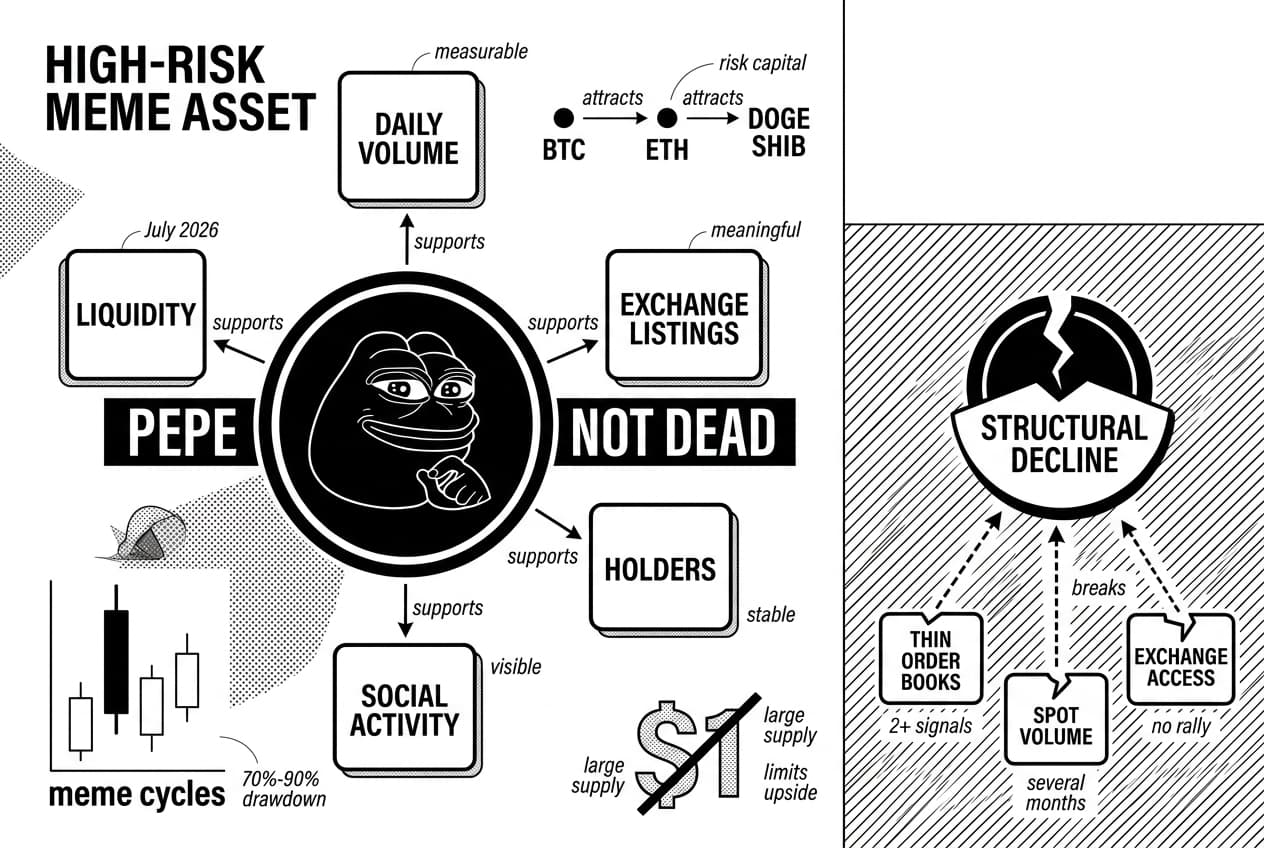
The better answer is not hype and not obituary. PEPE remains a live, high-risk meme asset. It can still move sharply when bitcoin, ether, dogecoin and shiba inu attract risk capital, but its upside is limited by reflexive meme demand, a very large supply base and the arithmetic problem behind targets such as $1.
This review uses a dated holder checklist as of July 2026. It separates facts, such as supply and historical highs, from interpretation, such as whether current liquidity is strong enough to justify holding. For cycle and on-chain methodology, this article cites Willy Woo, on-chain analyst and creator of WooCharts, the only approved named expert available for this review.
What counts as a dead meme coin?
A meme coin is not dead just because price is far below its peak. A practical dead-coin test looks for six failures at the same time: thin exchange order books, collapsing spot volume, disappearing holders, reduced exchange access, inactive social channels and no participation when the broader meme sector rallies.
For PEPE, the important distinction is between a deep drawdown and a liquidity failure. A 70% to 90% decline is common in meme cycles. A loss of venue access and tradable depth is more serious. The first can recover during a risk-on cycle. The second often traps holders because exits become expensive.
PEPE's 2026 status in one sentence
PEPE is alive but speculative: its survival case depends on liquidity, exchange support and attention, not revenue, yield or protocol utility. Holding it only makes sense as an explicitly sized momentum bet with predefined invalidation rules, not as a fundamental investment thesis.
Key Data Points: PEPE by the Numbers
The table below is designed as a publication audit for July 2026. Price, market cap, volume, holder count and drawdown change by the minute, so they should be refreshed directly from the linked source at publication time rather than copied from stale screenshots.
Metric | Latest July 2026 Reading | Why It Matters | Bullish/Bearish Interpretation |
|---|---|---|---|
Price | Refresh from CoinGecko, accessed July 2026 | Sets the current market reference point for all support and resistance levels. | Bullish if price holds above reclaimed support with rising volume; bearish if it keeps losing prior breakout zones. |
Market cap | Refresh from CoinMarketCap, accessed July 2026 | Shows PEPE's size relative to dogecoin, shiba inu and newer meme assets. | Bullish if rank stabilizes inside the liquid meme-coin tier; bearish if rank falls while volume also contracts. |
24-hour volume | Refresh from CoinGecko, accessed July 2026 | Tests whether price moves have real participation or are driven by thin books. | Bullish if volume expands on green candles; bearish if rallies arrive on lower participation. |
Supply | About 420.69 trillion PEPE, per CoinGecko, accessed July 2026 | Defines the market-cap math behind every price target. | Fixed supply removes inflation risk, but the huge unit count makes $1 targets impossible under current supply. |
Holder count | Refresh from Etherscan, accessed July 2026 | Shows whether ownership breadth is expanding or contracting. | Bullish if holders rise during drawdowns; bearish if holders decline alongside price and volume. |
ATH drawdown | Calculate against the $0.00002803 high reported by CoinGecko, May 2024 | Measures loss overhang and likely resistance from trapped buyers. | Bullish if drawdown narrows with volume; bearish if drawdown stays deep while liquidity fades. |
Four fixed reference numbers matter before any 2026 opinion. PEPE's all-time high was about $0.00002803, according to CoinGecko, May 2024. Its supply is about 420.69 trillion tokens, per CoinGecko, accessed July 2026. Its early 2023 market cap crossed $1.6 billion after major listings, per CoinMarketCap, May 2023. At a hypothetical $1 price, the same supply would imply about $420.69 trillion in market value, using the July 2026 supply figure from CoinGecko.
Publication audit trail
The evidence standard for this analysis is a repeatable source check rather than an anonymous forecast. Before publishing or updating a holder decision, record the source URL, access date and timestamp for each metric below. That creates a basic transcript of the market state behind the thesis.
Audit item | Primary source | What to record | Decision use |
|---|---|---|---|
Market quote | CoinGecko, accessed July 2026 | Price, market cap, 24-hour volume and ATH drawdown at the same timestamp. | Prevents mixing data from different market conditions. |
Exchange rank and liquidity | CoinMarketCap, accessed July 2026 | Venue list, trading pairs and reported volume share by exchange. | Shows whether PEPE remains easy to trade across venues. |
Holder base | Etherscan, accessed July 2026 | Holder count, top-wallet concentration and transfer activity. | Tests whether ownership breadth is rising or shrinking. |
Macro comparison | World Bank GDP data, 2024 | Global GDP, about $105 trillion in 2024. | Shows why $1 PEPE price claims fail basic scale checks. |
Metrics to pull before publication
- Spot price: record the exact source, date and time.
- Market-cap rank: compare PEPE with other meme assets, not only the full crypto list.
- 24-hour and 30-day volume: check whether volume is expanding or fading.
- Exchange split: compare centralized exchange volume with decentralized exchange volume.
- Depth near price: inspect liquidity within roughly 2% of the mid-price on exchange books or pools.
- Holder concentration: use Etherscan to track whether top wallets are adding or distributing.
- Social trend: compare current activity with the 90-day baseline on public social-data tools.
- Correlation: compare PEPE with bitcoin, ether, dogecoin and shiba inu on a rolling 30-day basis.
How to interpret the numbers
Our primary framework is the PEPE Liveliness Score, a five-signal test built for this holder review. PEPE remains structurally alive when liquidity, volume, listings, holders and social activity are all intact. One weak signal is normal during a correction. Two weak signals demand caution. Three or more weak signals suggest the market may be treating PEPE as a fading cycle asset.
PEPE Liveliness Score input | Green reading | Warning reading | Bearish reading |
|---|---|---|---|
Liquidity | Stable depth near the mid-price | Depth thins during volatility | Exits require large slippage |
Volume | 30-day volume rises with price | Price rises but volume is flat | Volume falls for several months |
Listings | Major venues and pairs remain active | Minor pairs lose activity | Major pair removals or delistings appear |
Holders | Holder count grows or stays stable | Growth stalls | Holder count falls with price |
Social activity | Search and social activity recover with price | Social activity is noisy but flat | Attention fades during rallies |
We also use a volume-liquidity alignment test. A constructive move requires price rising, 30-day volume rising and depth near the current price improving. If price rises while volume and depth fall, the move is lower quality because fewer buyers are supporting a higher valuation.
That distinction matters for holders. A falling price with stable holders can be painful but not fatal. Falling price, falling holders and falling volume at the same time is the combination that most directly supports the claim that PEPE is weakening.
How PEPE Got Here: Price History and Meme-Coin Cycles
PEPE launched in April 2023 and quickly became one of the defining meme assets of that cycle. Its speed was the point. The token had no presale, no conventional business model and no cash-flow claim. It traded on the power of meme recognition, exchange access and the reflexive behavior that often drives retail crypto flows.
From 2023 launch to exchange listings
PEPE's early growth accelerated after listings on Binance and OKX in May 2023. That changed the market structure because centralized venues gave traders deeper liquidity, tighter spreads and easier access than decentralized markets alone. See the full PEPE launch history and early price timeline for the main milestones.
By May 2023, PEPE had reached a market cap above $1.6 billion, according to CoinMarketCap, May 2023. That figure matters because it shows PEPE was not only a one-week liquidity event. It became large enough to sit in the liquid meme-coin tier, where exchange support and market-maker participation can keep a token tradable through later corrections.
What past drawdowns tell holders
Deep drawdowns are normal for meme assets. They do not prove that a token is dead. The stronger warning sign is a breakdown in market structure: volume dries up, spreads widen, top venues reduce support and holder growth reverses for an extended period.
PEPE's 2024 high near $0.00002803, reported by CoinGecko, May 2024, created a large loss overhang. Every recovery attempt into prior high-volume zones can meet selling from holders who want to exit near breakeven. That is not a moral judgment on the token. It is supply waiting above the market.
The practical lesson is simple: price history alone does not answer whether PEPE is worth holding. Liquidity continuity, exchange access and holder behavior carry more information than a headline drawdown percentage.
PEPE Technical Analysis: Key Levels, Momentum, and Patterns
Technical analysis does not predict meme coins with certainty. It describes where buyers and sellers have previously acted, and where invalidation becomes easier to define. For PEPE, the most useful chart work is not a moon target. It is a map of levels where the holding thesis either strengthens or weakens.
Key price levels to watch
Support and resistance tend to form around prior high-volume zones, failed breakouts and liquidation pockets. For deeper scenario work, see our PEPE technical analysis and 2026 scenarios guide.
Level type | Price zone | Interpretation |
|---|---|---|
Major resistance | $0.0000270 to $0.0000290 | Near the $0.00002803 2024 high zone reported by CoinGecko, May 2024, where historical sellers may reappear. |
Mid resistance | $0.0000180 to $0.0000200 | A reclaim would suggest stronger momentum, especially if volume expands. |
Key support | $0.0000080 to $0.0000095 | A hold here supports the range-trading case; a loss weakens it. |
Deep support | $0.0000040 to $0.0000050 | A break would imply a much more damaged structure. |
Near-term liquidity zone | $0.0000120 to $0.0000135 | A common area for choppy price action when neither side has control. |
A weekly close above mid resistance would improve the recovery case. Failure to hold the $0.0000080 to $0.0000095 area would make the base case less attractive and bring deeper support into focus.
Moving averages and oscillators
The 200-day moving average is the main trend filter many traders watch. When PEPE trades below that average for long periods, rallies are more likely to be sold unless volume confirms the move. A 50-day average crossing above the 200-day average is more useful when it appears with rising spot activity, not by itself.
- RSI: Readings below 40 on higher time frames often mark stress, but they need volume confirmation before they become recovery signals.
- MACD: A bullish crossover is low conviction unless it occurs near support and alongside stronger volume.
- Commodity channel index: Readings below minus 100 can show oversold pressure, but they are not proof of a durable trend change.
- Rate of change: A flattening reading after a long decline can signal momentum exhaustion before a volatility spike.
Bullish and bearish candlestick patterns
Candlestick patterns on PEPE should be read in clusters. A single reversal candle is weak evidence. A reversal candle at support, followed by rising volume and a higher low, is more useful.
- Double top: A formation near the 2024 high zone helped define the later correction. The double top pattern guide explains how this setup usually forms.
- Double bottom: If PEPE retests deep support and holds with volume, a double bottom reversal setup would be one of the stronger recovery structures.
- Breakdown retests: After losing support, PEPE often rallies back to the old level. If it fails there, sellers remain in control.
- Failed breakouts: Wicks above resistance followed by bearish closes show that late buyers were absorbed by supply.
For broader pattern rules across volatile assets, see our crypto chart patterns and risk rules guide. Technical structure does not answer the entire holding question, but it gives holders defined levels for risk control.
Short-Term PEPE Price Scenarios for the Rest of 2026
Scenario analysis is more honest than a single price target. Each path below depends on observable inputs: bitcoin trend, meme-sector volume, exchange liquidity, holder behavior and social attention.
Bullish scenario
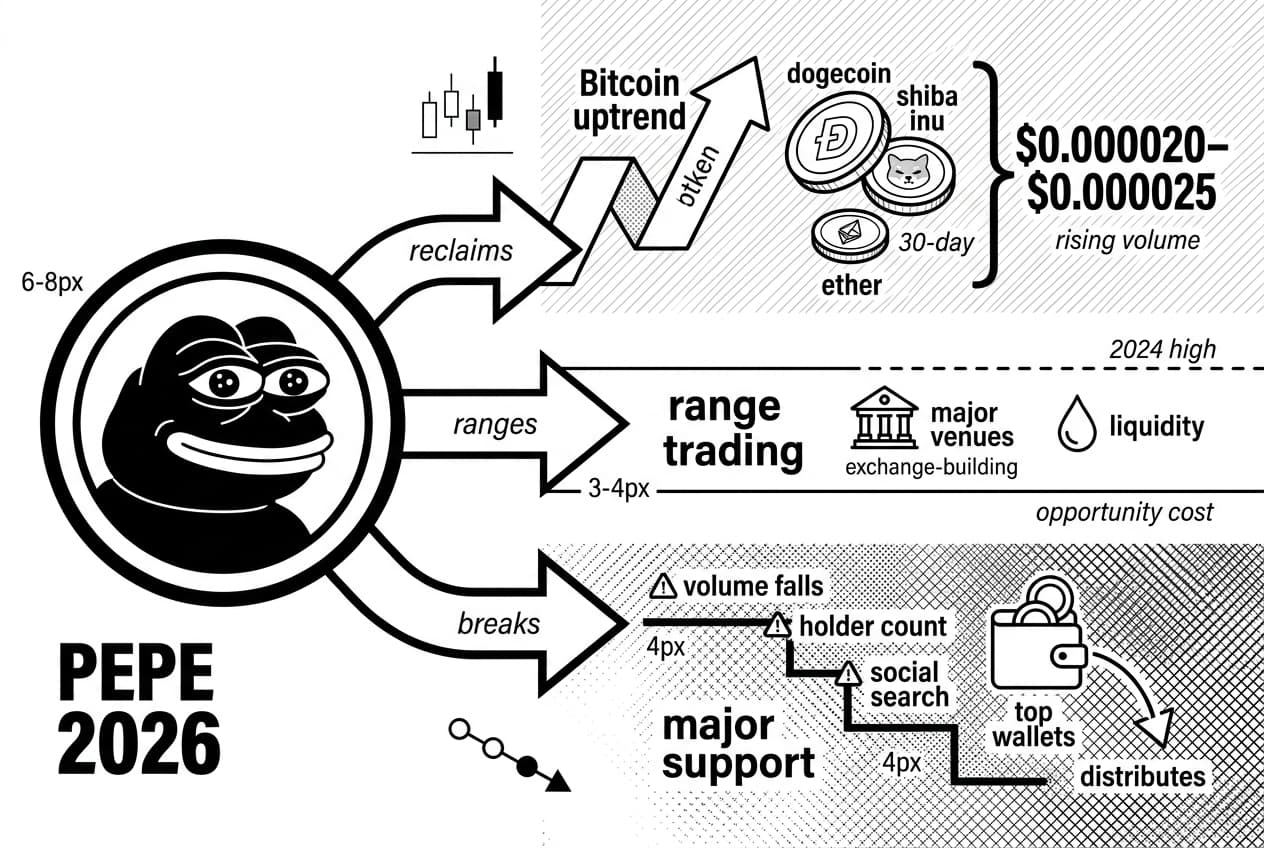
The bullish case requires macro support first. If bitcoin holds a strong uptrend, dogecoin and shiba inu outperform ether on a 30-day basis, and PEPE reclaims mid resistance with rising volume, then a move back toward the $0.000020 to $0.000025 area becomes plausible. This would still be a liquidity-driven rally, not a fundamental re-rating.
Base-case scenario
The base case is range trading. PEPE stays listed on major venues, remains liquid enough for active traders, but fails to attract enough new demand to challenge its 2024 high. In that case, asking whether PEPE is dead is the wrong framing. The more accurate concern is opportunity cost.
Bearish scenario
The bearish case becomes stronger if 30-day average volume falls for several months, holder count trends lower, top wallets distribute, and social search interest drops below earlier cycle baselines. A sustained break below major support without recovery volume would suggest the market is moving from correction to structural weakness.
Long-Term PEPE Outlook: 2026 to 2050 Forecasts in Context
Long-range PEPE forecasts from automated prediction sites should be treated carefully. Many models extend recent price action forward without modeling liquidity cliffs, exchange changes, whale concentration, cultural decay or competition from newer meme assets.
Why model-based price predictions can mislead
Most long-horizon models create false precision. A forecast for 2030 or 2050 may look analytical, but if it ignores exchange access, trading depth and social demand, it is not modeling the variables that actually drive a meme coin.
WooCharts, created by Willy Woo, on-chain analyst, is useful here because it focuses attention on market structure and flow data rather than decorative price targets. For PEPE, that means treating liquidity and participation as primary signals.
Can PEPE coin reach $1?
The math is blunt. With about 420.69 trillion PEPE in supply, per CoinGecko, accessed July 2026, a $1 price implies an approximate $420.69 trillion market cap. For comparison, global GDP was about $105 trillion in 2024, according to World Bank GDP data, 2024. A $1 PEPE would require a valuation roughly four times global GDP.
Target price | Implied market cap | Context | Realistic? |
|---|---|---|---|
$0.000001 | About $420.7 million | Mid-cap crypto range, based on 420.69 trillion supply from CoinGecko, accessed July 2026 | Plausible in weak conditions |
$0.00001 | About $4.2 billion | Large meme-coin tier, based on 420.69 trillion supply from CoinGecko, accessed July 2026 | Historically plausible |
$0.0001 | About $42.1 billion | Requires extreme meme demand, based on 420.69 trillion supply from CoinGecko, accessed July 2026 | Unlikely without a major cycle |
$0.01 | About $4.2 trillion | Larger than most public-market crypto valuation precedents, based on 420.69 trillion supply from CoinGecko, accessed July 2026 | Not credible under current supply |
$1.00 | About $420.7 trillion | Roughly four times 2024 global GDP, using World Bank GDP data, 2024 | Not realistic |
The useful question is not whether PEPE can reach $1. It is whether PEPE can keep enough attention, liquidity and exchange access to remain tradable through multiple market cycles.
Should PEPE Holders Worry? Main Risks and Bearish Signals
PEPE not being dead does not make it low risk. Holders should monitor the signals that usually appear before meme assets lose liquidity. These are observable warnings, not opinions.
Here are 7 signs PEPE may be weakening:
- Falling volume: multi-week contraction in daily trading volume suggests fewer marginal buyers.
- Lost support: a confirmed break below major support without recovery volume weakens the holding case.
- Delistings or pair removals: reduced venue access can widen spreads and make exits harder.
- Whale selling: distribution from large wallets can pressure price before retail traders see the full effect.
- Declining holders: falling unique-holder count during a drawdown signals that ownership breadth is shrinking.
- Fading social activity: lower search and social engagement reduces the chance of a reflexive meme rally.
- Rising bitcoin dominance: when capital rotates into bitcoin, high-beta meme assets often lose liquidity faster.
Tokenomics and supply risk
PEPE's supply is central to the risk case. A very low unit price can make the token feel cheap, but market cap is what matters. At $0.000010 per token, the implied valuation is about $4.2 billion based on the 420.69 trillion token supply cited by CoinGecko, accessed July 2026.
That valuation can be justified only if speculative demand remains strong. PEPE has no revenue stream, no protocol fee claim and no yield. Its value depends on liquidity and attention continuing to show up when risk appetite returns.
Correlation and market beta
PEPE should be treated as a high-beta crypto asset. When bitcoin rises, PEPE can rise faster. When bitcoin sells off, PEPE can fall harder because liquidity leaves speculative assets first. That makes position size more important than conviction.
Correlation with dogecoin and shiba inu also matters. Meme assets often move as a basket during sector rotations. If the whole basket weakens, PEPE-specific support may not be enough to prevent a drawdown.
Security and wallet hygiene
PEPE has inspired many counterfeit tokens. The Ethereum contract most commonly referenced for PEPE is 0x6982508145454Ce325dDbE47a25d4ec3d2311933, which can be checked on Etherscan, accessed July 2026. Always verify the contract before trading or approving any token interaction.
Token approvals are a separate risk. If a wallet has interacted with unofficial airdrops, trading tools or fake staking sites, old approvals may still expose funds. Learn how to revoke risky token approvals and repeat the check after using any unfamiliar contract.
Is PEPE Still Worth Holding? A Decision Framework
The answer depends on thesis, sizing and invalidation. PEPE can remain a viable speculative position for some holders, but it should not be confused with an asset that has cash flow or utility-based valuation support.
Hold, reduce or exit: questions to ask
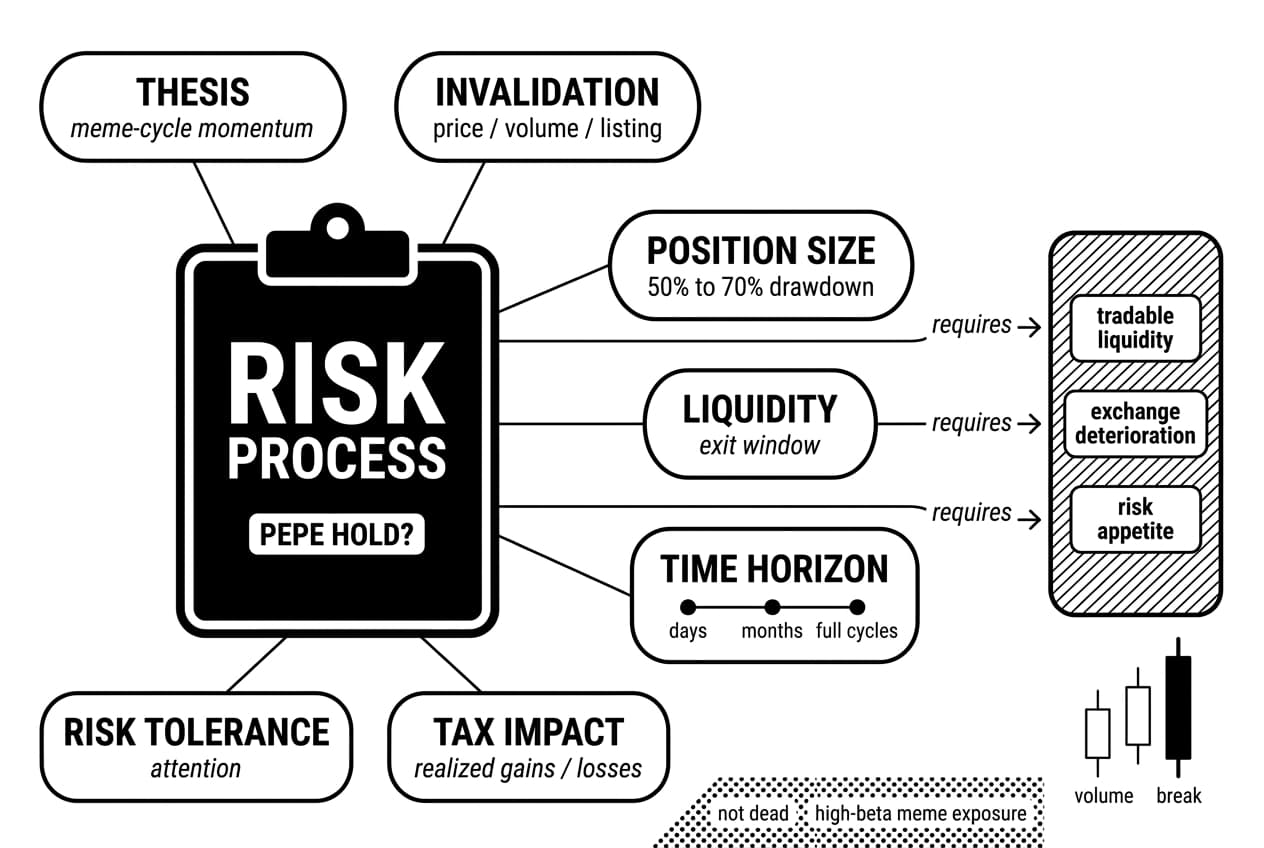
Before holding PEPE, ask:
- Thesis: am I holding for meme-cycle momentum, or do I have no clear reason?
- Invalidation: what price, volume or listing event would prove my thesis wrong?
- Position size: would a 50% to 70% drawdown damage my wider portfolio?
- Liquidity: can I exit without relying on a perfect market window?
- Time horizon: am I thinking in days, months or full cycles?
- Tax impact: have I accounted for realized gains, losses and local reporting rules?
- Risk tolerance: am I comfortable owning an asset driven mostly by attention?
This checklist is intentionally strict. If the thesis is vague, the position is oversized, or the exit rule is undefined, the problem is not PEPE alone. The problem is risk process.
What this means for investors
PEPE is not dead by the PEPE Liveliness Score if liquidity, volume, listings, holders and social activity remain intact. But not dead is only a floor. It does not automatically mean attractive, undervalued or suitable for every portfolio.
The strongest holding case requires three conditions: tradable liquidity, no major exchange deterioration and broader crypto risk appetite. If those hold, PEPE may remain a high-beta meme exposure. If they break together, the exit window can narrow quickly.
Frequently Asked Questions
- What is the future of PEPE coin?
- PEPE's future hinges on liquidity depth, exchange support, meme-coin demand cycles, and broader BTC and ETH market conditions. Unlike revenue-generating protocols, PEPE produces no yield or utility, so its long-term value is almost entirely narrative- and demand-driven. It can remain a relevant speculative asset, but sustained growth requires continuous community momentum.
- Will PEPE bounce back?
- A recovery is possible but conditional. PEPE is more likely to bounce if BTC stabilizes or trends upward, meme-coin trading volume rises, social activity picks up, and price reclaims key resistance levels. Conversely, continued volume decline, whale distribution, or a breakdown below major support levels makes a meaningful bounce considerably less likely.
- Can PEPE coin reach $1?
- Reaching $1 is essentially impossible under current supply conditions. With roughly 420 trillion PEPE in circulation, a $1 price would require a $420 trillion market cap — dwarfing the entire crypto market, Bitcoin, Ethereum, Dogecoin, and Shiba Inu combined many times over. No realistic demand scenario supports that valuation.
- What is going on with PEPE coin?
- Recent PEPE price action reflects a combination of meme-sector rotation, shifting broader crypto risk appetite, whale wallet movements, and reactions to key technical levels. No single factor fully explains the volatility. As of mid-2026, traders are watching exchange liquidity and on-chain data closely to distinguish short-term noise from meaningful directional shifts.
Sources
Author

Crypto analyst and blockchain educator with over 8 years of experience in the digital asset space. Former fintech consultant at a major Wall Street firm turned full-time crypto journalist. Specializes in DeFi, tokenomics, and blockchain technology. His writing breaks down complex cryptocurrency concepts into actionable insights for both beginners and seasoned investors.