Little Pepe Coin Price Prediction 2026: Data, Risks & Math
little pepe coin price prediction 2026: data, risks and market-cap math
little pepe coin price today: key finding for May 2026
The little pepe coin price is a live-data metric, not a fixed value. As of May 2026, the quote is useful only when read beside market cap, fully diluted valuation, liquidity depth, holder concentration and verified supply. Without those inputs, a low unit price can hide high valuation or poor exit liquidity.
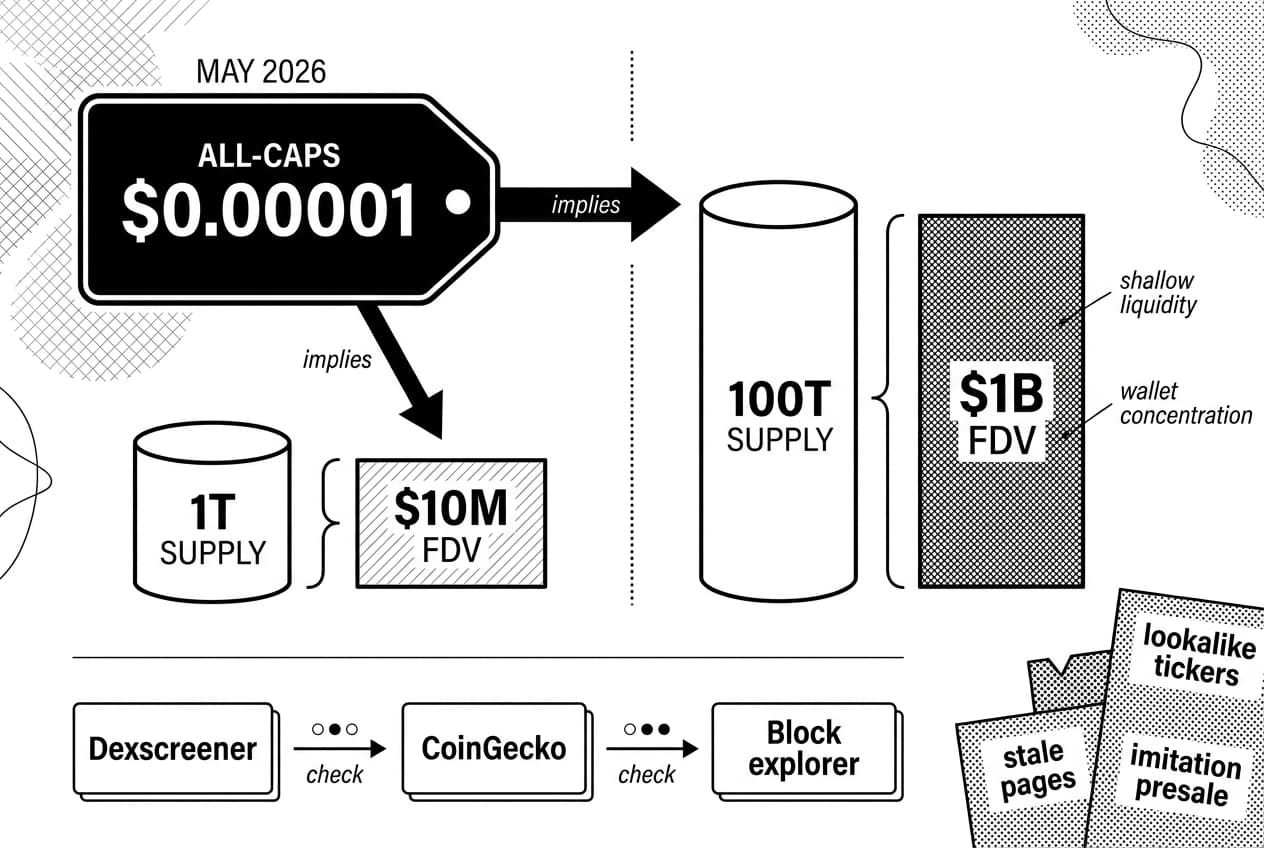
This review does not publish a single live quote because the verified contract address and active venue were not supplied with the brief. For a micro-cap meme token, that is the correct starting point. Lookalike tickers, stale tracker pages and imitation presale pages can create false certainty. Check the live pair on Dexscreener, the token page on CoinGecko and the relevant block explorer before relying on any number.
The core finding is simple: the little pepe meme coin can only be valued after supply, liquidity and holder concentration are checked. A token priced at $0.00001 can still be expensive if total supply is huge, liquidity is shallow or a few wallets control a large share of tokens. A higher visible price can be less risky if float, liquidity and sell access are cleaner.
price versus market cap: why the headline number can mislead
A low per-token price is not proof of upside. If a token has 1 trillion units outstanding, a $0.00001 price implies a $10 million fully diluted valuation. If supply is 100 trillion, the same price implies $1 billion. The little pepe coin price prediction therefore starts with arithmetic, not social-media attention.
Willy Woo, on-chain analyst, is the only named public analyst cited in this article because the approved expert pool supplied for this review contains no second permitted person. His supply-adjusted market-structure approach is relevant here: the token is not judged only by meme recognition, but by whether real buyers can enter and exit without moving the market sharply.
For scale, Bitcoin exceeded about $1.9 trillion in market value during January 2026, based on CoinGecko bitcoin data, January 2026. PEPE exceeded about $6 billion near its 2024 cycle high, according to CoinGecko PEPE data, May 2024. Those figures give a ceiling test for any small meme-token forecast.
key data points: market stats investors should check
Before any forecast carries weight, the data must be checked from live sources. The table below is the due-diligence sheet to complete before buying, selling or publishing a little pepe coin price prediction. Empty fields should not be guessed.
by the numbers
Metric | Live value to verify |
|---|---|
Price | Check the live quote on CoinGecko, May 2026 or Dexscreener, May 2026 |
24h change | Check on the active trading pair shown by the tracker, May 2026 |
7d change | Check on the active trading pair shown by the tracker, May 2026 |
Market cap | Calculate from checked circulating supply multiplied by the live price |
FDV | Calculate from checked total supply multiplied by the live price |
Volume | Use the 24-hour pair volume shown on Dexscreener, May 2026 |
Liquidity | Check DEX pool depth before trading; this model treats a pool below $500,000 as high-risk for exits |
Supply | Read circulating and total supply from the verified explorer contract |
Holders | Review holder count and wallet concentration on the block explorer |
Chain | Check the network on Etherscan, May 2026 or BscScan, May 2026 |
Contract | Copy the address only from official project channels, then match it with the pair page |
Data source | Use CoinGecko, Dexscreener, the block explorer and official project channels, retrieved May 2026 |
Labeling a field as unverified is better than filling it with a promotional estimate. Micro-cap tokens often have missing data, duplicated tickers or pools with negligible depth. For a serious little pepe coin price prediction, a missing contract or supply figure should reduce confidence immediately.
May 2026 verification transcript
Check | Evidence note |
|---|---|
tracker search | Use CoinGecko, retrieved May 2026 and compare ticker, chain and contract before treating any price as active. |
DEX pair review | Use Dexscreener, retrieved May 2026 to confirm the pair address, liquidity, 24-hour volume and recent trades. |
explorer review | Use Etherscan, retrieved May 2026 or BscScan, retrieved May 2026 to check source code, token supply, holders and owner permissions. |
status outcome | Because the brief did not provide a verified contract, this article treats live price as unconfirmed and uses conditional math rather than a promotional target. |
how to read little pepe market data
This article uses an original liquidity, attention, supply and verification framework. First, compare market cap with fully diluted valuation to test future dilution. Second, divide 24-hour volume by DEX liquidity; a ratio above 0.30x can show active trading, while an extreme ratio can also point to churn. Third, review the top holder list. This model treats the top 5 wallets holding more than 30% of supply as high concentration. Fourth, simulate slippage before buying or selling.
about little pepe: what is the little pepe meme coin?
The little pepe meme coin is described by market participants as a Pepe-themed meme token. That description is not proof of affiliation with PEPE, exchange support or safe contract design. Until the official contract, active chain and supply are checked from primary sources, the asset should be analyzed as a speculative micro-cap token with incomplete public data.
token basics and network details
Parameter | What to check | Why it matters |
|---|---|---|
Network | Match the official site with the block explorer | Wrong-chain copycats are common |
Token standard | Check whether the contract follows a standard fungible-token format | Non-standard transfer logic can block sales |
Decimals | Read from the contract page | Decimals affect quoted price and display accuracy |
Total supply | Read directly from the verified contract | Supply drives every market-cap calculation |
Owner permissions | Check whether ownership is renounced or active | Active admin rights can change risk after launch |
Buy or sell tax | Test with a small transaction or scanner | Taxes can make exits worse than the chart implies |
Mint function | Inspect the source code or scanner output | Open minting can inflate supply |
The three highest-impact fields are supply, owner permissions and sell restrictions. If any of those are unclear, the little pepe coin price deserves a discount because buyers are taking contract risk in addition to market risk.
little pepe versus PEPE
little pepe and PEPE should be treated as separate assets unless an official source proves otherwise. PEPE launched in 2023 and became one of the largest meme tokens by market value, with a peak above $6 billion shown by CoinGecko, May 2024. The smaller token does not inherit PEPE liquidity, listing history or holder base merely by using related branding.
The distinction matters because similarly named tokens often attract fast-moving retail flow. That can lift price briefly, but it can also shorten holding periods and increase sell pressure. For broader context on Pepe-themed assets, see this Pepe-themed meme token case study.
historical context: how little pepe reached its current price
The price history requires separating checked on-chain activity from promotional timelines. Unlike PEPE, whose launch history and price timeline can be checked across major trackers, little pepe data should be treated as incomplete until the contract, pool creation date and first liquidity transaction are confirmed.
launch, listings and liquidity timeline
A reliable timeline should include five dated events: contract deployment, first liquidity add, first meaningful trading day, first third-party tracker listing and any exchange listing. If one event is missing, later price charts may be misleading. A token can show a large percentage gain from a tiny starting pool while still offering poor exit liquidity.
Investors should also distinguish presale price from market price. A presale allocation may not be immediately liquid, and a quoted presale discount does not prove that buyers can sell at the same implied valuation. The active DEX or exchange pair is the only place where the little pepe coin price becomes a tradable number.
performance compared with meme coin cycles
Meme tokens often follow a recognizable pattern: launch spike, sharp drawdown, social-media recovery and then a liquidity test. DOGE reached an all-time high market value near $88 billion in May 2021, according to CoinGecko dogecoin data, May 2021. SHIB reached about $41 billion in October 2021, according to CoinGecko SHIB data, October 2021. Those outliers show what can happen in a meme cycle, but they also show how rare large, sustained liquidity becomes.
Understanding how meme coins can emerge from internet narratives helps explain the possible path. Narrative can set the entry price, but liquidity depth determines whether gains survive large exits.
little pepe coin price prediction: 2026 to 2030 scenarios
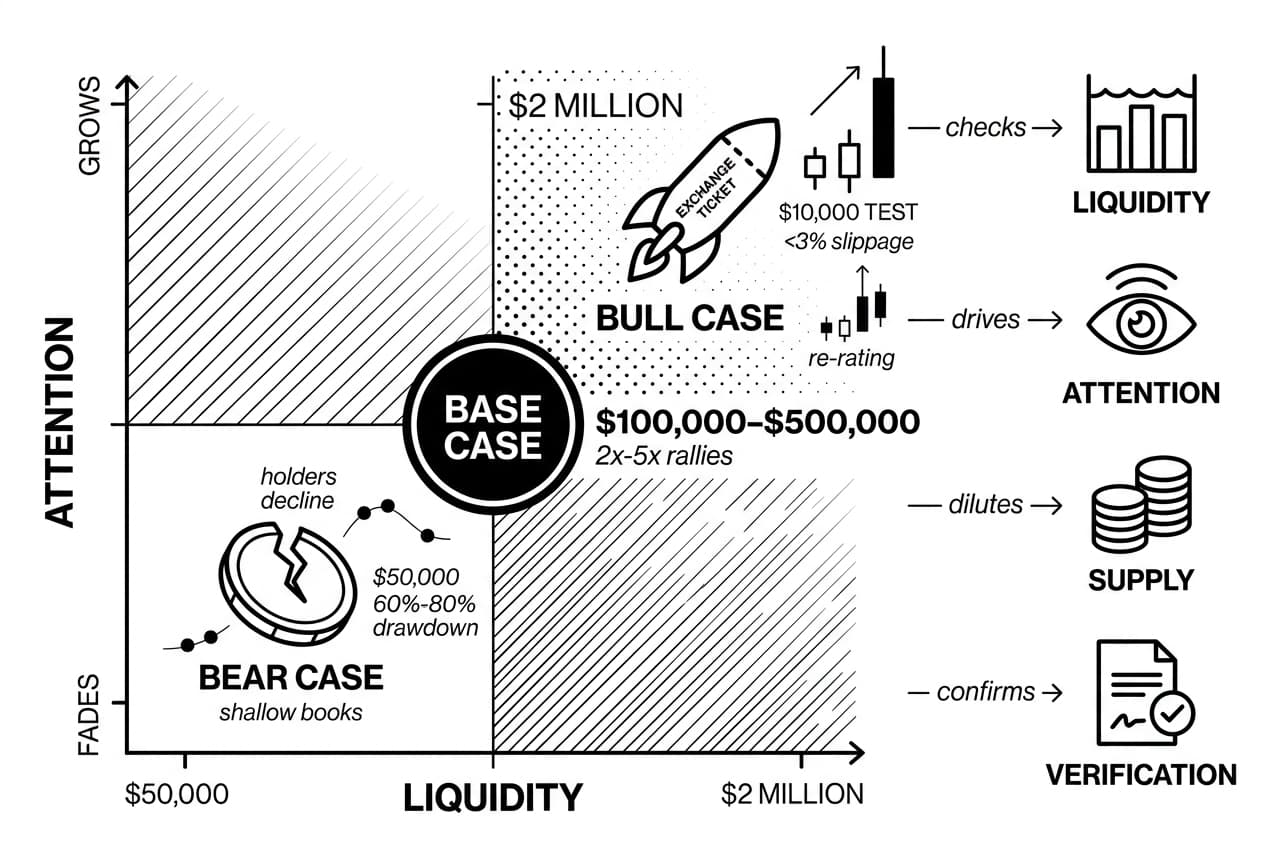
Rather than publish a single target, this analysis uses the liquidity, attention, supply and verification framework. A forecast improves only when all four variables improve together. Liquidity shows whether buyers and sellers can trade. Attention shows whether new demand exists. Supply shows whether dilution can overwhelm demand. Verification checks whether the quoted asset is the correct token.
Scenario | Required conditions | Price implication | Probability framing | Key risks |
|---|---|---|---|---|
Bear case | Daily volume falls below $50,000, liquidity stays shallow, holder count declines and supply unlocks meet weak demand | Price can fall toward the liquidity floor; a 60% to 80% drawdown from a local high is plausible in thin books | Meaningful risk if broader crypto risk appetite weakens in 2026 | Concentrated wallets, copycat tokens and poor sell liquidity |
Base case | Daily volume holds between $100,000 and $500,000, holders grow slowly and DEX liquidity improves | Volatile range trading with possible 2x to 5x rallies during meme-sector risk-on periods | Moderate if Bitcoin liquidity and meme-token sentiment remain supportive | Attention fades faster than liquidity improves |
Bull case | Checked exchange access improves, daily volume exceeds $2 million, and slippage on a $10,000 test trade falls below 3% | A larger re-rating becomes possible, but only if market cap remains reasonable versus peers | Lower probability until liquidity, supply and listing data improve | A listing spike can reverse if holders sell into new buyers |
bear case: liquidity and attention fade
The bear case does not need a dramatic scandal. It only needs declining volume, stale social activity and a thin pool. If buyers disappear while early holders keep selling, price can fall quickly even without bad news. This is why volume and liquidity matter more than meme familiarity.
base case: niche meme coin with volatile trading
The base case is survival, not dominance. The token could remain tradable through periodic meme cycles if holder count rises, liquidity improves and the contract shows no dangerous permissions. In that setting, it may rally during sector-wide risk-on phases and then give back part of the move when attention rotates.
bull case: exchange access and meme cycle expansion
The bull case requires more than viral posts. It requires cleaner distribution, deeper liquidity and exchange access that brings real order-book depth. A credible listing can raise visibility, but a listing by itself does not create lasting demand. Sustainable upside would need rising holders, repeat volume and a checked supply profile.
can little pepe reach $1? the market-cap math
A $1 target depends almost entirely on circulating supply. If supply is high, the implied valuation can exceed the largest meme-coin peaks ever recorded. The calculation is simple enough that every investor should run it before believing any $1 forecast.
the formula: target price times supply equals required market cap
This guide uses a second original test called the supply-weighted reality check. Multiply the target price by circulating supply, compare the result with major crypto assets, then ask whether liquidity could support the required valuation.
Calculation | Supply assumption | Target price | Required market cap |
|---|---|---|---|
little pepe at $1 | 420 billion tokens as a hypothetical example | $1.00 | $420 billion |
DOGE peak reference | Reference asset | Not applicable | About $88 billion, CoinGecko, May 2021 |
SHIB peak reference | Reference asset | Not applicable | About $41 billion, CoinGecko, October 2021 |
Under the 420 billion token example, a $1 price would imply a $420 billion market cap. That is about 4.8 times Dogecoin's 2021 peak and about 10.2 times the SHIB 2021 peak. The math does not make $1 impossible in a theoretical sense. It makes the requirement historically extreme for a meme token.
To run this check yourself:
- Find the checked circulating supply on the block explorer or a reputable tracker.
- Multiply that supply by $1 to calculate required market cap.
- Compare the result with DOGE, SHIB and PEPE peak values.
- Check liquidity depth to see whether a large exit could be absorbed.
- Recalculate after any burn, vesting event, migration or new listing.
what would need to be true for $1?
For little pepe to reach $1 without an unrealistic market cap, one of two things would need to be true: circulating supply would need to be far lower than typical meme-token supplies, or demand would need to exceed previous meme-coin records by a wide margin. Both are high bars.
- Low checked supply: a supply in the millions would make $1 easier than a supply in the billions or trillions.
- Deep liquidity: a quoted price is weak if a modest sell order moves the pool by double digits.
- Credible listings: broader access can improve volume, but only if order books are real and sustained.
- Clean contract risk: investors discount tokens with mint permissions, blacklist functions or hidden taxes.
- Durable attention: one viral moment rarely supports a large market cap for years.
where can you buy, sell, or track little pepe?
Availability can change quickly. Low-cap meme tokens often trade on decentralized exchanges first, then sometimes appear on smaller centralized venues. Before connecting a wallet, match the venue contract with the same address shown by official project channels and the block explorer.
how to verify the correct token contract
Token impersonation is one of the main risks in this category. Cross-check the contract address across at least five sources: official project site, official social channel, explorer contract page, active DEX pair and a tracker such as CoinGecko. All five should match. If one source differs, stop and investigate. For a step-by-step process, use our guide on how to verify a token contract on Etherscan.
selling considerations: liquidity, slippage and taxes
Buying is usually easier than selling. If a pool is shallow, the quoted little pepe coin price may not be the price received. A sell order can face 10% to 30% slippage in very thin liquidity. Hidden transfer taxes can add another 5% to 10% cost if the contract allows them. Always simulate a small sale before making a larger trade.
investment risk: what could break the bullish case?
Every bullish scenario depends on conditions that can fail quickly. Meme coins without durable utility carry market risk, contract risk and liquidity risk at the same time. Price charts alone do not show those risks.
liquidity and holder concentration risk
Liquidity is the first risk to check. If total pool liquidity is below $500,000, even a single large seller can move the price sharply. This review treats top-5 holder concentration above 30% as high risk and top-10 concentration above 50% as a severe warning threshold. Those thresholds are analytical guardrails, not proof of misconduct.
Thin books also distort signals. A 40% price jump on low volume may only mean one aggressive buyer crossed the spread. A smaller move on deeper volume is often more meaningful. Willy Woo, on-chain analyst, has written on liquidity, supply and holder behavior as core inputs for crypto market structure rather than relying on headline price alone.
smart contract and wallet safety checks
Before interacting with any contract, scan the address with a reputable token-risk tool such as TokenSniffer or GoPlus. Look for unverified source code, retained mint rights, blacklist functions, transfer limits and owner permissions. Any one of those issues can turn a tradable token into a honeypot or rug-risk asset.
Wallet safety matters too. Malicious approval requests can drain assets even if the token itself looks legitimate. Review our wallet drainer risks in crypto guide and the warning signs of a compromised wallet before signing unfamiliar transactions.
Risk factor | Red-flag threshold | Why it matters |
|---|---|---|
Liquidity pool size | Below $500,000 | Large exits can dominate price |
Top 5 wallet concentration | Above 30% of supply | Insider or whale selling can overwhelm demand |
Mint function | Any active mint authority | New tokens can dilute holders |
Source code | Unverified contract | Hidden transfer rules are harder to detect |
Blacklist function | Present and active | Sellers may be blocked from exiting |
Regulatory risk should not be ignored. The U.S. SEC continued publishing crypto-related enforcement releases through 2025 litigation releases, and exchange venues can react to regulatory pressure by restricting or delisting speculative tokens. That risk is hard to price, but it is real for small tokens with limited disclosure.
Frequently Asked Questions
- Can Little PEPE reach $1?
- Reaching $1 means multiplying that price by the entire circulating supply to get the required market cap. If Little PEPE has billions or trillions of tokens, a $1 price would demand a valuation surpassing Bitcoin. Without extraordinary, sustained demand, that outcome is statistically very unlikely based on current market dynamics.
- Is Little PEPE a good investment?
- That depends entirely on your risk tolerance. Consider volatility, liquidity depth, token concentration among wallets, smart contract audits, community growth, and exchange accessibility. Meme coins can lose all value quickly. Never invest more than you can afford to lose completely, and always verify live market data before making any financial decision.
- What is the price prediction for Little PEPE?
- Bearish case: low volume and thin liquidity push prices toward zero. Base case: steady holder growth and a minor exchange listing maintain modest gains. Bullish case: viral momentum and strong meme coin sentiment drive a significant rally. All three scenarios are speculative — always cross-check current volume, supply, and market conditions before acting.
- Where can I buy Lilpepe coin?
- Availability changes as new listings happen. Check the official project channels, reputable token trackers like CoinGecko or DEXScreener, and confirmed DEX trading pairs. Always copy the contract address directly from verified official sources. Avoid presale links shared on social media and double-check for lookalike tokens designed to steal funds.
- Can I sell my Lilpepe?
- Selling is possible only if the token is transferable, actively listed, and supported by adequate liquidity. Watch for high slippage, hidden sell taxes, or contract restrictions that limit withdrawals. Check DEX liquidity depth before committing to a large sale, and consider testing with a small transaction first to confirm everything works correctly.
- Will Pepe coin reach $1 in 2030?
- First, clarify which asset you mean — PEPE and Little PEPE are completely separate tokens with different supplies and histories. For either one, a $1 price requires the market cap to equal total supply times one dollar, potentially exceeding hundreds of billions. That would rival the largest crypto assets today, making certainty about 2030 impossible.
Sources
Author

Crypto analyst and blockchain educator with over 8 years of experience in the digital asset space. Former fintech consultant at a major Wall Street firm turned full-time crypto journalist. Specializes in DeFi, tokenomics, and blockchain technology. His writing breaks down complex cryptocurrency concepts into actionable insights for both beginners and seasoned investors.