Pepe Coin Launch Date: Early History, Price & Timeline Guide

Pepe Coin Launch Date: The Short Answer
Pepe Coin launched in April 2023, and the best on-chain anchor for the pepe coin launch date is April 14, 2023 (Etherscan), when its Ethereum token contract was deployed. If you ask when did pepe coin launch, use that date, then separate it from later listings.
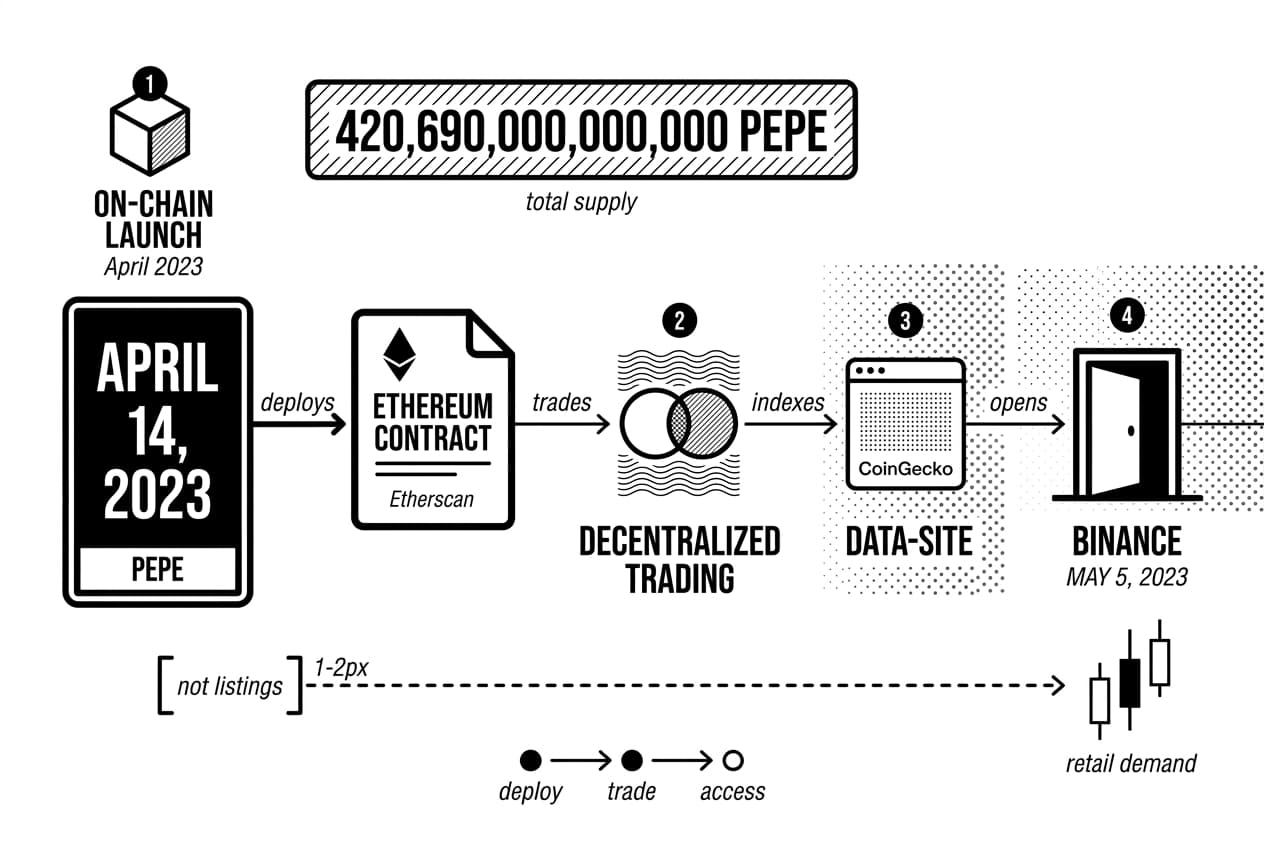
In plain English, PEPE is an Ethereum-based memecoin: a crypto token whose market value depends mainly on internet culture, trading demand, liquidity, and community attention rather than company revenue or product use.
Why it matters: the launch date affects how you read early price claims, return screenshots, holder concentration, and listing headlines. A token can be created on-chain before most buyers can find it on data sites or centralized exchanges, so one headline can hide several different starting points.
Our dated source trail
For this update, current as of March 2026, we rebuilt PEPE's early-history timeline from public records rather than social-media lore. The working dataset uses the contract page on Etherscan, the historical PEPE page on CoinGecko, and major exchange listing records. That produces a simple launch sequence: deployment first, decentralized trading next, data-site visibility after that, and broad retail access in May 2023.
- On-chain launch: April 14, 2023, recorded on the PEPE token page at Etherscan, April 2023.
- Total supply: 420,690,000,000,000 PEPE tokens, visible on the token contract page at Etherscan, April 2023.
- Major retail access: Binance opened PEPE spot trading on May 5, 2023, according to Binance, May 2023.
Background: why one launch can have several dates
Memecoin histories are easy to misread because several events can each look like the beginning. The smart contract is deployed on one date. Public trading may start minutes or hours later. A market-data page may appear days later. A centralized exchange listing can arrive weeks after that. Each date is real, but each answers a different question.
The useful lesson from PEPE's early history is not just that a few traders saw large gains. The better lesson is that structure mattered. PEPE combined an ERC-20 token, no stated transaction tax, fast liquidity on decentralized exchanges, rapid market-data visibility, and major exchange listings. That structure explains the risk and reward better than the meme alone.
What Is Pepe Coin?
Pepe Coin, ticker PEPE, is a memecoin on Ethereum. A memecoin is a crypto asset whose attention comes from jokes, images, online culture, and trading momentum instead of a promised business model.
PEPE is an ERC-20 token, which means it follows a common Ethereum token standard. A token contract is the program on Ethereum that records the token's supply and transfer rules. A wallet is the account a user controls to hold tokens. A gas fee is the Ethereum fee paid to process a transaction. If you are new to wallet control, start with our guide to custodial vs. non-custodial crypto wallets.
PEPE is also not a stock. It does not give holders ownership in a company, a legal claim on profits, or voting rights in a public business.
Memecoin vs. utility token
Utility tokens are meant to help run a network or application. ETH pays for Ethereum activity. LINK helps pay node operators that provide data to smart contracts, a role connected to Chainlink's work under Sergey Nazarov, Co-founder at Chainlink Labs. PEPE launched differently: no product roadmap, no protocol service, and no stated cash-flow model.
The smart-contract idea itself predates most crypto tokens. Nick Szabo, computer scientist and originator of the smart-contracts concept, helped frame how code could enforce agreements. PEPE uses that general token infrastructure, but it does not turn the meme into a business or protocol.
PEPE and the frog meme
The token borrowed the image language of a famous internet frog meme, which gave it instant recognition across crypto Twitter, Telegram, Reddit, and meme pages. That cultural head start helped PEPE spread faster than a token with a new name and no shared visual identity. Recognition, however, is not endorsement, revenue, or technical value.
- PEPE is a memecoin: its value depends on culture, trading demand, liquidity, and attention.
- It runs on Ethereum: transfers are recorded through an ERC-20 token contract.
- Gas fees apply: every on-chain PEPE transfer requires an Ethereum transaction fee.
- No stock ownership: PEPE holders do not own shares in a company.
Pepe Coin Early History: 2023 Timeline
PEPE's early history moved from on-chain deployment to retail visibility in only a few weeks. The table below separates the launch facts from the later attention cycle.
Date | Event | Why It Mattered |
|---|---|---|
April 14, 2023 | PEPE token contract deployed on Ethereum, shown on Etherscan, April 2023 | Created the verifiable on-chain launch date and the fixed token record. |
late April 2023 | Market-data visibility expanded on pages such as CoinGecko, April 2023 | Price, volume, market cap, and holder data became easier for non-technical buyers to track. |
May 5, 2023 | Major centralized exchange access began, including Binance spot trading records at Binance, May 2023 | Retail access widened because buyers could use exchange accounts instead of only Ethereum wallets. |
April 2023: deployment and first trading
The clearest answer to when was Pepe Coin launched is April 14, 2023. That is the date tied to the token contract on Etherscan. Early trading happened through decentralized exchanges, which are crypto markets where wallets swap directly through smart contracts instead of placing orders through a company account.
A block explorer works like a public receipt archive: each transaction has a timestamp, sender, recipient, and hash that anyone can inspect later. That is why the contract record is stronger evidence than a chart screenshot or social post.
late April 2023: data visibility and viral attention
After launch, PEPE began appearing on tracking sites. Those pages made it easier to see price, volume, market cap, and holders. According to CoinGecko, May 2023, PEPE reached a market capitalization above $1.6 billion during its first major run. That number helped draw traders who had missed earlier memecoin cycles.
May 2023: major exchange listings
Centralized exchanges changed the size of the audience. Binance reported more than 150 million registered users in 2023 corporate communications, and its PEPE listing on May 5, 2023, gave the token access to a far broader retail base than decentralized exchanges alone could provide (Binance Blog, 2023).
How Much Was Pepe Coin When It First Came Out?
PEPE's earliest trades were priced at tiny fractions of a cent. The exact first price depends on which trade, liquidity pool, and timestamp you select, so a single clean launch price can be misleading. Shortly after the April 14, 2023 deployment on Etherscan, early pool prices were often discussed in the sub-$0.000000001 range, but those trades happened before deep liquidity existed.
Why early memecoin prices look so small
Unit price is not the same as value. PEPE's supply was 420,690,000,000,000 tokens (Etherscan, April 2023). With that many units, each token can show many zeros even when the total network value is large. Market capitalization equals price per token multiplied by circulating supply.
Willy Woo, on-chain analyst, is known for using blockchain and market data to separate unit-price narratives from network-value analysis. That distinction matters for PEPE: a low unit price does not automatically mean a token is cheap.
If you invested $100 at launch
Launch-return screenshots often ignore execution costs. A buyer who tried to spend $100 in a thin early pool could face Ethereum gas and slippage. As a concrete example, a $100 trade with a $20 gas fee and 10% slippage has only about $70 of effective exposure before price movement. Gas mechanics are explained in our guide to how Ethereum gas fees work.
- Choose a sourced entry price. Use on-chain trades or a reputable data provider.
- Apply the return formula. Tokens bought equals dollars invested divided by entry price.
- Subtract gas. Ethereum transactions can be material for small trades.
- Subtract slippage. Thin pools can move against the buyer during execution.
- Check exit liquidity. A paper gain is not the same as a filled sale.
Who Created Pepe Coin and How Was It Launched?
PEPE was launched by an anonymous team. Anonymous means the people behind the token did not publicly verify real-world identities. That is common in memecoin culture, but it raises a practical research problem: buyers must rely on on-chain records rather than founder reputation.
No presale, no tax, and stealth-launch claims
The project described itself as having no presale and no transaction tax. A presale is an early private sale before public trading. A transaction tax is a fee deducted whenever tokens move between wallets. A stealth launch means the token appears without a long public fundraising period. These claims are useful starting points, but they are not proof of fair distribution.
The only way to test the launch structure is to inspect early wallet flows. If a small cluster of wallets receives or buys a large share before public visibility, the risk profile changes even when the website says no presale.
Token supply and holder concentration
PEPE launched with 420,690,000,000,000 tokens (Etherscan, April 2023). Holder concentration means how much supply is controlled by the largest wallets. If one wallet holds more than 20% of supply, that holder can heavily affect price by selling, transferring, or simply causing fear.
For current concentration, use the live holder tab on Etherscan or the token page on CoinGecko. Static articles age quickly because exchange wallets, burn addresses, and retail holders shift over time.
- Anonymous team: treat identity claims carefully because no public team verification anchors the project.
- No presale and no tax: these were project claims that should be checked against early wallet flows.
- Large supply: PEPE's 420.69 trillion-token supply explains the many zeros in early prices.
- Concentration risk: whale wallets can matter more than slogans.
Why Did PEPE Go Viral So Quickly?
PEPE spread quickly because price and attention reinforced each other. Rising prices drew posts, posts drew buyers, buyers raised volume, and higher volume created more market-data visibility. In finance, this feedback loop is often called reflexivity: the story affects price, and price strengthens the story.
The timing helped. By 2023, crypto traders already understood that Dogecoin and Shiba Inu could become large speculative markets. PEPE used a familiar meme identity and arrived when many traders wanted a new high-risk narrative. You can compare that low launch barrier with how another memecoin was created from scratch.
Community, attention, and liquidity
Attention can produce liquidity, but it does not create intrinsic value. Liquidity means how easily buyers and sellers can trade without moving the price too much. PEPE's early liquidity improved as exchanges listed it, yet the same mechanism can reverse. Falling prices can reduce attention, reduce bids, and make exits harder.
- Recognition helped: the meme identity needed little explanation.
- Listings widened access: centralized exchange accounts reached buyers who did not use Ethereum wallets.
- Liquidity changed the chart: thin early pools moved much faster than later exchange markets.
- Attention is fragile: viral interest can fade as quickly as it appears.
How to Verify the Pepe Coin Launch Date Yourself
You do not need to trust a blog post to verify PEPE's launch date. Because PEPE is an ERC-20 token on Ethereum, its deployment and early transfers are public. This is especially important because copycat tokens often use similar names, logos, and tickers.
For a deeper walkthrough, see our guide on how to verify a token contract on Etherscan.
A simple on-chain verification checklist
- Find the contract address. Start from a reputable market-data page such as CoinGecko, 2026, not a random social post.
- Open it in a block explorer. Paste the address into Etherscan and confirm that the page is for the original PEPE token.
- Check the creation transaction. On the token page, find the deployment transaction and read its timestamp. That timestamp is the on-chain launch anchor.
- Review early liquidity and trades. Look at the first transfers and early pool activity to see when public trading became possible.
- Compare against market-data and exchange dates. Check CoinGecko, CoinMarketCap, and exchange records. A claimed launch date far away from the on-chain date deserves extra caution.
What to Check | Where to Find It | Warning Sign |
|---|---|---|
Contract address | CoinGecko, CoinMarketCap, Etherscan | Address appears only in a Telegram post |
Deployment timestamp | Etherscan transaction record | Date does not match April 2023 |
Early liquidity | First transfer and pool transactions | No clear public trading path |
Holder distribution | Etherscan holders tab | One non-exchange wallet controls more than 20% |
On-chain checking is where Willy Woo, on-chain analyst, is most relevant to the beginner's process: use primary blockchain data before accepting a narrative. For PEPE, the timestamped contract record is the best starting point.
What PEPE's Early History Means in 2026
As of March 2026, PEPE's launch remains a useful case study in memecoin market structure. The fast move to a market capitalization above $1.6 billion by May 2023 (CoinGecko, May 2023) showed how quickly culture, liquidity, and exchange access can combine. It also showed why buyers should not treat viral history as a forecast.
The conditions that helped PEPE in 2023 were specific: a recognizable meme identity, Ethereum liquidity, a market looking for a new speculative story, and rapid exchange distribution. Copycat tokens may copy the frog branding, but they cannot copy the exact timing, holder base, liquidity path, or exchange sequence.
The lesson for new memecoin buyers
Use launch history as risk research. Before buying any memecoin, run a five-point entry check: confirm liquidity depth, review top-holder concentration, inspect contract permissions, verify real exchange support, and judge whether community activity looks organic or paid. For a broader high-risk research process, see how analysts evaluate high-risk crypto opportunities.
- Liquidity depth: thin pools can turn small trades into large price moves.
- Holder spread: a few whale wallets can dominate price risk.
- Contract permissions: minting, pausing, or blacklist powers can change the risk profile.
- Exchange support: large exchange access can widen buyers, but it does not remove volatility.
- Community quality: real discussion is more useful than bot-like hype.
Key Takeaways
- PEPE launched on April 14, 2023, based on the Ethereum contract record, making that the best answer to the launch-date query.
- Different launch dates describe different events: contract deployment, first trades, data-site visibility, and exchange listings did not all happen at once.
- PEPE's tiny early price came from huge supply and thin liquidity, not from a simple discount.
- The 2023 rise was driven by meme recognition, community attention, and exchange access, not by business revenue or product use.
- In 2026, PEPE's history is best used as a risk checklist, not as proof that future memecoin gains will repeat.
Frequently Asked Questions
- When did Pepe Coin come out?
- PEPE came out in April 2023, with April 14, 2023 commonly cited as the launch date based on early on-chain activity. Keep in mind that exchange listings and market-data pages appeared later, so different sources may reference slightly different milestones depending on which event they treat as the official start.
- When was Pepe Coin launched?
- The Pepe Coin launch date is generally recognized as April 14, 2023, when the token contract was deployed and early decentralized exchange trading began. Centralized exchange listings followed weeks later, which is why some platforms show a different date — each milestone marks a distinct step in the token's rollout.
- How much was Pepe Coin when it first came out?
- PEPE initially traded at tiny fractions of a cent. The exact opening price depends on which timestamp, liquidity pool, and data source you use. For the most accurate figures, check historical DEX trade records or trusted price aggregators, and remember that gas fees and slippage affected the real cost for early buyers.
- Will Pepe Coin reach $1?
- A $1 PEPE price would imply an extraordinarily large market capitalization given the token's massive circulating supply. Rather than focusing on unit price alone, compare the implied market cap against established cryptocurrencies. No price outcome is guaranteed, and projections that skip this supply context are often misleading.
- Can Pepe Coin reach 1 cent?
- Even 1 cent is a very aggressive target. Because market cap equals price multiplied by circulating supply, reaching that level would require a valuation comparable to some of the largest assets in crypto. Evaluate any price target by its implied market cap, and factor in supply, liquidity, demand trends, and broader market cycles.
- Does Pepe Coin have a future?
- PEPE's outlook depends on several variables: community strength, exchange liquidity, broader memecoin demand, holder distribution, and regulatory or market conditions. Notably, it has persisted beyond its initial hype cycle, which not all memecoins manage. That said, memecoins remain highly speculative, and past survival does not guarantee future performance.
- Does Elon Musk support Pepe Coin?
- Be skeptical of celebrity-support claims unless there is a clear, verifiable statement from an official account. Memes and social media posts are frequently interpreted loosely and used in misleading promotions. Before making any decision based on alleged endorsements, look for direct, unambiguous confirmation from the individual in question.
- Which year did Pepe Coin reach $1?
- As of 2026, PEPE has not reached $1. Because of its enormous token supply, hitting that price point would require a market capitalization that would rank it among the largest assets ever. If you encounter claims that PEPE has already reached $1, treat them with serious skepticism and verify through reliable data sources.
Sources
Author

Crypto analyst and blockchain educator with over 8 years of experience in the digital asset space. Former fintech consultant at a major Wall Street firm turned full-time crypto journalist. Specializes in DeFi, tokenomics, and blockchain technology. His writing breaks down complex cryptocurrency concepts into actionable insights for both beginners and seasoned investors.