OpenAI Crypto: Will OpenAI Ever Launch a Token in 2026?

OpenAI crypto: will OpenAI ever launch a token in 2026?
My Thesis: OpenAI probably will not launch a crypto token
Let me be direct: the OpenAI crypto trade is one of the easiest stories in the market to misunderstand. OpenAI is a real company with major enterprise demand, deep strategic partners, and a private-market path to capital. My view is that an official tradable open ai token is unlikely because it would add legal, brand, and governance risk without solving a problem OpenAI clearly has.
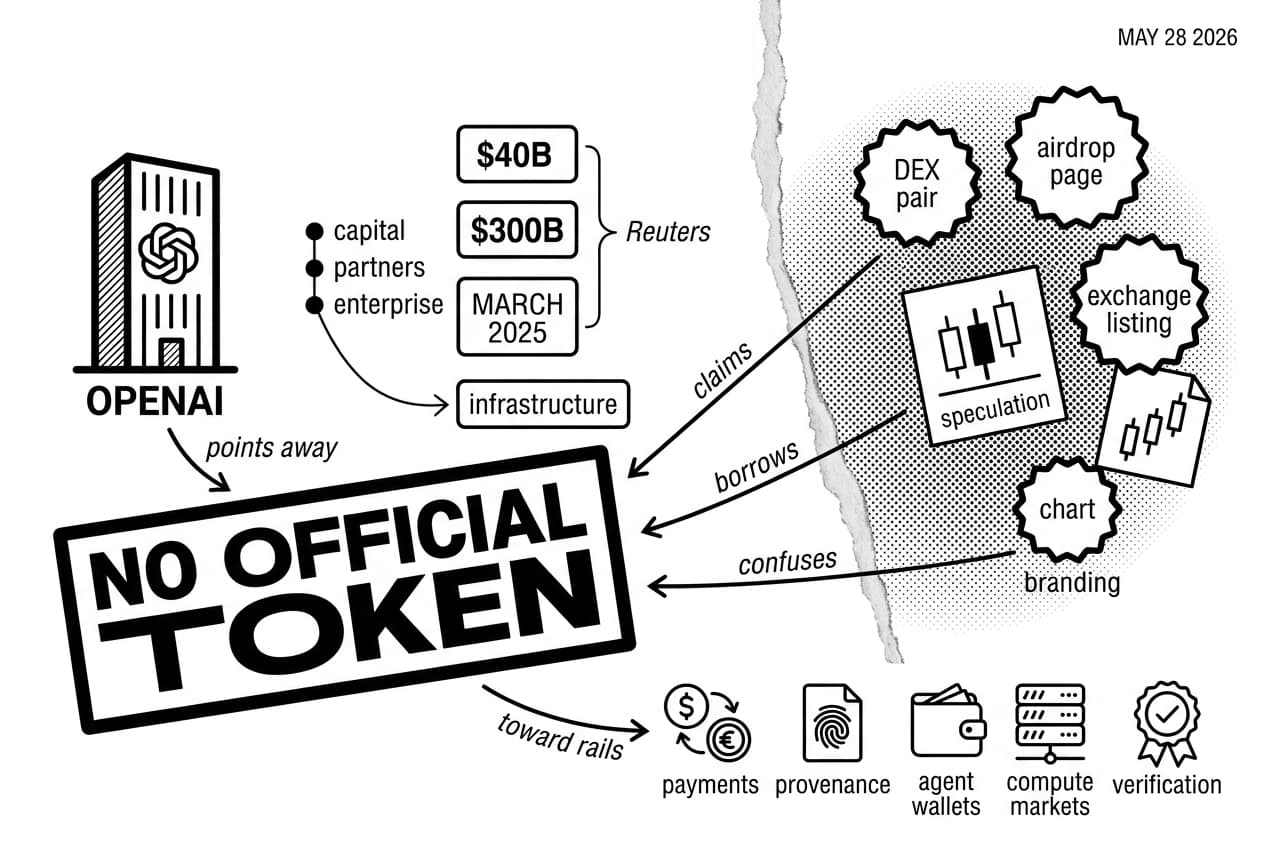
The evidence points away from a token and toward infrastructure. OpenAI raised $40 billion at a $300 billion valuation in March 2025 (Reuters, March 2025). A company with access to capital at that scale does not need a retail token sale. The more realistic overlap is crypto rails under AI systems: payments, provenance, agent wallets, compute markets, and verification.
The short answer for searchers
There is no official OpenAI coin or open ai token as of May 28, 2026. None. Any exchange listing, DEX pair, airdrop page, or chart using OpenAI branding should be treated as unaffiliated unless OpenAI announces it through its own channels. A market can be real while the claimed connection is not.
Why this is opinion, not financial advice
This article is analysis and risk framing, not a recommendation to buy, sell, short, or avoid any asset. Crypto markets can surprise even careful analysts. I am separating established facts from my interpretation so readers can make their own decision, check primary sources, and speak with a licensed adviser before taking financial risk.
As-of May 28, 2026 source check
To avoid treating search rumors as evidence, I used a simple dated source check: official company channels first, then public reporting, then market-data pages. The result supports the core thesis: there are unofficial OpenAI-themed markets, but no OpenAI-issued token.
Source checked | What it shows | Editorial read |
|---|---|---|
OpenAI official site, May 28, 2026 | No official tradable token announcement found | Primary-source silence matters more than token listings |
Reuters, Oct. 2024 | OpenAI completed funding at a $157 billion valuation | Private capital access was already very large before the 2025 round |
Reuters, March 2025 | OpenAI raised $40 billion at a $300 billion valuation | A token sale is not needed to fund the company |
CoinGecko, late 2023 listing page | An OpenAI-named ERC asset page existed outside OpenAI control | A price page is evidence of a market, not affiliation |
Why OpenAI crypto rumors keep spreading
The rumor cycle around an OpenAI token is not random. It comes from two forces colliding: AI is the dominant technology story of the decade, and crypto markets are very good at creating liquid proxies for assets most people cannot buy. If retail investors cannot access OpenAI equity, token issuers can still create something that looks tradeable, searchable, and emotionally connected to the brand.
AI hype creates a search vacuum
OpenAI remains private as of May 28, 2026, which means ordinary investors have no direct public-market route to its equity. That gap creates search demand. Unofficial ERC-20 tokens, synthetic products, and pre-stock narratives then try to occupy the empty space. Coin tracking pages can show price, fully diluted valuation, circulating supply, and liquidity data, but those fields do not prove company involvement.
Why price charts do not prove affiliation
A token can have a CoinMarketCap page, a USD chart, a DEX pair, and a market cap without any link to OpenAI. Anyone can deploy a contract, seed liquidity, and submit market data. The existence of trading activity tells you only that someone built a market. It does not tell you that OpenAI endorsed it, issued it, or benefits from it.
The memecoin precedent
Crypto communities do not need permission to build a market around a famous idea. The GPT-4-created memecoin Turbo is a useful example: launched in 2023 after a GPT-4 prompt shaped the concept, Turbo later crossed a widely reported nine-figure market value without OpenAI operating the project. The point is not that Turbo is equivalent to OpenAI. The point is that crypto can turn a narrative into a market even when the original company is not involved.
Naval Ravikant, co-founder of AngelList, has often framed crypto as a way to coordinate economic behavior around networks and shared belief. That lens explains the rumor cycle well: the OpenAI story is strong enough to anchor speculation, even if OpenAI never participates.
Fact Check: Does OpenAI have a coin, stock, or token?
OpenAI has no official crypto token, coin, or public stock as of May 28, 2026. The company remains private, and no OpenAI-issued digital asset has been announced. Unofficial tokens, pre-stock derivatives, and synthetic products may trade elsewhere, but they are not equivalent to assets issued or endorsed by OpenAI.
Asset type | Official OpenAI product? | What it represents | Main risk |
|---|---|---|---|
Official token | No | No OpenAI-issued tradable crypto asset exists | Fake announcements and impersonation |
Public stock | No | OpenAI is not listed on a public exchange | Confusing private-company value with public access |
Pre-stock derivative | No | A platform claim or synthetic exposure product | Counterparty, legal, and conversion risk |
ERC lookalike token | No | A third-party token using similar naming | Rug pull, low liquidity, or brand impersonation |
AI crypto sector token | No | A separate protocol focused on compute, agents, data, or verification | Sector correlation mistaken for OpenAI exposure |
No official OpenAI coin exists
This is the cleanest fact in the article. OpenAI has made no token announcement and has not launched a blockchain asset. When people search for an open ai token, they usually find meme coins, copycat tickers, or synthetic claims. None should be confused with company-issued exposure. Search confusion is also made worse by the difference between LLM tokens and crypto tokens, because the same word means two very different things.
OpenAI is not publicly traded
OpenAI completed a funding round valuing the company at $157 billion in October 2024 (Reuters, Oct. 2024), then followed with the larger 2025 financing referenced above. No IPO had been completed as of May 28, 2026. That means there is no public ticker, no listed share price, and no standard brokerage route for ordinary buyers.
Pre-stocks and derivatives are not the same thing
Some platforms market tokenized equity, pre-IPO claims, or synthetic exposure tied to OpenAI's valuation. These are not actual OpenAI shares and they are not OpenAI tokens. In my analysis, the main risk is the three-layer counterparty problem: you trust the platform, the legal enforceability of the claim, and the hope that a future liquidity event converts the product into something valuable.
Lyn Alden, founder of Lyn Alden Investment Strategy, has repeatedly warned that financial structures with extra intermediary layers can hide risk from retail buyers. That warning applies here. A pre-stock derivative can fail even if OpenAI itself becomes more valuable.
Why an official OpenAI token is unlikely
The case against an official OpenAI token is not just taste or skepticism. It is a practical cost-benefit analysis. OpenAI would take on securities questions, fraud risk, governance confusion, and brand damage while gaining little it cannot already get from private markets, enterprise revenue, strategic partners, or a future IPO.
A token would create securities and governance questions
A token tied to OpenAI's commercial growth would invite scrutiny under U.S. securities law. If holders buy expecting profit from OpenAI's work, the Howey analysis becomes hard to avoid. Crypto regulation under the SEC is still changing, and a major private AI company has little reason to become the test case. Governance would also get harder because token buyers often expect voting rights, disclosures, or influence that may conflict with OpenAI's current structure.
OpenAI does not need retail token liquidity
Many token launches solve a capital or coordination problem. OpenAI does not appear to have either problem in the way a decentralized network does. The company raised $40 billion at a $300 billion valuation in March 2025 (Reuters, March 2025). That is not the profile of a company that needs a public token sale for survival.
Lyn Alden, founder of Lyn Alden Investment Strategy, has argued that tokenization is strongest when it solves a real liquidity, settlement, or coordination problem better than existing rails. OpenAI can access private capital, cloud partnerships, subscriptions, and enterprise contracts. A tradable token adds complexity without clearly adding needed funding.
The brand risk is asymmetric
This is the point I find most persuasive. OpenAI's brand depends on trust. Users enter sensitive text, businesses integrate APIs into workflows, and developers build products on top of models. A token would create a permanent scam surface: fake airdrops, wallet drainers, impersonator contracts, paid phishing ads, and crash headlines. The upside is speculative enthusiasm. The downside is reputational damage attached to the OpenAI name.
Common framing: a token would let OpenAI share upside with its users. My view: OpenAI's core users mainly want reliability, security, compliance, and predictable pricing. A volatile asset would make the company noisier, not more useful.
Where OpenAI and crypto could actually intersect
Setting aside token speculation, the better question is where AI systems and crypto rails genuinely fit together. The answer is not a ticker symbol. It is infrastructure. These intersections are quieter than a token launch, but they are more credible and probably more important.
- Stablecoin payments — AI systems settling small payments through USDC or similar rails without a native OpenAI token.
- AI agent wallets — autonomous agents holding and spending crypto under user-defined permissions.
- content provenance — public records anchoring the origin of media, model outputs, or licensing claims.
- Decentralized compute — open GPU markets that may supplement centralized cloud capacity.
- zkML verification — proofs that a model or inference process ran as claimed without exposing private inputs.
- Machine-to-machine transactions — agents paying services, agents, or APIs across protocol boundaries.
Agent wallets and stablecoin payments
OpenAI's agent products point toward software that can take actions for users. Once agents can book, buy, subscribe, and settle, payment rails matter. Stablecoins are a natural fit for machine-speed settlement because they work globally, settle quickly, and do not require OpenAI to launch a token. AI agent crypto infrastructure is being built for this use case now.
Naval Ravikant, co-founder of AngelList, has described crypto's deepest use as enabling transactions among parties that do not fully trust each other. That framing fits agent-to-agent payment better than it fits most OpenAI-themed retail tokens.
Provenance, identity, and content authentication
An AI-saturated internet has an origin problem. When synthetic media is cheap to generate, people need a way to verify who created a file, when it changed, and whether a publisher signed it. OpenAI has supported content-authentication metadata for image outputs, and the OpenAI update on generated-content provenance in 2024 shows why this matters. Public ledgers could help anchor attestations, but OpenAI would not need to own the chain.
Compute markets and zkML
Compute is where Web3 ambition and AI economics meet most directly. Training and serving large models requires expensive GPU capacity. Decentralized compute markets may offer backup supply or specialized capacity, though they still face reliability and performance trade-offs compared with major cloud providers.
More technically interesting is zero-knowledge machine learning. zkML can let a prover show that a computation was run correctly, with a specific model or circuit, without exposing sensitive details. EZKL's public documentation, accessed May 2026, shows how verifiable inference tooling has moved from theory toward developer infrastructure. In my analysis, zkML is a stronger OpenAI crypto bridge than a token because it addresses verification rather than speculation.
None of this requires an open ai token. That is exactly why it is credible.
Counterarguments: The Case for an OpenAI token
A fair argument has to treat the opposing case seriously. There are reasons intelligent people can imagine OpenAI issuing a token one day. Tokens can coordinate networks, prepaid API credits could become transferable, and public demand for OpenAI exposure is real. I still think these arguments fall short for OpenAI specifically.
Tokens can coordinate open networks
The strongest pro-token argument is historical: tokens helped coordinate Ethereum validators, storage networks, liquidity providers, and open-source protocol communities. Andreas Antonopoulos, author and educator, has long explained that crypto assets are most useful when strangers need a shared economic rule set. That phrase matters. OpenAI is not a decentralized protocol maintained by unknown strangers. It is a private company with management, contracts, investors, customers, and product revenue.
Compute credits could become tokenized
A tokenized API credit is possible. A transferable credit for model usage could help developers resell unused capacity or prepay for compute. But that would be a usage voucher, not equity, governance, or a claim on OpenAI's upside. Calling it a full OpenAI crypto asset would confuse buyers unless the limits were extremely clear.
IPO delays create demand for synthetic exposure
Retail demand is real. OpenAI's $300 billion private valuation in March 2025 reporting by Reuters makes people want a way in. But demand from traders creates stronger incentives for third-party products than for OpenAI itself. OpenAI can wait for a regulated public listing or stay private longer. It does not need to satisfy speculative demand with a token.
How to evaluate OpenAI-themed coins, pre-stocks, and derivatives
Whether or not an official token ever appears, OpenAI-branded assets already trade. That requires a practical filter. I use what I call the OpenAI exposure filter: source, claim, contract, liquidity, and legal rights. If a product fails any one of those five gates, I assume it is not true OpenAI exposure.
- Verify any announcement directly through OpenAI's official site or blog, not screenshots or reposted claims.
- Verify a smart contract on Etherscan and check whether source code, ownership, minting, and upgrade permissions are visible.
- Check liquidity depth and whether liquidity-pool tokens are locked, including lock length and open up date.
- Review holder concentration; if the top 10 wallets control more than 40% of supply, exit risk is high unless there is a clear, documented reason.
- Understand fully diluted valuation relative to circulating supply; a tiny unit price can still hide an inflated valuation.
- Confirm what legal right the product claims to give you: equity, credit, derivative exposure, or nothing at all.
- Avoid fake airdrop claim pages entirely; how wallet drainers steal crypto through approval prompts is well documented.
- If you connected a wallet to a suspicious site, revoke risky token approvals before taking any other action.
Check official sources first
OpenAI publishes company and product announcements through its official site, and securities-related information would appear through recognized regulatory channels if the company became public. As of May 28, 2026, those sources did not show an official tradable token. If a third-party site claims early access, the burden of proof is on that site.
Read the contract and liquidity data
Contract verification can reveal mint permissions, upgrade keys, pause functions, and owner privileges. Liquidity data can show whether a pool is deep enough to absorb selling or whether it can be drained quickly. Chainalysis estimated at least $9.9 billion in crypto scam revenue in 2024 (Chainalysis, Feb. 2025), which is a reminder that brand-driven markets attract professional fraud, not just harmless memes.
Watch for fake airdrops and wallet drainers
Viral AI narratives predictably create phishing campaigns. Scammers register convincing domains, run paid social ads, and ask users to sign approvals that drain wallets. Andreas Antonopoulos, author and educator, has often emphasized that ordinary crypto users are usually attacked through social engineering, not exotic cryptography. Treat any unsolicited OpenAI token claim link as hostile until proven otherwise.
Frequently Asked Questions
- Does OpenAI have a coin?
- As of 2026, OpenAI has no official coin. Tokens using the OpenAI name do appear on decentralized exchanges and tracking sites, but a listing, price chart, or active community does not mean OpenAI created or endorses them. Always check official OpenAI channels before drawing any conclusions.
- How to buy OpenAI crypto?
- There is no official OpenAI crypto to buy. If you find OpenAI-branded tokens, treat them as unaffiliated speculative assets. Before interacting with any contract, verify it independently, check official OpenAI communications, and understand the wallet setup, liquidity limitations, and real scam risks involved.
- Does OpenAI have a stock or crypto?
- OpenAI is not publicly traded and has no official crypto token as of 2026. Private-market exposure, synthetic products, and pre-IPO platforms that reference OpenAI exist, but using them is not the same as owning public shares or a token that OpenAI itself has issued.
- Who owns 49% of OpenAI?
- OpenAI's ownership and economic-interest structure is complex and has evolved over time. Microsoft holds a significant stake, but distinguishing equity ownership from profit participation rights matters here. The relationship is not straightforward co-ownership. Always verify figures through the latest credible public reporting rather than relying on simplified summaries.
- Is there an OpenAI token?
- No official OpenAI token has been launched. Various unaffiliated ERC tokens, derivatives, and pre-stock products may use similar naming or branding, but none should be confused with a token actually issued by OpenAI. Until OpenAI makes an official announcement, no such token exists.
- Is there a crypto for OpenAI?
- There is no official crypto for OpenAI. The broader AI crypto sector does include interesting projects covering decentralized compute, AI agents, data markets, and provenance, but those are entirely separate companies and protocols. None of them represent OpenAI unless OpenAI makes a direct, official announcement.
- Is OpenAI going to IPO?
- An OpenAI IPO has been widely discussed but had not been completed as of 2026. Timing depends on corporate restructuring, market conditions, regulatory considerations, and internal strategy. For the most accurate picture, follow official company filings and verified reporting rather than speculation or secondhand sources.
- How to buy OpenAI stock token?
- Stock tokens and pre-IPO derivatives are not the same as publicly listed OpenAI shares. They carry counterparty risk, typically offer limited shareholder rights, and face jurisdictional restrictions. Before using any platform offering these products, confirm it is properly regulated and legally permitted to operate in your region.
Sources
Author

Crypto analyst and blockchain educator with over 8 years of experience in the digital asset space. Former fintech consultant at a major Wall Street firm turned full-time crypto journalist. Specializes in DeFi, tokenomics, and blockchain technology. His writing breaks down complex cryptocurrency concepts into actionable insights for both beginners and seasoned investors.