AI Crypto Airdrop Guide: How to Farm AI Token Drops 2026

AI crypto airdrop guide: how to farm AI token drops in 2026
This guide shows you how to find, farm, track, and safely claim AI token drops without chasing every noisy points campaign. You will set up a dedicated wallet, choose credible projects, complete real contribution tasks, record evidence, and use the grass airdrop as a case study for safer farming.
As of June 2026, the better opportunities tend to reward verifiable work: bandwidth sharing, compute, API calls, testing, data contribution, or sustained network activity. Your goal is not to appear everywhere. Your goal is to create proof that one wallet made useful contributions to a small number of credible networks.
What you'll need before farming an ai crypto airdrop
Before you touch a campaign, prepare a dedicated wallet, a separate email address, a password manager, official project bookmarks, and a simple tracker. You also need a small gas budget and the discipline to stop when the costs no longer make sense.
Airdrops are not guaranteed income. Treat every campaign as an experiment with an uncertain payout, not as a job with a promised wage. Lyn Alden often frames crypto risk around liquidity, custody, and incentives, which is the right mindset here: protect the downside before you chase upside.
Set a budget and time limit first
Pick a monthly cap before you start. For a beginner, a reasonable test budget is often $25 to $75 for gas, bridges, and small tool costs, depending on the chains you use. If a project pushes you into recurring paid activity before proving real user demand, skip it.
Use this rule: no single campaign should consume more than 25% of your monthly farming budget. If you only have $60 available, do not spend $50 on one speculative node or one bridge route. Keep enough dry powder to exit safely.
Warning: If a project requires a paid subscription only to remain eligible, treat that as a major risk signal. Real AI networks may reward resources, but they should not make eligibility look like a disguised membership fee.
Use a separate farming setup
Create a dedicated email address, browser profile, social account, and non-custodial wallet for airdrop activity. Keep this setup separate from your exchange accounts, cold storage, and everyday decentralized finance activity.
Install only the extensions required for the project you are farming. For example, if you are testing Grass, install the official Grass app or extension only from the official site, then remove unused extensions after the campaign ends.
Tip: Use a password manager such as Bitwarden to create unique passwords. Never reuse your exchange password, email password, or seed phrase storage method for airdrop farming.
Step 1: identify legit ai crypto airdrop candidates
An ai crypto airdrop is a token distribution from AI-related Web3 projects that rewards users for eligibility-based contributions such as data sharing, compute supply, product testing, API usage, bandwidth sharing, or network activity, with token rewards usually tied to points, snapshots, on-chain actions, or verified participation records.
Start by checking what the project actually does. If you are still learning how AI tokens differ from crypto tokens, read our guide on what tokens mean in AI and crypto before you spend money on gas.
Check the AI use case before you farm
Credible candidates usually fall into one of six buckets: data networks, decentralized compute, inference markets, AI agent tools, model training networks, or privacy systems for machine learning. Each bucket has a clear reason to reward users.
Ask one plain question: what useful resource does my wallet provide? If the answer is only “I followed an account and joined a chat,” the campaign is weak. If the answer is “I shared bandwidth, ran inference, tested a tool, or paid gas for real usage,” the campaign has stronger proof.
For examples of how AI agent tokens differ from each other, use our AI agent tokens compared breakdown as a research companion.
Use the contribution proof filter
Use this named framework before you join any campaign. The contribution proof filter scores each opportunity from 0 to 8. Give 2 points for a real AI product, 2 for measurable user contribution, 2 for public eligibility tracking, and 2 for a realistic claim path.
Signal | 0 points | 1 point | 2 points |
|---|---|---|---|
AI product | Buzzwords only | Prototype or waitlist | Working app, node, API, or network |
User contribution | Social clicks only | Mixed social and product tasks | Data, bandwidth, compute, testing, or fees |
Eligibility tracking | No dashboard | Private or unclear points | Visible points, XP, rank, or wallet history |
Claim path | No token plan | Hints only | Published claim, season, or reward details |
Only farm projects scoring 6 or higher unless the task is free and takes under 10 minutes. This forces you to spend time where your contribution can be measured.
Build a watchlist of active events
Use a watchlist instead of memory. Add only projects that pass your filter, then review them once a week. Our broader free crypto airdrop guide can help you find new candidates, but you should still verify every link at the official project site.
Category | Example task | Cost | Proof | Score trigger |
|---|---|---|---|---|
Bandwidth network | Run an app and share idle bandwidth | Usually free | Points dashboard and uptime history | Reward history or published season |
Compute network | Run a node or complete inference jobs | Hardware, cloud, or power cost | Node logs and wallet activity | Clear resource accounting |
AI app testnet | Test agents, queries, or workflows | Gas or test tokens | Transactions, screenshots, or XP | Public roadmap to rewards |
Step 2: secure a dedicated airdrop wallet
Once you pick a target, set up a wallet that holds only the funds needed for testing. This is your damage-control layer. If a claim page is fake or a contract behaves badly, your main holdings stay untouched.
Create a burner wallet for testing
Download MetaMask for EVM chains or Phantom for Solana directly from the official website. Open the extension, click “Create a new wallet,” write the 12-word recovery phrase on paper, and store it offline. Do not screenshot it or paste it into cloud notes.
Fund the wallet only with session money. If you need $4 of gas, send $4 to $6, not your full stack. If anything feels wrong after connecting to a new app, use our guide to check if your wallet is compromised.
Add networks and keep gas ready
AI token campaigns may use Ethereum, Base, Arbitrum, BNB chain, or Solana. Before signing anything, compare the chain, domain, and contract address against official documentation.
For low-cost chains, $3 to $5 of native gas is usually enough for a few simple interactions. Ethereum mainnet can cost much more during congestion, so avoid mainnet-heavy campaigns unless the reward path is already documented.
Never sign blind approvals
Warning: Scam claim pages often ask for unlimited approvals or unfamiliar signatures. Read the wallet prompt line by line. If you see unlimited access, a strange contract, or a request you do not understand, reject it. After a risky interaction, visit Revoke.cash and remove permissions.
Step 3: complete real usage tasks and earn points
This is where selective farmers beat checklist farmers. Projects can ignore social noise, but they have a harder time ignoring wallets that used the product for weeks and left evidence.
Follow this process:
- Choose a project that scores 6 or higher on the contribution proof filter.
- Create a dedicated wallet and fund it with only the gas needed for the session.
- Join official channels from the project website, then bookmark the docs, app, and announcement page.
- Complete product tasks such as running an app, testing an agent, calling an API, submitting data, bridging a small amount, or using a testnet.
- Earn points through steady activity across days and weeks instead of one large burst.
- Track eligibility by recording your wallet, task, date, cost, points, and proof.
- Verify the claim page through the official domain before you connect.
- Claim safely, save the transaction hash, and move tokens if you do not want them sitting in a farming wallet.
Farm product usage, not just social quests
Meaningful activity includes bandwidth sharing, data labeling, model queries, testnet transactions, API calls, node uptime, staking, swapping through a native app, or submitting feedback through the official product. Social tasks can help, but they rarely prove deep contribution by themselves.
Balaji Srinivasan has long argued that networks become more valuable when users can verify state and incentives. Apply that idea here: if the project cannot show what you contributed, you may struggle to prove eligibility later.
Use the grass airdrop as a farming model
The grass airdrop is useful because it rewarded a real resource: idle internet bandwidth. Users ran software, accumulated points, and later checked eligibility through official channels.
Grass market tracking began after its token launch period in October 2024, as shown on CoinGecko, Oct. 2024. The lesson is not “farm only Grass.” The lesson is to prefer campaigns where the network can measure your contribution directly.
Publishing note for readers: Before installing, claiming, or buying anything, check the live Grass app, claim status, and any current season details at the official Grass site. Details can change between seasons.
Keep activity consistent
Do not wait for snapshot rumors to begin. Sudden bursts of activity can look like farming automation or Sybil behavior. A simple weekly rhythm is safer and easier to maintain.
- Log in to each official dashboard once a week.
- Complete one real product task per active campaign.
- Record points, XP, rank, or uptime.
- Save one timestamped screenshot as evidence.
- Write down every gas or bridge cost.
Step 4: track eligibility, whitelists, and snapshot signals
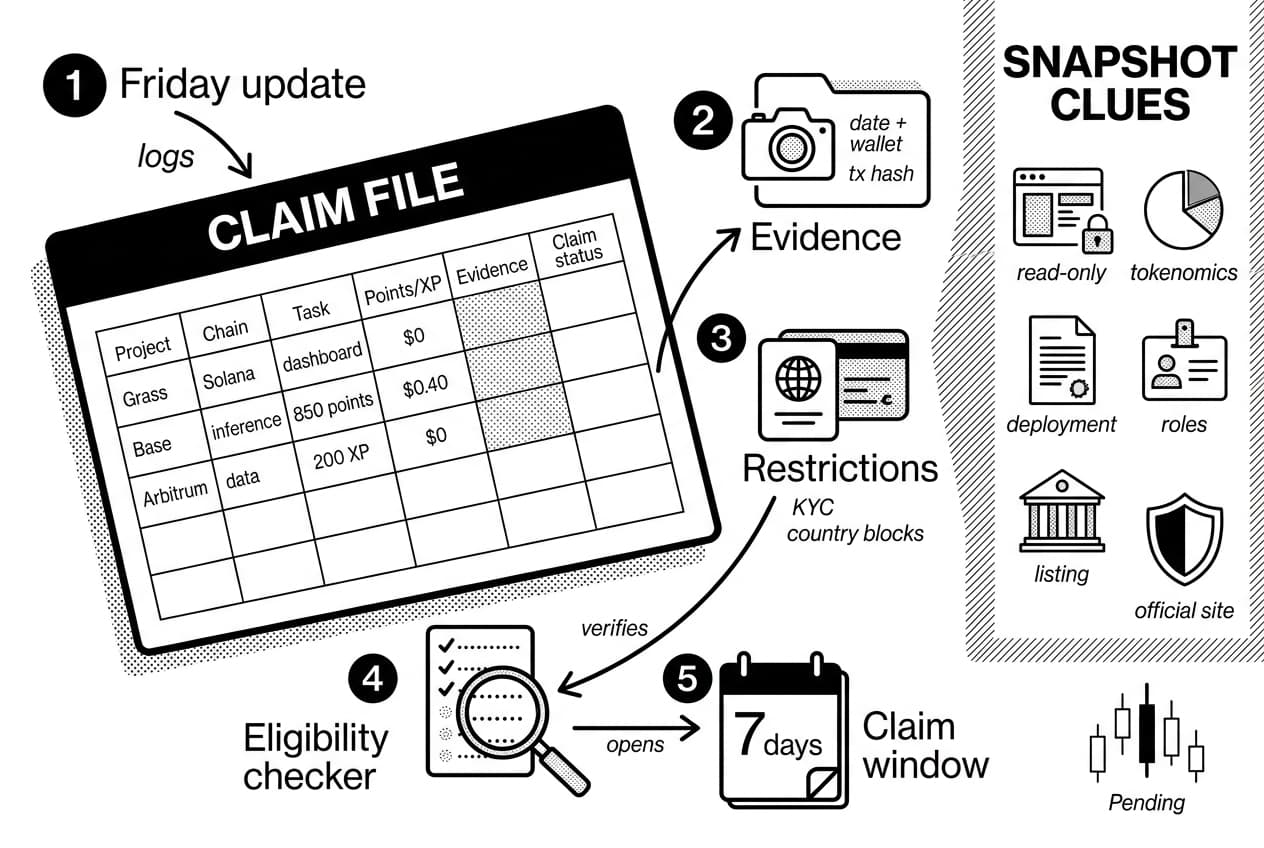
Tracking is what turns random activity into an auditable claim file. If a project opens a claim window for 7 days and you miss it, your previous work may be worthless.
Create a simple airdrop tracker
A spreadsheet is enough. Use one row per project and update it every Friday. Save screenshots in a folder named by date, project, and wallet address.
Project | Chain | Task | Points/XP | Cost | Evidence | Next reward | Claim status |
|---|---|---|---|---|---|---|---|
Grass | Solana | Bandwidth sharing | Dashboard points | $0 direct gas for earning | Dashboard screenshot | Check current season | Verify at official site |
Compute category candidate | Base | Inference test | 850 points | $0.40 gas estimate | Transaction hash | Possible snapshot | Pending |
Data category candidate | Arbitrum | Submit labeled data | 200 XP | $0 | Email and screenshot | Unknown | Watchlist only |
The evidence column matters most. If you have a transaction hash, paste it. If the action is off-chain, save a screenshot with the date visible.
Add a restriction column for KYC, country blocks, or wallet requirements. The Grass foundation has published claim-related notices, and you should always read current eligibility terms before assuming you can claim.
Watch for snapshot and claim clues
Common clues include a points dashboard turning read-only, a tokenomics post, a contract deployment, an eligibility checker, new role assignments, or official exchange listing notices. None of these guarantees a reward, but each one tells you to verify details.
Use only official channels. Fake accounts often post claim links within minutes of real news. Type the domain yourself or use a bookmark created before the claim rush.
Step 5: claim rewards safely, using grass airdrop lessons
Claim day is where beginners lose tokens. The task may take under 5 minutes, but you should move slowly. The safest farmers verify first, connect second, and sign last.
How do I claim my Grass airdrop? Type the official Grass URL yourself or open your saved bookmark, then compare it with verified Grass announcements. Connect only the eligible farming wallet, check allocation, read the wallet prompt, confirm the transaction, and save the hash. Never use Grass links from ads, direct messages, or unofficial groups.
Verify a claim page with the 3-source URL check
Before clicking “Connect wallet,” confirm the domain in three places: the official website, the verified social announcement, and the pinned community post. All three should match exactly. If one differs by even one character, stop.
Approval phishing is expensive for users. Chainalysis reported that approval phishing scammers stole at least $374.6 million from victims in 2023 (Chainalysis, Feb. 2024). That is why you should never rush a claim because a countdown timer says time is running out.
What to do after claiming
Save the claim transaction hash and add the token contract only from official documentation or a reputable market data page. Do not copy contract addresses from private messages, random comments, or paid ads.
Then decide whether to hold or sell based on your plan, not on panic. CoinGecko found that 46% of major airdrops reached their all-time high within the first 2 weeks (CoinGecko, Feb. 2024), so price behavior after launch can be fast and unforgiving.
Finally, revoke token approvals safely for permissions you no longer need.
Warning: Never enter your seed phrase on a claim page. No legitimate airdrop needs it. If any site asks for a recovery phrase, close the tab immediately and do not reconnect that wallet.
Step 6: calculate ROI, fees, taxes, and legal constraints
A claimed token is not profit until you subtract costs. Farming gets dangerous when you count rewards but ignore gas, bridge fees, tools, time, and taxes.
Estimate your real cost per campaign
Use this formula for every campaign:
Net return = token value at claim minus gas fees, bridge fees, paid tools, and time cost.
Cost type | Typical range | What to record |
|---|---|---|
Gas | $0.01 to $15 or more | Chain, transaction hash, and date |
Bridge fee | $2 to $20 or more | Bridge route and receipt |
Paid tools | $5 to $50 per month | Subscription invoice |
Time | Your hourly rate | Minutes spent per week |
Apply a 3-gate cost check before joining: cap your total fees, confirm there is visible contribution evidence, and make sure you can quit without losing more than you planned to spend.
Airdrops may be taxable
Warning: In many jurisdictions, receiving an airdrop may create taxable income when you gain control of the tokens. Selling later can create a separate capital gain or loss.
The IRS addressed airdrop income in revenue ruling 2023-14 (IRS, 2023). U.S. readers should record the date received, token amount, wallet address, and fair market value at receipt.
If you farm often, talk with a crypto tax accountant. Also check whether a project blocks your country, requires KYC, or restricts claims for legal reasons before you spend time or gas.
Frequently Asked Questions
- Does crypto airdrop make money?
- Airdrops can generate real income if the token lists at a meaningful price and you qualify for a meaningful allocation. However, rewards are never guaranteed. Factor in gas fees, time invested, taxes, and token volatility. Track your actual ROI instead of treating every airdrop as free money.
- What is the top 5 AI crypto?
- Top AI crypto projects shift constantly based on market cap, liquidity, active users, and revenue. Rather than relying on static lists, check live rankings and evaluate projects across categories like AI agents, decentralized compute, data networks, inference marketplaces, and zkML to find current leaders.
- How do I find a legit airdrop?
- Verify the official website, documentation, social accounts, funding history, and team transparency before participating. Confirm token status and smart contract links from official sources. Legitimate airdrops never ask for seed phrases, private keys, or unlimited approvals to unknown contracts. If something feels off, walk away.
- Are crypto airdrops legal in the US?
- Receiving airdrops is not automatically illegal in the US, but project restrictions, KYC requirements, sanctions rules, and securities concerns may affect your eligibility. Airdrops are also typically taxable as income. Keep detailed records of every drop you receive and consult a tax professional for your situation.
- How do I claim my Grass airdrop?
- Visit only the official Grass domain confirmed through their verified announcements. Connect your eligible wallet to the official claim page, check your allocation, and confirm the transaction. Never click claim links shared in Discord DMs, Telegram groups, or unofficial social posts, as these are commonly phishing attempts.
- Has the Grass airdrop ended?
- Earlier Grass claim windows and reward seasons may have already closed. Future seasons could carry different eligibility rules and timelines. Before assuming you can still claim, check the official Grass dashboard, foundation announcements, and the eligibility page directly for the most current June 2026 status.
- How much is one Grass token worth?
- The Grass token price changes continuously and should always be checked on live market data platforms, supported exchanges, or the official token page. Liquidity depth, exchange support, vesting schedules, and broader market conditions can all cause the price to move quickly in either direction.
- Will Grass tokens be rewarded via airdrop?
- Grass has previously distributed tokens to eligible participants through airdrop-style reward programs. Whether future seasons follow the same structure depends entirely on official program rules. Follow the Grass app, documentation, and verified social channels to stay updated on active seasons, eligibility requirements, and claim deadlines.
Sources
Author

Crypto analyst and blockchain educator with over 8 years of experience in the digital asset space. Former fintech consultant at a major Wall Street firm turned full-time crypto journalist. Specializes in DeFi, tokenomics, and blockchain technology. His writing breaks down complex cryptocurrency concepts into actionable insights for both beginners and seasoned investors.