Earn AI Crypto in 2026: Staking, Compute and Tasks Guide
Start here: what you can realistically earn from ai crypto
You earn ai crypto by giving an AI-focused network a scarce input it can verify: staked tokens for security, gpu compute for jobs, labeled data for model training, bug reports for better software, or votes that help decide protocol rules and budgets.
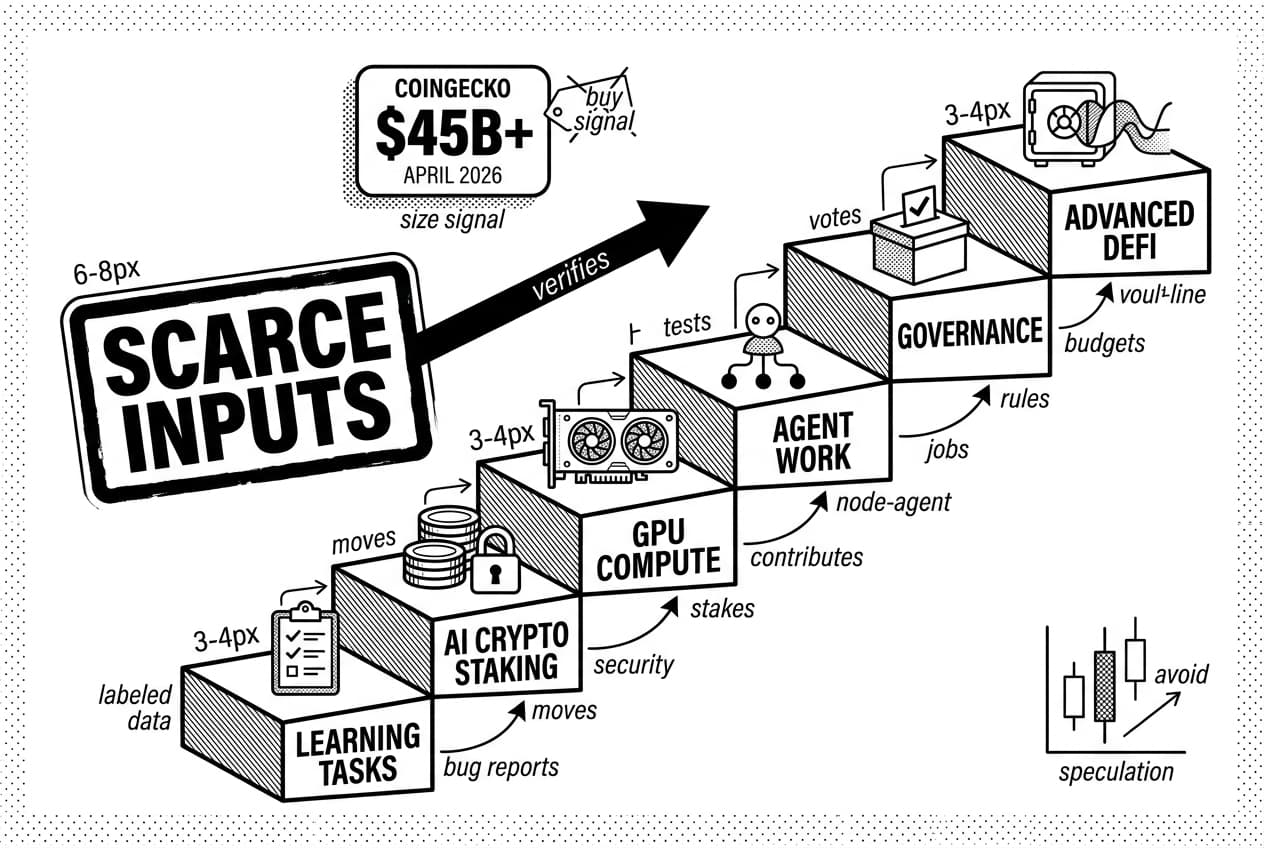
By the end of this guide, you will have a practical earning ladder for 2026. You will start with low-cost participation, move into ai crypto staking, and only then consider compute contribution, agent work, governance and advanced defi strategies.
The common pitch is that AI crypto income comes from trading bots, prompt tricks or buying the next AI token early. A safer edge is to sell inputs that networks can measure before price speculation enters the picture: compute, data, validation, security and governance participation.
What ai crypto means in 2026
AI crypto projects use tokens to pay people who support AI infrastructure. That can include decentralized compute, data marketplaces, model testing, agent tooling, storage and governance systems that decide how network budgets are spent.
The category is no longer tiny. AI-focused crypto tokens were tracked as a multi-billion-dollar sector, with category value moving above $45 billion on coingecko, april 2026. Use that number as a size signal, not as a buy signal, because category value can move quickly.
What it is not: buying a token with AI in the name, asking a chatbot to choose coins, or paying for a black-box trading bot. Those are speculation strategies. The methods below pay you for a visible action you can track.
The four-bucket earning framework
Use the four-bucket earning framework to classify any new opportunity before you connect a wallet. If an offer does not fit one of these buckets, slow down and verify what the network is actually paying for.
bucket | what you provide | example methods | typical entry barrier |
|---|---|---|---|
staking | token capital and a lockup period | native staking, delegated staking | low: tokens only |
compute and storage | gpu, cpu or disk capacity | render network, akash network, filecoin-style storage | medium: hardware and setup time |
data and model tasks | time, attention and task quality | labeling, model review, bug reports | low: skills and a wallet |
participation | usage, feedback, votes and community work | airdrops, testnets, governance | very low: mostly time |
Most beginners should start in the participation bucket. It costs little, teaches wallet safety, and builds the judgment you need before you put larger sums into ai crypto staking or hardware into compute jobs.
Our 30-day starter model for information gain
The table below is a beginner worksheet model, not a promise. It shows how you can compare routes using dated public benchmarks before you risk money.
route | starter test | public benchmark to check | go or stop rule |
|---|---|---|---|
staking | stake the minimum test amount for 30 days | AI token staking yield examples ranged from 6% to 18% apy in coinmarketcap education data, q1 2026 | continue only if net rewards exceed claim and exit fees |
gpu compute | run one worker node for 7 days | the average u.s. residential electricity price was 16.41 cents per kWh in eia electricity data, october 2025 | stop if power cost plus downtime exceeds rewards |
participation | complete 10 verified tasks across one project | ethereum gas often sat around $0.50 to $4.00 per simple transaction on etherscan gas tracker, march 2026 | continue only if task value is higher than fees and time cost |
What you'll need before you try to earn ai crypto
Before you buy a token or click a staking button, set up your security and cost tracking. Skipping this setup is how beginners lose funds to phishing, surprise gas fees or lockups they did not understand.
Set up a secure wallet and exchange account
Create a dedicated wallet for experiments, not the wallet that holds your long-term assets. Write the seed phrase on paper and store it offline. Do not screenshot it, upload it to cloud notes or paste it into a chat app.
A hardware wallet can keep private keys offline. Andreas Antonopoulos, a long-time crypto educator, has repeatedly taught that self-custody starts with understanding private keys before chasing yield. Read why self-custody matters for crypto earnings before connecting a wallet to a new AI protocol.
Turn on two-factor authentication for exchange accounts with an authenticator app, not sms. If a platform supports withdrawal address allowlisting, enable it and wait through the security delay before moving funds.
Budget for fees, lockups and hardware costs
Gas fees, unstaking delays and electricity costs can erase headline returns. Ethereum transaction costs often showed simple-transfer ranges near $0.50 to $4.00 on etherscan gas tracker, march 2026, while more complex staking or defi actions can cost more during congestion.
Unstaking periods also matter. Several proof-of-stake and delegated systems used 7 to 28 day unbonding windows in public dashboards tracked by defillama, may 2026. During that period, you may not be able to sell if the token falls.
cost type | working range to test | who it affects |
|---|---|---|
gas per transaction | $0.50 to $4.00 on simple transfers, higher for complex actions | stakers and task users |
unstaking delay | 7 to 28 days on many delegated systems | staking users |
electricity | 16.41 cents per kWh average in u.s. residential data | gpu contributors |
cloud server rental | $20 to $80 per month for small nodes, before bandwidth | node and agent operators |
Warning: do not confuse earning with guaranteed income. A 20% apy can still lose money if the token falls 40% before you can exit. Treat any fixed daily return from an AI crypto platform as a red flag.
Step 1: choose the right ai crypto earning route
Start by matching the route to what you already have. You may have capital, hardware, time, technical skill or a mix of all four. The right first step is the one you can test cheaply and measure cleanly.
Match the method to your resources
If you already hold AI tokens, staking is the simplest test. If you own a modern gpu that sits idle, compute rental may be worth a small trial. If you have more time than capital, data tasks, testnets and governance participation are safer starting points.
Beginners who start with staking or task work usually make fewer costly mistakes than users who jump straight into liquidity pools or trading bots. You learn wallet approvals, fees, confirmations and recordkeeping before the stakes get larger.
Compare effort, risk and payout timing
method | capital needed | skill level | payout timing | main risk |
|---|---|---|---|---|
ai crypto staking | $20 to $500 or more | beginner | daily to weekly | token price drop, slashing, lockup |
gpu compute rental | $300 to $2,000 or more in hardware | intermediate | weekly to monthly | low job demand, power cost, downtime |
data tasks and labeling | none to low | beginner | per task or weekly | low pay, rejected work, rule changes |
airdrops and testnets | none to minimal | beginner | one-time and unpredictable | no payout, sybil filters, phishing |
governance | $100 to $1,000 or more | intermediate | per epoch or proposal | vote lockups and poor decisions |
liquidity incentives | $200 to $5,000 or more | advanced | continuous | impermanent loss and contract bugs |
AI-assisted trading | $100 to $10,000 or more | advanced | continuous | market volatility and bot errors |
Liquidity incentives can pay continuously, but the risk is harder to understand than staking. Hayden Adams, founder of Uniswap Labs, is a useful reference point here because automated market maker design shows why pool earnings and price movement must be evaluated together. When you are ready, compare options with our guide to defi apps for lending, swaps and earning.
Avoid over-relying on AI trading bots
AI tools can help with research, journaling and checklist building. They do not remove market risk. A bot that worked in one market regime can fail when liquidity, volatility or news flow changes.
Use a bot only after you can explain what it buys, what it sells, where stop losses sit and what happens if an exchange connection fails. If a tool promises high returns with no drawdown, skip it and focus on measurable routes first.
Step 2: stake ai crypto tokens safely
Staking is usually the first capital-based method beginners try. You lock or delegate tokens, support the network and receive rewards. The main risks are token price moves, validator performance, lockups and fees.
Check the staking rules before you deposit
- apr versus apy: apr does not include compounding. apy does. Compare like with like.
- reward token: check whether rewards are paid in the same token or in a separate emissions token.
- minimum deposit: confirm the minimum before you move funds to the wallet.
- unstaking delay: many systems use 7 to 28 day unbonding windows, as shown in public staking dashboards tracked by defillama, may 2026.
- auto-compounding: check whether rewards reinvest automatically or require a claim transaction.
- slashing risk: a validator with poor uptime can cost you part of your stake.
- real yield: ask whether rewards come from network fees or from newly minted tokens.
High apy is not enough. If rewards are printed faster than real demand grows, your token balance can rise while your dollar value falls.
Stake through the official app
- Verify the official site by checking the project site, pinned social profile, coin tracker listing and github docs. Type the url manually if needed.
- Connect a dedicated wallet that holds only the amount you plan to test.
- Open the stake or delegate tab inside the official app dashboard. Do not use a link from a direct message.
- Choose a validator or pool with high uptime, a public track record and clear commission terms.
- Enter the amount you want to test. Start with the minimum that still makes the fee worthwhile.
- Review lockup and fees on the confirmation screen. Read the unstaking date before you approve.
- Confirm in your wallet by clicking the confirm button only after the address and network match.
- Monitor rewards for 24 to 48 hours and save the transaction hash in your tracking sheet.
Andreas Antonopoulos teaches verification as a basic self-custody habit. Apply that habit here: verify the url, verify the network, verify the approval, then confirm.
Pro tip: test with a small amount first
Pro tip: deposit the smallest useful amount first. Wait for confirmation, check the rewards screen after 24 hours, and test the claim flow if fees are low enough. Scale only after the process works end to end.
Earn ai crypto rewards gradually and you keep control. Chase a high apy without reading the terms and a 14-day lockup can turn a small dip into a forced hold.
Step 3: rent your gpu or compute power to AI networks
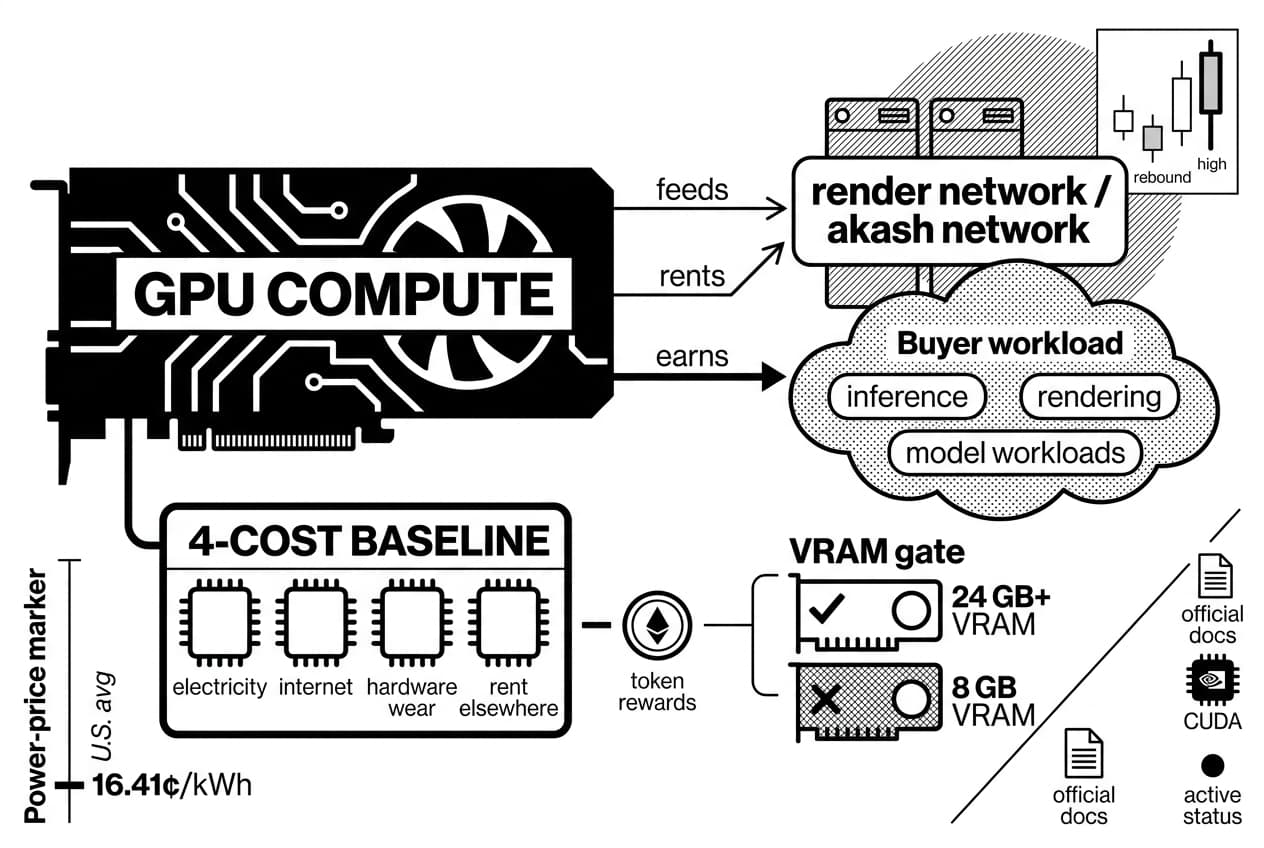
After staking, the next rung is supplying compute. Networks such as render network, akash network and other decentralized compute markets connect hardware owners with buyers that need gpu time for inference, rendering or model workloads.
Check whether your hardware is profitable
Use the 4-cost baseline: token rewards at the current market price minus electricity, internet overhead, hardware wear and the alternative value of renting or using the machine elsewhere.
Modern cards with 24 gb or more vram usually qualify for more AI workloads than older 8 gb cards. Before installing provider software, check the network docs for minimum vram, cuda version, operating system and uptime rules.
If your power price is near or above the 16.41 cents per kWh u.s. residential average reported by eia electricity data, october 2025, run a small trial before committing a full-time machine. A mid-tier gpu can lose money if job demand is low.
Install the node or provider software carefully
- Download from official docs only. Avoid installers posted in chat rooms.
- Verify system requirements for operating system, drivers, ram, storage and gpu memory.
- Create the provider account or api key in the official dashboard if the network requires one.
- Connect a compatible wallet and compare the saved payout address character by character.
- Set resource limits for cpu, ram and gpu use so the worker does not consume your whole machine.
- Start the worker and confirm that the dashboard shows active status within the expected setup window.
For platform-specific setup, use our guide on how to rent GPU power to AI crypto networks. It walks through provider setup for several compute networks.
Warning: monitor uptime and payout thresholds
Warning: first-time providers often lose earnings to blocked ports, a wrong payout address or a minimum payout threshold. Many compute markets reward high uptime. If your node disconnects at night, your expected payout can fall sharply.
During the first week, check the provider dashboard daily. Confirm active status, at least one completed job and the exact wallet address. After the setup proves stable, weekly checks may be enough.
Step 4: complete data, model and AI agent tasks
You do not need a large token balance or a gpu rack to participate. Data labeling, prompt review, model evaluation, bug reports and agent testing can all pay small rewards while teaching you how AI protocols work.
Find legitimate task marketplaces and bounty boards
Start with official project sources. Check the website, docs, forum and verified community channels before clicking a task link. Quest platforms can help, but always cross-check the task from the project side.
Social media posts are not enough proof. Scam task links can ask for wallet approvals, fake claims or malicious downloads. If a task requires a seed phrase, private key or unlimited approval, leave immediately.
If you want to go deeper into agent work, read our comparison of AI agent tokens compared. Focus on ecosystems with active docs, active forums and visible contributor programs.
Submit work that can be verified
Keep a proof folder for every task. Save screenshots, task ids, timestamps, wallet addresses, transaction hashes, commit links and short notes about what you submitted.
This evidence log protects you if a project manually reviews work before paying rewards. It also helps you build a contributor record. If you later want to build an AI agent crypto project, a history of useful testing and bug reports can support grant or governance applications.
Use AI tools as assistants, not shortcuts
Chatbots can summarize docs, draft a bug report or help structure test cases. You still need to verify every claim, link and output before submitting work.
Low-effort copied submissions can damage your reputation. Treat task work like a portfolio, not a faucet. Quality, timestamps and clear proof make you more likely to be paid and invited back.
Step 5: participate in airdrops, testnets and governance
Participation-based rewards let you earn possible upside by using products, testing features and helping protocols make decisions. These rewards are never guaranteed, but they can be a sensible beginner route because the cash cost is low.
Use the product before you expect rewards
Projects often filter out low-effort wallets. Use official apps, bridge only small amounts, complete listed missions and leave useful feedback. Stay active over multiple weeks instead of doing one transaction and disappearing.
Our AI crypto airdrop farming guide covers project selection in more detail. The safest rule is simple: never pay a large upfront fee for a possible future token.
Document your participation history
Keep a sheet with project name, wallet used, start date, task completed, transaction hash, forum name and reward status. Update it after every session. This takes minutes and prevents confusion when snapshot rules appear months later.
Warning: airdrops are never guaranteed
Warning: projects can change eligibility rules, exclude wallets that look like sybil farming, delay token launches or cancel rewards. If a testnet asks you to bridge meaningful capital or pay steep fees upfront, treat it as a red flag.
Airdrop farming is not free money. Gas, time and attention are real costs. If a project never launches, those costs are still yours.
Step 6: protect profits by tracking fees, taxes and security
Earning from AI crypto is only half the job. Keeping the earnings requires net-profit tracking, approval cleanup and tax records from day one.
Calculate net yield, not headline apy
A 40% apy dashboard can look attractive until you subtract fees, price movement and taxes. Use this checklist every month:
- Rewards earned: the gross token amount received.
- Token price change: the gain or loss while you held the token.
- Gas fees: stake, claim, bridge and unstake costs.
- Withdrawal fees: protocol or exchange exit costs.
- Hardware or cloud costs: gpu power, depreciation, bandwidth or server rental.
- Taxes: income and gains rules in your location.
- Security costs: hardware wallet, backup tools and monitoring.
Do not count paper gains as spendable profit until you exit. Historical price data from coinmarketcap, 2022 to 2023 shows how quickly token prices can reverse during bear markets.
Revoke risky approvals and separate wallets
Every protocol interaction can leave token approvals behind. Keep three wallet types: one small hot wallet for experiments, one wallet for active staking and one hardware wallet for long-term holdings.
After testing a new protocol, revoke risky token approvals with a trusted approval checker. A single unlimited approval on a compromised contract can drain a wallet.
Keep tax records from day one
Staking rewards, airdrops, bounties and trading gains may be taxable. The tax authority in the u.s. stated that staking rewards can be ordinary income when received in irs virtual currency guidance, 2023.
Export csv files from wallets, exchanges and protocols at least quarterly. If activity grows complex, working with a crypto tax accountant can cost less than fixing records later.
Summary: build your 2026 AI crypto earning plan
Your safest plan is a ladder: learn with participation tasks, test ai crypto staking with a small amount, then consider compute or advanced defi only after you can measure net profit.
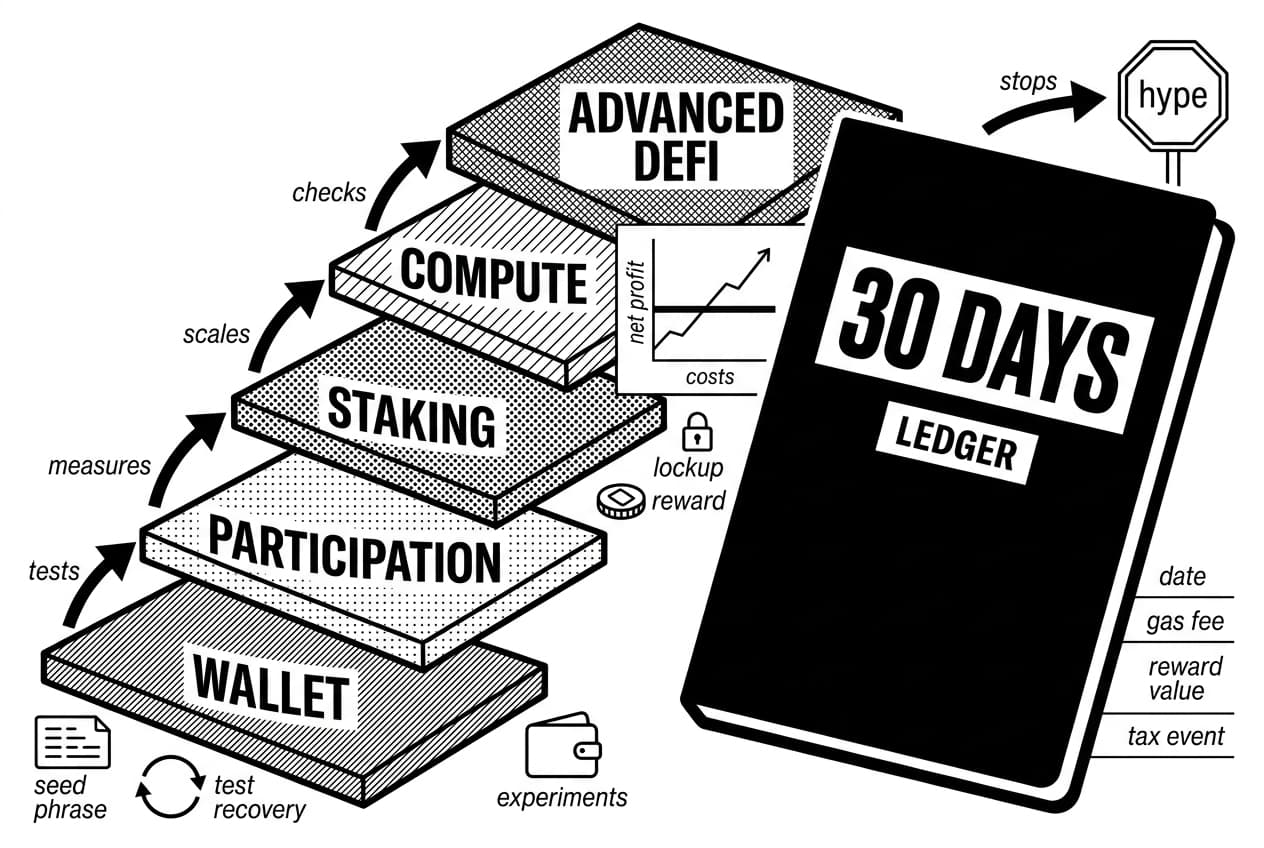
Use one method for 30 days. Log every fee, reward, lockup and mistake. Scale only when the numbers are positive after costs, and stop quickly when the route depends on hype rather than measurable demand.
Your next three actions
- Secure a non-custodial wallet. Write the seed phrase on paper, test recovery and use a dedicated wallet for experiments.
- Choose staking or participation first. Pick one route, not three. Your goal in week one is clean execution, not maximum yield.
- Create a tracking sheet. Record date, token, amount, gas fee, lockup end date, reward value and possible tax event. Review it on day 30.
The beginners who last treat AI crypto earning like a small business ledger. They test, measure, protect wallets and scale only what works.
Frequently Asked Questions
- How do you earn crypto with AI?
- You can earn AI crypto by staking AI-focused tokens, contributing GPU computing power, completing data labeling or model-testing tasks, participating in governance votes, and joining protocol airdrops. Payouts vary widely by platform and market conditions. Always verify official project links before connecting your wallet to any site.
- What is AI staking?
- AI staking means locking or delegating tokens from an AI-focused blockchain to support validators, secure the network, or access protocol rewards. Returns depend on APY, lockup periods, and inflation rates. If token prices fall faster than rewards accumulate, your real-world gains can still turn negative despite earning staking payouts.
- What is the most profitable crypto staking?
- The highest APY is not automatically the most profitable option. Real profitability depends on token inflation, lockup duration, validator reliability, liquidity, and whether the protocol is sustainable long term. A 200% APY on an inflating token can be worth less than a modest 8% yield on a stable, liquid asset.
- Can you make $100 a day with crypto?
- It is possible for experienced validators, GPU operators, active traders, or large stakers, but it typically requires meaningful capital, technical skills, or specialized hardware. Beginners are better served by tracking small, repeatable earnings first and always calculating net profit after gas fees, taxes, and operating costs before celebrating any figure.
- How do you make $1,000 a day with AI crypto?
- Generating $1,000 daily from AI crypto realistically requires enterprise-grade compute infrastructure, substantial staked capital, a proven trading edge, or a business-level service with paying clients. Anyone promising a fixed $1,000 daily income from AI with little effort is describing a scheme, not a legitimate strategy. Treat such claims with serious skepticism.
- How do you earn up to $2,000 when you buy $50 in crypto?
- Offers like this are almost always promotional claims tied to referral programs, trading volume requirements, raffle entries, or strict eligibility conditions most users never meet. Before depositing anything, read the full terms, verify the platform's legitimacy, and never fund an account solely because a bonus headline sounds attractive.
Sources
Author

Crypto analyst and blockchain educator with over 8 years of experience in the digital asset space. Former fintech consultant at a major Wall Street firm turned full-time crypto journalist. Specializes in DeFi, tokenomics, and blockchain technology. His writing breaks down complex cryptocurrency concepts into actionable insights for both beginners and seasoned investors.