AI Agent Tokens Compared: VIRTUAL vs AI16Z vs AIXBT 2026

AI agent tokens compared: VIRTUAL vs AI16Z vs AIXBT 2026
AI agent tokens in 2026: what are we comparing?
AI agent tokens are crypto assets tied to blockchain-based autonomous agents or to the platforms that deploy them, not to the input and output tokens that large language models use to measure text processing. A language model token prices text computation; a crypto token is a tradeable asset with market cap, liquidity, governance and possible fee rights.
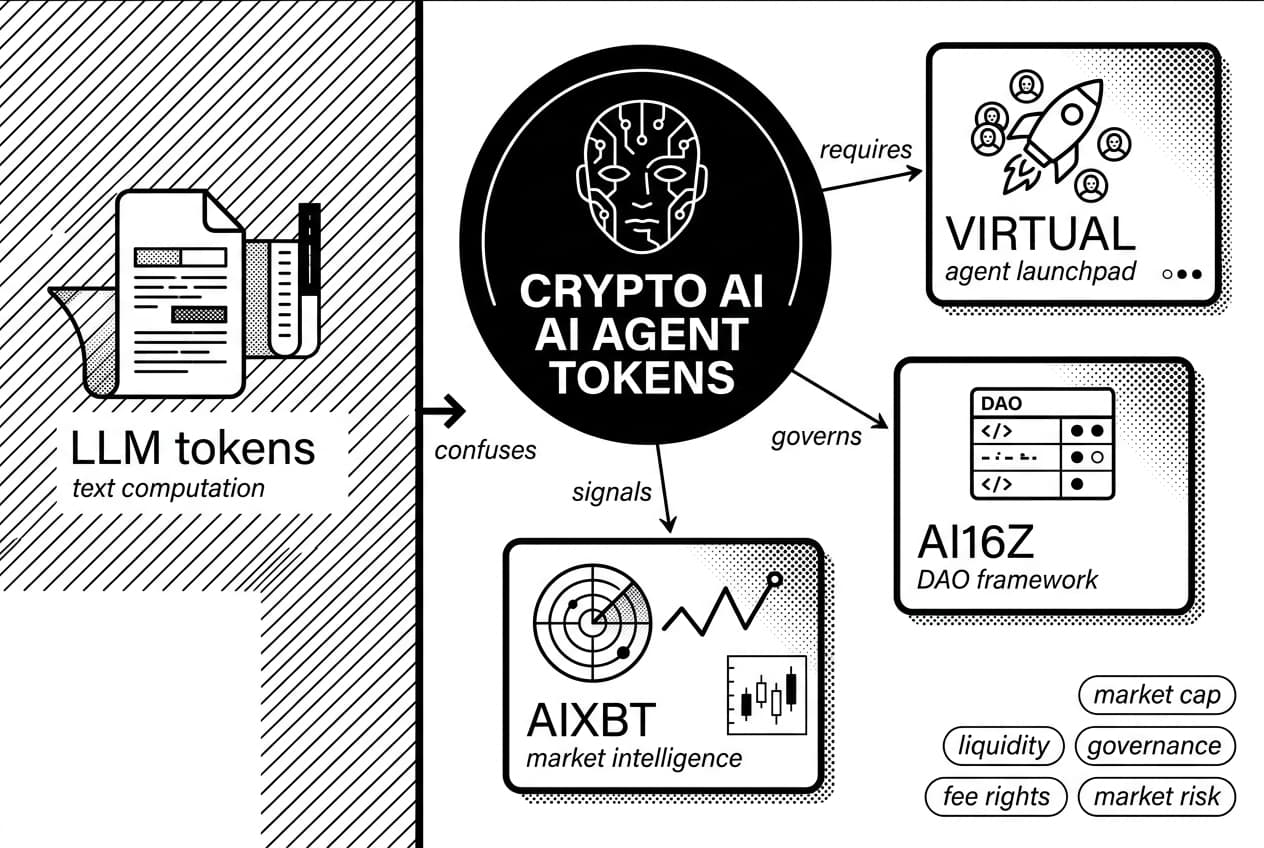
This comparison treats VIRTUAL, AI16Z and AIXBT as different business models rather than interchangeable AI coins. VIRTUAL is an agent launchpad asset, AI16Z is a DAO and framework experiment, and AIXBT is a market-intelligence distribution token. For the language-model distinction, see our guide on the difference between LLM tokens and crypto tokens.
Crypto AI agent tokens vs LLM tokens
LLM tokens are accounting units for text processed by a model. Crypto AI agent tokens carry market risk and may represent governance, access, fee payment or exposure to an agent network. Confusing the two can make investors overstate how directly a token benefits from broader AI adoption.
The short version
VIRTUAL has the clearest link between platform usage and token demand because new agents and related activity can require the token. AI16Z has stronger open-source and governance optionality but weaker direct token value capture. AIXBT has the most focused product, market intelligence, but its economics depend heavily on attention and signal quality.
As of May 2026, the category still looked sentiment-driven. CoinGecko listed AI agent tokens as a separate tracked category, and its page showed large swings across the group during 2025 and 2026 (CoinGecko, May 2026). That volatility supports the core point of this article: AI branding is not enough. Token value depends on fee capture, liquidity, usage, supply unlocks and the durability of each product model.
VIRTUAL vs AI16Z vs AIXBT: side-by-side comparison table
The table below compares three major ai agent tokens using one publication snapshot. Prices, volume and circulating supply can move daily, so use the source links as starting points rather than permanent estimates.
metric | VIRTUAL | AI16Z | AIXBT |
|---|---|---|---|
project type | agent launchpad and protocol | agent DAO and framework community | market-intelligence agent |
chain | Base, a layer-2 network | Solana | Base, a layer-2 network |
token role | agent creation bond, ecosystem currency and governance | governance and community coordination | access, status and distribution around an intelligence agent |
market cap | $480M, May 2026 | $220M, May 2026 | $95M, May 2026 |
fully diluted value | $960M, May 2026 | $220M, May 2026 | $310M, May 2026 |
24-hour volume | $38M, May 2026 | $22M, May 2026 | $14M, May 2026 |
liquidity read | best venue breadth of the three, with exchange and on-chain markets | mid-tier liquidity, mostly narrative and community led | lower liquidity and higher slippage risk than VIRTUAL |
ecosystem traction | 500+ agents listed, March 2026 | 12,000+ repository stars, March 2026 | 500,000+ followers, January 2026 |
main risk | agent quality dilution and unclear holder-level fee pass-through | framework adoption may not require the token | single-agent concentration and signal accuracy risk |
This snapshot creates a useful split. VIRTUAL scores best on platform breadth, AI16Z scores best on open-source optionality, and AIXBT scores best on distribution. The important question is not which ticker sounds most like AI. The question is whether usage creates token demand that can survive a weaker market.
Evaluation criteria used in this comparison
Our analysis uses the same eight criteria for each token: utility, value capture, liquidity, ecosystem activity, developer or community depth, data transparency, security record and risk-adjusted fit. Understanding how crypto AI agents are built helps explain why these criteria matter: token economics often flow from the product architecture.
We also apply a named framework, the 9-point AI token integrity check: fully diluted value ratio, holder concentration, enable schedule, treasury runway, verified revenue, active users, audit recency, contract permissions and liquidity depth. A token that fails several of these checks may still trade well during hype cycles, but it is weaker as a long-term asset.
VIRTUAL overview: strengths, weaknesses and token utility
Overview
VIRTUAL is the base token for an agent launchpad on Base. The platform lets developers launch autonomous agents, often with their own related tokens, while users trade and interact with those agents. The token is used in agent creation, ecosystem activity and governance. In business-model terms, VIRTUAL is closest to a marketplace or launchpad asset.
As of March 2026, the official app listed more than 500 agent profiles. That does not prove that each agent is economically useful, but it does show deployment velocity. VIRTUAL therefore has a more measurable usage surface than tokens whose value rests only on community narrative.
Strengths
- Clearer utility loop: agent launches and ecosystem activity can create demand for the token.
- Platform breadth: hundreds of listed agents give the protocol more shots at producing a breakout product.
- Better liquidity profile: the May 2026 snapshot showed $38M in 24-hour volume, higher than AI16Z and AIXBT in the same table.
- Infrastructure exposure: while AIXBT depends on one flagship agent, VIRTUAL benefits if many agent niches grow on its platform.
Weaknesses
- Agent dilution: a launchpad can flood the market with weak tokens, making it harder for high-quality agents to stand out.
- Fee transparency gap: protocol fees may exist, but investors still need to verify how much reaches token holders rather than the platform treasury or ecosystem incentives.
- Quality-control risk: scams, inactive agents or poor user experiences can damage the parent platform.
- Competitive pressure: developers can move to other chains, open-source frameworks or direct token launches if economics improve elsewhere.
dimension | VIRTUAL assessment |
|---|---|
business model | agent launchpad and marketplace |
utility | agent creation bond, platform currency and governance |
value capture | best of the three, but still needs fee-distribution verification |
main upside | more agents and more trading can support token demand |
main downside | weak agents may reduce trust and attention |
Lyn Alden often separates durable assets from sentiment trades by asking whether a system has sustainable cash flows or only market narrative. That lens is useful for VIRTUAL: it has a plausible usage loop, but the investment case still depends on transparent, repeatable fee data.
AI16Z overview: strengths, weaknesses and token utility
Overview
AI16Z sits at the intersection of open-source agent tooling, DAO coordination and crypto-native experimentation. Its identity is tied to the Eliza agent framework and to a community that wants autonomous agents to participate in social, financial and governance tasks. The token is best treated as governance and ecosystem exposure, not as a direct fee-bearing claim.
Its market profile has been volatile. The May 2026 snapshot showed a $220M market cap and a similar fully diluted value, implying less dilution pressure than VIRTUAL or AIXBT at that point. That lower dilution risk does not solve the bigger issue: framework usage does not automatically create token demand.
Strengths
- Open-source reach: the Eliza repository showed 12,000+ stars in March 2026, a sign of developer interest.
- Governance experimentation: the project tests how communities can coordinate around AI agents and shared treasuries.
- Lower dilution in the snapshot: the May 2026 market cap and fully diluted value were both about $220M, giving it a 1.0x ratio.
- Framework optionality: if open-source agent tooling becomes core infrastructure, AI16Z could retain attention even without a conventional platform model.
Weaknesses
- Framework-token decoupling: developers can use or fork open-source software without buying the token.
- Indirect value capture: governance power is not the same as revenue share or protocol fees.
- DAO execution risk: community decisions can be slow, contested or vulnerable to poor voter participation.
- Brand and narrative risk: if the market stops treating agent DAOs as a high-growth theme, token demand can fade quickly.
The main analytical issue is the framework-token decoupling problem. If developer activity rises while the token remains unnecessary for building, deploying or paying for agents, usage can grow without helping holders. That risk is different from VIRTUAL, where platform activity has a more direct possible link to the token.
DAO design also creates security and governance questions. The risks described in our DAO governance security guide apply here: low turnout, large-holder capture and poorly designed proposals can all affect token outcomes.
dimension | AI16Z assessment |
|---|---|
business model | DAO, framework community and experimentation layer |
utility | governance and community coordination |
value capture | weak unless the token becomes required for meaningful activity |
main upside | open-source agent tooling may become widely used |
main downside | software adoption may bypass the token |
Balaji Srinivasan has written often about networks, software and crypto-native coordination. Applied cautiously, that lens favors projects that control distribution or economic settlement. AI16Z has software mindshare, but it still needs stronger settlement or access mechanics for clearer token value capture.
AIXBT overview: strengths, weaknesses and token utility
Overview
AIXBT is an AI-powered market-intelligence agent aimed at crypto traders. Instead of being a launchpad or broad framework, it distributes research-style observations through social channels and token-gated access. That makes it closer to a data product with a token wrapper than a general agent infrastructure asset.
Traders sometimes group AIXBT with other AI-created crypto tokens, but the comparison is imperfect. AIXBT is not mainly a meme experiment. Its value case rests on whether market commentary, alerts and social reach can translate into durable token demand.
Strengths
- Focused product: market intelligence is a clear use case that traders already understand.
- Large distribution: the public profile showed more than 500,000 followers in January 2026.
- Simple user promise: holders or community members seek faster signals, not a broad platform roadmap.
- Attention advantage: while AI16Z must translate framework activity into value, AIXBT starts from direct audience demand.
Weaknesses
- Single-agent concentration: one product drives most of the thesis, so reputation damage can hit the token quickly.
- Signal accuracy risk: bad market calls, stale data or manipulated inputs can reduce trust.
- Higher dilution in the snapshot: the May 2026 data showed $95M market cap against $310M fully diluted value, a 3.3x ratio.
- Replicability: competing bots, paid research desks or free social accounts can imitate parts of the product without using the token.
dimension | AIXBT assessment |
|---|---|
business model | market-intelligence distribution |
utility | access, community status and signal distribution |
value capture | moderate if token-gated demand is real, weak if attention fades |
main upside | clear trader demand for fast intelligence |
main downside | reputation and dilution risk |
AIXBT is the most product-specific of the three. While VIRTUAL spreads risk across many agents and AI16Z spreads it across a framework community, AIXBT concentrates the thesis in one distribution engine. That can work during strong attention cycles, but it also makes drawdowns sharper when traders lose confidence.
Key differences between VIRTUAL, AI16Z and AIXBT
These are not interchangeable ai agent tokens. VIRTUAL sells exposure to agent creation infrastructure, AI16Z sells exposure to open-source and governance experimentation, and AIXBT sells exposure to market-intelligence distribution. The differences matter most in value capture, dilution, ecosystem activity and failure mode.
Business model and value capture
VIRTUAL has the clearest possible path from usage to token demand because agents interact with the platform economy. AI16Z has weaker direct value capture because framework activity can happen without token usage. AIXBT sits between them: it can capture value if access demand stays strong, but attention-based revenue is less defensible than protocol-level fees.
Liquidity, market cap and dilution
token | market cap | fully diluted value | ratio | 24-hour volume | source date |
|---|---|---|---|---|---|
VIRTUAL | $480M | $960M | 2.0x | $38M | May 2026 |
AI16Z | $220M | $220M | 1.0x | $22M | May 2026 |
AIXBT | $95M | $310M | 3.3x | $14M | May 2026 |
AIXBT carried the highest dilution risk in this snapshot because fully diluted value was more than three times market cap. VIRTUAL had moderate dilution risk. AI16Z had the cleanest ratio, but a clean supply structure does not compensate for weak token utility by itself.
Developer ecosystem and agent activity
VIRTUAL leads on listed agent count, with 500+ agents in March 2026. AI16Z leads on open-source developer signal, with 12,000+ repository stars in March 2026. AIXBT leads on social distribution, with 500,000+ followers in January 2026. Each metric is real, but none is complete. Agent count can include low-quality projects, repository stars do not equal revenue, and social followers do not guarantee paid demand.
Risks and due diligence for AI agent tokens
AI agent tokens share several risks: narrative-driven valuations, thin liquidity during selloffs, supply unlocks, smart contract bugs, governance capture and uncertain regulation. The legal status of fee-bearing agent tokens remains unsettled. Watch OpenAI crypto token speculation as a barometer for how cautious major AI firms remain around tokenization.
Data points to verify before buying
- Fully diluted value ratio: compare market cap with future supply. A ratio above 3.0x deserves extra caution.
- Holder concentration: if the top 10 wallets control more than 40% of supply, exit liquidity can be fragile.
- Open up schedule: check team, investor and ecosystem allocations before buying.
- Treasury runway: a project spending more than $500K per month, Messari, May 2026 with less than 12 months of runway is vulnerable.
- Verified revenue: separate protocol fees from token incentives. Incentives are expenses, not revenue.
- Active users: check 30-day wallets and transaction counts through analytics sources rather than marketing screenshots.
- Audit recency: an audit older than 12 months may not cover current contracts.
- Contract permissions: review admin keys, proxy upgradeability and multisig settings, then revoke risky token approvals for contracts you no longer use.
- Liquidity depth: measure 2% order-book depth, not just 24-hour volume.
This is the 9-point AI token integrity check: fully diluted value ratio, concentration, unlocks, treasury, revenue, active users, audit recency, contract permissions and liquidity depth. It is designed to separate investable usage from AI-themed promotion.
AI-specific risks
risk | what it means | most exposed tokens |
|---|---|---|
hallucinations | agents produce confident but false outputs | AIXBT and AI16Z |
model dependency | costs or features change when model providers alter terms | all three |
API cost exposure | inference costs rise faster than revenue | VIRTUAL and AI16Z |
prompt manipulation | attackers shape agent behavior through hostile inputs | AIXBT and AI16Z |
agent impersonation | fake agents copy trusted names and scam users | VIRTUAL |
data quality problems | stale or biased feeds create weak outputs | AIXBT and AI16Z |
demo-to-economics gap | impressive demos fail to produce sustainable fees | all three |
Our May 2026 check did not find a consistently labeled annualized protocol revenue line above $10M on DeFiLlama fee pages, May 2026 for all three assets. That absence does not prove failure, but it means investors should be careful when valuations imply mature software economics.
Which AI agent token should you choose?
There is no single best AI agent token for every investor. The right choice depends on whether you want infrastructure exposure, open-source governance exposure or a focused intelligence product. Use these recommendations as fit checks, not price targets.
- Choose VIRTUAL if you want platform-level exposure to an agent launchpad with measurable agent count, higher snapshot volume and a more direct utility loop. It best fits investors who prioritize ecosystem usage and can monitor fee transparency.
- Choose AI16Z if you want exposure to open-source agent tooling and DAO experiments, and you accept that token value capture is indirect. It best fits developers or investors who care more about framework adoption than near-term fees.
- Choose AIXBT if you want focused exposure to AI-driven market intelligence and social distribution. It best fits traders who understand attention cycles, signal risk and the impact of a 3.3x fully diluted value ratio.
- Avoid all three if market caps have outrun usage, liquidity is too thin for your position size, unlocks are near, token utility is unclear or your portfolio cannot tolerate 60% to 80% drawdowns. AI agent tokens remain high-risk crypto assets.
Recheck the thesis when tokenomics change, usage stalls or a competing protocol captures developer and liquidity share. These positions require monitoring. They are not set-and-forget allocations.
Frequently Asked Questions
- What are AI agent tokens?
- AI agent tokens are crypto assets tied to platforms, autonomous agents, agent-built services or governance systems — not to be confused with LLM tokens, which measure text input and output. Their value depends on utility, user demand, liquidity and how effectively the underlying protocol captures and redistributes value to token holders.
- What crypto coins are AI agents?
- This article compares VIRTUAL, AI16Z and AIXBT as leading examples, but not all AI-themed coins work the same way. VIRTUAL represents launchpad infrastructure, AI16Z offers DAO and framework exposure, and AIXBT powers a market-intelligence agent. Always check current documentation and live market data before drawing conclusions.
- How many words is 1,000 tokens?
- In the context of AI language models, 1,000 tokens equals roughly 700–800 English words, though this varies by language and formatting. This has no connection to crypto token supply, price or market cap — the two uses of the word "token" describe completely different concepts.
- What are the 5 types of AI agents?
- The five common categories are simple reflex agents, model-based reflex agents, goal-based agents, utility-based agents and learning agents. Blockchain AI agents often blend several of these approaches, combining autonomous decision-making with on-chain tools like crypto wallets, smart contracts and real-time data feeds to act independently in financial environments.
Sources
Author

Crypto analyst and blockchain educator with over 8 years of experience in the digital asset space. Former fintech consultant at a major Wall Street firm turned full-time crypto journalist. Specializes in DeFi, tokenomics, and blockchain technology. His writing breaks down complex cryptocurrency concepts into actionable insights for both beginners and seasoned investors.