Ledger Nano X vs Nano S Plus: Which Wallet Should You Buy?
ledger nano x vs nano s plus: quick overview
The ledger nano x vs nano s plus decision is not mainly a security contest. Both devices keep private keys inside a certified hardware wallet and require physical confirmation before signing. The real buying question is how you use self-custody in 2026: at a desk, from a phone, while traveling, with NFTs, or as an upgrade from an older device.
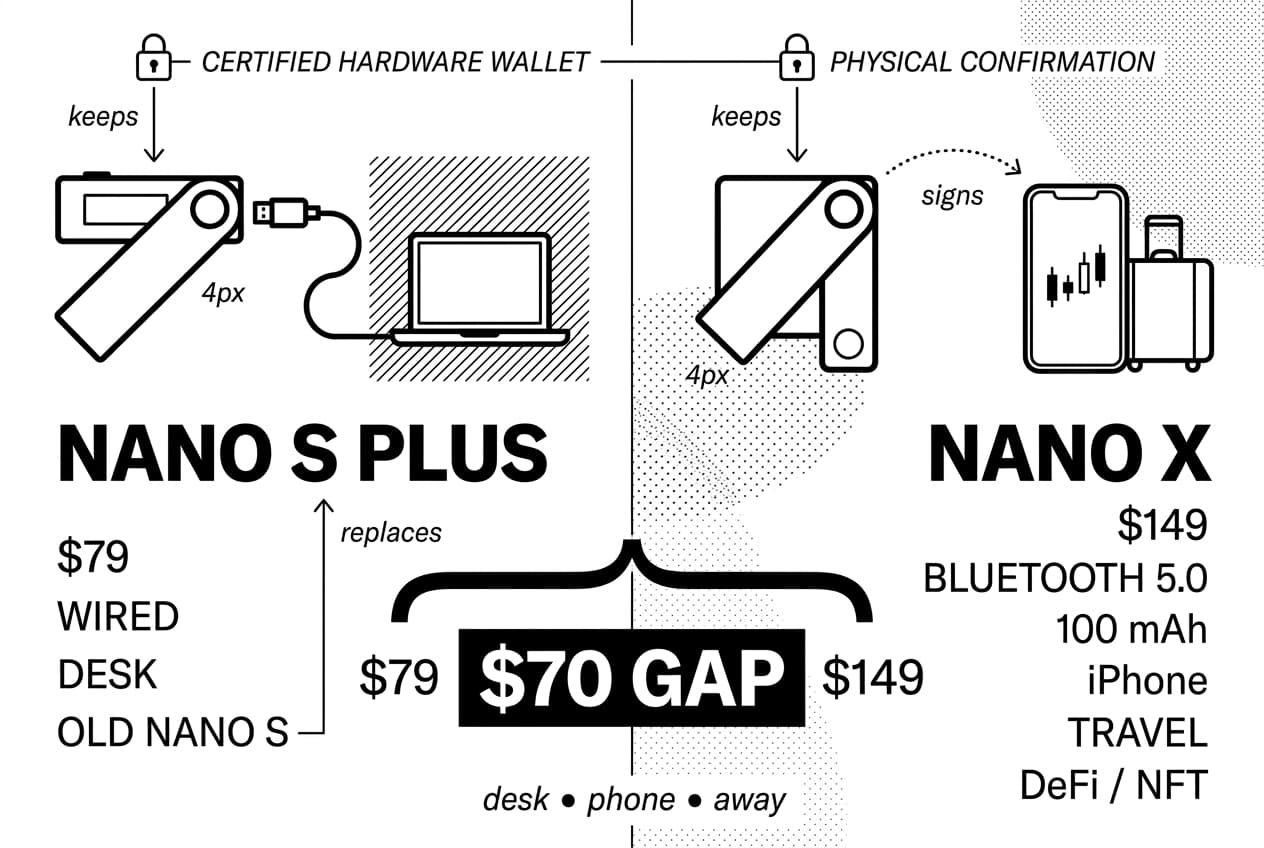
As of ledger official store, July 2026, the nano s plus lists at about $79 and the nano x lists at about $149. That $70 gap is the center of this comparison. The nano x adds Bluetooth 5.0 and a 100 mAh battery according to ledger nano x product specifications, July 2026, while the nano s plus stays wired and bus-powered.
Our take is deliberately conservative: the nano s plus is the better default for many holders because it gives the same basic cold-storage model without battery aging or a wireless radio. The nano x is worth paying for when you often sign away from a computer, especially on iPhone or during mobile DeFi and NFT activity. Why self-custody matters is a separate decision; here we assume you already want a hardware wallet.
fast recommendation
- Buy the nano s plus if you hold long term and sign from a laptop or desktop.
- Buy the nano x if iPhone signing, travel, or frequent phone-based approvals are part of your routine.
- Buy the nano s plus if you are replacing an older nano s and do not need wireless signing.
- Buy the nano x if you approve DeFi or NFT transactions away from a desk several times a month.
at a glance: nano x vs nano s plus comparison table
This table uses current public product pages and support pages rather than promotional claims. Both devices support more than 5,500 assets according to ledger supported assets, July 2026. Both also use a CC EAL5+ certified secure element, described by ledger secure element documentation, July 2026. That means the differences below affect convenience more than key custody.
Feature | ledger nano s plus | ledger nano x | buyer impact |
|---|---|---|---|
Price | About $79 | About $149 | The nano x costs about $70 more |
Connectivity | USB-C only | USB-C plus Bluetooth 5.0 | Wireless signing is the main upgrade |
Battery | None | 100 mAh built in | Portable, but it can age |
Mobile support | Android with cable; no iPhone signing | iOS and Android by Bluetooth | nano x fits phone-first users |
Supported assets | 5,500 plus | 5,500 plus | No meaningful asset gap |
Security chip | CC EAL5+ secure element | CC EAL5+ secure element | Core key protection is comparable |
App capacity | Up to about 100 apps | Up to about 100 apps | Enough for most portfolios |
Screen | 128 by 64 px | 128 by 64 px | Same address-checking space |
Recovery backup | 24-word phrase | 24-word phrase | Same recovery model |
Best for | Desk holders and budget buyers | Mobile signers and travelers | Use case should decide |
The short version: if you sign only at a desk, the nano s plus does almost everything that matters. If you sign from a phone, the nano x removes enough friction to justify its higher price.
how we compared the two ledger wallets
For this update we used a named scoring method: the Cable-first decision matrix. It scores each wallet against five common ownership patterns in 2026 rather than treating every specification as equally important. A long-term holder, a mobile DeFi user, and a traveler do not need the same workflow.
The matrix uses nine criteria: key custody, transaction review, mobile access, cable dependency, battery risk, supported assets, app capacity, price, and support status. We also checked the basic setup path against how to set up a ledger wallet, because a lower price does not help if the daily workflow is wrong for the buyer.
The information-gain dataset below is an editorial fit score, not a lab benchmark. A score of 5 means the wallet fits the ownership pattern with little friction. A score of 1 means the buyer should expect workarounds.
2026 ownership pattern | nano s plus fit | nano x fit | reason |
|---|---|---|---|
Desk-based long-term holder | 5/5 | 4/5 | Same custody model; lower price favors the wired device |
Mobile DeFi user | 2/5 | 5/5 | Phone signing is much easier with Bluetooth |
NFT collector | 3/5 | 4/5 | Both can sign; mobile display and approval favor nano x |
Frequent traveler | 2/5 | 5/5 | A battery and wireless pairing reduce cable dependence |
Older nano s replacement | 5/5 | 3/5 | The cheaper model fixes storage and USB-C limits |
Andreas Antonopoulos, author and educator, often explains hardware wallets through the separation of keys from internet-connected devices. That framing matters here because it shows why both models can be sound cold-storage tools. Hayden Adams, founder of the exchange protocol behind a large share of wallet-based DeFi activity, is relevant to the opposite side of the decision: active signing workflows can make mobile convenience valuable.
ledger nano s plus: overview, pros and cons
The nano s plus is the practical wired option. It is best understood as a lower-cost cold-storage device for people who do most financial activity from a computer and prefer fewer components that can age. It does not try to be a travel wallet. That is its limitation and also its appeal.
nano s plus overview
The nano s plus connects through USB-C and runs with ledger live on desktop, plus supported Android cable workflows. It uses the same broad asset list as the nano x, including BTC, ETH, XRP, SOL, stablecoins, and thousands of EVM tokens. The 128 by 64 px screen and 24-word recovery phrase are documented on ledger support, July 2026.
Compared with the original nano s, the main improvement is app storage. Instead of constantly uninstalling apps for a small portfolio, most users can keep the apps they actually need available at the same time. Deleting an app still does not delete the coins, because the recovery phrase and private keys control the accounts.
nano s plus strengths
- Lower cost: $79 at the official store makes it the better value for desk-based holders.
- No battery: There is no rechargeable cell to weaken after years in a drawer.
- Wired-only workflow: Users who dislike wireless radios may prefer the physical cable boundary.
- Same broad asset support: It uses the same supported-asset database as the nano x.
- Good upgrade path: It is a sensible replacement for an older nano s.
nano s plus weaknesses
- No Bluetooth: You cannot pair it wirelessly with ledger live mobile.
- No iPhone signing: iPhone users who want a hardware wallet workflow need the nano x or another model.
- Cable dependence: Android use can require an OTG cable, which is awkward on the move.
- Less convenient for DeFi: Frequent approvals from a phone become slower and more error-prone.
The nano s plus is not the cheaper version of a safer device. It is the cheaper version of a more portable device. If portability is not part of your wallet routine, the savings are meaningful.
ledger nano x: overview, pros and cons
The nano x is the mobile-first option. It costs more because it adds Bluetooth, a rechargeable battery, and native phone workflows. Those additions do not make the private keys more secure, but they can make good security easier to practice when you are not near a computer.
nano x overview
The nano x connects over USB-C or Bluetooth 5.0 and has a 100 mAh internal battery according to ledger product specifications, July 2026. Its value is clearest for iOS users, Android users who dislike cables, and people who approve transactions while traveling. The device still requires physical button approval, so phone pairing does not mean automatic signing.
Asset coverage is effectively the same as the nano s plus. It supports the same ledger live accounts, many third-party wallets, and the same 24-word recovery phrase model. The higher price pays for mobility, not a different seed standard or a stronger chip.
nano x strengths
- Bluetooth signing: It pairs with mobile devices without a cable.
- iPhone support: It is the better choice for iOS-first wallet management.
- Battery-powered use: You can review and sign transactions away from a powered USB port.
- Better travel fit: Fewer cables and adapters reduce daily friction.
- Mobile DeFi fit: WalletConnect and app-based approvals are easier from a phone.
nano x weaknesses
- Higher price: $149 is hard to justify if you sign only at a desktop.
- Battery aging: A weak battery can turn it into a mostly wired device over time.
- Wireless comfort: Some owners prefer no radio at all, even if private keys stay inside the chip.
- Same core security: The premium does not buy a different private-key model.
The nano x is at its best when convenience protects good habits. If easier mobile signing keeps you using a hardware wallet instead of a hot wallet, the added cost may be rational. If Bluetooth stays off permanently, you are mostly paying for hardware you do not use.
key differences that actually matter
The nano s plus is a wired, lower-cost hardware wallet, while the nano x adds Bluetooth, a battery, and smoother mobile use. Both keep private keys inside the same basic secure element model, so the buying decision is about signing workflow, cable tolerance, phone use, and long-term maintenance rather than stronger custody.
connectivity: USB-C versus USB-C plus Bluetooth
The nano s plus works through USB-C. The nano x works through USB-C and Bluetooth. Bluetooth does not send your private keys to the phone; transaction approval still happens on the device. The practical difference is friction. A cable can be a useful pause for cold storage, while wireless pairing is better for active mobile signing.
battery and lifespan
The nano s plus has no battery and draws power from the device it is plugged into. The nano x has a rechargeable cell, which is useful during travel but can degrade. A dead battery does not destroy funds. Your 24-word recovery phrase controls access, and that recovery model is described in ledger support, July 2026.
mobile app experience
The biggest workflow gap appears on iPhone. The nano s plus is not the right pick for iPhone signing because it lacks Bluetooth. Android users can use cables, but the setup is less tidy than wireless pairing. If your phone is your main transaction screen, the nano x earns its premium faster.
price and value
Device | Official price | What the extra money buys |
|---|---|---|
nano s plus | $79 | Cold storage, USB-C, desktop use, Android cable use |
nano x | $149 | All of the above, plus Bluetooth, battery, and iOS workflow |
The $70 premium buys convenience. It does not buy a more private recovery phrase, a different supported-asset list, or a stronger confirmation habit. Choose based on where you sign transactions, not on the assumption that the more expensive device is automatically safer.
security, supported coins, NFTs and ledger live
Once you strip out Bluetooth and the battery, the two devices are close siblings. Both are designed to keep private keys off the internet-connected computer or phone. Both require you to check transaction details on the device screen before approval. Both also depend heavily on how carefully you store the recovery phrase.
Shared features include:
- secure element: CC EAL5+ chip for private-key isolation.
- PIN: Local device lock with reset after repeated wrong attempts.
- recovery phrase: 24-word backup for restoring accounts.
- ledger live: Desktop and mobile app for accounts and transactions.
- major coin support: BTC, ETH, XRP, SOL, stablecoins, and many tokens.
- NFTs: Display and signing support through supported wallet paths.
- third-party wallets: Compatibility with tools such as MetaMask and wallet connectors.
security model
Both devices sign transactions internally. The host computer or phone prepares the transaction, but the hardware wallet approves it only after you confirm on the device. That design is why Andreas Antonopoulos emphasizes recovery-phrase safety and device verification as core self-custody habits.
The weak point is usually the owner process, not the chip. Never type the 24-word phrase into a website, cloud note, screenshot, or chat app. Buy from the official store or an authorized retailer, and check for the warning signs your wallet is compromised if anything about packaging, setup, or recovery words seems wrong.
available currencies and app capacity
Both wallets support over 5,500 coins and tokens according to ledger supported assets, July 2026. XRP works on both through the XRP app. ETH, SOL, BTC, USDC, USDT, and common EVM tokens are also covered, though buyers should always check current support before transferring funds.
App capacity is listed at up to about 100 apps for current models, but the exact number varies by app size. In practice, few owners need 100 chain apps installed at once. Removing a device app does not remove the crypto account or its balance.
NFTs, staking and DeFi access
NFT and DeFi access depends as much on the wallet interface as the device. Both models can sign supported transactions through ledger live and compatible third-party wallets. The nano x is better if you approve these transactions from a phone. The nano s plus is fine if you use a desktop browser wallet and cable.
DeFi users should also manage token permissions. Before interacting with protocols, review and revoke risky token approvals regularly. That habit matters regardless of which hardware wallet signs the transaction. Hayden Adams is relevant here because modern DeFi made repeated wallet approvals normal for everyday users.
price, support status and long-term ownership in 2026
Long-term ownership is not only about the purchase price. It also includes firmware updates, support pages, app compatibility, cable availability, and physical condition. A hardware wallet can remain safe for years if the recovery phrase is secure, but an unsupported or damaged device creates avoidable friction.
is the nano s plus being discontinued?
The older nano s was retired, but the nano s plus is a different product. As of ledger official store, July 2026, the nano s plus is still sold. Buyers should still verify support status before purchase because hardware lineups change. For long-term holders who rarely transact, the lower price can pair well with broader risk planning such as crypto insurance for digital assets.
is the nano x obsolete?
The nano x is not obsolete if it still receives firmware support and the battery remains usable. A unit bought in 2019 may feel older in 2026 because battery performance naturally declines, but that is a convenience issue. The device can still be restored or replaced using the recovery phrase if the owner has stored it safely.
If buying new, compare the nano x against any newer wallet models available at the official store. The nano x still has a clear role for iPhone users and mobile signers, but it is no longer the automatic best buy for desk-based holders.
which should you choose?
Both devices can be good choices, but not for the same owner. The nano s plus wins on price, simplicity, and no battery maintenance. The nano x wins on iPhone support, travel, and mobile signing. Use these recommendations by behavior rather than trying to choose a universal winner.
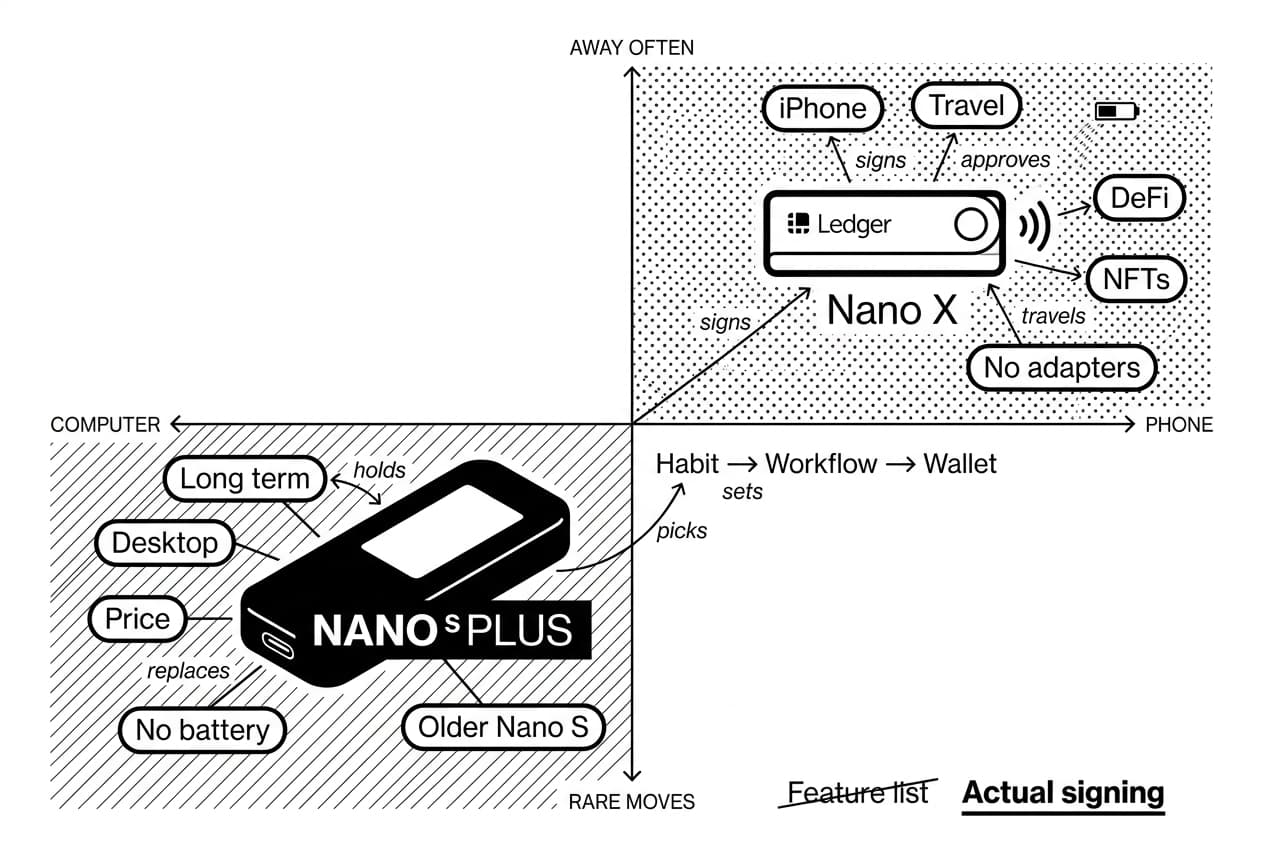
buy the nano s plus if...
- Choose Nano S Plus if you hold long term and rarely move funds.
- Choose Nano S Plus if you sign from a desktop or laptop.
- Choose Nano S Plus if price matters more than phone convenience.
- Choose Nano S Plus if you dislike wireless signing hardware.
- Choose Nano S Plus if you are replacing an older nano s.
buy the nano x if...
- Choose Nano X if you need iPhone hardware-wallet signing.
- Choose Nano X if you travel and transact away from a computer.
- Choose Nano X if you approve DeFi transactions from a phone.
- Choose Nano X if you manage NFTs on mobile often.
- Choose Nano X if cables and adapters would stop you using cold storage.
If you are still comparing card-form wallets with USB hardware wallets, read our Tangem vs Ledger comparison. The main buying rule remains the same: pick the device that matches your actual signing habits, not the one with the longest feature list.
Frequently Asked Questions
- Is Ledger Nano S Plus being discontinued?
- The Nano S Plus is a different product from the older Nano S, which Ledger previously sunset. As of this writing, the Nano S Plus remains available, but product availability can change. Check Ledger's official store and support pages for the latest status, and remember that discontinued sales and discontinued firmware support are separate matters.
- Should I buy Ledger Nano S or X?
- In today's lineup, the real choice is Nano S Plus vs. Nano X. Go with the Nano S Plus for affordable desktop cold storage. Choose the Nano X if you need Bluetooth, iPhone compatibility, or a battery-powered workflow for signing on the go. Both deliver the same core self-custody security.
- Can Ledger Nano S Plus hold XRP?
- Yes, the Nano S Plus supports XRP when the XRP app is installed and the account is managed through Ledger Live or a compatible wallet. Before transferring any funds, verify current XRP support and network requirements on Ledger's official supported-assets page, as compatibility details can change.
- Does Ledger Nano X report to IRS?
- No. The Nano X is a hardware wallet that stores private keys and signs transactions — it does not report anything to the IRS. Blockchain activity is publicly traceable, and exchanges or brokers may issue tax forms independently. You remain fully responsible for accurate crypto tax reporting.
- Is Nano S Plus or Nano X better?
- Neither is universally better — it comes down to how you use it. The Nano S Plus offers better value for desktop-based holders who connect via USB. The Nano X suits users who need Bluetooth, iPhone support, or frequent mobile signing. Core security and coin support are comparable across both devices.
- Is Ledger Nano S Plus still supported?
- Support status should always be confirmed on Ledger's official support pages, especially in 2026 when product lifecycles may shift. If it remains supported, keep both firmware and Ledger Live updated. Note that the Nano S Plus has a different support lifecycle than the older Nano S, which reached end-of-life earlier.
- Is Ledger Nano X obsolete?
- Not necessarily. A device isn't obsolete while it still receives firmware updates and functions reliably. The Nano X's Bluetooth and mobile signing capabilities remain a genuine advantage. That said, compare it against current Ledger models and check Ledger's official lifecycle notices before purchasing a new or secondhand unit.
- What is the lifespan of Ledger Nano X?
- Lifespan depends on battery health, physical condition, and continued firmware support. A weakening battery doesn't mean lost funds — your assets are controlled by your recovery phrase, not the device itself. Keep your recovery phrase backed up securely, and replace the hardware proactively if it becomes unreliable or unsupported.
- What is the best Ledger to buy?
- For most people, the Nano S Plus offers the best value for straightforward cold storage. The Nano X is the better pick for mobile users who want Bluetooth convenience. Premium models with larger screens may be worth it only if those features fit your workflow. Always buy from Ledger's official store or authorized retailers.
Sources
Author

Crypto analyst and blockchain educator with over 8 years of experience in the digital asset space. Former fintech consultant at a major Wall Street firm turned full-time crypto journalist. Specializes in DeFi, tokenomics, and blockchain technology. His writing breaks down complex cryptocurrency concepts into actionable insights for both beginners and seasoned investors.