Hardware Wallet vs Exchange: Why Self-Custody Matters in 2026
Hardware Wallet vs Exchange: Why Self-Custody Matters in 2026
Hardware Wallet vs Exchange: What Is Being Compared?
A hardware wallet stores private keys offline for self-custody, while an exchange stores crypto in a custodial account for easier trading. The hardware wallet vs exchange decision is not only about security. It is about who controls withdrawals, who can recover access, and who carries the operational risk when something goes wrong.
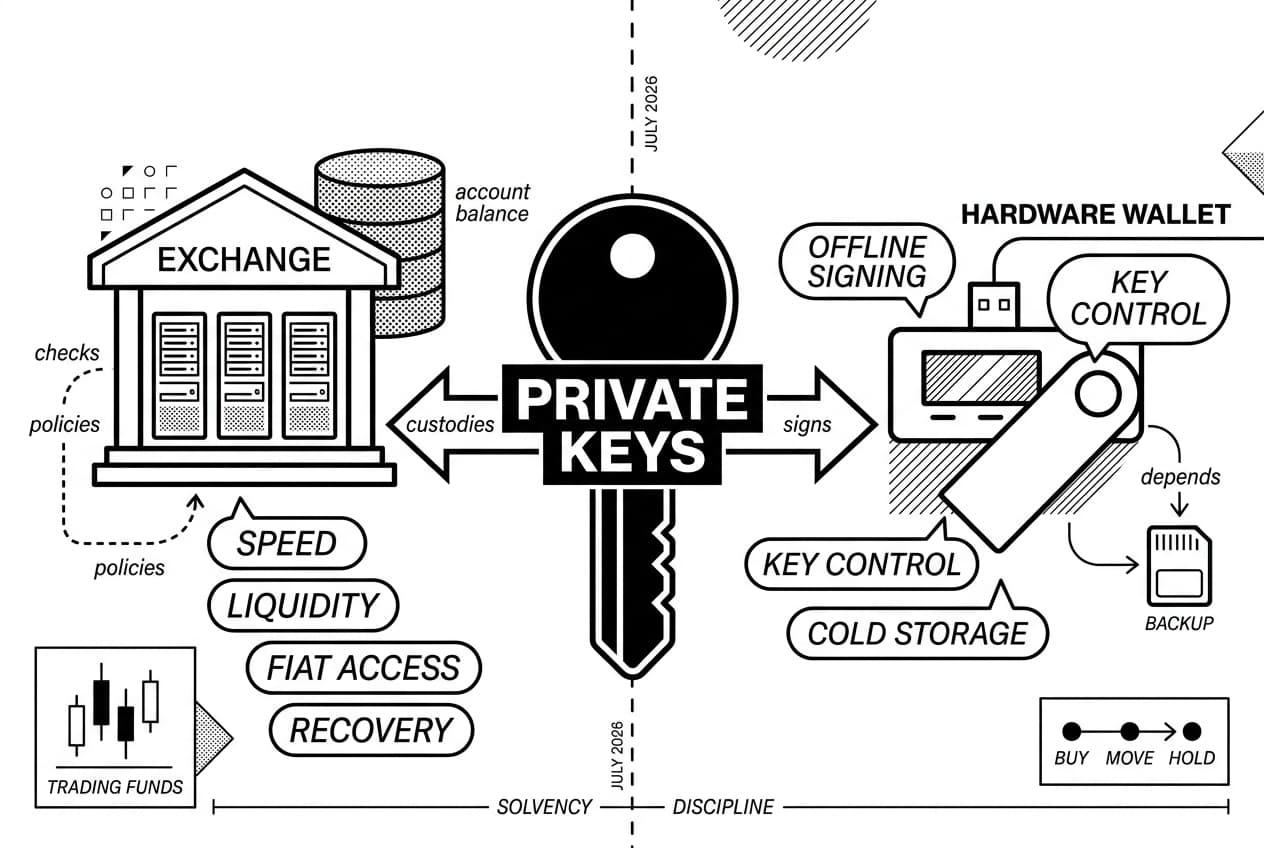
As of July 2026, asking “should i use hardware wallet or exchange” is best treated as a custody-risk question. Exchanges optimize for speed, liquidity, fiat access and account recovery. Hardware wallets optimize for offline signing, direct key control and independence from a platform’s balance sheet. Many users should not choose only one. A tiered setup can keep trading funds on an exchange while long-term holdings stay in cold storage.
Metric | Exchange storage | Hardware wallet |
|---|---|---|
Key custody | Platform holds private keys | User holds private keys |
Best function | Trading and fiat access | Long-term self-custody |
Main dependency | Exchange solvency and policies | User backup and signing discipline |
Typical cost | Account usually free | Device purchase required |
The custody question: who controls the private keys?
Crypto assets are controlled by private keys. If you keep coins on a centralized exchange, you usually hold an account balance in the platform’s internal database. The exchange controls the on-chain addresses and processes withdrawals when its systems, compliance checks and liquidity allow it.
With a hardware wallet, the private key is generated and stored inside a dedicated device. The device signs transactions without exposing the key to your computer or phone. Andreas Antonopoulos, author and educator, is widely known for emphasizing the private-key distinction: control of keys is control of coins, while custodial balances depend on another party’s promise to perform.
Why this matters after exchange failures and phishing waves
The risks are measurable. FTX filed for bankruptcy in November 2022, and later reporting described an $8.7 billion customer shortfall (Reuters, November 2022). Chainalysis reported that stolen crypto funds reached $3.8 billion in 2022 and then fell to $1.7 billion in 2023 (Chainalysis, January 2024). In 2024, stolen funds rose again to more than $2.2 billion (Chainalysis, December 2024).
The common slogan says hardware wallets are always safer. The practical answer is narrower: self-custody is safer only when the user can protect backups, verify transactions on the device screen and avoid phishing. A poorly managed hardware wallet can be less recoverable than a regulated exchange account, because there is no identity-based reset for a lost seed phrase.
Our 2026 custody-fit scorecard
To add a consistent decision layer, we scored four common user profiles against seven criteria: control, internet exposure, recovery, liquidity, setup burden, privacy and mistake tolerance. Scores run from 1 to 5, where 5 means the storage method fits that use case well. This is an editorial model, not investment advice.
User profile | Exchange score | Hardware wallet score | Reason |
|---|---|---|---|
First-time buyer under $500 | 4.3 | 2.8 | Recovery and fiat access matter most |
Weekly trader | 4.6 | 2.5 | Order books and speed dominate |
Long-term holder above $5,000 | 2.6 | 4.5 | Custody control outweighs convenience |
Active DeFi user | 2.9 | 3.9 | Self-custody helps, but approvals add risk |
The scorecard shows why a single winner would be misleading. Exchange storage can be rational for small or active balances, while hardware wallets become more attractive as balance size, holding period and platform-risk sensitivity increase.
Exchange vs Hardware Wallet: Side-by-Side Comparison Table
The exchange vs hardware wallet comparison below uses the same criteria for both options. Each cell is intentionally short so the trade-offs are easy to scan.
Criteria | Centralized exchange | Hardware wallet |
|---|---|---|
Key control | Exchange controls keys | User controls keys |
Internet exposure | Account and hot wallets online | Keys stay offline |
Cost | Account usually free | Device purchase required |
Fees | Trading and withdrawal fees | Network fees only |
Speed | Fast trading, slower withdrawals | Blockchain settlement speed |
Recovery | Email and identity recovery | Seed phrase recovery only |
Privacy | KYC usually required | No KYC for device use |
DeFi access | Limited or indirect | Direct wallet connection |
Best use case | Trading and fiat ramps | Long-term storage |
Main risk | Freeze, hack or insolvency | Lost backup or bad signature |
How to read this comparison
This table is not ranking one storage type above the other in every situation. A user placing weekly limit orders needs fast execution, tax records and fiat conversion. An investor holding bitcoin for several years has a different risk profile, where offline key storage may matter more than instant trading.
Brian Armstrong, co-founder and chief executive of Coinbase, represents the exchange-side trade-off: regulated platforms compete on liquidity, account controls and operational security. Erik Voorhees, founder of ShapeShift, represents the self-custody side of the market, where users choose direct control instead of custodial convenience. Both views are useful because the right answer depends on use case, not ideology.
Exchange Storage: Overview, Strengths and Weaknesses
Exchange storage is a custodial service. It is not simply a weaker version of a hardware wallet. It solves different problems: buying crypto with fiat, trading quickly, recovering access through identity checks and consolidating records in one account.
Overview: what happens when crypto stays on an exchange?
When you buy bitcoin, ether or another asset on a centralized exchange, you normally receive a balance entry rather than a private key. The exchange manages the on-chain wallets, keeps an internal ledger and processes withdrawals after risk checks. Large platforms typically separate internet-connected withdrawal wallets from offline reserves, but the user still depends on the platform to honor withdrawals.
This custody model can be appropriate for active use. It is also a counterparty relationship. If the exchange becomes insolvent, pauses withdrawals, flags your account or faces a legal order, you may not be able to move funds at the moment you want to move them.
Strengths: liquidity, speed, fiat access and recovery
Exchanges are strongest when speed and liquidity matter. Internal order matching is much faster than waiting for a blockchain transaction, and fiat rails make exchanges the normal entry point for new buyers. For users comparing purchase costs, this is also where guides such as the cheapest ways to buy Ethereum are most relevant.
Fees vary by venue and order type. Coinbase lists advanced trading fees up to 0.60% for some retail tiers, with lower rates at higher volume (Coinbase, accessed July 2026). That is not the cheapest possible structure, but it gives beginners a clear, regulated route from bank account to crypto balance.
Account recovery is another real advantage. If a user forgets a password or loses a phone, identity checks and support processes can restore access. This feature matters for beginners who are not yet ready to protect a seed phrase without mistakes.
Weaknesses: counterparty risk, freezes and withdrawal limits
The main weakness is dependency. The exchange holds the keys, so users cannot withdraw without platform cooperation. Bankruptcy, liquidity stress, sanctions screening, account flags and maintenance outages can all interrupt access. FTX’s November 2022 bankruptcy showed how quickly an exchange balance can become a legal claim rather than usable money (Reuters, November 2022).
Security risk also concentrates. Attackers prefer large custodians because one successful breach can affect many customers. Chainalysis reported more than $2.2 billion stolen across crypto hacks in 2024 (Chainalysis, December 2024). Not all losses came from exchanges, but the figure shows why platform security cannot be ignored.
Exchange storage is strongest for liquidity and recovery. It is weakest when you need censorship-resistant access, private-key control or long-term independence from one company’s operations.
Hardware Wallet Storage: Overview, Strengths and Weaknesses
A hardware wallet moves the critical secret, the private key, into a dedicated device. That device signs transactions locally, then returns a signed transaction that can be broadcast through a computer or phone. The goal is simple: keep the private key offline even when the transaction process touches the internet.
Overview: how a hardware wallet protects private keys
During setup, the device generates a seed phrase, usually 12 or 24 words. That seed phrase can restore the wallet on a compatible device if the original device is lost or damaged. The device itself is replaceable. The seed phrase is not. Anyone who obtains the seed can take the funds.
Hardware wallets can connect to wallet software for bitcoin, ether, stablecoins, NFTs and DeFi activity. The important step is transaction verification. The user should read the destination address, amount, asset and network on the device screen before approving. Offline keys do not help if the user signs a malicious approval.
Strengths: control, cold storage and reduced platform risk
The main strength is direct custody. A platform cannot freeze a transaction from a wallet you control. A failed exchange cannot lose your private key because it never had it. This is why hardware wallets are especially useful for long-term holdings, large balances and assets you do not need to trade every day.
- Control: You authorize transactions directly rather than requesting withdrawals.
- Offline signing: Private keys stay inside the device during normal use.
- Multi-asset support: One backup can often cover several supported networks.
- DeFi compatibility: Wallet connections can sign on-chain actions while keys remain offline.
If you are comparing device designs, our Tangem vs Ledger hardware wallet comparison explains how card-style devices and screen-based devices differ in everyday use.
Weaknesses: cost, backup mistakes and user responsibility
Self-custody has a real learning curve. A device costs money, setup takes care, and recovery depends on the user’s backup. The Trezor safe 3 is listed from $79 on the maker’s store (Trezor, accessed July 2026). That upfront cost is small compared with a large portfolio, but it is meaningful for someone buying their first $100 of crypto.
The bigger issue is recovery. If the seed phrase is lost, damaged or exposed, there is no exchange support team that can reverse the problem. Chainalysis has repeatedly noted that lost private keys are one reason a portion of older bitcoin supply appears inactive, though exact permanently lost amounts cannot be proven from public-chain data alone (Chainalysis, June 2020).
- Backup risk: A single insecure backup can compromise the whole wallet.
- Phishing risk: Fake wallet pages and support messages often target seed phrases.
- Approval risk: A hardware wallet can still sign a harmful smart-contract approval.
- Workflow friction: Trading requires device confirmation and on-chain settlement.
Hardware wallets reduce platform risk, but they do not remove human risk. They work best for users willing to practice backup discipline and transaction verification.
Key Differences That Matter Most in 2026
The most important differences are not abstract. They affect how quickly you can trade, how you recover access and who can stop a withdrawal.
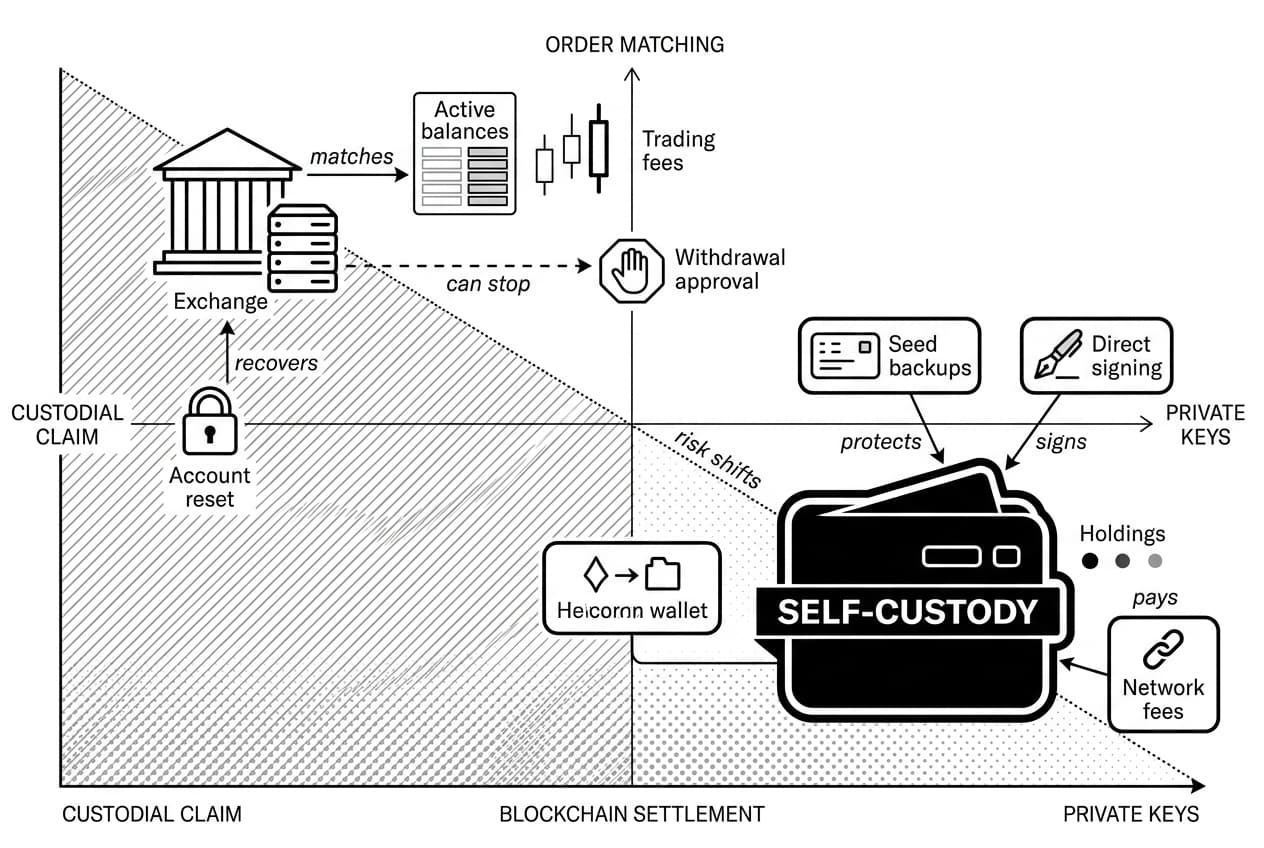
- Control: Hardware wallets give you private keys; exchanges give you a custodial claim.
- Security model: Exchanges centralize platform risk; hardware wallets shift risk to the user.
- Fees: Exchanges charge trading and withdrawal fees; hardware wallets pay network fees.
- Speed: Exchanges offer faster trading; hardware wallets rely on blockchain settlement.
- Recovery: Exchanges can reset accounts; hardware wallets rely on seed backups.
- Privacy: Exchanges usually require KYC; self-custody does not remove public-chain tracing.
- Ideal use case: Exchanges fit active balances; hardware wallets fit long-term holdings.
Control and legal ownership
Exchange balances depend on the platform’s terms and operational health. A hardware wallet gives the user direct signing authority. That does not make the user immune to mistakes, but it removes the need for a custodian to approve withdrawals.
Security model and attack surface
Exchange risk is institutional. The platform must defend customer accounts, withdrawal systems, internal controls and reserve management. Hardware wallet risk is personal. The user must defend the seed phrase, device access, browser sessions and smart-contract approvals. The attack surface changes rather than disappears.
Fees, speed and day-to-day usability
Exchanges are usually faster for trading because order matching happens internally. Hardware wallets require an on-chain transaction for movement of funds. Bitcoin’s target block interval is 10 minutes (Bitcoin developer guide, accessed July 2026), while other networks use different confirmation models. The result is clear: exchange storage is better for frequent trading, while hardware wallets are better for assets that can wait.
Privacy, KYC and compliance
Regulated exchanges collect identity information and link accounts to deposits and withdrawals. Self-custody removes that exchange-held identity file from normal wallet use, but it does not make public-chain activity invisible. As our guide to blockchain pseudonymity explained notes, wallet addresses can still be traced through public transaction history.
Should You Use an Exchange, a Hardware Wallet, or Both?
Most users should split storage by purpose. The right question is not “which storage type is best?” The right question is “what does this specific balance need to do?” Trading funds need liquidity. Savings need stronger custody control. DeFi funds need isolation from long-term holdings.
A practical split: trading balance vs long-term cold storage
Bucket | Purpose | Suggested storage | Example allocation |
|---|---|---|---|
Active trading balance | Spot trades and limit orders | Regulated exchange | 5% to 15% |
Emergency liquidity | Access within 24 to 48 hours | Exchange or hot wallet | 5% to 10% |
Long-term holdings | Multi-year storage | Hardware wallet | 75% to 90% |
DeFi activity | Protocol interactions | Separate wallet | Capped per session |
Keeping DeFi activity separate matters. A malicious approval can drain the connected wallet, so mixing long-term cold storage with active protocol use defeats the purpose of cold storage. Treat a DeFi wallet as a working wallet, not a savings vault. Our DeFi app guide for lending, swaps and earning explains protocol-specific risks in more detail.
How to move crypto off an exchange safely
- Set up the hardware wallet first. Complete setup and write the seed phrase before withdrawing. Our guide on how to set up a Ledger wallet walks through the process.
- Confirm the network. Match the withdrawal network to the receiving wallet. Wrong-network transfers can be difficult or impossible to recover.
- Use address allowlisting. If your exchange supports withdrawal address allowlists, turn them on before moving large balances.
- Send a test transaction. Send a small amount first, such as $5 to $20, and wait for confirmation.
- Verify on a block explorer. Check the destination address and received amount before sending the remainder.
- Move the remaining balance. Only send the larger transfer after the test transaction arrives correctly.
Intermediate users often skip the test transaction because the process feels familiar. That is a poor trade-off. A small fee and a short delay are better than an irreversible wrong-address or wrong-network mistake.
Common Beginner Mistakes to Avoid
Storage choice matters, but operational errors still cause many losses. The mistakes below are preventable and apply to both hardware wallet users and exchange users.
Seed phrase and recovery mistakes
Your seed phrase is the master backup for the wallet. Do not screenshot it, upload it to a cloud drive or type it into any website. Store it offline on paper or metal in a secure location. No legitimate wallet maker or exchange support team needs your seed phrase to solve a support issue.
Phishing remains active. Ledger’s security education pages describe common seed-phrase scams and support impersonation patterns (Ledger security education, accessed July 2026). The practical rule is strict: if a screen asks for the seed phrase outside device recovery, stop immediately.
Transaction and network mistakes
Wrong-network transfers are common. Sending a token on one network to a wallet or exchange deposit flow for another network can leave funds stuck. Always check the asset, network, destination address and memo or tag requirements before sending. For large transfers, use a test transaction first.
Token approvals are another risk. DeFi protocols often ask permission to spend tokens, and approvals can remain active after you stop using a protocol. Our guide on how to revoke token approvals explains how to review and remove old permissions.
Only buy hardware wallets from official stores or verified resellers. A tampered device or prewritten seed phrase can compromise funds from the start. If anything seems unusual after setup, review the warning signs your wallet is compromised before moving funds.
Frequently Asked Questions
- Is it better to keep crypto in a wallet or exchange?
- It depends on how you use your crypto. Exchanges suit active traders who need quick fiat access and straightforward account recovery. Self-custody wallets are better for long-term holdings where direct control matters. A practical approach is keeping only active trading funds on an exchange and moving larger balances to a wallet.
- What are the disadvantages of a hardware wallet?
- Hardware wallets come with real trade-offs: an upfront device cost, a more involved setup process, and full responsibility for your seed phrase backup. Trading becomes slower, and user error — losing your seed phrase or approving a malicious transaction — can be costly. A hardware wallet reduces exchange risk but does not eliminate phishing or recovery mistakes.
- Should I put my crypto in a hardware wallet?
- A hardware wallet makes sense if your balance is meaningful, you plan to hold long term, or you interact with DeFi or NFTs. Before moving funds, learn proper backup procedures, test with a small transfer first, and never store your seed phrase digitally. Getting the basics right matters more than buying the device.
- What is the difference between an exchange and a wallet?
- An exchange is a custodial platform where you buy, sell and hold assets under the company's control, usually requiring KYC verification. A wallet — software or hardware — manages your private keys directly and signs transactions on your behalf. Exchanges offer convenience; wallets give you genuine ownership of your assets.
- Should I use a hardware wallet or an exchange?
- Use an exchange for frequent trades and converting to fiat. Use a hardware wallet for long-term storage where security outweighs convenience. Many users benefit from both — keeping liquid funds on an exchange while securing larger holdings in self-custody. Your balance size, experience level and daily habits should guide the decision.
- What do Gen Z use instead of wallets?
- In everyday payments, Gen Z often favors mobile payment apps and digital wallets for speed and convenience. In crypto, many use exchange apps, mobile wallets or embedded wallets built into platforms. Convenience is improving across the board, but none of these options provide true self-custody unless you control your own private keys.
Sources
Author

Crypto analyst and blockchain educator with over 8 years of experience in the digital asset space. Former fintech consultant at a major Wall Street firm turned full-time crypto journalist. Specializes in DeFi, tokenomics, and blockchain technology. His writing breaks down complex cryptocurrency concepts into actionable insights for both beginners and seasoned investors.