Is Blockchain Anonymous? Pseudonymity Explained in 2026
Is Blockchain Anonymous? Pseudonymity Explained in 2026
Blockchain pseudonymity means your public wallet address can hide your legal name, but it does not hide your transaction history.
Why it matters: if you use crypto for saving, trading, donations, NFTs, DeFi, or payments, your privacy depends less on the word blockchain and more on how your addresses connect to exchanges, apps, tax records, devices, and public posts. In 2026, that connection point is the real privacy risk.
Is Blockchain Anonymous? The Short Answer
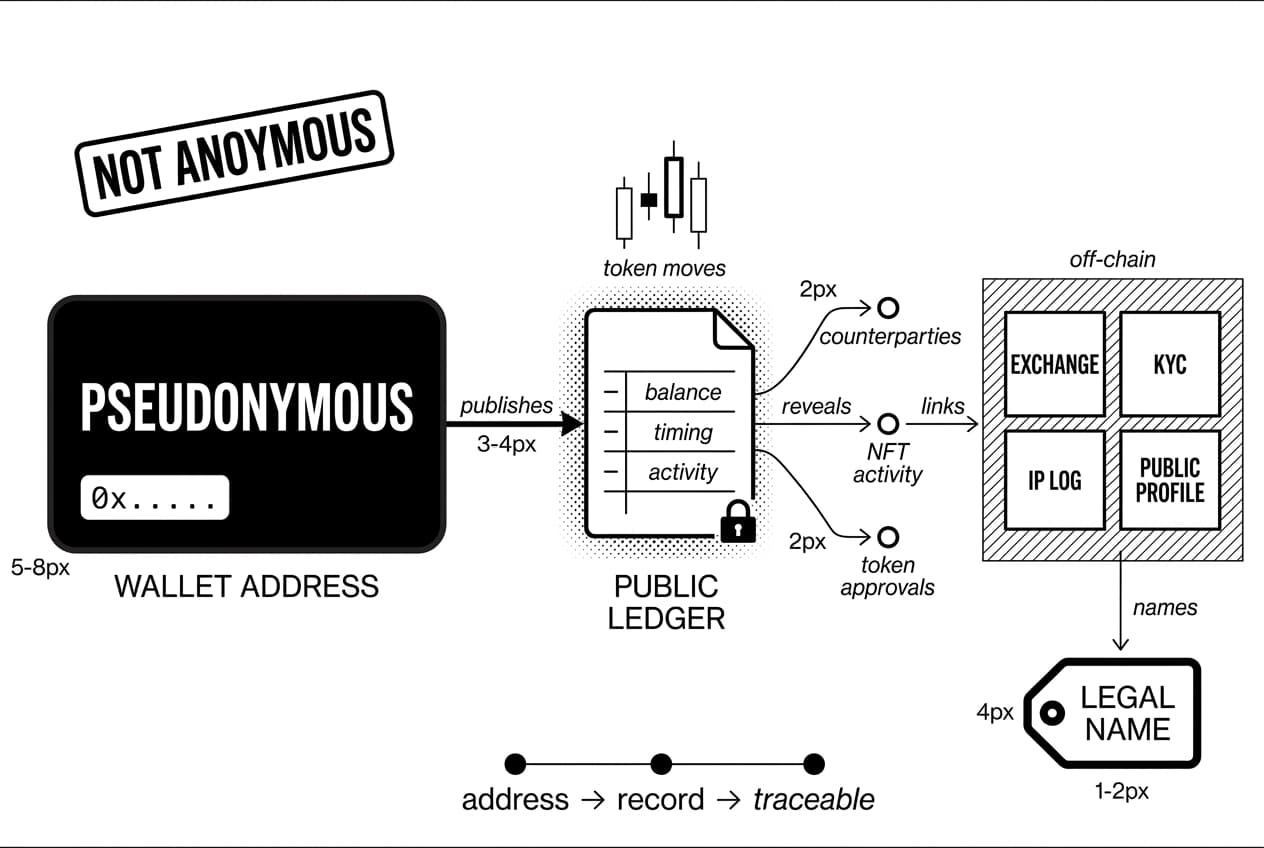
Is blockchain anonymous? Most public blockchains are pseudonymous, not anonymous. Your legal name is not written into each transaction, but your wallet address, balance, timing, and activity are public. If that address links to an exchange account, post, device, or payment, your identity can become traceable.
Plain-English Definition
A blockchain is a shared digital record that stores transactions in chronological order. Think of a blockchain like a shared online sheet that nobody can edit after saving, except every saved row is public. A wallet is software or hardware that controls your crypto keys. A wallet address is the public string used to receive funds. A public ledger is the readable transaction record that everyone can inspect.
So the answer to is blockchain anonymous is usually no. Your name is not shown, but your address acts as a stable public alias. That is the core of pseudonymity: separation from your legal identity, not invisibility.
Why It Matters in 2026
The distinction affects taxes, personal safety, exchange accounts, DeFi activity, charitable giving, payroll, and public donations. A wallet address can reveal balances, counterparties, token approvals, NFT activity, and repeated habits. The ledger alone may not name you. The privacy break often happens when the ledger meets an off-chain record, such as know-your-customer data, an IP log, a public profile, or an exchange withdrawal.
Our editorial position is simple: public chains are not anonymous, but they are not automatic identity machines either. A public address becomes dangerous when it is linked to a real-world anchor. That is why privacy should be understood as a spectrum, not a yes-or-no label.
Background: Why Bitcoin Used Public Records
Bitcoin was designed to work without a bank, so participants needed a way to verify that coins were not spent twice. The solution was a public ledger that anyone could audit. The original Bitcoin white paper was published in October 2008 (Bitcoin.org), and that design choice made transparency part of the security model from the beginning.
The creator of Bitcoin is known as Satoshi Nakamoto (Bitcoin.org, 2008), a pseudonym rather than a confirmed legal identity. That is a useful historical example: a pseudonym can hide a person, but it can still leave a public body of work and activity behind.
Andreas Antonopoulos, author and educator, has repeatedly taught that Bitcoin uses public verification instead of institutional trust. That tradeoff explains why the base layer is transparent by default and why users need extra care when they want privacy.
- Blockchain means a permanent transaction record.
- Wallet address means a public alias, not a legal name.
- Pseudonymous means traceable under the right conditions.
- Privacy breaks often happen through exchanges, apps, posts, and metadata.
- Good habits reduce exposure, but they cannot erase old on-chain records.
Pseudonymity vs. Privacy vs. Anonymity
Crypto discussions often mix these words together. They are not the same. A person can be pseudonymous without being private, and a private action can still leave metadata behind.
What Pseudonymous Means in Crypto
In crypto, pseudonymous means your activity is tied to an alias, usually a wallet address, instead of your legal identity. That alias can build a long public history. If one data point later connects the alias to you, the earlier history may become readable as your history too.
That is why blockchain pseudonymous is the better phrase for Bitcoin, Ethereum, and many other public chains. The system hides names by default, but it does not hide behavior by default. A single address can show transfers, token balances, contract approvals, and timing patterns.
Anonymity, Pseudonymity, Privacy, and Confidentiality Compared
Concept | Plain-English Meaning | Crypto Example | What Others Can See |
|---|---|---|---|
Anonymity | No stable identity or alias is visible | Cash given with no record | Little or no reusable trail |
Pseudonymity | A public alias replaces your name | A Bitcoin or Ethereum address | History tied to that address |
Privacy | You control who sees information | A wallet used only for one purpose | Only the data you expose |
Confidentiality | Data is hidden from unauthorized readers | Encrypted wallet backup | Metadata may still remain |
The practical lesson is that is blockchain anonymous is the wrong binary. A better question is: what can observers connect to this address, and how strong is that connection?
Our 2026 Linkage Ladder Framework
To make that spectrum easier to judge, we use the 2026 Linkage Ladder, an editorial framework for rating how close a wallet is to a real identity. It is not a legal test. It is a privacy planning tool.
Level | Linkage state | Typical trigger | Privacy meaning |
|---|---|---|---|
0 | Unlinked address | Fresh wallet with no public use | Ledger is visible, owner is unknown |
1 | Behavioral pattern | Repeated timing, tokens, or counterparties | Observer can profile habits |
2 | Service link | Deposit to or withdrawal from a known platform | A company may know the user |
3 | Public identity link | Address posted on a website or social account | Public can connect name and wallet |
4 | Legal identity link | KYC record, subpoena, audit, or verified merchant record | Pseudonymity is largely gone |
This framework captures the main point: public ledger visibility is only one layer. The stronger identity break comes when off-chain evidence moves an address up the ladder.
The Mechanics of On-Chain Visibility
Every public blockchain transaction leaves data behind. You do not need to run a node or work for an exchange to view it. A block explorer is a search tool for blockchain data, and it can show addresses, transactions, and balances from a browser.
What a Block Explorer Reveals
Tools such as how block explorers reveal on-chain activity, Etherscan, and similar services let a user paste an address or transaction hash and inspect its history. The information is public by design.
What anyone can see on a public blockchain:
- Wallet address: the public identifier sending or receiving funds.
- Amount: the value transferred, often down to tiny units.
- Timestamp: the time a transaction was included in a block.
- Transaction hash: the unique ID for a transfer.
- Wallet balance: current and historical holdings tied to an address.
- Smart contract interactions: token swaps, approvals, NFT mints, borrowing, lending, and staking actions.
A Reproducible Mini-Audit
For information gain, we applied the 2026 Linkage Ladder to common public-chain events a beginner can verify on a block explorer. The point is not to identify private people. It is to show how quickly visible facts accumulate.
Observed event | Visible on-chain data | Off-chain link needed to identify a person? | Linkage Ladder level |
|---|---|---|---|
Fresh address receives funds once | Address, amount, timestamp, transaction hash | Yes | 0 to 1 |
Same address trades tokens weekly | Repeated contracts, amounts, gas use, timing | Usually yes | 1 |
Wallet withdraws from a regulated exchange | Known exchange wallet and recipient address | The exchange may already hold it | 2 to 4 |
Address is posted on a donation page | Full wallet history plus public page context | No, if the page names the owner | 3 |
This mini-audit supports the article’s main claim: the ledger is visible first, and identity often arrives later through context.
Account-Based Chains vs. UTXO Chains
Blockchains do not all track balances in the same way. Bitcoin uses the UTXO model, short for unspent transaction output. A UTXO is a spendable chunk of bitcoin created by an earlier transaction. When a wallet spends, it consumes one or more chunks and usually creates a new change output.
Ethereum uses an account-based model. An account has a running balance and records interactions with smart contracts. A smart contract is code on a blockchain that can hold assets and run rules. This model makes DeFi activity, token approvals, NFT mints, and staking actions easier to follow from one address.
Both models are transparent. They simply reveal patterns in different formats.
Why Transparency Is a Security Feature
Public visibility helps users audit the system. Anyone can check supply rules, inspect protocol reserves, or track suspicious flows after a hack. That openness is part of what makes public chains verifiable.
The tradeoff is personal exposure. The same visibility that helps researchers follow stolen funds can help a stranger inspect your wallet if they learn your address. Vitalik Buterin, co-founder of Ethereum, has written and spoken often about the need for better privacy on public-chain systems, which reflects the broader Ethereum community’s view that transparency and personal privacy must be balanced.
On-chain transparency also scales. Chainalysis estimated that illicit addresses received $24.2 billion in value in 2023 (Chainalysis, 2024). That figure matters here because it shows why analytics firms and agencies invest in tracing public ledgers: the data is large, permanent, and searchable.
How Blockchain Accounts Get Traced to Real People
A blockchain account is usually traced through a combination of public ledger data and off-chain clues. The address is the starting point. Identity comes from records around it.
KYC, Exchanges, and Custodial Wallets
KYC means know your customer. It is the identity-check process used by regulated financial services. When you sign up for a major exchange, you may provide a legal name, address, date of birth, and government ID. The exchange can then connect your identity to deposits and withdrawals.
If a user withdraws 1 ETH from an exchange to a personal wallet, the chain shows the transfer. The exchange record may show the person behind it. Brian Armstrong, co-founder and CEO of Coinbase, leads a regulated U.S. exchange that publishes compliance and law-enforcement-request materials, which illustrates how custodial platforms sit between public ledgers and identity records.
This is also why custodial vs. non-custodial wallets matters. A custodial wallet is controlled by a service that may hold identity records. A non-custodial wallet is controlled by the user, though its public activity remains visible.
Address Reuse and Behavioral Fingerprints
Address reuse means using the same receiving address again and again. It is one of the easiest ways to weaken pseudonymity. Each new transaction adds another clue: income timing, token choices, counterparties, risk habits, donations, NFT activity, and DeFi preferences.
Behavioral fingerprints are patterns that repeat. A wallet that receives funds at the same time each month, swaps through the same pool, and sends to the same exchange may be easier to cluster than a wallet used once. A legal name is not required for the pattern to become recognizable.
Chain Analytics and Clustering
Clustering means grouping addresses that appear to be controlled by the same person or service. A common Bitcoin signal is shared input ownership: if several UTXOs fund the same transaction, analysts may infer that one wallet controlled them. This is a probability, not proof.
Clustering becomes stronger when it is combined with a known service address, a public donation address, a merchant payment record, or KYC data. That is the common privacy collapse: one known address can expose related addresses.
As a practical rule, do not treat a random-looking address as anonymous. Treat it as a public alias that can become identifiable later.
Privacy-Enhancing Technologies and Their Limits
Privacy tools can reduce traceability, but they do not turn a public blockchain into a fully invisible system. They also introduce usability, liquidity, and legal tradeoffs.
Privacy Coins and Shielded Transactions
Some cryptocurrencies are designed to hide more information than Bitcoin or Ethereum. Privacy-focused systems may obscure senders, receivers, or amounts. Shielded transactions are transactions that encrypt selected details while still letting the network verify validity.
Limits remain. A user can still reveal identity by sending funds to a KYC exchange, posting an address publicly, using a weak network setup, or creating unique timing patterns. Regulators also pay close attention to strong privacy tools. The U.S. Treasury sanctioned Tornado Cash in August 2022 (U.S. Treasury), showing that legal risk can affect access even when the code itself is public.
Zero-Knowledge Proofs
A zero-knowledge proof, or ZKP, lets someone prove a statement is true without revealing the underlying information. In crypto, ZKPs can support selective disclosure, such as proving eligibility, solvency, or transaction validity without exposing every detail.
ZKPs are powerful, but they are not magic. Protocol design matters. Wallet behavior matters. Network metadata can still leak. Our separate explainer on zero-knowledge proofs in crypto privacy covers the mechanics in more depth.
Mixers, CoinJoin, and UTXO Hygiene
CoinJoin is a technique where multiple Bitcoin users combine inputs and outputs in one transaction so that outside observers have a harder time matching sender to receiver. UTXO hygiene means managing spendable bitcoin chunks carefully so you do not accidentally merge separate histories.
Andreas Antonopoulos, author and educator, has taught for years that user behavior is central to Bitcoin privacy. Coin control, address separation, and careful spending can help. Poor timing, reused addresses, and later exchange deposits can undo much of the benefit.
Tools such as encrypted mempools and transaction privacy address a related issue: data leakage before a transaction is confirmed. A mempool is the waiting area where unconfirmed transactions sit before miners or validators include them in a block.
- Privacy is a spectrum: tools reduce linkability by degrees.
- Behavior matters: reused addresses and exchange links can defeat good tools.
- Legal access varies: privacy tools may face restrictions or delistings.
- ZKPs support selective disclosure: they can prove facts without exposing full histories.
- UTXO hygiene helps: it reduces accidental merging of separate Bitcoin histories.
Compliance, Taxes, and What Authorities Can See
A wallet address does not automatically display a taxpayer name. That does not mean agencies are blind. They can combine exchange records, public ledger data, subpoenas, broker reports, and analytics tools.
Can the IRS or Tax Agencies See Your Wallet?
No tax agency has a perfect public map of every wallet owner. It may not need one. When crypto touches a regulated platform, the platform can hold identity and transaction records. Agencies may request those records during investigations, audits, or reporting programs.
The IRS issued a large Coinbase summons and later received records for about 13,000 accounts (IRS, 2017). The IRS also finalized digital asset broker reporting rules that include Form 1099-DA reporting for the 2025 tax year (IRS, 2024). Those dated examples show how off-chain records can connect to on-chain transfers.
Authorities can also trace flows from a known address forward or backward through the ledger. The farther funds move through services, contracts, and addresses, the more probabilistic the analysis may become. But a single confirmed identity anchor can sharply narrow the uncertainty.
The Balance Between Privacy and Compliance
Privacy and compliance are often presented as opposites. In practice, most ordinary users want protection from doxxing, stalking, data breaches, and commercial profiling while still meeting tax duties. Regulators focus on sanctions, fraud, money laundering, and reporting.
Erik Voorhees, founder of ShapeShift, has argued publicly for financial privacy as a civil-liberties issue. That view explains why the debate remains active: people can support lawful reporting and still object to permanent public exposure of every financial action.
For everyday users, the takeaway is clear. Being blockchain pseudonymous is not the same as being tax-invisible. The ledger is public, and the identity link may be one exchange record, subpoena, or broker report away.
This article is for education only and is not legal, tax, or financial advice. If you have questions about your obligations, speak with a qualified professional in your jurisdiction.
- Exchanges can identify users: KYC platforms may hold names, addresses, IDs, and withdrawal records.
- Analytics can fill gaps: clustering can connect related addresses with varying confidence.
- Reporting rules are expanding: digital asset broker reports are becoming more common.
- Pseudonymity narrows at the edges: on-ramps, off-ramps, merchants, and public profiles create identity anchors.
- Records help: clean transaction records reduce stress during tax preparation or audits.
Practical Privacy Hygiene for Everyday Users
Good privacy habits will not make a public blockchain private, but they can reduce unnecessary exposure. The goal is not perfect secrecy. The goal is to avoid linking more of your financial life than needed.
Andreas Antonopoulos, author and educator, often emphasizes that many crypto privacy failures are behavioral. Reusing addresses, posting wallets publicly, and mixing personal funds with public activity can weaken pseudonymity faster than beginners expect.
Beginner Checklist
- Separate wallets by purpose. Keep exchange withdrawals, public donations, DeFi testing, NFTs, and long-term savings in different wallets where practical.
- Avoid address reuse. If your wallet can create a fresh receiving address, use that feature to limit visible history.
- Check your address on a block explorer. Review what strangers can see before you post or reuse an address.
- Secure your hardware wallet. Follow a trusted guide such as setting up a hardware wallet securely, and never store a seed phrase in a screenshot or cloud note.
- Record transactions early. Keep dates, amounts, counterparties, and cost basis while the context is fresh.
- Revoke risky approvals. Old unlimited token approvals can expose funds, and you can check whether your wallet is compromised if activity looks wrong.
- Think before posting a wallet address. A public post can permanently connect your online identity to your transaction history.
What Privacy Hygiene Cannot Fix
Privacy hygiene helps future behavior. It cannot rewrite the past. A transaction confirmed years ago remains on-chain. If a wallet touched a KYC exchange in 2021, that record may still exist with the platform, even if the user later moved funds elsewhere.
Switching wallets can reduce future linkage, but it does not erase old links. Moving funds from an exposed wallet to a new wallet may simply create a visible bridge between them. This is why planning before public use is easier than repairing exposure after it happens.
The practical target is controlled exposure: fewer public links, fewer repeated habits, better records, safer key storage, and a clear understanding that blockchain pseudonymous does not mean anonymous.
Key Takeaways: Blockchain Pseudonymity in 2026
- Public blockchains are usually pseudonymous, not anonymous. Addresses hide legal names by default, but transaction histories are visible.
- The ledger alone rarely identifies a person. Identity usually appears when an address connects to KYC data, public posts, devices, merchants, or repeated behavior.
- Privacy tools reduce traceability, not risk to zero. ZKPs, CoinJoin, privacy coins, and careful wallet use all have limits.
- Compliance records matter. The IRS and other agencies can combine exchange records with public-chain data.
- Your habits matter most. Separate wallets, avoid address reuse, secure keys, keep records, and think before sharing an address.
Final Plain-English Recap
Most public blockchains are transparent ledgers with pseudonymous addresses. They were built for public verification, not for default personal invisibility. That design makes them auditable, but it also means wallet activity can become personal once an address is linked to a real-world identity.
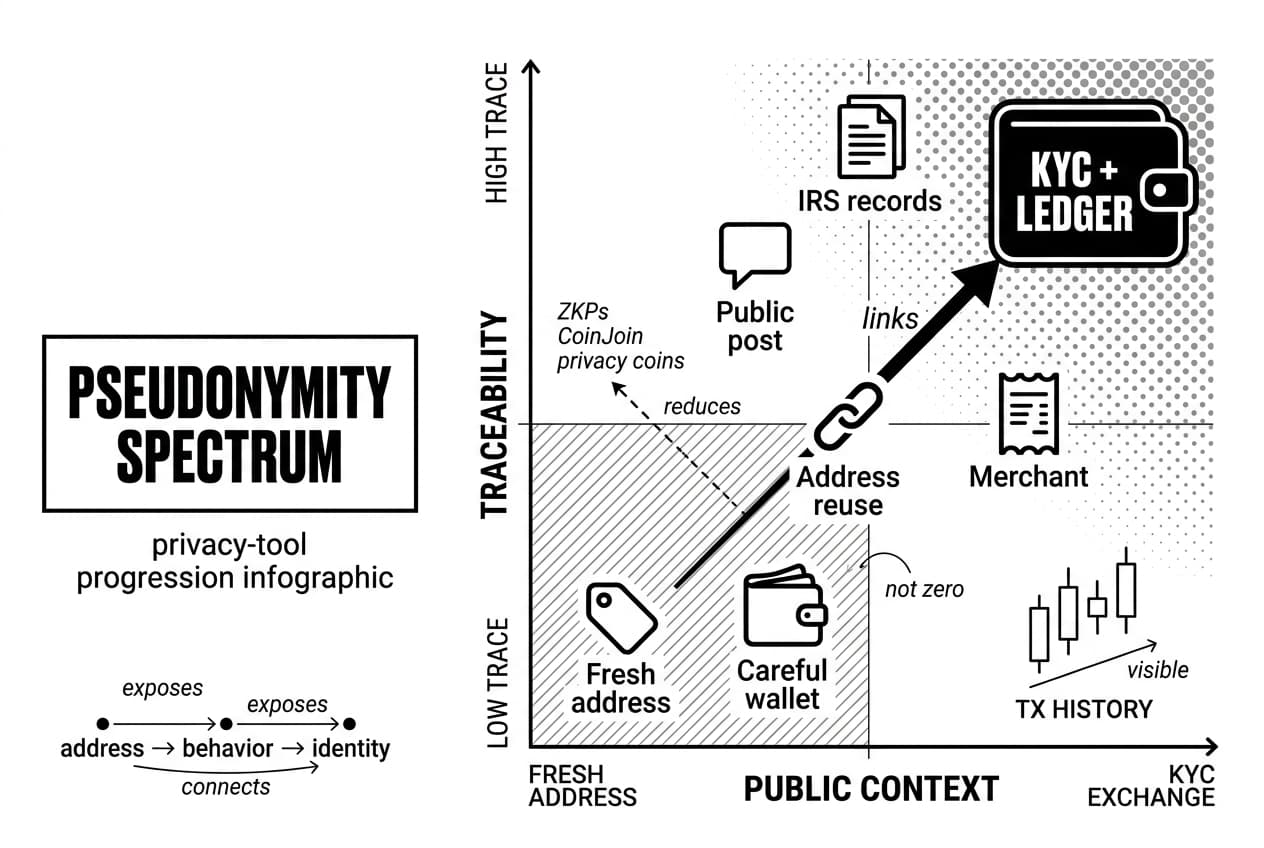
The safest mental model is a spectrum. At one end is a fresh address with no public context. At the other end is an address tied to a KYC exchange, a public profile, or a legal record. Understanding where your wallet sits on that spectrum is the practical answer to the question is blockchain anonymous in 2026.
Frequently Asked Questions
- Is blockchain truly anonymous?
- Most public blockchains are not truly anonymous — they are pseudonymous. Your wallet address may not display your legal name, but every transaction, balance, and timestamp is publicly recorded. Through exchange accounts, KYC records, or behavioral patterns, that data can sometimes be connected to a real person.
- Can a blockchain account be traced?
- Blockchain addresses can often be traced at the ledger level because all transaction history is public. Tying an address to a specific person typically requires off-chain clues — such as exchange accounts, reused addresses, social media posts, IP metadata, or clustering tools used by blockchain analytics firms.
- Can the IRS see your crypto wallet?
- Tax authorities may not automatically know every wallet owner, but they can request exchange records, analyze public blockchain data, and cross-reference deposits with withdrawals during audits. Maintaining accurate transaction records and consulting a qualified tax professional is strongly recommended for anyone holding or trading cryptocurrency.
- Which crypto is truly anonymous?
- No cryptocurrency can be called perfectly anonymous. Some privacy-focused protocols and shielded transaction systems offer stronger privacy than transparent chains, but actual anonymity depends on protocol design, how you use your wallet, network metadata, exchange connections, liquidity, and your own behavior patterns over time.
- Is a blockchain pseudonymous?
- Yes, most public blockchains are pseudonymous. Users transact through wallet addresses rather than legal names, but those addresses accumulate visible histories on the public ledger. If an address is linked to a person even once — through an exchange or data leak — past and future activity may become easier to analyze.
- Who is the pseudonymous creator of Bitcoin?
- Bitcoin's creator is known by the pseudonym Satoshi Nakamoto. Pseudonymous means operating under a name or identity that does not necessarily reveal a legal identity — the same principle that applies to blockchain wallet addresses, where users interact under an alias rather than their real name.
- Who is 34xp4vRoCGJym3xR7yCVPFHoCNxv4Twseo?
- That appears to be a Bitcoin wallet address, not a person. Any address can be viewed on a block explorer, and analytics firms sometimes apply labels to well-known addresses. However, confirmed ownership requires a direct statement from the holder or independently verified evidence — a public address alone does not identify anyone.
- What does pseudonymous mean in crypto?
- In crypto, pseudonymous means your activity is tied to an alias — typically a wallet address — rather than a legal identity. That alias is not inherently private; it can accumulate a visible transaction history and even develop a recognizable reputation over time, depending on how consistently it is used.
Sources
Author

Crypto analyst and blockchain educator with over 8 years of experience in the digital asset space. Former fintech consultant at a major Wall Street firm turned full-time crypto journalist. Specializes in DeFi, tokenomics, and blockchain technology. His writing breaks down complex cryptocurrency concepts into actionable insights for both beginners and seasoned investors.