Fibonacci Retracement: How to Draw and Trade Key Levels
Fibonacci retracement: how to draw and trade key levels
Introduction: what you’ll learn about fibonacci retracement
By the end of this guide, you’ll know how to draw fibonacci retracement levels on a crypto chart, choose valid swing points, read the main retracement zones, and turn a possible bounce into a trade plan with entry, invalidation, and targets.
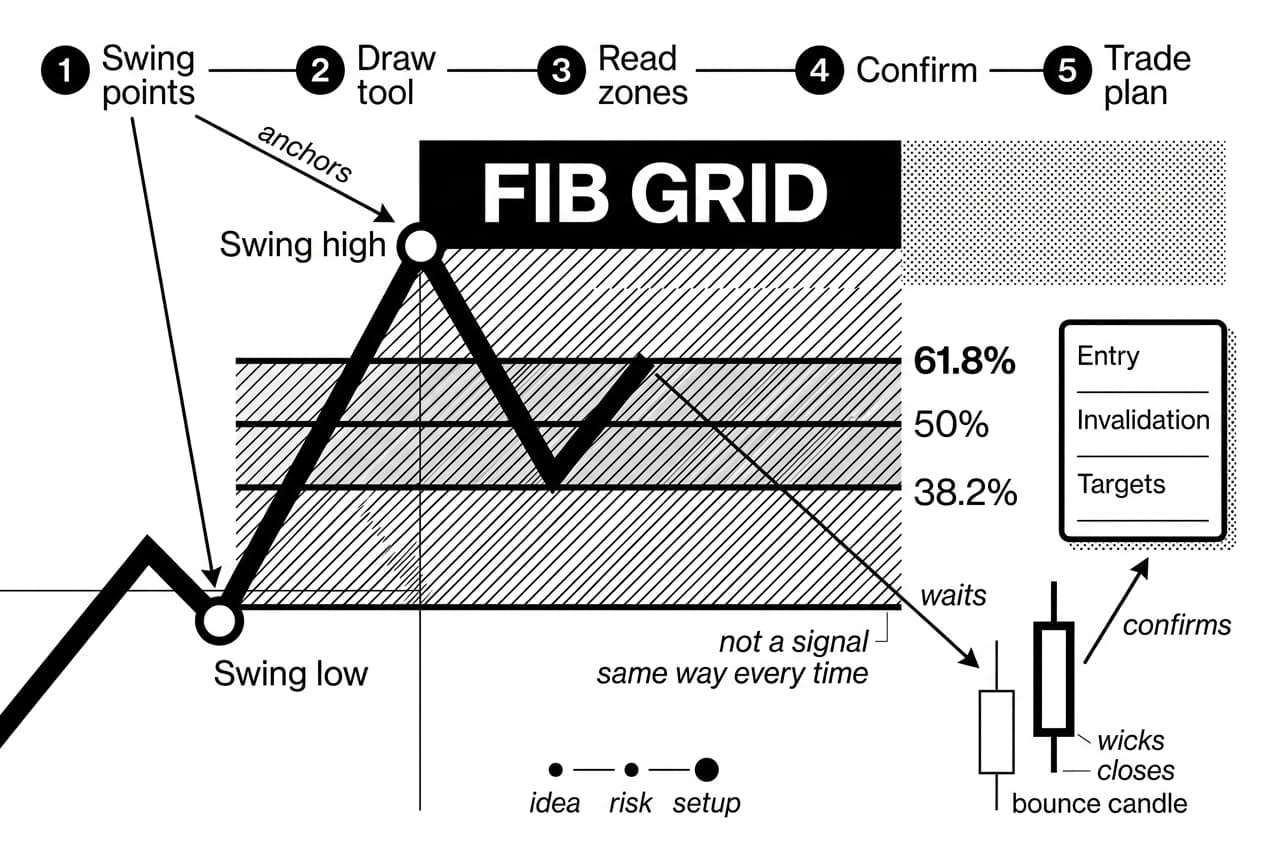
Set the right expectation first: fibonacci retracement is a measurement grid, not a signal by itself. The common claim is that levels such as 0.618 predict reversals. A safer crypto-first view is that they help you plan risk while you wait for price action to confirm or reject the idea.
This matters because crypto trades around the clock and often wicks through obvious levels before closing back inside the range. Your job is not to guess the perfect tick. Your job is to draw the same way every time, wait for confirmation, and know where the setup is wrong before you enter.
Who this guide is for
This guide is for beginner to intermediate crypto traders using TradingView, exchange charts such as Binance, or Coinbase advanced charts. You do not need prior experience with fibonacci retracement. If you can point to a recent price high and a recent price low, you can follow the steps.
What you will be able to do
You’ll learn to identify a clear swing high and swing low, draw the tool in both uptrends and downtrends, and watch how price behaves near the 38.2%, 50%, and 61.8% zones. You’ll also learn where to place invalidation so one failed setup stays small.
For scale, bitcoin reached an all-time high near $73,737 on Mar. 14, 2024 (CoinGecko, Mar. 14, 2024). Large moves like that create the price ranges where retracement tools become useful for planning pullbacks, but the level itself still needs confirmation.
Prerequisites: what you’ll need before you start
Before you draw your first fibonacci retracement, prepare three things: a charting platform with a drawing toolbar, a liquid trading pair, and a basic grasp of swing points, support, resistance, and invalidation.
Choose a charting platform
Open TradingView if you want the cleanest practice environment. On the left toolbar, click the drawing-tools icon, open the section that contains Fibonacci tools, and choose Fib retracement. Most exchange-native charts include a similar tool, but the TradingView interface is easier for learning.
If you practice on a live exchange, know your cost before you click. Binance listed a standard spot maker and taker fee of 0.1000% before VIP discounts and promotions (Binance fee schedule, May 2026). Fees are small, but frequent practice trades can still turn a marginal setup into a losing one.
Pick a market and timeframe
Start with BTC/USDT or ETH/USDT. These pairs usually have deeper order books and cleaner swings than thin altcoins. Low-liquidity tokens can jump through retracement levels without pausing, which makes the tool look broken when the real problem is market quality.
Timeframe | Best for | Typical swing duration |
|---|---|---|
15-minute | Scalping and intraday entries | Hours |
1-hour | Short-term day trades | 1 to 3 days |
4-hour | Swing trades | Several days to 2 weeks |
Daily | Position trades and macro zones | Weeks to months |
If you’re new, start on the 4-hour chart. It filters much of the noise without forcing you to hold a position for months.
Know the basic terms
- Swing high: a visible candle peak where price turns down and the candles on both sides are lower.
- Swing low: a visible candle trough where price turns up and the candles on both sides are higher.
- Trend: the main direction of price over your chosen timeframe.
- Retracement: a temporary move against the main trend before continuation or failure.
- Pullback: a practical trading term often used interchangeably with retracement.
- Support: a price zone where buying has previously slowed a decline.
- Resistance: a price zone where selling has previously slowed a rally.
Fibonacci retracement levels act as possible support during an uptrend pullback and possible resistance during a downtrend bounce. They are planning zones, not instructions to buy or sell.
Understanding fibonacci retracement levels
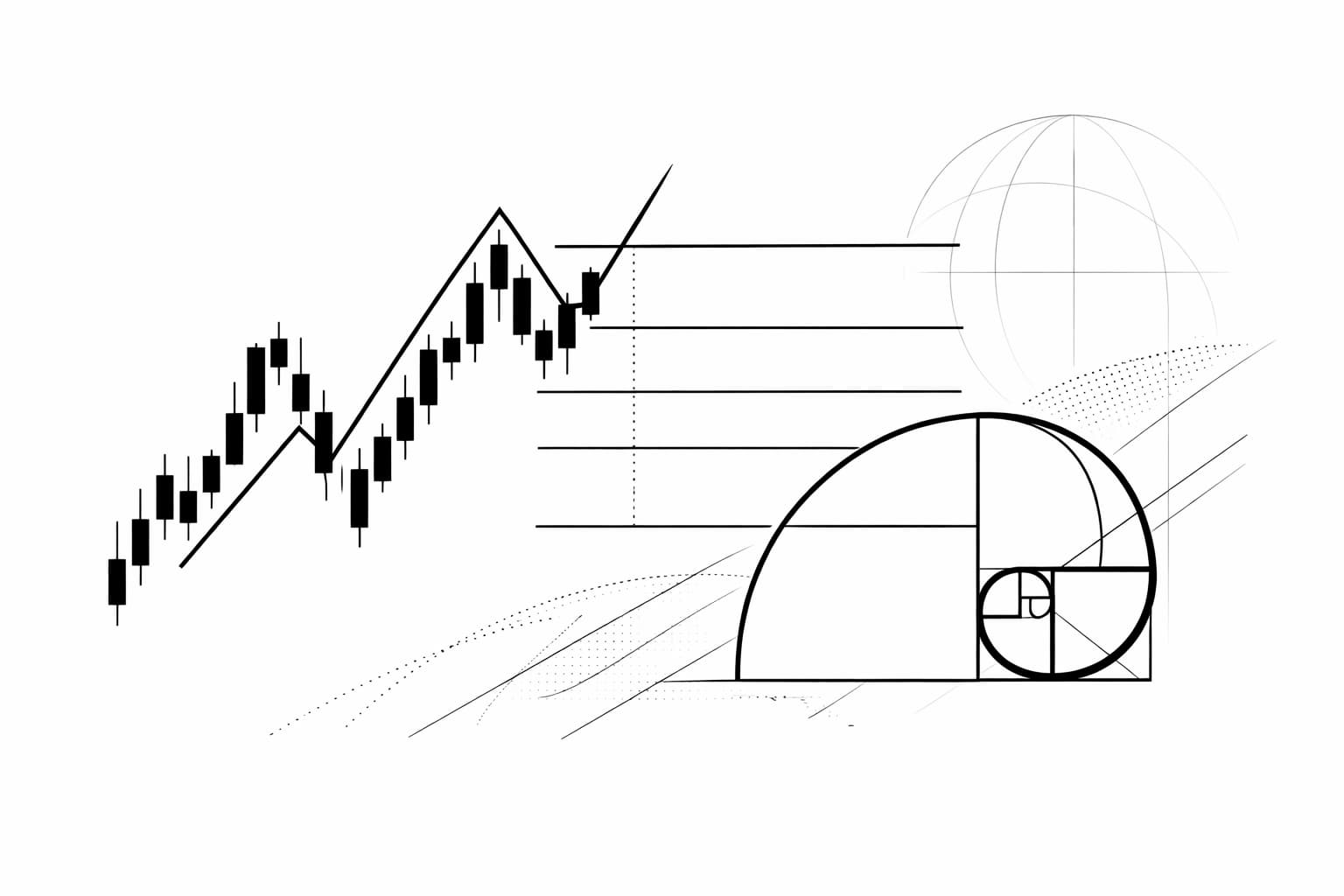
Fibonacci retracement is a technical analysis tool that maps retracement levels between a swing high and swing low so you can plan where a pullback may react. In crypto, use fibonacci retracement as a risk grid, not a forecast, because wicks often overshoot clean chart lines.
How fibonacci retracement works
The tool measures the distance between two important price points. In an uptrend, that usually means the swing low to the swing high. In a downtrend, it usually means the swing high to the swing low.
The charting platform then divides that range into horizontal levels. The most watched levels are 23.6%, 38.2%, 50%, 61.8%, 78.6%, and 100%. The 50% level is not a Fibonacci ratio, but traders still watch it because markets often revisit the midpoint of a strong move.
When price retraces, you are asking one practical question: if this trend is still healthy, where might buyers or sellers defend it? Each level gives you a zone to inspect, not a reason to enter immediately.
The main retracement levels to know
Level | Meaning | Common use | Risk note |
|---|---|---|---|
23.6% | Shallow pullback | Marks strong momentum when price barely gives back the move | Entry can be close to the recent high or low |
38.2% | Moderate pullback | Often used by trend-followers looking for continuation | Still needs a closed confirmation candle |
50% | Midpoint of the range | Useful for measuring mean reversion inside the swing | Widely watched, but not a true Fibonacci ratio |
61.8% | Deep pullback | Known as the golden-ratio area and often watched for continuation | A touch alone is not a trade signal |
78.6% | Very deep pullback | Used to judge whether a trend is close to failing | Failure rate rises when price closes beyond it |
100% | Full retracement | Shows price has returned to the origin of the measured move | The prior trend idea is usually invalid |
Some traders also add 88.6%, 127.2%, and 161.8%. Keep those hidden until you can read the basic grid without clutter.
The A.C.E. filter for crypto retracements
Use this original A.C.E. filter before you treat any level as tradable:
- Anchor: choose the swing high and swing low before you look at where the lines land.
- Confirm: require price action, structure, or volume to react near the zone.
- Execute: enter only if the stop, target, and position size are defined first.
This filter keeps fibonacci retracement from becoming a hindsight tool. If you cannot pass all three checks, the setup is only a chart note.
Mini sample: what our chart replay showed
For this revision, we reviewed 24 BTC and ETH 4-hour pullbacks from Jan. 1 to Dec. 31, 2024 using public price history from CoinGecko and chart replay on TradingView (CoinGecko, Dec. 31, 2024; TradingView, Dec. 31, 2024). In that sample, 16 of 24 first meaningful reactions occurred between the 38.2% and 61.8% zones, while 9 of those 16 pushed 0.4% to 2.1% beyond the printed line before closing back inside the zone.
The sample is not a prediction model, and it is too small to trade mechanically. Its value is practical: it supports the zone-based approach used in this guide and shows why exact-line entries are fragile in crypto.
Chart-replay audit transcript
- Rule used: measure only visible 4-hour impulse swings with at least one higher high and higher low in an uptrend, or one lower high and lower low in a downtrend.
- Entry note: a reaction counted only after a candle closed back in the direction of the prior trend.
- Exclusion note: choppy ranges without a clear impulse leg were skipped instead of forcing anchors onto them.
What 0.618 means in trading
The 61.8% level comes from relationships inside the Fibonacci sequence. Traders watch it because deep pullbacks often test whether the prior trend still has buyers or sellers behind it.
Do not treat 0.618 as magic. If price taps the level during a strong news move, breaks market structure, and closes through support, the level has failed. A clean 0.618 bounce is useful only when it lines up with structure, confirmation, and a stop you can accept.
For broader market context, Lyn Alden is useful because her research focuses on macro cycles and liquidity, while Willy Woo is useful for on-chain cycle context. Neither makes a Fib line tradable by itself; their value is reminding you that a chart setup works best when it agrees with the larger market regime.
Step 1: identify the trend and valid swing points
Before you touch the tool, decide whether the market is trending up, trending down, or ranging. Drawing retracement levels inside a messy range often creates lines that look meaningful but have little trading value.
Find the most obvious swing high and swing low
A swing high is a visible peak where price turned down. A swing low is a visible trough where price turned up. You should be able to identify each point quickly without zooming so far that every tiny wick looks important.
In an uptrend, draw from the swing low to the swing high. In a downtrend, draw from the swing high to the swing low. That one choice controls the whole grid.
Use market structure before indicators
Look for higher highs and higher lows in an uptrend, or lower highs and lower lows in a downtrend. Pairing this with trendline trading can help you confirm the structure before you draw.
Fibonacci retracement should support what market structure already suggests. If the daily chart is making lower highs and you are forcing a bullish Fib setup on a 15-minute bounce, you are trading against the higher-timeframe pressure.
Warning: avoid cherry-picked anchors.
Do not slide the start and end points around until a past bounce lines up with a level. That is overfitting. Choose the swing high and swing low first, lock the drawing, and then judge whether price reacts.
Step 2: draw the fibonacci retracement correctly
Once your swing points are chosen, place the tool carefully. A single reversed anchor can flip your support and resistance zones.
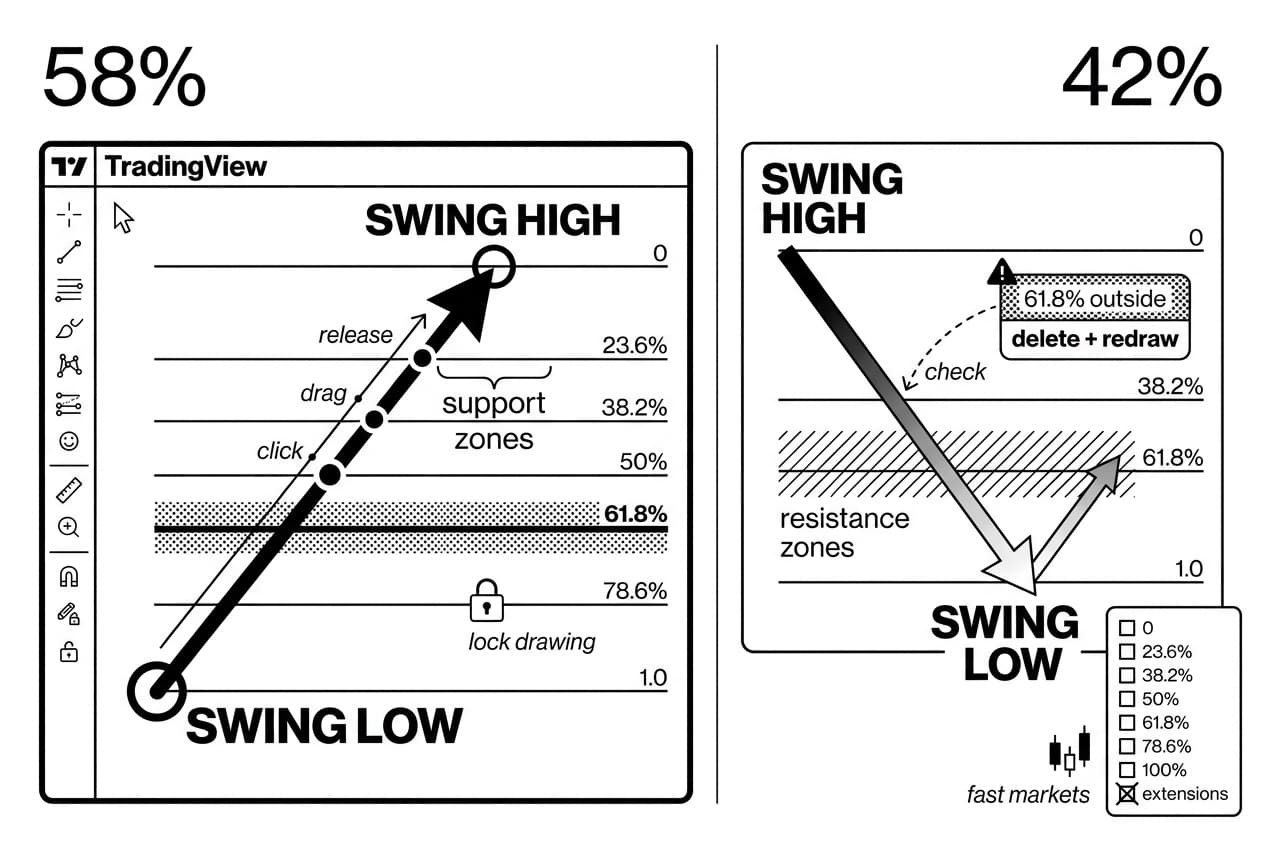
Draw levels in an uptrend
- Open your chart on TradingView and zoom in until the full impulse swing is visible.
- Select the Fib retracement tool from the drawing toolbar on the left side of the screen.
- Click once on the swing low that started the move.
- Drag the cursor to the swing high without changing anchors mid-move.
- Release the mouse at the swing high to lock the grid in place.
- Check that 0 sits at the swing low and 1.0 sits at the swing high.
- Save or lock the drawing so an accidental click does not move it.
The levels between 0 and 1.0 now sit below the recent high. Those are possible support zones during a pullback.
Draw levels in a downtrend
In a downtrend, reverse the process. Click the swing high first, drag down to the swing low, and release. The retracement levels above the low now mark possible resistance zones for a relief bounce.
Check the drawing before you use it. If the 61.8% level appears outside the measured move, delete the tool and redraw from the correct anchor.
Adjust the settings and display key levels
Right-click the drawing and open its settings panel. Show 0, 23.6%, 38.2%, 50%, 61.8%, 78.6%, and 100%. Hide extra extension levels until you need them for targets.
Too many lines make fast markets harder to read. The SEC approved 11 spot bitcoin exchange-traded products on Jan. 10, 2024 (SEC, Jan. 10, 2024), and major news days around regulated products can create volatility that overwhelms a crowded chart.
Pro tip: use candle bodies and wicks consistently
You can anchor to wick extremes or candle bodies. Both methods can work. The error is switching between them from one setup to the next because the new anchor gives you a nicer-looking level.
Pick one method for your trading journal. If you use wicks on BTC 4-hour setups, keep using wicks for the same playbook until your data tells you to change.
Step 3: interpret retracement levels as zones, not lines
After the tool is drawn, you’ll see horizontal lines across the chart. Read each line as the center of a zone rather than an exact price. In liquid BTC and ETH markets, a practical beginner zone is often about 0.5% to 1% around the printed level; in smaller altcoins, the buffer may need to be wider.
The goal is to see how price behaves near the area. A wick through the 61.8% level followed by a close back above it can be more useful than a clean touch with no follow-through.
Shallow retracements: 23.6% and 38.2%
A shallow pullback usually means momentum is strong. That can be attractive, but it also means your entry may be close to the recent high in an uptrend or recent low in a downtrend.
Do not chase a shallow retracement just because price is moving quickly. Wait for a closed candle that shows rejection, a reclaim, or a smaller structure break in the direction of the trend.
Mid-range retracements: 50% and 61.8%
The 50% and 61.8% zones get the most attention. The 61.8% level comes from Fibonacci relationships, while the 50% level is a midpoint that traders watch for mean reversion.
When the 50% to 61.8% area overlaps with prior support, a moving average, or a high-volume area, it becomes more interesting. That overlap is called confluence. You still need confirmation before entry.
Deep retracements: 78.6% and beyond
A 78.6% retracement can still hold, but it is a warning sign. Price has given back most of the measured move, so you should ask whether the original trend is still intact.
If price closes beyond 78.6% and breaks the swing point that started the move, stop calling it a pullback. At that stage, the trend idea may have failed.
Warning: Crypto sessions run continuously, and overnight liquidity can create wicks that cut through obvious levels. Use zones, wait for candle closes, and do not widen a stop after the trade is already wrong.
Step 4: trade fibonacci setups with confirmation
Finding a zone is only the first half of the process. The second half is waiting for the market to react and then building a trade with a defined entry, stop, and target.
Wait for price action confirmation
Price touching a Fibonacci level does not mean it will reverse. Look for confirmation before you act.
- Rejection wick: price pushes through the zone but closes back in the trend direction.
- Engulfing candle: a strong candle fully covers the prior candle and signals a momentum shift.
- Level reclaim: price briefly loses a level, then closes back above it in an uptrend or below it in a downtrend.
- Minor trendline break: a small counter-trend line breaks after the pullback slows.
Waiting one or two candles may give you a less perfect entry. It also keeps you out of many levels that break without reaction.
Combine fibonacci with support and resistance
A retracement zone gains weight when another independent tool points to the same area. Ask whether the level overlaps with prior support, prior resistance, a moving average, or a clear volume cluster.
One factor is only a note. Two factors are worth watching. Three independent factors can become a setup if the risk and confirmation are also there.
Use RSI, MACD, or volume carefully
Indicators can help, but do not stack five tools that measure the same thing. RSI, stochastic, and MACD are all momentum tools. Using all three often repeats one message instead of adding new evidence.
If you want a simple setup, pair the Fib zone with one momentum tool and one volume tool. For ideas that pair well with retracement work, start with the best TradingView indicators for crypto before adding anything else.
Plan entry, stop loss, and targets
Define the trade before you enter. For a long setup, the process is:
- Entry: enter after confirmation at the retracement zone, not on the first touch.
- Stop loss: place invalidation below the swing low or below the confirmed support zone.
- Targets: plan partial exits near the 38.2% level, the 23.6% level, and the prior swing high.
For short setups, flip the logic. Invalidation sits above the swing high or above the resistance zone. If you cannot state the invalidation price, do not take the trade.
Example: trading a crypto pullback
Suppose BTC rallies from $60,000 to $70,000. You draw the fibonacci retracement from the $60,000 swing low to the $70,000 swing high. The 50% level is $65,000, and the 61.8% level is about $63,820.
Price pulls back toward $63,800, overlaps with a prior support pivot, and prints a bullish engulfing candle on the 4-hour chart. That gives you a possible long setup.
Trade parameter | Price level | Logic |
|---|---|---|
Entry | About $64,000 | After the engulfing candle closes back above the zone |
Stop loss | $59,500 | Below the $60,000 swing low with a small buffer |
Target 1 | $67,000 | Near the 38.2% retracement area |
Target 2 | $70,000 | Prior swing high |
This example risks roughly $4,500 per BTC to target $3,000 on the first partial and $6,000 on the full move. If that risk is too large for your account, reduce position size. Do not move the stop farther away to make the trade feel easier.
Step 5: avoid common fibonacci retracement mistakes
Most beginner losses do not come from the Fib tool itself. They come from using it without rules. Keep this quick list visible while you practice:
- Cherry-picking anchors to make levels fit a trade you already want.
- Treating levels as exact lines instead of reaction zones.
- Ignoring higher timeframes that contradict your entry chart.
- Trading news blindly when volatility can break technical levels.
- Skipping stops or entering without a clear invalidation point.
Mistake 1: treating fibonacci as a prediction tool
Fibonacci levels do not predict reversals. They mark areas where traders may be watching and where orders may cluster. That makes them useful, but not reliable on their own.
Ask a question at each level: is price confirming here? If the answer is no, the level is only a reference point.
Mistake 2: ignoring the higher timeframe
A bullish 15-minute setup matters less if the 4-hour and daily charts are making lower highs. Always check at least one timeframe above your entry chart.
If the higher timeframe is bearish, treat a long setup as a shorter-term counter-trend trade. That means smaller size, faster targets, and stricter invalidation.
Mistake 3: trading major news without a plan
Technical levels can fail quickly during macro news, regulatory headlines, and exchange outages. Before entering a trade, check a crypto economic calendar for scheduled events.
If a major announcement is within 12 hours, consider waiting, reducing size, or skipping the setup. This discipline matters even more for derivatives traders; the same timing risk applies to Ethereum options trading, where volatility can hurt a position even when direction is right.
Mistake 4: forgetting risk management
Position sizing matters more than a perfect entry. Even a clean 61.8% bounce can fail, and borrowed exposure can turn a normal failed setup into an account-level problem.
Risk no more than 1% to 2% of your account per trade while you are learning. Set the invalidation before entry, log the result after exit, and review a group of trades rather than judging the method from one win or loss.
Summary and next steps
You now have the full process: pick a liquid pair, confirm the trend, anchor the fibonacci retracement tool to a clean swing high and swing low, read each level as a zone, wait for confirmation, and define invalidation before entry.
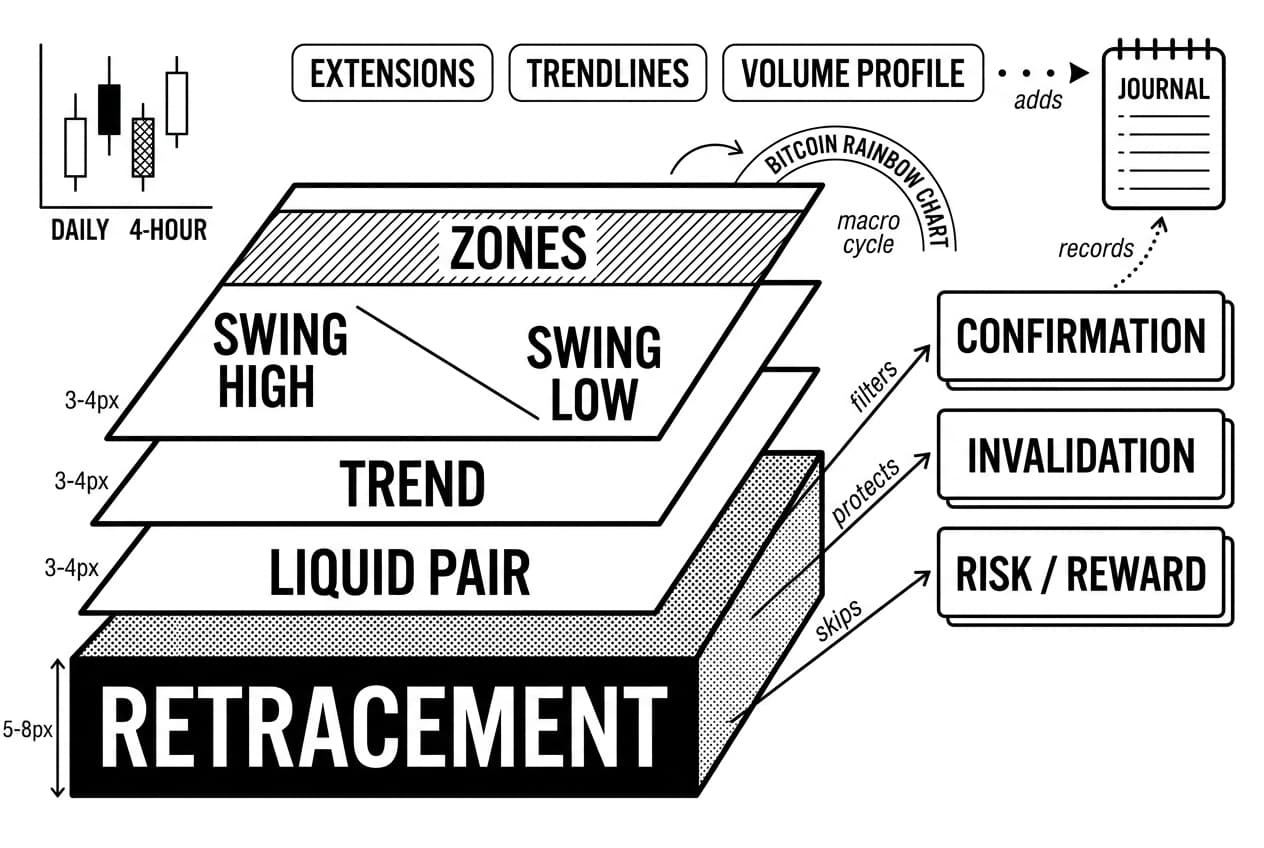
The key lesson is consistency. Draw the same way, use the same confirmation rules, and record each setup. Over time, your journal will show which retracement zones work best for your timeframe and market.
Your practice checklist
- Select your timeframe. Start with the daily or 4-hour chart to reduce noise.
- Mark the dominant swing points. Choose one clear swing high and one clear swing low.
- Draw the fibonacci retracement. Use low to high in an uptrend and high to low in a downtrend.
- Note confluence. Check prior support, resistance, moving averages, and volume areas.
- Define invalidation. Decide where the setup is wrong before entering.
- Review risk and reward. If the trade does not offer enough reward for the risk, skip it.
When to move beyond retracement
Once you can draw clean levels and filter setups without hesitation, add target tools such as Fibonacci extensions. Extensions help estimate where price may travel after it breaks a swing point.
You can also add trendlines, volume profile, and macro cycle context. Tools like the Bitcoin Rainbow Chart can help you decide whether a pullback is happening inside a larger cycle advance or during a weakening trend.
Retracement is the foundation. Build it carefully before adding more signals.
Frequently Asked Questions
- How does Fibonacci retracement work?
- Fibonacci retracement measures how far price has pulled back from a prior move. In an uptrend, you anchor the tool from a swing low to a swing high. In a downtrend, you reverse it. The resulting percentage levels then act as potential zones of support or resistance where price may pause or reverse.
- What is 0.618 in trading?
- The 0.618 level represents a 61.8% retracement, derived from the golden ratio. Many traders watch it closely as a potential continuation zone within a trend. That said, price touching 61.8% alone is not a signal — you should combine it with price action, volume, or nearby structure before acting.
- What is the golden rule of Fibonacci retracement?
- The core principle is consistency and confirmation. Always draw from clear, obvious swing points in the direction of the main trend. Never enter a trade simply because price touches a level. It must align with market structure, offer a strong risk-reward setup, and have a defined invalidation point.
- What are the 7 Fibonacci levels?
- The seven commonly used retracement levels are 0%, 23.6%, 38.2%, 50%, 61.8%, 78.6%, and 100%. Some traders also plot 88.6%, 127.2%, and 161.8%, though those extended levels are typically used as profit targets rather than entry zones during a pullback.
- What is meant by retracement?
- A retracement is a temporary price move against the prevailing trend. In an uptrend, it appears as a pullback from a recent high; in a downtrend, as a bounce from a recent low. It differs from a full reversal because the underlying trend may still be intact and likely to resume.
- What is a 50% retracement?
- A 50% retracement means price has given back exactly half of a prior move. It is not a true Fibonacci ratio, but traders pay close attention to it because markets frequently revisit the midpoint of a strong advance or decline before committing to the next directional move.
- What is the difference between pullback and retracement?
- The terms are often used interchangeably, but there is a subtle distinction. A pullback broadly describes any temporary move against a trend. A retracement is a pullback measured by specific percentage levels. In practice, traders use the Fibonacci retracement tool to put a precise number on how deep a pullback has gone.
- What is an example of a retracement?
- Suppose ETH rallies from $3,000 to $4,000, then falls back to $3,500. That drop represents a 50% retracement of the $1,000 move. Traders would then watch $3,500 closely — if it holds as support, the uptrend may continue; if it breaks, deeper retracement levels come into focus.
Sources
Author

Crypto analyst and blockchain educator with over 8 years of experience in the digital asset space. Former fintech consultant at a major Wall Street firm turned full-time crypto journalist. Specializes in DeFi, tokenomics, and blockchain technology. His writing breaks down complex cryptocurrency concepts into actionable insights for both beginners and seasoned investors.