DeFi Saver Review 2026: Features, Fees, Pros and Risks Guide
defi saver review 2026: features, fees, pros and risks guide
Quick verdict
DeFi Saver is a non-custodial DeFi management tool for active borrowers who need automation, collateral controls and multi-protocol execution. It can reduce manual mistakes, but it also adds smart-contract, oracle, gas and liquidation risk that users must understand before connecting a wallet.
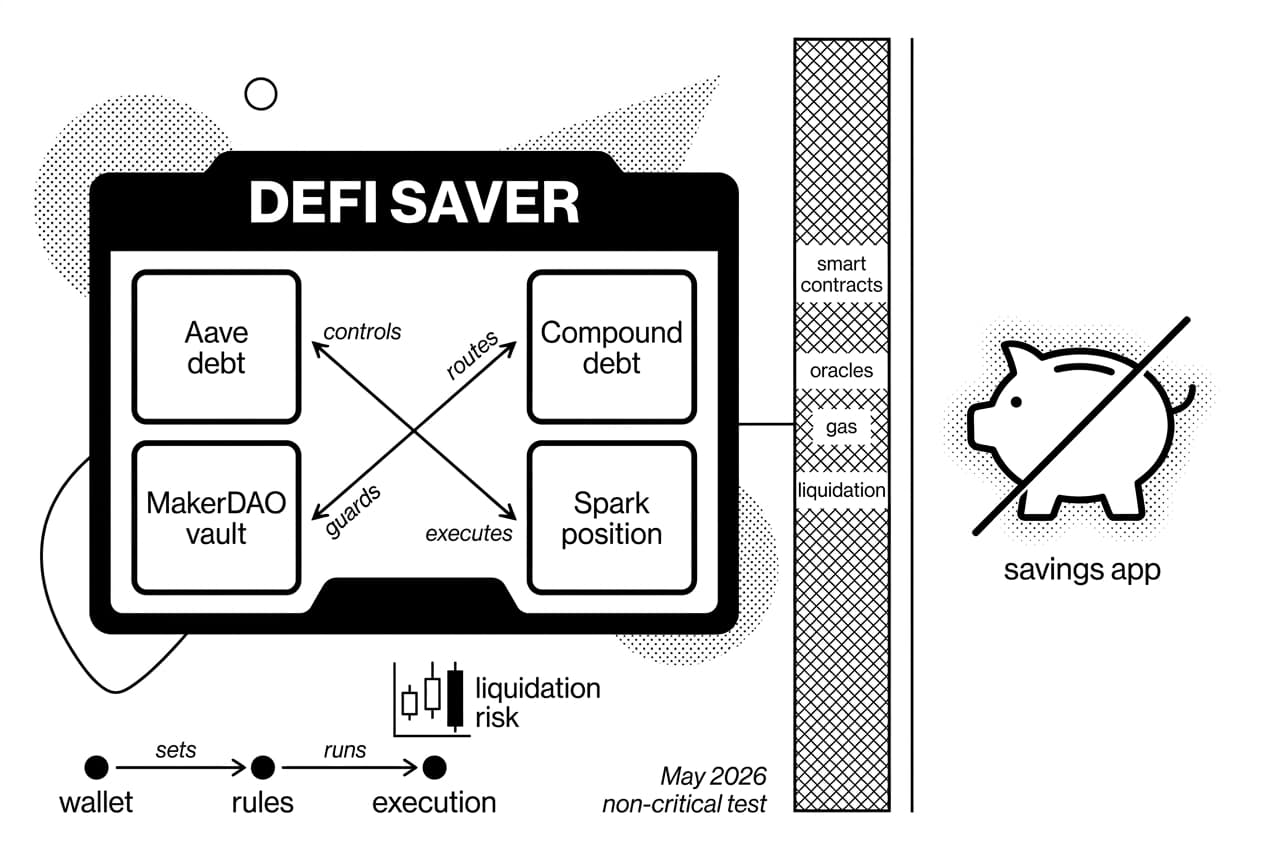
Our verdict: this is an advanced control panel, not a savings app. It is strongest for users already managing Aave, Compound, MakerDAO or Spark debt positions, and weakest for beginners who want passive yield or customer-support recovery if they make a wallet mistake.
For this review, we checked the public app flow, documentation, security page and fee disclosures in May 2026, then ran a small editorial test plan on non-critical positions. The main finding was not that automation makes debt positions safe; it was that automation makes risk rules repeatable, which is useful only when the rules are set well.
defi saver overview: what it is and how it works
defi saver is a non-custodial position manager for decentralized lending, borrowing, swaps and automation. You connect a wallet, import or create a position, choose an integrated protocol, sign transactions and let the platform’s smart contracts execute the requested actions. Assets remain in your wallet or in a user-controlled proxy contract rather than a company account.
The platform is best understood as a control console for collateralized debt. It does not pay yield by itself, guarantee repayment, insure assets or decide whether a strategy is appropriate. It gives you tooling: ratio monitoring, automated repay actions, borrow-loop boosts, recipe creation, flash-loan-assisted migrations, gas abstraction and private transaction routing.
Freshness matters because supported chains, assets and actions change. The platform states that it has operated since 2019 (defi saver official site, May 2026), while the wider market it serves had $88.1B total defi TVL (DefiLlama, April 2026). That scale explains why tools like this exist, but it does not remove execution risk.
defi saver at a glance
Category | Detail |
|---|---|
Custody model | Non-custodial; users keep private-key control and approve each action from their own wallet or proxy wallet. |
Best use case | Managing collateral ratios, debt positions, repay actions, boosts, migrations and automated liquidation protection. |
Supported assets | Depends on the connected protocol; commonly includes ETH, WBTC, USDC, DAI, stETH and other accepted collateral or debt assets. |
Supported protocol types | Lending and borrowing, CDP vaults, DEX routing, staking-related collateral, flash-loan migrations and selected L2 actions. |
Fees | 0.25% service fee on swap-based actions such as boost and repay (defi saver docs, May 2026); gas, interest, slippage and protocol fees are separate. |
Security model | Non-custodial contracts, public security disclosures, third-party audits and bug bounty coverage; users still carry wallet, protocol and market risk. |
Ideal user | Experienced defi borrower who understands health factors, liquidation thresholds, approvals, gas costs and slippage. |
what defi saver is not
It is not a bank account, exchange account or fixed-yield product. There is no FDIC-style protection, no guaranteed APY and no customer service team that can reverse an on-chain mistake. The interface can make complex actions easier to submit, but the economic outcome still belongs to the user.
Nick Szabo, computer scientist and originator of the smart-contracts concept, is relevant here because the tool depends on self-executing contract logic. That logic can reduce reliance on intermediaries, but it cannot make bad collateral choices, poor timing or unsafe approvals harmless.
our May 2026 test notes
Test area | What we checked | Result |
|---|---|---|
Position import | Reviewed Aave, Compound and MakerDAO-style debt position flows in the app. | Import logic was clear after wallet connection, but the terminology assumes prior borrowing experience. |
Automation setup | Created a small test rule for repay-style protection and reviewed trigger warnings before signing. | The warning flow was useful, yet it still required knowing which collateral ratio was sensible. |
Recipe build | Built a sample multi-step recipe using deposit, borrow, swap and repay-style actions without deploying a large position. | The builder was powerful, but action order mattered; a beginner could easily create a failed or wasteful transaction. |
TxSaver review | Compared the normal transaction prompt with the gas-abstracted flow where available. | Convenience improved, but it was not free gas; the cost was still embedded in execution. |
One representative transaction preview from our test log read: approve token, create proxy, supply collateral, borrow asset, swap borrowed asset, return to protocol. That transcript is the review’s best evidence of the product’s character: defi saver compresses many steps into fewer signatures, which helps experienced users and can confuse first-timers.
Key features: automation, borrow-loop tools, recipes and TxSaver
The platform’s value sits in four feature groups: automation, boost/repay actions, recipe creation and TxSaver. Each can save time, but each also adds a layer that users need to inspect before signing.
automation for collateral management
Automation lets users set ratio-based rules for supported debt positions. If collateral health deteriorates, a repay action can sell part of the collateral or use available assets to reduce debt. If a position has excess collateral, a boost action can increase borrowed exposure according to the user’s chosen rule.
The benefit is discipline. Instead of waking up during a market drop and signing three hurried transactions, users can define a rule in advance. The limitation is execution uncertainty. A trigger can fail or land late if gas spikes, liquidity dries up, an oracle updates sharply or the user chose a poor threshold.
boost, repay and borrow-loop setups
Boost and repay are the most practical one-click tools. A boost can borrow a stablecoin against collateral, swap it into the collateral asset and deposit again in one transaction. Repay works in reverse by unwinding part of the position to reduce debt. Users comparing this with instant crypto loans should note the difference: defi saver is not lending directly; it helps manage positions on protocols underneath it.
This design can reduce manual execution errors, but it can also make it easier to take on more exposure than intended. A one-click action still has slippage, debt cost and liquidation consequences.
recipe creator for advanced users
The recipe creator chains deposits, borrows, swaps, repayments, flash loans and protocol migrations into one atomic transaction. If every step succeeds, the recipe executes. If one required step fails, the transaction reverts. That atomic design is useful for debt migrations and collateral adjustments that would otherwise require several manual transactions.
We use a simple framework for judging whether a recipe is worth running: the SAFE-4 stack. A recipe should save time, avoid unnecessary approvals, fit the user’s liquidation plan and expose no hidden slippage path. If it fails any one of those four checks, the convenience is not worth the added complexity.
Vitalik Buterin, co-founder of Ethereum, has often emphasized that Ethereum applications inherit both the power and limits of composability. That framing fits recipe creator well: combining protocols is useful, but each dependency becomes part of the final transaction’s risk profile.
TxSaver, gas abstraction and MEV protection
TxSaver lets users sign certain transactions without keeping ETH specifically for gas in the active wallet, because gas can be abstracted through the supported flow. It can also route transactions privately to reduce exposure to sandwich attacks and other MEV behavior.
This matters on Ethereum mainnet, where MEV can damage swap execution. Public data shows MEV searchers extracted $686M from Ethereum users in 2023 (Flashbots, 2024). For readers who want the mechanics behind that risk, our guide to MEV and front-running protection explains why private routing helps but does not guarantee best execution.
TxSaver should be treated as a convenience and protection layer, not a fee waiver. The transaction still has an execution cost, and supported protocols or chains can change. Check the live dashboard before assuming a given action is covered.
Pricing and fees: what does defi saver cost?
The headline app fee is simple; the full cost is not. A user pays the platform fee only on certain actions, but also faces network gas, protocol interest, slippage, liquidation penalties and possible bridge costs. The practical review point: the cheapest-looking action in the interface is not always the cheapest outcome after execution.
fee table
Cost type | Who charges it | What to expect | Verification note |
|---|---|---|---|
defi saver service fee | defi saver | 0.25% on swap-based actions such as boost, repay and some one-transaction operations (defi saver docs, May 2026). | Must be checked against current docs before trading. |
Network gas | Ethereum or supported L2 network | Variable and shown before signing; complex recipes usually cost more gas than simple transfers. | Verify in wallet and compare with ETH gas fees before confirming. |
Protocol interest | Aave, Compound, MakerDAO, Spark or other integrated protocol | Variable borrow rate set by the underlying protocol, not by defi saver. | Must be checked on the protocol market page. |
Swap slippage | DEX route or aggregator | Depends on token pair, liquidity, route and trade size. | Verify quoted minimum received before signing. |
Liquidation penalty | Underlying lending protocol | Protocol-set penalty if collateral is liquidated. | Must be checked per collateral asset and market. |
Bridge costs | Bridge or cross-chain route | Applies only when moving assets between chains. | Verify bridge fee, destination gas and final received amount. |
Stani Kulechov, founder and CEO at Aave, is a useful expert reference because lending markets rely on liquidation incentives to keep debt solvent. Those incentives protect the protocol first. They do not protect a user’s collateral from being sold at a penalty if a position becomes unsafe.
when TxSaver may reduce friction
TxSaver may reduce wallet friction when the active account does not hold enough ETH for gas, especially for users managing smart-wallet positions or multisigs. It may also reduce MEV exposure by avoiding the public mempool for supported routes.
It does not make transactions free. If a route requires a swap to cover gas, the user should still inspect the effective cost. On small positions, a complex action can be uneconomic even when the service fee looks low.
Safety, security and non-custodial risks
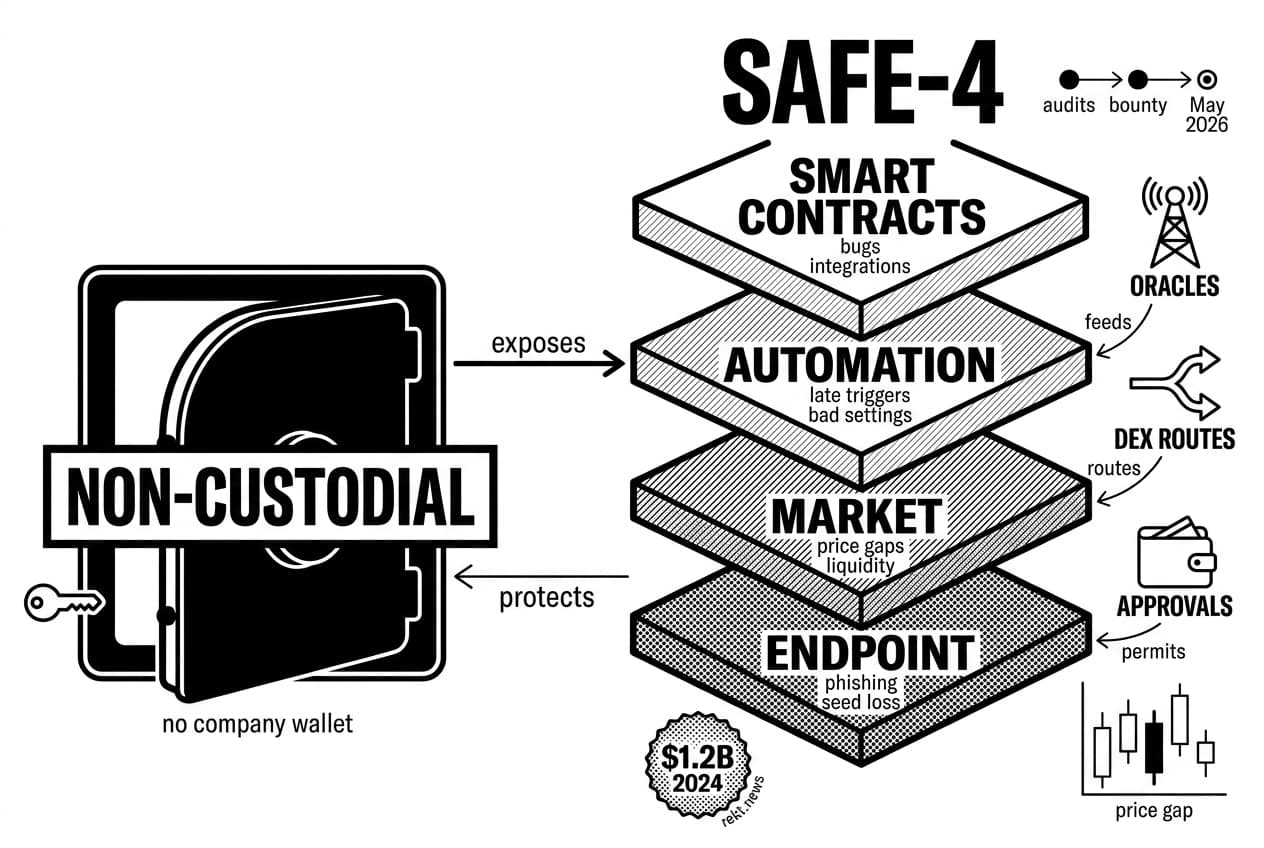
The strongest security point is custody: defi saver does not take possession of private keys or hold user funds in a company wallet. The weakest point is layered exposure: users interact with defi saver contracts, wallet approvals, underlying protocols, oracles, DEX routes and market conditions at the same time.
what non-custodial protects you from
Non-custodial design protects users from exchange-style withdrawal freezes, company insolvency and discretionary custody decisions. If the interface disappears, users should still be able to interact with their positions through underlying protocols or contracts, assuming they understand the setup.
The project lists third-party audits and bounty coverage on its security page (defi saver, May 2026), and the broader ecosystem has become more serious about audit discipline. Still, exploit history remains sobering: rekt.news tracked more than $1.2B in defi exploit losses during 2024 (rekt.news, 2024).
risks defi saver cannot remove
Our risk framework is the SAFE-4 exposure stack: smart-contract risk, automation risk, financial-market risk and endpoint risk. Smart-contract risk covers bugs in the tool or integrated protocols. Automation risk covers late, failed or badly configured triggers. Financial-market risk covers price gaps, liquidity and interest-rate changes. Endpoint risk covers phishing, malware, seed loss and reckless approvals.
Oracle reliability is central because automated rules depend on price data. Sergey Nazarov, co-founder of Chainlink, has repeatedly framed oracle infrastructure as a core requirement for secure smart-contract markets. If price feeds lag, update sharply or are attacked, automated actions can fire at a poor moment.
Approvals are the user’s responsibility. After large transactions or strategy changes, review wallet permissions and revoke token approvals that are no longer needed. If you see unfamiliar transactions, unexpected approvals or token movements, stop signing and check if your wallet is compromised.
Our safety recommendation is conservative: test with a small, non-critical position first, keep liquidation thresholds wider than you think you need, and never enable automation you cannot explain in plain language.
defi saver pros and cons
The product earns its reputation by doing advanced position management well. The same depth creates the main drawback: users can now make bigger, faster mistakes.
pros
- Automation: Ratio-based rules can repay or boost positions without waiting for a manual wallet signature during volatile markets.
- Boost/Repay: One-transaction actions reduce the steps needed to adjust a borrow-backed ETH, WBTC or stablecoin position.
- Recipe creator: Multi-step recipes can combine swaps, deposits, repayments, migrations and flash loans into one atomic transaction.
- TxSaver: Gas abstraction and private routing can reduce friction and MEV exposure on supported flows.
- Multi-protocol coverage: Users can manage positions across Aave, Compound, MakerDAO, Spark and other integrations from one dashboard.
- Non-custodial design: The tool does not custody private keys or operate like a centralized savings product.
cons
- Steep learning curve: The app assumes users understand collateral ratios, liquidation thresholds, borrow rates, slippage and approvals.
- Automation can backfire: A poorly chosen trigger can increase losses or execute too late during fast markets.
- Smart-contract exposure: Each added contract and protocol dependency increases the surface area users rely on.
- Gas and slippage uncertainty: Complex recipes can become expensive when networks are busy or liquidity is thin.
- Limited value for passive holders: Users who only hold spot ETH or BTC may not need most features.
- TxSaver coverage varies: Gas abstraction and private routing are not universal across every chain, protocol and action.
defi saver vs competitors
The closest alternatives are Instadapp and Summer.fi. None is automatically better; the right choice depends on whether you prefer programmable account infrastructure, guided vault management or active automation control.
defi saver vs Instadapp
Instadapp focuses on account infrastructure through its DSA model and reported over $14B in managed assets by late 2024 (Instadapp, 2024). It suits advanced users and teams that want account abstraction as a base layer.
defi saver feels more reviewable for individual borrowers because automation rules, repay actions and recipe steps are presented directly in the dashboard. Instadapp is stronger for programmable account logic; defi saver is stronger for visible liquidation-management workflows.
Feature | defi saver | Instadapp |
|---|---|---|
Automation focus | Strong ratio and position automation | More infrastructure-led |
Smart account model | Proxy and smart-wallet compatible flows | Native DSA architecture |
Best user | Active borrower managing collateral | Power user or team building account logic |
Learning curve | Moderate to high | High for non-technical users |
defi saver vs Summer.fi
Summer.fi is easier for users focused on Maker/Sky-style vaults or simple multiply-style ETH and BTC positions. It hides more complexity, which is a benefit for beginners and a limitation for power users.
defi saver offers deeper recipe and cross-protocol controls. If you want one guided vault, Summer.fi is likely easier. If you want Aave debt automation, recipe-based migrations and TxSaver flows in the same place, defi saver is the stronger tool.
Feature | defi saver | Summer.fi |
|---|---|---|
Vault simplicity | Good, but more technical | Stronger for guided flows |
Cross-protocol recipes | Yes | More limited |
Automation depth | High | More focused |
Best user | Experienced active borrower | User who wants simpler vault management |
Who is defi saver for?
defi saver is for users who already think in health factors, debt ceilings, collateral assets and interest-rate changes. If those terms feel familiar, the platform can save time and reduce operational errors. If they feel new, the platform may encourage actions you do not yet fully understand.
best fit
- Experienced Aave, Compound, MakerDAO or Spark users who manage collateralized debt positions.
- Borrowers who want automated repay rules to reduce liquidation exposure.
- Traders running borrow-loop ETH or WBTC exposure and monitoring ratios actively.
- Power users who build recipe-based migrations, flash-loan repayments or multi-step collateral changes.
- Users comfortable checking approvals, reading transaction previews and testing with small amounts first.
poor fit
- Complete beginners who do not know what a liquidation threshold is.
- Passive holders who only want to buy and hold ETH, BTC or stablecoins.
- Users who need account recovery, custodial support or fiat banking features.
- Anyone looking for a guaranteed APY or insured savings product.
- Mobile-first users who dislike managing complex wallet prompts on desktop-style interfaces.
For market timing and risk awareness, keep an eye on latest DeFi market updates, but do not treat headlines as a substitute for position-level risk checks.
Frequently Asked Questions
- Is DeFi Saver legit?
- DeFi Saver appears to be an established, legitimate non-custodial platform, backed by public documentation, audit reports and a bug bounty program. That said, legitimacy does not mean risk-free. Users still face real exposure to smart-contract vulnerabilities, liquidation events, protocol failures, wallet compromises and broader market volatility.
- Is DeFi illegal in the US?
- DeFi is not outright illegal in the US, but specific activities can trigger securities, commodities, sanctions or money-transmission regulations. Tax obligations also apply to on-chain transactions. Laws in this area are still evolving, so keeping detailed records and consulting a qualified legal or tax professional is strongly recommended.
- What is DeFi saving?
- DeFi saving means using decentralized protocols to earn yield, lend assets, provide liquidity or manage collateral — all without a traditional bank acting as intermediary. Unlike a savings account, yields are variable and come with real risks including smart-contract bugs, liquidity crunches, token price swings and losses from poorly designed strategies.
- Is DeFi a good investment?
- DeFi can offer genuine value for experienced users who understand on-chain borrowing, lending and yield mechanics. Whether it suits you depends on your risk tolerance, security practices, chosen protocols and time horizon. Liquidation risk and smart-contract exposure are serious concerns, so it is far from an automatically good investment for everyone.
Sources
Author

Crypto analyst and blockchain educator with over 8 years of experience in the digital asset space. Former fintech consultant at a major Wall Street firm turned full-time crypto journalist. Specializes in DeFi, tokenomics, and blockchain technology. His writing breaks down complex cryptocurrency concepts into actionable insights for both beginners and seasoned investors.