DeFi Protocols by TVL: Top 10 Platforms Ranked in 2026
DeFi Protocols by TVL: Top 10 Platforms Ranked in 2026
This ranking starts with total value locked, then filters the biggest defi protocols through practical quality signals: fee generation, user activity, chain coverage, liquidity depth, smart contract maturity, and whether deposits are productive or inflated by incentives, staking loops, or repeated borrowing. The result is a ranked list for readers who want size, but not size alone.
How We Ranked the Top DeFi Protocols by TVL
Our base dataset is a July 2026 snapshot from DefiLlama, checked against protocol dashboards and public fee pages where available. TVL changes daily, so every number below should be treated as a dated snapshot rather than a permanent rank. For fast-moving changes, keep an eye on latest DeFi market updates.
The common shortcut is to assume the largest protocols are automatically the safest or best. That shortcut fails in 2026. Liquid staking, restaking, recursive lending, and token rewards can make deposits look larger than durable demand really is. A protocol with $10B of incentive-driven deposits can be weaker than one with $6B of active borrowing, deep liquidity, and repeat fee-paying users.
Selection criteria: TVL first, quality filters second
Every protocol on this list cleared a baseline TVL threshold from DefiLlama, July 2026. We then applied a named scoring framework, the six-signal health check, to decide how much confidence to place in each TVL number.
- Total value locked: primary ranking input, adjusted for category differences.
- Protocol fees: recurring fee income shows real demand better than headline deposits alone.
- Active use: borrowing, swap volume, user wallets, and vault activity reveal whether capital is working.
- Chain coverage: multi-chain depth can reduce dependence on one execution environment, though it also adds contract surface area.
- Security maturity: age, audits, bug bounties, incident response, and upgrade controls matter more than brand size.
- Deposit quality: TVL funded mainly by token rewards, points, or looped collateral gets discounted.
Stani Kulechov, Founder and CEO at Aave, is included in the approved expert pool and is relevant here because Aave governance has repeatedly treated collateral caps, isolation settings, and borrower demand as core risk controls rather than cosmetic dashboard metrics. That practical risk lens shaped this ranking.
We also cite Vitalik Buterin, Co-founder of the Ethereum Foundation, because most of the top defi protocols still settle their deepest liquidity on Ethereum or Ethereum layer 2 networks. Settlement-layer security, data availability, and transaction costs remain central to protocol quality.
Quick Comparison: Top DeFi Protocols in 2026
The table below is built for quick extraction. TVL values are rounded snapshots from DefiLlama protocol pages in July 2026 unless noted. Use it to compare the top defi protocols by role, not as a substitute for checking live data before depositing funds.
Rank | Protocol | Category | TVL | Main Chains | Best For | Main Risk |
|---|---|---|---|---|---|---|
1 | Aave | lending | $22-24B, DefiLlama, July 2026 | Ethereum, Arbitrum, Base | borrowing depth | oracle and bad debt risk |
2 | Lido | liquid staking | $20-22B, DefiLlama, July 2026 | Ethereum, Polygon | staked ETH liquidity | validator concentration |
3 | EigenLayer | restaking | $10-12B, DefiLlama, July 2026 | Ethereum | extra ETH yield | slashing complexity |
4 | MakerDAO/Sky | stablecoin | $8-9B, DefiLlama, July 2026 | Ethereum | DAI and USDS | RWA and governance risk |
5 | Uniswap | DEX | $5-7B, DefiLlama, July 2026 | Ethereum, Arbitrum, Base | spot swaps | impermanent loss |
6 | Ethena | synthetic dollar | $3-4B, DefiLlama, July 2026 | Ethereum | USDe yield | funding and custody risk |
7 | Pendle | yield trading | $3-4B, DefiLlama, July 2026 | Ethereum, Arbitrum, BNB chain | fixed yields | maturity and liquidity risk |
8 | Morpho | lending | $3-4B, DefiLlama, July 2026 | Ethereum, Base | curated lending vaults | curator risk |
9 | Curve | stable AMM | $2-3B, DefiLlama, July 2026 | Ethereum, Arbitrum, Optimism | stablecoin swaps | depeg and exploit risk |
10 | Spark | lending | $2-3B, DefiLlama, July 2026 | Ethereum | DAI and USDS borrowing | Sky dependency |
One pattern matters more than the rank itself: productive capital beats passive capital. Lido has huge staked ETH deposits, while Aave turns a larger share of deposits into active loans. Understanding ETH and gas fees also matters because many Ethereum-native positions are less attractive for small users once transaction costs are included.
Top DeFi Protocols by TVL: Ranked List
The protocols below are ordered by July 2026 TVL, then judged with the six-signal health check. Each entry includes at least one distinguishing stat beyond TVL so you can compare size, use, and risk together.
1. Aave: best for lending and borrowing
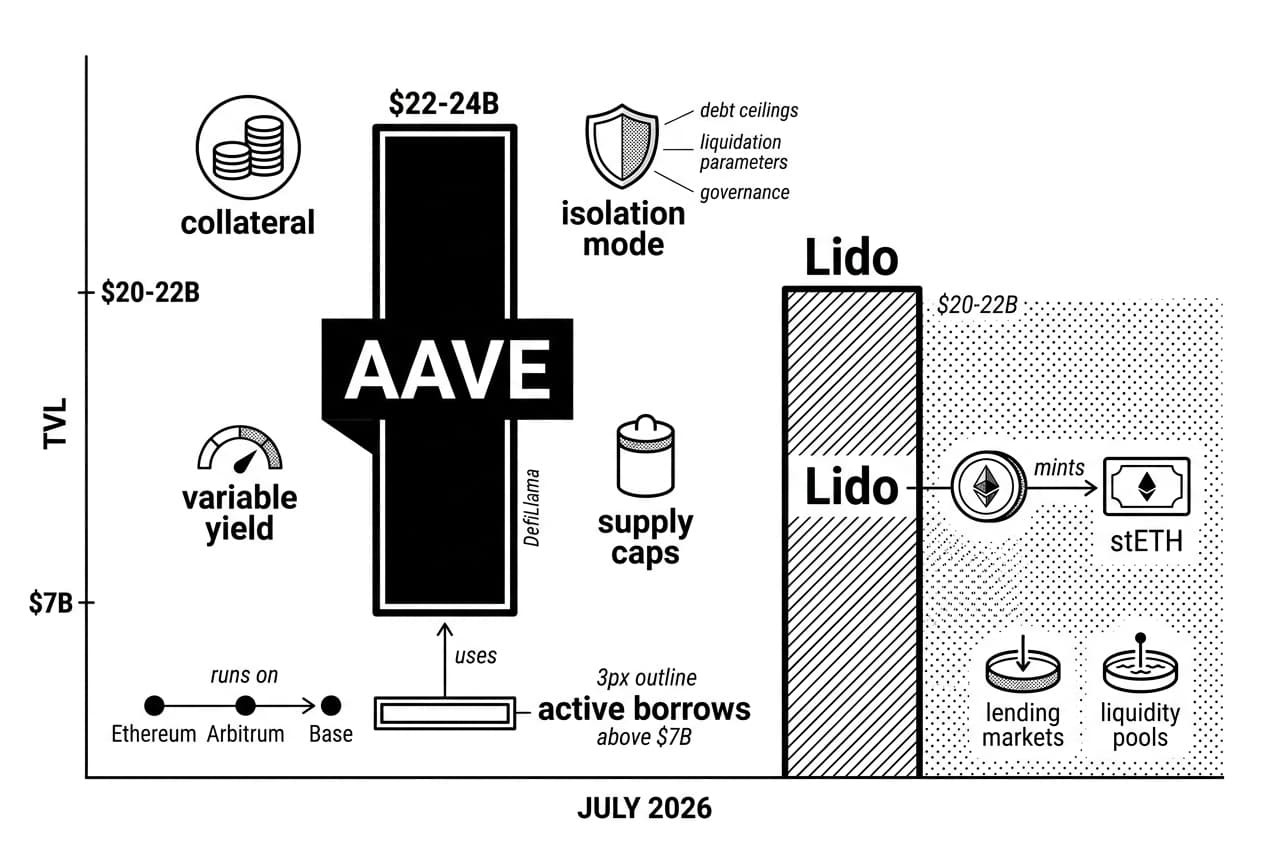
Aave ranks first because its deposits are not just large, they are actively used. The protocol held about $22-24B in TVL, DefiLlama, July 2026, across Ethereum mainnet and major layer 2 deployments such as Arbitrum and Base. Users supply collateral, earn variable yield, and borrow against posted assets with parameters set by governance.
The distinguishing stat is borrow demand. Active borrows regularly sat above $7B, DefiLlama, July 2026, which means much of the supplied capital is doing work rather than sitting idle. Aave v3 also uses isolation mode, supply caps, debt ceilings, and liquidation parameters to contain risky assets before they can damage the whole market.
The tradeoff is complexity. Aave runs on many chains and supports many collateral types, so users must understand asset-specific rules before borrowing. Still, its operating history since 2020, deep liquidity, and visible risk governance make it the strongest all-around DeFi money market in this ranking.
2. Lido: best for liquid staking depth
Lido remains the largest liquid staking protocol, with about $20-22B in TVL, DefiLlama, July 2026. Users deposit ETH and receive stETH, a liquid staking token that can be used across lending markets, liquidity pools, and collateral vaults while the underlying ETH earns consensus-layer rewards.
The key stat is market share. Lido has often controlled roughly 28-30% of staked ETH, Dune, July 2026, which explains both its liquidity advantage and its centralization concern. stETH is widely accepted across Aave, Curve, MakerDAO/Sky, and other protocols, giving it a network effect that smaller liquid staking tokens struggle to match.
The risk is concentration. A broad validator set reduces single-operator risk, but Lido still represents a large share of Ethereum staking. If stETH liquidity thins during stress, collateralized users can face liquidations even if ETH itself remains sound. Lido is useful, liquid, and mature, but it should not be treated as risk-free ETH.
3. EigenLayer: best for advanced restaking exposure
EigenLayer held roughly $10-12B in TVL, DefiLlama, July 2026, making it one of the fastest-growing infrastructure protocols of the cycle. Restakers commit ETH or liquid staking tokens to help secure additional services, earning extra yield in exchange for accepting more slashing conditions.
The distinguishing stat is ecosystem breadth. By mid-2026, EigenLayer supported dozens of actively validated services, including oracle, data availability, and cross-chain verification systems. That breadth is why restaking attracted institutional attention, but it is also why the risk model is harder to evaluate than a normal lending market.
The biggest concern is rehypothecation risk. The same ETH can secure several commitments at once, so a bug or malicious action in one service may harm restakers who did not fully understand the added obligation. EigenLayer belongs near the top by TVL and influence, but it is not a beginner protocol.
4. MakerDAO/Sky: best for decentralized stablecoin infrastructure
MakerDAO, now operating under the Sky brand, remains a core stablecoin protocol. The combined ecosystem held about $8-9B in TVL, DefiLlama, July 2026. DAI and USDS are backed by a mix of on-chain collateral, liquid staking tokens, and real-world asset exposure including short-term U.S. Treasuries through institutional arrangements.
The distinguishing stat is stablecoin scale. DAI supply remained above $5B, DefiLlama, July 2026, while USDS adoption grew through the Sky savings rate and related incentive programs. That gives MakerDAO/Sky a role far beyond its raw TVL, because its stablecoins are used as collateral, liquidity, and settlement assets across DeFi.
The risk is governance plus off-chain exposure. Real-world assets can improve revenue, but they add custodian, legal, and rate-market risk. The DAI-to-USDS transition also creates user confusion and liquidity fragmentation. MakerDAO/Sky remains foundational, but it is no longer a simple ETH-backed stablecoin system.
5. Uniswap: best for spot token swaps
Uniswap held about $5-7B in TVL, DefiLlama, July 2026, but TVL is not the best way to judge a decentralized exchange. The better signal is trading volume. Uniswap regularly processed around $1-2B in daily volume, Dune, July 2026, across v3 and v4 deployments on Ethereum, Arbitrum, Base, and other chains.
Hayden Adams, Founder at Uniswap Labs, is relevant because Uniswap v3 changed automated market maker design with concentrated liquidity. LPs can place capital inside chosen price ranges, which improves depth around active prices but requires more monitoring than older full-range pools.
The main risk is impermanent loss. Concentrated positions can earn strong fees, but they can also fall out of range and stop earning while price exposure worsens. Uniswap earns a high rank because it is the default routing layer for spot liquidity, not because passive LP returns are easy.
6. Ethena: best for synthetic dollar yield, with major caveats
Ethena reached about $3-4B in TVL, DefiLlama, July 2026, while USDe supply exceeded $5B, DefiLlama, July 2026. The protocol creates a synthetic dollar by pairing crypto collateral with short perpetual futures positions, aiming to offset price exposure while capturing staking rewards and funding-rate income.
The distinguishing stat is yield variability. USDe returns have moved from mid-single digits to above 20% annualized in favorable funding periods, Ethena dashboard, July 2026. That explains its rapid growth, but it also shows why the product should not be treated like a bank deposit or a fully cash-backed stablecoin.
The risks are structural. Funding can turn negative, exchange custody introduces counterparty exposure, and large redemptions during market stress can force hedges to be unwound at poor prices. Ethena is influential and highly liquid, but it is best suited to users who understand basis trades.
7. Pendle: best for fixed-rate yield trading
Pendle held roughly $3-4B in TVL, DefiLlama, July 2026. It splits yield-bearing assets into a principal token and a yield token. Buyers of the principal token can lock in an implied fixed return, while buyers of the yield token take direct exposure to future yield changes.
The distinguishing stat is volume during yield cycles. During restaking and points-farming peaks, Pendle weekly volume exceeded $500M, DefiLlama, July 2026. That made it the main market for pricing staked ETH yield, restaking expectations, and fixed-rate strategies on Ethereum and Arbitrum.
The risk is product complexity. A position can look safe if the discount appears attractive, but maturity dates, implied rates, liquidity depth, and underlying token risk all matter. Pendle is powerful for sophisticated users who want rate exposure. It is not a set-and-forget yield app.
8. Morpho: best for curated lending vaults
Morpho grew to about $3-4B in TVL, DefiLlama, July 2026. Its lending design differs from Aave because markets are isolated and parameterized at deployment. That reduces shared-pool contagion, but it also shifts more responsibility onto market creators, vault curators, and users.
The distinguishing stat is market count. Morpho had more than 200 active lending markets, DefiLlama, July 2026, across assets such as ETH, USDC, USDT, wstETH, and other collateral. Curated vaults route passive deposits into selected markets, allowing users to outsource part of the risk selection process.
The main risk is curator quality. The base contracts may be minimal and audited, but depositors can still lose if a vault allocates to poorly designed markets or weak collateral. Morpho is attractive for rate-sensitive lenders and borrowers, but users should inspect the curator, collateral, oracle, and loan-to-value settings before depositing.
9. Curve: best for stablecoin and pegged-asset liquidity
Curve held about $2-3B in TVL, DefiLlama, July 2026, down sharply from its 2022 peak above $20B, DefiLlama historical chart, July 2026. Even after that decline, Curve remains important because it specializes in low-slippage swaps between assets expected to trade near parity, such as stablecoins and staked ETH pairs.
The distinguishing stat is fee design. Many classic Curve pools charge around 0.04% per swap, Curve documentation, July 2026, with incentives shaped by veCRV voting. The lowercase curve wars era inflated deposits through emission competition, but current fee and volume data give a cleaner picture of lasting demand.
The risk history is real. In July 2023, a Vyper compiler bug affected several Curve pools and led to more than $60M in losses, rekt.news, July 2023. Curve still fills a hard-to-replace role, but LPs should model depeg risk, smart contract risk, and CRV incentive changes before entering a pool.
10. Spark: best for DAI and USDS borrowing
Spark rounds out the list with about $2-3B in TVL, DefiLlama, July 2026. It is a lending protocol tied closely to the MakerDAO/Sky ecosystem and originally built from Aave v3-style infrastructure. Its strongest use case is borrowing DAI or USDS against conservative collateral such as ETH and wstETH.
The distinguishing stat is its link to Sky monetary policy. Borrow rates and available liquidity are influenced by Sky governance, debt ceilings, and stablecoin growth targets. That can make Spark more attractive than broad money markets when DAI or USDS borrowing is subsidized or strategically priced.
The risk is dependency. Spark benefits from MakerDAO/Sky risk management, but it also inherits governance decisions, stablecoin migration risk, and concentration in one ecosystem. It earns the tenth spot because it is useful, liquid, and connected to a major stablecoin system, not because it is the most independent lending market.
What TVL Measures—and What It Misses
Total value locked (TVL) in DeFi is the dollar value of assets deposited in a protocol's smart contracts at a specific time, including lending collateral, liquidity pools, staking positions, and vault deposits. It measures size and capital attraction, not safety, profitability, or user quality. A high TVL can still hide weak revenue, concentrated users, risky collateral, or deposits that leave when rewards decline.
The gap between TVL and protocol health is wide. Price moves can shift TVL by hundreds of millions without any new deposits. DefiLlama, May 2026, also flags double-counting cases where the same asset appears as collateral in one place and deposited liquidity in another. Token rewards and points programs can attract capital that disappears once incentives fade.
Better metrics to pair with TVL
Our preferred framework is the six-signal health check: (1) protocol revenue and fees, (2) 30-day active users or borrowers, (3) transaction volume relative to TVL, (4) collateral quality and liquidation history, (5) audit record and exploit history, and (6) token emissions as a share of income.
- Protocol revenue and fees: real fees from repeat users are stronger than deposits paid for by token inflation.
- Active users and volume: TVL can sit idle, while borrowers, traders, and vault activity show use.
- Collateral quality: ETH, USDC, and deep liquid staking tokens are easier to liquidate than long-tail assets.
- Liquidation history: clean liquidations during the May 2021 crash and November 2022 exchange failures are useful stress-test evidence.
- Audit and exploit record: public audits, bug bounties, and slow upgrade controls reduce preventable risk.
- Token emissions: high rewards relative to fee income suggest rented TVL rather than earned demand.
Stani Kulechov, Founder and CEO at Aave, is cited again because lending markets make the TVL problem easy to see: deposits matter only if collateral, borrow demand, oracle rules, and liquidation systems remain sound under stress.
Key Risks When Using DeFi Protocols
Even the top DeFi protocols by TVL carry real risk. Smart contract bugs remain one of the largest threats. Chainalysis reported $2.2 billion in stolen crypto in 2024, Chainalysis, February 2025, and DeFi exploits were a major part of that loss total. Audits reduce risk, but they do not remove it.
Oracle failures are another major concern. If a price feed is manipulated or stale, lending protocols can trigger unfair liquidations or allow bad debt. Sergey Nazarov, Co-founder of Chainlink Labs, is relevant here because decentralized oracle networks are core infrastructure for lending, derivatives, and collateral systems.
Run this safety checklist before depositing into any protocol:
- Verify the URL: bookmark the official site from a trusted source and avoid sponsored search results.
- Use a hardware wallet: keep signing keys offline for any meaningful position size.
- Test with a small amount: make one low-value deposit and withdrawal before moving more funds.
- Check audits: read audit dates, contract versions, bug bounty terms, and upgrade permissions.
- Review liquidation rules: model the price move that would liquidate you before borrowing.
- Revoke unused approvals: old unlimited approvals can drain funds long after you stop using a protocol.
Other risks include bridge exploits, impermanent loss, governance attacks, admin keys, sanctions screening, and wallet approval exposure. Learn how to revoke unused token approvals before stale approvals become a liability. Also review how blockchain surveillance works and how securities rules apply to crypto before assuming permissionless access means no legal exposure.
Safety checklist before depositing
- Verify the official URL. Bookmark it directly from the protocol documentation or a trusted aggregator.
- Use a hardware wallet. Read more on why self-custody matters before connecting a large wallet.
- Test with a small amount first. Confirm deposits, withdrawals, and approvals behave as expected.
- Check audits and their dates. A stale audit may not cover upgraded contracts.
- Review liquidation thresholds. Know your liquidation price before borrowing.
- Revoke unused approvals regularly. Audit approvals after every major protocol interaction.
- Avoid unsustainable yields. If you cannot explain the yield source, stay out.
- Consider coverage options. Explore crypto insurance for DeFi risks if the position is large enough to justify the cost.
None of these steps guarantees safety. They do remove many preventable mistakes, especially phishing, bad approvals, stale contract assumptions, and liquidation surprises.
How to Choose the Right DeFi Protocol
Your goal matters more than the leaderboard. Use this list as a starting point, then compare live TVL, fees, audits, and chain-specific liquidity. For a wider app-level view, cross-check our guide to the best DeFi apps by use case.
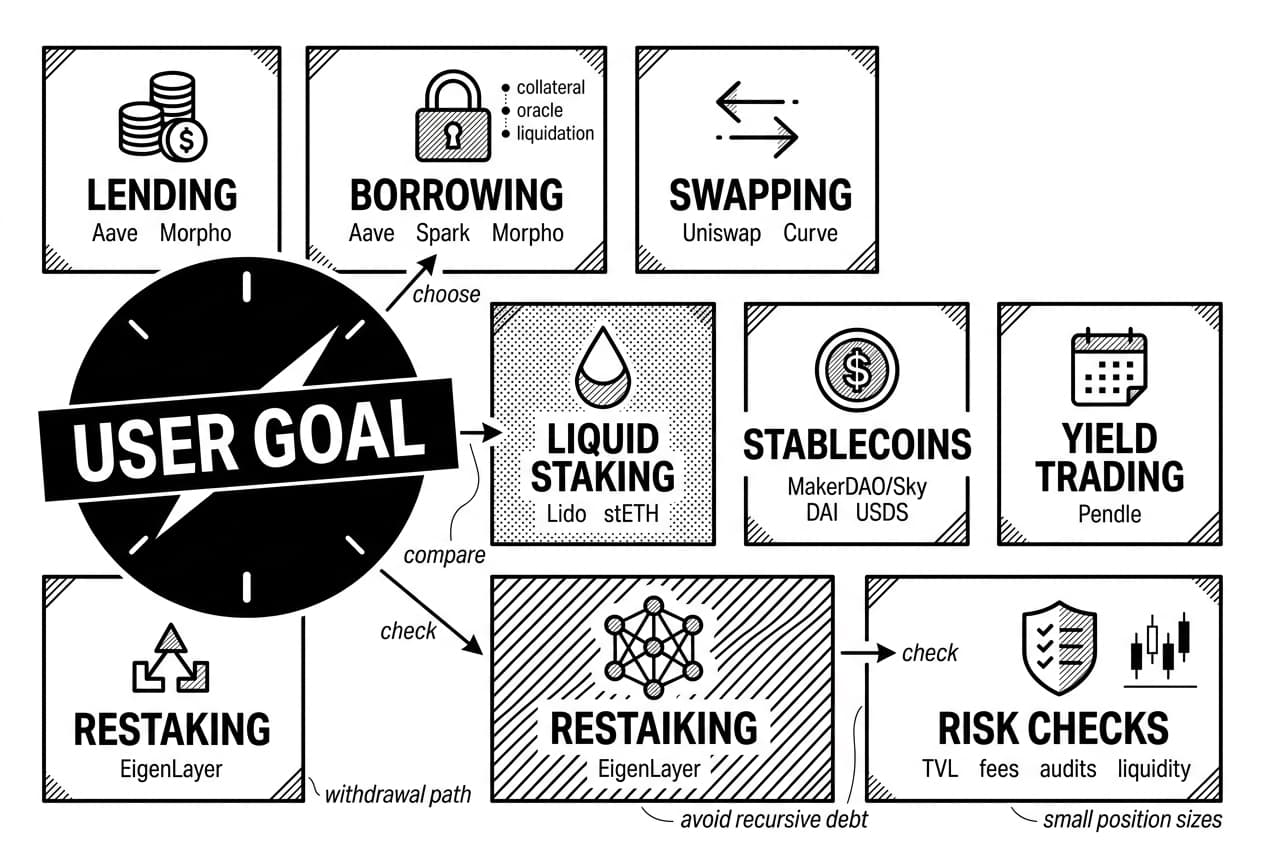
Best picks by user goal
- Lending: choose Aave for the deepest multi-chain loan books or Morpho for curated vaults and potentially tighter rates.
- Borrowing: use Aave for broad collateral choices, Spark for DAI or USDS borrowing, and Morpho only after checking curator and oracle settings.
- Swapping: use Uniswap for broad token routing and Curve for stablecoin or pegged-asset swaps with lower slippage.
- Liquid staking: use Lido when stETH liquidity matters, but monitor validator concentration and stETH liquidity during stress.
- Stablecoins: use MakerDAO/Sky for DAI and USDS exposure, especially if you understand savings-rate and governance tradeoffs.
- Yield trading: use Pendle if you can model fixed yields, maturity dates, and implied rates.
- Advanced restaking: use EigenLayer only if you understand slashing, operator selection, and correlated service risk.
No single protocol wins every category. Conservative users should start with mature Ethereum deployments, avoid recursive debt, and keep position sizes small until they understand the withdrawal path, liquidation rules, and smart contract risk.
Frequently Asked Questions
- What is a DeFi protocol?
- A DeFi protocol is a blockchain-based application or set of smart contracts that delivers financial services — lending, borrowing, trading, staking, stablecoins, and yield markets — without a traditional intermediary like a bank. Users connect through self-custodied wallets rather than opening accounts with a financial institution.
- Is DeFi illegal in the US?
- DeFi is not automatically illegal in the US, but users and builders can still run into tax obligations, securities rules, sanctions compliance, AML requirements, and consumer protection laws. This is not legal advice — anyone running a DeFi business or handling large transactions should consult a qualified crypto attorney and review current regulatory guidance.
- What are the key DeFi protocols?
- Key protocols span several categories: Aave and Morpho for lending, Uniswap and Curve for decentralized exchange liquidity, Lido for liquid staking, MakerDAO/Sky for stablecoins, EigenLayer for restaking, Pendle for yield trading, and Ethena for synthetic dollar exposure. Each category serves a distinct function within the broader DeFi ecosystem.
- What is an example of a DeFi protocol?
- Aave is a straightforward example. Users deposit crypto into smart contracts, earn algorithmically determined yield, and can borrow against posted collateral. Interest rates adjust automatically based on supply and demand. If collateral value drops too far relative to outstanding debt, the protocol triggers liquidation to protect lenders.
- What are the top 10 DeFi tokens?
- Top DeFi tokens by market cap differ from top protocols by TVL, and rankings shift constantly. Common names that frequently appear include UNI, AAVE, MKR, LDO, CRV, PENDLE, COMP, and ENA, among others. Always verify current standings using a live data source like CoinGecko or CoinMarketCap before making any decisions.
- What are the top 5 DeFi apps?
- Rather than one universal ranking, think by use case: Aave leads for lending, Uniswap for token swaps, Lido for liquid staking, MakerDAO/Sky for stablecoins, and Curve or Pendle for liquidity and yield strategies. Rankings shift meaningfully with TVL, trading volume, and broader market cycles, so check live data regularly.
- What are the 5 layers of DeFi?
- Five commonly referenced layers are: settlement blockchains like Ethereum that process transactions, assets such as ETH and stablecoins that move through the system, protocol smart contracts that encode financial logic, application interfaces like wallets and dashboards users interact with, and aggregation or risk-management layers that route liquidity and automate positions.
- Which blockchain is mostly used for DeFi?
- Ethereum remains the dominant DeFi settlement layer by liquidity depth and protocol maturity. However, significant activity runs across Layer 2 networks like Arbitrum and Base, plus Solana, BNB Chain, and Tron depending on the category. TVL distribution shifts regularly, so checking a chain-level breakdown on DeFiLlama before acting is worthwhile.
Sources
Author

Crypto analyst and blockchain educator with over 8 years of experience in the digital asset space. Former fintech consultant at a major Wall Street firm turned full-time crypto journalist. Specializes in DeFi, tokenomics, and blockchain technology. His writing breaks down complex cryptocurrency concepts into actionable insights for both beginners and seasoned investors.