DeFi News 2026: Latest Developments and Market Updates Today

DeFi news 2026: latest developments and market updates today
Latest DeFi news today: what changed in June 2026
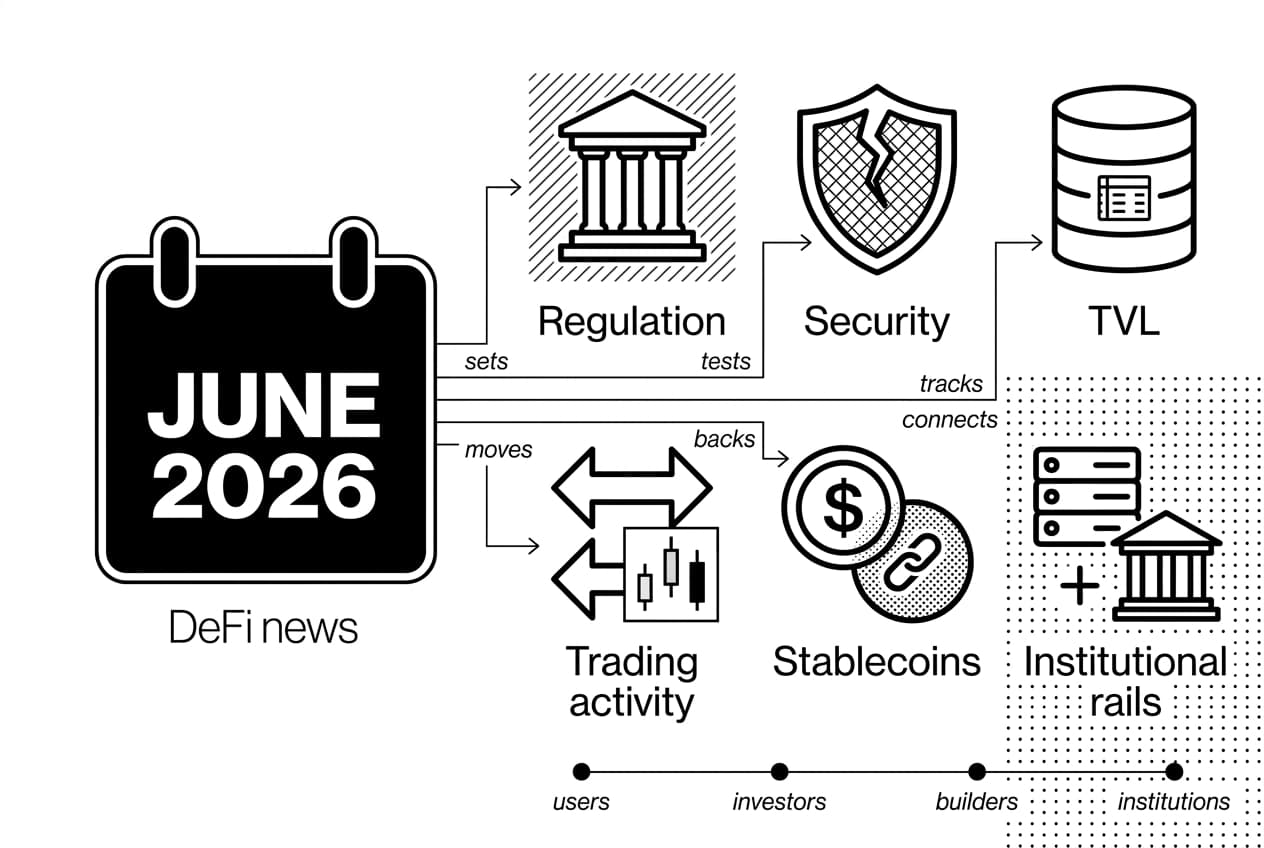
- Regulation: U.S. stablecoin and market-structure bills remain the main June policy focus, with official text tracked through Congress.gov, June 5, 2026.
- Security: Reported exploit losses reached $290 million in Q1 2026, according to rekt.news, March 2026, keeping risk controls at the center of DeFi news.
- TVL: Total value locked stood near $112.4 billion, based on DefiLlama, June 5, 2026, making liquidity concentration the key market signal.
- Stablecoins: Cross-chain stablecoin supply was estimated near $198.7 billion, per DefiLlama, June 5, 2026, supporting lending, settlement and DEX depth.
- Institutions: Tokenized real-world assets reached $21.3 billion, according to RWA.xyz, May 2026, showing that collateral markets are moving onchain.
DeFi news in early June 2026 is being driven by market structure: regulators are refining stablecoin and token rules, liquidity is concentrating in larger protocols, and exploit data is forcing users to check risk before chasing yield. The shift matters because durable usage now depends less on isolated token rallies and more on collateral quality, settlement rails and protocol controls.
Stani Kulechov, founder and CEO at Aave, has repeatedly framed DeFi lending as infrastructure that needs clearer collateral standards and stronger risk controls. That position is now being tested as stablecoins, tokenized assets and institutional pools become larger parts of everyday DeFi activity.
What this means now
The practical takeaway is simple: treat each headline as one input in a market-structure signal matrix. This briefing groups developments by five checks: policy direction, liquidity depth, security history, collateral quality and institutional settlement use. A protocol that improves on all five deserves closer attention than one posting only short-term yield.
Market snapshot: TVL, liquidity and trading activity
The market is not showing one clean signal. TVL, DEX volume and stablecoin supply point to renewed activity, while exploit totals and governance risk argue for tighter screening. Hayden Adams, founder at Uniswap Labs, has publicly emphasized that liquidity design affects execution quality, a point reflected in the growing role of concentrated liquidity on major trading pairs.
metric | latest reading | source | why it matters |
|---|---|---|---|
TVL | $112.4B as of June 5, 2026 | DefiLlama, June 5, 2026 | Shows capital committed to protocols and where liquidity is clustering. |
DEX monthly volume | $198.3B in May 2026 | DefiLlama, May 2026 | Tracks real trading demand beyond token price moves. |
Stablecoin supply | $198.7B as of June 5, 2026 | DefiLlama, June 5, 2026 | Measures available onchain dollar liquidity for trading, lending and settlement. |
Lending activity | $28.1B in outstanding loans as of June 5, 2026 | DefiLlama, June 5, 2026 | Helps assess collateral demand and liquidation risk. |
Protocol fees | $420M in May 2026 | DefiLlama, May 2026 | Shows whether users are paying for services rather than only collecting incentives. |
Ethereum gas fees remain an important input for DeFi users because low execution costs can make small swaps, collateral moves and loan adjustments more practical. The better signal is not one fee print, but whether activity holds when incentives decline.
Regulation update: stablecoins, digital assets and the CLARITY Act
Policy remains the top non-market driver for DeFi in June. The GENIUS Act debate focuses on payment stablecoin reserves and disclosures, while the CLARITY Act debate focuses on how tokens and trading venues should be treated under U.S. law, according to Congress.gov, June 5, 2026.
For background on the U.S. policy shift, see this analysis of the current SEC chair's crypto agenda. In the EU, MiCA stablecoin rules are already shaping issuer disclosures and reserve expectations, according to ESMA, January 2026.
Why stablecoin rules matter for DeFi
Stablecoins are base collateral for lending, DEX pools and cross-border settlement. If reserve, redemption or issuer rules change, DeFi protocols may need to adjust collateral listings, loan parameters and liquidity incentives. For users, the main question is not only yield, but whether the asset backing that yield can be redeemed under stress.
Security watch: hacks, recovery tokens and DAO risk
Security remains the fastest way for a DeFi headline to become a user loss. Reported exploit losses of $290 million in Q1 2026, tracked by rekt.news, March 2026, show that audits, bug bounties and governance controls still vary widely by protocol.
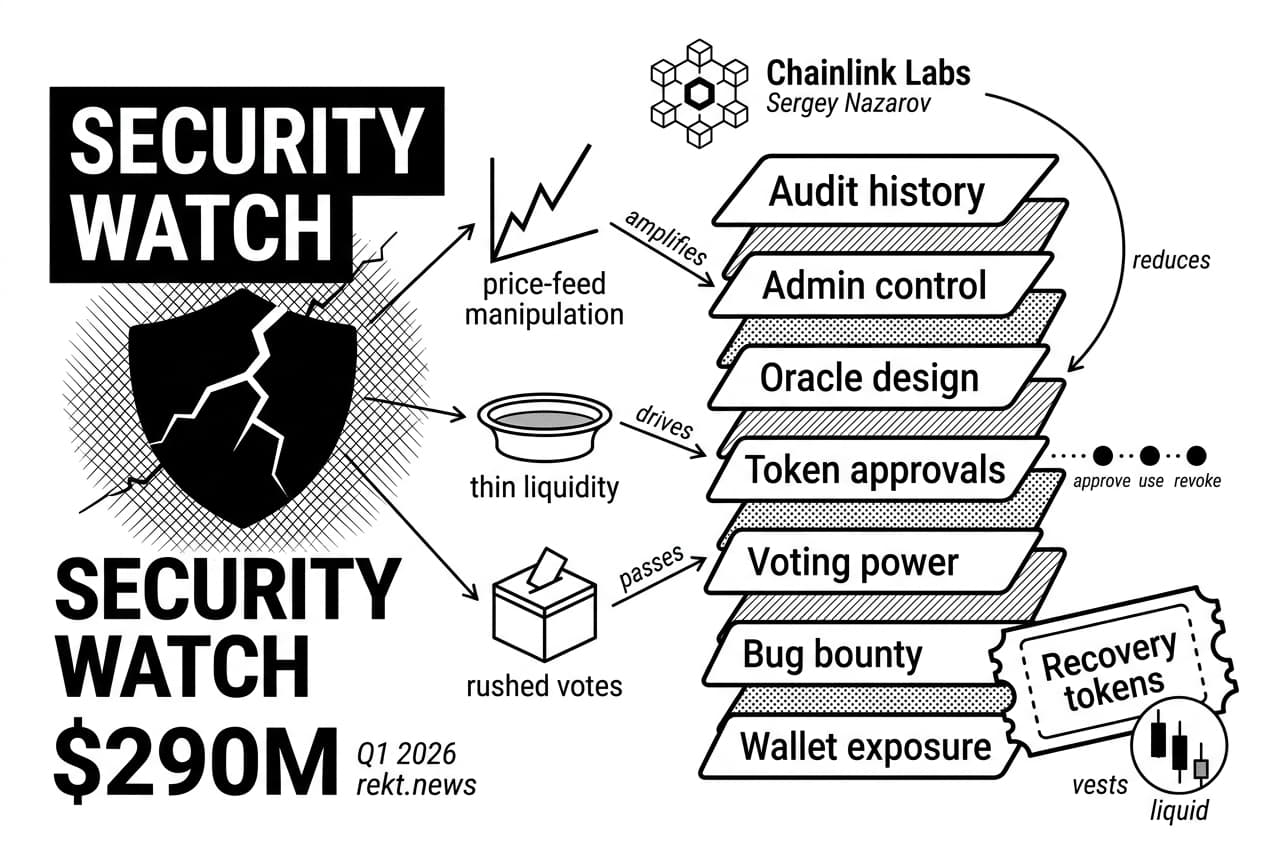
Sergey Nazarov, co-founder at Chainlink Labs, has publicly argued that reliable oracle infrastructure reduces a repeat attack surface in DeFi. That matters because price-feed manipulation, thin liquidity and rushed governance votes can turn a small design error into a large loss.
Recovery tokens should not be treated as repayment until value is distributed and liquid. Some plans vest over months, and market prices can fall below the dollar amount users lost. For governance attack patterns, see DAO security risks and the ranked guide to smart contract security risks.
Seven-layer protocol check
- Audit history: confirm a recent audit and check whether severe findings were fixed.
- Admin control: prefer delayed upgrades and visible multisig governance.
- Oracle design: avoid protocols that rely on one thin price feed.
- Token approvals: learn how to revoke token approvals after using new contracts.
- Voting power: review whether one wallet or small group can pass proposals.
- Bug bounty: look for active rewards that match the value at risk.
- Wallet exposure: if you used an exploited contract, check if your wallet is compromised.
Adoption trends: onchain marketplaces, RWAs and consumer DeFi
Adoption is moving from subsidy-driven yield toward collateral and settlement use. Tokenized real-world assets reached $21.3 billion, according to RWA.xyz, May 2026, with tokenized Treasury products making up a large share of reported value.
That changes how DeFi is used. Tokenized collateral can support instant crypto loans, while stablecoin rails can support payroll, remittances and merchant settlement. The weak spot remains liquidity: if a tokenized asset trades rarely, posted value can overstate how easily users can exit.
From yield farming to real usage
The main adoption test is settlement volume, not wallet count. A protocol that processes repeat borrowing, swaps or payments is showing stronger demand than one that attracts short-term deposits through emissions. That distinction is why RWA collateral, stablecoin payments and DEX depth now dominate serious DeFi news coverage.
Institutional DeFi: digital asset infrastructure and liquidity
Institutional DeFi is growing through custody, permissioned pools and tokenized collateral rather than open-ended risk taking. The key June 2026 signal is infrastructure: firms want compliance checks at entry, controlled liquidity access in the middle and onchain settlement at exit.
Three-layer convergence test
This briefing uses a three-layer convergence test for institutional DeFi. First, the entry point must screen wallets and counterparties. Second, the pool must define who can trade or borrow. Third, settlement must be visible onchain. Protocols that meet all three conditions are better positioned for institutional liquidity than protocols relying only on high yields.
How to follow DeFi news without chasing every headline
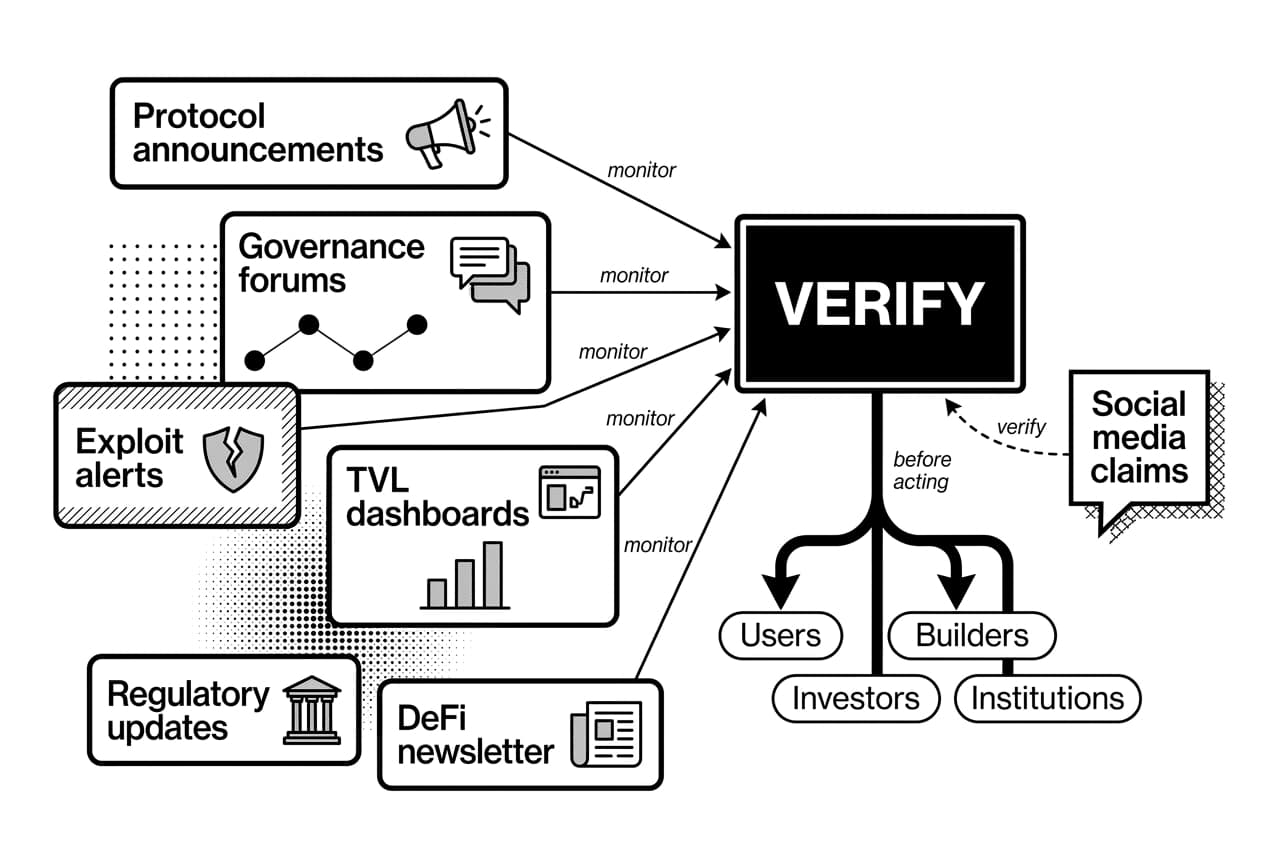
Speed is useful, but verification matters more. Andreas Antonopoulos, author and educator, has long stressed that users should verify systems and claims rather than outsource trust to branding or social media posts.
- Protocol blogs and official announcements: check the team's own release before acting.
- Governance forums: review Snapshot, Tally and forum proposals before votes reach headlines.
- Data dashboards: compare TVL, fees, volume and stablecoin supply on primary dashboards.
- Exploit trackers: confirm whether an incident is verified before moving funds in panic.
- Regulatory releases: read agency and legislative pages directly for rule changes.
- A vetted DeFi newsletter: choose one that cites primary links, dates its numbers and separates reporting from opinion.
What makes a good DeFi newsletter
A useful DeFi newsletter does not only list launches. It links to source documents, shows dates on metrics, flags conflicts, covers exploit risk and explains why a development matters for users, builders or investors. If a newsletter only highlights yield and token upside, it is not a reliable briefing tool.
FAQ: DeFi news, safety and 2026 outlook
Does DeFi have a future?
Yes, DeFi likely has a future if stablecoins, lending, DEX trading and tokenized collateral keep showing repeat usage. The risk is that growth can still reverse after hacks, liquidity stress or regulatory changes, so users should track actual volume and fees rather than only token prices.
Can DeFi coin reach $1 dollar?
It depends on the specific token, not on DeFi as a sector. A $1 target must be compared with circulating supply, emissions, liquidity and market capitalization; for high-supply tokens, the implied valuation may be too large to support without major adoption.
Is DeFi a good investment?
DeFi can offer exposure to crypto trading, lending and settlement infrastructure, but it is high risk. Smart contract bugs, governance attacks, token dilution and legal uncertainty can all reduce returns, so position size and due diligence matter more than headline yield.
Will DeFi make a comeback?
DeFi activity can recover when liquidity, stablecoin supply and user confidence improve together. A lasting comeback requires safer protocols and real settlement demand, not only incentive programs; TVL, fees and DEX volume provide a better read than social media sentiment.
What is the best crypto newsletter?
The best crypto or DeFi newsletter depends on whether you need breaking news, policy, data or beginner education. Choose one that cites primary sources, dates every metric, discloses sponsors and clearly separates factual reporting from opinion or trading commentary.
Will DeFi coin reach $1?
Any token reaching $1 depends on supply, demand, exchange access, protocol revenue and market conditions. Before trusting a target, calculate the market value at $1 and compare it with similar protocols; the math often shows whether the forecast is realistic.
Is DeFi safe for beginners?
DeFi is not fully safe for beginners because users control their own wallets and approvals. Start with small amounts, use reputable protocols, revoke old approvals and avoid urgent links; even audited contracts can fail during exploits, oracle errors or liquidity shocks.
Frequently Asked Questions
- Does DeFi have a future?
- DeFi likely has a future, but it depends on continued improvements in security, liquidity, user experience and regulatory clarity. In 2026, the strongest use cases include stablecoins, lending, DEX trading, tokenized assets and institutional settlement. Adoption remains uneven, and speculative activity alone won't sustain long-term growth.
- Can DeFi coin reach $1 dollar?
- Price potential depends entirely on the specific token. Circulating supply, market cap, utility, liquidity and broader market conditions all matter. For high-supply tokens, a $1 price target implies a market cap that may be unrealistic. Always identify the exact asset and calculate implied valuation before trusting any price target.
- Is DeFi a good investment?
- DeFi offers exposure to crypto infrastructure, lending, trading and yield markets, but the risks are significant. Smart contract exploits, token volatility, governance failures, regulatory uncertainty and liquidity problems are all real concerns. Rather than blanket approval, focus on thorough research and sizing positions according to your actual risk tolerance.
- Will DeFi make a comeback?
- DeFi activity has historically moved in cycles tied to crypto liquidity, stablecoin growth and risk appetite. A genuine comeback requires real usage, safer protocols, smoother onboarding and clearer regulation — not just incentive programs. Tracking 2026 TVL and trading volume data gives a more honest picture than sentiment alone.
- What is the best crypto newsletter?
- The best crypto or DeFi newsletter depends on what you actually need — breaking news, deep research, trading data, policy coverage or beginner education. Evaluate options by source quality, editorial transparency, publication frequency and whether they clearly separate factual reporting from opinion or sponsored content.
- Will DeFi coin reach $1?
- Any token reaching $1 depends on supply, demand, exchange listings, protocol revenue, token emissions and overall market sentiment. Before relying on a price target, calculate the implied market capitalization at $1. For tokens with billions of units in circulation, that number often reveals how ambitious — or unrealistic — the target really is.
- Is DeFi safe for beginners?
- DeFi is not risk-free for beginners. Users are fully responsible for their own wallets, transaction approvals and security. Start with small amounts, stick to reputable protocols and use a hardware wallet. Learn how to revoke token approvals and stay alert to phishing attempts, bridge vulnerabilities and smart contract exploits before committing real funds.
Author

Crypto analyst and blockchain educator with over 8 years of experience in the digital asset space. Former fintech consultant at a major Wall Street firm turned full-time crypto journalist. Specializes in DeFi, tokenomics, and blockchain technology. His writing breaks down complex cryptocurrency concepts into actionable insights for both beginners and seasoned investors.