DeFi App Guide 2026: Top DApps for Lending, Swaps, Earning
DeFi app guide 2026: top DApps for lending, swaps and earning
The best defi apps in 2026 are not the ones shouting the highest APY. They are the ones with deep liquidity, clear risks, visible fee sources and wallet permissions you can keep under control. This ranked guide compares lending, swapping and earning apps by practical use case rather than by promotional yield.
Our editorial position is simple: choose the defi application that fits your goal first, then check yield second. The ranking below uses current protocol metrics, dated source links and a risk-adjusted scoring model so you can decide what deserves a wallet connection. For broader sector context, see our latest DeFi news coverage.
How we ranked the best defi apps in 2026
We scored each defi app with our RAU score, short for risk-adjusted utility. The score uses eight inputs: total value locked, liquidity depth, security history, live fee demand, chain coverage, wallet-permission exposure, user experience and whether the yield comes from real protocol activity or token incentives. Apps with thin liquidity or unclear contract permissions were pushed down even when their APY looked attractive.
As of April 2026, DeFi TVL was cited at $88.7B across chains (DefiLlama, April 2026). That scale matters because users no longer need to chase two-week-old contracts to find lending markets, swap routes or staking yield. We treated mature liquidity as a safety feature, not just a popularity signal.
Our evidence log for this revision used three dated source types: protocol TVL and chain data from DefiLlama, May 2026, fee and volume claims from protocol pages where available, and public safety reporting such as Chainalysis, 2024. Before placing funds, recheck live dashboards because DeFi metrics can change within hours.
DeFi apps vs DeFi.App: clear up the search confusion first
A defi app is a blockchain-based financial application for lending, borrowing, trading or earning without a central intermediary. Generic DeFi applications include protocols such as Aave, Uniswap and Lido. DeFi.App, with that exact branding, is a separate project with its own product pages, token data and launch details.
If you came here looking for DeFi.App token price, circulating supply or open up timing, use the project link shown on CoinGecko or CoinMarketCap and verify the domain before connecting a wallet. A search result for generic DeFi apps is not automatically a page about that branded project.
Quick comparison: best defi apps by use case
The table gives the impatient reader the short version. Each row lists a use case, a dated metric and the main risk to understand before you connect a wallet.
Rank | App | Best use case | Key 2026 metric | Supported chains | Main risk |
|---|---|---|---|---|---|
1 | Aave v3 | Lending and borrowing | $23.1B TVL (DefiLlama, May 2026) | Ethereum, Arbitrum, Base, Polygon | Liquidation and oracle risk |
2 | Uniswap v4 | Token swaps | $2.4T cumulative volume (uniswap.org blog, May 2026) | Ethereum, Base, Arbitrum, Polygon | Slippage, MEV and scam tokens |
3 | Lido | Liquid staking | 9.4M ETH staked (Lido dashboard, May 2026) | Ethereum | Validator and concentration risk |
4 | Morpho | Curated lending markets | $4.7B TVL (DefiLlama, May 2026) | Ethereum, Base | Curator and market-parameter risk |
5 | Pendle | Fixed yield and yield trading | $4.3B TVL (DefiLlama, May 2026) | Ethereum, Arbitrum | Duration and exit-liquidity risk |
6 | Curve | Stablecoin swaps | $2.1B TVL (DefiLlama, May 2026) | Ethereum plus major L2s | Depeg and pool imbalance risk |
7 | defisaver.com automation | Position management | Automation for Aave, Morpho and other markets (official site, May 2026) | Ethereum and selected L2s | Extra contract layer risk |
The ranking favors utility over novelty. Aave and Uniswap rank highest because they solve common user problems with deep liquidity. Pendle and Morpho rank lower for beginners because their payoff mechanics require more work, even though both are useful for experienced users.
Top defi apps for lending, swapping and earning
Here is the ranked mini-list before the detailed reviews:
- Aave: best defi app for lending and borrowing.
- Uniswap: best app for token swaps on Ethereum and L2s.
- Lido: best app for liquid ETH staking.
- Morpho: best app for curated lending rates.
- Pendle: best app for fixed yield and yield trading.
- Curve: best app for stablecoin and pegged-asset swaps.
- defisaver.com automation: best app for managing complex positions.
1. Aave: best defi app for lending and borrowing
Aave is the benchmark for on-chain lending because it combines large collateral markets, multiple chains and a long operating record. As of May 2026, Aave showed about $23.1B in TVL (DefiLlama, May 2026). Users can supply assets such as ETH, USDC, wBTC and stETH, then borrow against collateral at ratios that vary by asset and market conditions.
The reason Aave ranks first is not yield alone. It ranks first because liquidity is deep, risk parameters are public and liquidations are visible on-chain. Stani Kulechov, founder and chief executive at Aave, has framed the protocol as credit-market infrastructure rather than a short-term yield product. That matches how users should treat it: a lending venue where collateral quality and health factor matter more than headline APY.
The main risks are smart contract failure, oracle manipulation and liquidation during volatile moves. If you borrow, keep a wide buffer above the liquidation threshold and test the market with a small deposit first.
2. Uniswap: best defi app for token swapping
Uniswap remains the default swap venue for many Ethereum-ecosystem assets. Its concentrated liquidity design allows liquidity providers to place capital in defined price ranges, which improves capital efficiency compared with older automated market maker designs. The protocol has reported more than $2.4T in cumulative volume since launch (uniswap.org blog, May 2026), and fee tiers commonly range from 0.01% to 1% depending on the pool.
Hayden Adams, founder of the organization behind Uniswap, has described v4 hooks as a way for developers to customize pool logic while keeping liquidity easier to access. For users, the practical benefit is simple: more routes, more pool designs and fewer reasons to move to obscure swap sites.
The risk is that Uniswap is permissionless. Anyone can list a token. Always verify token contract addresses, check slippage before confirming and avoid large swaps in thin pools. Uniswap is a powerful exchange tool, not a safety filter.
3. Lido: best defi app for liquid ETH staking
Lido lets ETH holders earn staking rewards without running validator hardware or committing 32 ETH directly. When users stake, they receive stETH, a liquid token that represents staked ETH plus accrued rewards. As of May 2026, Lido dashboards showed about 9.4M ETH staked (Lido dashboard, May 2026). The protocol charges a 10% fee on staking rewards (Lido, May 2026), split between node operators and the DAO treasury.
Lido ranks above higher-yield products because the use case is clear: passive ETH staking with liquidity. stETH is widely accepted across DeFi, which makes it useful as collateral or as a pool asset. That utility is stronger than a temporary rewards campaign on a newer staking app.
The trade-off is concentration. A large share of staked ETH flowing through one protocol can create network-level concerns. Users also face smart contract risk, validator slashing risk and stETH market discount risk. Treat stETH as a liquid staking token, not as identical to ETH.
4. Morpho: best defi app for curated lending rates
Morpho uses isolated lending markets rather than one broad pooled market. Each vault can have its own collateral asset, loan asset and risk settings. That structure lets lenders target specific risk and rate profiles. As of May 2026, Morpho showed about $4.7B in TVL (DefiLlama, May 2026), with active markets on Ethereum and Base.
Morpho makes the list because it can offer more precise lending exposure than a general pool. It is useful for users who already understand collateral quality, liquidation ratios and curator behavior. The app is not ranked above Aave because the curator model creates an extra diligence step. A vault is only as good as its parameters and the group setting them.
Before depositing, check the vault curator, collateral asset, liquidation loan-to-value, oracle source and withdrawal liquidity. Morpho can be efficient, but it is less forgiving for users who only read the displayed rate.
5. Pendle: best defi app for fixed yield and yield trading
Pendle splits a yield-bearing token into two pieces: a principal token and a yield token. The principal token can be bought at a discount and redeemed at maturity. The yield token receives the yield until expiry. That design lets users lock fixed yield or take a view on whether future yield will rise or fall. As of May 2026, Pendle showed about $4.3B in TVL (DefiLlama, May 2026).
Pendle earns its place because it solves a real problem: DeFi yield is usually variable, while many users want a known return window. It is especially useful for liquid staking tokens and other yield-bearing assets where maturity dates and implied rates can be compared.
The risk is payoff complexity. A yield token can lose value quickly if expected yield drops or time to maturity shrinks. Some markets also have thin exit liquidity. Pendle is a strong tool for experienced users, but beginners should start with a small fixed-yield position before buying yield tokens.
6. Curve: best defi app for stablecoin and pegged-asset swaps
Curve specializes in swaps between assets that should trade near the same value, such as stablecoins or liquid staking tokens. Its StableSwap design reduces slippage for correlated assets, which is why large stablecoin trades often route through Curve. As of May 2026, Curve showed about $2.1B in TVL (DefiLlama, May 2026), and many pools charge around 0.04% on swaps (Curve resources, May 2026).
Curve ranks sixth because it is excellent at a narrow job. If you need to move between USDC, USDT, DAI or pegged staking assets, it can be cheaper than a general exchange route. For stablecoin users, that cost difference becomes meaningful at larger size.
The core danger is depeg exposure. If one asset in a pool breaks its peg, liquidity providers may be left holding the weaker asset. Basic swap users face less risk than liquidity providers, but everyone should check pool balances before trading during market stress.
7. defisaver.com automation: best for managing complex positions
The automation app at defisaver.com is not a lending market or a decentralized exchange. It is a management layer for positions across protocols such as Aave, Morpho and others. Its main value is automation: users can set rules for collateral ratios, debt repayment or position adjustments instead of manually watching every market move. The official app lists support for major Ethereum-based markets as of May 2026 (official site).
This app made the list because liquidation management is a real user problem. If you borrow against volatile collateral, a missed alert can cost more than any yield earned. Automation can reduce that operational risk when used correctly.
The trade-off is that an extra management layer adds another contract surface. It also does not remove the risk of the underlying protocol. If your Aave or Morpho position has poor collateral settings, automation may help but it cannot make the strategy safe by itself.
How to choose the right defi app for your goal
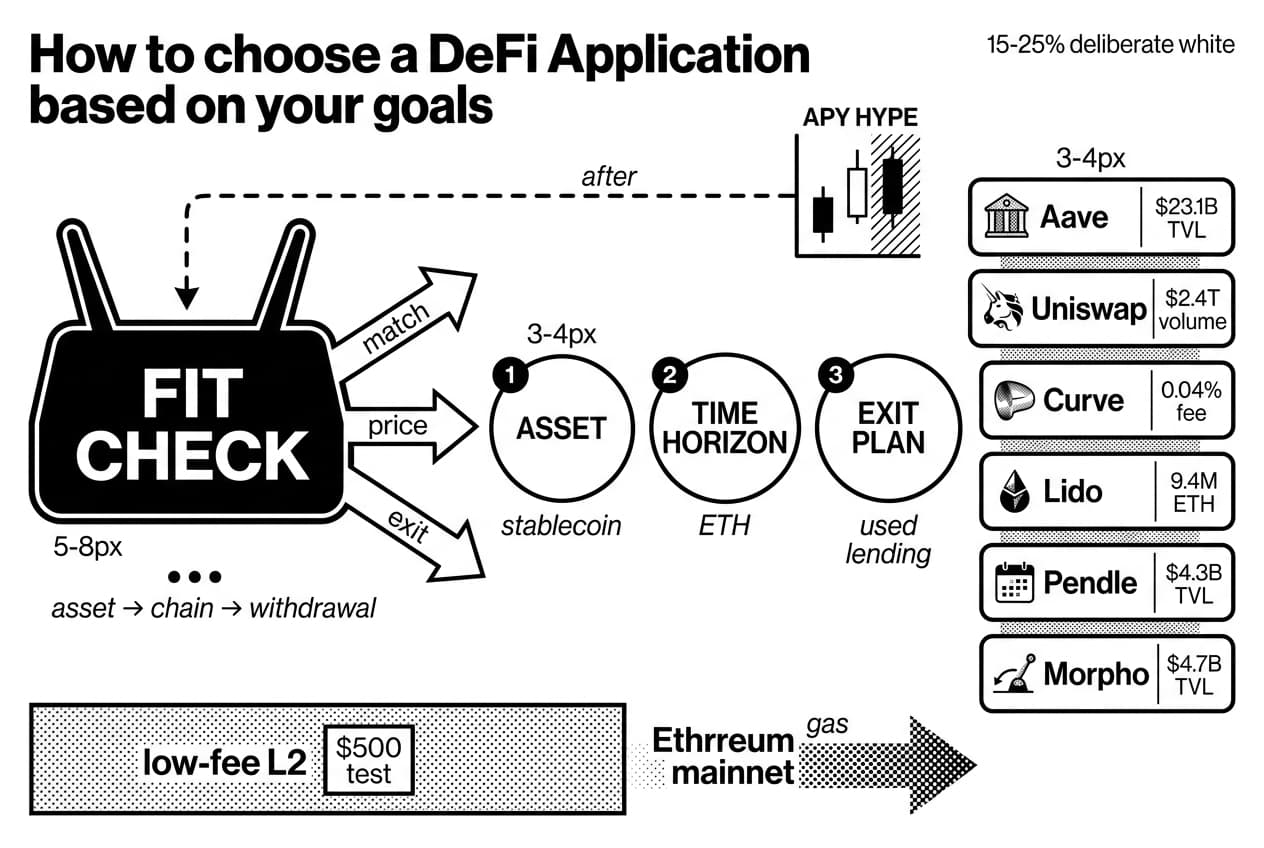
The fastest way to lose money in DeFi is not always a hack. Often it is using the wrong app for the job. Match the app to your asset, time horizon, chain and exit plan before looking at APY.
Best defi app by user type
User type | Best app | Why it fits | Metric to check |
|---|---|---|---|
Beginner | Aave | Clear lending flow, deep liquidity and no lockup for suppliers | $23.1B TVL (DefiLlama, May 2026) |
Active trader | Uniswap | Deep token coverage and strong L2 availability | $2.4T cumulative volume (uniswap.org blog, May 2026) |
Stablecoin user | Curve | Purpose-built swaps for correlated assets | 0.04% common pool fee (Curve resources, May 2026) |
ETH holder | Lido | Liquid staking without running a validator | 9.4M ETH staked (Lido dashboard, May 2026) |
Yield seeker | Pendle | Fixed-yield and yield-token markets with maturity dates | $4.3B TVL (DefiLlama, May 2026) |
Advanced borrower | Morpho plus automation | Curated markets with position-management tools | $4.7B TVL (DefiLlama, May 2026) |
Small positions should usually avoid Ethereum mainnet when gas is high. If your test amount is under $500, a low-fee L2 can make the learning process less expensive. Chain choice changes the economics of every swap, approval and withdrawal.
Use the three-part fit check: asset type, time horizon and exit plan. A stablecoin swap, an ETH staking deposit and a used lending position need different apps. If you cannot explain where the yield comes from, reduce size or skip the trade.
Safety, wallet permissions and app privacy checks
Choosing the right defi app is only half the work. A safe protocol can still expose you to phishing domains, unlimited approvals or a compromised front end. Chainalysis reported $1.7B in stolen crypto during 2023, with reporting published in 2024 (Chainalysis, 2024), and many user losses involved social engineering rather than direct protocol failure.
Sergey Nazarov, co-founder at Chainlink, has repeatedly emphasized the importance of reliable oracle infrastructure in DeFi. The user lesson is wider than oracles: invisible dependencies matter. Price feeds, wallet permissions, front-end code and analytics scripts can all create risk before you ever click confirm.
What to check before connecting a wallet
Run this checklist before connecting to any defi application. If anything looks wrong after a connection, review our guide to signs your crypto wallet is compromised.
- Verify the URL against the protocol site, documentation and official social links before connecting.
- Simulate the transaction with a wallet preview or transaction simulator before signing.
- Limit token approvals to the amount you plan to use instead of granting unlimited access.
- Revoke stale approvals after each session; use our guide on how to revoke token approvals.
- Check audit links on the protocol site and favor recent reports dated within the last 18 months.
- Monitor oracle sources for lending and derivatives apps that depend on live prices.
- Review the privacy policy for wallet-address tracking, IP logging and third-party analytics.
- Connect a hardware wallet for funds you would be uncomfortable losing.
Fees, taxes and legal considerations in 2026
Using a DeFi app is rarely free. Costs can include Ethereum gas fees, swap fees, protocol fees, slippage and bridge costs. Uniswap pools, for example, commonly use fee tiers from 0.01% to 1% (Uniswap support, May 2026). Small trades can become uneconomic when these costs stack.
Taxes also matter. In the US, token swaps, yield earnings and liquidity pool exits can create taxable events. The IRS continued publishing digital-asset guidance through 2024 (IRS), and active DeFi users should keep records by wallet and transaction hash. If you trade often, working with a crypto tax accountant who understands DeFi can save time.
DeFi is not automatically illegal in the US, but users still need to consider sanctions rules, reporting duties and whether a product creates securities-law exposure. Our guide to how SEC rules apply to crypto explains the main issues for 2026. Local rules differ, so treat legal risk as part of the app-selection process.
Beginner workflow: your first safe defi app transaction
Rankings help, but the first transaction should be small and boring. A good first session teaches wallet signing, gas, swap review and approval cleanup without putting meaningful capital at risk.
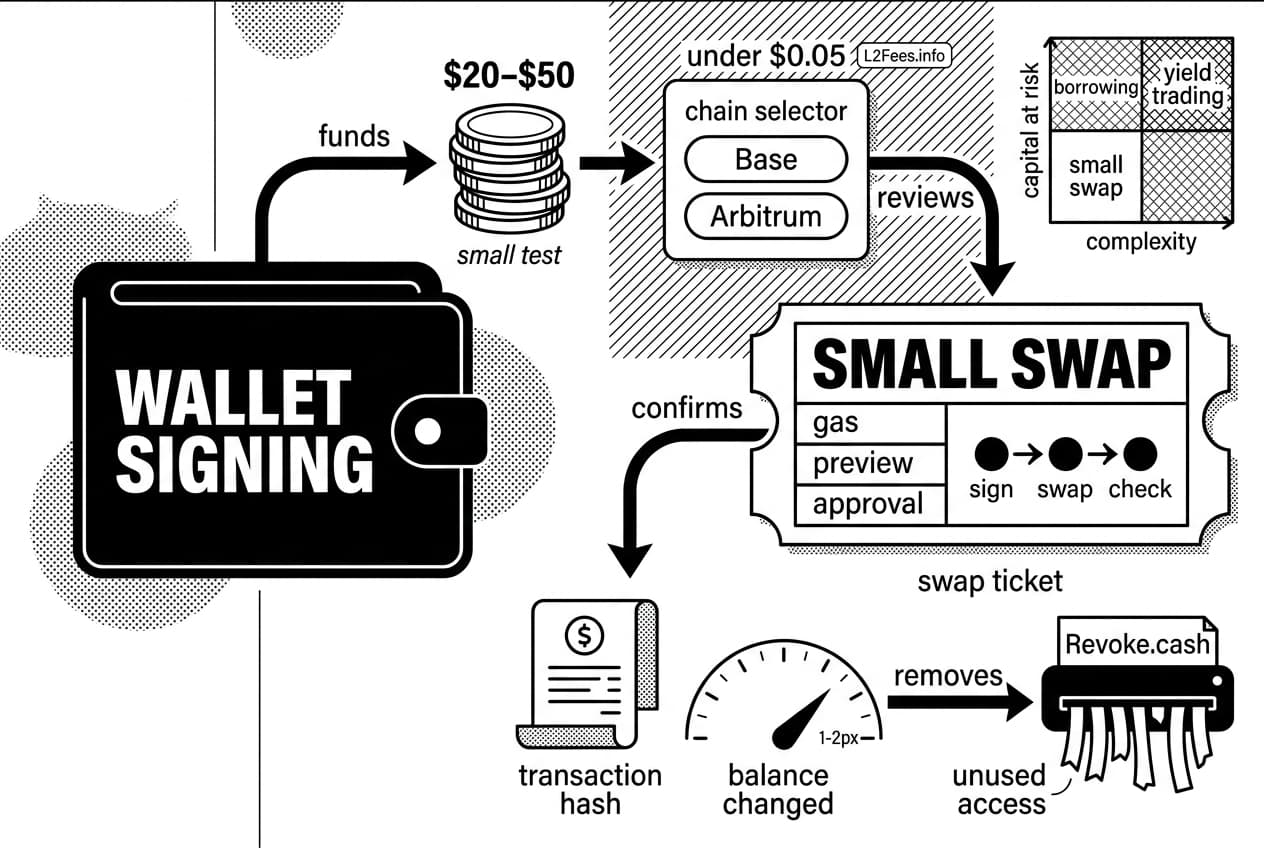
- Set up a wallet. For stronger custody, set up a Ledger wallet. For low-value practice, a browser wallet can work.
- Fund with a small amount. Start with $20 to $50. If a failed test would bother you, the amount is too high.
- Pick a low-fee chain. Base and Arbitrum swaps were often shown under $0.05 in early 2026 (L2Fees.info), which is useful for practice.
- Run one small swap first. Do not begin with borrowing or yield trading. Confirm one simple swap and read the wallet preview.
- Track your position. Check the transaction hash and confirm the balance changed as expected.
- Revoke unused approvals. Visit Revoke.cash after the session and remove access you no longer need.
Only after this workflow feels routine should you test a lending deposit or yield product. Small tests are not timid. They are how careful DeFi users separate a working app from a costly mistake.
Frequently Asked Questions
- What is the DeFi app?
- A DeFi app is any blockchain-based financial application that lets users lend, borrow, swap, stake or earn yield through smart contracts — no bank or broker required. Some platforms brand themselves as "DeFi.App," but the term broadly covers any protocol replacing traditional financial intermediaries with code.
- What are DeFi apps?
- DeFi apps are decentralized finance applications that run on blockchains and connect directly to your crypto wallet. Common categories include decentralized exchanges, lending markets, staking platforms, yield vaults, cross-chain bridges and portfolio trackers. Users keep control of their funds, but that also means they carry full responsibility for security and decisions.
- What are the top 5 DeFi apps?
- Based on current rankings, standout options include Aave for lending, Uniswap for token swapping, Curve for stablecoin swaps, Morpho for optimized lending rates and Lido or Pendle for earning yield. Rankings shift regularly as TVL, liquidity, fees and security track records evolve across protocols.
- Is the DeFi app safe?
- No DeFi app is entirely risk-free. Safety depends on smart-contract audits, protocol history, oracle design and your own habits. Always verify URLs, start with small amounts, use a hardware wallet for larger holdings, regularly review token approvals and avoid unaudited protocols promising unusually high yields.
- Is DeFi good or bad?
- DeFi is a tool, not inherently good or bad. It can expand financial access, increase transparency and support self-custody of assets. At the same time, it exposes users to smart-contract exploits, scams, liquidation risk and tax complexity. The outcome largely depends on the protocol chosen, your knowledge and how carefully you manage risk.
- Is DeFi illegal in the US?
- Using DeFi is not automatically illegal in the US, but legal obligations still apply. Users must consider tax reporting requirements, OFAC sanctions rules, potential securities regulations and platform-specific restrictions. Individual situations vary considerably, so consulting a qualified legal or tax professional for your specific circumstances is strongly recommended.
Sources
Author

Crypto analyst and blockchain educator with over 8 years of experience in the digital asset space. Former fintech consultant at a major Wall Street firm turned full-time crypto journalist. Specializes in DeFi, tokenomics, and blockchain technology. His writing breaks down complex cryptocurrency concepts into actionable insights for both beginners and seasoned investors.