DeFi Development Corp Stock Analysis: DFDV Investor Guide

DeFi Development Corp Stock Analysis: Key Thesis for 2026
Key finding: DeFi Development Corp stock should not be analyzed as a normal DeFi-themed operating company. The better 2026 lens is a public crypto-treasury model: estimate the value of its disclosed Solana exposure, adjust for liabilities and dilution, then decide whether the stock’s premium or discount to that asset value is justified. This article is analytical context only and is not financial advice.
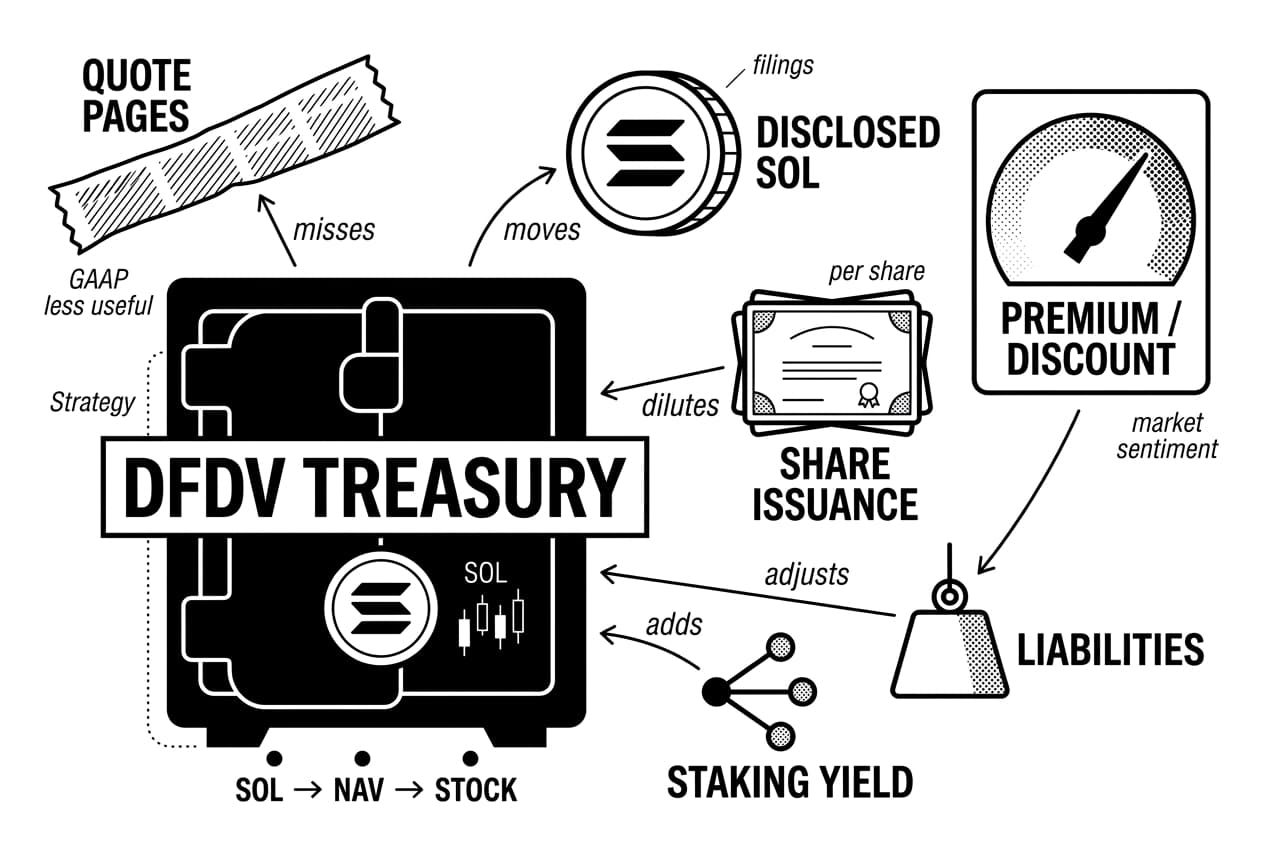
The common stock-quote approach looks at market cap, trailing earnings and price targets. That misses the main issue. For a company whose value can move with SOL, staking rewards, share issuance and custody execution, GAAP earnings can be less useful than per-share crypto asset value. The relevant comparison is not a typical asset manager; it is closer to the treasury-equity model associated with Michael Saylor, Executive Chairman at Strategy, although DFDV’s asset concentration, size and liquidity profile are different.
bottom line for readers
- Core thesis: DFDV is best viewed as a Solana-linked public equity whose valuation depends on SOL exposure per share, dilution and market sentiment toward crypto treasury stocks.
- Known versus unknown: filings and official disclosures should drive the analysis; social posts, quote pages and stale price targets should not be treated as primary evidence.
- Upside case: if SOL rises, staking yields remain steady and share issuance is accretive, NAV per share can grow faster than a simple operating-business screen implies.
- Downside case: if SOL falls, the stock can suffer both asset-value compression and equity-wrapper discounting, especially if capital raises expand the share count at weak prices.
our analytical framework
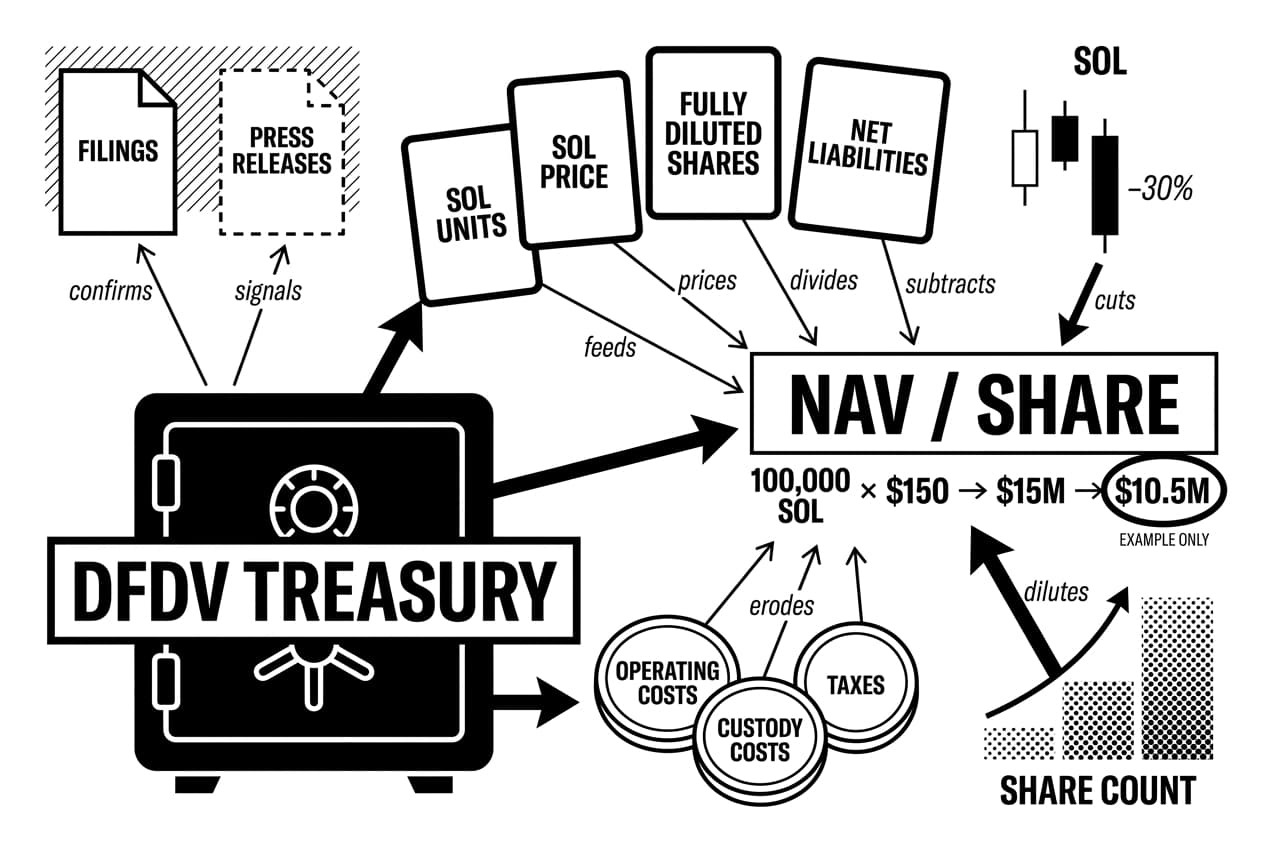
This report uses the nav-dilution-staking test, an original three-step framework for DeFi Development Corp stock analysis. First, estimate digital-asset value from the latest official holdings disclosure. Second, divide that value by the fully diluted share count, not just the basic share count. Third, add staking rewards only after adjusting for custody costs, taxes, operating expenses and any new equity issuance. The test is designed to separate treasury value from operating-business claims.
For market context, two public crypto-equity comparators matter. Lyn Alden, Founder of Lyn Alden Investment Strategy, is useful for macro and liquidity-cycle framing. Hayden Adams, Founder of Uniswap Labs, is relevant to DeFi market-structure context because protocol activity, liquidity and fee pressure affect how investors value crypto infrastructure businesses. Neither reference turns DFDV into a buy or sell; both help define the correct analytical category.
What does DeFi Development Corp do?
DeFi Development Corp is a Nasdaq-listed public company trading under the ticker DFDV. In plain language, it gives equity investors exposure to a Solana-focused treasury and related staking economics. Its value is expected to be driven more by disclosed SOL holdings, staking yield, dilution and crypto-market cycles than by traditional product revenue.
about the company
DFDV should be researched through its official filings, press releases and exchange data before any financial decision is made. The company’s public narrative centers on Solana exposure and digital-asset treasury strategy. That makes how DeFi market structure works relevant background, because token liquidity, validator economics and on-chain activity can influence the equity story even when they do not appear cleanly in quarterly revenue.
The conservative investor question is simple: what does one share represent after accounting for digital assets, cash, liabilities, operating burn, warrants, converts and future share issuance? If that calculation is unclear, the stock should be treated as a high-variance crypto proxy rather than a conventional operating company.
defi development corp vs defi technologies
DeFi Development Corp and DeFi Technologies are separate public companies. The naming overlap can create research errors, so investors should verify ticker, exchange, jurisdiction and business model before comparing the two.
metric | defi development corp | defi technologies |
|---|---|---|
main public ticker focus | DFDV, a Solana-linked treasury equity | DEFI-related listings and digital-asset financial products |
primary model | treasury accumulation, staking economics and related crypto exposure | crypto products, asset-management activity and broader digital-asset exposure |
main investor metric | market value versus disclosed crypto asset value per diluted share | assets under management, product revenue, treasury assets and operating margin |
main risk | SOL concentration, dilution, liquidity and custody execution | product flows, crypto-cycle revenue, regulation and asset-price exposure |
The key distinction is that DeFi Technologies is not a clean substitute for DFDV. It has a different jurisdiction, product mix and revenue base. DFDV stock analysis should start with Solana exposure and share count; DeFi Technologies analysis should start with product economics, assets under management and jurisdiction-specific filings.
Historical context: how DFDV got here
Public-market appetite for crypto balance-sheet exposure accelerated after U.S. spot bitcoin exchange-traded products were approved. The U.S. securities regulator approved 11 spot bitcoin exchange-traded products on January 10, 2024 (SEC, January 2024). That date matters because it marked a shift in how regulated accounts could access crypto beta, and it widened interest in crypto-linked equities.
Crypto-treasury stocks then became a distinct category. Strategy’s bitcoin model showed that a public company can trade on a treasury multiple rather than a simple earnings multiple. DFDV’s Solana angle is different because SOL can produce staking rewards, but that yield is paid in tokens whose dollar value changes with market price. The result is a stock that can behave like a mix of equity, closed-end crypto vehicle and high-beta Layer-1 proxy.
timeline investors should verify
period | what to verify | primary source |
|---|---|---|
2024 | prior business description, risk factors and any early digital-asset language | SEC filing search, 2024 |
2025 | name changes, ticker updates, treasury-strategy announcements and capital-raising authority | SEC filing search, 2025 |
2026 | latest quarterly balance sheet, share count, digital-asset disclosure and subsequent events | SEC filing search, May 2026 |
The historical lesson is not that every treasury stock will copy Strategy’s outcome. It is that public-market wrappers can trade at premiums or discounts to the underlying crypto assets for long periods. That premium can expand in bull markets and compress quickly when liquidity leaves the sector.
Key data points: DFDV by the numbers
The most useful DFDV data table is not a stale quote snapshot. It is a source checklist that forces investors to update the same fields on the same date. Live share price, market cap and 52-week range can change intraday; SEC filings can lag current treasury activity. Use the table below as the minimum dataset for DeFi Development Corp stock analysis, updated as of the day you run the model.
metric | latest value to record with source and date |
|---|---|
share price | record live quote from Nasdaq, May 2026 |
market cap | record live market cap from exchange data or filings on the same date as the share price |
52-week high and low | record exchange quote range from Nasdaq, May 2026 |
year-to-date performance | calculate from the first 2026 trading close to the current quote date |
trailing twelve-month revenue | pull from the latest 10-K or 10-Q in SEC EDGAR, May 2026 |
trailing twelve-month eps | pull from the latest 10-K or 10-Q in SEC EDGAR, May 2026 |
cash | pull from the latest balance sheet, excluding digital assets unless separately disclosed |
debt | include notes, converts and other liabilities from filing footnotes |
shares outstanding | use basic and fully diluted figures from the latest filing and any later offering documents |
disclosed crypto holdings | use the latest company filing or official treasury update, then multiply by live SOL price |
market data that matters
Several sourced numbers help frame the risk even without publishing a stale DFDV quote. Solana traded near $260 in November 2021 and later fell near $8 in December 2022 (CoinGecko, December 2022 data), a peak-to-trough move of roughly 97%. Solana staking yields have commonly been shown in the 6% to 8% annualized range on public validator dashboards (Solana Compass, May 2026). U.S. digital-asset accounting also changed for fiscal years beginning after December 15, 2024 (FASB, ASU 2023-08).
Those three data points affect DFDV directly. A large SOL drawdown can overwhelm staking income. A 6% to 8% token yield can grow holdings in SOL terms but cannot guarantee dollar profit. Fair-value accounting can make quarterly earnings look better in rallies and worse in selloffs, even when operating cash flow has not changed much.
Business model and crypto exposure
The confirmed analytical center is the treasury. Any claim that DFDV has durable operating revenue beyond staking or related crypto activity should be checked against audited statements and quarterly filings. Branding alone is not revenue. Press releases can explain intent, but they do not replace income-statement evidence.
revenue sources and economic drivers
The clearest economic driver is staking income on SOL, where applicable and disclosed. If a company holds staked SOL, rewards accrue in SOL terms. That is economically useful only if token rewards exceed operating costs, custody costs, taxes and dilution on a per-share basis. A 7% token yield can still be a poor outcome if SOL falls 50% or if share count grows faster than treasury value.
Other possible revenue lines, such as validator services, protocol participation or advisory activity, should be treated as unproven until they appear in filings with amounts, dates and accounting treatment. Investors should separate hard data from management ambition.
sol, defi and treasury sensitivity
The nav-dilution-staking test can be run with four inputs: disclosed SOL units, live SOL price, fully diluted shares and net liabilities. Example only: if a treasury holds 100,000 SOL and SOL trades at $150, gross asset value is $15 million. If SOL falls 30%, gross asset value falls to $10.5 million before any operating costs. The example is arithmetic, not a claim about DFDV’s current holdings.
DFDV’s sensitivity also connects to Solana network health, validator economics and institutional crypto appetite. This is why the real-world asset crypto market matters indirectly: if more tokenized assets, stablecoins or trading venues use high-throughput chains, investor willingness to pay for Solana-linked exposure may change.
custody, staking and controls
Custody is not a footnote. Investors should look for the custodian, staking percentage, validator concentration, insurance coverage, internal controls and whether any assets are pledged. If those details are missing, the gap should be treated as an information risk. Staking also creates timing issues because unstaking can be slower than selling a listed share during market stress.
The practical control question is whether the company can protect assets while also earning yield. Extra yield strategies may increase counterparty risk. For a concentrated treasury stock, small custody or disclosure weaknesses can have a large effect on the equity multiple.
DFDV stock performance, valuation, and peer comparison
DFDV stock performance should be judged against SOL, not just against equity indexes. If the stock rises less than SOL after dilution, the treasury wrapper may be destroying per-share value. If it rises more than SOL, the excess return may reflect a premium that can later reverse. Both outcomes require NAV tracking.
price performance and technical context
Crypto-linked small caps often show sharp gaps around filings, financing announcements and token-price moves. Traders using a trendline trading framework or Fibonacci retracement levels should account for thin order books and overnight crypto moves. TradingView indicators for crypto traders can help review volume and momentum, but charts do not solve valuation risk.
valuation framework
Price-to-earnings can be misleading for a digital-asset treasury because fair-value gains and losses can dominate earnings. The better metrics are market value versus crypto NAV, fully diluted NAV per share, price-to-book after fair-value adjustments and market value relative to annualized staking rewards.
A simple investor calculation is: disclosed SOL units multiplied by live SOL price, plus cash, minus debt and other liabilities, divided by fully diluted shares. Compare that number with the current share price. If the stock trades far above the estimate, the market is paying for future accumulation, management skill, scarcity value or speculative demand. If it trades below, the market may be discounting dilution, custody, liquidity or operating costs.
peer set
company or ticker | business type | main crypto exposure | valuation lens |
|---|---|---|---|
DFDV | Solana-linked treasury and staking exposure | SOL concentration | NAV per diluted share and dilution rate |
DeFi Technologies | digital-asset products and asset-management activity | broader crypto basket and product revenue | assets under management, revenue and NAV |
Strategy | bitcoin treasury plus operating business | BTC concentration | market value versus bitcoin asset value |
Coinbase | exchange, custody and staking platform | crypto-cycle revenue exposure | sales, earnings and transaction activity |
The peer table shows why “the Solana version of Strategy” is only partly useful. Strategy has deep liquidity, brand recognition and a long track record in capital markets. DFDV is a smaller, more concentrated and potentially less liquid vehicle. The valuation multiple should reflect that difference.
Profitability, balance sheet, and catalysts to watch
Profitability analysis starts with separating operating income from digital-asset marks. Under updated accounting rules, unrealized changes in qualifying crypto assets can flow through earnings. That can improve transparency, but it can also make quarterly income volatile. Investors should compare net income with operating cash flow, not just the headline profit number.
is defi development corp profitable?
The answer depends on the period and on how much of reported profit comes from crypto marks rather than recurring operations. If SOL rises during a quarter, reported earnings may look strong. If SOL falls, earnings may reverse. The cleaner question is whether DFDV can cover corporate costs without selling assets or issuing new shares.
balance sheet strength and dilution risk
The main balance-sheet risk is not only debt. It is dilution. At-the-market offerings, warrants, converts and shelf registrations can increase shares outstanding. If new shares are sold above NAV and used to buy SOL efficiently, the action may help per-share value. If shares are sold below NAV or during weak markets, the result can hurt existing holders.
This is the treasury dilution squeeze: the company raises equity to buy crypto, but each new share divides future asset value among more owners. The model works only when capital raises increase crypto value per diluted share after costs.
near-term catalysts
- Quarterly filings: compare operating cash flow, digital-asset marks, share count and footnotes.
- Treasury updates: check whether disclosed SOL units per diluted share are rising or falling.
- Financing notices: review any new shelf registration, at-the-market program, warrant exercise or convertible debt.
- SOL price: track spot price, validator yield and network activity together rather than one metric alone.
- Regulatory changes: monitor U.S. treatment of staking income, digital-asset custody and token classification.
- DeFi product evidence: require revenue amounts and dates before assigning value to new business lines.
Liquidity framing from Lyn Alden, Founder of Lyn Alden Investment Strategy, is relevant here: small, liquidity-sensitive assets can reprice faster than fundamentals appear to change. For DFDV, that means catalyst timing can matter almost as much as the long-term thesis.
Risks and 2026 scenarios for DeFi Development Corp
The following scenario table is not a forecast. It is a stress test for how DFDV could behave if SOL price, dilution and market sentiment move in different combinations during 2026.
bull, base and bear case framework
scenario | conditions | potential stock impact | key data to monitor |
|---|---|---|---|
bull | SOL rises, staking yield remains near public validator-dashboard ranges, equity issuance is limited or accretive, and crypto risk appetite improves | NAV per share rises; the stock may trade at a premium if investors value the treasury wrapper | disclosed SOL units, fully diluted shares, SOL spot price, staking yield and financing terms |
base | SOL trades sideways, filings show moderate dilution, and operating costs remain manageable | stock likely tracks SOL with added equity volatility; premium or discount may remain range-bound | NAV spread, cash burn, share count, volume and filing cadence |
bear | SOL drops sharply, new shares are issued at weak prices, custody details remain thin or liquidity leaves crypto equities | NAV falls and the equity wrapper may move to a discount, causing the stock to underperform spot SOL | SOL drawdown depth, filings, bid-ask spread, short interest and any custody disclosure |
A crypto winter downside scenario is the main stress case. The 2021 to 2022 SOL decline shown by CoinGecko is a reminder that Layer-1 assets can fall far more than traditional equity investors expect. Staking yield can soften token-unit dilution, but it cannot offset a severe dollar-price collapse.
major risks investors should track
- Crypto volatility: SOL has already shown cycle-level drawdowns of roughly 97% from late 2021 to late 2022 based on public price history.
- NAV discount risk: public wrappers can trade below asset value when sentiment turns or liquidity thins.
- Dilution risk: share issuance can reduce crypto exposure per share even while total treasury assets grow.
- Custody risk: concentrated digital assets require strong safekeeping, control testing and clear disclosure.
- Regulatory risk: staking, custody and token classification rules can change the economics of the model.
- Name-confusion risk: investors may mix up DFDV with DeFi Technologies, producing flawed peer comparisons or incorrect ticker research.
What this means for investors
DFDV is a high-variance instrument. A disciplined investor should treat it as a Solana-sensitive equity wrapper, not as a simple DeFi stock. The research process should begin with primary filings, then move to NAV, dilution, staking economics and liquidity.
investor checklist
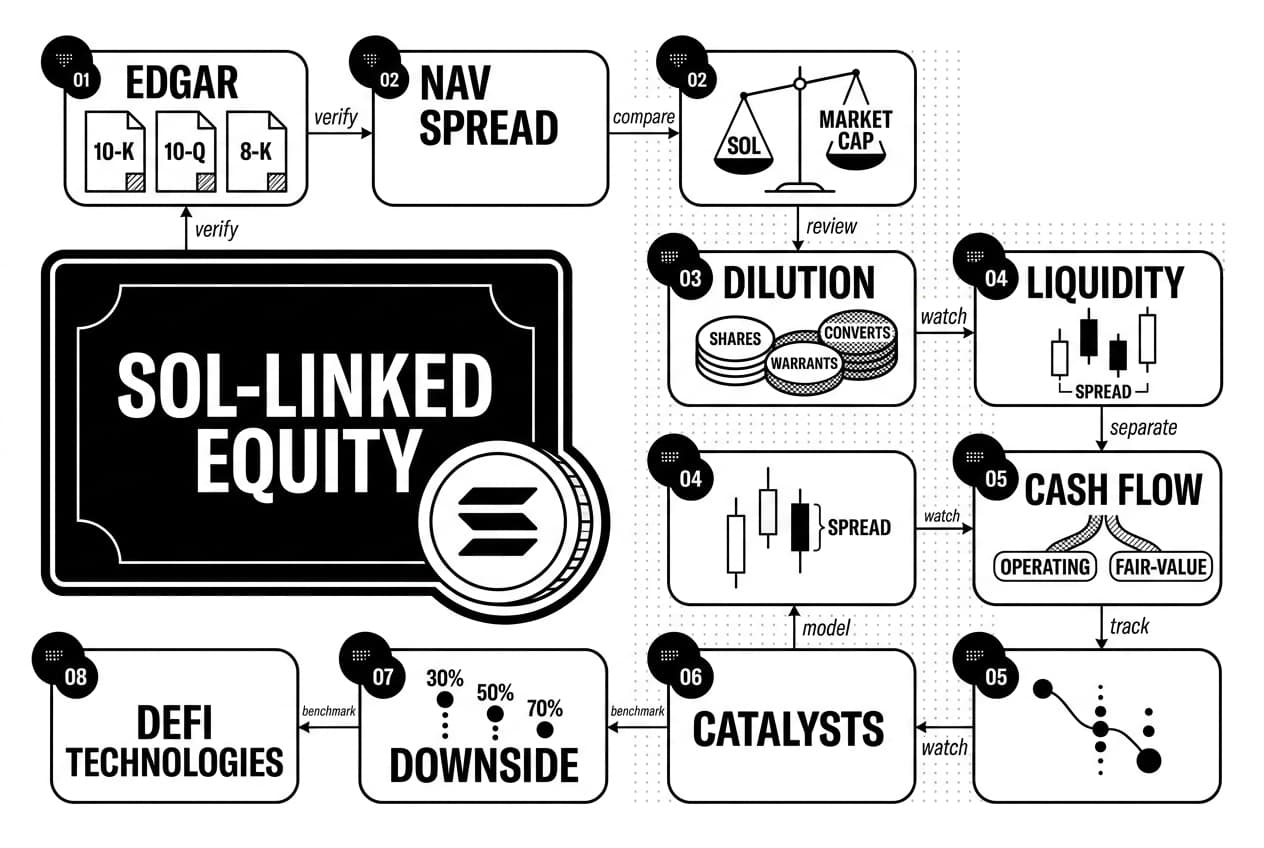
- Verify filings first. Pull the latest 10-K, 10-Q and 8-K documents from SEC EDGAR before relying on summaries.
- Compare NAV to market cap. Multiply disclosed SOL holdings by live SOL price, subtract liabilities and compare the result with current equity value.
- Check dilution. Review basic shares, fully diluted shares, warrants, converts and any active offering program.
- Review liquidity. Look at trading volume, bid-ask spread and how the stock behaves during SOL drawdowns.
- Assess profitability. Separate operating cash flow from fair-value crypto gains and staking rewards.
- Monitor catalysts. Track filing dates, treasury updates, financing notices, Solana network changes and regulatory events.
- Stress-test crypto downside. Model 30%, 50% and 70% SOL declines and recalculate NAV per diluted share.
- Compare against DeFi Technologies. Do not treat the two companies as interchangeable; review asset mix, jurisdiction, product revenue and filings separately.
key takeaways
- DFDV is primarily a SOL-linked equity. Traditional stock screens can miss the real driver: crypto asset value per diluted share.
- The NAV spread is the central valuation question. A premium requires a reason; a discount requires an explanation.
- Dilution is structural. Capital raises can help or hurt depending on pricing, timing and how many SOL units are added per share.
- Staking yield is not a shield. Token rewards may compound holdings, but they do not prevent fiat-value losses during a SOL selloff.
- Primary sources matter. SEC filings, official company releases and live market data should outrank social sentiment and stale quote pages.
Our overall view: DeFi Development Corp stock analysis requires a treasury model first and an operating-business model second. If an investor cannot update the NAV, dilution and staking inputs, the risk is difficult to measure.
Frequently Asked Questions
- Is DFDV stock a good buy?
- No direct recommendation can be made here. DFDV may appeal to investors wanting public-equity exposure to DeFi or crypto treasury strategies, but the right decision depends on current valuation, whether shares trade at a premium or discount to NAV, dilution risk from share issuances, profitability trends, trading liquidity, and your personal risk tolerance.
- What does DeFi Development Corp do?
- DeFi Development Corp trades under the ticker DFDV and operates as a Solana-focused treasury company. Its model centers on accumulating SOL, generating yield through staking, and leveraging capital markets activity. Company value is driven primarily by its crypto treasury holdings and staking returns rather than traditional operating revenues.
- Is DeFi a good stock to buy?
- "DeFi" refers to multiple companies, including DeFi Development Corp and DeFi Technologies, which are separate entities. Stock-specific analysis should focus on financial statements, valuation metrics, management execution, liquidity, and actual crypto exposure rather than the DeFi label alone, which can create misleading assumptions about what you are actually buying.
- Is DeFi Development Corp profitable?
- Profitability at DeFi Development Corp is heavily influenced by crypto market conditions. GAAP net income can appear strong during SOL price rallies due to unrealized gains, and weak during downturns. Investors should separate operating cash flow from paper gains, since treasury-driven profits can reverse quickly when token prices decline.
- Is DeFi development a good investment?
- At the sector level, DeFi development carries meaningful long-term infrastructure potential, but investments tied to it can be highly volatile. Regulatory uncertainty, smart contract vulnerabilities, liquidity cycles, token price swings, and unproven revenue models all introduce significant risk. The opportunity is real, but so is the downside, particularly in early-stage projects.
- What is the price target for DFDV?
- Analyst coverage of DFDV remains thin, which makes any published price targets less reliable than those for widely followed stocks. Where targets exist, examine the underlying assumptions carefully, including SOL price forecasts, NAV estimates, projected dilution from share issuances, revenue growth expectations, and the market multiples applied to arrive at that figure.
- Is DeFi Technologies a good buy?
- DeFi Technologies is a separate company from DeFi Development Corp, so analysis should not be conflated. To evaluate DeFi Technologies, review its product lines, assets under management, revenue growth, profitability, balance sheet strength, and valuation relative to peers. Its performance is also sensitive to broader crypto market cycles, which introduces meaningful volatility.
- What do DeFi Technologies do?
- DeFi Technologies operates as a digital asset and crypto financial services company, offering products that include crypto ETPs and asset management solutions. Its model differs from DeFi Development Corp, which focuses on a Solana treasury strategy. Investors should verify current operations directly from official filings to avoid confusing the two companies.
- Is DeFi a good investment?
- DeFi as a sector offers genuine potential through open financial infrastructure and programmable markets that reduce intermediaries. However, risks are substantial, including protocol hacks, evolving regulation, liquidity fragmentation, governance failures, and sharp token price swings. Whether it suits your portfolio depends on your time horizon, risk appetite, and diversification strategy.
- Does DeFi technology have a future?
- DeFi technology is likely to remain relevant where it genuinely improves settlement speed, transparency, collateral management, or market access. Broader adoption will depend on resolving security vulnerabilities, achieving regulatory clarity, improving user experience for mainstream audiences, attracting institutional demand, and developing sustainable economic models that do not rely solely on token inflation.
Sources
Author

Crypto analyst and blockchain educator with over 8 years of experience in the digital asset space. Former fintech consultant at a major Wall Street firm turned full-time crypto journalist. Specializes in DeFi, tokenomics, and blockchain technology. His writing breaks down complex cryptocurrency concepts into actionable insights for both beginners and seasoned investors.