Data Availability Layer: Celestia vs EigenDA vs Avail 2026
Data availability layers compared: what this guide covers
This buyer’s guide compares Celestia, EigenDA and Avail as data availability layer options for rollup teams, appchain builders and Web3 analysts in 2026. The central question is not which network is cheapest in isolation. It is which trust model, verification method, cost curve and integration path best fits a specific chain.
Ethereum changed the baseline when EIP-4844 introduced blob transactions in March 2024, according to the EIP record. Blobspace reduced the need for rollups to post all data as calldata, while Dune dashboards tracking blobs showed an early fee drop often cited near 10x after launch in 2024. That improvement did not end the market for external DA. It made the decision more exacting.
Our 2026 view is deliberately neutral: dedicated DA networks are not automatically better than Ethereum blobs. They are better only when lower posting cost, higher throughput or sovereign design outweighs new bridge assumptions, separate validator economics, operator concentration and engineering work.
Who this comparison is for
This guide is written for teams choosing a DA backend before mainnet, appchain developers comparing modular stacks, infrastructure researchers checking trust assumptions and analysts assessing network maturity. It explains the core mechanics in plain language, then applies the same technical criteria to all three projects.
The short answer
Celestia is the most sovereign-first option, with live light-node data availability sampling and its own proof-of-stake security. EigenDA is the most Ethereum-aligned option, using restaked ETH operators through EigenLayer rather than a separate DA token. Avail sits between those poles, combining an independent validator set with KZG commitments, sampling and a cross-ecosystem roadmap.
Celestia vs EigenDA vs Avail: quick comparison table
The table below is the article’s public-source comparison dataset. We checked official docs, launch posts and public dashboards for dated facts, then marked uncertain commercial data as variable instead of inventing fixed prices. Treat this as a 2026 starting point and re-check live dashboards before signing an infrastructure contract.
Criterion | Celestia | EigenDA | Avail |
|---|---|---|---|
Security model | Independent proof-of-stake chain secured by TIA staking | Actively validated service using restaked ETH operators through EigenLayer | Independent nominated proof-of-stake network secured by AVAIL staking |
Mainnet timing | Launched in October 2023, according to the Celestia launch post | EigenLayer mainnet and EigenDA went live in April 2024, according to the launch post | Public mainnet launched in 2024, according to Avail’s site |
Sampling model | Light clients sample encoded block shares | Operators attest to data dispersal; no production light-client sampling model like Celestia | Light clients sample data against KZG commitments |
Encoding and commitments | Namespaced Merkle trees with erasure coding | Erasure-coded chunks with operator signatures and KZG-style commitments in design docs | KZG polynomial commitments with erasure coding |
Throughput reference | Block time near 15 seconds on Celenium, checked in 2026; capacity grows by upgrade | Documentation cites a 10 MiB/s launch target, EigenLayer docs, 2025 | Docs describe a 20-second block time and upgrade path, Avail docs, 2026 |
Cost model | TIA gas market; live fee depends on block demand | Operator payment market; commercial rate depends on bandwidth and operator terms | AVAIL fee market; early rates depend on demand and subsidy policy |
Ethereum alignment | Can connect to Ethereum settlement but uses a separate DA trust domain | Strongest Ethereum alignment because security is denominated in restaked ETH | Settlement-neutral design with Ethereum and non-Ethereum integrations |
Ecosystem maturity | Longest production history among the three since 2023 | Benefits from EigenLayer adoption; restaked value exceeded 15 billion dollars on DefiLlama in early 2026 | Younger production ecosystem with active rollup framework integrations |
Best fit | Sovereign rollups, appchains and modular builders that want DA independence | Ethereum rollups that value ETH-denominated security and EigenLayer proximity | Multi-settlement teams, ZK rollups and builders that want KZG-friendly DA |
How to read these metrics
Throughput targets, fee markets and integration counts can change after an upgrade or demand spike. We therefore separate dated public facts from variable commercial claims. A launch date, block-time reference or restaked-value snapshot is suitable for comparison; a quoted per-megabyte price without a live dashboard is not enough for production planning.
Before choosing a provider, verify the latest fee market, validator or operator count, bridge design and support path. Token liquidity and network value can be cross-checked on DefiLlama and CoinGecko. Security assumptions should carry more weight than a temporary fee advantage.
What is a data availability layer?
A data availability layer is a blockchain component that proves transaction data was published and can be retrieved, while leaving transaction execution to another layer. It helps rollups prove users can reconstruct state, but it does not run smart contracts, execute trades or settle disputes by itself.
The distinction matters. Execution layers process computation. Settlement layers finalize state transitions and disputes. A DA layer answers a narrower question: was the data needed to verify a block actually made public? If the answer is no, users cannot independently check the rollup’s state, even if a sequencer published a block header.
Data availability versus data storage
DA is not the same as archival storage. Data availability proves that data was published during the verification window for fraud proofs, validity proofs or independent reconstruction. Long-term storage systems aim to preserve files for months or years. Many DA networks prune data after a limited period, so rollups still need archival plans.
Why rollups care about DA
If a rollup sequencer withholds transaction data, users cannot reconstruct the chain state. Optimistic rollups cannot produce fraud proofs, and ZK systems cannot let outside verifiers inspect the inputs behind a validity proof. The chain may keep producing commitments, but users lose the ability to verify them independently.
Vitalik Buterin, a co-founder associated with Ethereum, has repeatedly framed data availability as a core bottleneck for rollup scaling because validators need access to inputs, not only proofs. This is why Ethereum gas fees and blobspace became a major design variable after EIP-4844 shipped in March 2024.
Core terms: sampling, erasure coding, KZG and committees
- Data availability sampling: Light clients download small random pieces of encoded block data. If enough independent samples are available, the network gains high confidence that the full block was published.
- Erasure coding: Data is expanded into redundant chunks so the original can be reconstructed from a large enough subset. This makes hiding a tiny number of chunks insufficient for an attacker.
- KZG commitments: Short cryptographic commitments let verifiers check that data was encoded consistently without downloading the full dataset.
- Committees: A set of nodes can attest that data is available. This can reduce cost, but it adds trust in committee honesty and liveness.
For the three networks compared here, the first architectural fork is whether a rollup wants sampling by light clients, operator attestations backed by restaked capital or a hybrid design with independent validator security.
How we evaluate each data availability layer
We use the three-axis DA fit test, an original framework for this comparison. Each option is scored on three axes at once: trust minimization, cost efficiency and ecosystem readiness. A cheap DA provider with weak verification is not a clear win. A highly secure option with poor tooling may also be a poor fit for a small engineering team.
Security and trust assumptions
The first question is who guarantees data availability. Celestia relies on its own proof-of-stake chain and light-client sampling. EigenDA relies on operators that accept EigenLayer slashing conditions. Avail relies on an independent nominated proof-of-stake validator set plus sampling and commitments.
The failure modes differ. Celestia security depends on TIA staking and validator diversity. EigenDA security depends on restaked ETH, operator honesty and slashing implementation. Avail security depends on AVAIL staking, validator participation and light-client adoption. Teams connecting DA proofs back to Ethereum’s role as a settlement layer must also check bridge and contract assumptions.
Gavin Wood, founder of Polkadot and a co-founder associated with Ethereum, is relevant to the Avail discussion because Avail’s chain design draws from the broader Substrate and interoperability tradition. That does not make Avail safer by itself, but it explains why its architecture looks more settlement-neutral than EigenDA’s Ethereum-first model.
Cost, speed and scalability
We separate current measurable properties from roadmap targets. Celestia’s block cadence can be checked on Celenium, 2026, where blocks appear near a 15-second interval. EigenDA documentation cites a 10 MiB/s target in 2025 docs. Avail documentation lists a 20-second block cadence in 2026 docs. Those numbers help sizing, but they do not replace a live fee quote.
The cost question is harder because each network prices data differently. Celestia uses a TIA gas market. EigenDA uses operator payments tied to bandwidth and restaked security. Avail uses AVAIL-denominated fees. Lower posting cost can be erased by bridge fees, proof work, monitoring, migration time or unavailable support during an incident.
Developer and ecosystem fit
A DA layer is useful only if a team can integrate it safely. We compare support for OP stack chains, Arbitrum orbit deployments, Polygon cdk projects, ZK frameworks, monitoring tools, documentation quality and production references. Celestia has the longest live track record. EigenDA has the strongest Ethereum-adjacent distribution. Avail has a smaller base but a clear multi-chain engineering focus.
For production teams, developer experience includes failure handling: how a sequencer retries data posting, how a prover confirms data roots, what happens when the DA endpoint is degraded and whether dashboards expose enough detail for alerts. Those operational checks often matter more than headline throughput.
Celestia overview: strengths, weaknesses and best fit
Overview
Celestia is a purpose-built DA and consensus network for modular chains. Rollups post transaction data to Celestia, where the network orders and publishes the data. Light nodes then sample small shares of each encoded block. If samples are returned successfully, users gain statistical confidence that the full block is available without downloading every byte.
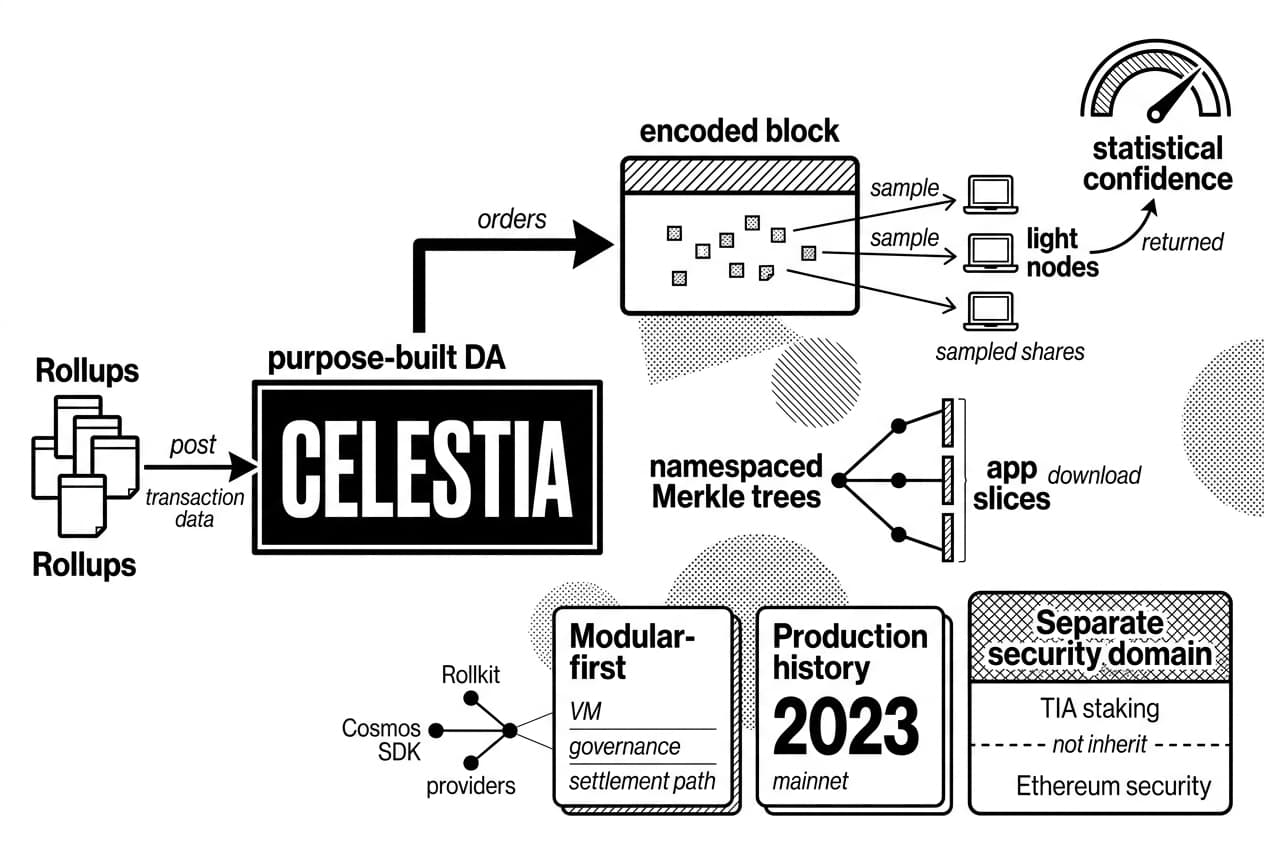
Celestia also uses namespaced Merkle trees, which let applications download only the slices of block data relevant to them. Its mainnet launched in October 2023, according to the official launch post, giving it the longest production history among these three DA networks.
Strengths
- Modular-first architecture: Celestia was built specifically to separate DA from execution and settlement, which suits sovereign rollups and appchains.
- Light-node sampling: Users can verify availability with sampled shares instead of downloading full blocks, supporting broader participation as block sizes grow.
- Application flexibility: Teams can choose their own virtual machine, governance and settlement path rather than inheriting Ethereum rules by default.
- Production history: A live network since 2023 gives developers more operational examples than newer DA competitors.
- Tooling base: Rollkit, Cosmos sdk projects and several rollup service providers support Celestia integrations.
Weaknesses
- Separate security domain: Celestia does not inherit Ethereum base-layer security. Teams must be comfortable with TIA staking and Celestia validator economics.
- Settlement complexity: A rollup that settles on Ethereum while posting DA to Celestia adds bridge and proof-routing assumptions.
- Token risk: The cost to attack the DA layer is tied to TIA value and staking participation, which can change with market conditions.
- Archival planning: DA publication is not permanent storage. Teams still need a plan for historical data retrieval.
- Narrowing cost gap: Ethereum blobs reduced the advantage of external DA for lower-volume rollups after 2024.
Best fit: Celestia fits sovereign appchains, Cosmos-adjacent projects and modular rollups that value independence from Ethereum settlement. It is strongest when architectural freedom and light-client DA matter more than ETH-denominated security.
EigenDA overview: strengths, weaknesses and best fit
Overview
EigenDA is an actively validated service built on EigenLayer. Instead of launching a separate DA validator economy, it uses operators backed by restaked ETH. EigenLayer mainnet launched in April 2024, according to the project launch post, with EigenDA introduced as an early production service.
The design is most attractive to Ethereum rollups that want higher data throughput while keeping security capital in ETH terms. A rollup sends data to a disperser, operators store and attest to the chunks, and the system returns signatures that can be verified by the rollup stack.
Strengths
- Ethereum alignment: EigenDA is easier to justify for Ethereum-native rollups than a separate sovereign DA domain.
- Restaked ETH security: Operators have capital at risk through EigenLayer, avoiding the need for a new DA token.
- High throughput target: EigenLayer docs cite 10 MiB/s in 2025 documentation, which is attractive for high-volume rollups.
- Operator reuse: Teams already working with EigenLayer services can build on familiar operator relationships.
- Rollup fit: Ethereum rollup teams may face less narrative and auditor friction than they would with a non-Ethereum DA network.
Weaknesses
- Restaking is layered security: EigenDA does not become Ethereum consensus. It relies on EigenLayer contracts, operators and slashing rules.
- Operator concentration risk: If many services depend on the same operators, failures can become correlated across systems.
- No Celestia-style sampling: Lightweight users do not verify availability through the same sampling model used by Celestia.
- Commercial uncertainty: Real cost depends on operator markets, bandwidth needs and contract terms rather than a simple public gas market.
- Systemic risk: Poorly designed slashing or shared operator failures could affect more than one actively validated service at the same time.
Best fit: EigenDA fits Ethereum-native rollups that want ETH-denominated security, high data throughput and proximity to EigenLayer. It is weaker for teams that require direct light-client sampling or want to avoid restaking complexity.
Avail overview: strengths, weaknesses and best fit
Overview
Avail is an independent DA network for rollups, appchains and sovereign chains. Its architecture combines erasure coding, KZG commitments and data availability sampling so light clients can check publication without downloading full blocks. The project’s public site dates mainnet activity to 2024, according to Avail.
Avail is designed to be settlement-neutral. That makes it different from Celestia’s sovereign-rollup emphasis and EigenDA’s Ethereum-first positioning. It is especially relevant for teams using zero-knowledge proofs in blockchain systems, because KZG commitments fit naturally with many validity-proof workflows.
Strengths
- Cross-ecosystem design: Avail aims to serve chains that settle on different systems, not only Ethereum or one sovereign stack.
- Sampling support: Light-client sampling reduces the need for every verifier to download full data.
- KZG-friendly architecture: Polynomial commitments can fit ZK rollup pipelines that already rely on compact proofs.
- Independent validator set: Teams that do not want restaking exposure get a separate security model.
- Interoperability focus: Avail’s roadmap emphasizes data publication, aggregation and shared security components for multi-chain builders.
Weaknesses
- Younger ecosystem: Avail has less production history than Celestia and less Ethereum distribution than EigenDA.
- Separate token security: Like Celestia, Avail does not inherit Ethereum base-layer security directly.
- Roadmap complexity: Building DA, aggregation and security modules at once increases delivery risk.
- Tooling depth: Documentation is improving, but third-party service coverage is thinner than Celestia’s.
- Liquidity and adoption: Teams must evaluate AVAIL market depth and validator participation before depending on the network for high-value chains.
Best fit: Avail fits ZK rollups, multi-settlement appchains and teams that want KZG-friendly DA without committing fully to Ethereum restaking or Celestia-style sovereignty. It is best for builders that value flexibility and can tolerate earlier-stage infrastructure.
Key differences: Celestia vs EigenDA vs Avail
The key differences are not cosmetic. Celestia, EigenDA and Avail diverge on who provides security, how users verify data, how closely the network tracks Ethereum and how much engineering work a rollup must absorb.
Security model
Celestia and Avail each run independent proof-of-stake networks, while EigenDA uses restaked ETH operators. That makes EigenDA easier for Ethereum-aligned teams to explain, but it also creates layered restaking risk. Celestia and Avail avoid that restaking dependency, but their security budgets depend on their own token economies.
Teams should also review smart contract security risks before bridging DA attestations into a settlement contract. A strong DA layer can still be undermined by a weak bridge, verifier contract or upgrade key.
Verification model
Celestia and Avail emphasize light-client sampling. EigenDA emphasizes operator attestations backed by economic penalties. Sampling reduces trust in a specific operator group, while attestation-based systems can be faster to integrate into Ethereum rollup workflows. The right model depends on whether your users need direct availability checks or are comfortable with restaked operator guarantees.
Cost and throughput
Metric | Celestia | EigenDA | Avail |
|---|---|---|---|
Public timing reference | Near 15-second blocks on Celenium, 2026 | Ethereum-adjacent operator workflow after April 2024 launch | 20-second cadence in Avail docs, 2026 |
Throughput reference | Upgrade-based capacity growth; verify live blocks before sizing | 10 MiB/s target in docs, 2025 | Upgrade-based capacity growth; verify docs before sizing |
Fee basis | TIA gas | Operator payments and restaked ETH economics | AVAIL fees |
Headline throughput does not equal lower total cost. A high-throughput DA path can still be expensive after bridge fees, reserved bandwidth, proof changes, monitoring and incident response. For small rollups, Ethereum blobs may remain simpler even when a dedicated DA network posts cheaper raw data.
Ecosystem maturity and network effects
Celestia has the longest production history because its mainnet launched in 2023. EigenDA benefits from EigenLayer’s fast capital growth; DefiLlama showed EigenLayer restaked value above 15 billion dollars in early 2026. Avail is younger, but its settlement-neutral architecture may matter for teams building outside a single ecosystem.
Which data availability layer should you choose?
No single DA layer wins every category. Use the recommendations below by use case, not as a universal ranking.
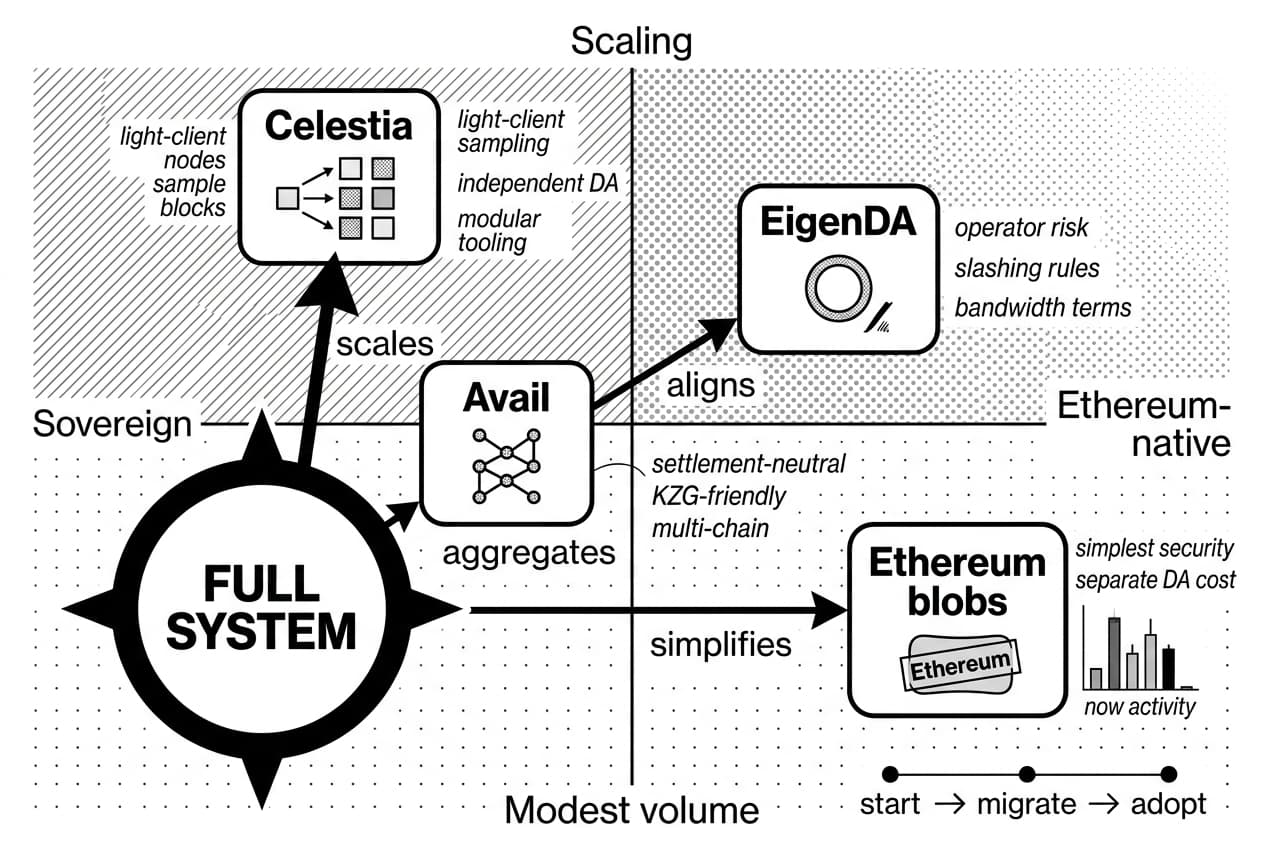
- choose Celestia if... you are building a sovereign appchain or modular rollup and want live light-client sampling, independent DA and broad modular tooling. It is a strong fit for teams exploring Web3 developer projects using modular infrastructure.
- choose EigenDA if... you are deploying an Ethereum-native rollup, want ETH-denominated security assumptions and can evaluate EigenLayer operator risk, slashing rules and commercial bandwidth terms.
- choose Avail if... you need a settlement-neutral DA layer, KZG-friendly commitments or a roadmap aimed at multi-chain aggregation rather than a single rollup ecosystem.
- use Ethereum blobs if... your transaction volume is modest, your users demand the simplest Ethereum security story and the operational cost of a separate DA provider outweighs raw posting savings.
The decision can change over time. A team may start on Ethereum blobs, migrate to Celestia for sovereign scaling, choose EigenDA after restaking risk becomes acceptable or adopt Avail for ZK-heavy multi-chain designs. The practical test is whether the DA layer improves the full system, not only the data-posting line item.
Frequently Asked Questions
- What is a data availability layer?
- A data availability layer ensures that transaction data has been published and remains accessible so users and validators can verify blockchain state. Rollups rely on DA layers to cut costs while keeping data available for fraud proofs, validity proofs, or independent chain reconstruction without storing everything on a base layer.
- What is the Avail data availability layer?
- Avail is a modular data availability network built specifically for rollups and appchains. It competes directly with Celestia and EigenDA, using data availability sampling and cryptographic commitments to confirm data is published. Avail places particular emphasis on interoperability, aiming to serve multiple blockchain ecosystems rather than a single stack.
- Is XRP an L1 or L2?
- XRP runs on the XRP Ledger, which is generally categorized as a layer-1 blockchain. This sits outside the data availability layer conversation entirely, since DA layers exist to serve rollups and modular chains. The XRP Ledger handles its own consensus and settlement rather than publishing data for other networks.
- Is BNB a L1 or L2?
- BNB Smart Chain is generally treated as a layer-1 blockchain that processes its own transactions and maintains its own consensus. While the broader BNB Chain ecosystem includes scaling networks, an L1 handles full execution independently. Data availability layers like Celestia or EigenDA serve a different purpose, publishing and verifying rollup data rather than running their own execution environment.
Sources
Author

Crypto analyst and blockchain educator with over 8 years of experience in the digital asset space. Former fintech consultant at a major Wall Street firm turned full-time crypto journalist. Specializes in DeFi, tokenomics, and blockchain technology. His writing breaks down complex cryptocurrency concepts into actionable insights for both beginners and seasoned investors.