Gasless Transactions Explained: Meta-Transactions Guide
Gasless transactions explained: meta-transactions guide
Gasless transactions: plain-English definition and why it matters
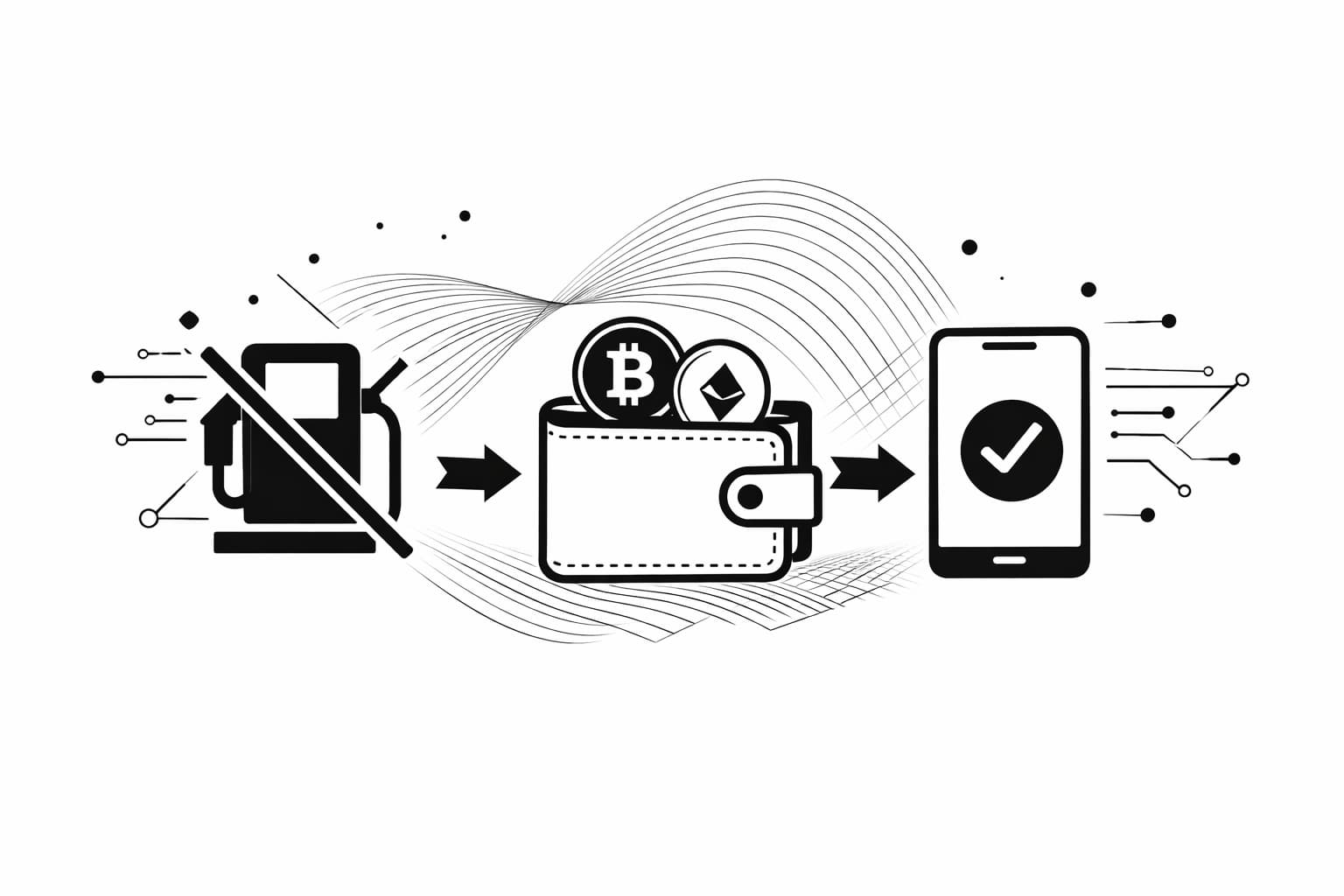
Gasless transactions let a person use a blockchain app without paying the network fee upfront in the chain's native token.
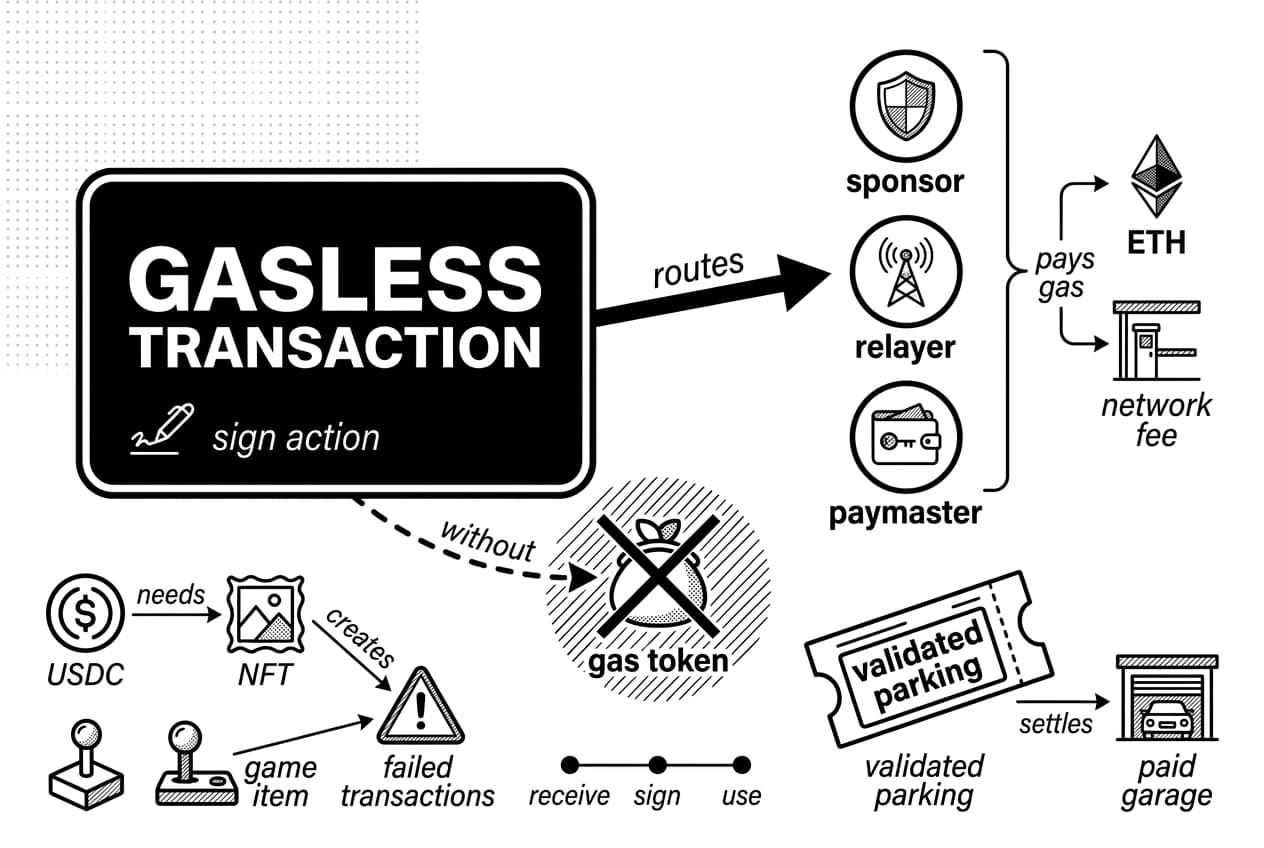
Gasless transactions are a design pattern where a sponsor, relayer or paymaster pays the network fee on the user's behalf, so the user can sign an action without holding ETH or another gas token. The fee does not disappear; it is shifted to another party that sets the rules.
Why it matters
The practical problem is simple: many crypto apps ask people to buy crypto before they can use crypto. A new Ethereum user may receive USDC, an NFT or a game item, then discover that every transfer still needs ETH for gas. That extra step creates failed transactions, abandoned sign-ups and support tickets. If the user is trying to cut down on funding costs, there are ways to reduce Ethereum buying fees, but gasless transactions address a different issue: they remove the need to hold the gas asset before the first useful action.
Vitalik Buterin, co-founder of Ethereum, has repeatedly argued through Ethereum's public roadmap work that account abstraction should make wallets easier to use without hiding the security model. That is the right frame for this guide. Gasless design is not free computation. It is a sponsorship, routing and risk-control layer.
A concrete analogy
A useful everyday analogy is validated parking. The driver still uses a paid garage, but the store stamps the ticket and settles the parking cost later because the visit is worth more than the fee. Gasless transactions work the same way. The app, protocol or sponsor pays because onboarding, retention or a business rule makes that cost acceptable.
Our take: the common claim that gasless transactions make Web3 free is misleading. Someone still pays every network fee, decides which actions qualify and absorbs spam, relayer failure and security risk. As of July 2026, the strongest gasless designs are the ones that show users what is being signed, who is paying and when sponsorship can stop.
Background: from Ethereum gas fees to sponsored transactions
To understand gasless transactions, start with why Ethereum charges fees. Ethereum is a shared computing network. A validator is a participant that proposes or checks blocks. A gas fee is the ETH paid to get computation included in a block. A wallet is software or hardware that holds private keys and signs actions. A smart contract is code stored on-chain that runs when called.
Why blockchains charge gas
Every token transfer, swap, mint or contract call consumes computing resources. Ethereum measures that work in gas. Since the London upgrade activated EIP-1559 in August 2021 (ethereum.org gas docs), Ethereum transactions include a base fee mechanism that burns part of the fee. That burn is a direct reminder that the cost is real even when an app hides it from the user. For a deeper beginner explanation, see how Ethereum gas fees work.
A standard externally owned account, often shortened to EOA, can only submit a transaction if it has enough ETH to pay gas. That is the chicken-and-egg problem: a user may own a token, but without ETH the wallet cannot move it.
History: early meta-transaction experiments and GSN
By 2018 and 2019, developers were using a pattern called a meta-transaction. The user signed an off-chain message that described the desired action. A third-party relayer, meaning a server or network service with ETH, sent the on-chain transaction and paid gas. The user's intent was executed, but the relayer's wallet paid the network.
The gas station network, usually shortened to GSN, helped standardize that idea. OpenGSN documentation, first released for production use around 2019, described contracts and relayer services that let dApps sponsor calls without forcing users to buy ETH first. OpenZeppelin later added reusable contract patterns so teams did not have to write trusted-forwarder logic from scratch.
The key lesson from that history still applies in 2026: gas is not removed. It is moved from the end user to a sponsor with a budget, rules and monitoring duties.
How a normal blockchain transaction works
Before meta transactions ethereum patterns make sense, it helps to follow a normal transaction from click to confirmation.
Wallets, signatures and network fees
A user wants to send 10 USDC. The wallet prepares a transaction, signs it with the user's private key and broadcasts it to Ethereum. The signature proves that the key holder approved this exact action. Validators check the signature, execute the transfer and include the result in a block. After the Merge completed in September 2022 (ethereum.org Merge page), Ethereum settled into roughly 12-second slot timing, so simple confirmations can appear quickly, although finality and app display times vary.
For a broader primer on the chain itself, see our Ethereum basics for beginners guide. The important point here is that the sender pays gas in ETH even when the asset being moved is USDC, an NFT or another token.
What happens if a transaction runs out of gas
Every Ethereum transaction includes a gas limit, which is the maximum computation the sender is willing to pay for. If execution reaches that limit before the action finishes, the transaction reverts. Revert means the intended state change, such as a token transfer, is cancelled.
The spent gas is not refunded because validators already performed work. In a normal transaction, the user loses that fee. In a gasless setup, the relayer, paymaster or sponsor usually absorbs the failed execution cost instead.
What is a meta-transaction? meta transactions ethereum in practice
A meta-transaction is a signed instruction that lets someone other than the user submit the on-chain transaction and pay gas. The word meta means the user signs a message about the action, while a relayer turns that message into the transaction Ethereum actually processes.
The core process
- User signs a message: the wallet signs structured data describing the requested action, such as transferring 10 USDC.
- Relayer receives it: the app sends that signed message off-chain to a relayer or bundler service.
- Contract verifies signature: a smart contract checks that the signature matches the user's address and has not expired.
- Relayer pays gas: the relayer submits the on-chain transaction from its own funded account or through a paymaster.
- Blockchain executes the action: validators include the transaction, and the smart contract carries out the user's original request.
This is the article's first core framework: Sign-Relay-Settle. The user signs intent, infrastructure relays it and Ethereum settles the final state change. The user experience can feel simple, but the chain still sees a paid transaction.
Message signing versus on-chain transactions
Signing a message is not the same as sending a transaction. A signed message can be created off-chain without gas. It only has an effect if another party submits it to a contract that accepts and verifies it. That difference is useful, but it also creates phishing risk because a dangerous message can look harmless if the wallet display is poor.
EIP-712 and readable signatures
Early signing prompts often showed unreadable hexadecimal strings. EIP-712 (Ethereum EIPs, 2017 proposal with broad wallet adoption by 2022) introduced structured data signing, which lets wallets show readable fields such as token amount, recipient address, deadline and contract domain. Hayden Adams, founder of Uniswap's main protocol company, has often stressed that readable approvals are central to safer DeFi use. For gasless systems, readable typed data is not a nice extra. It is a safety requirement.
The gasless transaction architecture: relayers, paymasters and GSN
A gasless transaction system is a set of roles, not a single button. The table below shows who does what, who pays and where risk appears.
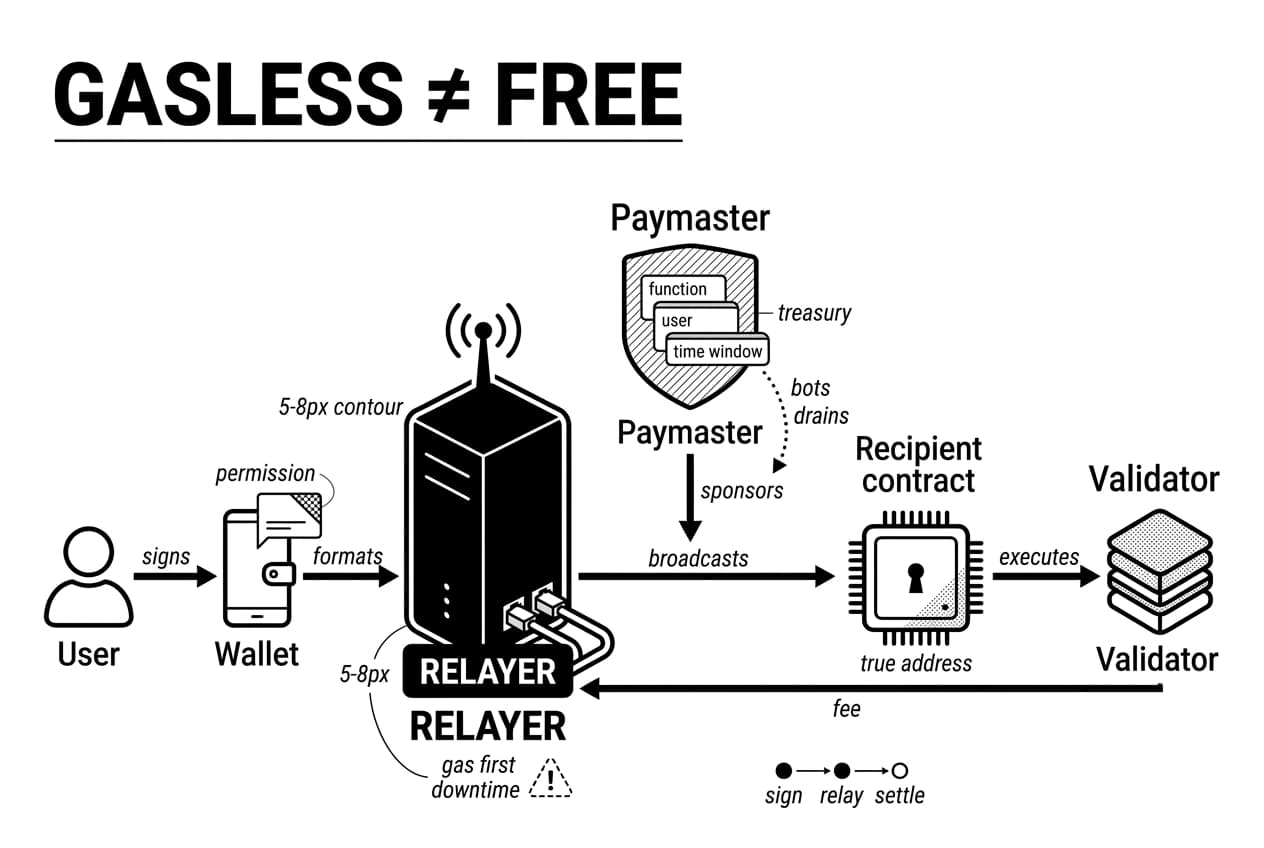
Actor | Role | Who pays | Main risk |
|---|---|---|---|
user | Signs the requested action | Usually pays nothing upfront | May sign a malicious or confusing message |
wallet | Formats and displays the message for approval | Does not pay network gas | Poor display can hide the real permission |
relayer | Broadcasts the paid transaction on-chain | Pays gas first or routes through a paymaster | Downtime, censorship or failed reimbursement |
paymaster | Approves sponsorship rules and covers eligible gas | App, DAO, company or protocol treasury | Budget drain from bots or bad rules |
recipient contract | Executes the user's intended action | Does not pay if sponsorship is valid | Bad sender checks or contract bugs |
validator | Includes the transaction in a block | Earns the transaction fee from the submitted transaction | No special gasless risk beyond normal network rules |
Relayers
A relayer is a funded service that receives signed messages and submits real blockchain transactions. The relayer's address appears as the gas-paying sender at the network layer. The recipient contract must still recover the user's true address from the signed message, or the app may credit the wrong party.
Paymasters and sponsors
A paymaster is a contract or service that decides whether a transaction qualifies for sponsorship. Good paymasters do not cover everything. They set limits by function, user, time window, region, risk score or campaign budget. A sponsor may be a wallet provider, game studio, DAO treasury, stablecoin app or enterprise operations team.
GSN and OpenZeppelin tooling
GSN-style systems often use a trusted forwarder, which is a contract that verifies signatures and passes the original sender to the dApp. OpenZeppelin supports this style through ERC-2771 helpers in its contract libraries. The OpenZeppelin contracts v5.x documentation, 2024 shows how teams can add forwarder support without writing every low-level check themselves.
Account abstraction versus classic meta-transactions
Classic meta-transactions solve gas sponsorship at the application layer. Account abstraction moves more logic into the account itself. EIP-4337, deployed on Ethereum mainnet infrastructure in March 2023, introduced user operations, bundlers and paymasters without changing Ethereum consensus. A smart account can define custom validation rules, and a paymaster can sponsor fees as a first-class part of the flow.
In our analysis, classic ERC-2771 meta-transactions still matter because they work with many existing wallets. EIP-4337 paymasters are cleaner for new smart-account apps, but adoption depends on wallet support, audits and user migration.
Step-by-step example: sending a gasless transfer
A user has 100 USDC on Ethereum and 0 ETH. They want to send 25 USDC to a friend. Without sponsorship, the wallet cannot submit the transaction because it lacks ETH. With a gasless flow, the path changes.
Step 1: the wallet prepares the request
The app prepares a typed message: transfer 25 USDC to the recipient address before a stated deadline. The wallet shows the amount, token, recipient and contract. The user signs the message, but no network gas is consumed at the signing step.
Step 2: the sponsor funds the paymaster
The dApp has already deposited ETH or another accepted asset into a paymaster. The paymaster rules might cover only first transfers, only USDC transfers under a cap or only wallets that passed a fraud check. This creates a measurable operating budget rather than a blank promise of free transactions.
Step 3: the relayer submits and the chain settles
The relayer receives the signature, packages it into an on-chain transaction and pays the network fee. The contract verifies the signature, nonce and deadline, then moves 25 USDC. The user's USDC balance becomes 75 USDC, the friend's balance rises by 25 USDC and the user's ETH balance remains 0.
Our sponsor budget model
For product teams, the useful question is not whether gasless feels nice. The question is whether sponsorship survives real traffic. We use a simple sponsor-fit scorecard with four checks: expected transactions per user, maximum sponsored gas per action, fraud controls and business value per completed action.
Scenario | Assumption | What the team learns |
|---|---|---|
low traffic launch | 1,000 sponsored actions in a day | Good for testing monitoring, alerts and user messaging |
growth campaign | 50,000 sponsored actions in a week | Requires rate limits, fraud scoring and a clear budget owner |
bot attack drill | Repeated signatures from many new wallets | Paymaster rules must stop spend before the treasury is drained |
This generated model is deliberately simple, but it gives teams a repeatable way to compare UX upside against treasury risk before going live.
Where gasless makes the biggest impact
Gasless transactions help most when the user wants to do a small, valuable action but lacks the native gas asset. They help least when the app hides material financial risk behind a sponsored button.
Consumer apps, games and NFT minting
Games, loyalty apps and NFT claims benefit because the first action is often low value but high intent. Sponsoring the first mint or claim lets a user experience ownership before learning every wallet funding detail. The app should still show that a blockchain action is being signed.
DeFi and stablecoin payments
Stablecoin users often hold USDC but no ETH. A paymaster that accepts USDC or sponsors a transfer can let them send, lend or swap through DeFi apps where gasless onboarding can help. This is especially useful on layer 2 networks where fee sponsorship can be cheap enough for high-volume consumer flows. Public trackers have shown leading Ethereum layer 2 transfer fees below $0.01 at times (L2Fees.info, May 2026), although live costs change by network demand.
Enterprise and custody workflows
Companies do not want hundreds of customer or employee wallets topped up manually with native gas tokens. Gas sponsorship lets a central treasury handle fees, enforce policy and produce cleaner accounting. The tradeoff is that the sponsor now needs uptime, spending limits and incident response.
- Consumer apps: best for first actions and low-value claims.
- Stablecoin payments: useful when users hold tokens but not the gas asset.
- Enterprise wallets: useful when policy-controlled fee management matters more than user self-funding.
- All use cases: sponsorship should simplify the experience without hiding the permission being signed.
Risks, costs and tradeoffs of gasless transactions
Gasless transactions shift cost and responsibility. They do not remove risk. Review these issues before using or building a sponsored flow:
- Hidden costs: fees may be recovered through wider spreads, app charges, token incentives or treasury spend.
- Relayer downtime: if the relayer or paymaster fails, sponsored actions may stop even while Ethereum keeps running.
- Signature phishing: malicious sites can trick users into signing dangerous approvals or transfers.
- Replay attacks: old signed messages can be reused if nonces, deadlines and domain checks are missing.
- Smart contract bugs: flawed forwarders, paymasters or recipient contracts can lose funds or misread the sender.
- Sponsorship abuse: bots can drain a gas budget if rate limits and allowlists are weak.
Gasless usually means subsidized, not free
Projects pay for gas through treasury funds, business revenue, investor capital or fees charged elsewhere. OpenGSN's production guidance discusses paymasters and relay hubs as funded systems that must be monitored (OpenGSN docs, March 2024). If a campaign budget ends, users may suddenly see raw gas fees again.
Signature safety and phishing risk
Off-chain signing can feel harmless because no fee appears immediately. That feeling is dangerous. Andreas Antonopoulos, author and educator, has long taught that users must understand what their keys authorize, not just whether an action costs money now. Read the signing prompt. Check token, amount, contract, recipient and deadline. If you already approved something suspicious, use our guide on how to revoke risky token approvals.
Relayer dependence, censorship and downtime
A single relayer can become a single point of failure. It can go offline, run out of funds or refuse to submit certain requests. Multi-relayer routing and public relay networks reduce that risk, but they do not erase it. Product teams should test failure screens as carefully as success screens.
Replay protection and contract safety
A safe meta-transaction uses a nonce, meaning a number that can be used only once; a deadline, meaning an expiration time; and domain separation, meaning the signature is valid only for a specific contract and chain. These checks stop a valid old signature from becoming a reusable blank check.
How developers build gasless dApps in 2026
In 2026, developers usually choose between a classic GSN or ERC-2771 style flow, an EIP-4337 smart-account flow or a managed relayer provider. The right choice depends on wallet support, audit budget and how much control the team needs.
Building a GSN-powered dApp
- Make the contract meta-transaction aware. The contract must read the original user from the forwarded message, not blindly trust the relayer address.
- Set the trusted forwarder. Use a known forwarder for the target chain and test it against your contract.
- Fund the paymaster. Deposit enough gas budget and define which methods, users and limits qualify.
- Test sponsored calls end to end. Confirm signatures, nonces, deadlines, reimbursement and failure handling.
This work fits naturally beside smart contract development in Solidity, especially for teams already writing and testing contracts.
Starter kit checklist
A useful starter kit should include a recipient contract with forwarder support, explicit paymaster rules, local tests, Sepolia deployment scripts, relayer configuration, balance alerts and front-end copy that says gas fee sponsored by this app. Avoid vague free-transaction labels because they hide the sponsor's role.
Sepolia first, mainnet later
Deploy to Sepolia testnet before mainnet. Test expired signatures, insufficient paymaster balance, duplicate nonces, relayer outages and users closing a tab halfway through signing. Vitalik Buterin has emphasized that account abstraction improves UX only when wallets handle errors clearly, not merely when the happy path works.
Operational checklist before going live
- Rate limits: cap sponsored transactions per wallet and per time window.
- Function allowlists: sponsor only the contract calls that match the product goal.
- Daily spend caps: stop a bug or attack before it empties the paymaster.
- Balance alerts: monitor paymaster funds and relayer wallets in real time.
- Relayer redundancy: keep at least two submission paths for important flows.
- Clear user messaging: state who pays, what is signed and what happens if sponsorship fails.
Shipping gasless transactions is less about magic code and more about budgeting, monitoring and honest user prompts.
Frequently Asked Questions
- What is a gasless transaction?
- A gasless transaction is a blockchain action where the user does not pay the network fee upfront in the native token. The fee still exists — it is simply covered by a relayer, paymaster, app or sponsor. The cost is shifted to another party, not eliminated entirely.
- What is the advantage of a gasless transaction?
- The main advantage is a smoother user experience. People can interact with a smart contract, send tokens or mint an NFT without first buying ETH or another gas token. This lowers the barrier to entry for games, stablecoin payments and any business that wants predictable fee management and frictionless onboarding.
- Which crypto has no gas fees?
- Some networks advertise feeless or near-zero-cost transactions, but blockchains always require computing resources to operate. When users pay nothing directly, costs are typically covered through inflation, validators, sponsoring apps or other business models. True zero-cost transactions rarely exist — the fee is usually just hidden or absorbed elsewhere.
- What happens if a transaction runs out of gas?
- If a transaction runs out of gas, the intended action fails and the blockchain state reverts to what it was before. The gas already consumed is not refunded, because validators used real computing resources to process the work up to that point, regardless of whether it completed successfully.
Sources
Author

Crypto analyst and blockchain educator with over 8 years of experience in the digital asset space. Former fintech consultant at a major Wall Street firm turned full-time crypto journalist. Specializes in DeFi, tokenomics, and blockchain technology. His writing breaks down complex cryptocurrency concepts into actionable insights for both beginners and seasoned investors.