Solidity ABI Encode and Decode: Complete Developer Guide

Solidity ABI Encode and Decode: Complete Developer Guide
What You Will Build and Why ABI Encoding Matters
By the end of this guide, you will be able to encode function inputs from scratch, read raw calldata, decode return data, and spot the ABI mistakes that break low-level calls. You will practice by splitting calldata into selector, head, tail, offsets, lengths, and values before using Solidity helpers safely.
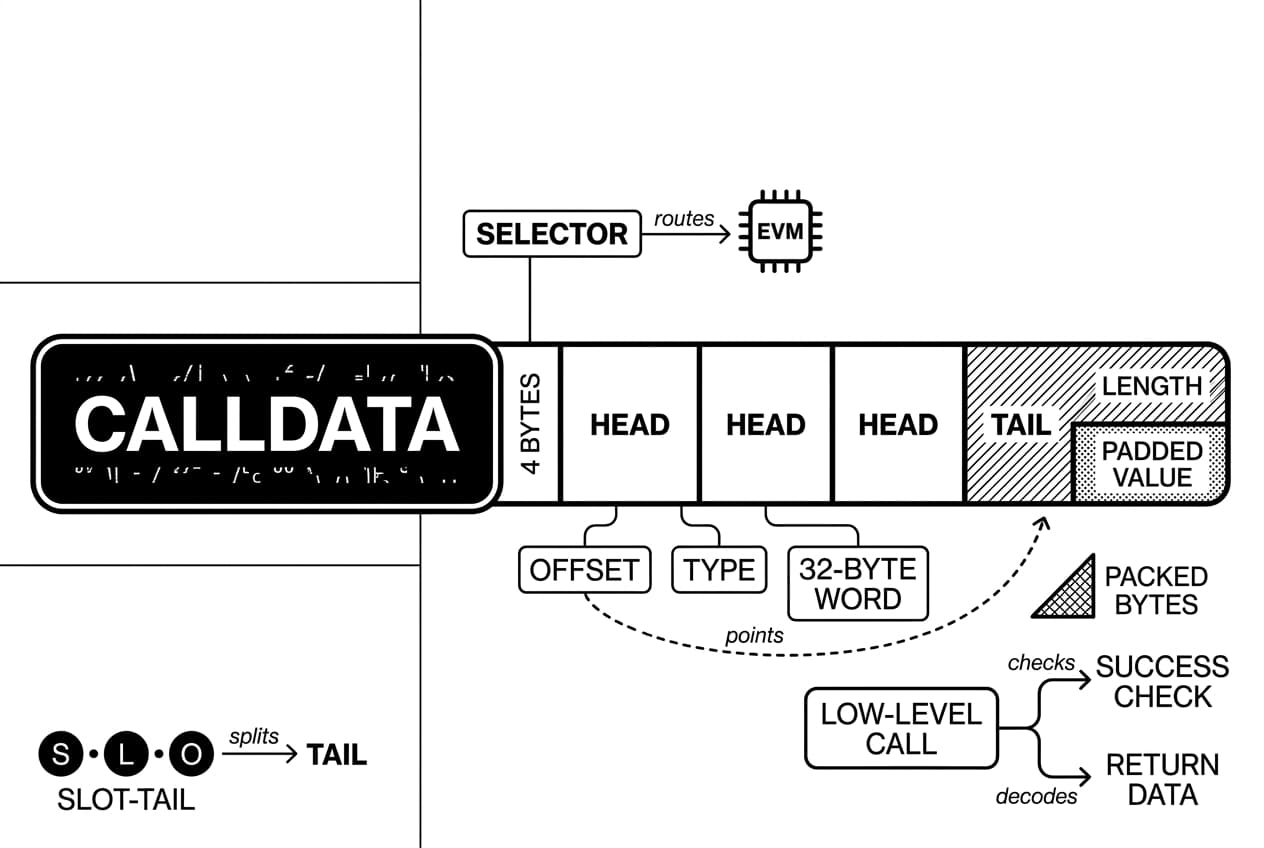
What is Solidity ABI encoding? The ABI, short for application binary interface, is the byte format the EVM expects when contracts, wallets, and off-chain tools exchange data. When you solidity abi encode a call, Solidity converts typed arguments into a binary payload the EVM can route, parse, and decode predictably.
The common shortcut is to outsource abi encoding decoding to ethers.js, viem, or a block explorer. That is useful, but it is not enough. Production mistakes usually come from misreading shifting offsets, treating packed bytes as unambiguous, or decoding low-level return data before checking whether the call succeeded.
The End Goal: Read Calldata Without Guessing
You should be able to open a failed transaction, copy the hex payload, and label each part: the first 4 bytes, each 32-byte head word, each offset, each length word, and each padded value. That skill lets you debug faster than trial-and-error library calls.
Use the SLOT-TAIL debugging framework throughout this guide: Selector, Layout, Offsets, Types, then TAIL for tail length, tail address, item values, and length checks. It gives you a repeatable order for reading any ABI payload.
As of the Solidity 0.8.26 ABI specification, published in 2024, ABI values are encoded in 32-byte words. That 32-byte rule is the anchor for every example in this guide.
Where ABI Encoding Appears in Real Web3 Work
ABI encoding appears in nearly every layer of a production Web3 stack:
- Contract-to-contract calls:
call,delegatecall, andstaticcallall send ABI-encoded calldata. - Wallet transactions: a wallet encodes your function arguments before broadcasting the transaction.
- Return value decoding: off-chain scripts decode responses with the same ABI rules used to encode them.
- Events versus function calls: indexed event topics use different rules from function inputs, so do not decode topics as normal calldata.
- Multisigs and proxies: Safe-style multisigs and UUPS proxies forward raw payloads, so one malformed offset can route the wrong action.
- Relayers and gasless transactions and meta-transactions: relayers often forward user payloads, and mismatched encoding is a frequent revert source.
- Failed transaction debugging: revert reasons are ABI-encoded, including the standard
Error(string)payload.
Vitalik Buterin, Co-founder at Ethereum Foundation has consistently emphasized shared protocol standards for contract interoperability. ABI encoding is one of those standards. Gavin Wood, founder of Polkadot and co-founder of Ethereum, authored the original Ethereum yellow paper work that made byte-level EVM execution precise. That history matters because ABI bytes are not a library preference. They are part of how the EVM interface stays deterministic.
Generated ABI Trace Dataset for This Guide
The table below is a small generated dataset you can reproduce in Remix, Foundry, or an ethers.js console. It gives you fixed checkpoints while you learn to read calldata manually.
Case | Expression | Expected length | Manual trace |
|---|---|---|---|
Static tuple | abi.encode(uint256(7), address(0x000000000000000000000000000000000000abcd), true) | 96 bytes because 3 values × 32 bytes | word 0 = 7; word 1 = address left-padded to 32 bytes; word 2 = 1 |
Shifting string plus integer | abi.encode(string("hi"), uint256(7)) | 128 bytes: 64-byte head plus 64-byte tail | word 0 = offset 0x40; word 1 = 7; word 2 = length 2; word 3 = 0x6869 right-padded |
Function selector | transfer(address,uint256) | 4 bytes before arguments | 0xa9059cbb, listed by 4byte.directory, accessed July 2026 |
Manual transcript, July 2026
case: abi.encode(string("hi"), uint256(7))
head[0] = 0x0000000000000000000000000000000000000000000000000000000000000040
head[1] = 0x0000000000000000000000000000000000000000000000000000000000000007
tail[0] = 0x0000000000000000000000000000000000000000000000000000000000000002tail[1] = 0x6869000000000000000000000000000000000000000000000000000000000000
What You Will Need Before You Encode or Decode
Before you start splitting calldata by hand, set up a simple environment. You only need a compiler, a way to run small calls, and a place to inspect raw bytes.
Warning: ABI encoding is word based. Every static value, offset, and length field occupies exactly 32 bytes. When you paste hex into a debugger, count in 64-character chunks because 64 hex characters equal one 32-byte word.
Tools to Use in 2026
Tool | Best for | Where to get it |
|---|---|---|
Remix browser IDE | Beginner tests with no install. Open the deploy panel, enter arguments, then click the orange transact button. | remix.ethereum.org |
Foundry | Local tests, forge test, and command-line ABI checks. | book.getfoundry.sh |
Hardhat | javascript-based local testing with ethers integration. | hardhat.org |
Etherscan or Tenderly | Inspecting real transaction calldata and revert bytes. | etherscan.io |
ethers.js ABI coder | Cross-checking your manual decode against a known encoder. | docs.ethers.org |
For learning, use Remix for quick experiments and Foundry for repeatable tests. On a live transaction, Etherscan’s input data panel is useful after you already understand how the 32-byte chunks are arranged.
Use a modern compiler. The Solidity 0.8.26 documentation, published in 2024, reflects the current ABI helpers and syntax used in this guide.
Terms You Must Know First
- Byte: 8 bits, displayed as 2 hex characters, such as
0xff. - Word: 32 bytes, displayed as 64 hex characters.
- Calldata: the raw bytes sent to a contract in a transaction’s
datafield. - Function selector: the first 4 bytes of a function call, derived from the function signature hash.
- Function signature: a canonical string such as
transfer(address,uint256), with no spaces and no argument names. - Static type: a type with fixed size, such as
uint256,address,bool, orbytes32. - Shifting type: a type with runtime length, such as
bytes,string, and active arrays. - Offset: a 32-byte pointer measured in bytes from the start of the encoded arguments block.
- Length: a 32-byte word that tells the decoder how many bytes or elements follow.
Step 1: Identify the Function Signature and Selector
Start every decode by identifying the function. The EVM reads the first 4 bytes of calldata, compares that selector to the contract’s dispatch table, and then treats the remaining bytes as arguments.
Write the Canonical Function Signature
The canonical signature is name(type1,type2,...). Do not include spaces, parameter names, storage locations, or aliases.
Solidity declaration | Canonical form |
|---|---|
address recipient | address |
uint256 amount | uint256 |
bytes32 hash | bytes32 |
string memory label | string |
uint256[] calldata ids | uint256[] |
struct Order { address to; uint256 amount; } | (address,uint256) |
The ERC-20 transfer declaration function transfer(address recipient, uint256 amount) becomes transfer(address,uint256). Strip everything except the function name and normalized types.
Tip:uintandintare aliases in Solidity, but canonical ABI signatures useuint256andint256. If you hashtransfer(address,uint), you do not get the deployed ERC-20 selector.
Take the First 4 Bytes as the Selector
Hash the canonical signature with keccak256 and take the first 4 bytes. For transfer(address,uint256), the selector is 0xa9059cbb, shown in 4byte.directory, accessed July 2026.
Those 4 bytes occupy calldata bytes 0 through 3. Everything after byte 3 is argument data. When you decode arguments with abi.decode, you remove the selector first.
Warning: Selector Collisions Are Possible
Warning: A 4-byte selector has 4,294,967,296 possible values, calculated from 2^32 and described by the Solidity ABI function selector specification, 2024. Collisions can happen. Do not use msg.sig alone as an authorization check.Step 2: Encode Static Values with abi.encode
After you identify the selector, encode the arguments. Static types are the easiest starting point because each value occupies one 32-byte word.
Encode uint256, address, bool, and bytes32
Integers and addresses are left-padded with zeros. The number 7 becomes 31 zero bytes followed by 07. A 20-byte address gets 12 zero bytes on the left.
Booleans encode as 1 for true or 0 for false, left-padded to 32 bytes. Fixed bytes such as bytes32 are already 32 bytes; shorter fixed-byte values are right-padded.
Calling abi.encode(uint256(7), address(0x000000000000000000000000000000000000abcd), true) returns exactly 96 bytes, based on 3 ABI words × 32 bytes, under the Solidity ABI encoding rules, 2024.
Encode a Fixed-Size Array with Static Types
A fixed array such as uint256[3] is static when its element type is static. Each element gets its own 32-byte slot, with no offset pointer.
abi.encode(uint256[3]([1, 2, 3])) produces 96 bytes. Slot one holds 1, slot two holds 2, and slot three holds 3.
This matters when you are building a Solidity token vesting contract. If vesting milestones are a fixed array, you can estimate calldata size without tracking active offsets.
Tip: Use abi.encode for Hashes Unless You Understand Packing
abi.encodePacked can save bytes, but it removes boundaries. Two different typed inputs can produce the same packed byte string if the decoder cannot tell where one value ends and the next begins.
Use full abi.encode when the bytes will be decoded later, signed off-chain, or used across a trust boundary. Packed mode is only safe when you can prove the input structure is unambiguous.
Step 3: Encode Shifting Values with Offsets and Lengths
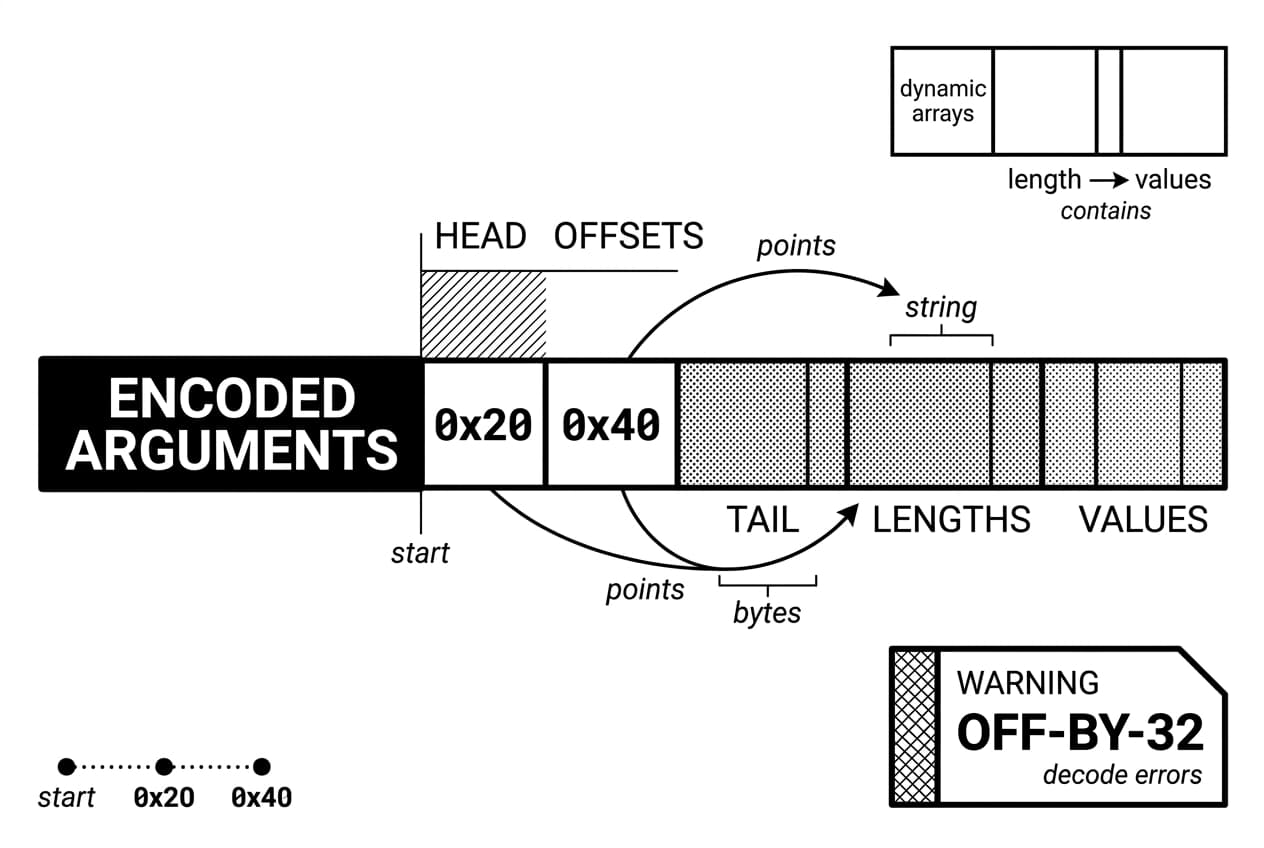
Active types need an extra structure. The ABI uses a head-tail layout: the head contains one 32-byte slot per top-level argument, and the tail contains the variable-length data.
Split the Payload into Head and Tail
Use this six-step process every time you encode shifting values:
- Identify shifting types. Mark each
string,bytes,T[], or fixed array whose element type is active. - Reserve head slots. Give every top-level argument one 32-byte head slot. Static values go directly into their slots.
- Calculate offsets. For each active argument, write the byte distance from the start of the arguments block to that argument’s tail entry.
- Write lengths. At the start of each tail entry, write the number of bytes for
stringandbytes, or the number of elements for a active array. - Append contents. Write the actual bytes or array elements after the length word.
- Pad to 32 bytes. Right-pad variable-length content with zero bytes until the tail entry ends on a 32-byte boundary.
Offsets are measured from the start of the encoded arguments block, not from the function selector and not from the offset slot itself. That detail prevents most off-by-32 errors.
Warning: The offset points to the length word, not to the first content byte. If you jump directly to content, every later read is 32 bytes too far ahead.
Encode Strings and Bytes
A string is stored as UTF-8 bytes with no null terminator. The tail starts with a 32-byte length word, then the content bytes, then zero padding.
For string("hi"), the length is 2. The content word starts with 0x6869 and then has 30 zero bytes of padding.
Encode Active Arrays and Fixed Arrays Holding Active Types
A active array such as uint256[] writes its element count first, then writes each 32-byte element. There are no per-element offsets because uint256 is static.
Arrays such as string[], bytes[], and string[2] are more involved. Each element is shifting, so the array body has its own small head-tail layout.
Type | Length word in tail? | Per-element offsets? | Padding applied? |
|---|---|---|---|
uint256[] | Yes, element count | No | Each element is already 32 bytes |
string[] or bytes[] | Yes, element count | Yes | Yes, each value is right-padded |
string[2] | No, fixed length is known | Yes | Yes, each string is right-padded |
Once you can read this layout by hand, abi.encode stops feeling like a black box. You will know what bytes it should produce before you run the code.
Step 4: Decode Calldata and Return Data with abi.decode
Decoding runs the process in reverse. The main rule is simple: abi.decode expects argument bytes, not a full function call with the selector still attached.
Quick checklist before you call abi.decode:
- Confirm the function by checking the first 4-byte selector.
- Remove the selector so only argument bytes remain.
- Match the exact Solidity type list in the original order.
- Follow active-type offsets to the correct tail locations.
- Decode values and confirm array or string lengths.
- Validate decoded values before using them in business logic.
Remove the 4-Byte Selector Before Decoding Arguments
msg.data starts with the selector. If your payload came from abi.encodeWithSelector, slice off the first 4 bytes before decoding.
bytes memory args = msg.data[4:];(uint256 amount, address recipient) = abi.decode(args, (uint256, address));
If the bytes were produced by plain abi.encode, no selector exists and you decode from byte 0.
Warning: Passing full calldata intoabi.decodemisaligns every value. Auint256may absorb 4 selector bytes plus 28 bytes from the first argument, and that can produce a wrong value instead of a clean revert.
Decode Multiple Values as a Tuple
Multiple parameters are decoded as one tuple. The type order must match the original encoding exactly.
If data was encoded as (uint256,address,bytes), decoding it as (address,uint256,bytes) gives wrong results. Structs follow the same rule because the ABI treats a struct as a tuple in field order.
Decode Return Data from a Low-Level Call
Low-level calls return a success flag and raw bytes:
(bool success, bytes memory returnData) = target.call(payload);
Check success before decoding. If the call reverted, returnData may contain an error selector and an encoded reason string rather than the return type you expected.
For the standard revert reason, check whether the first 4 bytes match 0x08c379a0, the Error(string) selector documented in the Solidity 0.8.26 error handling documentation, 2024. Then slice past the selector and decode the rest as (string).
Step 5: Choose the Right Encoding Helper
Solidity gives you five common encoding helpers. The right helper depends on whether you need a selector, compile-time type checking, or compact bytes.
Helper | What it returns | Best use case | Main risk |
|---|---|---|---|
abi.encode | ABI-padded bytes without a selector | Structured data, hashing, later decoding | Larger output than packed mode |
abi.encodePacked | Compact bytes without padding | Single-value hashing or fixed-size concatenation | Ambiguous output and hash collisions with multiple active values |
abi.encodeWithSelector | 4-byte selector plus ABI-padded arguments | Low-level .call() when you already know the selector | No compile-time argument check |
abi.encodeWithSignature | Selector derived from a signature string plus ABI-padded arguments | Low-level calls when you only have a signature string | Typos or spaces in the string produce the wrong selector |
abi.encodeCall | Selector plus ABI-padded arguments | Type-checked low-level calls through an interface or function pointer | Requires the function to be available to the compiler |
Use abi.encode for Standard ABI Arguments
Use abi.encode as your default when you need structured bytes. It pads values to 32 bytes, preserves type boundaries, and creates data that abi.decode can reconstruct later.
Good use cases include EIP-712 struct hashes, encoded arguments stored for later execution, and test fixtures where exact type boundaries matter.
Use abi.encodeWithSelector or abi.encodeWithSignature for Low-Level Calls
When you send bytes to address.call(), prepend a selector. abi.encodeWithSelector takes a bytes4 selector directly. abi.encodeWithSignature hashes a signature string for you.
Prefer abi.encodeWithSelector when you can. A signature string with one wrong type or extra space silently generates the wrong selector.
Prefer abi.encodeCall for production code when an interface is available. It lets the compiler check argument types before deployment. The helper is documented in the Solidity 0.8.26 ABI helper documentation, 2024.
Warning: abi.encodePacked Can Create Hash Collisions
Packed encoding writes values back-to-back with no length markers. That is fine for a single active value or a set of fixed-size values, but unsafe for adjacent active values.
For example, abi.encodePacked("abc", "def") and abi.encodePacked("ab", "cdef") both produce 0x616263646566. If you hash either result, the digest is the same.
Warning: Do not sign or authorize packed bytes containing two adjacent active values. Hash each value first, add a domain separator, or use abi.encode so boundaries remain clear.The non-standard packed mode warning is documented in the Solidity 0.8.26 ABI specification, 2024. Treat that warning as a security rule, not a style preference.
Step 6: Encode Structs, Tuples, and Nested Arrays
Structs, tuples, and nested arrays are where most calldata debugging slows down. The fix is to keep using the same SLOT-TAIL order and resolve one layer at a time.
Map Structs to Tuples in Field Order
Solidity encodes a struct as a tuple using the exact field order in the contract.
struct Profile {
string name;
uint256[] scores;}
Profile becomes (string,uint256[]). Both fields are active, so the tuple has offsets pointing to the name tail entry and the scores tail entry.
Warning: If your off-chain decoder swaps name and scores, it will follow the wrong offsets. Match field declaration order exactly.
Trace Multiple Array Arguments Separately
When a function takes two active arguments, each gets its own offset slot in the top-level head. Resolve the first offset fully, then return to the top-level head and resolve the next one.
This is the two-pass offset rule: first collect top-level offsets, then decode each referenced tail block independently. Do not jump between nested tails until the current block is complete.
Understand Triple-Nested Arrays Without Animation
A type such as uint256[][][] is recursive, not special. Follow these steps:
- Start at the outer offset. Jump to that byte position and read the outer array length.
- Read each inner offset. Each offset points to a middle array. Jump to one middle array at a time.
- Follow recursively. At the innermost level, read raw
uint256values in sequence because they are static.
Each shifting layer adds one length word and then either element values or element offsets. This matches the recursive head-tail rule in the Solidity ABI specification, 2024.
Tip: When tracing nested arrays manually, write each offset as a decimal byte index before jumping. Mixing decimal and hex during a trace is a reliable way to land on the wrong word.
Step 7: Test Calldata Length, Gas Cost, and Failure Cases
Correct encoding is only half the job. You also need to test calldata length, malformed inputs, and gas cost before a contract depends on the bytes.
Measure Calldata Length Before Optimizing
Every calldata byte has a protocol gas cost. Since EIP-2028, finalized in 2019, a non-zero calldata byte costs 16 gas and a zero calldata byte costs 4 gas. That difference matters for large arrays and long strings.
To understand how Ethereum gas fees work at the byte level, read the dedicated gas guide after you finish this tutorial.
bytes memory encoded = abi.encodeWithSelector(selector, myArray);emit log_uint(encoded.length);
Run this before and after any data-structure change. A switch from string[] to bytes32[] can reduce padding and offsets, but measure before you rewrite code for gas.
Test Empty, Maximum, and Malformed Inputs
Your test suite should include boundary cases, not just normal inputs:
- Empty string and empty array: confirm the length word is zero and no content follows.
- One-element array: check the simplest shifting case.
- Large array with 1,000 or more elements: stress-test calldata length and block gas fit.
- Nested arrays: confirm each layer adds the expected offset layer.
- Wrong selector: swap the first 4 bytes and require a clean revert.
- Truncated calldata: remove the last 32 bytes and confirm decoding fails.
In Hardhat, send raw hex with signer.sendTransaction({ to: addr, data: '0xdeadbeef' }) and assert the revert. In Foundry, use vm.expectRevert() for selector and truncation cases. Pair these tests with smart contract access control patterns so malformed calldata cannot bypass sensitive checks.
Tip: Do not optimize into unsafe packed data.abi.encodePackedcan reduce bytes, but it removes the length prefixes and padding that make decoding unambiguous. Use standardabi.encodefor data that crosses a trust boundary, is signed off-chain, or is decoded by another contract.
Summary and Next Steps for Solidity ABI Encode and ABI Encoding Decoding
You now have the full mental model. Selector first. Then one 32-byte word per top-level argument in the head. Active values point into the tail with byte offsets. Each active tail entry starts with a length word, then padded content.
The core ABI layout has stayed stable across modern Solidity releases. That is why the same reasoning works in wallets, block explorers, SDKs, debuggers, proxies, and low-level calls.
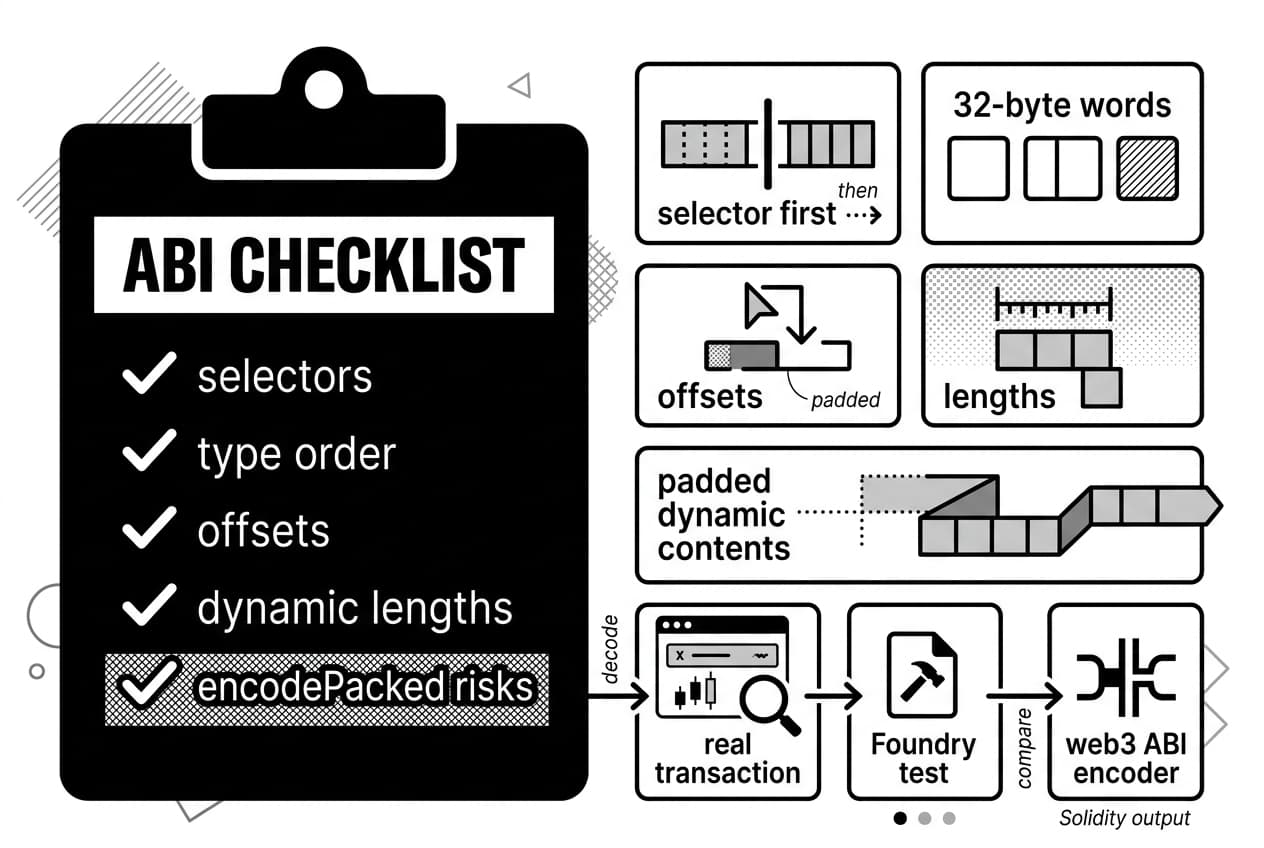
Your ABI Debugging Checklist
Before you send a low-level call or file a bug report, run through this checklist:
- Function signature: is it canonical, with no spaces, names, or aliases?
- Selector: does
bytes4(keccak256(...))match the first 4 calldata bytes? - Argument types: are static and shifting types in the exact function order?
- Head words: is there one 32-byte slot per top-level argument?
- Tail offsets: are offsets measured from the start of the encoded arguments block?
- Lengths: does each shifting segment begin with a 32-byte length word?
- Padding: are integers and addresses left-padded, while strings and bytes are right-padded?
- Decode target: are you passing the correct tuple type to
abi.decode? - Packed risk: if you used
abi.encodePacked, have you ruled out adjacent shifting-value collisions?
Where to Go After This Guide
- Decode a real transaction. Pick a contract interaction on Etherscan, copy the transaction data, and map each 32-byte chunk to the checklist above.
- Write a Foundry test. Use
vm.expectCallwithabi.encodeCallto assert exact calldata. - Compare with a web3 encoder. Run the same call through ethers.js v6 and compare its hex output byte-for-byte.
- Study low-level calls and calldata gas. ABI layout lets you reduce bytes deliberately instead of guessing.
- Move into contract security testing. Selector clashing, proxy calls, revert decoding, and signature validation all depend on ABI accuracy.
- Practice access control reviews. Many role checks pass encoded identifiers, so byte-level reading helps during audits.
If you want structured practice, free blockchain training for Solidity developers covers low-level calls, Foundry testing, and contract security patterns in a hands-on format.
Keep the SLOT-TAIL framework nearby. When calldata behaves unexpectedly, walk through selector, layout, offsets, types, tail length, tail address, item values, and length checks. You will spend less time guessing and more time shipping safe Solidity code.
Frequently Asked Questions
- What is ABI encoding in Solidity?
- ABI encoding is the standard way Solidity turns typed data into bytes that the EVM can understand. It is used whenever contracts, wallets, or scripts send function inputs or read return values.
Sources
Author

Crypto analyst and blockchain educator with over 8 years of experience in the digital asset space. Former fintech consultant at a major Wall Street firm turned full-time crypto journalist. Specializes in DeFi, tokenomics, and blockchain technology. His writing breaks down complex cryptocurrency concepts into actionable insights for both beginners and seasoned investors.