DAO Dispute Resolution: How Conflicts Are Solved in 2026
What is DAO Dispute Resolution?
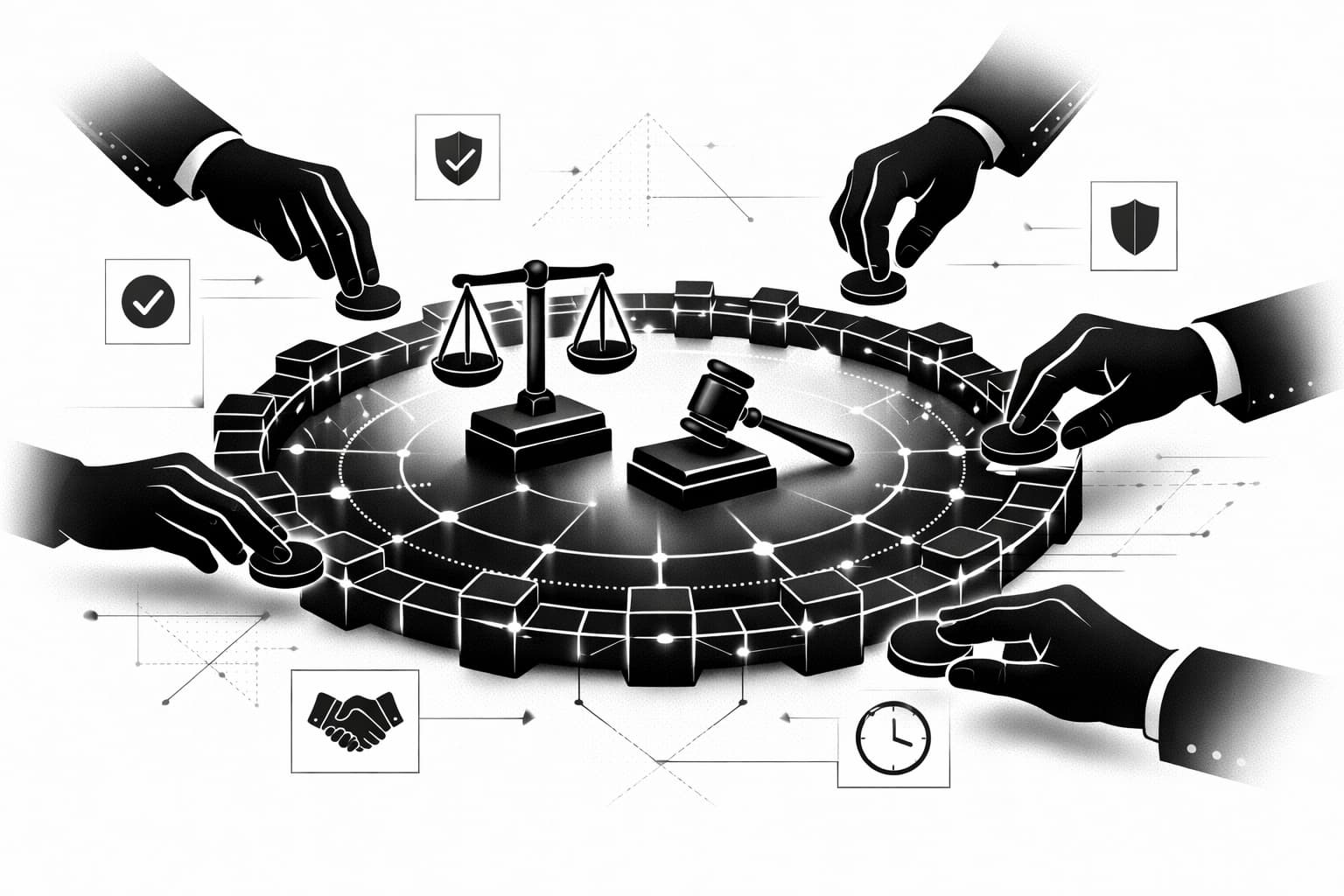
DAO dispute resolution refers to the methods a decentralized autonomous organization (DAO) uses to solve disagreements among its members without relying on traditional courts. Think of a DAO as a digital co-op, owned and managed by its members. Just like any co-op needs bylaws for when people disagree, a DAO needs a clear system to handle conflicts. Without one, a simple argument can escalate, jeopardizing the community's treasury, stalling important decisions, and eroding the trust that holds the organization together. Effective conflict resolution is not just a nice-to-have; it's essential for a DAO's long-term health and survival.
Why Traditional Legal Systems Fall Short for DAOs
Applying conventional law to DAOs is like trying to fit a square peg in a round hole. Traditional legal systems are built on geography and clear identity, concepts that often don't apply in the decentralized world. For instance, which country's laws govern a DAO with anonymous members scattered across a dozen nations? Who would a court order compel to act if control is distributed among thousands of token holders? These challenges with jurisdiction, anonymity, and enforcement make old-world legal frameworks ineffective for resolving on-chain disputes, pushing DAOs to develop their own internal justice systems.
Common Types of Disputes in DAOs
Disagreements can arise in any organization, and DAOs are no exception. While every community is unique, conflicts often center on a few key areas. Understanding these common friction points is the first step toward designing a fair system to address them.
- Treasury Management: The most frequent source of conflict involves how the collective funds are spent. Members might disagree on investment strategies, funding for certain projects, or the size of grants.
- Protocol Upgrades: Debates over technical changes to the DAO's underlying smart contracts can be intense, as they directly impact how the protocol functions and its future direction.
- Contributor Compensation: Determining fair pay is a major challenge. Disputes often arise over the value of contributions, salary levels, or the structure of reward programs like bounties. You can learn more about different models for contributor compensation to see why this is so complex.
- Code of Conduct Violations: Clashes can occur when a member's behavior is seen as harmful to the community, leading to debates about moderation, censorship, and what constitutes acceptable conduct.
On-Chain vs. Off-Chain Resolution Mechanisms
When disagreements arise, DAOs generally follow one of two paths to find a solution. The two main approaches to DAO dispute resolution are:
- On-Chain Resolution
- Uses smart contracts for automatic enforcement.
- Decisions are executed without direct human intervention.
- Often faster and less biased, but also less flexible.
- Off-Chain Resolution
- Involves human discussion, negotiation, and voting.
- Relies on social consensus to reach a decision.
- More adaptable to complex situations but can be slower.
Think of this as the difference between a vending machine and a courtroom. One follows rigid, pre-programmed rules automatically, while the other relies on human deliberation to interpret rules and context. Both have their place in a well-functioning decentralized system, and many DAOs use a combination of both.
On-Chain Solutions: Automated Enforcement
On-chain resolution embodies the "code is law" principle. These methods use smart contracts—self-executing agreements with the terms written directly into code—to handle disputes. For example, two parties might lock funds in a smart contract that automatically releases the money to one party if a specific, verifiable condition is met on the blockchain. There's no need for a trusted third party because the code itself is the enforcer. This process is incredibly fast and removes human bias, but it has a significant limitation: it can only handle disputes that are simple and can be verified entirely by code. It cannot interpret nuance, intent, or any information that exists outside the blockchain.
Off-Chain Solutions: Human-in-the-Loop
When a conflict is too complex for a smart contract to judge, DAOs turn to off-chain solutions. This is where the community gets involved. The process usually starts with discussions on platforms like Discord or a forum. If a consensus isn't reached, a formal proposal might be created on a voting platform like Snapshot. Members then use their governance tokens to vote on a resolution. This approach is powerful because it can handle subjective and complicated issues. Once a decision is made off-chain, it must be implemented on-chain. This is often done through a multi-signature (or "multi-sig") wallet, which requires a certain number of trusted community leaders to sign a transaction to execute the community's decision.
Popular On-Chain Dispute Resolution Tools
When a disagreement can't be settled through simple voting, DAOs can turn to specialized on-chain platforms. Think of these as decentralized court systems built directly into the blockchain. Instead of relying on traditional legal frameworks, these tools use code, economic incentives, and crowdsourced judgment to arrive at a fair outcome. This approach provides a transparent and enforceable method for dao dispute resolution directly within the digital environment.
Kleros: A Decentralized Arbitration Service
Kleros is one of the most well-known platforms in this space. It functions as a general-purpose arbitration system. When a dispute is submitted, Kleros randomly selects a panel of pseudonymous jurors from a large pool. To become a juror, individuals must "stake" Kleros's native token, PNK. This stake acts as a security deposit; jurors who vote with the majority earn fees, while those who vote against the final consensus lose their staked tokens. This system uses game theory to create a powerful economic incentive for jurors to vote honestly and reach a common-sense conclusion, known as a Schelling Point, without ever communicating with each other.
Aragon Court: Resolving Subjective Disagreements
While Kleros can handle many types of cases, Aragon Court specializes in resolving subjective disputes that are difficult for smart contracts to interpret on their own. Imagine a DAO funds a project to create a piece of art. Did the artist deliver on their promise? A simple line of code can't answer that. Aragon Court provides a service where human jurors, also staked with tokens, can review the evidence and make a subjective judgment. This makes it a powerful "subjective oracle"—a human-powered system that provides answers to questions that code cannot, ensuring agreements are upheld based on their original intent and not just their programmable logic.
Exploring Off-Chain and Hybrid Models
While fully on-chain systems offer mathematical certainty, they can lack the nuance needed for complex human disagreements. This is why many organizations turn to off-chain and hybrid approaches for DAO dispute resolution. These methods blend the flexibility of human judgment with the security of blockchain enforcement, creating a powerful middle ground for solving conflicts before they escalate.
Web3 Arbitration and Mediation Platforms
Think of these platforms as specialized digital courts for the decentralized world. When a dispute arises, a DAO can engage with a service that connects them to expert mediators or arbitrators. These neutral third parties help the conflicting members negotiate a solution. The entire discussion and decision-making process happens off-chain, allowing for private, detailed conversation. Once an agreement is reached, the outcome can be encoded into a transaction and executed on-chain, making the resolution binding and transparent.
The Role of Community Reputation and Social Slashing
Not every conflict requires a formal ruling. Sometimes, the most effective tools are social ones. Reputation systems within a DAO track a member's contributions and behavior. A member who acts in bad faith might not lose funds directly, but they could lose status, voting power, or be removed from key roles. This is often called "social slashing." It's a non-financial penalty that protects the community's integrity. Strong social norms and clear consequences for breaking them are a key way to measure DAO health and prevent minor issues from becoming major disputes.
Case Studies: DAO Conflicts in the Wild
Theory and tools are one thing, but seeing them tested under pressure is another. Examining real-world conflicts reveals the complexities and high stakes of decentralized governance. These historical examples show how communities have handled crises, shaping the future of dao dispute resolution.
The BZX DAO Hack and Treasury Dispute
In 2021, the BZX protocol suffered a phishing attack, leading to the loss of millions from its treasury. The community faced a difficult choice. A governance proposal was passed to use an admin key to seize governance tokens held by the attacker. This controversial move sparked a massive debate. Was it a justified act to recover stolen community funds, or a dangerous overreach of power that violated the principles of decentralization? The incident became a key example of the ethical lines DAOs must address when faced with an existential threat.
Lessons from 'The DAO' Fork
Perhaps the most famous conflict is the 2016 hack of 'The DAO,' the first major decentralized autonomous organization. An attacker exploited a vulnerability and drained a huge portion of its funds. The community couldn't agree on a solution. The dispute was so fundamental that it led to the ultimate resolution: a hard fork of the entire Ethereum blockchain. This drastic step reversed the fraudulent transactions but split the community, creating two separate chains: Ethereum (the new chain) and Ethereum Classic (the original, unaltered chain). It stands as a powerful reminder of how unresolved disputes can have permanent, chain-splitting consequences.
The Legal Frontier: DAOs and Traditional Law
While DAOs operate on principles of digital self-governance, they don't exist in a vacuum. As these organizations grow and interact with the physical world, they inevitably brush up against traditional legal systems. This intersection raises complex questions about liability, enforcement, and how code-based rules translate into court-recognized agreements.
DAO Legal Wrappers: Bridging Web3 and the Real World
To manage this complex terrain, many DAOs adopt a "legal wrapper." Think of this as a recognized corporate structure—like an LLC or a foundation—that provides the DAO with a legal identity. Jurisdictions like Wyoming in the United States and Switzerland have created specific legal entities tailored for DAOs. This wrapper allows the organization to sign contracts, open bank accounts, and hire employees. Most importantly, it can offer limited liability protection to members, shielding their personal assets from the DAO's debts or legal troubles, an important step for managing risk.
The Challenge of Legal Enforcement and Liability
Despite these advances, significant questions remain. If a DAO's actions cause harm, who is legally responsible? Is it every token holder who participated in a vote? Or the core developers who wrote the code? This ambiguity is a central point of regulatory uncertainty. Enforcing decisions is another major hurdle. A traditional court may not recognize or know how to enforce a ruling made by an on-chain arbitration protocol. This creates difficult scenarios where the worlds of code and law conflict, making legally sound dao dispute resolution a developing field that requires careful consideration.
Key Takeaways for DAO Dispute Resolution
Handling conflict within a decentralized organization can feel complex, but keeping a few core principles in mind provides a clear path forward. As we've explored the various methods for effective DAO dispute resolution, here are the most important points to remember:
- Plan Proactively, Not Reactively: The most successful DAOs build dispute resolution mechanisms into their foundational governance from day one. Waiting for a crisis to design a solution is often too late.
- Hybrid Models Offer Flexibility: Relying solely on rigid on-chain voting or purely subjective off-chain discussion can be limiting. The most effective strategies often blend the two, using tools like arbitration for nuance and smart contracts for enforcement.
- Community Legitimacy is Paramount: A resolution process is only as good as the community's faith in it. Whatever system you choose, it must be seen as transparent, fair, and aligned with the DAO's core values to maintain member trust and participation.
- The Legal Bridge is Unavoidable: While DAOs operate with novel structures, they do not exist in a vacuum. Understanding how internal conflicts might intersect with traditional legal systems is essential for long-term resilience and risk management.
Frequently Asked Questions
- Can you sue a DAO?
- Suing a DAO is legally complex. Unincorporated DAOs lack a distinct legal entity, making them difficult to sue directly. However, DAOs with a 'legal wrapper,' like a Wyoming LLC, can be sued. In other cases, courts may attempt to hold individual token holders liable, creating significant legal uncertainty for members.
- What are the risks of a DAO?
- Primary risks include smart contract vulnerabilities leading to hacks, malicious governance attacks, and regulatory uncertainty. Internally, a major risk is unresolved disputes, which can cause community forks, treasury dissolution, or gridlock. This highlights the critical need for robust conflict resolution frameworks to ensure the DAO's survival and success.
- What are the top 5 DAOs?
- While DAOs like Uniswap, MakerDAO, and Aave are prominent examples of large-scale decentralized governance, each operates differently. Instead of a ranked list, it's more useful to study their unique frameworks for proposals and decision-making. How they handle disagreements is a key factor in their long-term stability and success.
- How are DAO members compensated?
- Compensation models include salaried core roles, project-based bounties, and retroactive grants, usually paid in the DAO's native token or stablecoins. Disagreements over compensation amounts and fairness are a very common source of internal disputes, requiring clear governance and resolution pathways to maintain community alignment and contributor morale.
Sources
Author

Crypto analyst and blockchain educator with over 8 years of experience in the digital asset space. Former fintech consultant at a major Wall Street firm turned full-time crypto journalist. Specializes in DeFi, tokenomics, and blockchain technology. His writing breaks down complex cryptocurrency concepts into actionable insights for both beginners and seasoned investors.