Crypto Tax Accountant: How to Find the Right CPA in 2026
Crypto tax accountant: how to find the right CPA in 2026
What you'll accomplish with this guide
This guide gives you a practical buyer's checklist for finding, vetting, and working with a crypto tax accountant in 2026. By the end, you'll know whether you truly need a specialist, what to ask on the first call, how to prepare your records, and how to avoid paying specialist rates for ordinary tax work.
This is educational content for taxpayers in the United States. It is not personalized tax advice. If your facts are unusual, your return may require guidance from a licensed tax professional who can review your records directly.
Two public signals explain why the bar is higher in 2026. SEC commissioner Hester Peirce has long focused on digital asset market rules, while Coinbase co-founder Brian Armstrong leads one of the largest regulated crypto platforms serving taxpayers who receive tax forms and transaction exports. The practical takeaway is simple: crypto now sits inside normal financial reporting, so your records need to be defensible.
Who this guide is for
Use this guide if crypto made your tax picture harder to explain. That includes spot investors, DeFi users, NFT traders, miners, stakers, protocol founders, freelancers paid in crypto, and business owners who accept digital assets as payment.
If you only bought and held Bitcoin or ETH on one exchange, you may not need a specialist. If you used several wallets, earned staking rewards, bridged assets, sold NFTs, mined coins, accepted crypto for work, or lost cost-basis records, a crypto CPA can save you from expensive mistakes.
Quick answer: when a crypto CPA is worth it
Simple buy-and-hold activity can often be handled with crypto tax software plus a short review from a general CPA. The real need for a crypto tax accountant starts when your return involves judgment calls that software cannot make for you.
The IRS sent more than 10,000 educational letters to virtual currency owners (IRS, July 2019). Broker reporting rules later expanded under the 2021 federal infrastructure law (Congress.gov, November 2021). For custodial broker transactions, reporting on form 1099-DA generally begins with 2025 activity and first reaches many taxpayers in 2026 (IRS, June 2024).
Use this rule of thumb: if you cannot confidently answer, “What is my cost basis, and how did I acquire each lot?” you should at least book a consultation.
The 2026 crypto tax triage scorecard
Before you hire anyone, score your own situation. Add one point for each item that applies:
- You used more than one exchange or self-custody wallet.
- You made DeFi swaps, bridge transfers, liquidity pool deposits, or yield-farming transactions.
- You bought, sold, minted, or received NFTs.
- You earned staking, mining, airdrop, referral, or DAO income.
- You accepted crypto as a contractor, freelancer, or business owner.
- You are missing exchange exports, wallet records, or cost-basis data.
- You need to amend a prior return or respond to an IRS notice.
A score of zero or one usually points to tax software plus review. A score of two or three suggests a review-only CPA engagement. A score of four or higher means you should look for a specialist crypto tax accountant.
What you'll need before you contact a crypto tax accountant
Before you spend money on a consultation, collect your records. A prepared client usually gets a cleaner quote because the accountant can see the real scope instead of pricing for unknowns.
Documents and data to collect
Download or export these items before your first call. On most exchanges, open your account menu, select tax center or statements, choose the full-year date range, and click export or download CSV.
- Exchange transaction histories in CSV format: include every year you were active, not only the current year.
- Wallet public addresses: list self-custody addresses from MetaMask, Ledger, Trezor, or similar tools.
- Cost-basis records: save screenshots, spreadsheets, or software reports showing what you paid and when.
- Forms 1099-DA or 1099-B: check account dashboards and email notices from brokers.
- Prior-year returns: bring at least the last two filed returns so the CPA can see how crypto was previously reported.
- DeFi and NFT activity logs: include liquidity pool entries and exits, NFT mints, royalties, and sales.
- Staking and mining income records: include dates received, fair market value at receipt, and receiving wallet address.
- Business records: if you are accepting Bitcoin payments for business, bring invoices and payment timestamps.
- IRS correspondence: upload notices, audit letters, penalty letters, or mismatch notices immediately.
Warning: incomplete wallet history can raise your bill
Gaps in your history force the accountant to reconstruct activity. A missing wallet, deleted exchange account, or undocumented bridge transfer can turn a simple filing into a research project.
Use the six-gap record map before the call. Check for missing exchanges, missing wallets, missing cost basis, missing income labels, missing prior-year treatment, and missing business context. If one of those gaps exists, tell the accountant upfront.
If you cannot recover records from a closed platform, say so early. Your CPA can discuss reasonable methods such as first-in, first-out or specific identification, but the approach should be documented before the return is filed.
Step 1: Decide whether you need a crypto CPA or tax software
Start with the activity, not your anxiety level. The best option depends on what you did during the tax year and whether your records are complete.
Situation | Best option | Why |
|---|---|---|
Simple exchange trading | Crypto tax software | Clean exchange records usually require calculation, not specialist judgment. |
Many wallets | Review-only crypto CPA or specialist accountant | Transfers must be matched so wallet movement is not mistaken for a sale. |
DeFi or NFTs | Crypto tax accountant | Swaps, liquidity pools, royalties, and mints often need manual classification. |
Mining or staking | Crypto tax accountant | Income timing and valuation matter. Staking rewards were addressed in revenue ruling 2023-14 (IRS, July 31, 2023). |
Business crypto income | Crypto CPA with business tax experience | Self-employment tax, entity returns, deductions, payroll, and bookkeeping may apply. |
IRS notice or audit | Tax representative with crypto experience | You need someone who can respond to the notice, not only prepare forms. |
Use software if your activity is simple
If you made a small number of trades on one centralized exchange, received no income in crypto, and have complete transaction records, software may be enough. Tools such as Koinly, CoinTracker, TaxBit, and CoinLedger can import exchange files and produce form 8949 reports.
After importing, compare the software ending balances against your exchange account. If the numbers do not match, stop and fix the import before you file.
Hire a specialist when judgment calls matter
A crypto tax accountant earns the fee when the facts need interpretation. DeFi lending, liquidity pools, wrapped assets, crypto airdrops, NFT royalties, mining, staking rewards, and DAO compensation can all require careful treatment.
Amended returns are another clear signal. If you underreported prior-year crypto income, do not rerun old software reports and hope for the best. Ask a CPA how they would document the correction.
Pro tip: ask for review-only pricing
If you already imported your activity into crypto tax software, ask whether the firm offers a review-only engagement. In that setup, the CPA checks your report, flags errors, and prepares or reviews the tax forms instead of rebuilding every transaction from scratch.
This option is not right for missing records or heavy DeFi use. It can be a good fit when your data is organized and you want professional review without a full reconstruction project.
Step 2: Search for qualified crypto tax accountants
Now build a shortlist. Your goal is to find a crypto tax accountant who handles real digital asset returns, not a general tax preparer who added “crypto” to a service page.
Search nationwide, not only near you
Many crypto CPAs work remotely. They use encrypted portals, video calls, e-signature tools, and read-only transaction exports. Limiting your search to your city can shrink an already small pool.
Start with terms such as crypto tax accountant, crypto CPA, cryptocurrency tax CPA services, and DeFi tax specialist. Also check partner directories from crypto tax software providers, because those lists often show accountants who already know the platform you used.
Check credentials and licensing
Anyone can claim crypto tax expertise. A CPA license, enrolled agent status, or tax attorney credential is the baseline to verify before you book. Use your state accountancy board lookup for CPAs and the IRS enrolled agent lookup for enrolled agents.
The CPA license is not the same thing as crypto experience. Confirm whether the firm prepares individual returns, business returns, or both. If you have an entity, payroll, or contractor income, a personal-return specialist may not be enough.
Look for specific crypto experience
Generic tax knowledge does not cover the issues that catch crypto holders off guard. Staking rewards, NFT royalties, failed bridge transfers, and blockchain pseudonymity can all affect cost-basis reconstruction.
Look for public signs of hands-on work: articles about DeFi tax treatment, service pages naming specific transaction types, or software workflows that mention CSV imports and wallet labeling. Ask directly, “Have you filed returns involving staking income, NFT sales, or DeFi transactions during the last two filing seasons?”
Pro tip: Apply the three-signal credibility test before shortlisting anyone: verified credential, public content about a specific crypto tax scenario, and named experience with at least one crypto tax software tool. A candidate who clears all three deserves a call.
Step 3: Screen each crypto tax accountant with the right questions
The first consultation is where you separate a real crypto CPA from a generalist. Use the questions below as your script and listen for specific answers.
Questions to ask before you hire
- Ask which software they use and whether they can import your exchange files or read-only wallet data.
- Confirm they handle DeFi activity, including liquidity pools, wrapped tokens, bridges, and yield rewards.
- Ask how they reconcile transfers between wallets you own so transfers are not treated as sales.
- Ask which cost-basis methods they support, including first-in, first-out and specific identification.
- Confirm they review income categories for staking, mining, airdrops, royalties, and contractor payments.
- Ask whether they handle foreign-account reporting if you used non-U.S. platforms.
- Confirm they support amended returns if prior years were filed without crypto income or gains.
- Ask how they document uncertain positions and whether you receive written notes with the return.
- Ask about business crypto accounting if you accept BTC or ETH, run payroll, or use crypto loans for business purposes.
- Confirm the fee structure upfront, including what triggers hourly billing, overage charges, or added forms.
What a strong answer sounds like
Use this transcript-style exchange as a benchmark:
You: “I have two exchanges, three wallets, staking rewards, and one missing CSV. How would you start?”
CPA: “First, I would import the exchange files, map your wallet transfers, separate rewards from transfers, and list the missing CSV as an open item. Then I would show you any assumptions before filing.”
That answer is specific, process-based, and cautious. A weak answer sounds like, “Crypto is easy, just send everything over.”
Red flags to avoid
- Guaranteed refunds: no preparer can promise a result before reviewing your records.
- Claims that crypto is invisible: exchanges, brokers, and on-chain records can create a clear audit trail.
- Vague fees: you should receive a written estimate before signing an engagement letter.
- No secure portal: plain email is a poor way to send tax records and wallet exports.
- Pressure to file without review: speed does not help if the return is wrong.
Warning: never share your seed phrase or private keys. A legitimate crypto tax accountant needs CSV files, tax reports, public wallet addresses, or read-only API access. They do not need recovery phrases, wallet-signing access, or private keys.
Step 4: Compare fees, scope, and turnaround time
Once you have a shortlist, ask for written quotes. A low quote is not useful unless you know what it includes.
Typical pricing models
Crypto CPAs commonly charge by hourly billing, flat-fee package, form add-on, transaction tier, or separate bookkeeping project. Ask which model applies to you before you upload sensitive documents.
A simple spot-trading return should not be priced like a DeFi reconstruction project. A return with missing cost basis, business income, or several wallets will usually need more time.
Service type | What it includes | What can increase the fee |
|---|---|---|
Intro consultation | Situation review, record checklist, and quote discussion. | Several tax years, missing data, or IRS correspondence. |
Review-only service | CPA checks your software report and flags errors before filing. | DeFi transactions, NFT activity, or balances that do not reconcile. |
Full individual return | Personal return, capital gain reporting, and crypto income schedules. | Trade volume, state returns, missing basis, or several wallets. |
Business return | Entity or self-employment filing with crypto income and expense records. | Payroll, mining equipment, contractor payments, or inventory-style tracking. |
Transaction reconstruction | Importing, labeling, and reconciling raw wallet and exchange data. | Closed exchanges, incomplete CSV files, bridges, or chain-specific errors. |
Planning session | Loss harvesting, estimated tax planning, and entity discussion. | Business activity, high-value positions, or several planned transactions. |
Amended return | Correction of a filed return with new crypto data. | Several years, changed cost basis, or prior unreported income. |
IRS notice support | Response support for mismatch notices, letters, or examination requests. | Documentation gaps, legal issues, or a broad agency request. |
What drives the cost higher
Fees rise when the accountant must spend time interpreting and reconstructing. Watch for DeFi protocols, liquidity pools, NFT sales, margin or futures activity, several self-custody wallets, business income, missing CSV files, and prior-year amendments.
Do not ask only, “How much is a crypto return?” Ask, “What is included, what is excluded, and what would cause the invoice to increase?”
Pro tip: get the scope in writing
Before paying a deposit, ask the accountant to confirm the scope in writing. For many individual filers, the engagement letter should mention capital gain reporting, income categories, state returns, transaction reconstruction, tax planning, notice support, and any excluded years.
If the quote does not mention your DeFi, NFT, staking, mining, or business activity, ask for a revised scope. Silence in the engagement letter usually means the service is not included.
Step 5: Prepare your crypto records for the first consultation
Organized records reduce confusion and help the CPA quote accurately. Your goal is to hand over a clean package that shows where the data lives, what is missing, and what questions you need answered.
Create a one-page crypto activity summary
Before the call, prepare a short document with these items:
- Exchanges used: list each platform and the years your account was active.
- Wallets owned: group public addresses by chain, such as Ethereum, Solana, and Bitcoin.
- Major protocols: list DeFi platforms, staking providers, bridges, and NFT marketplaces.
- Estimated transaction count: give a rough range so the CPA can size the work.
- Special events: note airdrops, forks, hacks, gifts, lost access, or wallet drains.
- Tax years in scope: state whether you need one year, several years, or amendments.
If you suspect a wallet was drained or accessed without permission, review our guide on wallet compromise warning signs before the consultation. That helps you explain whether a transaction was a transfer, theft, sale, or unknown event.
Label taxable and non-taxable events carefully
Not every on-chain action is taxable. The IRS digital asset page explains that sales, exchanges, and other disposals can create taxable events (IRS, 2025). Transfers between wallets you own generally need different treatment from sales.
Go through your transaction history and label each row as buy, sell, swap, transfer, reward, payment, airdrop, fee, or unknown. If you are unsure, use “unknown” instead of guessing. A bad label can create phantom gains.
Use secure portals, not email attachments
Your CSV files can include account identifiers, trade history, and other sensitive details. Ask the firm for its secure portal before sending anything.
If the firm tells you to email raw tax files with no portal, pause. Data-handling habits during onboarding are often a good preview of how carefully your return will be handled.
Step 6: Choose your CPA and set expectations for the process
After you choose a crypto tax accountant, the process usually follows the same path: engagement letter, document upload, data cleanup, draft review, e-signature, and payment. Complex returns can take several weeks, especially if you have DeFi, staking, cross-chain transfers, or missing records.
Do not start days before the filing deadline. Individual taxpayers who request an extension often get until October 15 to file (IRS, 2025), but an extension to file is not an extension to pay.
Review the engagement letter
Read the engagement letter before uploading files. It defines what you are buying and what the CPA is not agreeing to do.
- Services included: confirm whether the scope covers federal, state, DeFi, NFTs, and business income.
- Fees and payment schedule: know whether the job is fixed-fee, hourly, or tiered.
- Deadlines: confirm what you must deliver and when.
- Data security: require encrypted file transfer for wallet and exchange records.
- Planning: tax preparation and tax planning are separate unless the letter says otherwise.
- Assumptions policy: ask how missing cost basis will be handled and documented.
Ask for a draft review before filing
Your CPA should send a draft return before filing. Open the crypto schedules and compare them to your transaction history.
- Holding periods: confirm short-term and long-term gains are classified correctly.
- Income categories: review staking, mining, airdrops, and business payments.
- Wallet labels: confirm personal wallets are not treated as outside exchanges.
- Assumptions: make sure missing data is clearly flagged before you approve filing.
Only authorize e-signature after your questions are answered. A good crypto CPA will welcome careful review because it reduces the chance of a later correction.
Summary and next steps
You have now covered the full process: decide whether you need a specialist, gather records, search broadly, screen candidates, compare scope, and review the draft before filing. Your next move is to build your exchange and wallet inventory today.
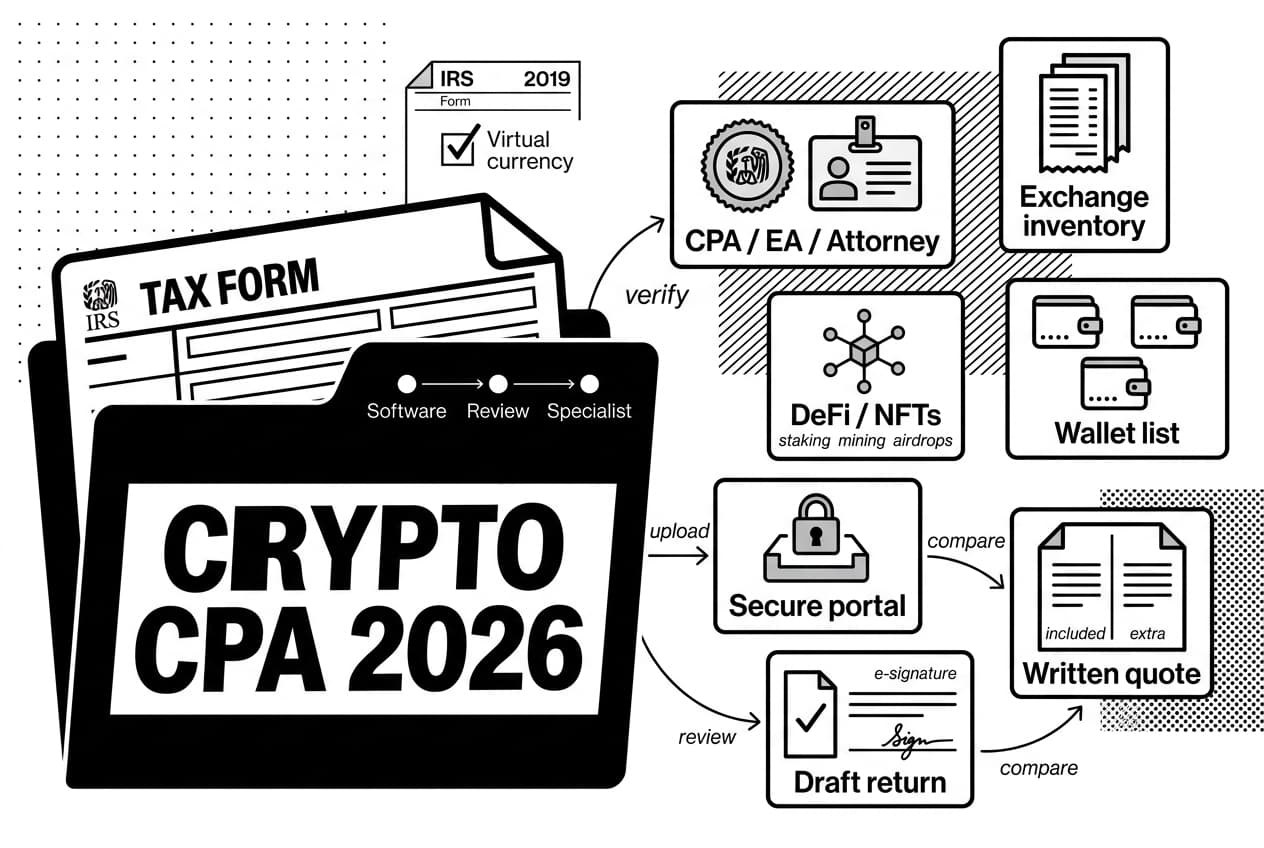
The IRS added a virtual currency question to individual tax forms for the 2019 tax year (IRS, 2019). That history matters because crypto reporting is no longer a niche add-on. It is part of standard tax compliance.
How to choose a crypto tax accountant in 2026
- Verify the CPA, enrolled agent, or attorney credential before the call.
- Use the triage scorecard to decide whether you need software, review, or full specialist help.
- Ask for direct experience with DeFi, NFTs, staking, mining, airdrops, or business crypto income.
- Require a secure portal for transaction files, wallet lists, and tax documents.
- Get a written quote that names what is included and what costs extra.
- Confirm the accountant uses crypto tax software and can explain the workflow.
- Read the engagement letter before paying a deposit.
- Review the draft return before authorizing e-signature.
Finding the right crypto tax accountant is not glamorous, but it is much easier than fixing a bad filing later. Start with your records, ask specific questions, and give yourself enough time to choose carefully.
Frequently Asked Questions
- How much does a crypto tax accountant cost?
- Costs vary widely based on transaction volume, DeFi complexity, missing records, and business activity. Some CPAs charge hourly, others use flat fees or add-on pricing for crypto schedules. Whether they're preparing your full return or only reviewing crypto reports also affects the total. Always get a written quote before committing.
- How much do crypto accountants charge?
- Crypto accountants typically charge more than standard tax preparers because they reconcile wallets, exchanges, DeFi protocols, NFTs, staking, and cost basis. Before agreeing to a fee, ask whether the price covers consultation, bookkeeping, Form 8949 preparation, state returns, and support if you receive an IRS notice.
- Do accountants do crypto taxes?
- Some accountants handle crypto taxes, but not all have real experience with digital assets. Look for a CPA or tax professional who understands capital gains, ordinary income, staking, mining, DeFi, and NFTs, and who is familiar with the crypto tax software needed to accurately reconcile transaction history.
- Who can help me with my crypto taxes?
- Depending on complexity, help can come from a crypto CPA, Enrolled Agent, tax attorney, or dedicated crypto tax software. A CPA works well for return preparation and tax planning. If you're facing an IRS dispute or serious legal issue, a tax attorney with crypto experience may be the better choice.
- What is a CPA in crypto?
- A crypto CPA is a Certified Public Accountant who handles cryptocurrency-related tax and accounting work. The CPA credential itself is general, so you should still verify hands-on experience with exchanges, wallets, DeFi, NFTs, staking rewards, mining income, and the IRS reporting requirements that apply to each activity.
- Do 68% of American millionaires own crypto?
- Crypto ownership figures among high-net-worth individuals vary by survey and change frequently. The practical tax takeaway is straightforward: larger portfolios and more complex activity across exchanges, DeFi, and NFTs make accurate recordkeeping and professional tax planning significantly more important, regardless of the exact ownership percentage.
- How much should I expect to pay for a CPA?
- Standard CPA fees depend on return complexity, your location, business activity, and the forms required. Adding crypto can increase costs if the CPA must reconcile transactions or review specialized reports. Compare at least two quotes and confirm upfront whether crypto-specific schedules like Form 8949 are included in the price.
Sources
Author

Crypto analyst and blockchain educator with over 8 years of experience in the digital asset space. Former fintech consultant at a major Wall Street firm turned full-time crypto journalist. Specializes in DeFi, tokenomics, and blockchain technology. His writing breaks down complex cryptocurrency concepts into actionable insights for both beginners and seasoned investors.