Chart Patterns Crypto Guide: Trade Setups & Risk Rules 2026
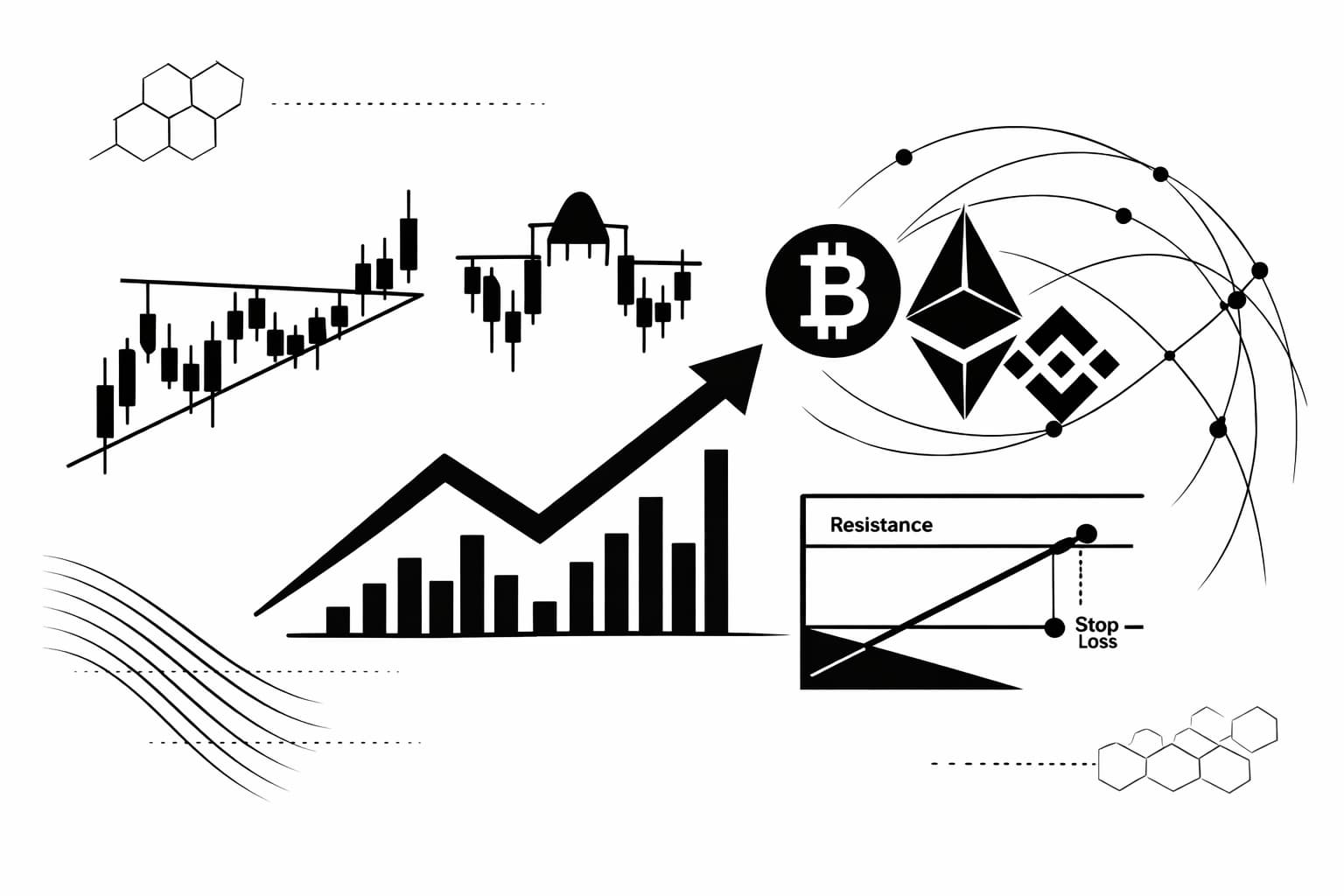
Chart patterns crypto guide: trade setups and risk rules 2026
By the end of this guide, you will know how to read crypto chart patterns as a repeatable decision process rather than a memorization test. You will learn how to check market context, draw levels, classify the setup, confirm the breakout, size the trade, and avoid the false signals that often punish rushed entries.
Reviewed: June 14, 2026. This guide is educational and is not financial advice. Crypto prices can move sharply at any hour, and every setup should be treated as a probability with a defined invalidation point.
What are crypto chart patterns?
The chart patterns crypto traders use are recurring price structures formed by support, resistance, trendlines, and buyer-seller behavior. Their purpose is to frame likely breakouts, reversals, or continuations, not predict outcomes with certainty. A pattern becomes tradable only after confirmation from context, volume, candle closes, and risk rules.
The common mistake is treating crypto chart patterns as magic signals. Our take is stricter: a trading chart pattern matters only when it fits the trend, forms near a meaningful level, confirms with volume, and gives you a clear place to say the idea is wrong.
Quick answer: how chart patterns work in crypto
Patterns help you map where pressure may shift from buyers to sellers, or from sellers to buyers. They show likely decision zones. They do not remove uncertainty, and they do not excuse poor sizing. In crypto, clean shapes fail often because liquidity sweeps, thin weekend books, funding pressure, and sudden headlines can distort textbook setups.
Why crypto patterns behave differently from stock patterns
Stocks close. Crypto trades 24 hours a day, 7 days a week. That one difference changes how patterns form, break, and fail. A support line that looks calm on Friday can be pierced during a Sunday low-volume window before the market snaps back.
- 24/7 trading: Breakouts can occur while you sleep, so alerts and preplanned stops matter.
- Thin altcoin liquidity: Smaller tokens can wick through a level because one large order shifts the book.
- Exchange fragmentation: A breakout on one venue may be weaker on another, especially outside bitcoin and ether.
- Perpetual futures pressure: Funding and forced liquidations can push price through obvious support or resistance before reversing.
- Fast news shocks: ETF news, enforcement actions, protocol exploits, and macro data can invalidate a pattern in minutes.
Use dated market context. The U.S. securities regulator approved 11 spot bitcoin exchange-traded products on January 10, 2024 (SEC, January 2024). Bitcoin also traded above $73,000 in March 2024 after starting that year near $44,000 (CoinGecko, March 2024). Those moves remind you that regime shifts can overwhelm small-pattern signals.
Willy Woo, on-chain analyst, emphasizes supply behavior and network activity alongside price. That perspective is useful here because chart geometry alone cannot tell you whether real demand supports a breakout.
What you'll need before you start
Set up your workspace before you hunt for patterns. You need a liquid pair, a clear chart, a small watchlist, and a written risk rule. If any of those are missing, you will be more likely to force trades.
Prerequisites for pattern trading
- A liquid pair: Start with BTC/USDT, BTC/USD, ETH/USDT, or ETH/USD before moving to smaller altcoins.
- A charting platform: TradingView is a common option for candles, trendlines, alerts, and multi-exchange views.
- Volume bars: Turn them on before drawing patterns. On TradingView, click Indicators, search volume, then add it to the chart.
- A watchlist: Keep it to 5 to 10 pairs while learning. More charts usually means more weak setups.
- A risk limit: Decide your maximum loss per trade before you mark an entry.
Recommended chart settings for beginners
Use candlestick charts because they show open, high, low, close, and wick behavior. On TradingView, click the chart-type menu near the top left and choose candles. For daily or weekly bitcoin charts, turn on log scale from the lower-right price axis so large percentage moves are easier to compare. This is also useful when reviewing long-term tools like the bitcoin rainbow chart.
- Starting timeframes: Begin with the daily and 4-hour charts. Drop to 1-hour only after the higher timeframe is clear.
- Drawing tools: Use the left toolbar for horizontal lines, trendlines, and price-range tools.
- Alerts: Right-click a level and choose add alert so you do not stare at the screen.
Indicators that help confirm patterns
A pattern is your hypothesis. Indicators help test it. Keep the panel simple: volume for participation, RSI for momentum, and moving averages for trend context are enough for most beginners.
Indicator | What it shows | How it helps |
|---|---|---|
volume | Trading activity per candle | Breakouts with expanding volume deserve more attention than low-volume wicks. |
RSI | Momentum on a 0 to 100 scale | Divergence warns that price may be losing force. |
moving averages | Trend direction over a chosen period | The 50-day and 200-day averages often act as shifting support or resistance. |
ATR | Recent volatility range | Helps place stops beyond normal noise rather than directly on obvious levels. |
Warning: More indicators do not make a weak setup strong. Pick two or three filters and apply them consistently.
Step 1: read the market context first
Before naming any pattern, ask what the market is already doing. A bullish flag in a weekly downtrend is not the same trade as a bullish flag in a strong uptrend. Context is your first filter.
Warning: If you have to squint to see a pattern, skip it. Ambiguous patterns create ambiguous decisions.
Check the higher timeframe trend
Start with the daily chart, then move to the 4-hour chart. Mark higher highs and higher lows for an uptrend, or lower highs and lower lows for a downtrend. If the two timeframes disagree, reduce size or wait.
Lyn Alden, founder of Lyn Alden Investment Strategy, regularly frames bitcoin within broader liquidity, macro, and cycle conditions. That is relevant because patterns usually work better when the setup aligns with the larger regime instead of fighting it.
Also check bitcoin before trading altcoins. Many altcoin patterns fail when bitcoin breaks a major level, because correlations often rise during stress.
Confirm liquidity and volatility
Look at spread, volume, and wick behavior before you trade. If a token has wide spreads and long random wicks, your stop may get hit even when your pattern read is reasonable. The bitcoin protocol has a fixed supply cap of 21,000,000 BTC (Bitcoin white paper, 2008), but tradable liquidity on exchanges still changes hour by hour.
Crypto volatility also changes after major supply events. The April 2024 bitcoin halving cut the block subsidy from 6.25 BTC to 3.125 BTC (Bitcoin.org, April 2024). Around events like that, do not assume yesterday's range is enough room for tomorrow's stop.
Step 2: draw key levels correctly
Draw levels before you identify the pattern. Support, resistance, and trendlines give the setup its structure. Without them, you are only reacting to shapes.
Pro tip: Treat levels as zones, not exact prices. A level can be a band of candles where buyers or sellers repeatedly reacted.
Draw support and resistance zones
Start with prior swing highs and lows. Mark areas where price reacted more than once. Use candle bodies to see where trading clustered, and wicks to see how far price probed before rejection.
A zone tested three or more times is more important than a zone touched once. For a worked example, see our guide to ethereum resistance levels.
Draw trendlines without forcing them
A useful trendline needs at least two meaningful swing points. A third touch gives it more credibility. If you must rotate the line repeatedly to make it fit, remove it.
Weekend wicks can create fake swing points. Check when the candle formed before anchoring a trendline to it. For the full process, read our guide on how to draw trendlines correctly.
Mark the neckline on reversal patterns
The neckline is the trigger level for many reversal setups. For a head-and-shoulders setup, connect the reaction lows. For an inverse version, connect the reaction highs. For a double top, use the swing low between the peaks. For a double bottom, use the swing high between the troughs.
Do not enter on the second peak or second trough alone. Wait for a candle close beyond the neckline, then check volume.
Step 3: spot reversal chart patterns
Reversal patterns suggest that an existing trend may be weakening. They do not prove that a new trend has started. Your job is to wait until price confirms the turn.

Use the 3-point confirmation test: the setup must form at a meaningful level, volume must support the move, and price must close beyond the trigger level. If one part is missing, the trade is lower quality.
Pattern | Bias | Confirmation trigger | Target method | Invalidation |
|---|---|---|---|---|
head and shoulders | Bearish | Close below neckline | Head-to-neckline distance projected down | Close above the right shoulder |
inverse head and shoulders | Bullish | Close above neckline | Head-to-neckline distance projected up | Close below the right-shoulder low |
double top | Bearish | Close below neckline | Pattern height projected down | Close above the second peak |
double bottom | Bullish | Close above neckline | Pattern height projected up | Close below the second trough |
falling wedge | Often bullish in reversal context | Close above upper trendline | Wedge height projected up | Close below lower trendline |
rising wedge | Often bearish in reversal context | Close below lower trendline | Wedge height projected down | Close above upper trendline |
Head and shoulders and inverse head and shoulders
The bearish version forms three peaks: a left shoulder, a higher head, and a right shoulder that fails to match the head. That failure shows buyers losing control. The inverse version uses the same logic in reverse.
Measure from the head to the neckline, then project that distance from the break. Wait for a close, not a wick. Willy Woo, on-chain analyst, often pairs price action with on-chain accumulation data, which can help you decide whether a reversal pattern has real support.
Double top and double bottom
A double top chart pattern forms when price tests resistance twice and then breaks the swing low between the peaks. The second rejection alone is not confirmation.
A double bottom chart pattern works in reverse. It needs a close above the swing high between the troughs. In crypto, a wick below the first trough can be a liquidity sweep, so wait for the actual close.
Wedges
Wedges can act as reversals or continuations. Context decides. A falling wedge after a long selloff can mark seller exhaustion, while the same shape inside an uptrend may simply be a pause.
Warning: Never enter a reversal before confirmation. An unbroken neckline is only a level, not a completed pattern.
Step 4: spot continuation chart patterns
Continuation patterns show where price pauses inside an existing trend. The key phrase is existing trend. If there was no clear impulse move before the pattern, you may be trading chop.
Triangle crypto chart patterns
Triangle setups compress price between converging lines or between one flat level and one angled level. An ascending version has flat resistance and rising lows. A descending version has flat support and falling highs. A symmetrical version is neutral until it breaks.
Wait for a candle close outside the boundary. In crypto, wicks beyond triangle lines are common and often reverse quickly.
Rectangle chart patterns
A rectangle forms when price ranges between horizontal support and resistance. In an uptrend, a break above the range may continue higher. In a downtrend, a break below the range may continue lower.
The target is usually the range height projected from the breakout. The invalidation is a close back inside the range.
Flag, pennant, and pole patterns
Flags and pennants follow a fast impulse move. A flag drifts against the trend in a small channel. A pennant compresses into a small triangle.
You want strong volume during the pole, quieter volume during consolidation, and renewed volume on the breakout. If volume rises during consolidation against the trend, be cautious.
Cup and handle and measured-move patterns
A cup-and-handle setup takes longer to form. The cup shows a rounded base, and the handle is a shallow pullback before a rim breakout. Longer bases often matter more on daily and weekly charts than on short intraday charts.
Measured-move setups use legs and projections. For example, an initial move, a retracement, and an extension can help set a target. When bitcoin moved from roughly $44,000 in January 2024 to above $73,000 in March 2024 (CoinGecko, March 2024), the broader trend made continuation setups more useful than isolated bearish guesses.
Quick-reference: crypto chart patterns at a glance
Pattern | Pattern type | Bullish or bearish bias | Confirmation trigger | Common target method | Invalidation |
|---|---|---|---|---|---|
ascending triangle | Continuation | Usually bullish | Close above flat resistance with volume | Triangle height projected from breakout | Close back inside below rising support |
descending triangle | Continuation | Usually bearish | Close below flat support with volume | Triangle height projected from breakout | Close back inside above falling resistance |
symmetrical triangle | Continuation or neutral | Depends on breakout | Close beyond either boundary | Triangle height projected from breakout | Close back inside the triangle |
rectangle | Continuation | Trend-dependent | Close outside range boundary | Range height projected from breakout | Close back inside the range |
flag | Continuation | Trend-dependent | Breakout with volume expansion | Pole length projected from breakout | Close beyond the opposite flag boundary |
pennant | Continuation | Trend-dependent | Close beyond pennant boundary | Pole length projected from breakout | Close back inside the pennant |
wedge | Reversal or continuation | Context-dependent | Close outside the wedge | Wedge height projected from breakout | Close back inside the wedge |
head and shoulders | Reversal | Bearish | Close below neckline | Head-to-neckline distance projected down | Close back above neckline or right shoulder |
double top | Reversal | Bearish | Close below neckline or swing low | Pattern height projected down | Close above the second top |
double bottom | Reversal | Bullish | Close above neckline or swing high | Pattern height projected up | Close below the second bottom |
Step 5: confirm the signal before you enter
Spotting the pattern is not enough. You need proof that price is following through. Confirmation keeps you from buying every wick through resistance or shorting every wick below support.
Warning: Do not enter while the breakout candle is still forming. A candle that looks strong with 10 minutes left can reverse before it closes.
Wait for a break and close
A wick is not a breakout. Price should close beyond your level on the timeframe you are trading. If you are using the 4-hour chart, wait for the full 4-hour candle to close.
Use volume, RSI, and trend filters
Use a simple 3-filter confirmation test: volume, momentum, and trend alignment. Volume should expand on the break. RSI should support the direction rather than diverge. The higher timeframe should not be clearly fighting your trade.
A practical rule is two out of three filters before entry, and all three before full size. If the signal triggers during a low-volume weekend window, demand a cleaner close or skip it.
Watch for the retest
After a real breakout, price often returns to test the broken level. Former resistance can become support, and former support can become resistance. This gives you a cleaner entry and a clearer stop.
- Price closes beyond the level.
- Price pulls back to the level.
- The level holds on closing basis.
- You enter with invalidation just beyond the failed level.
The trade-off is that some crypto moves do not retest. That is why a scaled entry can help: partial size on the close, more size on the retest.
Step 6: plan the trade before risking money
A clean setup is not a plan. Before you place any order, define entry, invalidation, stop, target, position size, and exit rules. If you cannot write the plan in one minute, you are not ready to trade it.
- Identify setup: Name the pattern, pair, and timeframe.
- Mark entry: Choose the exact trigger price or candle-close condition.
- Define invalidation: Mark the price that proves the setup failed.
- Place stop-loss: Put the stop beyond invalidation, not at a random round number.
- Calculate position size: Work backward from your allowed loss and stop distance.
- Set targets: Use measured moves, prior structure, or Fibonacci levels.
- Plan exit: Decide whether you will scale out, trail, or close fully.
- Journal the result: Record the chart, reason, execution, and outcome.
Pro tip: Aim for at least a 2:1 reward-to-risk ratio. If the target does not justify the stop, skip the trade.
Choose an entry method
A breakout entry gets you in early after confirmation, but the price may be worse. A retest entry improves the stop location, but the move may not come back. A scaled entry splits the difference by entering part on the breakout and part on a retest.
Place the stop-loss at invalidation
Your stop belongs where the trade idea is wrong. For a head-and-shoulders setup, that may be above the right shoulder. For a bull flag, it may be below the lowest flag wick.
If the proper stop is too wide, reduce the position size. Do not move the stop closer just to make the trade feel easier.
Set targets with measured moves and Fibonacci
The first target is often the measured move. Take the pattern height and project it from the breakout. Then compare that target with prior support, prior resistance, and Fibonacci retracement levels.
Fibonacci levels are not magic. They are useful because many traders watch the same areas, especially the 61.8% retracement and the 1.618 extension.
Size the position around risk
Pick your maximum account risk first. Many beginners use 1% or less while learning. If your account is $5,000 and you risk 1%, the maximum loss is $50 before fees and slippage.
Position size equals allowed dollar risk divided by stop distance. If your entry is $2,000 and your stop is $1,950, the stop distance is $50. With $50 allowed risk, the position is 1 unit before fees.
Step 7: manage risk and avoid false breakouts
After entry, your job changes. You are no longer proving the pattern right. You are managing the trade against the plan you already wrote.
Warning: No chart pattern removes loss risk. Crypto markets can sweep stops, gap across illiquid books, and reverse after news. Always decide your loss before you enter.
Recognize pattern failure early
Pattern failure usually means price closes back inside the structure it just broke from. If a rectangle breaks upward and then closes back inside the range, the breakout has failed. Do not wait for several more candles to confirm what your invalidation already told you.
Liquidity sweeps are common around obvious highs, lows, and round numbers. A single wick through support is not a confirmed breakdown unless the candle closes beyond the level.
Avoid overtrading pattern noise
You can draw a wedge on almost any 5-minute chart. That does not mean it is tradable. Beginners usually improve faster by taking fewer trades on cleaner 4-hour or daily patterns.
Use the three-clean-setup rule: the pattern must be visible without squinting, the breakout must have meaningful volume, and the plan must offer at least 2:1 reward-to-risk. If any answer is no, skip it.
Use a trading journal
Record every trade with the pattern, timeframe, entry, confirmation signal, stop, target, outcome, and mistake notes. After 20 to 30 trades, you will start seeing which setups actually work for you.
Your journal is the evidence layer. Without it, you may remember only the big wins and repeat the same losing behavior.
Step 8: evaluate success rates and AI pattern scanners
Published win rates can be misleading. A double bottom on a liquid bitcoin daily chart is not comparable to a double bottom on a thin altcoin 5-minute chart. Asset, timeframe, confirmation rule, fees, and stop method all change the result.

Why success rates are hard to compare
If a study says a pattern works 70% of the time, ask what counted as a win. Did it include fees? Did it require a close or just a wick? Was the test on crypto, stocks, or futures? Without those details, the number is not useful for your plan.
Instead of copying someone else's rate, build your own sample. This gives you information gain that fits your exact market, timeframe, and execution style.
How to backtest a trading chart pattern
- Define the setup: Write the exact pattern rules, timeframe, trigger, stop, and target.
- Collect examples: Review at least 30 examples of the same setup on the same pair.
- Log each result: Record win or loss, average win, average loss, fees, and slippage.
- Calculate expectancy: Use win rate times average win minus loss rate times average loss.
- Review screenshots: Save before-and-after images so you can see whether your rules were consistent.
This guide uses a repeatable framework called context, level, pattern, confirmation, risk. Context tells you whether the market is favorable. Level defines the battlefield. Pattern gives the setup name. Confirmation prevents wick-chasing. Risk controls the damage when you are wrong.
Use AI scanners as alerts, not answers
AI scanners can find shapes quickly, which is helpful for watchlists. They are weaker at judging liquidity, funding pressure, news risk, and whether the higher timeframe supports the setup.
Scanner strength | Scanner weakness |
|---|---|
Finds many pattern candidates quickly | May ignore trend context |
Saves manual chart-scanning time | Cannot fully judge order-book depth |
Applies geometry rules consistently | May miss volume divergence or funding stress |
Helps build a watchlist | Does not replace invalidation planning |
Let the scanner bring you to the chart. Then apply your own process before risking money.
Frequently Asked Questions
- Do chart patterns work in crypto?
- Yes, but only as probability tools, not guarantees. Crypto chart patterns can help identify potential breakouts, reversals, and continuations when confirmed with volume and context. However, 24/7 volatility and widespread leverage make false breakouts common. Without proper confirmation, liquidity awareness, and disciplined risk management, patterns fail regularly.
- Can you make $100 a day trading crypto?
- It is possible, but not reliable or guaranteed. Your results depend on account size, skill level, risk per trade, fees, slippage, and market conditions. Beginners should avoid setting fixed daily income targets — they encourage overtrading and poor decisions. Focus on executing a sound process consistently instead of chasing a specific dollar number.
- Which chart pattern is most profitable?
- There is no universal winner. Profitability depends on market regime, timeframe, entry rules, stop placement, and risk-reward ratio. Double bottoms, head and shoulders, triangles, and flags can all produce strong results when properly confirmed and backtested. The pattern matters far less than how consistently and carefully you execute it.
- What is the best crypto chart?
- Candlestick charts are the best starting point for most traders because they clearly display open, high, low, close, wicks, and momentum in one view. Begin with daily and 4-hour charts where patterns form more cleanly. Only move to lower timeframes once you genuinely understand price structure and can read context confidently.
- What is the best chart pattern to trade?
- The best pattern is whichever one you have personally tested and can execute with consistency. Beginners should start with straightforward setups like double tops, double bottoms, triangles, rectangles, and flags. These build strong foundational skills before attempting more advanced harmonic or complex multi-leg patterns that require significantly more experience to trade well.
- What is the 3 5 7 rule in trading?
- Different traders use this phrase to mean different things, so always verify the exact source before applying it. When framed as a risk framework, the core principle is sound: limit risk per trade, avoid overconcentration in one position, and follow predefined rules. Structured thinking beats emotional decision-making in every market condition.
- What is the 10 am rule?
- The 10 am rule originates in U.S. stock trading and references waiting past the volatile market open before entering trades. It does not apply directly to 24/7 crypto markets. The underlying lesson still holds — avoid impulsive entries during highly volatile, news-driven, or low-liquidity periods where price action is erratic and hard to read.
- Does chart pattern really work in trading?
- Chart patterns can work when they genuinely reflect shifts in supply, demand, momentum, and trader behavior. They do not work mechanically every single time. Results depend on proper confirmation, clean execution, accounting for trading costs, and cutting losses quickly. Tested over a large sample size with strict discipline, many patterns demonstrate a real statistical edge.
Sources
Author

Crypto analyst and blockchain educator with over 8 years of experience in the digital asset space. Former fintech consultant at a major Wall Street firm turned full-time crypto journalist. Specializes in DeFi, tokenomics, and blockchain technology. His writing breaks down complex cryptocurrency concepts into actionable insights for both beginners and seasoned investors.