AI Crypto Sectors Map 2026: Agents, Compute, Data Layers

AI crypto sectors map 2026: agents, compute, data layers
What you'll build: a 2026 AI crypto sectors map
AI crypto sectors are categories of blockchain projects that support, monetize, or coordinate artificial intelligence systems. A practical 2026 map covers infrastructure, agents, compute, and data so you can classify projects by function instead of chasing whichever token has the loudest AI branding.
By the end of this guide, you will have a working sheet for sorting any AI-related crypto project by the scarce resource it coordinates. This is an educational framework, not financial advice, and it is not a ranked list of tokens to buy.
Why a sector map beats a coin list
Coin lists help with discovery. You can check the top AI crypto coins by market cap and see what the market currently prices highest. The weakness is that a list rarely tells you why a project matters, what it depends on, or whether token holders capture any of the value created.
A sector map shows the dependency stack. Agents need payments, identity, compute, and data. Compute projects need paying workloads. Data layers need recurring queries, storage, or licensing demand. When you see those links clearly, you can ask better questions about where economic value may land.
Common framing says ai crypto sectors are best understood as a basket of trending AI coins. Our take is different: market-cap rankings are a weak map because value may accrue to layers that control scarce compute, verifiable data, and agent execution rather than to tokens with the strongest AI story. As of May 2026, use market-cap pages only as a discovery source, then rebuild the list with the framework below.
What you'll need before you map AI crypto categories
Before you place projects into ai crypto categories, set up your workspace. Open a spreadsheet, a market-data tab such as CoinGecko or CoinMarketCap, the project docs, the tokenomics page, and at least one activity source such as DefiLlama, a block explorer, or the protocol dashboard.
Set up your tracking sheet
Create columns for project, ticker, category, live product, 30-day fees, token role, open up risk, security notes, and source links. In a spreadsheet app, select the category column, click data validation, and create a fixed list: compute, data, agents, model networks, indexing, storage, infrastructure, and application layer.
That dropdown matters because it stops you from inventing a new category every time a project uses different marketing language. Once your sheet is ready, review how to buy and store AI tokens safely before you commit capital to anything you map.
Warning: avoid AI label-chasing. Many tokens adopted AI branding during the 2024-2025 cycle without tying the token to model inference, compute payments, data rewards, or agent execution. Lyn Alden, founder of Lyn Alden Investment Strategy, has written often about separating durable network utility from financial narratives. In this guide, if the token has no documented role in paying for compute, rewarding data providers, securing middleware, or governing a live service, leave the demand column blank until you find proof.
Use the scarce resource ownership framework
This article uses an original worksheet called the scarce resource ownership framework. For each project, you record the scarce resource, buyer, payment path, token requirement, usage metric, and risk. That gives you a small generated dataset of comparable rows rather than a pile of unrelated tickers.
worksheet field | what you enter | why it matters |
|---|---|---|
scarce resource | compute, data, execution, identity, storage | Shows the real sector |
buyer | developer, model builder, agent, enterprise, user | Separates demand from hype |
payment path | token, stablecoin, gas token, off-chain invoice | Tests token capture |
usage metric | jobs, queries, deals, fees, active wallets | Tracks live demand |
risk flag | security, emissions, regulation, centralization | Prevents one-sided scoring |
Step 1: Define the four core AI crypto sectors
Start by assigning each project to the resource it coordinates. The table below is your base map for ai crypto sectors in 2026.
AI crypto sector | what it provides | example use cases | metrics to check | sample projects to research |
|---|---|---|---|---|
Infrastructure | Base chains, wallets, identity, payments, middleware | Agent wallets, payment routing, execution rules | Fees, active addresses, developer activity | near protocol, cosmos IBC |
Compute | GPU supply, inference, training, rendering markets | Model jobs, real-time inference, render queues | Paid jobs, utilization, uptime | render network, akash network |
Data | Storage, indexing, labeling, provenance, rights records | Queries, datasets, agent memory, licensing proof | Queries, active storage, update speed | the graph protocol, Filecoin, ocean protocol |
Agents | Software that acts on-chain with limited autonomy | Trading, task execution, treasury actions | Transactions, success rate, controls | Bittensor, fetch.ai |
Infrastructure
Classify a project as infrastructure when other projects need it for execution, payments, identity, messaging, or account control. For AI agents, the key question is whether the system gives software a safe way to hold permissions and act on-chain.
Account abstraction is one reason this bucket matters. The ERC-4337 account-abstraction standard was published in March 2023 (EIP-4337, March 2023), giving developers a clearer path to smart accounts, session keys, spending limits, and agent-controlled wallets.
Compute
Compute projects coordinate hardware supply for training, inference, rendering, or batch jobs. The sector is attractive because AI workloads are expensive, but the token only matters if usage creates token demand or fee capture.
The off-chain signal is also clear: NVIDIA reported $47.5 billion in data-center revenue for fiscal 2025 (NVIDIA annual report, February 2025). That number does not prove decentralized compute will win, but it explains why crypto projects are competing to coordinate cheaper or more open GPU markets.
Data
Data projects handle storage, indexing, labeling, provenance, and rights management. Filecoin is a useful research starting point because storage demand can be checked through public explorers. Filscan showed more than 1.8 exabytes of active storage deals in March 2025 (Filscan, March 2025), though raw storage does not automatically mean AI training demand.
Your job is to separate storage capacity from paid AI usage. Ask whether a model builder, agent platform, or application must pay the network for retrieval, indexing, or proof of origin.
Agents
Agents are autonomous or semi-autonomous programs that can request data, sign transactions, route payments, and complete tasks. This sector is early, which means you should be stricter with evidence, not looser.
Balaji Srinivasan, author and investor, has argued that programmable money plus software automation changes the unit of analysis from a token alone to the network that coordinates action. Apply that idea here: if the agent token has no wallet control, execution layer, permission system, or payment path, it belongs in your speculative column.
Step 2: Separate infrastructure from applications and tokens
Next, stop trusting how a project describes itself and look at what it supplies. A token can trade in an AI category and still be only a consumer app sitting on centralized cloud services.
Check what the network actually does
Open the docs, not only the homepage. Ask one direct question: what does this network coordinate? The honest answer is usually compute, data, model coordination, agent execution, payments, storage, or an AI-themed application.
For example, the akash network GPU marketplace coordinates compute supply, so it belongs in the compute or infrastructure row depending on the workload you are studying. A chatbot token with no compute market, data market, or agent execution rail belongs in the application row.
Identify the buyer of the service
Ask who pays. Infrastructure protocols usually sell to developers, model builders, node operators, or other protocols. Applications usually sell to retail users or enterprises through a front-end product.
If the buyer is a human end-user clicking a chatbot, you are probably looking at an application. If the buyer is a developer paying for inference, data access, or agent execution, you may be looking at core infrastructure.
Pro tip: classify by demand source
Classify by demand source, not ticker category. Some of the most misclassified ai crypto categories are projects listed under AI on aggregator sites whose actual demand comes from speculation. The buyer test cuts through that fast: write down who pays, what they receive, and whether the token is required.
Common framing says a project is AI infrastructure because the homepage says so. The better test is whether developers are paying protocol fees for compute, data, identity, execution, or storage. Without that paying technical buyer, the label is positioning.
Balaji Srinivasan, author and investor, has described the network as the core unit of crypto analysis. Use that lens here: classify what the network coordinates, then evaluate the token separately.
Step 3: Map decentralized compute and hardware supply
Now go one level deeper on compute. This is the most capital-heavy part of the AI stack, so you need to check real workloads rather than headline GPU counts.
Compare training, inference, and rendering
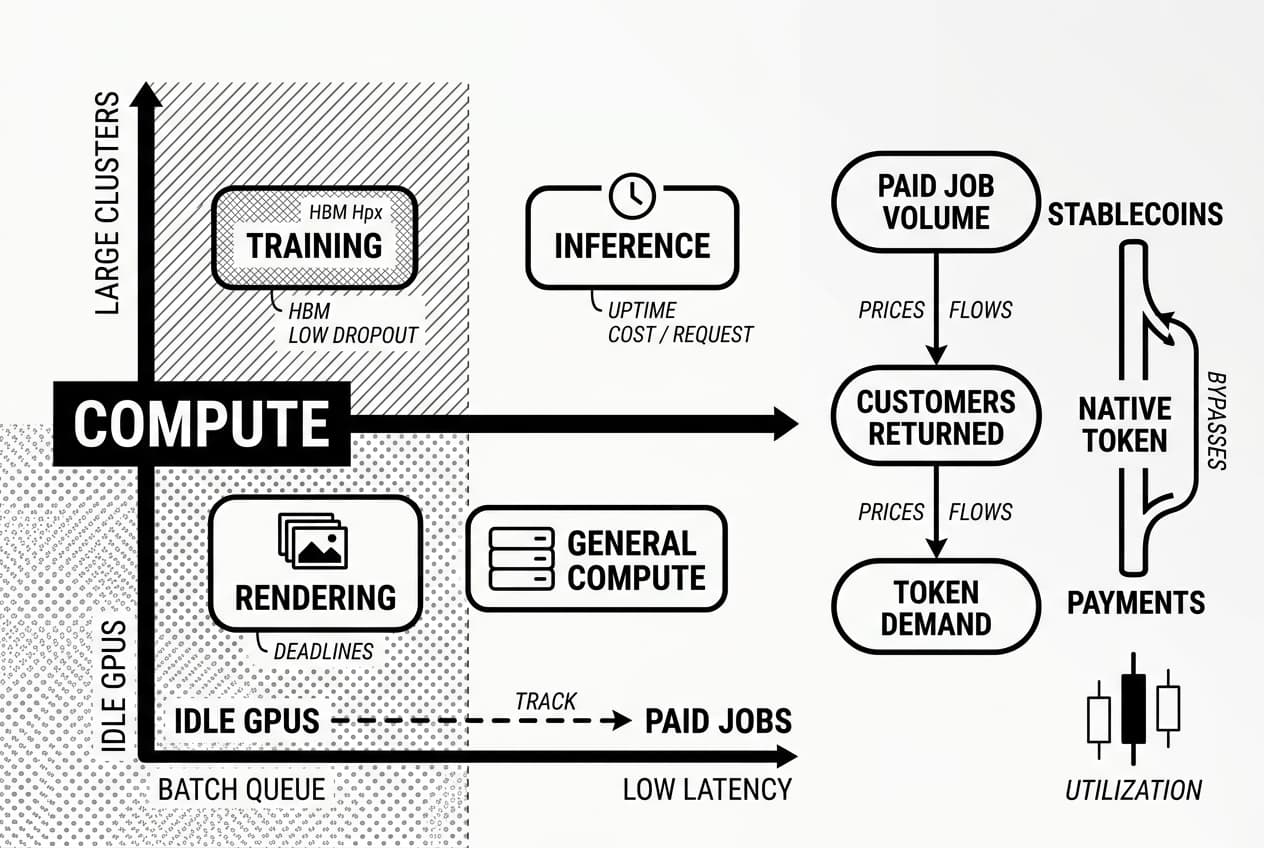
AI model training needs large clusters, high-bandwidth memory, and low dropout. AI inference runs a finished model and cares more about latency, uptime, and cost per request. Rendering is different again: it is often a batch queue where deadlines matter more than millisecond response times.
In your sheet, add a workload column. Use training, inference, rendering, or general compute. A network tuned for rendering does not automatically win inference customers, and a network with idle GPUs does not automatically create token demand.
Track utilization, not just supply
A network can list thousands of GPUs and still have weak revenue. The metric you want is paid job volume: how many jobs completed, at what price, and whether customers returned.
For render network or other GPU marketplaces, record completed jobs, active nodes, customer announcements, and payment mechanics. If users can pay entirely in stablecoins while the native token has no required role, usage may not flow to token demand.
Warning: Compute tokens may capture less value than the network itself if competition pushes prices down or if payments bypass the token. Check the fee route before assuming GPU demand creates token demand.
If you want to go beyond mapping, read how to rent GPU power to AI crypto networks and how to earn AI crypto through compute and tasks.
Compute examples to research
Use the table below as practice. These are research examples, not endorsements.
project | primary workload | key metric to check |
|---|---|---|
render network | Rendering and GPU batch jobs | Completed jobs per month |
akash network | General compute and inference | Active leases and provider count |
io.net | Inference clusters | Connected GPUs versus used GPUs |
Apply the supply-demand gap test: write down total advertised capacity, then write down verified paid demand. If you cannot find the second number in official dashboards, explorer data, or customer disclosures, mark the project as unproven for mapping purposes.
Step 4: Evaluate data, indexing, and model provenance layers
After compute, ask where the data comes from and who controls access to it. AI systems need inputs, retrieval, permissions, and proof of origin. Crypto may help when those records must be shared, paid for, or verified across many parties.
Review storage and retrieval
Decentralized storage can host datasets, model weights, agent memory, and records without a single provider. The important test is not capacity alone. Ask whether the AI workflow requires the token for storage, retrieval, repair, or payment.
If the token is only for governance, mark that clearly. Governance-only does not mean useless, but it changes the demand score because usage may not create direct buy pressure.
Check indexing and knowledge graphs
AI agents querying blockchain state need structured data quickly. Indexing protocols organize events, balances, governance votes, prices, and app state into formats that software can query.
Check whether developers must pay for queries or whether a free hosted tier undercuts token demand. Also review how data availability layers interact with indexing projects, because the same AI pipeline can need both raw data publication and fast retrieval.
Verify provenance and rights management
Provenance covers proof of origin, licensing, and attribution. This matters when models train on copyrighted data, licensed datasets, synthetic media, or enterprise documents.
The legal trigger is dated and real. The EU AI Act entered into force on 1 August 2024 (EU AI office, August 2024), and enterprises are now paying closer attention to data records, model documentation, and audit trails.
Common framing treats data provenance as a niche feature. A better view is that provenance can become infrastructure when companies need records showing what data was used, who licensed it, and whether outputs can be traced.
data type | scarce resource | token demand test |
|---|---|---|
Decentralized storage | Persistent capacity | Required for retrieval payments? |
Indexing | Queryable on-chain state | Required for query access? |
Provenance | Attribution and licensing records | Required to mint or verify proofs? |
Use that token demand test before adding any data project to your map. If every answer is no, the token may still have governance value, but your usage score should stay modest.
Step 5: Classify AI agents and agent platforms
Agents are the most hyped ai crypto category, so classify them carefully. An agent is software that receives a goal and takes actions such as trading, posting, routing payments, or coordinating with other agents.
Separate agent tokens from agent infrastructure
A branded agent token is often a bet on one agent's audience. Agent infrastructure is different: it lets many agents run with identity, wallets, permissions, execution logs, and payment controls.
When mapping your ai crypto sectors, put identity primitives, agent-to-agent payment rails, smart-account tooling, and sandboxed execution systems in infrastructure. Put single-character tokens with no shared rails in the speculative token column. For project-level comparisons, use the AI agent tokens compared breakdown.
Map what crypto AI agents will use
Agents do not need a token because it has AI in the name. They need reliable primitives: gas for transactions, stablecoins for predictable payments, smart accounts for permissions, data APIs for context, compute markets for inference, and coordination rails for task delegation.
resource type | example primitive | sector column |
|---|---|---|
Payments | Stablecoins and gas tokens | Applications or payment rails |
Wallet and identity | Smart accounts and session keys | Infrastructure |
Data and context | Indexers and oracle feeds | Data |
Compute and inference | GPU markets | Compute |
Coordination | Agent messaging and task routing | Infrastructure |
This five-resource agent stack is a quick filter. If a project does not own one scarce slot in the stack, it is adjacent to the agent trend rather than core agent infrastructure.
Warning: autonomy increases security risk
Warning: Autonomous agents create risks that passive token holdings do not. Attackers can use malicious prompts, broad contract approvals, poisoned data, or stolen session keys. Before connecting funds, confirm spending caps, scoped approvals, key separation, revocation tools, and transaction logs. Review self-custody wallet rules before testing any agent platform with real assets.
Balaji Srinivasan, author and investor, has argued that programmable wallets and automated software will change how people interact with networks. That same shift also expands the attack surface, so permission design belongs in your risk column.
Common framing says agent tokens are a direct play on AI adoption. The better test is whether the project provides execution rails, identity, audited permissions, or payment routing that other agents actually need.
Step 6: Score projects by demand, token utility, and risk
With your map built, score projects before you look at price charts. The goal is to compare real demand, token design, and risk across different ai crypto categories.
Use a simple 1-to-5 checklist
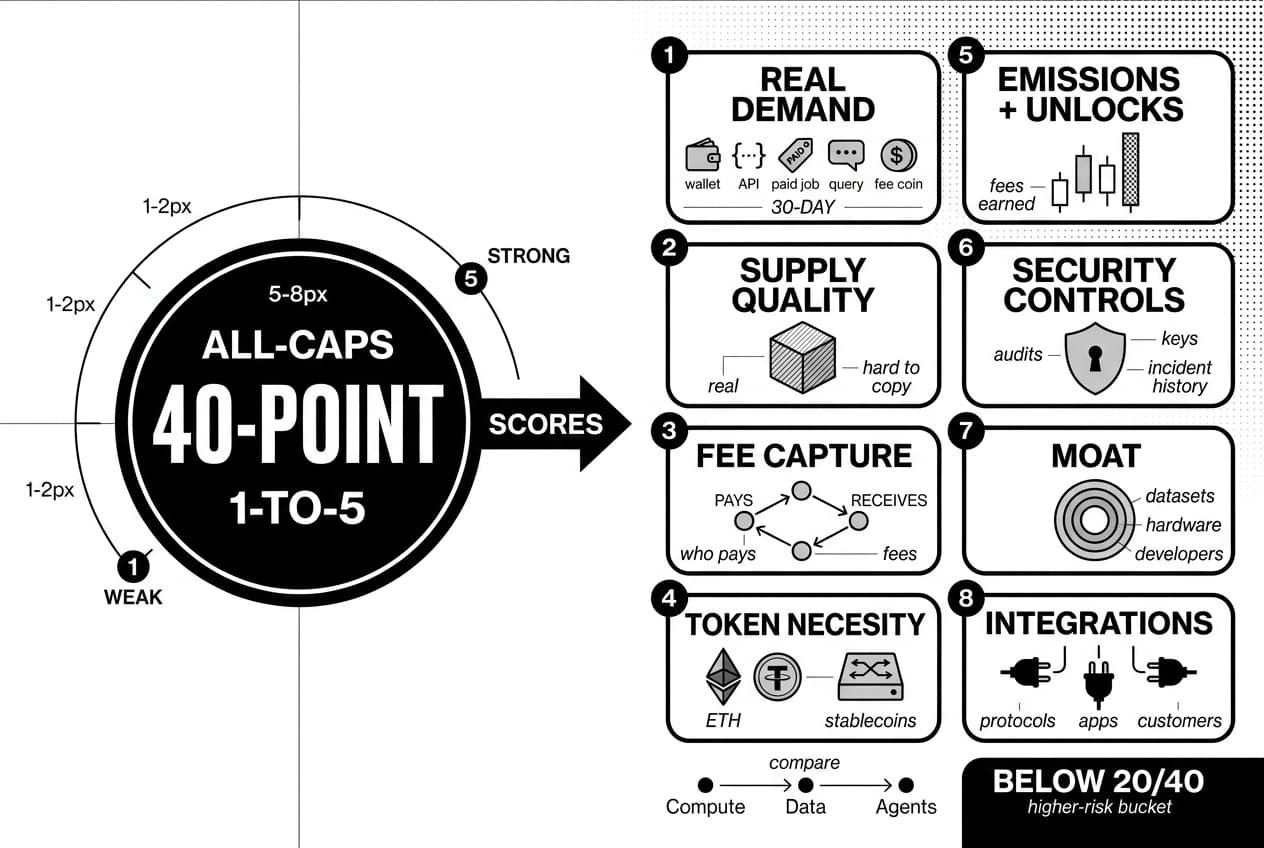
Score each item from 1 weak to 5 strong. A project can score well in one sector and poorly in another, so compare within category first, then across categories.
- Check real demand: Track wallets, API calls, paid jobs, queries, or fees over a fixed 30-day period.
- Compare supply quality: Verify whether the scarce resource is real, scarce, and hard to copy.
- Review fee capture: Confirm who pays, what they pay with, and who receives the fees.
- Verify token necessity: Ask whether the network would still work if users paid only with ETH or stablecoins.
- Check emissions and unlocks: Compare token releases, inflation, and incentives against fees earned.
- Review security controls: Look for audits, permission limits, key management, and incident history.
- Score the moat: Identify network effects, datasets, hardware relationships, or developer adoption that competitors cannot copy quickly.
- Compare integrations: Count external protocols, apps, or customers that rely on the project today.
Use a 40-point total. In our editorial scoring, projects below 20 out of 40 usually depend more on narrative than measurable demand. That does not make them automatic failures, but it does place them in a higher-risk bucket.
Compare sectors before comparing tickers
Compute networks, data layers, and agent platforms have different adoption clocks. Compute competes on price and reliability. Data provenance may move more slowly because buyers need legal, procurement, and compliance review. Agent platforms can spread quickly but carry higher smart-contract and permission risk.
Lyn Alden, founder of Lyn Alden Investment Strategy, has often emphasized that crypto networks need real utility and fee mechanics rather than circular token incentives. Apply that directly: a compute project scoring 4 out of 5 on fees beats an agent token scoring 5 out of 5 on social attention.
sector | margin profile | adoption timing | main risk |
|---|---|---|---|
Decentralized compute | Thin if pricing is commodity-like | Medium, often 12-24 months | Low utilization |
Data and provenance | Medium if licensing works | Slow enterprise cycles | Weak token demand |
Infrastructure | Medium to high if fees accrue | Medium | Developer migration |
Agents and platforms | High if users stay | Fast but volatile | Security and regulation |
For a dated external risk marker, Reuters tracked at least 17 AI copyright cases in 2024 (Reuters, December 2024). That matters for your map because data and provenance projects may gain demand from audit needs, while agent and model projects may face more legal review.
Avoid the top AI coin trap
Common framing asks for the single best AI crypto. That is the wrong question because a GPU network, a data protocol, and an agent platform are different risk instruments.
Your thesis should guide your scoring. If your time horizon is under 12 months, liquidity and token open up schedules should receive extra weight. If you are studying a multi-year position, fee sustainability, token necessity, and moat matter more.
Before you farm new launches, read the AI crypto airdrop farming risks guide. Many early projects score high on attention but near zero on token necessity and revenue.
Frequently Asked Questions
- What is the best AI cryptocurrency to invest in?
- There is no single best AI cryptocurrency for everyone. The right choice depends on your thesis — compute, data, infrastructure, or agents. Before deciding, compare real usage metrics, token utility, liquidity, unlock schedules, security audits, and regulatory exposure. No project guarantees returns, so thorough research matters more than following trends.
- Which AI coin will boom in 2026?
- No one can reliably predict which AI coin will outperform in 2026. Performance will likely depend on broader AI adoption, crypto market liquidity, token unlock pressure, exchange access, and whether a project genuinely solves a real compute, data, or agent coordination problem — not just market hype cycles.
- What crypto is most linked to AI?
- Several crypto sectors connect directly to AI, including decentralized compute networks, data indexing protocols, storage layers, agent platforms, model marketplaces, and AI-focused blockchains. Rather than focusing on a single project, classify candidates by their actual function within the AI stack before drawing any investment conclusions.
- What crypto will AI agents use?
- AI agents may rely on gas tokens for on-chain transactions, stablecoins for payments, custodial wallets for asset management, data networks for information retrieval, and compute networks for inference. Smart contracts handle execution logic. Any autonomous spending setup should include strict permission controls and spending limits to manage security risk.
- What is the top 5 AI crypto?
- Top-five lists typically reflect market cap or short-term trend data, and those rankings shift frequently. Instead of treating any single list as authoritative, compare leading projects across compute, data, agents, infrastructure, and storage categories. A sector map gives you a more complete and durable picture than a snapshot ranking.
- What are the crypto categories?
- Broad crypto categories include Layer 1 blockchains, Layer 2 scaling networks, DeFi protocols, stablecoins, NFTs, gaming, infrastructure, storage, privacy, data availability, and AI-focused crypto. Within AI crypto alone, subcategories span compute, data, agents, and verification. Many projects overlap multiple categories, so classification requires looking at actual product function.
- Which are the categories of AI?
- Core AI categories include machine learning, generative AI, computer vision, natural language processing, robotics, autonomous agents, and data infrastructure. Each maps to crypto sectors differently — compute networks support model training and inference, data protocols handle inputs and indexing, and agent frameworks coordinate on-chain execution and decision-making autonomously.
Sources
Author

Crypto analyst and blockchain educator with over 8 years of experience in the digital asset space. Former fintech consultant at a major Wall Street firm turned full-time crypto journalist. Specializes in DeFi, tokenomics, and blockchain technology. His writing breaks down complex cryptocurrency concepts into actionable insights for both beginners and seasoned investors.