zkML: A Guide to Zero-Knowledge Machine Learning on Blockchain
What is zkML (Zero-Knowledge Machine Learning)?
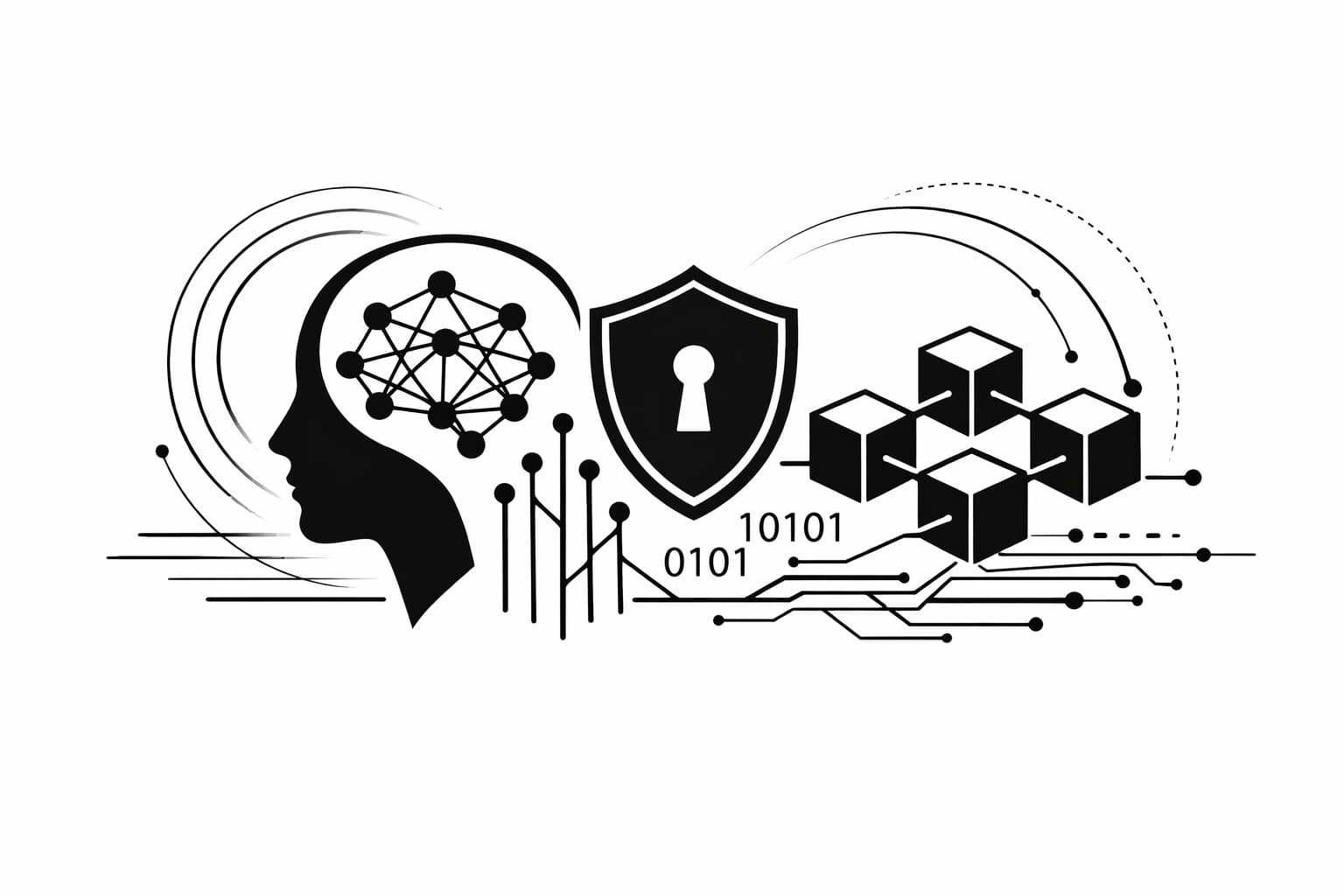
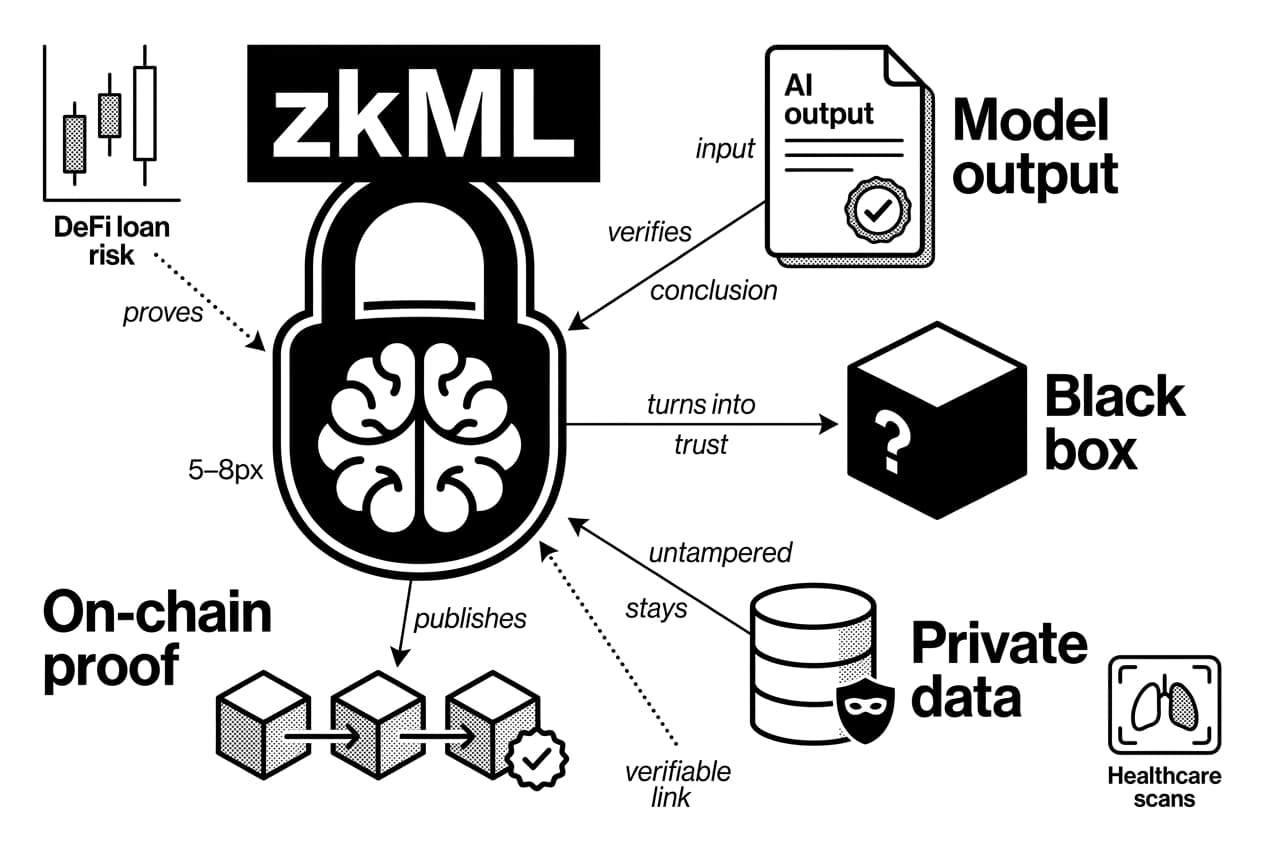
Zero-Knowledge Machine Learning (zkML) is a technology that allows for the verification of an AI model's output without revealing the model itself or the private data used to generate that output. Think of it as a way for an AI to prove its work is correct without showing its homework. This cryptographic method creates a verifiable link between an AI's input and its conclusion, building a foundation of trust where there was once only a "black box."
Why zkML Matters for AI and Blockchain
The implications of this technology are massive, especially where artificial intelligence meets the world of blockchain. Imagine a healthcare system where you can use a powerful AI to analyze your medical scans for signs of disease, and the AI can prove its diagnosis is valid without your sensitive health data ever leaving your possession. Or picture a decentralized finance (DeFi) application that uses a complex AI to assess loan risk and can prove its assessment is honest and untampered with directly on-chain. This is the promise of zkml: it unlocks the ability to use private data securely, verify AI integrity publicly, and build intelligent applications that don't require you to blindly trust a central company. It injects verifiable truth into automated systems.
The Two Pillars: ZKPs and Machine Learning
To grasp how zkml works, it helps to look at its two core components. First, there's Machine Learning (ML), the field of AI focused on training computer systems to learn from data, identify patterns, and make decisions with minimal human intervention. Second, you have Zero-Knowledge Proofs (ZKPs). This is a cryptographic technique that lets one party (the prover) prove to another party (the verifier) that a statement is true, without revealing any information beyond the validity of the statement itself. By combining them, you can prove that an ML model processed certain data and reached a specific conclusion, all while keeping both the data and the model's internal logic completely private and secure.
How Zero-Knowledge Proofs (ZKPs) Provide Privacy
Before we can understand how AI models can be verified, we need to grasp the foundational technology that makes it all possible: Zero-Knowledge Proofs, or ZKPs. A ZKP is a method where one party (the prover) can prove to another party (the verifier) that a specific statement is true, without revealing any information beyond the validity of the statement itself. It’s a way to prove you know a secret without ever showing the secret.
The Core Idea: Proving Without Revealing
Imagine you've found Waldo in a giant "Where's Waldo?" book. You want to prove to your friend that you found him, but you don't want to point him out and ruin their search. How could you do it? You could take a large piece of cardboard, cut a tiny Waldo-sized hole in it, and place it over the page so only Waldo is visible through the hole. Your friend sees Waldo and is convinced you found him. Yet, because the rest of the massive page is covered, they have absolutely no idea about his location. You’ve proven your knowledge with zero extra information.
This is the simple but powerful idea behind a zero-knowledge proof. It's a mathematical guarantee of knowledge without disclosure.
ZKPs in the Blockchain Context
This concept is already a cornerstone in the world of cryptocurrency. Blockchains like Zcash use a type of ZKP called a ZK-SNARK to enable private transactions. Users can prove they have sufficient funds to make a payment without revealing their account balance or the transaction details on the public ledger. ZKPs are also used to help blockchains scale by bundling thousands of transactions into a single, verifiable proof. This foundation of verifying information privately and efficiently is exactly what opens the door for zkml.
The Challenge of Verifying AI Models on a Blockchain
Now that we understand the basic ideas behind zero-knowledge proofs, a natural question arises: why not just run the artificial intelligence model directly on the blockchain? While it seems like the simplest solution, the reality is that blockchains are not built for that kind of heavy lifting. They are intentionally slow and deliberate to maintain security and decentralization. Trying to run a complex AI model on-chain would be incredibly expensive and time-consuming, similar to asking an entire committee to approve every single calculation in a long division problem. It just isn’t practical.
Beyond the sheer cost, we face the ‘black box’ problem. Many powerful AI models are so intricate that even their creators don't fully understand their internal reasoning. We can see the input data and the final output, but the process in between is often a mystery. How can a network trust an AI’s decision if it’s impossible to verify the steps it took to reach it? This challenge is compounded by data privacy. Most useful AI models are trained on sensitive information, and placing that data onto a public, permanent ledger would be a security and privacy disaster.
These core hurdles—massive computational costs, the opaque nature of AI logic, and the critical need for data privacy—have long made verifiable AI on a blockchain seem out of reach. This is precisely the set of problems that zkml is designed to solve. It provides a way to confirm that an AI model ran correctly, using specific private data, without performing the expensive computation on-chain or revealing any of the underlying information.
How zkML Works: A Step-by-Step Breakdown
Now that we understand the challenge of getting blockchains to trust AI computations, let's walk through how the zkml process elegantly solves it. Think of it not as running a massive AI on the blockchain, but as running it elsewhere and bringing a small, mathematically sound "receipt" to the blockchain for verification. The entire process can be broken down into three main stages.
Step 1: Model Training and Conversion
First, the artificial intelligence model itself is created. This is the most computationally intensive part, involving training a neural network on vast amounts of data. Because this requires so much processing power, it happens entirely "off-chain," on powerful, specialized computers. This is like a chef perfecting a complex recipe in a fully equipped professional kitchen, not on a small camping stove.
Once the model is trained and ready, it can't be used for generating proofs just yet. It must be converted from its standard format into a special mathematical representation, almost like translating the recipe into a universal language that zero-knowledge proof systems can understand. This conversion creates a circuit-like structure that maps out every single calculation the model performs.
Step 2: Generating the Proof of Inference
With the provable model ready, the magic happens. When a user provides a new input—say, a picture of an animal for an image recognition AI—the system performs two tasks at once. It runs the model to get the result (the "inference"), for example, "This is a cat." At the same time, it generates a tiny, cryptographic zero-knowledge proof. This proof is a digital guarantee that confirms the model was executed correctly on the input to produce that specific output. The proof does this without revealing the model's internal workings (its "secret sauce" or weights) or, if needed, the input itself.
Step 3: On-Chain Verification
Finally, this small proof is sent to the blockchain. A smart contract on the network receives the proof. It doesn't need to re-run the entire complex AI calculation. Instead, it performs a quick and computationally cheap check to verify the proof's validity. If the proof checks out, the smart contract accepts the AI's output as true and can then trigger other actions. This verification is the final stamp of approval, providing a trustless way to use AI results within decentralized applications and AI-powered smart contracts.
Top 5 Real-World Use Cases for zkML in 2026
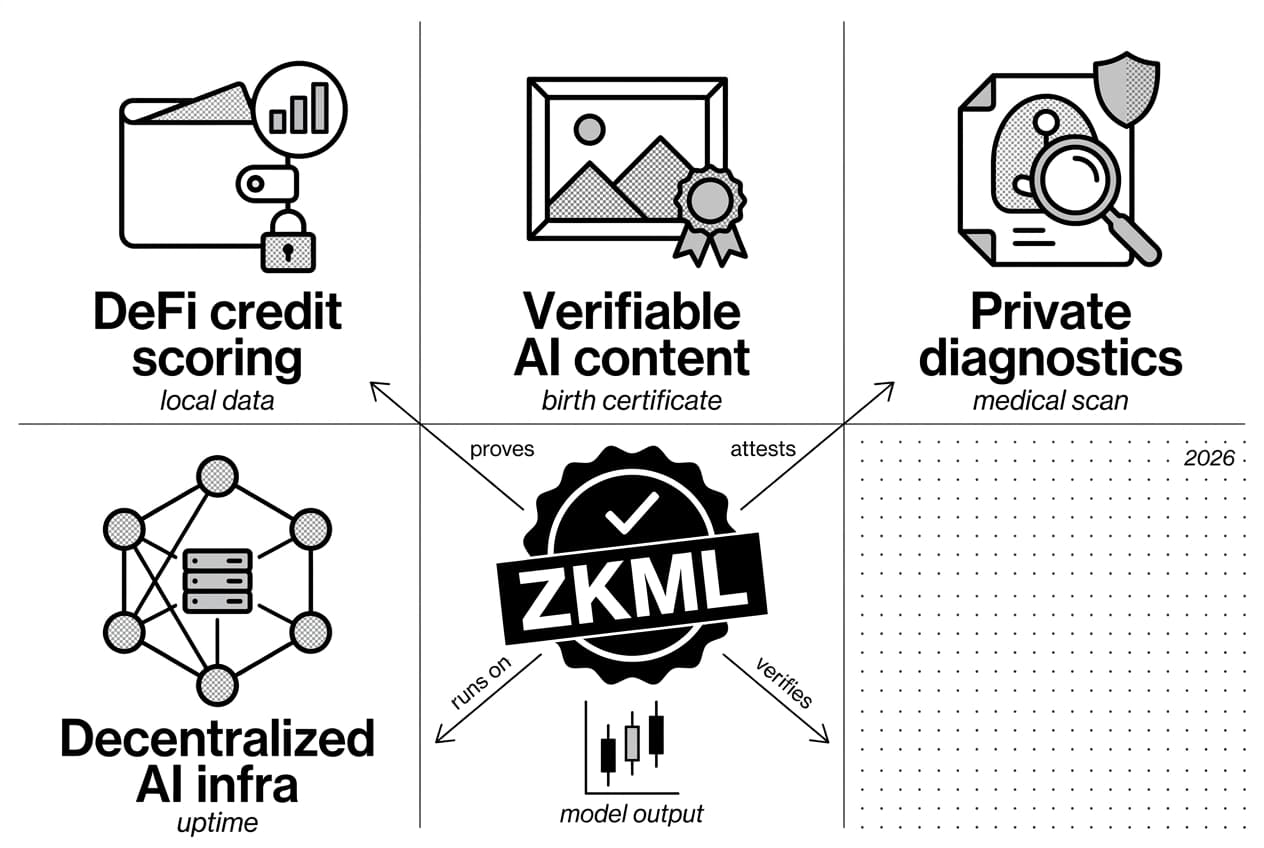
Now that we understand the building blocks, let's see how they come together. The theory behind zkML is impressive, but its true power shines when applied to real-world problems. These applications, once just ideas, are now becoming practical realities in 2026, creating new possibilities for trust and privacy in the digital world. These powerful models often run on specialized decentralized infrastructure for AI to ensure uptime and security.
DeFi Credit Scoring
In decentralized finance (DeFi), lending protocols often struggle to assess risk because they can't access a user's private financial history. With zkML, you could run a credit scoring AI model on your personal transaction data locally. The model would output a zero-knowledge proof verifying your credit score without ever revealing your account balances, spending habits, or any personal details to the lender.Verifiable AI-Generated Content
In an age of sophisticated deepfakes, proving the origin of digital content is a massive challenge. ZkML allows an AI art generator to create an image and simultaneously produce a proof that the image was created by that specific model, at that specific time. This creates a verifiable "birth certificate" for digital media, helping to distinguish authentic AI creations from malicious fakes.Private Healthcare Diagnostics
Imagine an AI that can detect early-stage cancer from a medical scan with incredible accuracy. Patients and hospitals are understandably hesitant to upload such sensitive data to a third-party service. ZkML solves this by allowing the AI model to analyze the scan on a secure, local server. It can then publish a verifiable result and proof to a blockchain, confirming the diagnosis without the patient's private scan ever leaving the hospital's control.Fair On-Chain Gaming
Blockchain games promise true ownership of assets, but ensuring fair play, especially with AI-powered opponents (NPCs), is tricky. How do you know the AI isn't cheating? ZkML can force an AI opponent to generate a proof with every move, verifying that it is following the game's rules and not using information it shouldn't have, all while keeping its strategic decision-making process a secret.Secure Biometric Authentication
Using your face or fingerprint to unlock services is convenient but carries privacy risks if the raw data is stored centrally. ZkML enables a new level of security. Your device can prove that your fingerprint matches the registered template by generating a proof of the match. The proof is verified, not your actual fingerprint data, which never has to be exposed or transmitted.
Key zkML Projects and Frameworks
Understanding the potential of zkML is one thing, but actually building with it presents another challenge entirely. Thankfully, developers don't have to start from scratch. A new wave of projects is creating the essential tools and frameworks, much like how game engines make it possible for creators to build complex video games without programming every single pixel from the ground up. These platforms handle the incredibly complex cryptography, letting builders focus on the AI model itself.
Several teams are leading the charge to make building with zkml more accessible:
- EZKL: This project offers a library that acts as a bridge, helping to convert common machine learning models into a format that can generate zero-knowledge proofs. It’s a key tool for data scientists entering the space.
- Giza: Focusing on usability, Giza is building a platform designed to easily deploy and run verifiable AI models on-chain. Their work aims to power a new generation of autonomous, on-chain agents.
- Modulus Labs: Known for performance, this team creates highly optimized, custom ZK provers for specific AI tasks. They specialize in pushing the boundaries of efficiency for demanding applications like on-chain gaming.
The common goal of these projects is to lower the barrier to entry. They are turning a theoretical concept into a practical tool for a wider range of developers. By providing these foundational layers, they pave the way for applications where AI can verifiably interact with on-chain systems, influencing everything from decentralized finance to systems involving tokens in AI.
Challenges and Future of Verifiable AI
While the potential of verifiable AI is immense, the road to widespread adoption is still under construction. Like any groundbreaking technology, zkML faces significant hurdles that developers and researchers are actively working to overcome. Understanding these challenges gives us a realistic picture of where the technology stands today and where it's headed.
Current Hurdles: Cost and Complexity
The primary obstacles right now are computational and financial. Generating a zero-knowledge proof for an AI model's decision is incredibly resource-intensive. Think of it as the difference between your computer solving a simple math problem versus rendering a feature-length animated movie; the latter requires vastly more processing power and time. This computational work translates directly into higher costs on a blockchain. Current methods are best suited for smaller, simpler AI models. Applying zkML to the massive models that power today's most advanced AI is still a frontier for research.
What's Next for zkML?
The future for verifiable AI is bright, with a global community dedicated to solving these issues. Researchers are developing more efficient proof systems and specialized hardware to drastically cut down the time and cost of proof generation. The goal is to make zkML practical for increasingly complex models, opening up a new world of applications. We are also seeing better developer tools emerge, making it easier to integrate this technology into new and existing systems. As these advancements continue, verifiable AI is poised to become a fundamental building block for a more transparent and trustworthy digital world.
Key Takeaways
As we've explored the exciting intersection of cryptography and artificial intelligence, a few key ideas stand out. Here's a quick summary of what you need to remember about this powerful technology:
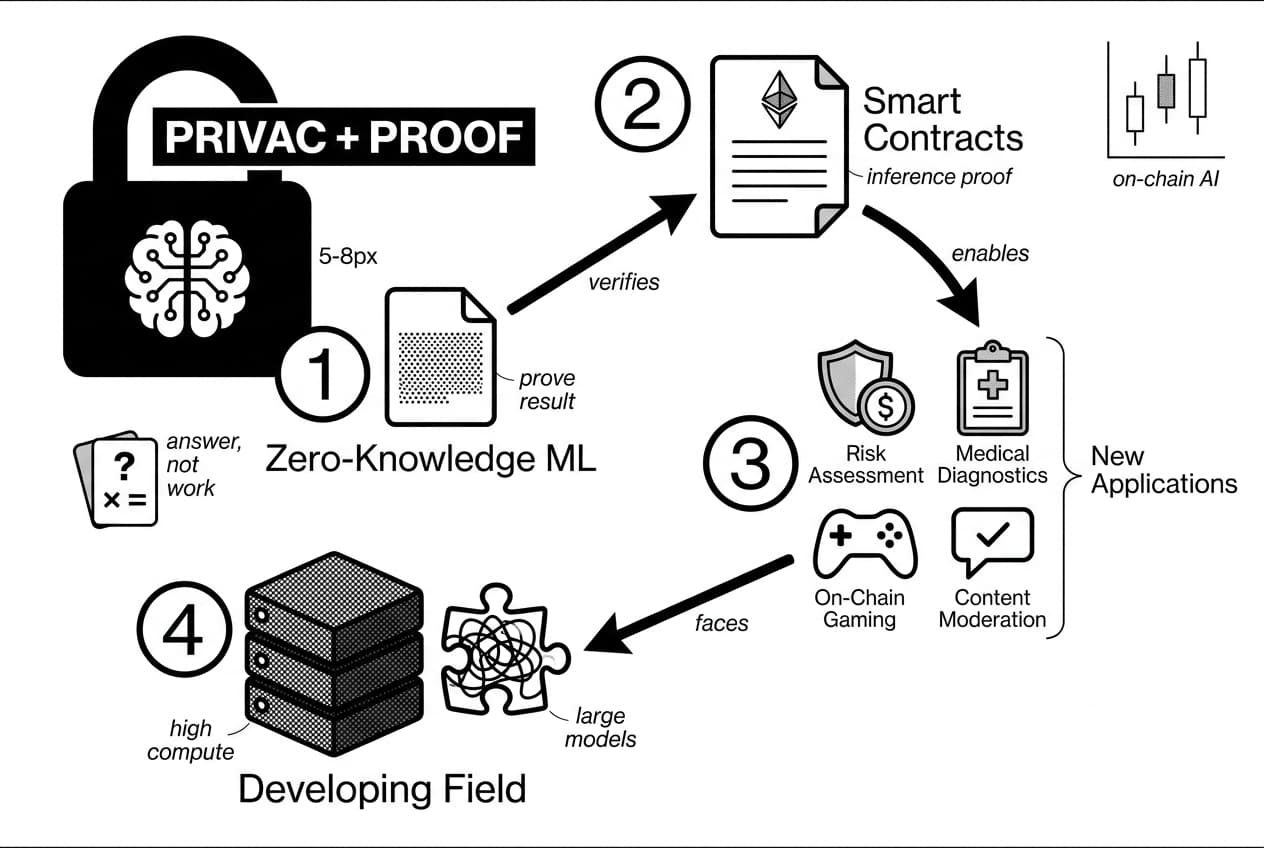
- Privacy and Proof Combined: Zero-Knowledge Machine Learning allows an AI model to prove its result is correct without revealing the private data it used or the model's inner workings. It's like showing the answer to a math problem without showing your work.
- Building Trust for On-Chain AI: By providing mathematical proof of an AI's inference, zkML makes it possible to trust AI outputs within smart contracts and decentralized applications, where trust is normally hard to establish.
- Unlocking New Applications: This technology enables new possibilities, from private financial risk assessment and verifiable medical diagnostics to fair on-chain gaming and decentralized content moderation.
- A Developing Field: While incredibly promising, the practical use of zkml is still growing. The main hurdles today are the high computational power needed to generate proofs and the complexity of applying it to very large AI models.
Frequently Asked Questions
- What is zkML crypto?
- zkML isn't a single cryptocurrency. It's a powerful technology that merges Zero-Knowledge Proofs with Machine Learning, allowing for verifiable AI computations. While various crypto projects implement zkML for new features and may have their own tokens, zkML itself is the underlying cryptographic method, not a specific coin.
- Is XRP a ZKP?
- No, XRP is not a Zero-Knowledge Proof (ZKP). XRP is a specific cryptocurrency and a digital payment network. In contrast, ZKPs are a broad cryptographic technique used to prove something is true without revealing the information itself. They are a type of technology, not a particular coin or token.
- Is zero-knowledge proof legit?
- Yes, Zero-Knowledge Proofs are absolutely legit. This is a well-established and heavily researched field within modern cryptography with academic roots stretching back decades. The growing adoption of ZKPs by major blockchain platforms for scaling and privacy solutions is a strong testament to their security, reliability, and real-world utility.
- What is a real world zkML application?
- A great real-world example is in DeFi lending. A user could use a zkML-powered protocol to prove they have a high credit score, as determined by an AI model, without revealing any personal financial data. This enables private, on-chain credit assessments, protecting user privacy while maintaining protocol security.
Sources
- ZKML: An Optimizing System for ML Inference in Zero-Knowledge Proofs | Proceedings of the Nineteenth European Conference on Computer Systems
- ZKML: Verifiable Machine Learning using Zero-Knowledge Proof - Joo Yeon Cho - Kudelski Security
- zKML price today, ZKML to USD live price, marketcap and chart | CoinMarketCap
Author

Crypto analyst and blockchain educator with over 8 years of experience in the digital asset space. Former fintech consultant at a major Wall Street firm turned full-time crypto journalist. Specializes in DeFi, tokenomics, and blockchain technology. His writing breaks down complex cryptocurrency concepts into actionable insights for both beginners and seasoned investors.