What Is an Encrypted Mempool? A Guide to Preventing Front-Running
What Is an Encrypted Mempool? (And Why It Matters)
An encrypted mempool is a private waiting area for blockchain transactions that keeps the details of your trade secret until it's officially confirmed. This system is designed to stop a practice called front-running, where automated bots see your pending transaction and place their own orders first to profit at your expense. By shielding this information with cryptography, it creates a much fairer environment for everyday users.
The Problem: The Public Mempool and Front-Running
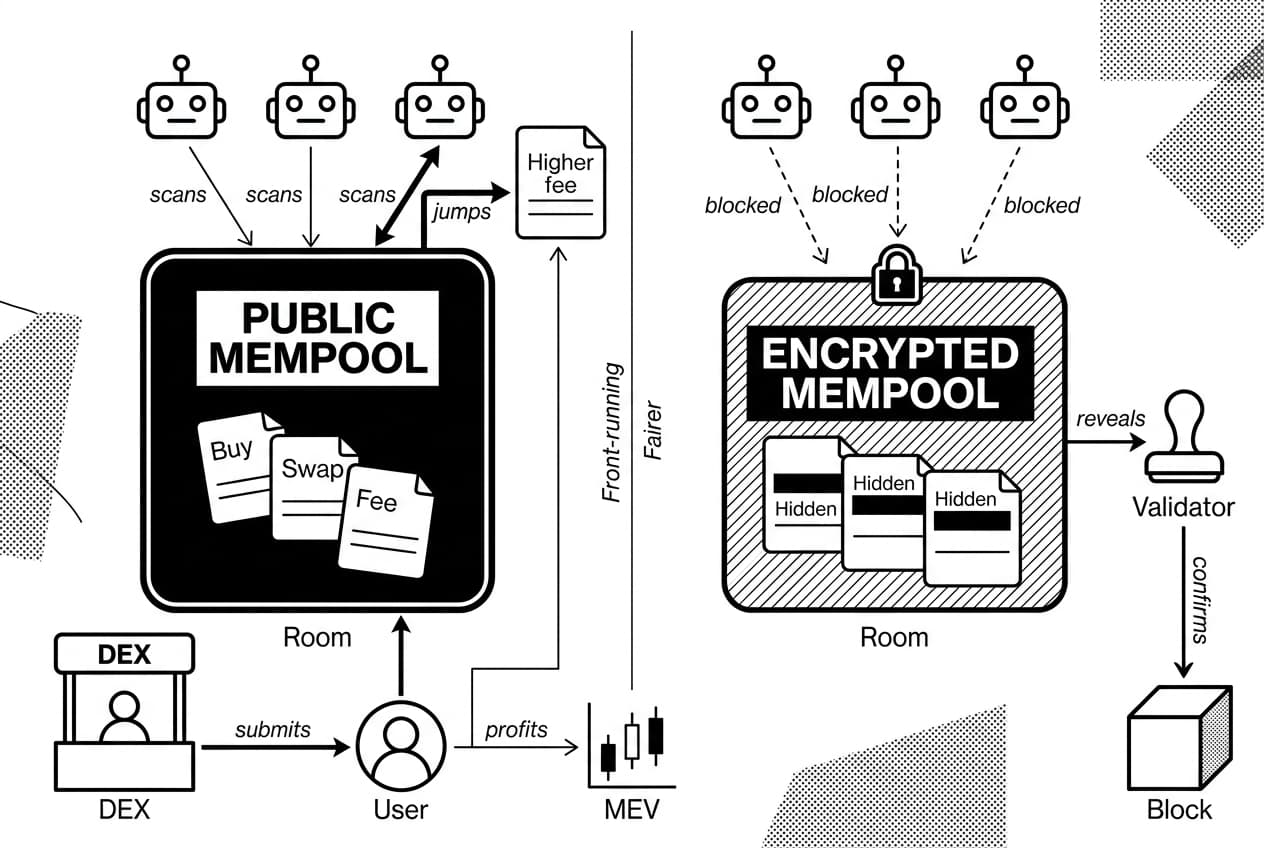
Think of the standard, unencrypted mempool as a completely transparent waiting room. When you decide to trade one cryptocurrency for another on a decentralized exchange (DEX), you submit your transaction, and it lands in this public area. Here, it waits for a network validator to pick it up and add it to the next block on the chain. The catch is that this waiting room is open for everyone to see.
Automated bots are constantly scanning this public space. If one sees your large buy order for a particular token, it can instantly submit its own buy order with a higher fee, ensuring its transaction gets processed first. The bot buys the token, driving the price up slightly, and then immediately sells it back to you as your transaction is processed. This is front-running. The profit these bots make from such strategies is known as Maximal Extractable Value (MEV), and it comes directly out of your pocket.
Why Encrypted Mempools Matter for You
This isn't just a theoretical problem; it has a real impact on your trades. Front-running means you often get a worse price than you expected. An encrypted mempool changes the game by acting like a sealed, opaque envelope for your transaction. Your trade details—what you're buying, how much, and at what price—are scrambled and unreadable inside the mempool. Bots can't see what you're doing, so they can't front-run you. This simple but powerful solution helps ensure that the price you see when you click "swap" is the price you actually get, protecting your funds and making the entire system more equitable.
How Encrypted Mempools Work: A Step-by-Step Guide
Now that we understand why an open mempool can be a problem, let's explore how an encrypted mempool provides a solution. The entire process is best understood by thinking of a sealed-bid auction. In a typical auction, you can see every other bid, allowing you to react. But in a sealed-bid auction, everyone submits their offer in a sealed envelope. The contents remain a secret until the auctioneer opens them all at once. This model introduces a powerful layer of fairness, which is exactly what encrypted mempools bring to blockchain networks.
Here is a breakdown of a transaction's journey through this system.
- Transaction Encryption
It all begins in your crypto wallet. When you initiate a transaction, like swapping one token for another, your wallet software doesn't just broadcast the details for all to see. Instead, it wraps the critical information—the amount, the destination, the fee you're willing to pay—inside a strong cryptographic "envelope." This encryption happens on your local device, meaning your transaction is secure and private before it even leaves your control. - Entering the Encrypted Mempool
This sealed digital envelope is then sent out to the network's waiting area, the mempool. Here is where the protective magic happens. While everyone can see that a transaction has been submitted, its contents are completely unreadable. Predatory bots that constantly scan for profitable trades are blinded. They can't front-run you because they have no idea what you're trying to do. Your transaction is just an anonymous, indecipherable piece of data among many others. - Block Proposal
Next, a network validator, acting as the block proposer, selects a batch of these encrypted transactions to include in the next block. This is like the auctioneer collecting all the sealed envelopes. The validator arranges them into a specific order, but they do so without knowing what is inside any of them. This blindness is essential, as it prevents the validator from prioritizing their own transactions or selling favorable placement to others. - Decryption and Execution
Only after the block has been built and its order is permanently set does the final reveal happen. A special, distributed group of network participants provides the necessary components to generate a decryption key. Think of it like several people needing to turn their keys simultaneously to open a high-security vault. This key decrypts all the transactions in the block at the same time. At this moment, the transactions are then decrypted and executed in their predetermined sequence. By the time anyone sees the details of your trade, it's already locked in, making front-running impossible.
The Core Technology: Threshold Encryption Explained
At its core, an encrypted mempool relies on a powerful cryptographic method known as threshold encryption. In simple terms, this is a way of taking a single secret key, splitting it into multiple unique pieces (called key shares), and distributing those pieces among a group of participants, like network validators. No single piece can unlock the data on its own.
Think of it like a high-tech treasure chest that requires multiple people to open it. Instead of one master key, the chest can only be unlocked if, for example, three out of five designated keyholders bring their unique keys together at the same time. One person trying to open it alone will fail; two will also fail. Only when the required "threshold" of three keyholders cooperates does the lock finally open.
This is exactly how an encrypted mempool protects transactions. The validators are the keyholders, and your transaction is the treasure inside the chest. No individual validator can peek at your transaction details early because they only hold one piece of the key. The full key is only reconstructed to decrypt and reveal all transactions when it's time to build a new block, ensuring a fair and level playing field for everyone.
Benefits of Using Encrypted Mempools
Now that we understand how an encrypted mempool works like a sealed, time-locked envelope for your transaction, we can see the powerful advantages it creates. These benefits go beyond technical novelty; they fundamentally improve fairness and security for every user on the network.
Prevents Front-Running and Sandwich Attacks
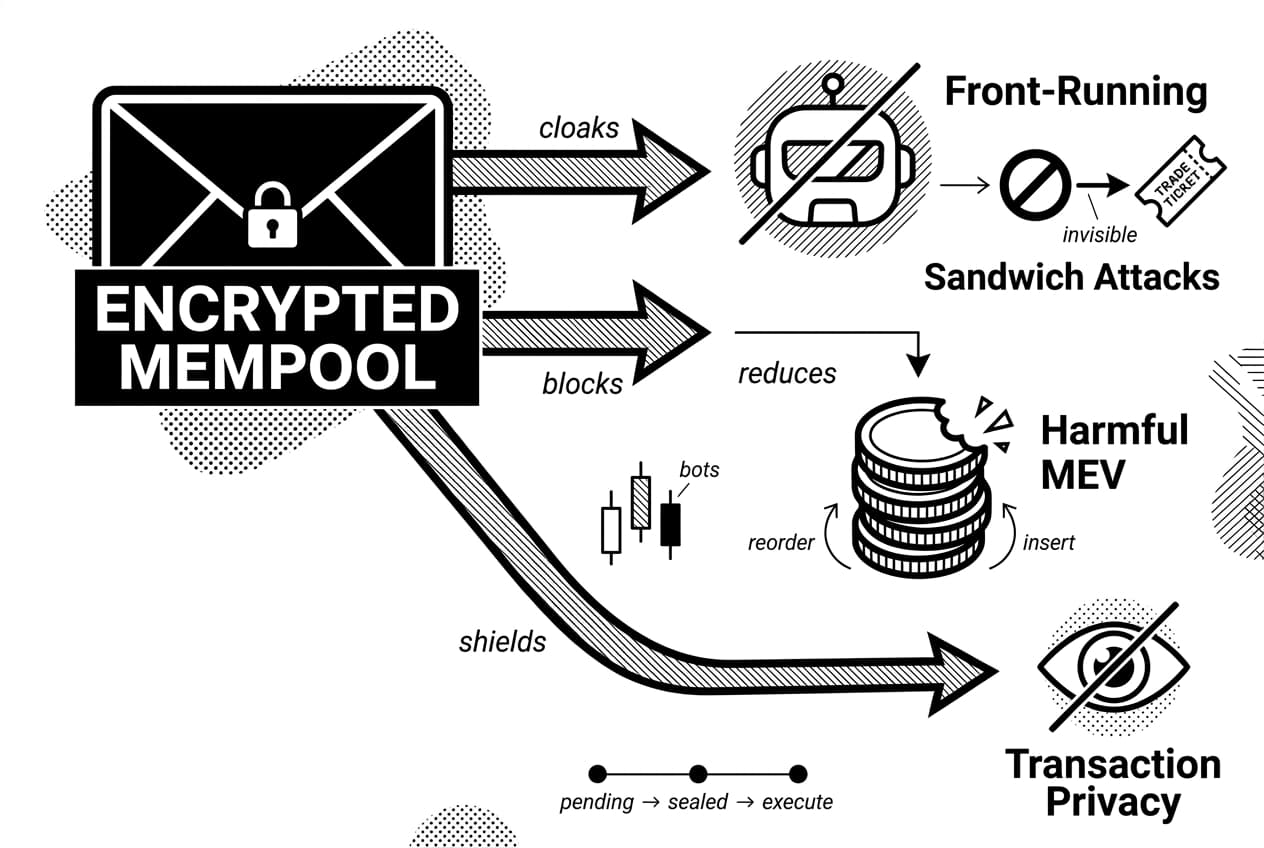
The most immediate and celebrated benefit is the end of predatory trading bots. Imagine a predator that can only hunt what it can see. By cloaking transaction details until the moment of execution, an encrypted mempool makes your trade invisible to these bots. This directly neutralizes common exploits like front-running and Sandwich Attacks, ensuring you get the price you expected without being exploited by a high-speed algorithm.
Reduces Harmful MEV
This protection against front-running contributes to a healthier ecosystem by reducing harmful Maximal Extractable Value (MEV). While some MEV is a natural part of blockchain operations, the predatory kind extracts value directly from users' pockets. By blinding bots and removing their ability to reorder or insert transactions for profit, encrypted mempools create a more equitable environment where your transaction's outcome isn't dictated by who has the most sophisticated bot.
Enhances Transaction Privacy
Beyond financial protection, this technology brings a significant privacy boost. In a typical public mempool, your pending transaction details are visible to the entire world. An encrypted mempool shields this sensitive information—who you're transacting with and for how much—from public view until it is irreversibly confirmed on-chain. This protects your financial activity from constant surveillance.
Current Challenges and Limitations
While the benefits are clear, the path to making every blockchain transaction fair isn't a simple one. As of 2026, implementing an encrypted mempool presents its own set of hurdles that developers are actively working to overcome. These challenges are not deal-breakers, but they do explain why this technology isn't yet a standard feature on every network.
Technical Challenges
First, there are significant technical puzzles to solve. The process of encrypting a transaction, submitting it, and then having a group of key-holders decrypt it adds extra steps. This can introduce a small delay, or latency, to transaction processing. Think of it like sending a package that needs to be unlocked by ten different people before it can be delivered—it's more secure, but it's not as fast as just handing it directly to the recipient. Ensuring the initial setup for distributing the key pieces (a process called distributed key generation or DKG) is completely secure is another major focus area, as the entire system's integrity depends on it.
Economic and Efficiency Challenges
Beyond the code, there are practical economic questions. The validators or key-holders who perform the essential decryption work need to be rewarded for their efforts. Designing a fair and sustainable incentive system is key to keeping the network running smoothly. Also, all this encryption and decryption requires extra processing power from the network's computers. This increased computational load can make the network slightly less efficient and potentially more expensive to operate. Finding the right balance between the powerful security an encrypted mempool provides and the resources it consumes is the central challenge for teams building this next generation of blockchain infrastructure.
The Future: Encrypted Mempools on Ethereum and Beyond
While the benefits are clear, an encrypted mempool is not yet a standard feature on major networks like Ethereum. The good news is that the roadmap for implementing one is taking shape, driven by core protocol upgrades and dedicated teams working to solve this very problem. A foundational shift making this possible is known as Proposer-Builder Separation (PBS).
Think of PBS as creating a specialized assembly line for creating blocks. Instead of one entity doing everything, the job is split. A specialized "builder" gathers and orders transactions into a block, and a "proposer" simply takes the finished, sealed block and adds it to the chain. This separation creates the perfect opportunity to slot in an encrypted mempool, allowing builders to order transactions without being able to see their contents and front-run them.
Pioneering projects like Shutter Network and initiatives from research groups like Flashbots are leading the charge. They are building the actual cryptographic systems and infrastructure needed to bring a functional encrypted mempool to life within this new architecture. As these solutions are proven on Ethereum, they will likely provide a blueprint for other blockchains seeking to offer stronger front-running protection and a fairer environment for all their users.
Key Takeaways
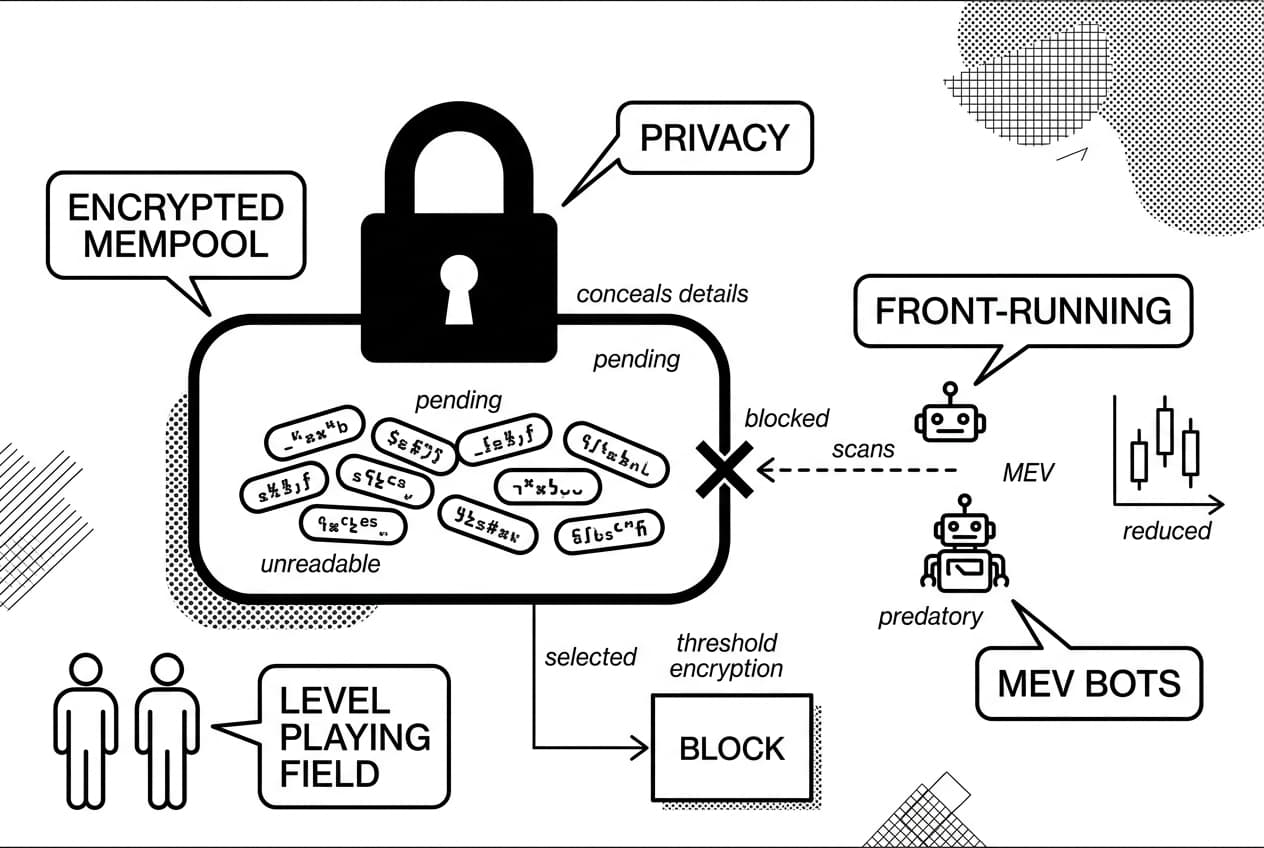
- An encrypted mempool is a privacy feature that conceals transaction details before they are finalized, preventing unfair advantages.
- Its primary goal is to stop front-running and other MEV strategies by making pending transactions unreadable to predatory bots.
- Using threshold encryption, transactions are kept secret until they are officially selected for a block, ensuring a level playing field for all users.
- This technology represents a major step towards making decentralized finance (DeFi) and other on-chain activities more secure and equitable.
Sources
Author

Crypto analyst and blockchain educator with over 8 years of experience in the digital asset space. Former fintech consultant at a major Wall Street firm turned full-time crypto journalist. Specializes in DeFi, tokenomics, and blockchain technology. His writing breaks down complex cryptocurrency concepts into actionable insights for both beginners and seasoned investors.