Zero Knowledge Encryption: How ZK Enables Private Compute
Zero knowledge encryption: how ZK enables private compute
What is zero knowledge encryption?
Zero knowledge encryption is a privacy design where a service can store, check, or help process your information without seeing the secret itself, so your password, private key, file contents, or personal data stays hidden from the system handling it.
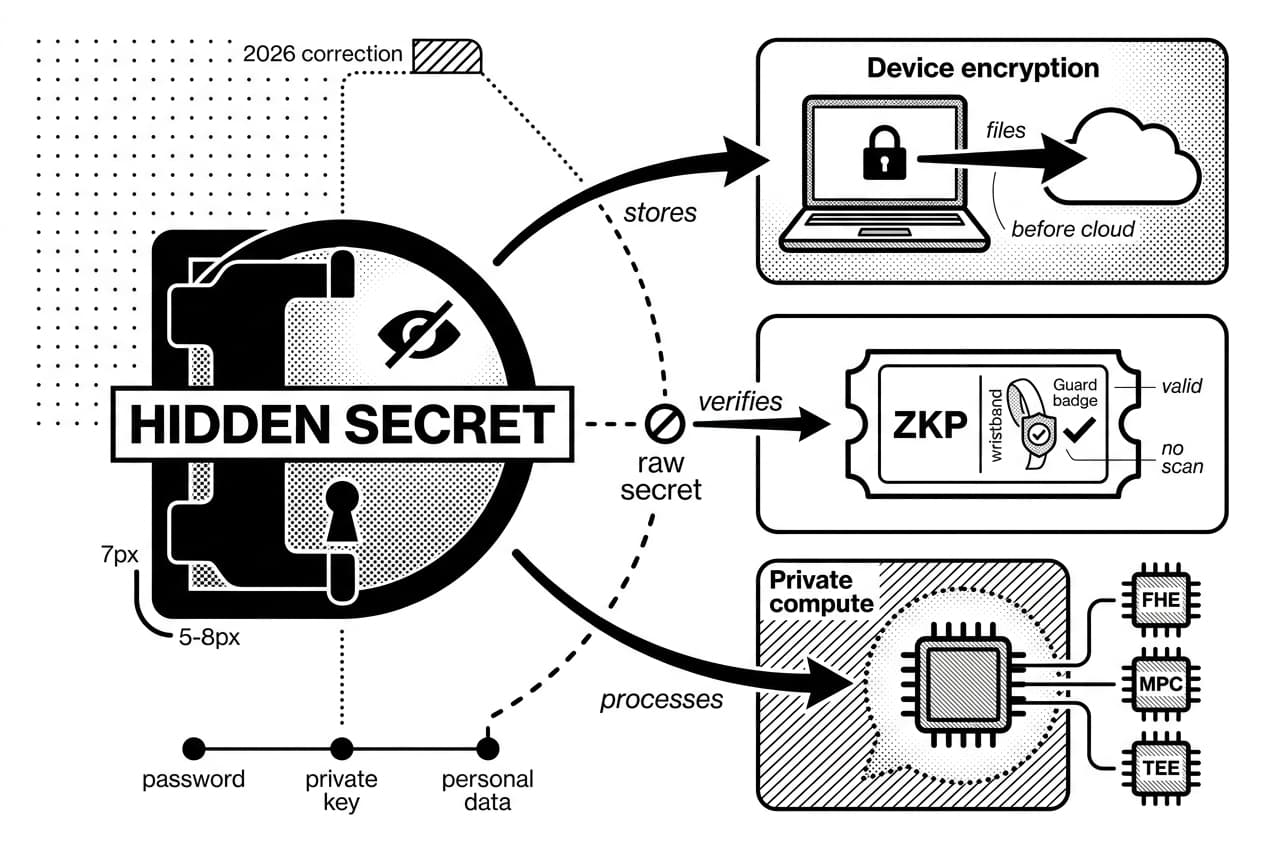
Why it matters: as more wallets, cloud apps, exchanges, and AI tools ask for sensitive data, zero knowledge encryption gives users a way to prove or use information without handing over the raw secret.
The phrase is used in three related but different ways. First, it can mean a zero-knowledge cloud architecture, where files are encrypted on your device before a provider receives them. Second, it can mean a zero-knowledge proof, often shortened to ZKP, which is a mathematical proof that a statement is true without exposing the private data behind it. Third, it can refer to encrypted computation, where data is processed while it remains hidden through tools such as fully homomorphic encryption, multi-party computation, or trusted execution environments.
Here is the important correction for 2026: ZK proofs do not usually encrypt data by themselves. They verify claims about hidden data. If a product says it uses zero knowledge encryption, ask which layer it means: storage encryption, proof-based verification, or private computation.
A concrete way to picture a ZK proof
A ZK proof is closer to a venue wristband check than a full identity scan. The guard only needs to know that the wristband is valid. The guard does not need your full name, address, birthday, or payment history. In cryptography, the private fact is called the witness, the person or machine making the claim is the prover, and the party checking it is the verifier.
A valid zero-knowledge proof has three properties. Completeness means an honest prover can convince an honest verifier. Soundness means a dishonest prover should not be able to fake a true statement. Zero-knowledge means the verifier learns nothing beyond the fact that the statement checks out.
Why it matters in 2026
Data exposure is no longer a rare edge case. Public reporting counted 1.35 billion exposed records in the United States in 2023 (Statista, 2023). Crypto adds a separate problem: public blockchains make transactions easy to verify, but that same transparency can reveal balances, trading patterns, counterparties, and business strategy.
Vitalik Buterin, co-founder of the Ethereum Foundation, has written often about ZK rollups, account privacy, and verifiable computation because these systems let public networks check correctness without exposing every detail. Adam Back, co-founder and CEO of Blockstream, is useful context from the wider cryptography community: privacy systems usually combine more than one primitive rather than depending on a single magic layer. Nick Szabo, computer scientist and originator of the smart-contracts concept, also helps frame why verifiable agreements matter: software can enforce rules, but privacy determines how much of the underlying activity becomes public.
Our 2026 working model is the ZK Privacy Stack Fit Test. Before trusting a product claim, ask five questions: what secret is hidden, who holds the decryption key, what statement is proved, what metadata still leaks, and what happens if a key is lost. If a product cannot answer those five questions clearly, its zero-knowledge claim is probably a slogan rather than a security guarantee.
- Zero-knowledge cloud storage means the provider stores encrypted files it should not be able to read.
- Zero-knowledge proofs prove a fact about private data without revealing that data.
- Encrypted computation processes hidden data using tools such as fully homomorphic encryption, multi-party computation, or confidential hardware.
- ZK proofs and private compute are complements, not replacements for each other.
- In 2026, the strongest systems combine storage encryption, proof verification, careful key management, and metadata limits.
Zero-knowledge proofs vs encryption vs end-to-end encryption
These terms all involve secrets, but they do different jobs. Encryption hides data. End-to-end encryption hides message content from intermediaries. A zero-knowledge proof verifies a claim about hidden data. Fully homomorphic encryption, or FHE, allows certain computation on encrypted data.
Encryption hides data
Encryption converts readable data, called plaintext, into unreadable data, called ciphertext. A key is the secret value used to encrypt or decrypt the data. Symmetric encryption uses the same key for both directions. Public-key encryption uses a public key to encrypt and a private key to decrypt.
If Alice sends a 0.5 BTC payment instruction to Bob through an encrypted channel, encryption hides the message content while it travels. It does not prove that Alice has the funds, that the instruction follows a protocol rule, or that Bob is the right recipient. Those are separate checks.
ZK proofs verify claims about hidden data
A zero-knowledge proof lets a prover convince a verifier that a statement is true without exposing the private witness that makes it true. For example, a wallet can prove that a transaction follows a rule without showing the full balance or transaction history.
The key point is narrow but powerful: a ZK proof does not encrypt the witness. The witness remains private because it is never sent to the verifier. The proof is a compact mathematical object that says the hidden data satisfies the rule.
ZK proofs reached practical blockchain use through zk-SNARKs, a family of short proofs that are quick to verify. Zcash activated its Sapling upgrade in October 2018 (Zcash documentation, 2018), making shielded transactions lighter for users than earlier private transaction designs.
End-to-end encryption is not always zero knowledge
End-to-end encryption, or E2EE, means only the sender and recipient can read message content. The service provider should only see ciphertext. But E2EE does not automatically hide metadata such as who contacted whom, when, from which device, or how often. It also does not guarantee that the provider never touches recovery keys.
That gap matters for products that market themselves as private. A messaging app can protect message bodies while still exposing a contact graph. A cloud backup service can encrypt files but weaken privacy if it controls account recovery. True zero-knowledge architecture requires client-side encryption, no provider-held decryption keys, and careful limits on metadata collection.
Concept | What it does | What it does not do | Simple example |
|---|---|---|---|
Encryption | Scrambles data so only key holders can read it | Does not prove that a statement about the data is true | A file is encrypted before upload so the server stores ciphertext |
End-to-end encryption | Keeps message content private from the service provider | Does not automatically hide metadata, timing, contact graphs, or weak recovery flows | A chat app routes encrypted messages but cannot read the message body |
Zero-knowledge proof | Proves a statement is true without revealing the private witness | Does not encrypt the witness or process arbitrary encrypted data by itself | A wallet proves it has enough funds without showing the full balance |
Fully homomorphic encryption | Allows computation directly on ciphertext | Does not automatically prove the computation was done honestly and is still costly | A server adds encrypted numbers and returns an encrypted result |
How ZK proofs enable encrypted computation
ZK proofs enable encrypted computation indirectly. They do not make a server compute on ciphertext by default. Instead, they let a system prove that a private or hidden computation followed the correct rules. When paired with FHE, multi-party computation, or trusted hardware, they can make private compute verifiable.
Suppose a DeFi protocol gives a lower fee to wallets holding more than 1 ETH. A user has 4.7 ETH but does not want to reveal the exact balance to the protocol. A ZK proof can show that the condition is true while revealing only the public result: eligible.
- Choose private input. The user selects the hidden data, called the witness. In this example, the witness is the wallet balance.
- Encode rule. The protocol writes the condition as a mathematical circuit, such as balance greater than 1 ETH.
- Generate proof. The user runs the circuit locally and creates a cryptographic proof that the witness satisfies the rule.
- Submit proof/output. The user sends the proof and the public output, such as eligible, to a verifier or smart contract.
- Verify without revealing the secret. The verifier checks the proof and learns that the rule passed, but not that the hidden balance was 4.7 ETH.
Step 1: keep the private input hidden
The private input can be a balance, password hash, identity attribute, medical value, or trading position. The witness is used during proof generation, but it is not published. That is why ZK is useful for selective disclosure: the system learns only the claim that needs to be checked.
Step 2: encode the rule as a circuit
A circuit is a mathematical version of a rule. Instead of writing age is over 18 in normal language, a developer turns the rule into constraints a proof system can check. Circuit design is where many bugs happen. If the circuit encodes the wrong rule, the proof can be valid while the application is still unsafe.
Step 3: generate and verify the proof
The two proof families most readers will meet are SNARKs and STARKs. A SNARK, or succinct non-interactive argument of knowledge, creates very small proofs that verify quickly. Some SNARK designs require a trusted setup ceremony. A STARK, or scalable transparent argument of knowledge, avoids trusted setup and relies on hash functions, but its proofs are often larger.
Ethereum made on-chain SNARK verification cheaper when it added pairing precompiles through EIP-197 in 2017 (Ethereum Improvement Proposals, 2017). That change helped make proof verification practical inside smart contracts, which later supported ZK rollups, private transfers, and identity proofs.
The most accurate phrase is verifiable private computation. The private data is not simply encrypted and handed to a generic computer. Instead, the system proves that a specific rule was applied correctly to hidden inputs. General encrypted compute usually needs FHE, multi-party computation, confidential hardware, or a custom circuit.
Can zero-knowledge encryption work in the cloud?
Yes, but cloud use cases split into two levels. Storing encrypted data in the cloud is already practical. Searching, editing, ranking, or training on that data while it stays hidden is much harder.
Zero-knowledge cloud storage
In zero-knowledge cloud storage, your device encrypts data before upload. The provider stores ciphertext and should not possess the decryption key. Proton reported more than 100 million registered accounts in its 2023 transparency report (Proton, 2023), showing demand for services built around client-side encryption and privacy controls.
The user tradeoff is responsibility. If only you hold the key, losing the key can mean losing the files. This is similar to the custody problem explained in our guide to custodial vs non-custodial wallet security: control reduces dependence on a provider, but it also removes easy rescue paths.
The hard part: searching or processing encrypted files
Storage is easier than computation. A cloud provider can keep encrypted files without reading them, but search and editing require more structure. If the server cannot see words inside a file, it cannot run an ordinary keyword search over the plaintext.
Three approaches try to close the gap. Searchable encryption lets a server match encrypted queries against encrypted indexes. Fully homomorphic encryption lets computation run on ciphertext and return encrypted output. Trusted execution environments, or TEEs, isolate computation inside protected hardware regions. Each option has limits. Searchable encryption can leak access patterns, FHE remains slow for many workloads, and TEEs add hardware trust assumptions.
That is why zero knowledge encryption in the cloud should be read carefully. For backups, it can be mature. For live analytics, AI training, or document search, the system usually combines multiple privacy tools and accepts performance tradeoffs.
Where ZK fits in Web3 and crypto
Public blockchains are designed so anyone can verify the ledger. A ledger is a shared record of balances and transactions. That transparency protects against hidden tampering, but it can expose user behavior. ZK proofs help by letting the chain verify rules without publishing every private detail.
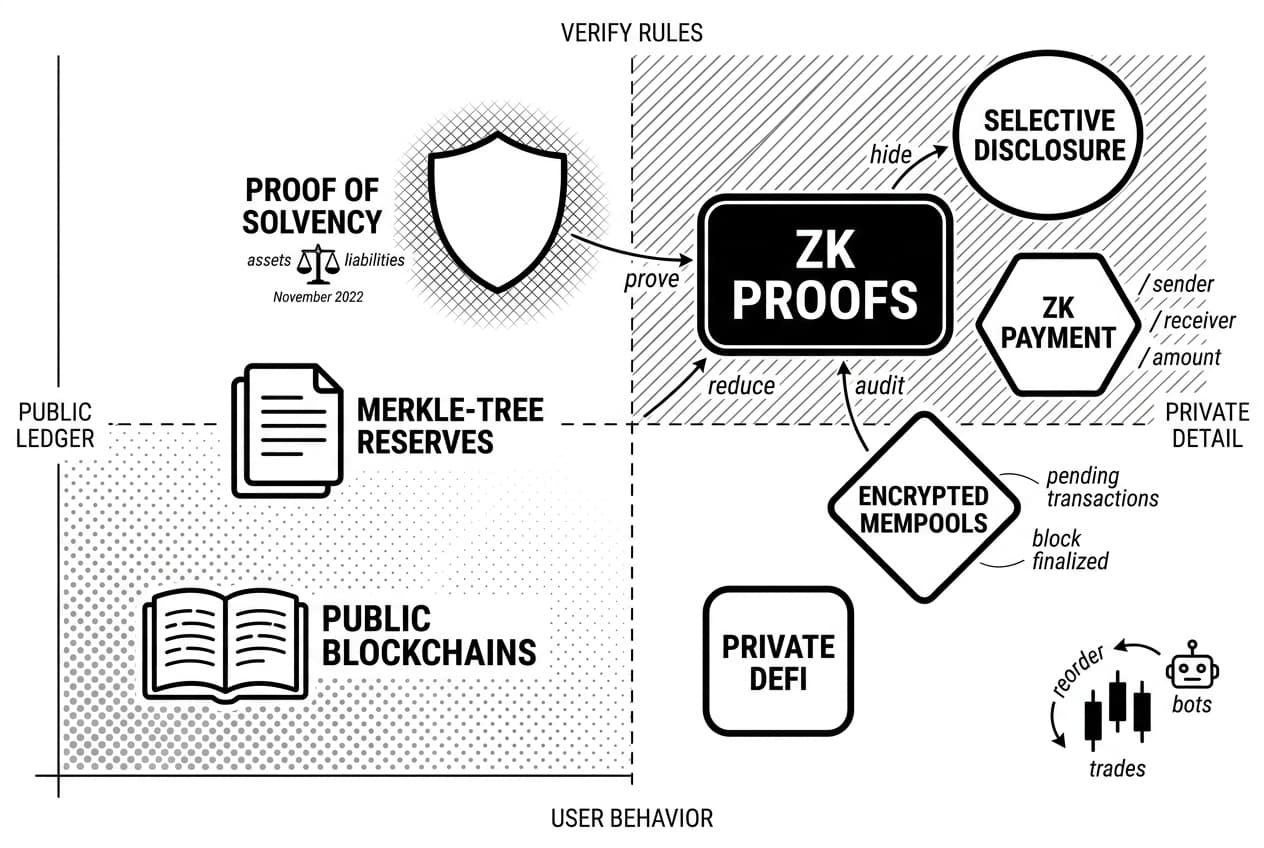
For example, encrypted mempools hide pending transaction details until a block is finalized, reducing the chance that bots copy or reorder trades before confirmation. Private DeFi trading venues use related privacy goals: match or settle activity without broadcasting full order size to the market.
Private transactions and selective disclosure
A ZK payment system can prove that a transaction is valid, funded, and follows protocol rules without revealing sender, receiver, or amount to everyone. Regulators and institutions often need auditability, so the practical route is usually selective disclosure. A user can prove compliance to an authorized party without publishing all details to the public ledger.
Proof of reserves and solvency
After the FTX collapse in November 2022 (U.S. Department of Justice, 2024), exchanges faced pressure to prove that customer assets were actually held. A ZK proof of solvency can show that assets exceed liabilities without publishing every user balance. Traditional Merkle-tree reserve proofs expose more structure; ZK designs can reduce that leakage.
zkML and private AI inference
Zero-knowledge machine learning, or zkML, applies proof systems to model inference. A model operator can prove that a model ran as claimed, while the application may hide the input, the model weights, or both. This is still early. Small proofs are practical in narrow cases, while large models remain expensive to prove.
For crypto builders, the lesson is simple: ZK is best when the rule is clear. Prove that a transfer is valid. Prove that a user is eligible. Prove that a batch of transactions follows the state transition rules. Broad private cloud computing needs more than a proof system alone.
Benefits and drawbacks of zero knowledge encryption
Zero knowledge encryption gives stronger privacy promises than ordinary provider trust, but it adds cost, key risk, and design complexity. The right question is not whether ZK is good in the abstract. The right question is whether the privacy gain justifies the operational burden for the specific use case.
Benefits: privacy without blind trust
The main benefit is data minimization. A service can verify a claim without collecting the full document, balance, or identity record. That reduces breach impact and makes surveillance harder. It also supports selective disclosure in regulated settings, where a user may need to prove eligibility without exposing unrelated personal data.
This tradeoff is especially visible in crypto privacy policy. Our coverage of crypto privacy tools and regulation shows the tension: users need legitimate privacy, while authorities worry about unlawful concealment. ZK systems can support narrower disclosures, but only if the rules are built carefully.
Drawbacks: speed, complexity, and usability
Proof generation can take real time and computing power, especially for large circuits. Circuit bugs can be hard to spot because the system may keep producing valid proofs for the wrong rule. Key management is also unforgiving. If the design gives only the user the decryption key, support staff cannot restore lost data without weakening the privacy model.
Metadata is another weak point. A system can hide message contents while still leaking IP addresses, transaction timing, gas patterns, or account linkages. Vitalik Buterin, co-founder of the Ethereum Foundation, has repeatedly discussed this problem in Ethereum privacy writing: content privacy is not the same as full activity privacy.
Benefit | Matching tradeoff |
|---|---|
Privacy without trusting a provider to behave | Key loss can mean permanent data loss |
Selective disclosure of only the needed claim | Metadata such as timing and IP address can still leak |
Verifiable computation over hidden inputs | Proof generation can be slow or costly |
Reduced breach exposure because servers store less readable data | Implementation errors can be subtle and serious |
Better fit for public blockchains that need verification | The zero-knowledge label is often used too loosely in marketing |
As of May 2026, the most practical evaluation method is the ZK Privacy Stack Fit Test: identify the secret, identify the key holder, identify the proof statement, identify metadata leakage, and identify the failure mode. That five-part review catches most exaggerated privacy claims quickly.
A brief history of zero-knowledge proofs
Zero-knowledge proofs began in academic cryptography, not in a blockchain product. A 1985 paper titled the knowledge complexity of interactive proof systems formalized the idea that a party could prove a statement without revealing the underlying information. The early versions were interactive, meaning prover and verifier exchanged several messages.
Later systems made proofs shorter and easier to verify. SNARKs reduced many interactions to a compact proof. STARKs added transparency by avoiding trusted setup ceremonies. Ethereum support for SNARK verification in 2017, followed by production privacy and scaling systems, moved the idea from theory into public infrastructure.
From theory to blockchain infrastructure
ZK proofs now support rollups, private payments, identity proofs, proof-of-solvency designs, and early zkML systems. A rollup is a scaling system that processes many transactions off the main chain and posts proof or summary data back to it. ZK rollups use proofs so the base chain can verify a batch without re-running every transaction.
The background also explains why terminology matters. Encryption hides data. ZK proofs verify statements. Encrypted computation processes hidden data. Modern systems may combine all three, but mixing the words makes it harder to evaluate real security.
Frequently Asked Questions
- What is zero-knowledge encryption?
- Zero-knowledge encryption is a privacy model where a service stores or verifies data without ever learning the underlying secret. In consumer apps, this typically means encryption happens on your device before data reaches any server. In cryptography, zero-knowledge proofs let one party verify a claim is true without exposing the private inputs behind it.
- Is XRP a ZKP?
- No, XRP is not a zero-knowledge proof. XRP is the native digital asset of the XRP Ledger, a blockchain network. While blockchains can integrate zero-knowledge proof technology to add privacy features, the token itself is simply a currency unit — not a SNARK, STARK, or any form of cryptographic proof system.
- Is 3DES still used today?
- 3DES, or Triple DES, has been deprecated for most modern applications because stronger algorithms like AES offer better security and performance. Some legacy systems still run it, but it is being phased out. Importantly, 3DES is a conventional symmetric encryption algorithm — it has no connection to zero-knowledge encryption or ZK proof systems.
- Is zero-knowledge encryption better than end-to-end encryption?
- They address related but distinct problems. End-to-end encryption ensures only communicating parties can read messages, while zero-knowledge design prevents the service provider from accessing your secrets at all. Neither approach is strictly superior — the strongest systems combine both, alongside careful key management and protections against metadata exposure.
Sources
Author

Crypto analyst and blockchain educator with over 8 years of experience in the digital asset space. Former fintech consultant at a major Wall Street firm turned full-time crypto journalist. Specializes in DeFi, tokenomics, and blockchain technology. His writing breaks down complex cryptocurrency concepts into actionable insights for both beginners and seasoned investors.