What Is the RGB Protocol? A 2026 Guide to Bitcoin Smart Contracts
What Is the RGB Protocol? (A Simple Explanation)
The RGB protocol is a system for creating and managing smart contracts and digital assets, like tokens, that operate on top of Bitcoin. It is designed to bring advanced functionality to the Bitcoin network without changing Bitcoin's core rules or slowing it down.
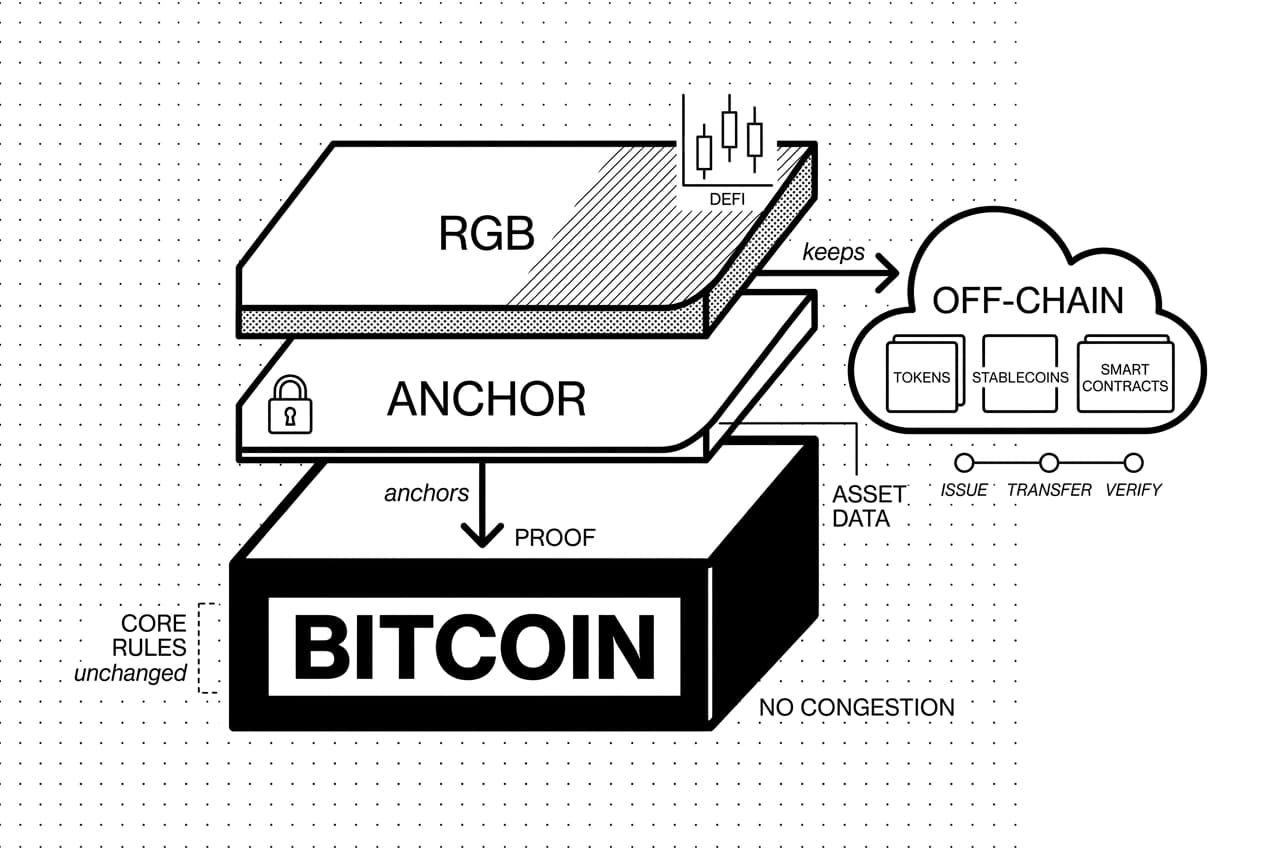
So, why is this so important? For years, Bitcoin has been incredibly secure and reliable, but it lacked the flexibility of other networks for things like creating new tokens or running complex applications. The rgb protocol changes that. Think of the main Bitcoin blockchain as the secure foundation of a building; RGB builds new, feature-rich floors on top of that foundation. It cleverly anchors proof of your assets to Bitcoin's unbreakable chain but keeps the actual asset data off the main network. This approach means rgb bitcoin applications gain the security of the world's strongest blockchain while enabling everything from stablecoins to intricate smart contract systems, all without causing congestion on the base layer. It's a key piece of technology that allows Bitcoin to evolve.
Why Bitcoin Needs a Protocol Like RGB
Now that we understand what the RGB protocol is, the natural next question is: why does it even exist? To answer that, we have to look at the original design of Bitcoin itself. Bitcoin was intentionally built with a very simple programming language, known as Script. This simplicity is a feature, not a bug; it makes the network incredibly secure and predictable. Its primary job is to handle one thing exceptionally well: the transfer of bitcoin.
However, this focused design means Bitcoin’s main layer can't handle complex operations like those seen on other blockchains. It doesn't natively support the creation of new tokens (like Ethereum's famous ERC-20 standard) or intricate smart contracts for applications like decentralized finance (DeFi). Think of the Bitcoin blockchain as the unshakeable foundation of a skyscraper. It’s immensely strong, but you can't live or work in the foundation alone. For years, developers faced a choice: build on a less secure foundation or accept Bitcoin’s limitations.
This is precisely the gap the RGB protocol fills. It allows developers to build the rest of the skyscraper—issuing assets, creating sophisticated contracts, and enabling a true RGB Bitcoin ecosystem—on a separate layer that still anchors its security to the main foundation. It extends Bitcoin’s capabilities without altering its core code, preserving the security and decentralization that make Bitcoin so valuable in the first place. It adds the missing functionality without compromise.
Core Concepts: How RGB Works Under the Hood
Now that we understand why Bitcoin needs a system like RGB, let's explore how it actually works. The genius of the RGB protocol is in its design, which adds incredible functionality without changing or congesting the main Bitcoin network. This is achieved through a few core components working in harmony.
Client-Side Validation: Keeping Bitcoin Uncluttered
The most fundamental concept to grasp is that the data for RGB assets—like the history of a token or the details of a smart contract—is not stored on the Bitcoin blockchain. Instead, this information is held and verified privately by the people who own the assets. This process is called "client-side validation" because the validation happens on the user's software (the "client"), not by the global network of miners.
Think of it like a private property deed. You don't broadcast every detail of your home purchase agreement to the entire world. You keep the detailed contract private between you and the seller. However, you do register the final transfer of ownership with a public land registry (the Bitcoin blockchain). The registry's job is simply to provide a public, undeniable record that the ownership changed. It doesn't need to store the entire history of negotiations or the contract's specific clauses. This is exactly how RGB keeps transaction details private and the Bitcoin blockchain lean and efficient.
Single-Use Seals and UTXOs: Anchoring to Bitcoin's Security
If the data is kept off-chain, you might wonder how RGB prevents someone from spending the same token twice. This is solved with a clever mechanism called "single-use seals" that directly link RGB assets to Bitcoin's own security model. Each RGB asset is essentially "sealed" to a specific piece of bitcoin, technically known as one of Bitcoin's Unspent Transaction Outputs (UTXOs).
A UTXO is like a digital check that can only be cashed once. By attaching an RGB asset to a particular UTXO, the protocol guarantees that to transfer the RGB asset, you must also spend the associated Bitcoin UTXO in a valid Bitcoin transaction. Because the Bitcoin network is incredibly effective at preventing a UTXO from being double-spent, any RGB bitcoin asset sealed to it gains that same level of security. It's a brilliant way to inherit Bitcoin's fortress-like protection without needing any changes to Bitcoin itself.
Schemas and Interfaces: Defining Smart Contract Logic
Finally, RGB provides a structured way to define what an asset is and how it can be used. This is done through schemas and interfaces. A schema acts as a blueprint or a template for a new asset. For example, a schema for a stablecoin could set rules like a fixed supply and specific transfer permissions. A schema for a concert ticket NFT could define that it is unique and non-divisible.
Interfaces then provide a standardized way for different wallets and applications to understand and interact with these assets. This ensures your wallet knows how to display your token balance or show you the details of your collectible, creating a consistent user experience. These components provide the flexible and programmable foundation needed for sophisticated smart contracts.
RGB on the Lightning Network: Scalable Tokens and Contracts
So far, we've seen how the RGB protocol allows us to create complex digital assets that are secured by Bitcoin. But creating an asset is only half the battle; it also needs to be usable for everyday transactions. This is where the real magic happens, as RGB integrates beautifully with Bitcoin’s scaling solution: the Lightning Network.
Think of the Lightning Network as a private payment lane between two people. Normally, you use this lane to send bitcoin back and forth instantly and with near-zero fees. The RGB protocol adds a fascinating new dimension to this. It allows you to send not just bitcoin, but also any RGB-defined asset—like a stablecoin, a company stock, or an event ticket—through that very same private lane.
Imagine you have a Lightning channel open with a coffee shop. You can pay for your latte with satoshis, as usual. But if you also hold a "CoffeeCoin-RGB" loyalty token issued by the shop, you could send one of those tokens through the same channel to claim a free drink. The transfer of that token happens off-chain, just like a Lightning payment. It’s instantaneous, private, and doesn’t add any congestion to the main Bitcoin blockchain. This collaboration between the rgb protocol and Lightning is what makes a new generation of scalable rgb bitcoin applications possible.
This combination solves the scalability problem that has challenged other token platforms. By moving the vast majority of token transfers into Lightning channels, the main Bitcoin network is reserved only for final settlement. The result is a system that can handle a massive volume of token transactions while inheriting the unmatched security and decentralization of Bitcoin itself.
Top Use Cases for the RGB Protocol in 2026
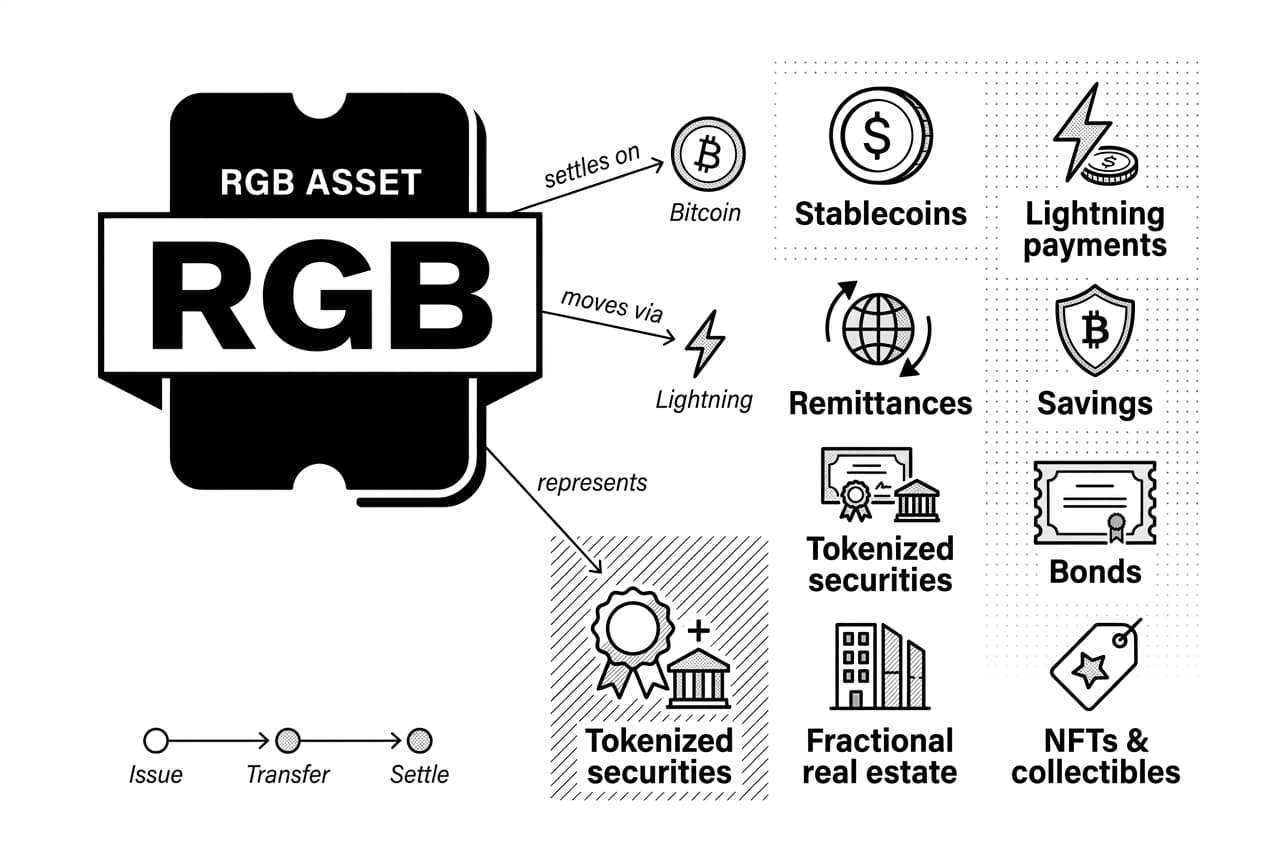
Understanding how the RGB protocol works is one thing, but seeing what it can do is where the excitement truly begins. After years of theoretical development, we are now seeing a wave of practical applications built on this technology. These tools extend Bitcoin's capabilities far beyond simple payments, turning it into a base layer for a new generation of digital assets and financial services. Here are some of the most prominent use cases gaining traction today.
Stablecoins on Bitcoin
Imagine a digital dollar that has the stability of the US dollar but inherits the security and censorship-resistance of the Bitcoin network. That's precisely what RGB enables. Developers can issue stablecoins—tokens pegged to a real-world currency—that are settled on Bitcoin. When combined with the Lightning Network, these stablecoins can be transferred across the globe in seconds for fractions of a cent, making them a powerful tool for payments, remittances, and savings.
Tokenized Securities (Real-World Assets)
The RGB protocol provides a way to represent ownership of real-world assets (RWAs) on the blockchain. Think of things like company stocks, bonds, or even a fractional share of a commercial building. By tokenizing these assets with RGB, they become easier to trade, divide, and manage. This process creates a digital representation of ownership that is secured by the most trusted settlement layer in the world: Bitcoin itself.
Non-Fungible Tokens (NFTs) & Collectibles
RGB introduces a more private and scalable approach to NFTs on Bitcoin. Unlike other methods that store all data directly on the blockchain, RGB keeps the asset information and transfer logic off-chain. The Bitcoin blockchain is only used to anchor the ownership history, preventing bloat and keeping transaction details confidential between the sender and receiver. This makes it ideal for digital art, collectibles, and in-game items where privacy and efficiency matter.
Decentralized Identity & Credentials
Beyond finance, RGB offers powerful tools for managing digital identity. A university could issue a degree as a secure, unforgeable RGB asset that you control in your own wallet. You could then prove you have this credential to a potential employer without revealing any other personal data. This concept of self-sovereign identity puts you in control of your own information, a significant step forward for digital rights and privacy.
Getting Started: Wallets and Tools for RGB
Understanding the potential of the RGB protocol is one thing, but interacting with it is the next exciting step. As of 2026, the ecosystem has matured significantly, making it much easier for everyday users to manage RGB assets. To begin, you will need a compatible wallet. Unlike standard Bitcoin wallets, RGB-enabled wallets have extra logic to interpret the client-side data that defines your tokens and smart contracts. This means your assets are truly under your control, validated by your own software.
Several excellent options have emerged as the leading wallets that support RGB. Wallets like Bitmask and MyCitadel offer user-friendly interfaces that let you send, receive, and view your RGB tokens—from stablecoins to digital collectibles—often directly over the Lightning Network. For developers looking to build on this powerful technology, the LNP/BP Standards Association is the primary resource. It maintains the core standards for both the Lightning Network Protocol (LNP) and Bitcoin Protocol (BP), providing the essential documentation and libraries needed to integrate the RGB Bitcoin protocol into new applications and services.
RGB vs. Alternatives (Ethereum, Ordinals, Taproot Assets)
With a clear understanding of what RGB can do, it's natural to ask how it stacks up against other methods for creating tokens and smart contracts. The cryptocurrency world isn't short on options, but the rgb protocol takes a path that sets it apart, especially within the rgb bitcoin ecosystem.
Compared to Ethereum, the difference is fundamental. Ethereum stores all contract logic and token data directly on its public blockchain. This makes verification simple but leads to high transaction fees and exposes all activity publicly. RGB avoids this by keeping data off-chain, using the Bitcoin blockchain only as a public bulletin board for proofs. This design choice dramatically enhances privacy and scalability.
Within Bitcoin, protocols like Ordinals and BRC-20 tokens have gained attention. These inscribe data directly onto the base blockchain, which can be inefficient and adds to network congestion. The rgb protocol is designed to be a better citizen of Bitcoin by keeping this complex data off-chain, preventing blockchain bloat.
Perhaps its closest relative is Taproot Assets. Both systems use client-side validation, where users verify their own transactions. However, RGB has a longer development history and is architected for more complex smart contract functionality beyond simple asset issuance, aiming to be a more generalized platform for programmable rights on Bitcoin.
Key Takeaways & The Future of Bitcoin DeFi
As we've explored, the RGB protocol is more than just an idea; it's a practical framework for expanding Bitcoin's capabilities. By building on top of Bitcoin's foundation, it opens up new possibilities without sacrificing core principles. Here are the essential points to remember:
- Private & Scalable Assets: RGB keeps transaction data private and off the main blockchain, using a concept called client-side validation. This prevents network bloat and protects user privacy.
- Bitcoin-Native Security: All RGB assets are ultimately anchored to the Bitcoin blockchain, inheriting its unmatched security and decentralization.
- Lightning Network Ready: The protocol is designed to work with the Lightning Network, allowing for instant, low-cost transfers of tokens and other complex assets.
The road ahead for the RGB protocol is exciting. By enabling a rich ecosystem of financial tools directly on RGB Bitcoin, it positions the original cryptocurrency to host a new wave of decentralized finance. This development could introduce a powerful, security-focused alternative in the world of smart contract platforms.
Frequently Asked Questions
- What is the RGB protocol?
- RGB is a smart contract system and off-chain protocol built for Bitcoin and the Lightning Network. It allows users to issue and manage highly scalable, private, and secure digital assets, such as tokens and collectibles, without congesting the main Bitcoin blockchain or sacrificing its core security principles.
- What is RGB in Bitcoin?
- In the context of Bitcoin, RGB is a Layer 2/3 protocol that operates on top of the main blockchain. It uses Bitcoin as its security and final settlement layer but keeps all asset data and contract logic off-chain. This approach maintains user privacy and enhances scalability for complex operations.
- What is the RGB++ protocol?
- RGB++ is a newer, extended version of the original RGB protocol. Its key innovation involves using a single Bitcoin UTXO to anchor multiple RGB transactions, a technique called "UTXO binding." This simplifies the complex client-side validation process, making the system more accessible for light clients and improving overall usability.
- What does RGB stand for?
- Unlike the color model, RGB does not stand for anything in this context; it is not an acronym. The name originated as a codename during early development by Peter Todd, referencing the concept of "coloring" coins to give them special properties. The name simply stuck with the project.
Author

Crypto analyst and blockchain educator with over 8 years of experience in the digital asset space. Former fintech consultant at a major Wall Street firm turned full-time crypto journalist. Specializes in DeFi, tokenomics, and blockchain technology. His writing breaks down complex cryptocurrency concepts into actionable insights for both beginners and seasoned investors.