Ledger vs Trezor 2026: Which Hardware Wallet Is Better?
Ledger vs Trezor in 2026: quick verdict
Ledger vs Trezor in 2026 is not a simple brand contest. Ledger offers certified secure-element hardware, polished mobile flows and broad app support, while Trezor offers public firmware, strong privacy controls and recovery options built around transparent self-custody. Both isolate private keys from internet-connected devices, which remains a practical step up from storing funds on an exchange. Ledger says hardware wallet adoption passed 10 million units by 2023 (Ledger academy, 2023), a reminder that self-custody is now a mainstream risk-management decision, not a niche hobby. If you are still weighing wallet ownership against custodial storage, start with our guide on why self-custody matters in 2026.
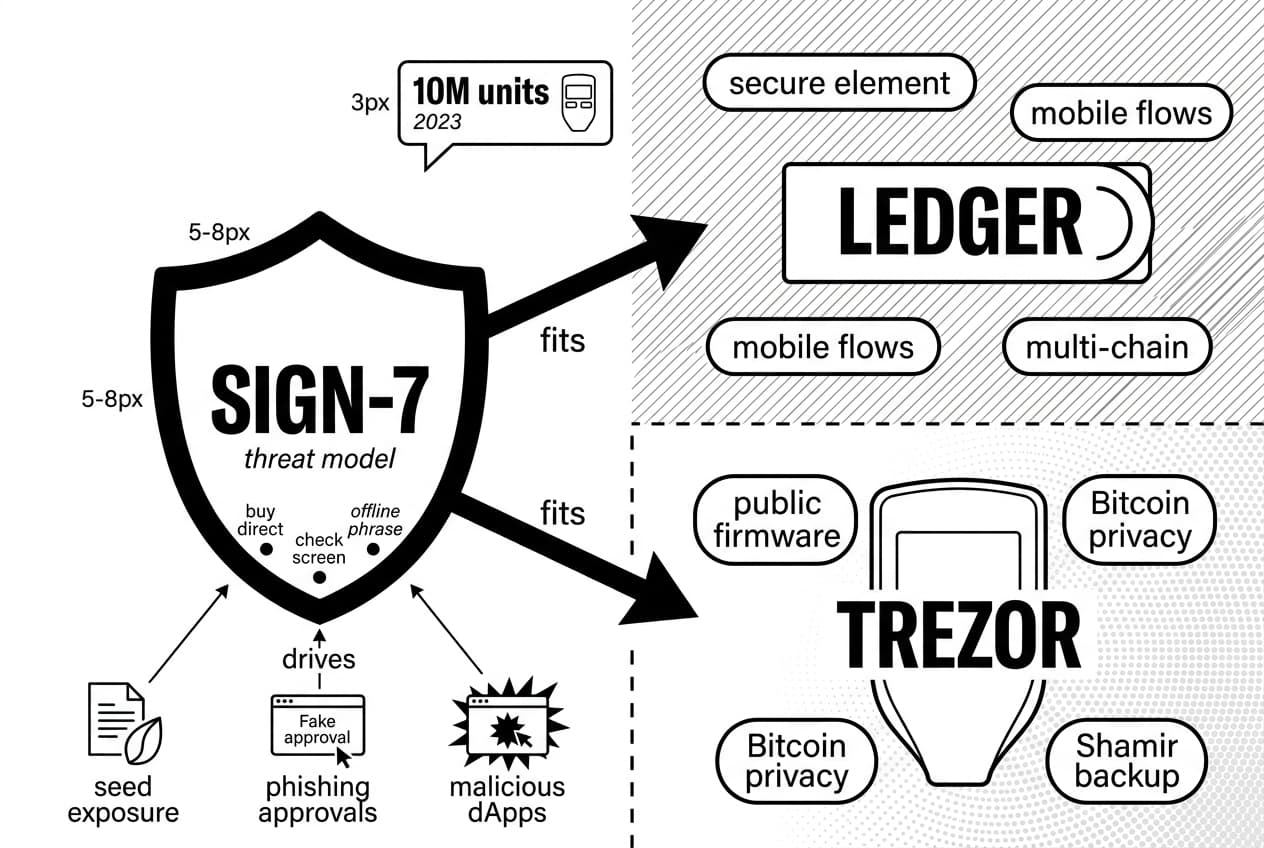
Our verdict: Ledger is usually the better fit for mobile-first, multi-chain and frequent DeFi users; Trezor is usually the better fit for open-source verification, Bitcoin privacy and recovery setups that benefit from Shamir backup. For simple cold storage of BTC or ETH, the device choice matters less than buying direct, checking addresses on-screen and protecting the recovery phrase offline.
We use a threat-model-first method called the SIGN-7 framework: signing clarity, isolation, governance transparency, network privacy, recovery resilience, asset coverage and daily friction. This matters because most retail losses in 2026 come from seed exposure, phishing approvals and malicious dApps rather than lab-grade chip extraction. Andreas Antonopoulos, author and educator, has repeatedly taught that the seed phrase is the wallet; the hardware is the signing tool. That framing guides the ranking below.
Who should read this comparison?
This guide is for first-time cold-storage buyers, Bitcoin holders leaving exchanges, ETH and Solana users, NFT collectors, DeFi participants, privacy-focused users and owners deciding whether to upgrade from an older device. If you already own either wallet, focus on the scenario tables and signing-risk sections before deciding to switch.
Short answer by user type
- Pick Ledger if you need Bluetooth, broad app compatibility, stronger mobile support or a larger ecosystem for staking, NFTs and DeFi.
- Pick Trezor if you prefer open firmware, built-in Tor routing in the companion app, Shamir backup or a simpler cold-storage workflow.
- Pick either for basic BTC or ETH cold storage if your recovery phrase is stored offline, never photographed and protected with a strong PIN and optional passphrase.
Ledger vs Trezor 2026 comparison table
The table compares wallet ecosystems rather than only one model. Ledger's current consumer line includes nano s plus, nano x, flex and stax. Trezor's current line centers on safe 3 and safe 5, while older model one and model t units still exist in the market. Prices and support can change, so verify details at the official Ledger store (May 2026) and the official Trezor store (May 2026) before buying.
Criteria | Ledger | Trezor |
|---|---|---|
Security model | Certified secure element across current models; closed components inside the secure operating system. | Open firmware across the stack; safe 3 and safe 5 add a secure element for physical attack resistance. |
Open-source status | Developer tools and apps are partly open, but the secure operating system is not fully public. | Firmware is public on github.com, May 2026, which supports independent review. |
Supported coins | Ledger lists 5,500+ supported coins and tokens (ledger.com, May 2026). | Trezor lists 1,000+ supported coins and tokens (trezor.io, May 2026), with many assets handled through integrations. |
Mobile support | Nano x, flex and stax support mobile pairing through Bluetooth; flex and stax also add NFC features. | Primarily wired. Mobile use usually requires USB-C or an adapter, so it is less convenient away from a desk. |
Screen and signing experience | Small screens on nano models; larger touch or e-ink screens on flex and stax improve transaction review. | Buttons on safe 3; color touchscreen on safe 5. Trezor suite displays straightforward transfers clearly. |
Recovery options | BIP39 seed phrase, optional passphrase and optional Ledger recover subscription for cloud-assisted recovery. | BIP39 seed phrase, optional passphrase and Shamir backup on supported models. |
Price range | About 79 dollars to 399 dollars (ledger.com, May 2026), depending on model. | About 79 dollars to 169 dollars for the main safe line (trezor.io, May 2026). |
Best use case | Mobile signing, multi-chain portfolios, NFTs, DeFi and users who want a polished all-in-one app. | Open-source cold storage, privacy-focused Bitcoin use and recovery designs that split backup responsibility. |
Our SIGN-7 scenario score
To add original information gain, we scored both ecosystems across seven real user scenarios. Scores run from 1 to 5, where 5 means the wallet is the stronger practical fit for that scenario as of May 2026.
Scenario | Ledger score | Trezor score | Why it matters |
|---|---|---|---|
Long-term BTC cold storage | 4 | 5 | Trezor's open firmware, coin control and Tor option give privacy-focused holders more control. |
Multi-chain portfolio | 5 | 3 | Ledger has broader direct app coverage and smoother chain switching. |
Mobile signing | 5 | 2 | Ledger's Bluetooth workflow is easier for phone-first users. |
DeFi approvals | 4 | 3 | Ledger has wider dApp integration, but both still depend on clear signing support. |
NFT management | 4 | 3 | Larger Ledger screens and marketplace integrations help with frequent NFT review. |
Recovery resilience | 3 | 5 | Trezor's Shamir backup is a strong tool for splitting recovery risk. |
Budget value | 4 | 4 | Entry models are close in price; the better value depends on whether app support or recovery design matters more. |
This score is not a lab certification. It is a practical decision dataset based on the same criteria applied to both wallets: signing clarity, recovery design, privacy defaults, app support, mobility, price and attack surface.
Key differences between Ledger and Trezor
- Security architecture: Ledger starts with a certified secure element, while Trezor starts with open firmware and adds secure-element protection on newer safe models.
- Code transparency: Trezor firmware is public, while Ledger keeps parts of the secure operating system closed.
- Mobile access: Ledger is stronger for phone-based signing, while Trezor is more desk-and-cable oriented.
- Recovery design: Ledger offers optional Ledger recover, while Trezor offers Shamir backup on supported models.
- Privacy controls: Trezor suite has a built-in Tor switch and node options; Ledger live is more app-like but sends more metadata to default infrastructure.
- App ecosystem: Ledger has broader integrations for DeFi, staking and NFTs; Trezor is more focused and conservative.
- Budget choice: Both have roughly 79 dollar entry points, so the decision should not be based on price alone.
Security philosophy: secure element vs transparency
Ledger's core argument is tamper resistance. Its secure element is designed to make physical extraction of private keys difficult even if a thief has the device. Trezor's core argument is verifiability. Its firmware can be inspected and built by the public, reducing the trust placed in the manufacturer.
The split is real, but it is often overstated. A user who stores a seed phrase in cloud photos or signs an unreadable malicious approval can lose funds on either device. The better question is not which brand sounds safer, but which model reduces the risks you are most likely to face.
Software ecosystem: Ledger live vs Trezor suite
Ledger live is more polished for portfolio viewing, swaps, staking, NFTs and app installation. That convenience adds external service dependencies, including swap and staking providers. Trezor suite is more restrained. It emphasizes account control, firmware updates, coin control and privacy settings rather than acting as a full financial dashboard.
For beginners, Ledger live often feels easier. For privacy-minded Bitcoin users, Trezor suite's Tor routing and node options are stronger defaults. Neither app removes the need to verify the address, amount and contract action on the hardware screen.
Connectivity and mobile use
Ledger's nano x, flex and stax support Bluetooth mobile signing, which is helpful for users who interact with wallets from a phone. Trezor avoids wireless connectivity, which reduces radio exposure but increases friction. If you sign transactions weekly from mobile, Ledger has the edge. If you sign a few times a year, Trezor's cable-only workflow is not a major drawback.
Ledger overview: models, strengths and weaknesses
Ledger is the more ecosystem-heavy choice. It aims to combine hardware isolation with a broad consumer app that covers buying, swaps, staking, NFTs and many chains. Ledger states that it had sold 7 million+ devices by early 2026 (ledger.com, 2026). That scale brings wide app support, but also more attention from attackers and more debate over closed firmware components.
What Ledger does best
Ledger's strongest advantages are asset coverage, mobile support and dApp integrations. The public asset directory lists 5,500+ coins and tokens (ledger.com, May 2026), and Ledger live handles many mainstream accounts directly. The nano x is useful for mobile users, while flex and stax add larger screens for clearer review.
Ledger is also a better fit for users who interact with DeFi protocols regularly. Hayden Adams, founder of Uniswap, has helped push wallet usability into mainstream DeFi, and that context matters: hardware wallets must now protect users during contract interactions, not only during simple transfers. Ledger's broader clear-signing and WalletConnect coverage gives it an advantage in many active workflows.
Ledger weaknesses to consider
The main drawback is trust. Ledger's secure element and operating system are not fully open-source, so users rely on Ledger's internal security process and external certifications. The 2023 launch of Ledger recover also changed the conversation because it showed that encrypted seed-shard backup could be added through firmware for users who opt in.
Ledger live is another dependency. It is convenient, but users who dislike default server lookups, partner integrations or a larger app surface may prefer a leaner tool. App storage on lower-cost devices can also annoy users who manage many chains and need to install or remove apps often.
Best Ledger models for different buyers
Model | Approximate price | Best for | Main tradeoff |
|---|---|---|---|
Ledger nano s plus | 79 dollars (ledger.com, May 2026) | Budget cold storage and desktop users. | No Bluetooth and limited convenience for mobile use. |
Ledger nano x | 149 dollars (ledger.com, May 2026) | Mobile users and multi-chain holders. | Small screen for complex contract review. |
Ledger flex | 249 dollars (ledger.com, May 2026) | Frequent signing, NFTs and users who want a clearer display. | Premium price for convenience rather than a different core custody model. |
Ledger stax | 399 dollars (ledger.com, May 2026) | Collectors and users who value the largest display. | Hard to justify for simple long-term storage. |
If you are choosing between the two lower-cost Ledger devices, our nano x versus nano s plus guide covers that decision in more detail.
Trezor overview: models, strengths and weaknesses
Trezor is the more transparency-heavy choice. Its firmware is public, its companion app is simpler, and its recovery features are strong for users who want to design their own storage plan. The tradeoff is less convenient mobile use and, in some cases, less direct app support for long-tail assets.
What Trezor does best
Trezor's strongest advantage is auditability. The firmware is public on github.com, May 2026, which lets researchers inspect how the wallet handles keys, signing and updates. Andreas Antonopoulos, author and educator, has long emphasized verifiability as a foundation of self-custody, and Trezor aligns closely with that principle.
Trezor suite is also strong for Bitcoin privacy. It supports coin control and Tor routing, and it can connect to user-controlled infrastructure. Shamir backup on supported models lets a user split recovery material into multiple shares, such as a 3-of-5 design, so no single backup location contains the full secret.
Trezor weaknesses to consider
Trezor is weaker for mobile-first use because it lacks Bluetooth. It is also less convenient for users who rely on many dApps, chains or wallet-native staking flows. Some assets work through third-party wallets rather than direct companion-app support, so users should check the official coin list before buying.
Older Trezor devices also have a documented physical-access risk. Researchers at Kraken security labs reported a voltage-glitching attack in January 2020 against older Trezor hardware when an attacker had the device in hand. A passphrase greatly reduces the value of that attack, and newer safe models add secure-element protection.
Best Trezor models for different buyers
Model | Approximate price | Best for | Main tradeoff |
|---|---|---|---|
Trezor safe 3 | 79 dollars (trezor.io, May 2026) | Budget cold storage, Bitcoin privacy and Shamir backup users. | No touchscreen and less mobile convenience. |
Trezor safe 5 | 169 dollars (trezor.io, May 2026) | Users who want a color touchscreen and clearer address review. | Costs more than safe 3 without changing the basic software philosophy. |
Older model one or model t | Varies by reseller | Low-cost basic storage only if bought from a trusted source. | Less attractive in 2026 because newer safe models address more physical-risk concerns. |
For most Trezor buyers, safe 3 is the value pick. Safe 5 is easier to use, but the upgrade mainly improves the interface rather than changing the recovery model or open-source advantage.
Security architecture and transaction verification
The main security difference is that Ledger uses a certified secure element to resist physical key extraction, while Trezor prioritizes open-source firmware that anyone can inspect. In practice, the larger 2026 risk for most users is careless signing: approving unreadable approvals, malicious contracts or altered addresses without checking the hardware screen.
Secure element compared with open-source security
Ledger's secure element is valuable if your threat model includes stolen devices, hostile physical access or tampering. Trezor's open firmware is valuable if your threat model includes opaque code, vendor trust and software supply-chain concerns. Both are rational designs; they simply defend against different failure modes.
The 2026 buyer should ask three questions: could someone physically access my device, do I trust closed firmware components, and how often do I sign complex transactions? The answers often matter more than the logo on the device.
What you actually approve when signing
Simple transfers are easy to verify: check the amount and recipient address on the hardware screen. DeFi and NFT transactions are harder because the device may show structured data, a contract name or an unreadable hex payload. If the device cannot show human-readable intent, you are blind signing.
Blind signing is where many users lose funds. A malicious approval can grant a contract permission to move tokens even though the private key never leaves the hardware wallet. After using unfamiliar dApps, review and revoke risky token approvals rather than leaving unlimited allowances active.
Physical theft, supply chain and firmware updates
Buy direct, inspect packaging, update firmware before funding the wallet and never type the recovery phrase into a website or chat window. Ledger publishes security notices through its security circulars page (ledger.com, 2023), while Trezor publishes firmware and reproducibility material publicly. Both approaches help, but neither protects a user who enters a seed phrase into malware.
Use a strong PIN and consider a BIP39 passphrase for high-value storage. A passphrase creates a separate hidden wallet, so a thief with the seed phrase but not the passphrase cannot access the protected funds.
Coins, NFTs, DeFi and app ecosystem
Asset support is where Ledger often pulls ahead for practical use. Trezor can still cover mainstream holdings, but Ledger usually has smoother direct support for more chains and more third-party integrations. Always check the official compatibility pages before purchase because support can change with firmware and app updates.
Coin and token support
Asset or network | Ledger | Trezor |
|---|---|---|
BTC | Direct account support and hardware signing. | Direct account support, coin control and strong privacy tools. |
ETH and ERC-20 tokens | Direct Ledger live support plus external wallet integrations. | Direct Trezor suite support for common assets plus external wallet integrations. |
XRP | Supported through Ledger live. | Listed on the official Trezor coin page; verify model support before purchase. |
Layer-2 networks | Often easier through Ledger live, WalletConnect and external wallets. | Often works through MetaMask or another connected wallet. |
Solana ecosystem | Generally stronger direct support and more common integrations. | Check the current Trezor coin page because support depends on model and software path. |
Long-tail altcoins | Strong coverage, but some assets require third-party apps. | Coverage varies; the public coin page should be checked asset by asset. |
NFTs, DeFi and wallet connections
Ledger is the stronger pick for active DeFi and NFT users because more dApps test Ledger flows and Ledger live is built around connected services. Trezor can still work well with MetaMask and WalletConnect, but the workflow may add more steps and compatibility checks.
Stani Kulechov, founder and chief executive at Aave, has often emphasized safer user experience in DeFi, and that point applies here: wallet hardware cannot save a user from approving the wrong contract. If you sign often, study DeFi app risks and workflows before treating any hardware wallet as automatic protection.
Ledger live vs Trezor suite in daily use
Ledger live is easier for portfolio tracking, staking, swaps and NFT viewing. Trezor suite is cleaner for privacy-oriented account management and Bitcoin control. Ledger offers convenience; Trezor offers fewer moving parts. The right choice depends on whether your daily risk comes from friction, privacy leakage or complex app approvals.
Recovery, backup, privacy and price
Recovery design is where many wallet comparisons underweight the real risk. A 399 dollar device cannot protect a seed phrase saved in a cloud note. A 79 dollar device can be enough if the recovery phrase, passphrase and signing habits are disciplined.
Backup and recovery options
Both wallets generate a BIP39 seed phrase. That phrase is the master key. Losing it can mean losing funds forever; exposing it can let someone else recover the wallet. Our self-custody wallet rules explain the basic storage discipline.
Trezor's differentiator is Shamir backup, which splits recovery into multiple shares and requires a chosen threshold to recover. Ledger's differentiator is optional Ledger recover, a subscription service that encrypts and splits recovery material for users who opt in. Privacy-focused users often prefer Trezor's local-only model; users worried about losing backups may prefer Ledger's assisted recovery option.
Privacy and data tradeoffs
Ledger live uses Ledger infrastructure by default for account discovery and balances. Trezor suite also has defaults, but its Tor switch and node options are easier for privacy-minded users. Address reuse remains a problem on both wallets if users ignore change-address handling.
Ledger's ecommerce breach exposed personal data for about 272,000 customers in July 2020 (ledger.com, 2020). The breach did not expose private keys or seed phrases, but it did fuel phishing and physical-threat scams. The lesson is broader than Ledger: minimize vendor data, use a shipping address you are comfortable exposing and distrust recovery-phrase requests.
Price and value in 2026
Model | Approximate official price | Value note |
|---|---|---|
Trezor safe 3 | 79 dollars (trezor.io, May 2026) | Best low-cost open-source option with Shamir backup. |
Trezor safe 5 | 169 dollars (trezor.io, May 2026) | Worth it if a touchscreen reduces address-review mistakes. |
Ledger nano s plus | 79 dollars (ledger.com, May 2026) | Good low-cost option for broad asset support. |
Ledger nano x | 149 dollars (ledger.com, May 2026) | Best mid-range Ledger for mobile use. |
Ledger flex | 249 dollars (ledger.com, May 2026) | Premium signing screen for active users. |
Shipping and backup accessories can change the real price. A steel backup plate may add 30 dollars to 80 dollars, while shipping often adds 5 dollars to 15 dollars depending on region. If you choose Ledger, our Ledger setup guide shows what to check before funding the device.
Which should you choose?
The best wallet is the one that matches your threat model and your real habits. Do not buy a mobile-first wallet if you never sign on mobile. Do not buy an open-source wallet and then store the seed phrase in email. The device is only one layer.
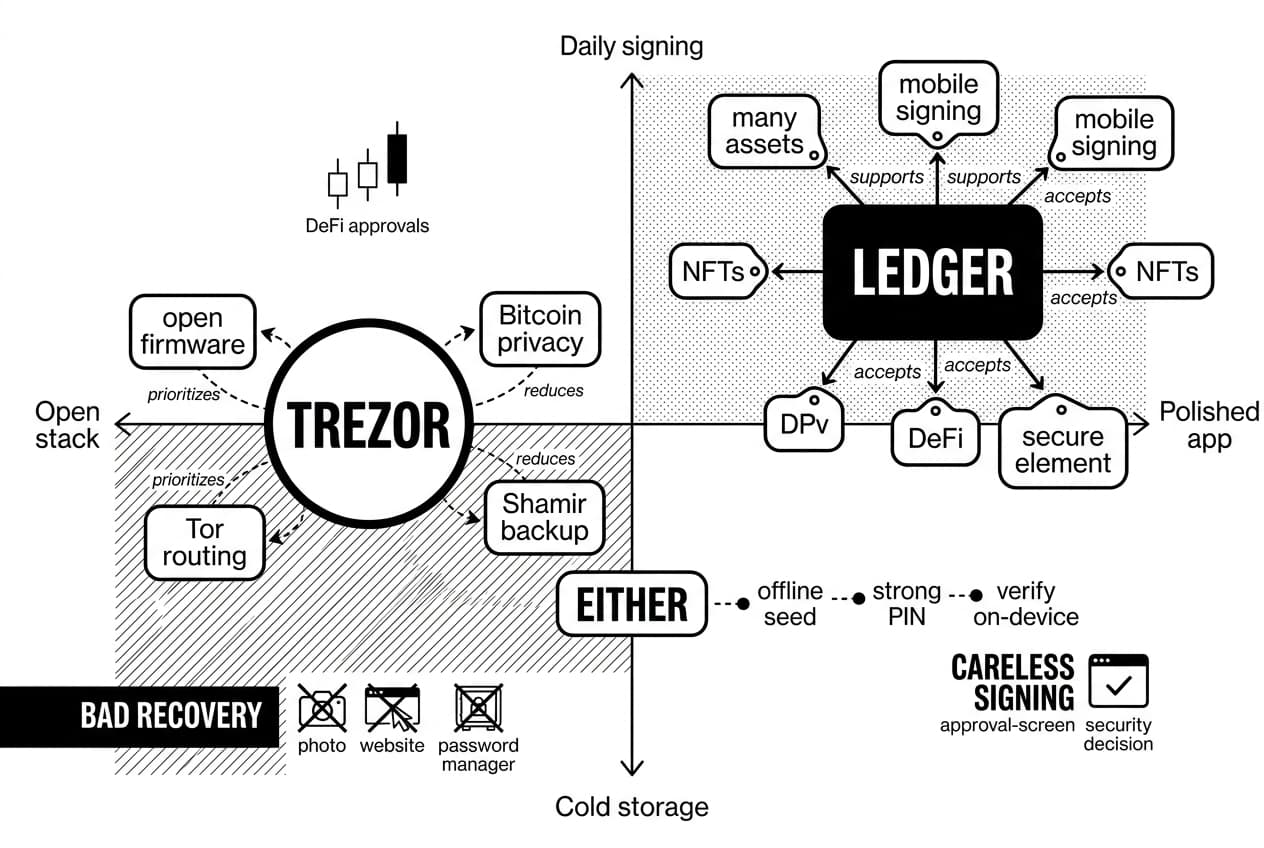
- Choose Ledger if... you hold many assets, need mobile signing, use NFTs or DeFi often, want a polished app and accept a partly closed secure-element trust model.
- Choose Ledger if... your main risk is daily friction that might push you back to an exchange or hot wallet.
- Choose Trezor if... you prioritize open firmware, Bitcoin privacy, Tor routing, Shamir backup and a more transparent software stack.
- Choose Trezor if... your main risk is recovery design, vendor trust or metadata leakage rather than mobile convenience.
- Choose either if... you only need simple cold storage and will protect the seed phrase offline, use a strong PIN and verify every transaction on-device.
Avoid both common mistakes
The first mistake is bad recovery storage. Never photograph the seed phrase, type it into a website or store it in a password manager unless you fully understand the risk model. The second mistake is careless signing. Treat every approval screen as a security decision, not a formality.
For high-value holdings, think beyond the device. A passphrase, multisig, estate planning and crypto insurance for digital assets may reduce risks that no hardware wallet can solve alone.
Frequently Asked Questions
- What crypto wallet is better than Ledger?
- No single wallet beats Ledger for every user. Trezor may suit those who prioritize open-source firmware and transparent design, while Tangem appeals to card-wallet fans and Coldcard to Bitcoin-only users. The right choice depends on your asset support needs, threat model and preferred signing habits.
- Is Ledger safe anymore?
- Ledger remains widely used and security-focused in 2026, but users should understand its secure element design, firmware trust assumptions and optional recovery services. Always buy directly from Ledger, keep firmware updated, protect your recovery phrase offline and verify every transaction on the device screen.
- What are the disadvantages of Trezor?
- Trezor has fewer convenience features than some Ledger models, a weaker mobile-first experience and occasional gaps in coin or chain support. Older Trezor models also carry physical attack concerns. The newer Trezor Safe series addresses several of these issues, so model choice matters significantly.
- Can my Trezor get hacked?
- Any hardware wallet can be compromised if the seed phrase is exposed, a malicious transaction is approved blindly or a skilled attacker gains physical device access. Trezor eliminates most remote attack vectors, but you still need a strong PIN, an optional passphrase and secure offline recovery phrase storage.
- Which crypto hardware wallet is best?
- The best wallet depends on your situation. Ledger suits broad coin support and mobile workflows; Trezor fits open-source transparency and straightforward cold storage; specialist wallets serve Bitcoin-only or card-based needs. Match the device to your specific assets, budget and day-to-day security habits rather than chasing a single top pick.
- Can Trezor hold XRP?
- XRP support on Trezor depends on the specific model and software integration available in 2026. Support levels can change with firmware and third-party wallet updates. If XRP is a core holding, verify current compatibility on Trezor's official coin support page before purchasing any device.
- Is Ledger still safe in 2026?
- Ledger can still be safe in 2026 when used correctly. Buy only from the official Ledger store, keep firmware current, store your recovery phrase securely offline and review every transaction carefully on-device. Be aware of closed-source firmware components and understand which optional services, like Ledger Recover, you choose to enable.
- Is Trezor better than Ledger?
- Trezor is better for users who value open-source transparency and straightforward self-custody. Ledger tends to be better for multi-chain support, mobile use and broader ecosystem integrations. Neither device wins outright. Evaluate both against your specific holdings, workflow and comfort level with each brand's security model.
- What is the most trusted crypto cold wallet?
- Ledger and Trezor are among the most established cold wallet brands, built on years of security research and large user bases. Ultimately, trust depends on the device's security model, update transparency, supply-chain controls and your own behavior. Always buy direct and practice disciplined seed phrase management regardless of brand.
Sources
Author

Crypto analyst and blockchain educator with over 8 years of experience in the digital asset space. Former fintech consultant at a major Wall Street firm turned full-time crypto journalist. Specializes in DeFi, tokenomics, and blockchain technology. His writing breaks down complex cryptocurrency concepts into actionable insights for both beginners and seasoned investors.