GPU Shortage & DePIN: How AI Startups Get Compute
What Is the GPU Shortage and Why Does It Still Hurt AI Startups in 2026?
Put simply, the GPU shortage is a gap between how many high-powered graphics processing units the world needs to build and run AI systems — and how few are actually available to buy or rent at a reasonable price.

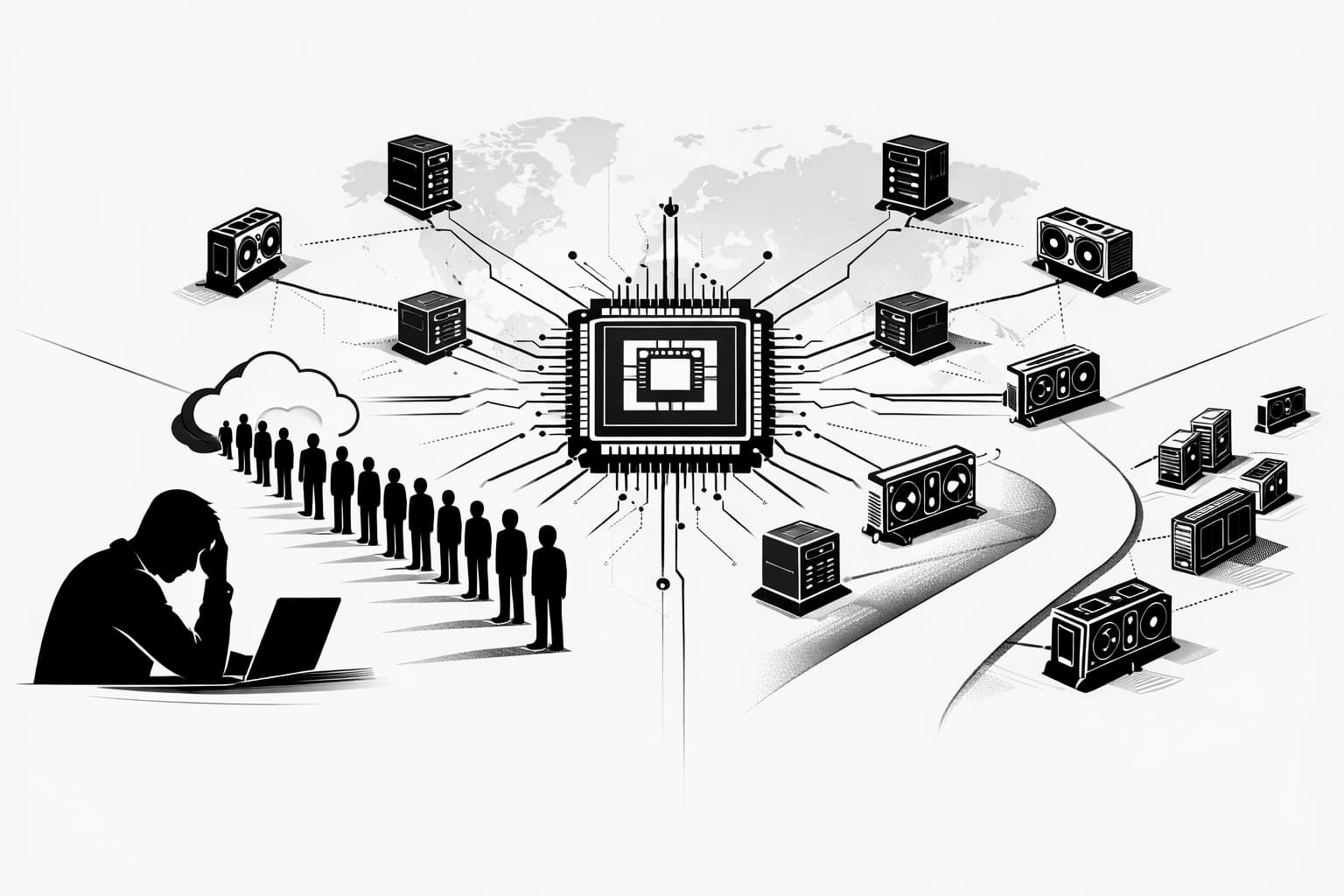
If you've spent any time trying to spin up a serious AI workload in the past two years, you already feel this in your gut. Maybe you joined a waitlist for NVIDIA H100 access that stretched six months into the future. Maybe your AWS GPU bill quietly doubled between quarters. Maybe you watched a well-funded competitor ship a product while your team was still waiting for compute. The shortage isn't an abstract supply-chain story — it's a real reason products launch late, burn rates spike, and promising startups quietly die.
The core demand driver is the AI inference explosion. Training large language models (LLMs) — the kind powering tools like GPT-4-class assistants — is GPU-hungry, but inference (actually running those models for end users at scale) is proving even more relentless in its appetite. Every chatbot query, image generation, and AI-powered API call needs GPU cycles. As inference workloads multiplied through 2024 and 2025, demand accelerated faster than any chip fab could respond. By early 2026, spot pricing for a single H100 on major cloud platforms regularly hit $8–$12 per hour, up from roughly $3 in 2023 — a price point that simply breaks the unit economics of most early-stage AI startups.
The Perfect Storm: Why Demand Outpaced Supply
Three forces collided to create this bottleneck. First, AI model training and inference workloads grew exponentially — not linearly. Second, TSMC, the Taiwanese foundry responsible for manufacturing NVIDIA's most advanced chips, operates at the physical limits of semiconductor fabrication. Adding meaningful new capacity takes years and billions of dollars. You can't just flip a switch and print more H100s.
Third — and this is the part that stings most for founders — hyperscalers like Microsoft, Google, and Amazon signed enormous, multi-year procurement deals with NVIDIA, effectively pre-booking the majority of available GPU supply. Think of it like every taxi in a city being contracted exclusively to five giant corporations before the app even opens to the public. Everyone else is left standing on the kerb, refreshing the screen.
Who Gets Hurt Most: SMEs vs. Hyperscalers
The inequality here is striking. AWS, Google Cloud, and Azure can absorb GPU supply at scale, negotiate preferential pricing, and pass costs on to customers. A startup, by contrast, faces quota limits — often capped at a handful of GPU instances regardless of how much they're willing to pay — alongside spot-instance volatility that can interrupt a training run without warning.
The cost gap compounds the problem. A hyperscaler running thousands of GPUs in-house pays a fraction of what a startup pays renting equivalent compute on-demand. Independent developers and small AI teams often end up choosing between an unaffordable cloud bill and an indefinite waitlist for dedicated hardware. Neither option moves a product forward.
- Key Takeaway 1: The GPU shortage is driven by exploding AI inference demand hitting a fabrication supply ceiling — a gap that won't close quickly.
- Key Takeaway 2: H100 spot prices have tripled since 2023, directly threatening the unit economics of AI startups.
- Key Takeaway 3: Bulk purchasing by hyperscalers locks smaller players out of the market at the source, not just at the price level.
- Key Takeaway 4: The result for founders is a painful trio: delayed launches, unpredictable costs, and an uneven playing field that favours the already-large.
What Is DePIN? A Plain-English Primer
DePIN (Decentralized Physical Infrastructure Network) is a blockchain-based system that lets individuals and businesses share real-world hardware — GPUs, storage drives, antennas — with anyone who needs it, coordinated automatically by software and rewarded with cryptocurrency tokens. No single company owns the network; thousands of hardware contributors run it together.
If you've just spent three weeks on a cloud provider's waitlist, that definition probably sounds pretty appealing. But let's slow down and build a clear picture of how this actually works in practice — because "blockchain-coordinated GPU sharing" can sound like buzzword soup until you see the mechanics underneath it.
The easiest way to understand DePIN is through an analogy you already know. Think of it as Airbnb for GPUs. Before Airbnb, spare bedrooms sat empty while hotels were fully booked. The platform created a marketplace that connected idle rooms with travelers who needed them — without Airbnb owning a single bed. DePIN does the same thing for computing power. Right now, there are GPUs sitting underused in university research labs, crypto mining facilities winding down operations, and high-end gaming rigs that run flat-out for six hours a day and idle for the other eighteen. DePIN networks unlock that dormant capacity and route it to AI startups that desperately need it. For a deeper background on the concept, What is DePIN is a solid place to start.
From Physical Hardware to Decentralized Network: How It Works
The architecture behind a DePIN compute network breaks down into three clean layers. Walking through them step by step makes the whole thing click.
- Hardware providers connect their GPUs. A data center operator, a university IT department, or even an individual with a high-end NVIDIA card installs lightweight software that registers their hardware with the network. This software monitors availability, benchmarks performance, and signals when the GPU is ready to take jobs. The owner sets a price — say, $0.40 per GPU-hour — and the network lists it.
- A blockchain protocol handles matching and payment. When an AI startup submits a compute job, the protocol automatically matches it to available hardware that meets the specs — the right GPU memory, the right location, the right price. A smart contract (think of it as a self-executing agreement written in code) locks the payment in escrow, releases funds to the hardware provider once the job completes, and logs everything transparently on-chain. No invoices, no net-30 payment terms, no account managers.
- AI developers access compute on demand. From the developer's perspective, the experience looks a lot like a standard cloud API. They submit a training job, specify their requirements, and get results back. The decentralized machinery underneath is largely invisible — which is exactly how it should be.
The blockchain layer is what makes this coordination trustless. Neither the GPU owner nor the AI startup has to trust the other person — they both trust the code. That distinction matters enormously when you're dealing with strangers across dozens of countries.
A Brief History: How DePIN Compute Emerged
The idea of decentralizing physical infrastructure didn't start with GPUs. The earliest experiments, around 2017 and 2018, focused on storage. Projects like Filecoin and Storj proved that you could coordinate thousands of independent hard drives into a coherent storage network using token incentives. If people would share disk space for tokens, the thinking went, why not other hardware?
The leap to GPU compute was slower, mainly because coordinating computation is technically harder than coordinating storage. A training job has strict latency requirements. You can't have a packet traveling from Singapore to São Paulo mid-epoch without consequences. Early GPU networks struggled with these performance constraints.
That changed meaningfully between 2022 and 2024. Two things happened at once. First, the AI boom created explosive demand for GPU compute — demand that centralized providers simply couldn't satisfy fast enough. Second, blockchain infrastructure matured. Solana's high-speed blockchain, capable of processing thousands of transactions per second with sub-second finality, gave developers the low-latency coordination layer that GPU compute networks actually needed. Networks like Render, Akash, and io.net emerged in this window, each taking somewhat different architectural approaches but all riding the same wave of unmet demand.
By 2025 and into 2026, the gpu shortage depin conversation had moved from niche crypto forums into mainstream AI founder circles — a sign that the technology had crossed from interesting experiment to genuine operational tool.
- DePIN networks pool idle, privately-owned hardware — GPUs, storage, bandwidth — into shared infrastructure anyone can access.
- Three layers do the work: hardware providers, a blockchain coordination protocol, and a developer-facing compute interface.
- Smart contracts replace trust — payments are automatic, transparent, and don't require a middleman.
- The model evolved from decentralized storage (Filecoin, Storj) before maturing into GPU compute networks between 2022 and 2026.
- For AI startups, the Airbnb analogy holds: DePIN unlocks capacity that already exists but has been sitting idle, routing it to the teams who need it most.
How DePIN Solves the Decentralized GPU Shortage: The Mechanics
Now that you understand what DePIN is, let's get into exactly how it works — because the mechanics are where this gets genuinely interesting for any founder sitting on a cloud waitlist right now.
Think of a DePIN compute network like a global freelance marketplace — except the contracts are self-executing and the payments are instant. No account managers, no approval queues, no billing surprises at the end of the month. A smart contract (a piece of code living on a blockchain that runs automatically when conditions are met) handles the entire transaction: matching you with a provider, holding payment in escrow, and releasing funds only after your job is verified complete. To understand how blockchain coordinates decentralized networks like this at a deeper level, it's worth seeing the underlying plumbing — but for now, just know the system doesn't need anyone in the middle to function.
Compute Marketplaces: Matching Supply and Demand On-Chain
Here's how a typical transaction plays out. A GPU provider — say, a data center in Warsaw with 40 idle H100s — lists their capacity on the network. They publish specs (GPU model, VRAM, bandwidth), availability windows, and a price per compute hour. On the other side, you submit a job request: the model size, expected runtime, and the maximum price you'll pay.
The smart contract matches these automatically, locks your payment in escrow within seconds, and spins up your workload. Compare that to a traditional cloud provider, where provisioning a reserved GPU instance can take days of approval, a sales call, and a six-month commitment. The on-chain marketplace collapses that to minutes.
Verification and Trust: How the Network Ensures You Get What You Pay For
The obvious concern is: how do you know the provider actually ran your job on the hardware they claimed? This is where proof-of-compute mechanisms come in. Networks like Render and Akash use cryptographic verification — mathematical fingerprints of the computation output — to confirm that real GPU work was performed. Some networks use challenge-response protocols, randomly sampling portions of a job and asking the provider to reproduce results.
Without this, decentralized compute would be a bad Craigslist deal waiting to happen. With it, the network becomes trustworthy enough for production AI workloads — which is exactly what makes the difference between a toy project and a real infrastructure layer.
Inference Workloads: The Killer Use Case for DePIN GPU Networks
In 2026, the workload DePIN networks are best suited for is AI inference — that's the process of running a trained model to actually generate outputs, like answering a question or generating an image. Training a model from scratch is a different beast: it requires tightly coordinated clusters, ultra-low latency between GPUs, and weeks of uninterrupted compute time.
Inference is friendlier. A single request can be handled by one GPU, results don't depend on millisecond synchronization across machines, and short bursts of compute are perfectly fine. That maps almost perfectly onto what a distributed network of independent providers can offer. If your startup is serving a language model API, running image generation, or processing batch predictions, DePIN networks are already a credible option — not a compromise.
- Smart contracts replace middlemen: Job matching, escrow, and payment happen automatically on-chain, cutting provisioning from days to minutes.
- Proof-of-compute builds trust: Cryptographic verification ensures providers actually deliver the GPU resources they promise.
- Inference is the sweet spot: Parallelizable, latency-tolerant inference workloads fit naturally onto distributed, independent GPU providers.
- The marketplace model is two-sided: Providers earn yield on idle hardware; buyers get access without long-term commitments or waitlists.
The Market Leaders: Four DePIN Compute Architectures AI Startups Should Know
Not all decentralized GPU networks are built the same — they differ in architecture, target workloads, cost structure, and maturity. Think of this section as a practical menu, not a product pitch. The goal is to help you match the right network to your actual use case, whether that's running inference on a fine-tuned language model or spinning up a distributed training cluster.
Here's a quick comparison table to anchor the discussion before we go deeper:
Platform | Chain | Token | Best For | Est. Cost vs. AWS |
|---|---|---|---|---|
Akash Network | Cosmos | AKT | Containerized AI inference, API hosting | 50–80% cheaper than EC2 GPU instances |
io.net | Solana | IO | ML training clusters, batch jobs | 40–90% cheaper depending on GPU tier |
Render Network | Solana | RENDER | Generative AI inference, image models | 30–60% cheaper for rendering workloads |
Nosana | Solana | NOS | CI/CD pipelines, smaller AI inference jobs | Up to 85% cheaper for short burst jobs |
Akash Network: The Open-Source Cloud Marketplace
Akash runs on a reverse-auction model — instead of you paying a fixed price posted by AWS, providers compete for your job by bidding down. You post what you need (GPU type, RAM, storage, duration), and suppliers undercut each other to win your deployment. It's the cloud equivalent of a contractor bidding on a renovation job, except the whole process takes about 30 seconds.
The network is built on the Cosmos SDK, which gives it a fast, sovereign blockchain that doesn't share congestion with Ethereum. Payments and governance flow through the AKT token. Deployments run inside standard Docker containers, which means if your AI inference stack already runs in a container locally — and it probably does — porting to Akash is genuinely straightforward.
For containerized AI inference workloads specifically, Akash shines. Startups hosting open-source LLM endpoints like Mistral or LLaMA derivatives have reported cutting costs by 50 to 80 percent compared to equivalent AWS EC2 GPU instances (p3 or g4 families). The tradeoff is that enterprise SLAs don't exist here — uptime depends on individual providers, so Akash works best when your architecture tolerates some redundancy management on your end.
io.net: Aggregating the Long Tail of GPU Capacity
io.net takes a different approach. Rather than building a marketplace of dedicated data centers, it acts more like a GPU aggregator — pulling in spare capacity from crypto mining operations, independent data centers, and even consumer gaming rigs, then presenting all of it as a unified compute layer your application can treat as one big cluster.
The coordination layer runs on Solana, chosen for its high transaction throughput and low fees — important when you're orchestrating thousands of micro-payments between distributed nodes. The native token is IO, used to pay for compute and reward suppliers.
Where io.net earns its place is ML training clusters. It supports spinning up multi-GPU groups across geographically distributed nodes, which makes it practical for distributed training jobs that don't require the ultra-low latency of a single physical rack. If you're fine-tuning a mid-sized model and flexibility matters more than raw interconnect speed, io.net is worth serious consideration. Cost savings of 40 to 90 percent versus AWS are realistic, with the range reflecting how exotic your GPU requirements are.
Render Network: GPU Compute for AI and Creative Workloads
Render started its life in the 3D rendering industry — artists and studios would rent idle GPU cycles from node operators to render frames overnight. That origin story matters because it means Render's node network was optimized early for parallel, embarrassingly distributed workloads, which turns out to map surprisingly well onto generative AI inference.
Since 2024, Render has deliberately expanded toward AI, rebranding its token from RNDR to RENDER as part of a broader architectural upgrade. Its node network suits image model inference particularly well — think Stable Diffusion variants, ControlNet pipelines, and video generation tasks. If your product involves generating visual media at scale, Render's existing ecosystem of GPU-equipped creative nodes gives it a natural fit that pure-compute networks lack.
One emerging network worth watching alongside these three is Nosana, which targets a slightly different niche: short-burst CI/CD and smaller inference jobs on Solana, with cost savings reportedly reaching 85 percent for lightweight, time-sensitive tasks. It's earlier-stage than the others but worth bookmarking if your workloads are sporadic rather than continuous.
The honest summary? None of these networks is a drop-in replacement for AWS in every scenario. But for the right workloads, they represent a genuinely different cost structure — one that can mean the difference between a startup being able to afford production-grade GPU compute or not. The next section covers how to evaluate which fits your specific stack.
Token Economics: The Incentive Layer That Makes DePIN Work
Token economics, at its simplest, is the system of financial rewards and rules that motivates people to contribute resources to a network — and in DePIN compute, it's what convinces GPU owners to plug in before there's a crowd of buyers waiting.

Think about the classic chicken-and-egg problem every marketplace faces. Airbnb needed hosts before it could attract guests, but why would a host list their spare room if no guests existed yet? DePIN networks solve this with a clever workaround: they pay providers in tokens just for showing up and staying reliable, even when demand is thin. Early GPU contributors earn rewards simply for being part of the network — demand fills in later. It's a bit like a new coffee shop paying baristas competitive wages on day one, even before the morning rush materializes.
If you want to go deeper on how these systems are designed from the ground up, the study of token economics and incentive design is worth your time — it explains why some networks sustain themselves long-term and others collapse.
How Providers Earn: Staking, Rewards, and Payment Flows
Let's walk through a concrete example. Imagine a small data center operator — call her Maya — who has 10 NVIDIA A100s sitting at 40% utilization. She connects them to a DePIN compute network. Here's what happens, step by step:
- Onboarding and staking. Maya deposits (stakes) 5,000 network tokens as collateral. Staking is essentially a security deposit — it signals she's serious, and she loses a portion if her GPUs go offline unexpectedly. Think of it like a landlord putting down a bond before listing on a rental platform.
- Earning base rewards. Just for keeping her GPUs online and passing uptime checks, the protocol mints and distributes token rewards to her daily — roughly 12 tokens per GPU per day at current emission rates, or about 120 tokens daily for her full fleet.
- Earning compute fees. When an AI startup rents her A100s to train a model, they pay in the network token (or, on many platforms, in USDC stablecoin). Maya earns, say, $2.10 per GPU-hour — competitive with mid-tier cloud pricing but with lower overhead since she owns the hardware outright.
- Converting to cash. Maya swaps her earned tokens to USDC on a decentralized exchange, or holds them if she expects the token price to rise. Either way, she has real flexibility.
From a buyer's perspective — an AI startup renting those A100s — the process mirrors booking cloud compute, except the counterparty is Maya's data center rather than AWS. The network's smart contracts handle payment escrow, uptime verification, and dispute resolution automatically.
What Token Volatility Means for Your Compute Budget
Here's where it's worth being honest: token prices move. A lot. If you budget $10,000 worth of compute at Monday's token price and the token drops 30% by Thursday, your purchasing power just shrank — even if the underlying GPU cost didn't change. For a scrappy startup modeling burn rate carefully, that uncertainty is a real headache.
The good news is that the market has responded. Most mature DePIN compute platforms now offer stablecoin payment rails — you pay in USDC or USDT and never touch the volatile token at all. Some platforms, targeting enterprise clients, go further with fixed-rate compute contracts: you lock in a price for 30 or 90 days, similar to a reserved instance on AWS. Render Network and Akash both support stablecoin settlement as of 2026, which removes most of the volatility risk for buyers.
The token volatility issue matters more on the provider side — GPU operators who hold tokens hoping for appreciation are taking on speculative risk. If you're curious whether that risk comes with upside opportunities like early network rewards, it's worth reading about DePIN token airdrops in 2026, which some providers have used to meaningfully offset hardware costs.
For most AI founders, the practical takeaway is simple: pay in stablecoins, plan around fixed-rate options where available, and treat token rewards as a provider's concern rather than yours. The incentive layer exists to keep GPU supply healthy — you just need to access that supply at a predictable price.
- Tokens solve the cold-start problem by rewarding GPU providers before organic demand fills the network.
- Staking acts as a reliability bond — providers with skin in the game are less likely to drop offline mid-job.
- Buyers can avoid token volatility entirely by using stablecoin payment options available on most major platforms.
- Fixed-rate contracts on some networks bring compute budgeting closer to the predictability of traditional cloud pricing.
- Token emissions fund early supply growth — which is ultimately what makes more GPU capacity available to you as a buyer.
DePIN by the Numbers: Market Growth and Real-World Traction in 2026
It's easy to dismiss any emerging technology as "theoretical" until the data tells a different story. By 2026, DePIN compute networks have crossed a threshold that matters: real startups are running real workloads on them, at scale, every single day.
The numbers are hard to ignore. The decentralized physical infrastructure market — of which GPU compute is the fastest-growing segment — is projected to exceed $3.5 billion in active network value in 2026, per Fortune Business Insights sector tracking. Leading DePIN compute networks collectively report delivering over 40 million GPU hours per month to paying developers. Active node counts across the top four networks have grown from tens of thousands in 2024 to well over 200,000 globally. Developer wallet registrations on these platforms grew roughly 3x year-over-year between 2024 and 2026 — a signal that adoption is moving beyond crypto-native experimenters into mainstream engineering teams.
The 2026 AI Inference Explosion: Why Timing Matters
Here's the shift that changed everything. Between 2022 and 2024, most GPU demand was concentrated in a single, intensive phase: training large models. That's an expensive, one-time sprint — you rent a cluster of A100s for weeks, train your model, and you're done. Centralized clouds were reasonably equipped to handle that kind of predictable, bulk demand.
But 2026 looks completely different. The training phase for most foundation models is largely complete. The new challenge is inference — actually running those models in production, answering millions of user queries per day, continuously, around the clock. Inference demand is distributed, persistent, and geographically spread out. A user in Lagos, a startup in Lisbon, and an app in Manila all need GPU cycles simultaneously, not in one big batch.
Centralized clouds struggle with this structurally. Serving globally distributed inference traffic through a handful of hyperscaler data centers creates latency, and pricing those workloads profitably at smaller scales remains awkward for the big providers. DePIN networks, by contrast, are built around distributed supply meeting distributed demand — which is exactly why the inference explosion didn't just benefit DePIN, it accelerated it from a niche option into a genuine infrastructure category.
- Market size: DePIN compute is on track to surpass $3.5B in network value in 2026
- Scale: 40M+ GPU hours delivered monthly across leading networks
- Supply: Over 200,000 active nodes globally, up dramatically from 2024
- Developer adoption: 3x year-over-year growth in registered developer accounts
- Key catalyst: The shift from training to mass inference deployment created exactly the kind of distributed, persistent demand that DePIN architectures are built to serve
The Hyperscaler Counterargument: Where Centralized Cloud Still Wins
Here's the honest truth that most DePIN advocates won't tell you: AWS, Google Cloud, and Azure are still the right answer for certain workloads — and knowing which ones will save you real pain down the road.
Think of it like choosing between a hotel and an Airbnb. Airbnb is often cheaper and more interesting, but if you're flying in for a critical board meeting and need a guaranteed room with 24/7 concierge service, you book the Marriott. No questions asked. Centralized cloud is your Marriott.
Specifically, the hyperscalers hold meaningful advantages in four areas. Enterprise SLAs — legally binding uptime guarantees of 99.99% — are simply not something decentralized networks can promise today, because no single entity controls enough nodes to make that commitment. Compliance certifications like SOC 2 Type II and HIPAA are baked into AWS and Azure's infrastructure, which matters enormously if you're handling medical records, financial data, or anything touched by GDPR. Ultra-low latency for real-time applications — think sub-50ms inference for a live voice assistant — is easier to guarantee when your compute sits in a single, well-optimized data center. And the integrated ML toolchains (SageMaker, Vertex AI, Azure ML) offer managed pipelines that a scrappy startup can ship to production faster than building on raw DePIN infrastructure.
When to Use DePIN vs. Traditional Cloud: A Practical Decision Framework
The good news is the decision doesn't have to be agonizing. A simple mental model helps:
Use DePIN when:
- Running cost-sensitive inference, overnight batch processing, or model fine-tuning experiments
- Your workload can tolerate a job failing and retrying without major consequences
- You need GPU access quickly without a long-term commitment or sales call
- You want to cut costs by 60–80% on non-customer-facing compute
Use centralized cloud when:
- Running customer-facing production APIs with strict latency budgets
- Handling data regulated under HIPAA, GDPR, or financial compliance frameworks
- Your workload contractually requires guaranteed uptime and enterprise SLAs
- You need deep integration with managed ML toolchains like SageMaker or Vertex AI
Many mature AI startups in 2026 run experimentation and batch inference on DePIN networks while keeping their customer-critical prediction endpoints on AWS or GCP. You get the savings where it's safe and the reliability where it counts. Treating these tools as opponents is the wrong frame. The smartest founders use them as complements — and understanding that distinction is what separates strategic infrastructure decisions from expensive mistakes.
Key Challenges Before DePIN Compute Goes Mainstream
DePIN compute is genuinely promising — but honest teachers show you the full picture, not just the highlights reel. Before you redirect your infrastructure budget, you should understand the real friction points that the most enthusiastic project whitepapers tend to skip past.
Start with hardware heterogeneity. A centralized cloud like AWS runs tightly controlled, uniform server fleets. A DePIN network is more like a potluck dinner — someone brings an RTX 4090, someone else shows up with an A100, and another contributor has a half-retired gaming rig from 2022. Scheduling a distributed AI training job across that mixed bag is genuinely hard. Matching the right workload to the right hardware, minimizing transfer overhead, and avoiding failed jobs mid-run requires sophisticated orchestration that most DePIN networks are still maturing.
Developer tooling is another honest gap. If you've ever spun up a GPU instance on AWS, you know the experience is polished. DePIN equivalents often require more manual configuration, custom SDKs, and tolerance for rough edges. That's improving fast, but it's real friction for a founder who just wants to ship.
Then there's regulatory uncertainty. Paying for compute with protocol tokens introduces questions around accounting treatment, cross-border payments, and tax classification that your CFO will absolutely ask about.
Reliability, SLAs, and the Trust Gap
Enterprise cloud providers offer Service Level Agreements — legally backed uptime guarantees, typically 99.9% or higher, with financial penalties if they miss the mark. Most DePIN networks can't make that promise today. A provider's node can go offline, a consumer-grade internet connection can drop, and your job simply fails.
The better DePIN projects are attacking this directly. Staking-based slashing is the most common mechanism — providers lock up tokens as collateral, and if their node underperforms or goes dark mid-job, a portion of that stake is automatically forfeited. It's a financial skin-in-the-game model that replaces the legal contract with economic incentive. Think of it like a security deposit that gets burned, not just returned.
Alongside slashing, leading networks are building redundant job routing — automatically re-assigning a failing workload to a backup node before you even notice the hiccup. It's the DePIN equivalent of how airlines overbook seats, except when someone drops out, the system quietly finds you another seat in seconds.
The trust gap is closing, but it hasn't closed yet. For batch inference or experimental training runs, today's reliability is often good enough. For production workloads where downtime costs real money, most teams should maintain a hybrid setup until these guarantees mature.
What This Means for AI Developers and Startup Founders
After all the architecture diagrams and token economics, here's the bottom line for your compute strategy: DePIN isn't a silver bullet, but it's a genuinely useful tool — especially when the big cloud providers have you stuck on a waitlist.
Think of it this way. You wouldn't run your entire business out of an Airbnb rental, but if every hotel in the city is fully booked and you need a place to sleep tonight, Airbnb solves your immediate problem. That's exactly the role DePIN compute fills for depin gpu ai startups right now — a flexible, accessible alternative when centralized supply runs dry. Many founders are discovering that a hybrid approach works best: AWS or GCP for latency-sensitive production inference, DePIN for training runs, experimentation, and cost-sensitive batch jobs.
If you want a deeper breakdown of provider comparisons and pricing benchmarks, the DePIN GPU guide for AI startups is worth bookmarking as a reference alongside this article.
How to Get Started: Your First DePIN Compute Job
Getting your first job running on a decentralized network is simpler than it sounds. Follow these four steps:
- Choose a network based on your workload. Need raw GPU hours for a training run? Look at io.net or Akash. Running inference at scale? Render Network or Nosana may suit you better. Match the network's specialty to your actual use case.
- Set up a compatible wallet. Most DePIN marketplaces require a Web3 wallet to handle token payments. If you've never done this before, set up a compatible crypto wallet before you try to spin up a job — it takes about ten minutes and will save you frustration later.
- Submit your compute job. Every major network offers either a web-based marketplace UI or a developer API. Upload your container or model checkpoint, specify GPU type and duration, and place your order. It's closer to a cloud console than you might expect.
- Monitor output and cost in real time. Watch your job logs, track token spend against your budget, and compare results against your baseline. Start small — a single short training run — before committing larger workloads.
Starting small is genuinely the right call. DePIN compute rewards founders who treat it as an experiment first and a core infrastructure decision second.
- Start with non-critical workloads — batch jobs, fine-tuning experiments, and dev environments are ideal first candidates.
- Evaluate providers on reliability metrics, not just token price — uptime guarantees and job completion rates matter more than raw cost per hour.
- Treat DePIN as a complement to centralized cloud, not a replacement — the two work better together than either does alone.
- Watch the token economics of whichever network you choose — a network whose token is inflating rapidly may cost more in six months than it does today.
Key Takeaways
- GPU shortage DePIN is a real fix: decentralized networks tap idle hardware worldwide to give AI startups genuine GPU access without cloud waitlists.
- Token incentives drive supply: GPU owners earn crypto rewards, creating a self-sustaining marketplace that grows as demand grows.
- Cost savings are significant: DePIN compute regularly runs 50–80% cheaper than AWS or Azure for compatible AI workloads.
- Limitations are real and honest: sensitive data, strict compliance requirements, and latency-critical inference still favor centralized cloud.
- Start hybrid: route experimental and training workloads to DePIN now, while keeping production-critical jobs on hyperscalers until reliability matures.
The road ahead looks encouraging. Through 2026 and into 2027, expect DePIN compute networks to close the reliability gap — better uptime guarantees, confidential computing support, and deeper integration with mainstream ML toolchains are all actively in development. The decentralized GPU shortage solution is not a distant theory; it is already running training jobs for real startups today. The founders who learn the field early, experiment thoughtfully, and build a hybrid compute strategy will be the ones who ship faster and spend smarter when the next wave of AI demand hits.
Frequently Asked Questions
- Has the GPU shortage ended?
- Consumer GPU supply has largely normalized, but enterprise-grade AI chips — NVIDIA H100, A100, and H200 — remain tightly constrained in 2026 due to relentless AI training and inference demand. DePIN networks offer a practical workaround by unlocking underutilized existing hardware capacity rather than depending on new supply reaching the market.
- What is causing the GPU shortage?
- Three forces are driving the crunch: explosive demand for AI model training and inference workloads, semiconductor fabrication bottlenecks at TSMC and Samsung limiting chip output, and hyperscalers like Microsoft, Google, and Amazon securing bulk purchasing agreements that lock up supply years in advance. Together, these factors price out and exclude most AI startups from the market.
- Will there be a GPU shortage in 2026?
- Yes — high-end AI GPU scarcity persists well into 2026, largely driven by the inference scaling wave as more companies deploy production AI applications. DePIN compute networks and secondary GPU markets are emerging as realistic mitigation strategies for startups that cannot secure hyperscaler cloud quotas or afford reserved instance pricing.
- What GPUs are most affected by shortages?
- NVIDIA's H100, H200, and A100 data center GPUs are the most severely constrained due to concentrated AI workload demand. Consumer cards like the RTX 4090 are far more accessible. DePIN networks strategically aggregate these consumer-grade GPUs across thousands of contributors, building meaningful collective compute capacity that rivals smaller cloud configurations.
- Is there a global GPU shortage?
- The shortage is global but uneven, concentrated specifically in data-center-grade AI chips rather than consumer hardware. Geographic concentration of advanced chip manufacturing in Taiwan adds significant supply chain risk. DePIN addresses this structurally by distributing compute demand across globally dispersed hardware providers, reducing dependence on any single region or supplier.
- Why are GPUs so hard to get now?
- Simply put, AI demand grew far faster than chip fabrication plants can physically scale. Hyperscalers reserved capacity years ahead, shutting out smaller buyers. Each new model generation also requires dramatically more compute than the last. For startups, DePIN compute marketplaces represent one of the few structural solutions that doesn't require enterprise-scale purchasing power.
Sources
Author

Crypto analyst and blockchain educator with over 8 years of experience in the digital asset space. Former fintech consultant at a major Wall Street firm turned full-time crypto journalist. Specializes in DeFi, tokenomics, and blockchain technology. His writing breaks down complex cryptocurrency concepts into actionable insights for both beginners and seasoned investors.