FOMC Bitcoin: How Fed Meetings Impact Crypto Prices in 2026
Introduction: What the FOMC Means for Your Bitcoin
Simply put, the decisions made in Federal Open Market Committee (FOMC) meetings directly impact the price of Bitcoin by changing how attractive it is to hold riskier assets versus saving cash.
So, why should a crypto investor care about a group of economists in Washington D.C.? Because understanding these meetings gives you a map to understand Bitcoin's volatility. When the FOMC raises interest rates, borrowing money becomes more expensive, and safer investments like bonds look more appealing. This often leads investors to sell off assets they see as risky, including Bitcoin. Conversely, when rates are cut, investors may seek higher returns elsewhere, pushing money into the crypto markets. Watching the relationship between the fomc bitcoin price action helps you move from simply reacting to market swings to anticipating them, making you a much more informed investor.
What Is the FOMC and What Does It Do?
The Federal Open Market Committee (FOMC) is the branch of the U.S. Federal Reserve that determines the direction of monetary policy, which directly impacts Bitcoin and crypto markets by influencing interest rates and market liquidity.
Think of the FOMC as the economy's thermostat operator. If the economy is running too "hot" with high inflation, the committee can raise interest rates to cool things down. If it's too "cold" with slow growth, they can lower rates to encourage spending and investment. These adjustments change how expensive it is to borrow money across the entire financial system. These ripples inevitably reach all assets, and understanding the relationship between the fomc bitcoin price action is the first step for any serious crypto investor.
The Fed's Dual Mandate: Price Stability and Employment
The FOMC's decisions are guided by two primary goals set by Congress, known as the "dual mandate." First, they aim for price stability, which means keeping inflation under control so your money holds its value. Second, they strive for maximum employment, creating conditions where people who want a job can find one. These two goals can sometimes be in conflict, and the committee's work is a constant balancing act between them.
FOMC Meeting Schedule: Key Dates for Crypto Traders
The committee holds eight regularly scheduled meetings each year, about every six weeks. These dates are circled on the calendars of traders worldwide. The post-meeting announcement, where the Fed chair explains their decisions and outlook, can trigger significant price swings in stocks, bonds, and yes, even Bitcoin. For this reason, these meetings have become must-watch events for the crypto community, as the outcomes often set the market's tone for weeks to come.
The Core Connection: Interest Rates and Risk-On Assets
At its heart, the connection between FOMC decisions and Bitcoin's price is about the cost of money. When borrowing money is cheap, investors are more willing to take chances on assets with higher potential rewards. When money becomes expensive, they tend to retreat to safety. This simple push-and-pull dynamic explains a great deal about the market's reactions.
Understanding this relationship helps you see that the link between **fomc bitcoin** price action isn't random. It’s a logical response to major shifts in the financial weather. When the Fed adjusts interest rates, it changes the incentives for every investor, from the largest hedge fund down to the individual retail buyer. These changed incentives ripple through every market, including crypto.
Understanding Liquidity's Role
When the FOMC lowers interest rates, it's like turning on a faucet for the entire economy. Suddenly, it’s cheaper for businesses to take out loans to expand and for individuals to get mortgages or finance big purchases. This injects more cash into the system, a concept economists call liquidity. Think of liquidity as the total amount of money sloshing around, looking for a home.
Where does all that new money go? Some of it finds its way into riskier investments that promise higher returns than a simple savings account. This includes tech stocks, venture capital, and, of course, digital assets like Bitcoin. An increase in liquidity often leads to asset price inflation because there is simply more money chasing the same number of assets. This is a primary reason why periods of low interest rates have historically been bullish for Bitcoin.
Bitcoin as a 'Risk-On' Asset
In traditional finance, investments are often categorized as either "risk-on" or "risk-off." A risk-on asset is one that performs well when investors are optimistic and willing to take chances for higher growth. Think of tech stocks or emerging market equities. A "risk-off" asset is a safe haven, like U.S. Treasury bonds, where investors park their money when they are fearful.
From the perspective of institutional capital, Bitcoin is definitively a risk-on asset. It is known for its volatility and its potential for explosive growth, but it doesn't provide a steady income stream like a bond's interest payment. When the FOMC raises rates, those "safe" government bonds suddenly become much more attractive. Why gamble on Bitcoin's unpredictable price when you can get a guaranteed return from a bond? This prompts a flow of capital away from riskier assets and into safer ones, putting downward pressure on Bitcoin's price as it responds to these broader macroeconomic conditions.
Hawkish vs. Dovish: Decoding the Fed's Language
While the actual interest rate decision makes headlines, experienced traders know the real action often happens in the press conference that follows. The key isn't just what the FOMC decides, but how they talk about the economy's future. This communication style is often categorized into two distinct tones: hawkish and dovish.
Think of it like this: a "hawk" is a bird of prey, aggressive and focused on hunting down inflation. A hawkish Fed is primarily concerned with rising prices and will favor higher interest rates and tighter financial conditions to cool down the economy. On the other hand, a "dove" is a symbol of peace, focused on nurturing growth. A dovish Fed is more worried about unemployment and slow growth, so it will favor lower interest rates to encourage borrowing and stimulate the economy.
The market often anticipates the rate decision itself, meaning it's already "priced in." The real volatility comes from the clues about future policy dropped in the official statement and the Fed Chair's answers to reporters. A subtle change in wording can signal a shift in thinking, causing investors to rapidly reassess the economic outlook. This interpretation of the Fed's stance—and the potential for future rate changes—is what often sends assets like Bitcoin moving sharply after an FOMC meeting.
Hawkish Stance | Dovish Stance |
|---|---|
Primary concern: Fighting inflation Favors higher interest rates Aims to slow down an overheating economy Willing to risk slower growth to control prices Generally bearish for Bitcoin | Primary concern: Promoting growth & employment Favors lower interest rates Aims to stimulate a sluggish economy Willing to tolerate some inflation for job growth Generally bullish for Bitcoin |
Ultimately, decoding the Fed’s message is about reading between the lines. The market's reaction to an fomc bitcoin event is often less about the current decision and more about the story the Fed tells about the road ahead. An unexpectedly hawkish tone can pull liquidity from the market and be a headwind for Bitcoin, while a surprisingly dovish outlook can signal easier financial conditions, often providing a tailwind for its price.
Historical FOMC Announcements and Bitcoin's Reaction
Theory is one thing, but seeing how these economic forces play out in the real world makes the connection much clearer. By looking at a few key moments in recent history, we can observe the direct cause-and-effect relationship between the Fed's decisions and the crypto market's response. The data shows a powerful link between fomc bitcoin price movements.
One of the most striking examples was the aggressive rate-hiking cycle that began in March 2022. With inflation running at multi-decade highs, the FOMC took a decidedly hawkish stance, raising interest rates at a rapid pace. This made holding cash in a high-yield savings account or buying government bonds far more attractive than speculating on riskier assets. For Bitcoin, the effect was profound. As higher rates squeezed liquidity from the financial system, capital flowed out of crypto, triggering a deep and prolonged bear market that lasted for much of the year.
In contrast, a shift in tone can have the opposite effect. In late 2023, after a long period of hikes, Fed officials began to signal that they might be finished raising rates. This hint of a "dovish pivot" was all the market needed. Even though rates weren't cut immediately, the mere expectation of looser financial conditions in the future sparked a powerful relief rally. Investors, anticipating a more favorable environment for risk-on assets, began moving back into Bitcoin, driving its price significantly higher well before any official policy change occurred.
This table summarizes some key events to illustrate the pattern:
Date Range | FOMC Action / Signal | Bitcoin Price Reaction |
|---|---|---|
March 2022 - Mid 2023 | Hawkish: Aggressive and consistent interest rate hikes to combat inflation. | Negative: Entered a sustained bear market as liquidity dried up. |
Late 2023 - Early 2024 | Dovish Pivot: Officials signaled an end to hikes and hinted at future cuts. | Positive: Sparked a significant and sustained price rally. |
Mid 2025 | Neutral/Uncertain: Paused rate cuts due to stubborn economic data. | Volatile: Sideways price action and sharp swings on announcement days. |
These examples reveal that the market is always looking ahead. It's not just the decision on meeting day that matters, but the story the Fed tells about the future. The subtle changes in language and economic projections often have a bigger impact than the rate change itself.
How to Prepare for an FOMC Meeting as a Bitcoin Investor
While you can't predict exactly what the Fed will say, you can certainly prepare for the volatility that often follows. A smart approach involves understanding market expectations and having a clear plan before the announcement happens. This isn't about perfectly timing the market; it's about managing risk during a period of known uncertainty. The relationship between the fomc bitcoin price can be sharp, so having a strategy is wise.
Using the CME FedWatch Tool
Before any FOMC meeting, one of the most valuable resources is the CME FedWatch Tool. Think of it as a real-time poll of the market's expectations. It analyzes futures contract pricing to show the probability that traders assign to different interest rate outcomes. If the tool shows a 95% probability of a 25-basis-point rate hike, the market has likely already priced that in. A surprise decision, however, could cause significant price swings. Checking this tool gives you a baseline for what is expected versus what would be a market-moving shock.
Strategies to Manage Volatility
Knowing that volatility is likely, you can adjust your strategy accordingly. The goal is to protect your capital. Consider these simple approaches:
- Set Stop-Losses: A stop-loss is a pre-set order to sell your Bitcoin if it drops to a certain price. This can protect you from major downside moves in the immediate aftermath of an announcement.
- Reduce Position Size: If you're concerned about volatility, you might temporarily reduce your exposure. This is a core part of thoughtfully allocating Bitcoin in your portfolio during uncertain times.
- Avoid High-Build on Trades: The hours around an FOMC announcement are among the riskiest times to use take advantage of. Sudden price spikes can lead to rapid liquidations. It's often better to wait for the dust to settle.
By preparing ahead of time, you can approach these events with a clear head instead of reacting emotionally to market swings.
Beyond Interest Rates: Other FOMC Levers Affecting BTC
While the federal funds rate grabs the headlines, it's not the only tool in the Federal Reserve's shed. The Fed can also influence the economy by adjusting the size of its balance sheet through policies known as Quantitative Easing (QE) and Quantitative Tightening (QT).
Think of Quantitative Easing (QE) as the Fed printing new money to buy assets like government bonds. This action injects cash directly into the financial system, increasing the overall money supply. It’s like turning on a massive sprinkler for the economy; with more liquidity available, some of that extra money finds its way into riskier assets, including Bitcoin, potentially pushing prices up.
On the flip side is Quantitative Tightening (QT), where the Fed does the opposite. It either sells assets or lets them mature without reinvesting the proceeds, which effectively pulls money out of the financial system. This is like turning the sprinkler off. With less money circulating, borrowing becomes more expensive, and investors tend to become more cautious, often moving away from speculative assets. Understanding this dynamic is a deeper step in grasping the full **fomc bitcoin** relationship beyond just a single rate decision.
The Future: Will Bitcoin Decouple from Macro Trends?
A major question for investors in 2026 is whether Bitcoin will ever break free from the Fed's influence. One school of thought suggests that as Bitcoin matures, it will. Proponents believe that growing adoption, driven by things like spot ETFs and clearer rules around institutional investment and regulatory factors, will help Bitcoin establish itself as a true digital store of value. In this scenario, it would behave more like digital gold, becoming less sensitive to the day-to-day monetary policy shifts from the FOMC.
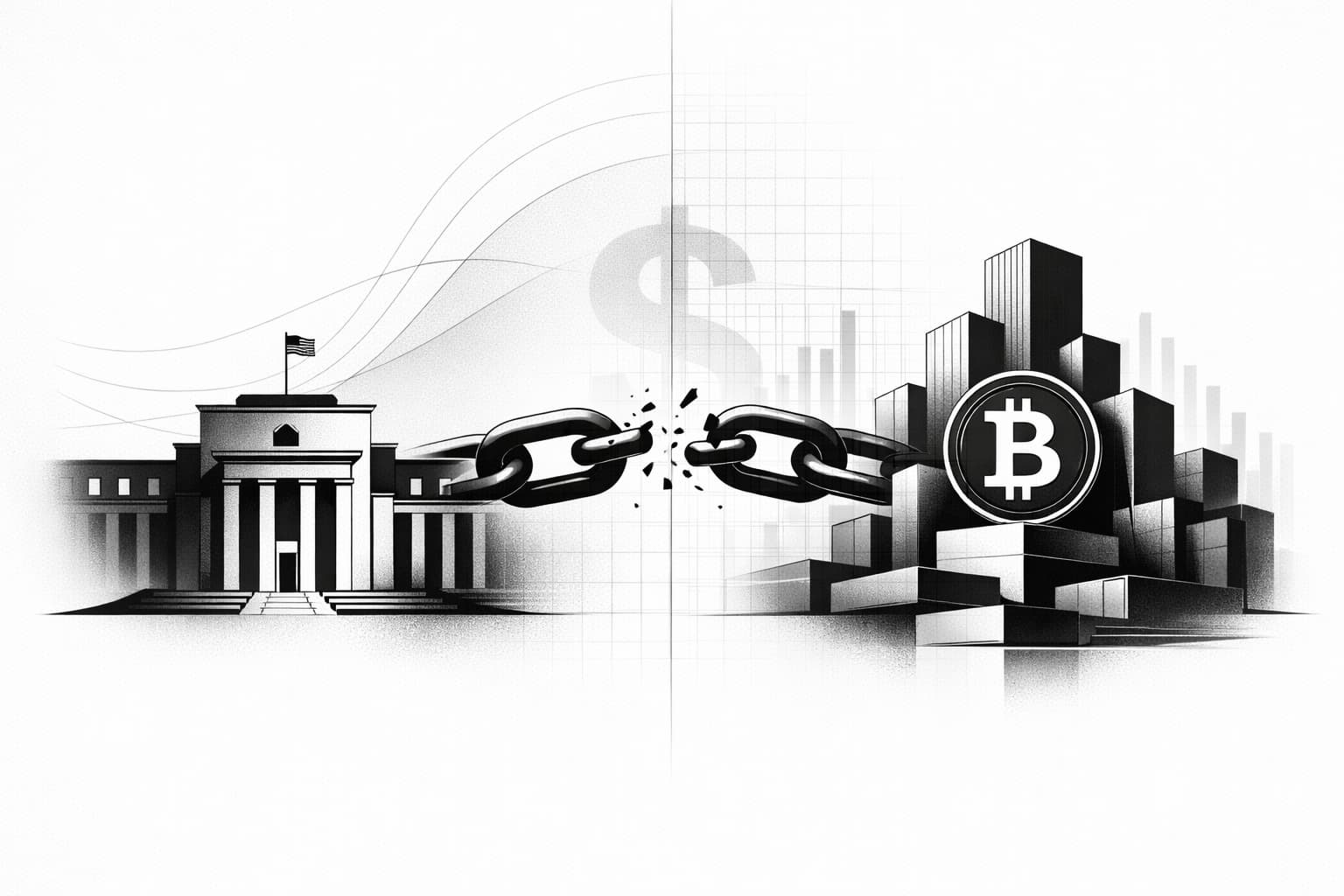
However, a compelling counterargument remains. As long as Bitcoin's value is primarily measured and traded in U.S. dollars, it will likely stay connected to the health of the dollar. Since the FOMC holds the main levers controlling the dollar's strength and supply, its decisions will continue to send ripples through the market. The relationship between the fomc bitcoin price may change, but it is unlikely to disappear completely while the dollar remains the world's primary reserve currency.
Key Takeaways
- Interest Rates Drive Risk Appetite: FOMC decisions on interest rates are a primary driver of Bitcoin's price. Higher rates make safer investments like bonds more attractive, pulling money away from risk-on assets like Bitcoin. Lower rates have the opposite effect, often leading to bullish price action.
- Language Matters: The market reacts not just to the current rate decision but to the Fed's future outlook. A "hawkish" tone (focused on fighting inflation) is typically bearish for Bitcoin, while a "dovish" tone (focused on stimulating growth) is generally bullish.
- Liquidity is Key: Beyond interest rates, policies like Quantitative Easing (QE) and Quantitative Tightening (QT) directly impact the amount of money in the financial system. QE increases liquidity and is a tailwind for BTC, while QT removes liquidity, acting as a headwind.
- Preparation is Critical: As an investor, you can prepare for the volatility around FOMC meetings by monitoring market expectations with tools like the CME FedWatch Tool and implementing risk management strategies like setting stop-losses or reducing position sizes.
Frequently Asked Questions
- Does FOMC affect Bitcoin?
- Yes, FOMC decisions significantly impact Bitcoin's price. As the Federal Reserve's policy committee, its announcements on interest rates alter investor appetite for risk assets. A more restrictive (hawkish) policy often dampens enthusiasm for volatile assets like Bitcoin, while a looser (dovish) stance can have the opposite effect, causing volatility.
- What does FOMC mean in crypto?
- In the crypto world, the FOMC is a major driver of macroeconomic trends. Its decisions on interest rates and market liquidity directly impact the attractiveness of crypto compared to safer investments like bonds. For this reason, crypto traders view FOMC meetings as critical events that can trigger significant market movements.
Sources
Author

Crypto analyst and blockchain educator with over 8 years of experience in the digital asset space. Former fintech consultant at a major Wall Street firm turned full-time crypto journalist. Specializes in DeFi, tokenomics, and blockchain technology. His writing breaks down complex cryptocurrency concepts into actionable insights for both beginners and seasoned investors.