Ethereum for Beginners: What to Know Before Buying in 2026
Ethereum for beginners: what to know before buying in 2026
This guide helps you decide whether ETH belongs in your plan before you place your first order. You will learn what Ethereum is, how ETH differs from an ether ETF, which security steps to finish first, how fees work, and how to avoid the mistakes that cost beginners money.
Understand what Ethereum is before you buy
Ethereum is a programmable blockchain that runs applications and smart contracts without a central operator. ETH is its native cryptocurrency, and users pay ETH for transactions, smart contracts, and network activity. For beginners, buying ETH means buying both a risky asset and access to a live software network.
The common pitch is simple: Ethereum is a smart-contract network, so beginners should buy ETH for long-term upside. The safer starting point is stricter: Ethereum only makes sense as a first crypto purchase if you understand custody, gas fees, scams, and whether you want direct ETH or brokerage exposure.
Use the BUY-SAFE readiness framework
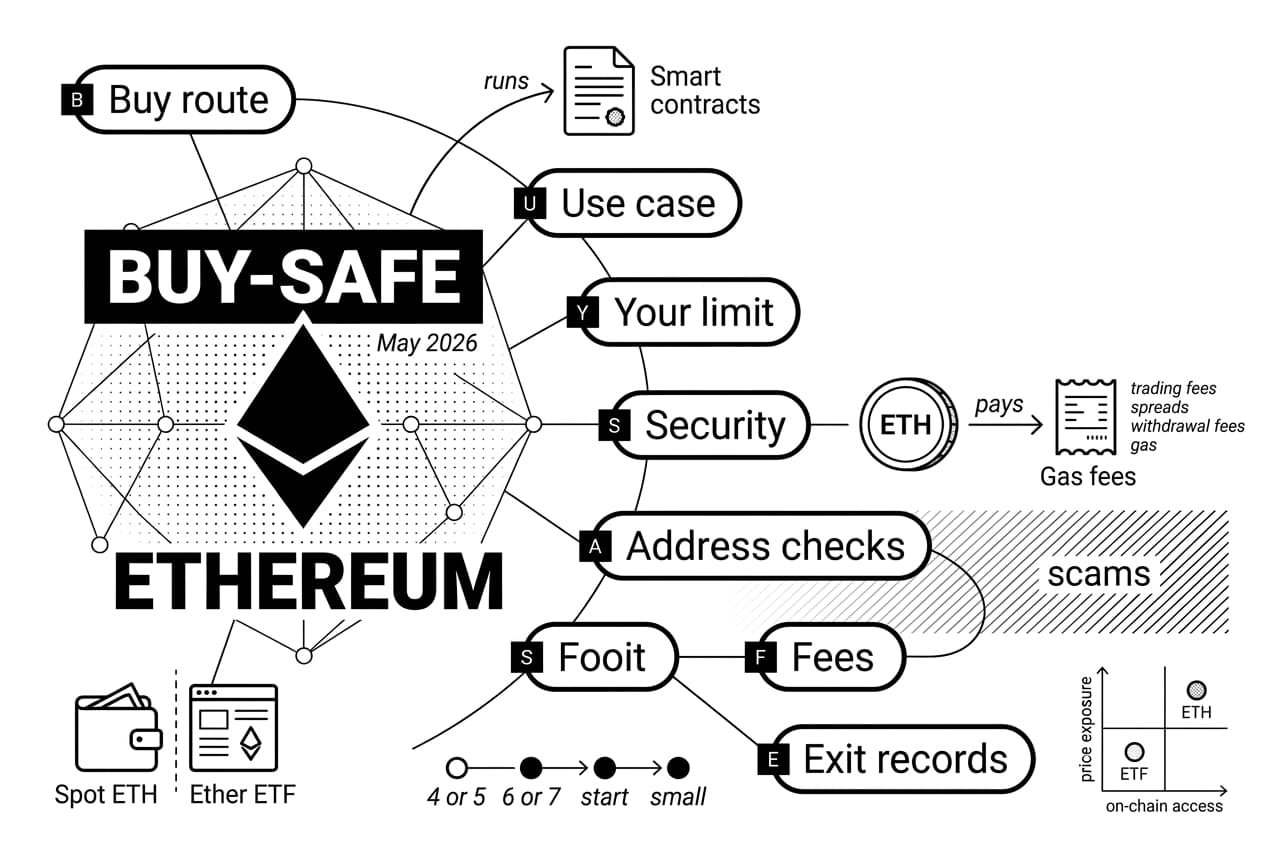
As of May 2026, use this original BUY-SAFE check before you buy. Give yourself one point for each item you can explain without opening another tab.
Letter | Question to answer before buying | Why it matters |
|---|---|---|
B | Buy route | You know whether you want spot ETH or an ether ETF. |
U | Use case | You know whether you want price exposure only or on-chain access. |
Y | Your limit | You have written a maximum position size before opening the order screen. |
S | Security | You have app-based two-factor authentication and a unique password ready. |
A | Address checks | You know how to verify a wallet address before sending ETH. |
F | Fees | You know the difference between trading fees, spreads, withdrawal fees, and gas. |
E | Exit records | You know how you will save tax records and transaction history. |
A score of 6 or 7 means you are ready to start small. A score of 4 or 5 means keep reading before buying. A score under 4 means your biggest risk is not price volatility; it is an operational mistake.
Know the difference between Ethereum and ETH
Ethereum is the network. ETH is the asset traded on exchanges and used to pay transaction costs. You do not buy the network itself. You buy ETH, which can be held, transferred, staked, or spent on network fees.
Ethereum launched on July 30, 2015, according to ethereum.org history records. That date matters because ETH has lived through multiple market cycles, protocol upgrades, exchange failures, and periods of heavy network demand. You are not buying an untested idea, but you are still buying a volatile asset.
Understand what the EVM does
The EVM, short for ethereum virtual machine, is the system that runs smart contracts. A smart contract is code stored on the blockchain. Once the required conditions are met, the code runs without a bank, broker, or support desk approving it.
Nick Szabo, computer scientist and originator of the smart-contract concept, described self-executing agreements years before Ethereum existed. Ethereum made that idea available to developers at global scale.
This is why ETH is more than a ticker symbol. It is the fee asset for decentralized exchanges, lending markets, stablecoin transfers, NFT minting, wallet transactions, and other on-chain activity. That utility can support demand, but it does not remove price risk.
Compare Ethereum with bitcoin and other crypto
Most beginners compare ETH with bitcoin first. That is useful, but only if you compare the right features. Bitcoin is mainly a scarce monetary asset. Ethereum is programmable infrastructure with a native asset used to pay for computation.
A side-by-side look at BTC vs ETH
Bitcoin launched in 2009 with a 21 million coin limit. Ethereum does not have the same fixed supply story. Vitalik Buterin, co-founder listed through ethereum.org, is associated with Ethereum’s broader goal: a programmable settlement layer for applications, not only digital money.
Feature | Bitcoin | Ethereum |
|---|---|---|
Purpose | Decentralized money and store of value | Programmable blockchain for apps and digital assets |
Native asset | BTC | ETH |
Main use case | Savings, payments, and scarcity exposure | DeFi, stablecoins, NFTs, smart contracts, and fees |
Consensus model | Proof-of-work mining | Proof-of-stake validation since the Merge |
Programmability | Limited scripting | General-purpose smart contracts |
Beginner consideration | Simpler thesis with fewer moving parts | More useful on-chain, but harder to learn safely |
Ethereum completed the Merge on September 15, 2022, according to ethereum.org. The change moved Ethereum from proof-of-work to proof-of-stake. The network’s estimated energy use fell by about 99.95% after the Merge, according to ethereum.org energy data published in 2022.
When Ethereum may not be the right first crypto
If your only goal is simple price exposure, ETH may not be the easiest first step. Ethereum requires you to understand gas, wallets, approvals, staking, and the difference between layer 1 and layer 2 networks.
Bitcoin has a simpler beginner story: fixed issuance, no smart-contract approvals, and fewer app-specific risks. ETH can be more useful if you want to interact with on-chain apps, but usefulness comes with more ways to make mistakes.
For many first-time buyers, an ETF inside a brokerage account is a safer training wheel. You can learn price behavior first, then move to spot ETH when you are ready to manage wallets and transactions.
Check what you’ll need before buying ETH
Before you deposit money, finish your prerequisites. This section is your setup checklist. Doing it now prevents delays during identity checks and reduces the chance that a rushed security decision costs you later.
Personal information and payment requirements
Regulated exchanges usually ask for your full legal name, date of birth, home address, government-issued photo ID, and sometimes a selfie or short video. Your bank name and exchange account name should match exactly. A missing middle name or nickname can delay deposits and withdrawals.
Most platforms complete identity checks within minutes to a few days. Timing depends on your country, document quality, and whether the platform needs manual review. If you plan to buy before a specific date, do not leave verification until the last minute.
Payment method | Typical speed | Common cost pattern | Beginner note |
|---|---|---|---|
Debit card | Usually instant | Often the most expensive option | Convenient for small tests, costly for larger buys |
Bank transfer | Often 1 to 5 business days | Often low cost or free | ETH may be unavailable to withdraw until funds clear |
Wire transfer | Same day or next business day | Often a flat bank fee | Better suited to larger transfers than tiny starter buys |
Tax treatment is not an afterthought. In the U.S., the IRS has treated convertible virtual currency as property since Notice 2014-21, published by the IRS in 2014. That means sales, swaps, and some rewards may create taxable events. Check your local rules before trading.
Security setup before you deposit money
Andreas Antonopoulos, author and educator, has long taught that self-custody and account security require personal responsibility. You do not need to be technical, but you do need a repeatable process.
- Unique password: Create one password used only for your exchange or brokerage account.
- Password manager: Use a reputable password manager so you are not inventing weak passwords by memory.
- App-based 2FA: Use an authenticator app, not SMS-only codes, where the platform allows it.
- Dedicated email: Use an email account that is not shared with shopping, games, or social accounts.
- Withdrawal allowlist: If available, allow withdrawals only to addresses you approve in advance.
Warning: Do this before funding your account. Once money is visible in an exchange account, a stolen email password or SIM-swap attack becomes much more expensive.
Step 1: Choose how you want exposure to Ethereum
Your first action is to choose your exposure route. Do you want actual ETH that you can withdraw and use, or do you only want price exposure through a brokerage product? The right answer depends on your goal.
Compare spot ETH with an ether ETF
Buying spot ETH means you own the crypto asset on an exchange or in your own wallet. You can withdraw it, send it, stake it where allowed, and use it in decentralized apps. You also become responsible for handling transactions correctly.
A spot ether ETF trades in a brokerage account and tracks the price of ETH. The SEC approved exchange rule changes for spot ether products on May 23, 2024, according to an SEC statement. ETF exposure can be easier for beginners who do not want wallet responsibility.
The tradeoff is direct access. ETF shares cannot pay gas, connect to a wallet, or interact with an app. They are price exposure, not network access.
Feature | Spot ETH | Spot ether ETF |
|---|---|---|
Actual on-chain asset | Yes | No |
Can use apps and pay gas | Yes | No |
Can self-custody | Yes | No |
Trades in brokerage account | No | Yes |
Main beginner risk | Wallet, gas, and sending errors | Management fees, tracking, and no on-chain use |
Choose custodial or self-custody ownership
If you buy spot ETH, decide who controls the private keys. A custodial exchange holds the keys for you. You log in with an account, and the platform handles storage. This is easier at first, but you rely on the company.
A non-custodial wallet gives you control of the keys. During setup you receive a 12- or 24-word seed phrase. Anyone with that phrase can move your ETH. If you lose it, there is no password reset.
For most beginners, starting with a reputable custodial exchange while you learn is reasonable. Move to self-custody only after you can explain seed phrases, test transactions, network selection, and address checks.
Warning: Exchange balances are not the same as bank deposits. If a platform freezes withdrawals or fails, access to your assets can be delayed or lost. Learn the tradeoff in our guide to custodial vs. non-custodial crypto wallets.
Step 2: Open an account and secure it
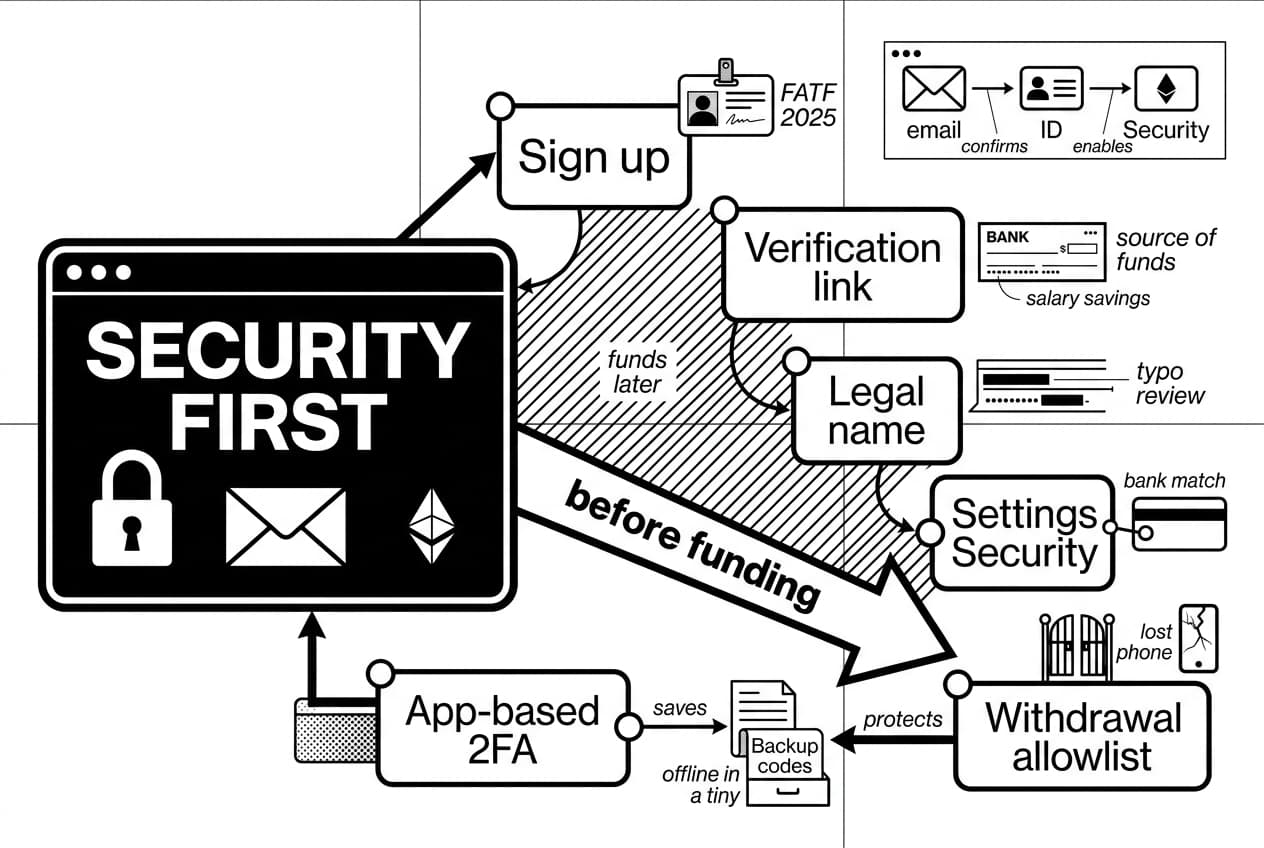
Your next action is to open the account you will use, then secure it before depositing funds. Do not reverse that order. Beginners often fund first and adjust security later, which leaves an avoidable gap.
Complete identity verification carefully
Open the exchange or brokerage website, select Sign up, enter your email, and confirm the verification link. Then complete identity verification with your legal name, address, date of birth, and ID document.
Many regulated platforms follow FATF anti-money-laundering standards, referenced by FATF guidance as of 2025. If the platform asks about source of funds, answer plainly: salary, savings, investment account, or business income if true.
Check every field before submitting. A typo in your legal name can trigger manual review. A mismatch between your exchange account and bank account can block deposits or delay withdrawals.
Turn on security settings before funding
After approval, go to Settings, then Security. The wording differs by platform, but the items below are common. If you cannot find them, search the help center before depositing money.
Pro tip: Enable app-based 2FA, an anti-phishing code if offered, device management, and withdrawal allowlisting. If a platform has no withdrawal allowlist or account activity log, treat that as a reason to compare alternatives.
Save backup codes offline. Do not store them in the same email account used to log in. If your phone is lost, backup codes may be the difference between a quick recovery and a long support process.
Step 3: Place your first ETH order and understand fees
Your account is ready. Now buy a small starter amount, review every fee, and save your records. You are learning the process first, not trying to make a perfect market-timing decision.
Use this order flow:
- Choose your platform and log in from the official app or bookmarked website.
- Deposit funds with a bank transfer, card, or supported payment method.
- Search ETH in the buy or trade screen.
- Choose order type, usually market or limit.
- Enter the amount, such as $50 or $100 for a first test buy.
- Review fees, including trading fee, spread, card fee, and any withdrawal estimate.
- Confirm only after checking the final ETH amount shown on screen.
- Save records by downloading the trade confirmation or exporting transaction history.
Choose market order or limit order
A market order buys immediately at the available price. It is simple, but the final execution price may differ slightly from the quote during fast markets.
A limit order lets you set the maximum price you will pay. If ETH trades above your limit, the order may not fill. For a small first purchase, a market order is usually easier. For larger purchases, a limit order gives more price control.
Review every fee before confirming
Fee type | What it means | When you see it |
|---|---|---|
Trading fee | Commission for buying or selling | At order preview |
Spread | Gap between quoted buy and sell prices | Built into the quote on many retail apps |
Deposit fee | Cost to fund the account | Before or after funding, depending on method |
Withdrawal fee | Platform charge to send ETH out | At withdrawal preview |
Gas fee | Network fee paid for an on-chain transaction | When sending ETH or using a smart contract |
You usually do not pay Ethereum gas when buying ETH inside an exchange. The exchange updates its internal ledger. Gas appears when you withdraw ETH to a wallet or interact with an on-chain app. Check current conditions on Etherscan gas data, accessed May 2026 before sending.
Warning: Make your first order small. If you later withdraw to a wallet, send a tiny test transaction first, such as $5 worth of ETH. Confirm arrival before sending the rest. A wrong address or wrong network can cause permanent loss.
Step 4: Store, send, and use Ethereum safely
After buying, decide where the ETH will live. Storage is not a side issue. For beginners, a custody mistake can be more damaging than a bad entry price.
Choose a wallet type
Wallet type | Examples | Who controls keys | Best fit |
|---|---|---|---|
Exchange custody | Coinbase or Kraken | The platform | Beginners not ready to withdraw |
Mobile wallet | Rainbow | You | Small everyday balances |
Browser wallet | MetaMask or Rabby | You | Using apps and DeFi |
Hardware wallet | Trezor or Ledger | You, with keys kept offline | Larger balances and long-term storage |
The seed phrase is the main safety concept. It is usually 12 or 24 words that can recover the wallet. Write it offline. Never type it into a website, chat, email, or support form. No legitimate service needs it.
Andreas Antonopoulos, author and educator, often frames self-custody as a responsibility rather than a convenience feature. That is the right mindset. You gain control, but you also lose the usual support desk safety net.
If you are ready for offline storage, use our step-by-step guide on how to set up a Trezor hardware wallet.
Send ETH without losing it
- Open the exchange app and select Withdraw or Send.
- Select ETH and choose the Ethereum network unless your destination wallet clearly supports a different network.
- Paste the destination address from your wallet’s receive screen. Do not type it manually.
- Check the first four and last four characters against the wallet screen.
- Review the network fee and make sure you still have enough ETH after fees.
- Send a test transaction, confirm it arrives, then send the remaining amount.
Warning: Clipboard malware can replace an address after you copy it. If the address changes, stop immediately. If you already sent funds and something looks wrong, review warning signs your wallet is compromised.
Check transactions on a block explorer
Every Ethereum transaction has a transaction hash that starts with 0x. Paste it into Etherscan, accessed May 2026. You can see the status, recipient address, gas paid, timestamp, and whether the transaction succeeded or failed.
Make this a habit. Every send should end with a block explorer check. If you cannot find the transaction hash, do not send more money until you understand what happened.
Step 5: Decide whether Ethereum fits your plan
Now make the investment decision. ETH may be useful and valuable, but it is still risky. Your job is to decide whether it fits your finances, time horizon, and tolerance for operational responsibility.
Understand why some investors buy ETH
ETH has several demand drivers. Developers use Ethereum for apps. Users pay ETH for network activity. Validators stake ETH to help secure the chain. Layer 2 networks settle activity back to Ethereum.
The 2024 crypto developer report, published in 2024 tracked thousands of monthly active developers across crypto ecosystems, with Ethereum remaining a major developer hub. Developer activity does not guarantee price gains, but it helps explain why ETH has demand beyond speculation.
Hayden Adams, founder associated with uniswap.org, built one of the best-known decentralized exchange protocols on Ethereum. That example matters because it shows the network’s role as settlement infrastructure for permissionless trading.
Review the risks beginners should not ignore
- Volatility: ETH reached about $4,878 in November 2021, according to CoinGecko historical data, then traded far lower during the 2022 bear market.
- Scams: Fake support accounts, phishing sites, and wallet-draining links target new users.
- Smart contract bugs: Code can fail, and exploited contracts may not be recoverable.
- Custody mistakes: A lost seed phrase or wrong network transfer can be permanent.
- Regulation: Tax, staking, exchange, and ETF rules can change by country.
- Taxes: Sales, swaps, rewards, and some transfers may need records.
- Competition: Other chains compete for users, developers, and fees.
Before connecting a wallet to any site, read how wallet drainers steal crypto. Before using a protocol, review common smart contract security risks.
Set a position size before you buy
Write down your maximum ETH allocation before you open the order screen. A written cap helps you avoid changing the plan during a rally.
- Keep emergency savings first. Do not use rent money, tax money, or cash needed for bills.
- Cap speculative exposure. Many beginners start with a small single-digit percentage of investable assets, not a life-changing bet.
- Use dollar-cost averaging if helpful. Fixed weekly or monthly buys reduce the pressure to pick one perfect entry.
- Avoid borrowed money. Debt plus crypto volatility can turn a bad entry into forced selling.
If you want to study price zones before placing larger orders, read our guide to Ethereum resistance levels.
Learn what Ethereum is used for in 2026
Understanding use cases helps you decide whether you are buying a technology you actually want exposure to. You do not need to use every app, but you should know what activity creates demand for block space.
Smart contracts in plain English
A smart contract is code that lives on Ethereum and runs when its rules are met. For example, a token swap contract can accept one asset and return another according to prices and liquidity available at that moment.
- Token swaps: Decentralized exchanges let users trade without a traditional order book.
- Lending: Some protocols allow users to borrow against crypto collateral.
- Stablecoins: Dollar-linked tokens move across Ethereum and layer 2 networks.
- NFTs: Contracts can issue unique tokens tied to art, memberships, game items, or records.
- DAOs: Token holders can vote on proposals that guide protocol decisions.
Smart contracts are not safe just because they are on-chain. Read audits when available, check protocol history, and never approve unlimited token access unless you understand the risk.
Use layer 2 networks for lower fees
Ethereum’s main chain can be expensive when demand is high. Layer 2 networks such as Arbitrum, Optimism, and Base process activity more cheaply, then settle results back to Ethereum.
As of May 2026, you may use a layer 2 without noticing because many wallets and apps default to them. Always confirm the network before sending funds. ETH on one network is not automatically in your wallet on another network.
Frequently Asked Questions
- Is it worth putting $100 in Ethereum?
- A $100 purchase can be a sensible starting point if you can genuinely afford to lose it. Ethereum is volatile, exchange fees can eat into small amounts, and $100 won't diversify a portfolio. Think of it as tuition — a practical way to learn order placement, wallet custody, and how blockchain transactions actually work.
- What if you invested $1,000 in Ethereum 10 years ago?
- Around 2015–2016, ETH traded below $10, meaning a $1,000 investment could have purchased hundreds of coins. At 2026 prices, that position would be worth a substantial multiple of the original amount. That said, past performance never guarantees future results, and most investors did not hold through multiple 70–90% drawdowns along the way.
- What should beginners know about buying Ethereum?
- Ethereum is the network; ETH is the tradable asset. Prices swing sharply, sometimes daily. Fees vary by platform and network congestion. Transactions are generally irreversible, so wallet security matters enormously. You can buy ETH directly on a spot exchange or gain price exposure through a spot Ethereum ETF without managing a wallet yourself.
- How much is $100 dollars in Ethereum?
- Divide $100 by the current ETH price, then subtract any platform fee or spread. For example, if ETH is priced at $2,500, $100 buys roughly 0.04 ETH before fees. Because ETH prices move continuously, always check the live quote on your chosen exchange immediately before confirming any purchase.
Sources
Author

Crypto analyst and blockchain educator with over 8 years of experience in the digital asset space. Former fintech consultant at a major Wall Street firm turned full-time crypto journalist. Specializes in DeFi, tokenomics, and blockchain technology. His writing breaks down complex cryptocurrency concepts into actionable insights for both beginners and seasoned investors.