Cyfrin Updraft Review: Free Blockchain Training in 2026

Quick verdict: cyfrin updraft review
cyfrin updraft is one of the strongest free ways to learn Solidity, smart contract testing, and security habits in 2026, but it is not a job-placement program. The course library is useful because it pushes learners toward public repositories, local tooling, and audit-style thinking, not because the videos cost $0.
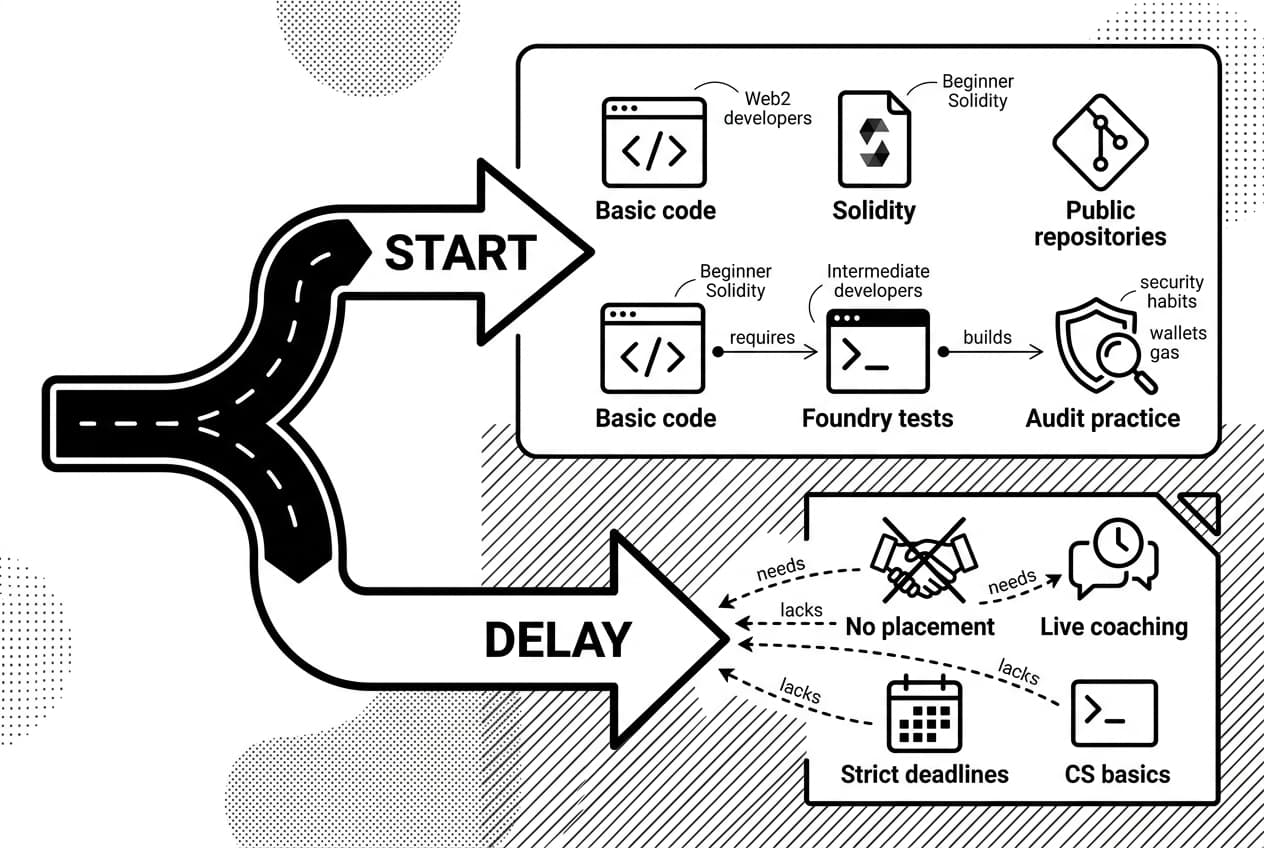
Our verdict after testing the core path: start it if you can already read basic code and you are willing to ship projects. Skip it, or delay it, if you need live coaching, strict deadlines, or a beginner programming course before touching wallets, gas, and Solidity.
Best for
- Web2 developers with JavaScript, Python, or backend experience who want a low-cost path into smart contracts.
- Beginner Solidity learners who need guided projects rather than isolated syntax lessons.
- Intermediate developers who want to add security habits, Foundry tests, and audit contest practice to a public portfolio.
Not ideal for
- People with no programming background who need basic computer science and terminal practice first.
- Learners who need instructor feedback within a set response window.
- Job seekers expecting employer introductions, guaranteed placement, or a hiring pipeline.
Overview: what is cyfrin updraft?
Cyfrin Updraft is a free blockchain developer training platform from Cyfrin that teaches Solidity, smart contracts, projects, and security through guided videos, local repositories, tests, and community discussion, with a path from beginner coding practice to audit-minded Web3 engineering work in 2026.
Cyfrin is known for smart contract security work, and that background shapes the education product. The platform does not treat security as a short final chapter. Even development lessons tend to ask how a contract can fail, how tests should prove behavior, and how a public repository can show more than course completion.
The official course library lists free access at $0, checked January 2026. Cyfrin also states that the platform has reached 100,000 plus learners, checked January 2026. Earlier free Solidity training that helped seed the audience had passed 6 million views on YouTube by December 2023, which helps explain why the community is unusually large for a technical course site.
How the platform works
Learners move through lessons tied to GitHub repositories, local setup, Foundry tests, deployment scripts, and security exercises. In our testing, the best workflow was to clone the repository, run the tests locally before watching the next lesson, commit changes in small chunks, and then rewrite the readme in plain English. That last step matters because employers often judge a junior developer by whether the repo explains the problem, tradeoffs, and test coverage.
Why it matters in 2026
Smart contract education is still relevant because deployed capital creates ongoing maintenance and security work. DefiLlama showed more than $90 billion in DeFi total value locked in May 2026. That number is not a hiring guarantee, but it is a useful reminder that protocols need developers who can read contracts, test assumptions, and spot failure modes.
Vitalik Buterin, Ethereum co-founder, has long framed smart contracts as programs with real economic consequences, not just scripts. Sergey Nazarov, co-founder at Chainlink, has also argued that oracle-connected contracts are core infrastructure for serious Web3 applications. For learners, the practical point is simple: Solidity alone is not enough. You need testing, security review, and deployment judgment.
Key features tested in this cyfrin updraft review
We evaluated the platform as a career tool, not as a free video archive. The test covered six checkpoints: account access, course sequencing, local repository setup, Foundry testing, project output, and security signal. We used a simple original framework, the skill conversion score, to judge whether a lesson turns attention into evidence.
The skill conversion score framework
Our framework scores a learning platform on four outcomes: code shipped, tests written, security decisions explained, and proof made public. A course that only teaches concepts scores low. A course that leaves learners with a documented repo, failing and passing tests, deployment notes, and a security write-up scores high. cyfrin updraft performs best when learners treat every module as a portfolio artifact.
Tested area | What we checked | Observed result | Career value |
|---|---|---|---|
Access | Whether core lessons required payment | Core courses opened at $0 | Low risk starting point |
Repos | Whether lessons map to code | Companion repositories support local work | Creates public proof if pushed cleanly |
Tooling | Whether setup mirrors work practice | Foundry, tests, scripts, and local terminal use | Close to protocol team workflows |
Support | Whether blockers get help | Community help exists, but no promised instructor window | Good for self-directed learners, weaker for people needing coaching |
Security | Whether lessons teach failure cases | Vulnerabilities and audit habits appear throughout advanced tracks | Better hiring signal than syntax-only courses |
Project-based Solidity training
The strongest feature is the project structure. Learners write contracts, run tests, deploy to test environments, and inspect bugs instead of only watching slides. The Foundry-based work is especially useful because it teaches the same test-first habits used by many production teams. If you finish a module, push a clean repo, and explain what broke during testing, you have a stronger artifact than a completion badge.
For broader context on turning course work into hiring evidence, see Web3 developer portfolio projects.
Repository structure and code workflow
Each course repository works best when used actively. Clone it, create your own branch, run tests before editing, commit small changes, then document what you changed. The workflow is close to how protocol teams expect contributors to work. The main friction is setup. Foundry, Node, wallet configuration, RPC endpoints, and terminal errors can stop beginners before the first real contract.
This is where the platform is honest but demanding. It teaches tooling, yet it expects learners to debug environment issues. That is realistic for Web3 work, but it can be rough for people who have only used browser-based coding lessons.
Community and support channels
The community is active enough to matter, especially compared with older course forums. Cyfrin reported a large learner base on its official site, and the course-specific channels give students a place to compare errors, tests, and deployment problems. The tradeoff is that support is not the same as mentorship. You may get a helpful answer in minutes, or you may have to solve a niche local bug yourself.
That limitation is not fatal, but it changes who should use the platform. Self-directed developers will learn from the public debugging flow. Learners who need live review, calendar pressure, or weekly grading should consider a paid cohort instead.
Courses and skills covered: beginner to advanced
The curriculum runs from blockchain basics into Solidity, Foundry, DeFi-style projects, testing, deployment, and smart contract security. It is wide for a free platform, but it is not magic. Skipping the early modules makes the security track harder because later lessons assume you understand state, calls, gas, and test structure.
Beginner blockchain and Solidity courses
New learners should first understand wallets, gas, transactions, and block confirmations. This background pairs well with Ethereum gas fees and ETH basics. The early courses explain the chain model and then move into Solidity syntax. A learner with basic JavaScript or Python will move faster than someone starting from zero.
Andreas Antonopoulos, author and educator, has often taught that understanding the system model matters before chasing tools. That advice fits here. If you do not understand why a transaction costs gas or why contract state is public, advanced Solidity patterns will feel arbitrary.
Advanced and specialization courses
The deeper lessons cover ERC token patterns, DeFi interactions, Foundry testing, scripted deployment, and security review habits. The security path is the most valuable part for intermediate developers because it trains learners to ask what can fail before they ask whether the contract compiles. Students also learn practical deployment tasks such as how to verify a contract on Etherscan, which is a small but real workplace skill.
Recommended learning path
- Fundamentals: Learn wallets, gas, transactions, blocks, and why smart contracts are hard to change after deployment.
- Solidity basics: Build simple contracts, understand state, functions, events, errors, and access control.
- Projects: Create fund-me contracts, ERC token examples, and small DeFi interactions that can live in public repos.
- Testing: Use Foundry unit tests, fuzz tests, fixtures, and scripts until testing feels normal rather than optional.
- Deployment: Practice testnet deployments, verification, environment variables, wallet safety, and readme documentation.
- Security: Study reentrancy, oracle issues, authorization bugs, invariant thinking, and audit report structure.
- Certification or portfolio work: Prepare for SSCD plus, enter audit contests, or build a capstone repository with a written security review.
The main point: do not treat the course order as entertainment. The testing and security sections are where employer-relevant skill starts to show.
Pricing and fees: is cyfrin updraft really free?
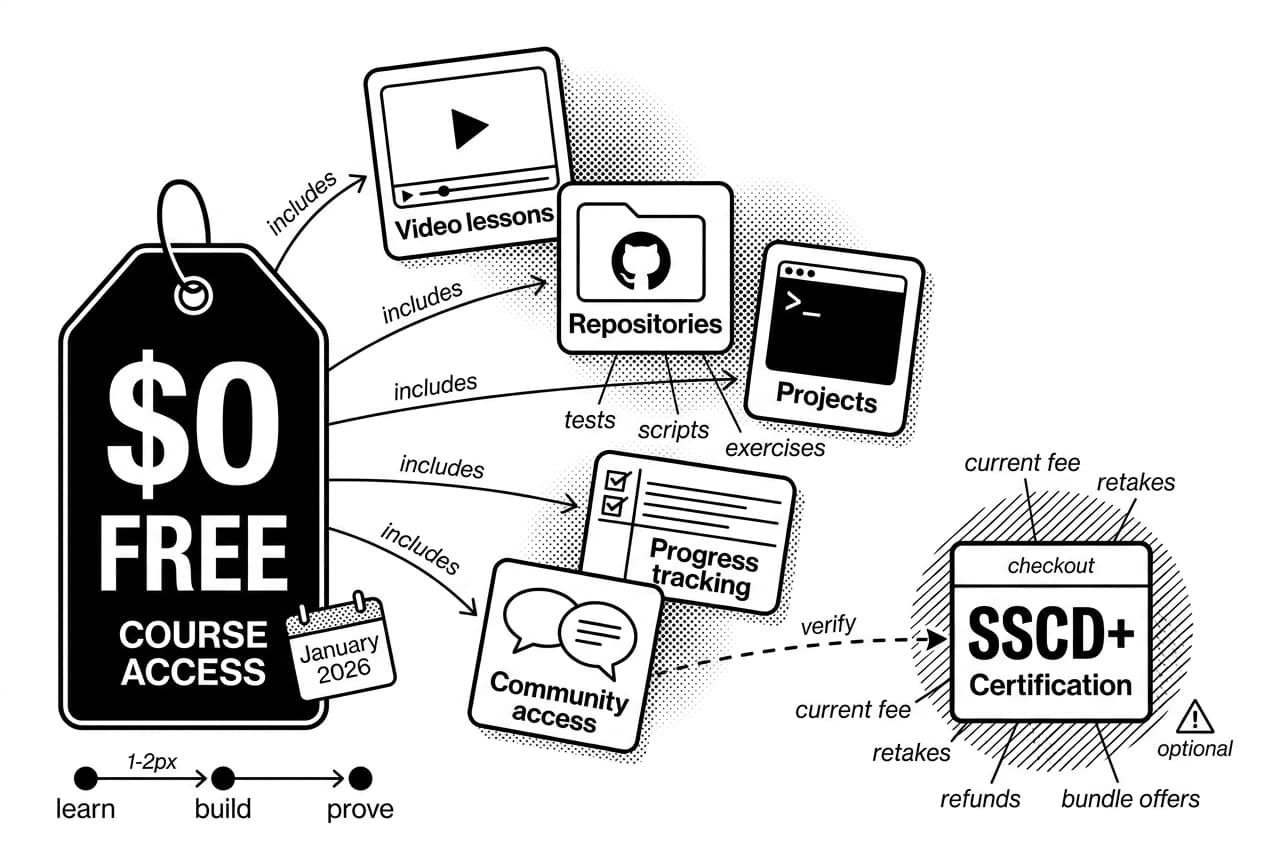
Yes. Core course access is free. The official training site listed course access at $0, checked January 2026. You can watch lessons, use the repositories, and build projects without a subscription. Optional credentialing is separate and should be verified before you pay.
Item | Cost | What you get | Notes |
|---|---|---|---|
Course access | $0 / free | Video lessons, repositories, projects, and progress tracking | Price checked on the official site in January 2026 |
Community access | $0 / free | Peer discussion and course-specific troubleshooting | Help quality varies by channel and time |
Project materials | $0 / free | Code repositories, tests, scripts, and exercises | You still need your own local setup |
Course completion proof | Verify current status | Possible proof that a course was finished | Availability can vary by course |
SSCD plus certification | Requires current verification | Optional exam or credential tied to security skills | Confirm price, retakes, refund terms, and bundle offers on Cyfrin checkout before purchase |
Free course access
In our test, the core learning path did not place a paywall between the learner and the main course content. That matters because comparable Web3 bootcamps can require hundreds or thousands of dollars before a beginner knows whether smart contract development is a fit.
Certification and exam costs
The optional SSCD plus path is the part to verify. Do not assume the credential is free just because the coursework is free. Check Cyfrin checkout for the current fee, retake rules, refund window, and any hardware wallet bundle before paying. If a Trezor bundle is part of a live offer, readers may also want to review how to set up a Trezor wallet.
Pros and cons
cyfrin updraft is strongest for learners who turn lessons into public proof. It is weaker for people who need external pressure, live mentoring, or a credential that every hiring manager already knows.
Pros
- Free core training: The main lessons and project materials cost $0, so beginners can test the path without a tuition decision.
- Security-first course design: Lessons push learners to think about attack paths, bad assumptions, and test coverage instead of only syntax.
- GitHub-native output: Projects can become public repositories that show code, tests, deployment notes, and written reasoning.
- Real tooling practice: Foundry, local tests, scripts, and verification tasks line up with how smart contract teams work.
- Useful bridge to audit contests: The security modules can prepare motivated learners for Code4rena, Sherlock, or similar practice, although contest success still takes extra work.
Cons
- No built-in accountability: Self-paced learning means no cohort deadlines, grades, or required weekly submissions.
- Setup can block beginners: Terminal errors, local tooling, RPC settings, and wallet configuration may frustrate people new to development.
- Limited live mentorship: Community help exists, but there is no guaranteed instructor response window at the free level.
- Credential recognition is still maturing: SSCD plus may help in Web3 security circles, but it is not as widely recognized as a degree or long work history.
- Portfolio work is not automatic: The platform gives projects, but learners must clean, document, and present them for employers.
Certification, SSCD plus and student outcomes
The optional certification path can add a signal, but it should not be treated as a shortcut. The stronger hiring story is a three-part bundle: completed course work, public repositories, and evidence of security reasoning through tests, write-ups, or audit contest participation.
What is SSCD plus?
SSCD plus is Cyfrin's optional smart contract security credential path. Verify the current full name, exam scope, price, retake rules, and purchase terms on the official Cyfrin certification page before enrolling. Based on the course structure, the credential appears aimed at Solidity security, vulnerability recognition, audit process, and contract hardening rather than basic blockchain vocabulary.
Before attempting it, learners should understand common risk categories. The OWASP smart contract top 10 risks is a useful companion because it frames security issues in a way that maps to audit work.
Student outcomes and career proof
Student testimonials can be encouraging, but they are not guarantees. A contest payout, open-source contribution, or documented security fix is stronger evidence than a vague success quote. The best outcome from cyfrin updraft is not a finished progress bar. It is a GitHub profile showing contracts, tests, deployment notes, and explanations of what could go wrong.
For market context, Electric Capital reported in January 2024 that full-time crypto developers fell 24 percent year over year in 2023. That decline makes a free starting path rational. Learners can test interest and ability before spending money on advanced training.
Who is cyfrin updraft for? Alternatives and competitors
The platform fits a specific learner: someone who can study alone, tolerate tooling friction, and convert lessons into public artifacts. It is less suitable for people buying a credential first and building skills later.
Best use cases
- Learning Solidity from a low-cost starting point: Good for developers who know basic code and want structured smart contract practice.
- Building a Web3 portfolio: The repository-based format helps learners create work that employers can inspect.
- Preparing for security work: The audit-minded lessons help intermediate developers move beyond contract creation into review and testing.
- Testing career fit: Because course access is free, learners can find out whether on-chain development suits them before paying for a bootcamp.
- Refreshing skills: Developers returning to Solidity can use the projects and tests to rebuild practical confidence.
cyfrin updraft vs RareSkills
cyfrin updraft is the better first stop for zero-to-intermediate Solidity learners because it is free and project-heavy. RareSkills bootcamp is a better fit for developers who already understand the basics and want advanced Solidity, gas optimization, or zero-knowledge proof training in a paid cohort.
Factor | cyfrin updraft | RareSkills |
|---|---|---|
Cost | Free core courses, optional credential cost to verify | Paid cohort pricing |
Entry level | Beginner to intermediate | Intermediate to advanced |
Teaching model | Self-paced lessons and repositories | Cohort learning with more structure |
Advanced depth | Strong Solidity and security basics, less depth in ZK | Stronger fit for advanced math-heavy topics |
Support | Community-driven help | More direct cohort support |
When to choose another path
Choose another path if you cannot yet read code, if you need live mentorship, or if your main goal is a recognized hiring credential outside Web3. A basic programming course, traditional computer science sequence, or paid cohort may be more effective first. If your goal is audit contest performance, combine the courses with direct contest practice and past report reviews rather than waiting until every video is complete.
Frequently Asked Questions
- Is Cyfrin Updraft free?
- Yes, the core training on Cyfrin Updraft is free. Courses, lessons, and project materials are available at no cost. However, optional certification or exams may carry separate fees. Check the current Cyfrin certification page directly before assuming everything, including credentialing, is included for free.
- What is Cyfrin Updraft?
- Cyfrin Updraft is a free Web3 education platform built by the Cyfrin team. It teaches blockchain development through structured video lessons, hands-on projects, and GitHub repositories. Topics include Solidity, smart contract development, security practices, testing workflows, and the broader skills needed to work as a professional blockchain developer.
- Is blockchain a dead technology?
- Blockchain is not dead, but the speculative hype has settled. In 2026, demand is more focused and practical, centered on stablecoins, DeFi protocols, asset tokenization, smart contract security, wallet infrastructure, and developer tooling. Skilled developers who solve real problems still find genuine opportunities in the space.
- What are the benefits of Cyfrin Updraft?
- Key benefits include free access to structured Solidity courses, hands-on smart contract projects, security-focused instruction, and community support. Completing projects builds a public portfolio that demonstrates real skills to employers. Optional certification adds a credential. That said, benefits come from doing the work, not just watching the videos.
Sources
Author

Crypto analyst and blockchain educator with over 8 years of experience in the digital asset space. Former fintech consultant at a major Wall Street firm turned full-time crypto journalist. Specializes in DeFi, tokenomics, and blockchain technology. His writing breaks down complex cryptocurrency concepts into actionable insights for both beginners and seasoned investors.