Crypto Lawyer Guide: When to Hire One and How to Choose
Start Here: Decide What You Need From a Crypto Lawyer
This guide helps you decide whether your crypto problem is legal, match it to the right type of attorney, estimate 2026 costs, and prepare for a useful first call. It is educational only and is not legal advice. Digital asset rules vary by country, state, regulator, asset type, and facts.
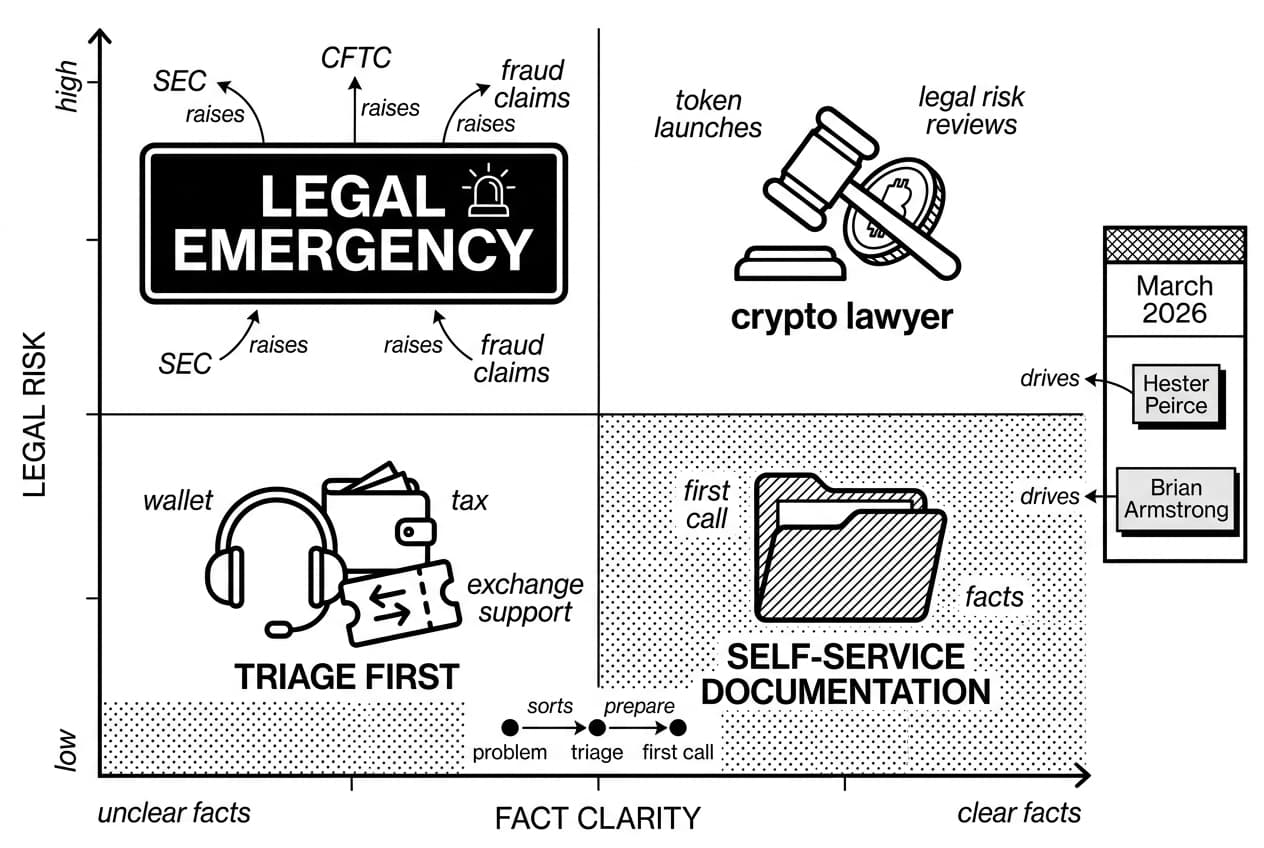
A crypto lawyer is an attorney who advises a cryptocurrency attorney client on digital assets, compliance, disputes, and blockchain businesses. They may handle token launches, SEC or CFTC inquiries, exchange freezes, fraud claims, smart contract deals, DAO governance, NFT rights, and legal risk reviews before money moves or litigation starts.
The practical mistake is assuming every crypto headache should go straight to a specialist lawyer. As of March 2026, our editorial triage model separates matters into three lanes: legal emergency, professional support, and self-service documentation. A crypto lawyer is essential for regulated, adversarial, or high-value matters. Many wallet, tax, and exchange-support problems should be triaged first.
Regulatory ambiguity is still a major driver of legal demand. Hester Peirce, SEC Commissioner, has repeatedly called for clearer digital asset rules. Brian Armstrong, Coinbase co-founder and CEO, has also made regulatory clarity a central public theme for Coinbase. The takeaway for you is simple: unclear rules raise legal risk, but unclear facts raise your legal bill.
Use the 2026 Crypto Legal Triage Matrix
Use this original 2026 Crypto Legal Triage Matrix before you book a paid consultation. It gives you a quick first sort, not a final legal answer.
- Red lane: hire now. You received a subpoena, regulator letter, lawsuit threat, criminal inquiry, frozen high-value account, sanctions flag, investor demand, or business hack.
- Yellow lane: prepare, then call. You need a token review, DAO structure, NFT license, exchange dispute, tax controversy, recovery demand, or contract negotiation.
- Green lane: triage first. You lost a seed phrase, need routine tax filing, have a small support-ticket issue, or need to revoke wallet permissions.
The SEC says its crypto-assets enforcement program has brought more than 200 crypto-related actions since 2013 (SEC, accessed March 2026). FinCEN announced a $3.4 billion civil money penalty against Binance (FinCEN, November 2023). The CFTC reported a Binance order requiring $2.7 billion in disgorgement and a $1.35 billion civil penalty (CFTC, December 2023). Those numbers show why regulated matters belong in the red lane.
When This Guide Applies
You will find this guide useful if you are in one of these groups:
- Investors dealing with exchange insolvency, frozen accounts, failed withdrawals, or suspected fraud.
- Founders and developers building token projects, DAOs, apps, custody products, or blockchain businesses that touch regulated markets.
- DAO contributors unsure whether governance work creates personal liability.
- NFT creators facing IP disputes, licensing questions, or royalty enforcement problems.
- Exchange users whose funds were seized, accounts terminated, or transactions flagged.
- Scam and hack victims deciding whether civil recovery, law enforcement reporting, or on-chain tracing makes sense.
If your issue is routine tax preparation, basic wallet hygiene, or ordinary exchange support, a CPA, forensic analyst, or support ticket may be faster and cheaper than a lawyer. The steps below show you how to decide.
What You'll Need Before Contacting a Cryptocurrency Attorney
Before you contact a cryptocurrency attorney, build a first-call evidence packet. This is the single best way to reduce wasted billable time. Your goal is to give the lawyer enough facts to evaluate jurisdiction, urgency, deadlines, and possible remedies.
Collect Transaction Records and Wallet Details
Pull the raw records before you tell the story. Attorneys cannot assess a case from vague descriptions such as "my funds disappeared" or "the exchange will not answer."
- Wallet addresses for every wallet involved.
- Transaction hashes copied from a block explorer such as Etherscan or Blockchain.com.
- Exchange records, including CSV exports, trade history, deposits, withdrawals, login notices, and freeze emails.
- Screenshots showing account balances, error messages, support-ticket numbers, and transaction status pages.
- Chat transcripts from Discord, Telegram, email, Signal, or customer support. Export the full thread when possible.
- Project documents, including token sale pages, whitepapers, SAFTs, NFT licenses, DAO votes, and terms of service.
- Official notices, including tax letters, subpoenas, police reports, exchange freeze notices, or regulator correspondence.
If you suspect your funds moved without permission, check if your wallet is compromised first and save the evidence. Do not delete browser history, wipe devices, or close accounts before you preserve screenshots and logs.
Write a One-Page Timeline
A short, dated timeline helps a crypto lawyer see the case quickly. Keep it factual. Include dates, dollar amounts, platforms, transaction hashes, counterparties, support-ticket numbers, and the outcome you want.
Use this format:
- Date: When the event happened.
- Asset and amount: Example: 2.4 ETH or $18,500 at the date of transfer.
- Platform or wallet: Exchange name, wallet address, app, or protocol.
- Evidence: Screenshot filename, transaction hash, email subject, or transcript page.
- Deadline: Any court date, response deadline, appeal window, or freeze notice date.
Do not send seed phrases or private keys. No legitimate attorney needs them for an intake review.
Step 1: Triage Your Crypto Issue Before You Pay Legal Fees
Start by sorting your issue before you pay for legal time. This step can save hundreds or thousands of dollars and can also help you avoid waiting too long when the issue is urgent.
Hire a Lawyer Immediately for High-Risk Legal Matters
Call a crypto lawyer before responding, transferring funds, or negotiating if any of these apply:
- A subpoena or government inquiry from the SEC, CFTC, IRS-CI, DOJ, FinCEN, OFAC, or a state regulator.
- Criminal allegations involving fraud, money laundering, sanctions, unlicensed money transmission, or market manipulation.
- A frozen exchange account holding a material amount, especially if the notice mentions sanctions, suspicious activity, or law enforcement.
- An investor dispute involving a token sale, fund, DAO, staking product, yield program, or public statements.
- A business hack involving company funds, customer assets, custody keys, treasury wallets, or smart contracts.
- Sanctions exposure involving a flagged address. Treasury listed more than 100 recent sanctions actions on its public sanctions feed during 2024 (U.S. Treasury, 2024).
Hester Peirce, SEC Commissioner, has publicly argued that unclear token rules increase uncertainty for builders and investors. If a regulator is involved, do not guess at the answer yourself. Your first response can shape the rest of the matter.
Do Not Overpay for Non-Legal Problems
Many crypto problems do not need a lawyer first. Routine tax filing belongs with a crypto-specialist CPA. A lost seed phrase is usually a wallet recovery or device-forensics issue. A small withdrawal delay may belong in the exchange support queue.
If you clicked a suspicious link and want to clean up wallet permissions, you can revoke risky token approvals before paying anyone. If funds are already gone, document the transaction path first and then decide whether legal escalation makes sense.
Warning: If you were scammed or hacked, do not move funds, delete messages, reinstall wallets, or wipe devices until you preserve evidence. Screenshots, transaction hashes, chat transcripts, browser logs, and support tickets may matter later. A lawyer or blockchain investigator can only work with what still exists.
The FTC reported that people had lost more than $1 billion to crypto scams since 2021, based on reports through the first quarter of 2022 (FTC, June 2022). That does not mean every loss is recoverable. It means you should preserve evidence early and spend legal money only where it can change the outcome.
Step 2: Match the Problem to the Right Crypto Lawyer
Now match the issue to the right attorney type. A general business attorney may be fine for a simple contract. A regulator letter, asset freeze, token sale, or sanctions issue needs a specialist.
Crypto issue | Lawyer type | Common deliverable | Other expert you may need |
|---|---|---|---|
SEC/CFTC investigation, token launch, staking product, or yield program | Regulatory and securities counsel | Risk memo, registration strategy, response letter, Wells response, settlement analysis | Compliance consultant, forensic accountant, policy adviser |
AML/KYC gaps, FinCEN registration, sanctions screening, or state licensing | Financial-regulatory counsel | BSA/AML policy, sanctions review, license application, remediation plan | Compliance officer, blockchain analytics provider |
Crypto tax reporting, cost-basis dispute, amended return, or tax notice | Tax attorney for controversy; CPA for preparation | Tax opinion, amended return support, response to tax authority, privilege-aware review | Crypto tax accountant |
Fraud recovery, wallet drain, exchange freeze, insolvency, or stolen funds | Litigation and asset-recovery attorney | Demand letter, emergency injunction, subpoena, proof of claim, settlement demand | Blockchain forensics firm, cybersecurity specialist |
NFT licensing, IP ownership, marketplace takedown, or creator royalties | IP and business attorney | License agreement, copyright assignment, marketplace notice, terms of service | Smart contract auditor, licensing consultant |
DAO governance, token compensation, treasury controls, or contributor liability | Business, securities, and governance counsel | Operating agreement, governance charter, contributor agreement, token plan | DAO security specialist; see DAO security risks |
Exchange disputes, account closure, KYC hold, or failed withdrawal | Consumer litigation or commercial disputes counsel | Escalation letter, arbitration demand, complaint, settlement request | CPA, identity-verification specialist, forensic investigator |
Regulatory and Compliance Counsel
These attorneys advise exchanges, token issuers, DeFi protocols, custody businesses, funds, and payment companies. They focus on securities law, commodities rules, FinCEN registration, AML/KYC controls, sanctions screening, custody, disclosures, and state licensing.
Regulatory counsel becomes more important as the dollar value and public exposure rise. The SEC says its crypto-assets unit expanded from 30 to 50 dedicated positions (SEC, May 2022). That staffing change is one reason serious token and exchange matters should not be handled casually.
Litigation, Fraud, and Asset Recovery Attorneys
If you were scammed, hacked, or frozen out of an account, look for a litigator with crypto evidence experience. They may file emergency papers, send preservation letters, issue subpoenas, handle arbitration, or file a proof of claim in an insolvency case.
Speed matters. On-chain funds can move through several wallets before you finish a support ticket. Your evidence packet should let counsel see the transaction path, value at stake, and best target for a freeze or subpoena.
Business, Tax, IP, and Employment Specialists
Founders, DAOs, and NFT creators often need more than one professional. A business lawyer may handle entity formation, financing documents, token vesting, and vendor contracts. An IP lawyer may handle NFT rights and takedowns. A tax professional may handle valuation and reporting.
For token compensation plans and DAO governance charters, coordinate the legal review with a crypto tax accountant. A structure that looks clean legally can still create tax reporting problems if no one models the tax side.
Step 3: Estimate Costs, Timelines, and Fee Structures
Once you know the attorney type, estimate the budget. The table below is our 2026 editorial benchmark compiled from public attorney fee pages, legal-market rate discussions, and intake patterns reviewed for this guide. It is not a price guarantee. Your location, urgency, and facts can move the number sharply.
Typical 2026 Cost Ranges
Service type | Typical 2026 pricing | Usual timeline | Caveat |
|---|---|---|---|
Consultation | Free to $500 | 15 to 60 minutes | Free calls are often screening calls; complex tax or regulator matters may be paid from minute one. |
Hourly advisory work | $300 to $1,000+ per hour | Same week to ongoing | Former enforcement, securities, or white-collar defense experience can push rates higher. |
Flat-fee review | $500 to $3,500 | 2 to 10 business days | Best for one NFT license, exchange letter, token contract, or narrow memo. |
Retainer | $2,000 to $10,000+ | 30 to 90 days of advisory work | Ask whether unused funds are refundable and where the funds are held. |
Litigation | $10,000 to $25,000+ initial retainer | Weeks to years | Arbitration, emergency motions, discovery, and expert witnesses can add cost quickly. |
Regulatory defense | $25,000 to $250,000+ | 12 to 36 months | Formal SEC, CFTC, FinCEN, or criminal matters are scope-sensitive and often involve multiple specialists. |
These costs should be read against enforcement risk. The CFTC Binance order alone involved $2.7 billion in disgorgement and a $1.35 billion civil penalty (CFTC, December 2023). FinCEN separately announced a $3.4 billion civil money penalty (FinCEN, November 2023). Most readers will never face those numbers, but they show why compliance and regulator work commands premium rates.
Choose Flat Fee, Hourly, Retainer, or Contingency
Flat fees work best when the task is narrow: one contract review, one demand letter, or one short risk memo. Hourly billing fits open-ended advice. Retainers are prepaid funds against future work and are common in litigation and regulatory defense.
Contingency fees sound appealing for fraud recovery, but pure contingency is uncommon. Crypto losses are often hard to collect because defendants may be pseudonymous, assets may move cross-border, and recovery targets may be insolvent. Many lawyers prefer a hybrid: reduced hourly billing plus a success fee.
Before you sign, ask for a written 90-day budget broken into phases. Phase one might be intake and evidence review. Phase two might be a preservation letter or exchange demand. Phase three might be litigation, arbitration, or regulator response.
Warning: Do not hire anyone who guarantees recovery. A real cryptocurrency attorney can explain strategy, probabilities, costs, and risks. They cannot promise that a court, exchange, regulator, or unknown wallet owner will produce your funds.
Step 4: Find Qualified Crypto Lawyers Online and Near You
Build a shortlist of two or three candidates. Do not rely only on sponsored search results. You want lawyers with documented experience in your exact problem, not a homepage that added the word blockchain last month.
Search by Problem, Jurisdiction, and Regulator
Search for the issue, regulator, and location together. Try phrases such as crypto lawyer SEC investigation, cryptocurrency attorney asset recovery, blockchain startup counsel, or crypto money transmitter lawyer California.
Jurisdiction matters. For the recent SEC crypto enforcement context, look for counsel with federal securities experience. For a state money-transmitter license, look for someone admitted in that state or someone who regularly works with local co-counsel.
Use Bar Directories, Referrals, and Specialist Networks
Check the state bar directory for each candidate. Confirm active status, admission date, public discipline, and contact information. This takes less than five minutes and filters out many risky leads.
Then look for real work product: court filings, regulator matters, published alerts, podcast appearances, conference panels, or CLE teaching. Referrals from a CPA, auditor, compliance officer, or founder you trust are often better than cold search.
The ABA's public resources can be a starting point for committee activity and legal education, but do not treat membership as proof of competence (ABA, accessed March 2026). You still need to verify bar status and ask matter-specific questions.
Consider Remote Counsel Carefully
Remote crypto lawyers work well for federal matters, contract drafting, token reviews, general advisory work, and many startup issues. You can often handle intake, document review, and strategy calls by video.
Local admission may be required for court filings, emergency injunctions, state licensing, criminal defense, or certain consumer claims. Ask at the start whether local co-counsel is needed and whether that cost is included in the budget.
Practice note: Before the first call, search the attorney's name in PACER for federal cases or in your state court docket system. Actual filings tell you more than a polished biography. If you cannot find filings, ask the lawyer to describe relevant experience without naming confidential clients.
Step 5: Vet Credentials, Conflicts, and Red Flags
Now test the shortlist. Your goal is not to find the loudest crypto lawyer online. Your goal is to find a licensed attorney with the right matter experience, clear billing, no conflict, and a communication style you can work with.
Questions to Ask Before You Hire
Use this checklist during your consultation. Write the answers down while they are fresh.
- Verify the attorney's active bar license, admission date, and public discipline record.
- Ask whether they have handled your exact issue type before, such as an exchange freeze, SEC inquiry, tax notice, DAO structure, NFT license, or fraud recovery.
- Confirm which jurisdictions matter and whether local co-counsel will be required.
- Review who will do the work: partner, associate, contract attorney, paralegal, or outside specialist.
- Ask for a written budget range for the first 30, 60, and 90 days.
- Confirm how they handle related tax, AML/KYC, sanctions, custody, and securities issues.
- Review the engagement letter for scope, rates, billing increments, retainer handling, and refund terms.
- Ask what evidence they need from you and how they want it shared securely.
- Confirm the timeline, next milestone, and communication cadence.
- Avoid anyone who guarantees recovery, asks for seed phrases, requests crypto-only fees, or pressures you to sign before conflicts are checked.
Red Flags That Should Make You Pause
Watch for patterns, not just one awkward answer. Two or more of the warning signs below should make you slow down and seek a second candidate.
- Guaranteed fund recovery or guaranteed legal outcome.
- A request to send crypto upfront to an unknown wallet.
- No verifiable bar number, office address, or written engagement letter.
- Pressure to sign immediately before you compare options.
- Advice that ignores securities law, AML/KYC, tax, custody, or sanctions.
- Unrealistic timing, such as promising a complex recovery in a few days.
- Requests for your private keys, seed phrase, remote wallet access, or exchange password.
The FTC's crypto scam data is a useful reminder that urgency is often used against victims. The agency reported more than 46,000 people had reported crypto scam losses from 2021 through the first quarter of 2022 (FTC, June 2022). Slow down before you pay anyone who found you first.
Check Conflicts and Confidentiality
A licensed attorney should run a conflict check before accepting you as a client. This matters if the lawyer already represents an exchange, token issuer, fund, investor, developer, or counterparty involved in your dispute.
Do not send sensitive material before the conflict check and engagement letter are complete. You can describe the issue generally. Hold back seed phrases, private keys, passwords, full account exports, and sensitive financial documents until secure intake is set up.
Step 6: Prepare for the First Consultation
Once you book the call, prepare like the first hour is billable because it often is. A focused intake packet helps the lawyer spend less time sorting facts and more time explaining options.
Send a Short Intake Summary
Email a one-page summary before the call if the attorney invites intake materials. Use bullets, not a long narrative.
- Core issue: One or two sentences on what happened or what you want to do.
- Amount at stake: USD value at today's price and asset quantity.
- Your location: State or country because jurisdiction shapes the answer.
- Hard deadlines: Tax response dates, court dates, exchange appeal windows, or regulator deadlines.
- Transaction hashes: Copy directly from the block explorer or exchange export.
- Evidence list: Screenshots, transcripts, contracts, notices, and support-ticket numbers.
- Desired outcome: Recovery, compliance clearance, contract review, negotiation, defense, or filing.
Warning: Never share your private keys or seed phrases with anyone, including your attorney. A legitimate cryptocurrency attorney does not need them. If a supposed lawyer asks for them, end the conversation and verify the person's license through the state bar directory.
Ask for a Written Scope and Budget
Before signing, request a written engagement letter. This document should explain who the client is, what the lawyer will do, what they will not do, how billing works, and how either side can end the relationship.
Your engagement letter should include:
- Client identity: you personally, your company, your DAO entity, or more than one party.
- Hourly rates for each lawyer, paralegal, or specialist.
- Retainer amount, trust-account handling, and refund terms for unused funds.
- Billing increments, such as 0.1 hour or 0.25 hour.
- Specific deliverables: memo, filing, demand letter, policy, license application, or negotiation.
- Conflict disclosures and limits on representation.
- Expected timeline and first milestone.
End the call with one written next step. Examples: the lawyer sends an engagement letter by Friday, you upload three months of exchange statements, or both sides schedule a paid strategy session after the conflict check.
Step 7: Hire, Manage, or Escalate the Matter
After you hire a crypto lawyer, manage the relationship like a project. Clear owners, dates, documents, and budgets keep small matters from turning into expensive surprises.
Manage the Relationship Like a Project
Create a shared tracker with action items, deadlines, responsible people, and status. After every call, send a short email confirming what was decided, who owns the next step, and when it is due.
- Review invoices weekly. Question unclear time entries while the work is fresh.
- Ask for plain-English strategy notes. You should understand why each step is being taken.
- Set budget checkpoints. Ask for notice before the matter crosses 50%, 75%, and 100% of the retainer.
- Store documents securely. Use encrypted file sharing for wallet addresses, account exports, financial records, and identity documents.
Written communication protects both sides. It reduces confusion about scope, billing, and deadlines, especially when the matter involves multiple experts.
Know When to Escalate
Crypto matters often change category. A contract dispute can become a tax issue. A wallet drain can become a civil fraud claim. A token question can become a regulator inquiry.
Escalation trigger | Specialist to add |
|---|---|
Exchange refuses withdrawal or freezes a material amount | Litigation counsel plus blockchain forensic investigator |
Tax notice, unreported gains, or missing cost basis | Tax attorney for controversy; CPA for records and returns |
Suspected hack or fraud involving third parties | Asset-recovery counsel, forensic firm, and possible law enforcement report |
SEC, CFTC, FinCEN, OFAC, or state regulator inquiry | Regulatory defense counsel familiar with that agency |
Business reaches operational scale | Outside general counsel or in-house counsel on retainer |
Loss may be covered by insurance | Insurance coverage counsel and prompt carrier notice |
A second opinion is reasonable when the stakes are high, the strategy is unclear, or the budget is growing faster than expected. Even experienced attorneys can disagree on unsettled crypto questions. Your lawyer should be able to explain the path, the tradeoffs, and the next decision point.
Summary: Your Next Steps Before You Call a Crypto Lawyer
You now have a practical path: triage the issue, collect evidence, match the attorney type, estimate cost, vet the shortlist, and prepare for the first call. The gap between uncertainty and a productive consultation is usually 30 minutes of focused work.
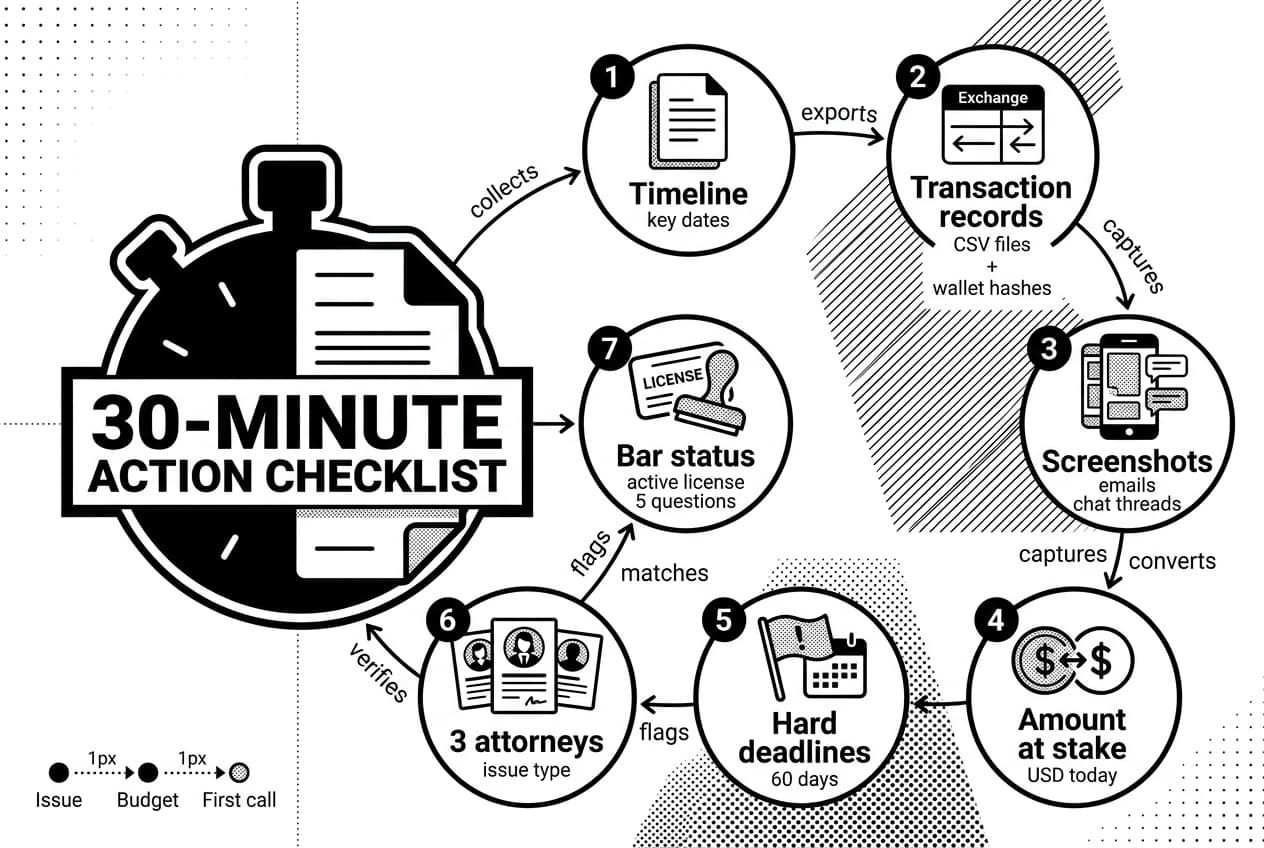
30-Minute Action Checklist
- Write your timeline. Include every key date, deadline, platform, asset, and amount.
- Export transaction records. Pull CSV files from exchanges and copy wallet transaction hashes from block explorers.
- Save screenshots and transcripts. Capture balances, error messages, support tickets, emails, and chat threads.
- Estimate the amount at stake. Convert the asset value to USD using today's price and note the date.
- Identify hard deadlines. Flag any court, tax, exchange, or regulator deadline within 60 days.
- Shortlist three attorneys. Match each candidate to your issue type, not just the crypto label.
- Verify bar status. Check active license status before you share sensitive documents.
- Prepare five questions. Ask about relevant experience, fees, timeline, staffing, and first deliverable.
If you complete this checklist, you will enter the first consultation better prepared than most prospective clients. That usually means a shorter call, a clearer budget, and a better chance of hiring the right crypto lawyer for the problem you actually have.
Frequently Asked Questions
- What does a crypto lawyer do?
- A crypto lawyer advises on legal issues involving digital assets, blockchain businesses, token launches, exchanges, DeFi, NFTs, regulatory compliance, disputes, fraud, and government investigations. They are distinct from CPAs, who handle taxes, cybersecurity experts, who protect systems, and blockchain forensic analysts, who trace transactions on-chain.
- How much does a crypto lawyer cost?
- Most crypto lawyers charge between $300 and $1,000 or more per hour. Initial consultations range from free to $500, and retainers typically start in the low thousands. Litigation, regulatory defense, and cross-border asset recovery tend to cost significantly more due to their complexity and time demands.
- Can I sue a crypto company?
- Yes, in some cases. Success depends on the company's terms of service, any arbitration clauses, jurisdiction, available evidence, and whether the company can be served and holds recoverable assets. Preserve all transaction records, communications, and account screenshots immediately, then consult litigation counsel as soon as possible.
- What type of attorney do I need to recover crypto losses?
- Look for a lawyer experienced in crypto fraud, asset recovery, civil litigation, and emergency injunctions, ideally one who works alongside blockchain forensic investigators. Tax losses, exchange disputes, compromised wallets, and investment fraud each involve different legal strategies, so the right attorney depends on your specific situation.
Sources
Author

Crypto analyst and blockchain educator with over 8 years of experience in the digital asset space. Former fintech consultant at a major Wall Street firm turned full-time crypto journalist. Specializes in DeFi, tokenomics, and blockchain technology. His writing breaks down complex cryptocurrency concepts into actionable insights for both beginners and seasoned investors.