Atlantic Council CBDC Tracker: A 2026 Guide to Using It

What is the Atlantic Council CBDC Tracker?
If you want to understand the global race for the future of money, the Atlantic Council CBDC Tracker is your most important dashboard. Developed by the Atlantic Council's Geoeconomics Center, this interactive tool provides an up-to-the-minute look at how countries are approaching central bank digital currencies, often called CBDCs.
But it's more than just a map of government projects. The tracker also monitors the growth of private-sector innovations like stablecoins and the broader crypto market, giving you a complete picture of the evolving financial system. It helps answer key questions: Which nations are leading the charge? How many countries testing digital currency have already launched? What is the status of the digital dollar or euro?
Instead of just looking at the findings, this guide will show you how to use the cbdc tracker yourself. You'll learn how to use its features, interpret the data, and filter information to conduct your own analysis. By the end, you'll be able to confidently monitor global digital currency progress on your own terms.
Understanding the Tracker's Key Features & Layout
Before you start pulling data, let's get you familiar with the main dashboard. When you first open the Atlantic Council CBDC Tracker, you're greeted by a clean, data-rich interface. Think of this as your command center for global digital currency information. The layout is designed to give you a high-level overview at a glance, with options to explore deeper. Let's break down the two most important components you'll be using.
The Interactive Map
The centerpiece of the tracker is the large, color-coded world map. This isn't just a static image; it's your primary tool for visual analysis. Each country is shaded with a specific color that instantly tells you where it stands in its central bank digital currency journey. A quick look shows you regional trends, highlighting hotspots of activity in places like the Caribbean, China, and Nigeria. You can hover over any country to see its name and current status.
CBDC Status Legend
So, what do those colors mean? Below the map, you'll find the legend, which is the key to interpreting the data. Understanding these categories is essential for using the cbdc tracker effectively.
- Launched: These countries have fully rolled out a CBDC for public use.
- Pilot: The CBDC is in a live testing phase with a limited group of users.
- Development: A country is actively building the technology for its CBDC.
- Research: The central bank is formally researching the pros and cons, but no decision to build has been made.
- Inactive: Research was conducted, but work has been dormant for over two years.
- Canceled: The country has officially halted its CBDC project.
Step 1: Explore the Interactive CBDC Map
Now that you're familiar with the general layout, let's get into the heart of the tool. The interactive map is your primary window into global CBDC developments, offering a powerful, at-a-glance visual summary of where every country stands. Getting comfortable with its controls is the first step to unlocking its potential. Follow these steps to master the map's functions:
- Explore Regions by Panning and Zooming. Use your mouse to click and drag the map to focus on different continents. You can also use the zoom controls (plus and minus icons) or your scroll wheel to get a closer look at activity in specific regions, like the European Union or Southeast Asia.
- Hover Over Countries for Quick Insights. For a fast update, just move your cursor over any country. A small tooltip will appear showing its name and current CBDC status—like 'Research', 'Pilot', or 'Launched'. This is perfect for quickly scanning an area to understand the general trend.
- Click on a Country for Detailed Information. When you want to go deeper, simply click on a country. This action opens a dedicated data panel where you'll find key details like the project name, the central bank in charge, and a timeline of major milestones.
- Filter the Map to Focus Your Research. Look for the legend or filter panel, usually on the side of the screen. Here, you can check or uncheck boxes to show only countries with a specific status. For example, selecting the 'Launched' filter instantly declutters your view to show only the pioneers in the field.
By following these steps, you can move from a high-level overview to a granular analysis of any single project.
Step 2: Analyze Different Types of CBDCs (Retail vs. Wholesale)
Now that you're comfortable moving around the map, the next step is to understand what you're actually looking at. Not all digital currencies are created equal. A country's choice between a retail or a wholesale CBDC reveals a lot about its economic goals. The Atlantic Council CBDC Tracker makes distinguishing between them simple.
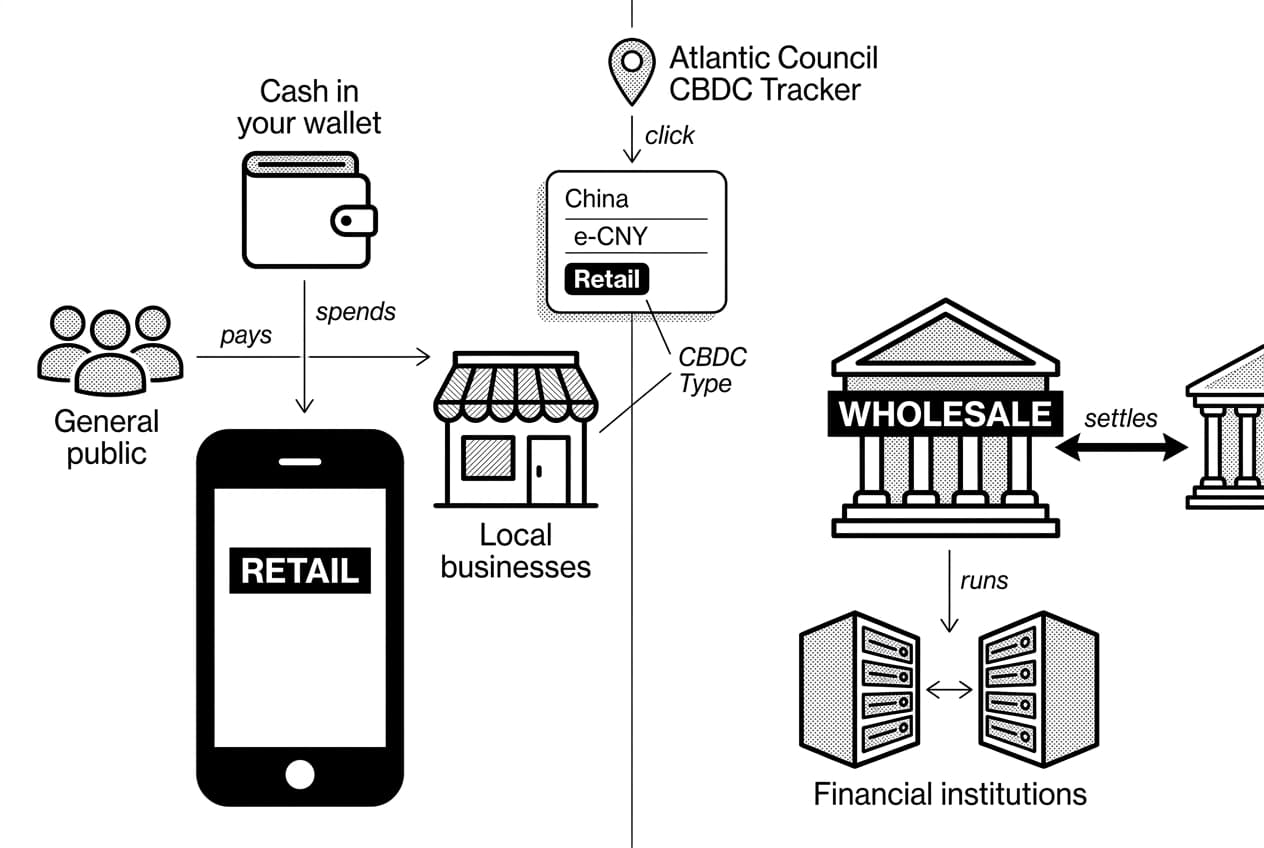
First, let's clarify the terms. A retail CBDC is designed for the general public. Think of it as a digital version of the cash in your wallet, intended for you, your neighbors, and local businesses to use for everyday transactions. On the other hand, a wholesale CBDC is a specialized tool built for financial institutions. Banks and other large entities would use it to settle massive payments between one another quickly and securely.
To see this in action, click on any country on the tracker's map. A detailed pop-up or side panel will appear with specifics about that nation's project. Look for a field labeled "CBDC Type." For example, if you click on China, you will see its e-CNY project is clearly marked as "Retail." This immediately tells you their focus is on a currency for public use. Exploring the cbdc tracker this way helps you move beyond headlines and analyze the real-world intentions behind each project.
Step 3: Track the Progress of Major Economies
Now that you can distinguish between different CBDC types, let's focus on the geopolitical story. The Atlantic Council CBDC Tracker is an invaluable tool for monitoring the world's largest economic players as they move along the path to digital currency. By filtering the map for specific countries, you can get an instant snapshot of their progress and understand the global competition.
The United States: Project Hamilton and the Digital Dollar
When you center the map on the United States, you'll see it is still marked as being in the research phase. As of 2026, the US has not committed to a digital dollar. The tracker notes ongoing research from initiatives like the Federal Reserve's Project Hamilton. This cautious approach reflects the intense political debate surrounding a digital dollar and its potential impact on the existing financial system.
China: The e-CNY Pilot Expansion
In stark contrast, China is a world leader in this space. The cbdc tracker clearly shows China in an advanced pilot stage. You can see details about its retail CBDC, the e-CNY (or digital yuan), which is already being tested by millions of citizens in major cities. This first-mover advantage gives China significant influence in shaping international standards for digital currencies.
The European Union: The Digital Euro Project
The European Union represents a middle ground. On the tracker, you’ll find the European Central Bank (ECB) deep in the "investigation phase" for a Digital Euro. The project is actively developing a framework and prototype. The key focus for the EU, as highlighted in tracker updates, is designing a CBDC that respects citizen privacy while remaining compliant with stringent financial regulations.
Step 4: Go Beyond CBDCs — Exploring Stablecoin and Crypto Data
Now that you've mastered tracking central bank projects, it's time to broaden your view. A country's approach to CBDCs doesn't happen in a vacuum. The Atlantic Council CBDC Tracker also provides valuable context on other digital assets, giving you a more complete understanding of the global financial shift.
Analyze the Global Stablecoin Supply
In the main navigation menu of the tracker, locate and click on the "Stablecoins" tab. This will switch your view from the CBDC map to a detailed chart displaying the total market supply of major stablecoins. You can observe the growth of assets like USDT and USDC over time. This data is critical for understanding the private sector's influence on the digital currency space and how it competes with or complements state-led initiatives.
Check the Legal Status of Cryptocurrencies
To get a snapshot of the regulatory environment, find the map overlay or filter, often labeled "Status of Crypto." Activating this feature color-codes the world map, instantly showing you the legal standing of decentralized cryptocurrencies country by country. You can quickly identify where assets are fully legal, where restrictions apply, or where there are outright prohibitions. This provides excellent context for why a country might be pursuing a CBDC, especially when you compare it to their policies on legalized or banned cryptocurrencies.
Next Steps: Using Atlantic Council Reports for Deeper Analysis
You've now mastered the core features of the Atlantic Council CBDC Tracker. You can explore the map, compare currencies, and track progress across the globe. But the data itself is just the beginning. To truly understand the story behind the numbers, your next step is to explore the expert analysis that accompanies the tracker.
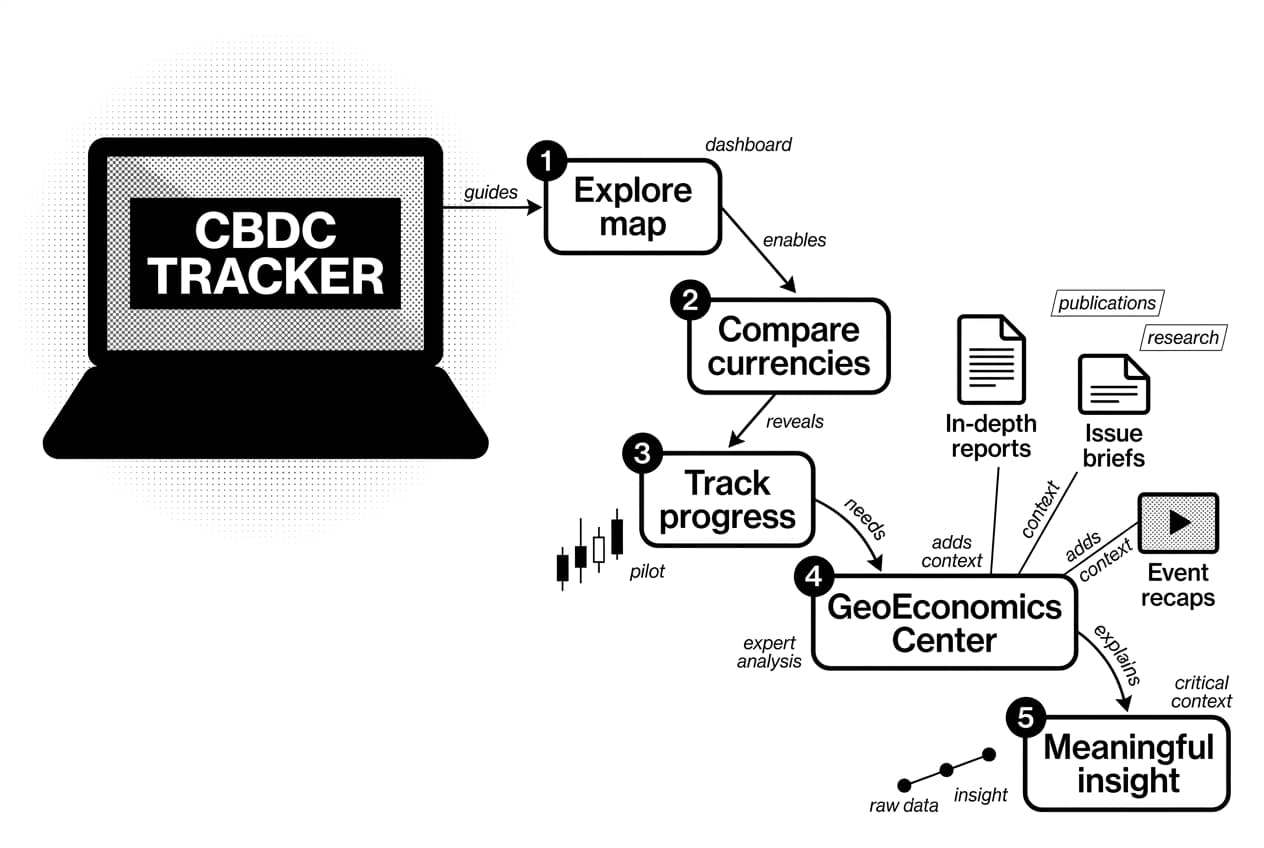
Think of the cbdc tracker as your dynamic dashboard. The in-depth reports, commentaries, and event summaries from the Atlantic Council’s GeoEconomics Center are the detailed briefings that explain why the dashboard looks the way it does. They provide the critical context that turns raw data into meaningful insight.
Where to Find Expert Commentary
On the Atlantic Council website, look for sections labeled “Publications,” “Research,” or “Expert Analysis,” often connected directly to the GeoEconomics Center. Here you’ll find a wealth of information that builds upon the tracker’s data. You can discover:
- In-depth Reports: Long-form analysis on specific topics, such as the geopolitical implications of a digital yuan or the privacy concerns of a digital dollar.
- Issue Briefs: Shorter articles that react to recent developments, like a country launching a new pilot program you just spotted on the map.
- Event Recaps: Summaries and videos from panels where global financial leaders discuss the future of money.
By pairing your own exploration of the tracker with these expert resources, you gain a far more nuanced understanding. You're no longer just observing changes—you're learning the economic, political, and technological forces driving them forward.
Frequently Asked Questions
- Which countries are using CBDC in 2026?
- According to the Atlantic Council's tracker, countries with a fully launched CBDC include Nigeria, The Bahamas, and Jamaica. Many others are in an advanced pilot phase, including major economies like China and India. This indicates a strong global trend toward wider adoption in the coming years.
- Is a CBDC coming to the US?
- The tracker currently lists the US in the 'Development' phase. While research like "Project Hamilton" explores a digital dollar, there is no official decision to launch one as of 2026. The idea remains a topic of significant political and economic debate regarding privacy, stability, and implementation.
- Are CBDCs traceable?
- Yes, unlike physical cash, CBDCs are issued by central banks and designed to be traceable. The precise level of user privacy is a critical design choice and a major policy debate for countries developing them. The EU's Digital Euro project, for example, is heavily focused on this balance.
- Is CBDC a threat to Bitcoin?
- Not directly, as they serve fundamentally different purposes. CBDCs are centralized digital versions of state-issued currency, controlled by governments. Bitcoin is a decentralized asset valued for its scarcity and censorship resistance. They can coexist but represent conflicting visions for the future of money and finance.
Sources
Author

Crypto analyst and blockchain educator with over 8 years of experience in the digital asset space. Former fintech consultant at a major Wall Street firm turned full-time crypto journalist. Specializes in DeFi, tokenomics, and blockchain technology. His writing breaks down complex cryptocurrency concepts into actionable insights for both beginners and seasoned investors.