10 Best Staking Cryptocurrency for Passive Income (2026 Guide)

What is Crypto Staking & How Does it Generate Passive Income?
Crypto staking offers a powerful way to earn passive income directly from your digital assets. Think of it like earning interest in a high-yield savings account. By participating in staking, you lock up a portion of your cryptocurrency to help secure and validate transactions on a specific blockchain network. In return for your contribution, the network rewards you with more of that same cryptocurrency. It's a fundamental process that allows investors to put their assets to work.
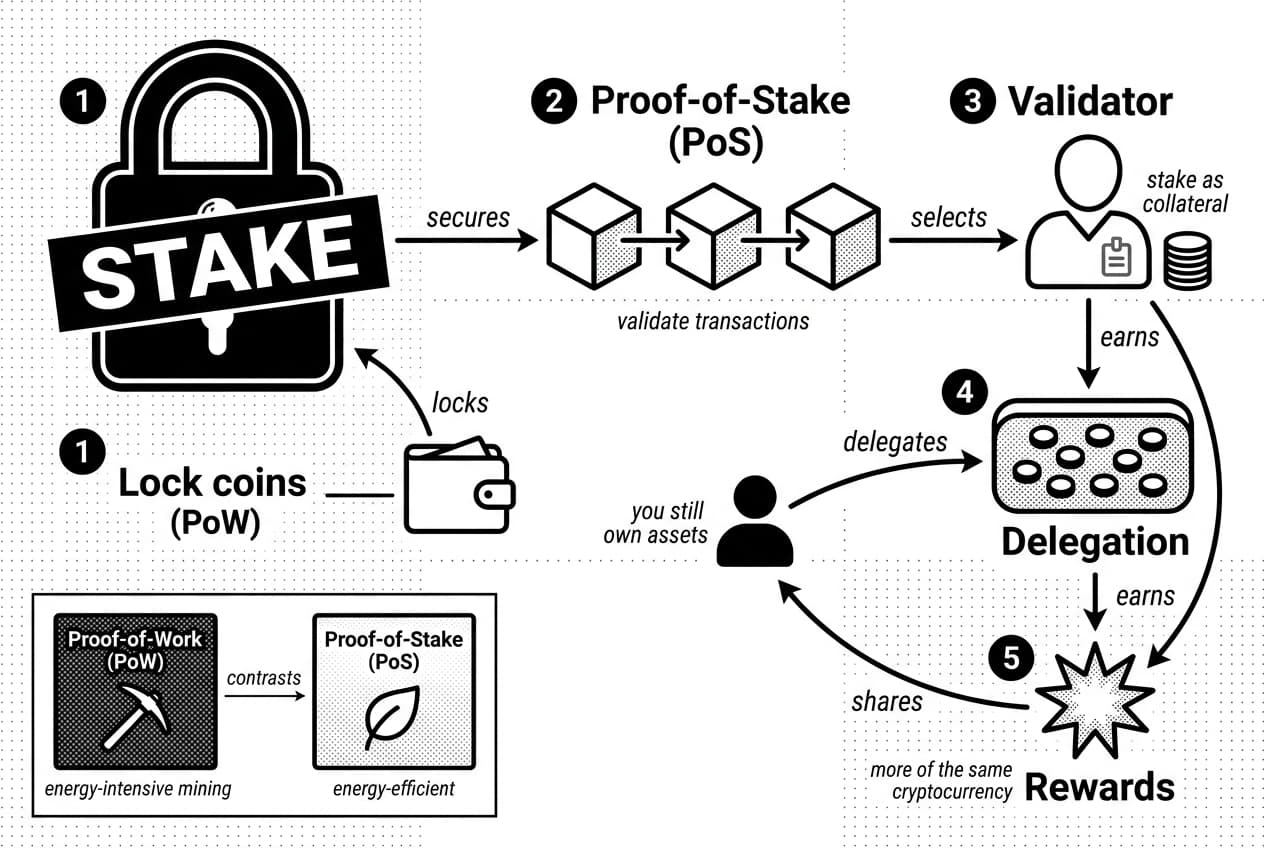
This system operates on a consensus mechanism known as Proof-of-Stake (PoS). It stands in contrast to the older Proof-of-Work (PoW) model used by Bitcoin, which relies on energy-intensive mining. In a PoS system, individuals or groups known as validators are chosen to create new blocks and confirm transactions based on the number of coins they hold and are willing to "stake" as collateral. This makes the network more energy-efficient and scalable.
For most investors, direct validation isn't practical due to the technical requirements and large capital needed. Instead, you can participate through delegation. This involves assigning your coins to a trusted validator's pool. You still own your assets, but your stake adds to the validator's weight on the network. When that validator earns rewards for securing the network, they share a portion of those earnings with you. Understanding this mechanism is the first step toward finding the best staking cryptocurrency to match your financial goals.
The Different Types of Crypto Staking Explained
Now that you understand how staking secures networks and generates rewards, the next step is choosing how you want to participate. The method you select is just as important as the asset, as it directly impacts your potential returns, security, and level of involvement. Finding the best staking cryptocurrency for your portfolio begins with understanding your options. For most investors in 2026, staking falls into one of a few main categories.
- Solo Staking: This involves running your own validator node to directly participate in a network's consensus. It offers the highest rewards but requires significant technical expertise and a large capital investment.
- Delegated Staking: You delegate your coins to a professional validator who runs a node on your behalf. This is a popular, user-friendly option that balances good returns with lower technical barriers.
- Liquid Staking: You stake your assets through a protocol and receive a tokenized receipt of your staked position. This token can then be used in other DeFi applications, allowing you to earn staking rewards while keeping your capital liquid.
- Centralized Exchange (CEX) Staking: This is the simplest method, where you stake your coins directly through an exchange like Coinbase or Kraken. It offers maximum convenience but requires you to trust the exchange with your assets.
Solo Staking vs. Delegated Staking
Running your own validator node, or solo staking, puts you in complete control. You connect directly to the blockchain, validate transactions, and earn full staking rewards without paying any fees to a third party. However, this path is not for everyone. It demands technical skill to set up and maintain the hardware, a constant internet connection, and a substantial upfront investment to meet the minimum stake (like the 32 ETH required for Ethereum). Any downtime or mistakes can lead to penalties, known as "slashing," where you lose a portion of your staked crypto.
Delegated Proof-of-Stake (DPoS) offers a much more accessible alternative. Instead of running a node yourself, you delegate your voting power and coins to a trusted validator. They do the technical work, and you receive a share of the rewards, minus a small commission they take for their service. This is a "set and forget" approach for many, making it an excellent entry point for earning passive income without the operational burdens of solo staking.
Liquid Staking
Liquid staking has become a dominant force in the world of decentralized finance. With this method, you deposit your assets into a smart contract (like Lido or Rocket Pool) and receive a liquid staking token (LST) in return. For example, if you stake ETH, you might receive stETH. This LST represents your claim on the underlying staked asset and its accruing rewards. The key advantage is that while your original crypto is locked and securing the network, your LST is free to be used across other protocols. You can lend it, provide it as collateral, or use it in DeFi staking and yield farming strategies, effectively earning multiple yields on the same capital.
Staking on Centralized Exchanges (CEX)
For sheer simplicity, nothing beats staking on a centralized exchange. Platforms like Kraken, Binance, and Coinbase have made staking as easy as clicking a button. They abstract away all the complexity of validators and nodes, presenting you with a simple interface and a clear APY. This is an ideal starting point for beginners. The primary trade-off is custody. When you stake on a CEX, you are handing over your assets to a third party. This introduces custodial risk—if the exchange fails or is hacked, your funds could be at risk. While convenient, it runs counter to the crypto ethos of "not your keys, not your coins."
Quick Comparison: Top Staking Cryptocurrencies of 2026
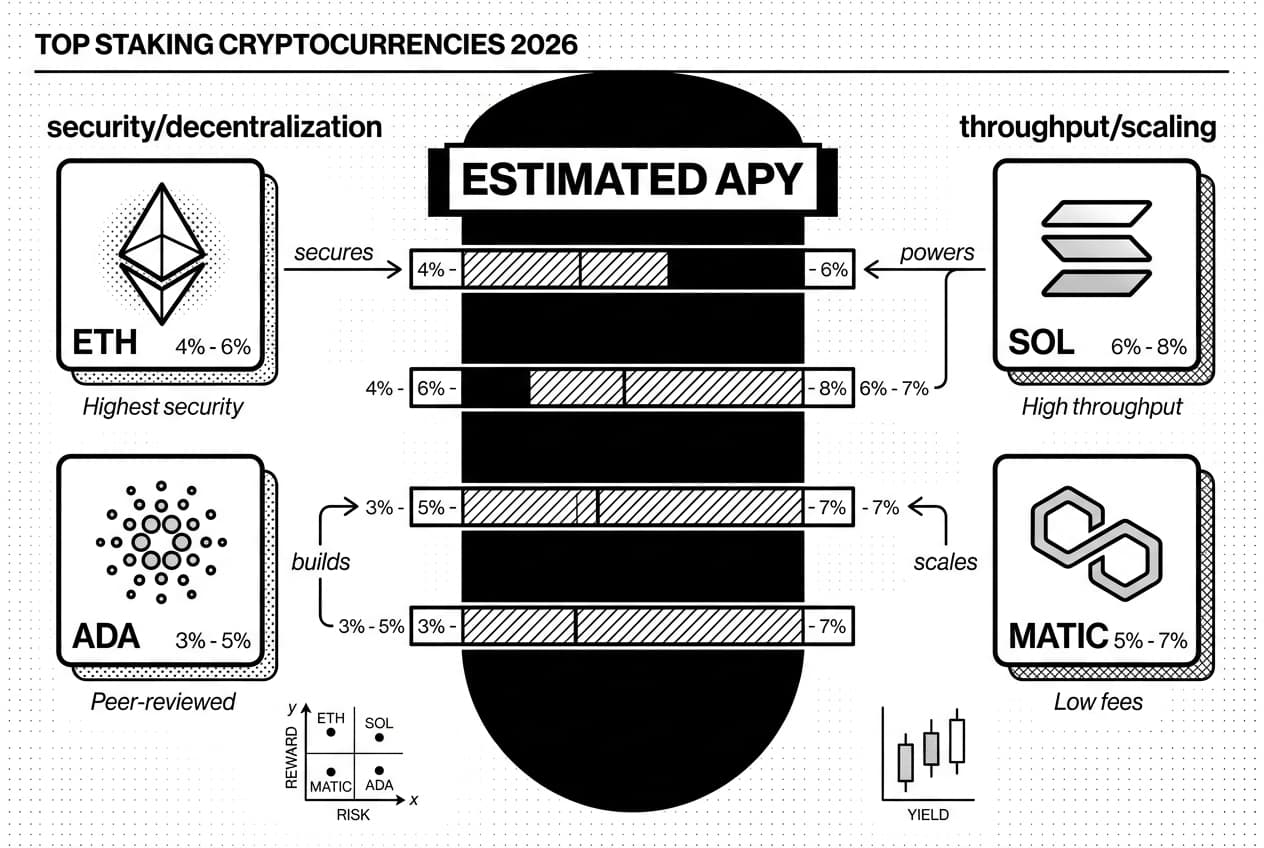
For those who want a quick snapshot of the leading options, this table highlights our top picks for earning passive income. We've organized them to give you a clear view of potential returns and what makes each one unique. This at-a-glance summary helps you compare the best staking cryptocurrency options before reading our detailed analysis.
Cryptocurrency | Ticker | Estimated APY | Key Feature |
|---|---|---|---|
Ethereum | ETH | 4% - 6% | Highest security & network decentralization. |
Solana | SOL | 6% - 8% | High throughput for DeFi and NFT applications. |
Polygon | MATIC | 5% - 7% | Leading Ethereum scaling solution with low fees. |
Cardano | ADA | 3% - 5% | Peer-reviewed development and strong community. |
The Best Staking Cryptocurrency: Our Top 7 Picks
After analyzing dozens of assets based on security, yield, decentralization, and ecosystem health, we've curated our list of the top contenders for 2026. This isn't just about chasing the highest annual percentage yield (APY); it's about finding a sustainable balance between risk and reward. Our picks range from market-leading blue-chips to original mid-caps, offering something for every type of passive income investor.
Ethereum (ETH) - Best for Blue-Chip Security & Liquid Staking
As the undisputed king of smart contracts, Ethereum's move to Proof-of-Stake has made it a foundational asset for passive income. Staking ETH directly contributes to the security of the most battle-tested and valuable smart contract network. While running your own validator node requires 32 ETH, the rise of liquid staking protocols like Lido and Rocket Pool has made it accessible to everyone. These services allow you to stake any amount of ETH and receive a liquid staking token (like stETH) in return, which you can use in DeFi while still earning rewards.
The yield on Ethereum is often seen as the "risk-free" rate of the crypto world. While its APY might be lower than some competitors, the security and stability of the network are unmatched. For investors prioritizing capital preservation and long-term, reliable yield, Ethereum is arguably the best staking cryptocurrency available.- Estimated APY: 3% - 5%
- Pros: Unmatched network security, vast and active ecosystem, high liquidity through liquid staking derivatives.
- Cons: Lower APY compared to rivals, high technical barrier for solo staking.
Solana (SOL) - Best for High APY & Ecosystem Growth
Solana has carved out a niche as a high-performance blockchain capable of processing thousands of transactions per second at a very low cost. This efficiency translates into an attractive staking model that rewards participants generously for securing the network. Staking SOL is straightforward, with numerous wallets offering native delegation to a wide selection of validators.
The appeal of staking Solana lies in the combination of a high relative APY and exposure to a rapidly growing ecosystem. From decentralized finance (DeFi) to NFTs and gaming, the development on Solana is vibrant. This activity drives network fees, which in turn contribute to staking rewards. Investors comfortable with a higher-risk, higher-reward profile will find Solana's yield and growth potential compelling.- Estimated APY: 6% - 8%
- Pros: High transaction speeds, low fees, strong APY, rapidly expanding dApp ecosystem.
- Cons: Less decentralized than Ethereum, has experienced network outages in the past.
Stacks (STX) - Best for Earning Bitcoin Yield
Stacks offers a truly unique value proposition: securing a smart contract layer for Bitcoin and earning rewards in native BTC. The process, known as "Stacking," involves locking up your STX tokens to support the network's consensus mechanism. In return, the protocol distributes the Bitcoin that miners spend on transaction fees directly to Stackers. This creates a powerful link between the two ecosystems.
For those who believe in Bitcoin as the ultimate store of value, Stacks presents an incredible opportunity. It allows you to generate a passive yield paid in the industry's premier asset without selling your BTC. This mechanism of earning rewards in native Bitcoin makes it a top choice for long-term Bitcoin holders looking to put their capital to work.- Estimated APY (paid in BTC): 4% - 7%
- Pros: Yield is paid in hard BTC, direct connection to Bitcoin's security, growing ecosystem of Bitcoin dApps.
- Cons: Yield can be variable depending on network activity, requires a minimum amount of STX for direct Stacking cycles.
Cardano (ADA) - Best for Decentralization & Low-Barrier Entry
Cardano was built from the ground up with a focus on academic rigor, formal methods, and true decentralization. This philosophy is evident in its staking mechanism. With thousands of community-run stake pools, delegating your ADA is incredibly simple and non-custodial—your coins never leave your wallet. This design makes it one of the most accessible and secure options for beginners.
The network's Ouroboros Proof-of-Stake protocol is designed to provide consistent and predictable rewards. While the APY isn't the highest on the market, its stability and the network's commitment to decentralization make it a favorite among investors who value a methodical and community-driven approach to blockchain development.- Estimated APY: 3% - 4%
- Pros: Highly decentralized with thousands of pools, non-custodial staking is very user-friendly, strong community focus.
- Cons: Slower ecosystem development compared to some rivals, lower APY.
Polkadot (DOT) - Best for Interoperability & Nominated Proof-of-Stake
Polkadot aims to be the internet of blockchains, enabling different networks to communicate and share data smoothly. Securing this ambitious vision is done through its unique Nominated Proof-of-Stake (NPoS) system. DOT holders can participate as "nominators," selecting up to 16 trusted validators to delegate their stake to. This system helps maximize decentralization and security.
Staking DOT not only earns you rewards but also plays a direct role in securing the entire ecosystem of connected "parachains." The rewards are attractive, and the process encourages active participation in network governance. Polkadot is an excellent choice for those who want to support a future of interconnected blockchains while earning a solid yield.- Estimated APY: 10% - 14%
- Pros: High potential APY, original NPoS model, key role in securing the wider parachain ecosystem.
- Cons: Staking can be more complex than other chains, has a 28-day unbonding period.
Cosmos (ATOM) - Best for App-Chain Ecosystem Rewards
Cosmos is another major player in the interoperability space, championing a vision of sovereign, interconnected blockchains. Staking ATOM secures the Cosmos Hub, the central ledger of the ecosystem, and facilitates cross-chain communication. The process is straightforward, with delegation available through popular wallets like Keplr.
One of the most exciting aspects of staking ATOM is the "airdrops" culture. Many new projects launching their own blockchain within the Cosmos ecosystem distribute their new tokens to ATOM stakers as a way to bootstrap their community. This means that in addition to the base staking APY, you have the potential to receive valuable tokens from emerging projects, adding a significant upside to your passive income strategy.- Estimated APY: 13% - 17% (not including airdrops)
- Pros: High base APY, significant potential for airdrop rewards from new ecosystem projects, active and original community.
- Cons: Airdrop value is speculative, the ecosystem can be complex to understand.
Stablecoins (USDT/USDC) via DeFi - Best for Low-Volatility Yield
While not technically "staking" in the Proof-of-Stake sense, earning yield on stablecoins is a cornerstone of passive income in crypto. By supplying stablecoins like USDT or USDC to decentralized lending protocols (e.g., Aave, Compound), you provide liquidity for borrowers and earn a variable interest rate in return. This method completely removes the price volatility associated with staking native crypto assets.
This approach is perfect for investors who want to generate income without being exposed to the wild price swings of the crypto market. The yield is typically lower than staking volatile assets but offers a much more predictable and stable return, making it a key component of a diversified passive income portfolio.- Estimated APY: 2% - 6% (variable)
- Pros: No price volatility risk, highly liquid, simple way to earn yield on cash-equivalent assets.
- Cons: Subject to smart contract risk, yields can fluctuate based on market demand for borrowing.
How to Choose the Best Crypto Staking Platform
Once you’ve identified which asset to stake, the next critical step is selecting where to do it. The platform you choose directly impacts your returns, security, and overall experience. This decision boils down to two main paths: using a centralized exchange or a non-custodial wallet.
Centralized exchanges like Kraken and Coinbase offer unmatched convenience. Staking is often just a few clicks away, abstracting away the technical complexities. This makes them an excellent starting point for newcomers. However, this simplicity comes with a trade-off. You are trusting the exchange to hold your assets, which introduces specific custodial risks. The mantra "not your keys, not your crypto" is paramount here.
For those who prioritize absolute control, a non-custodial wallet like Xverse is the superior option. You hold your own private keys, giving you full sovereignty over your funds. This approach provides greater security from platform failures but demands more personal responsibility and technical understanding. Choosing the best staking cryptocurrency is only half the battle; choosing the right venue is just as important.
Key Factors for Your Decision
- Security and Control: Decide on your comfort level. Are you okay with a reputable third party managing your crypto, or do you insist on complete self-custody?
- Fees and Commissions: Most centralized staking services take a percentage of your rewards as a commission. These fees can vary widely, so compare them carefully as they directly reduce your passive income.
- Supported Assets: Before committing to a platform, confirm it supports the specific cryptocurrency you plan to stake. Not all platforms offer staking for every proof-of-stake coin.
- Ease of Use: Consider the user interface. Exchanges are typically designed for simplicity, while some non-custodial wallets and direct delegation methods can have a steeper learning curve.
The Risks of Crypto Staking You Must Understand
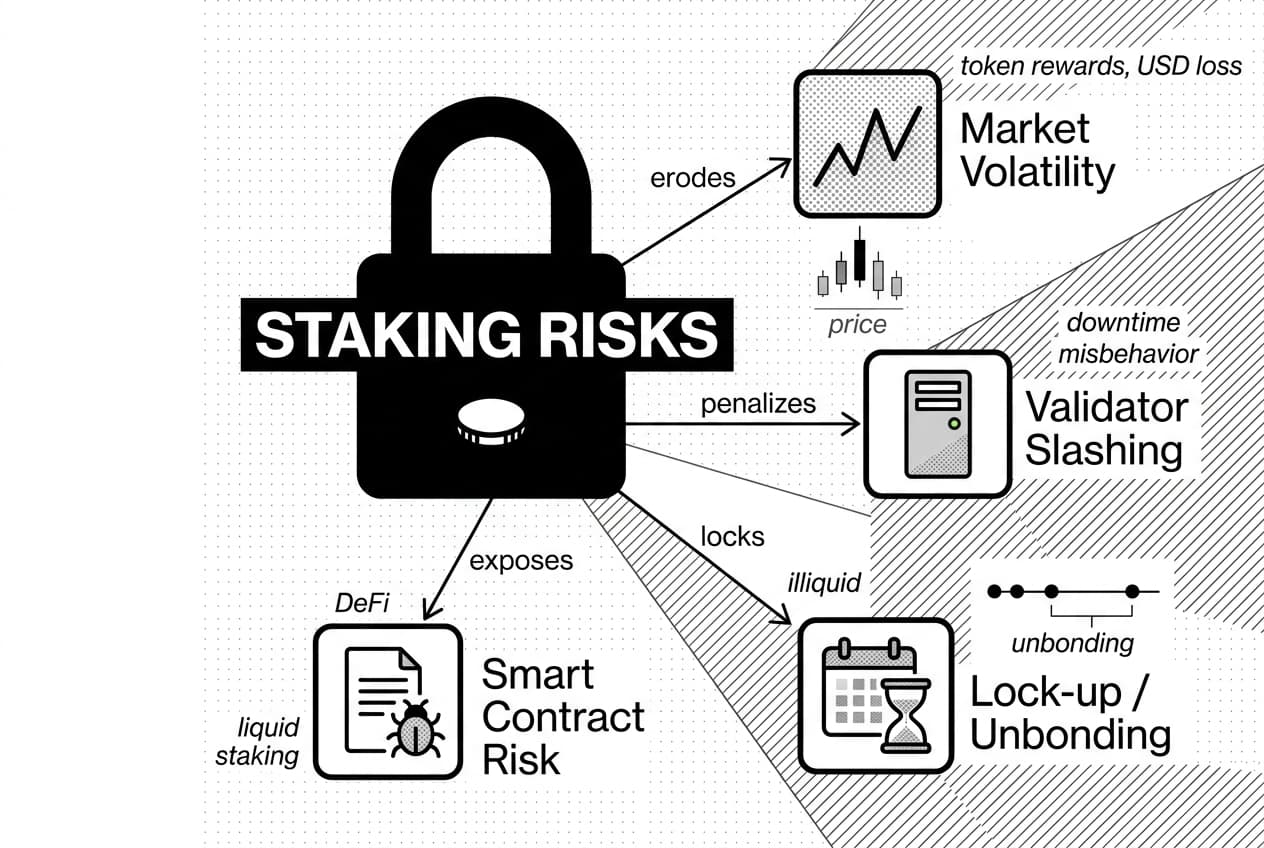
While the passive income potential is compelling, a clear-eyed view of the risks is essential before you commit your capital. Staking is not a risk-free savings account. Understanding these potential downsides is a critical step in selecting the best staking cryptocurrency for your personal risk tolerance.
Market and Price Volatility
The most significant risk is the underlying volatility of the asset itself. Staking rewards are typically paid in the native token. If that token's price falls by 50%, a 10% APY won't protect your portfolio from substantial losses. Your dollar-denominated returns can easily turn negative, even while you are accumulating more tokens.
Slashing and Validator Penalties
When you delegate your stake, you are trusting a validator to act honestly and maintain their node's uptime. If a validator misbehaves or has significant downtime, the network can "slash" a portion of their staked assets—including yours—as a penalty. Choosing a reputable validator is non-negotiable to mitigate this risk.
Lock-up and Unbonding Periods
Many Proof-of-Stake networks require a "lock-up" or "unbonding" period when you decide to withdraw your funds. This can range from a few days to several weeks. During this time, your assets are illiquid. You cannot sell them, leaving you completely exposed to market volatility without any way to react to a sudden price crash.
Smart Contract Vulnerabilities
With liquid staking protocols and other DeFi staking platforms, you introduce smart contract risk. A bug, exploit, or flaw in the underlying code could be targeted by hackers, potentially leading to a partial or complete loss of your staked funds. Always verify a protocol's security audits and track record before depositing assets.
Frequently Asked Questions
- What is the most profitable staking crypto?
- The "most profitable" staking crypto often carries the highest risk. Newer altcoins might offer triple-digit APYs, but their value can be extremely volatile. Established coins like Ethereum provide more stable, albeit lower, returns. Ultimately, the best choice depends entirely on your personal risk tolerance and your long-term investment strategy.
- What is the best crypto to use on stake?
- There's no single "best" crypto for everyone, as it depends on your goals. For network security and stability, consider Ethereum. For potentially higher yields, look at Solana. If earning Bitcoin is your aim, Stacks is an option. For the lowest volatility, stablecoins are ideal. Review our main list to match a coin to your specific strategy.
- Can you make $1000 a day with crypto staking?
- While technically possible, making $1000 a day from staking would require an enormous capital investment, likely millions of dollars. For the average investor, this is highly unrealistic. Pursuing such high returns would also involve taking on an immense level of risk, as the underlying assets could fluctuate dramatically in value.
- Is staking crypto really worth it in 2026?
- For long-term believers in a project, staking in 2026 is absolutely worth considering. It allows you to earn passive income on your holdings while actively supporting the network's security and operation. While market volatility and lock-up periods are risks, the potential for yield makes it a compelling strategy for many.
Sources
Author

Crypto analyst and blockchain educator with over 8 years of experience in the digital asset space. Former fintech consultant at a major Wall Street firm turned full-time crypto journalist. Specializes in DeFi, tokenomics, and blockchain technology. His writing breaks down complex cryptocurrency concepts into actionable insights for both beginners and seasoned investors.