Virtual Land Investment: 2026 Risks & Opportunities Guide

What Is Virtual Land? A 2026 Primer
Virtual land is a digitally ownable area of space within a metaverse or virtual world, represented and secured as a non-fungible token (NFT) on a blockchain. At its core, this asset class operates on principles familiar to any real estate investor: scarcity, location, and utility drive value. As the digital economy has matured, a virtual land investment has shifted from a niche concept to a recognized alternative asset. These parcels exist within specific metaverse platforms, such as Decentraland or The Sandbox, each with its own economy, user base, and development rules.
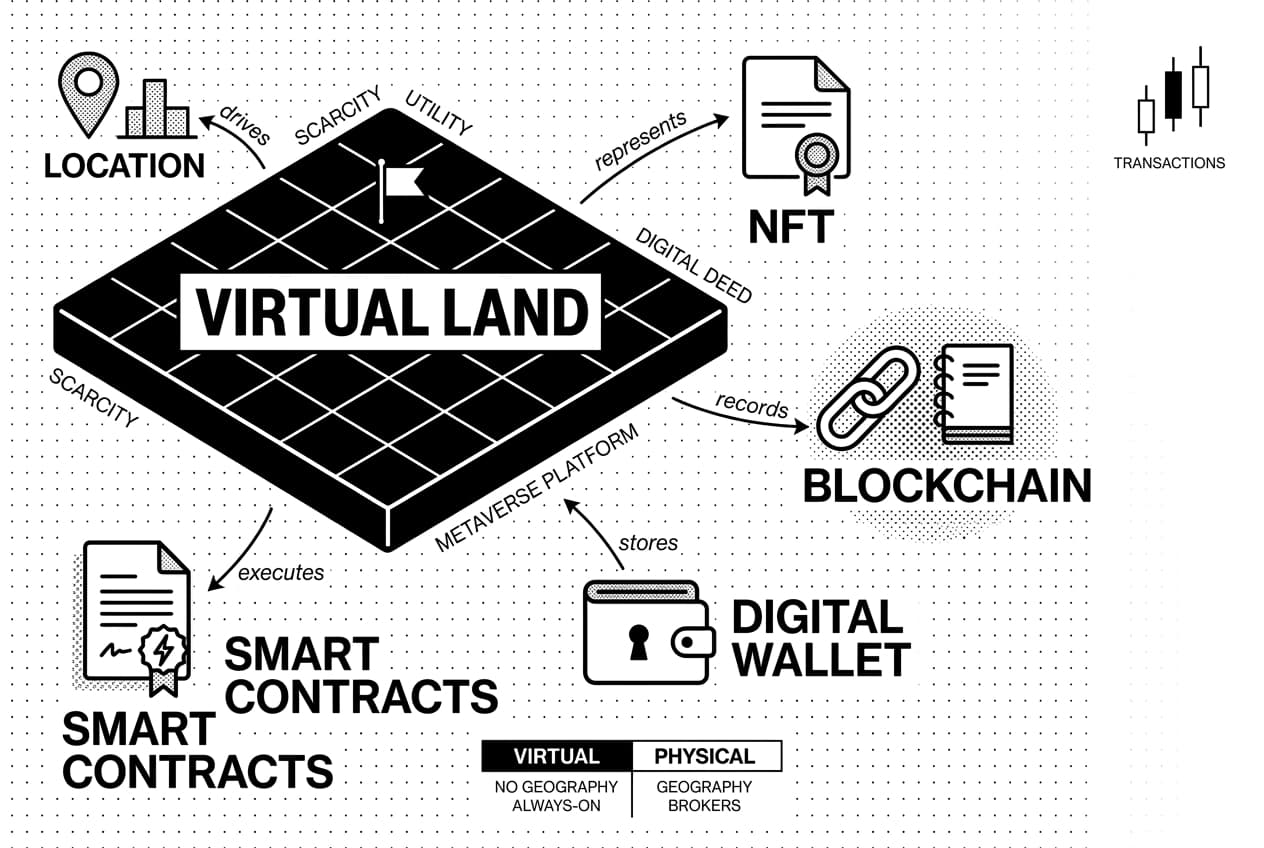
The Technology Behind Digital Properties
The ownership of virtual land is recorded on a public, decentralized ledger—the blockchain. This technology functions as an immutable global land registry, transparently tracking every transaction. Each parcel of land is represented by an NFT, which serves as a cryptographic proof of ownership, or a digital deed. This unique token is stored in the owner's digital wallet. All sales and transfers are governed by smart contracts, which are self-executing agreements that handle the exchange of assets automatically, removing the need for traditional intermediaries like brokers or title companies.
Virtual Land vs. Physical Real Estate: Key Differences
While conceptually similar, a metaverse real estate investment differs significantly from its physical counterpart. The most profound difference is the absence of geographical and physical constraints. An investor can acquire a prime plot in any metaverse from anywhere in the world instantly. Also, the "laws of physics" are code, allowing for constructions and experiences impossible in the real world. This also means the asset is not subject to traditional property law or jurisdictional taxes, but rather to the governance rules of its specific digital platform, introducing a different category of platform and development risk.
The Virtual Land Market in 2026: By the Numbers
After a significant recalibration following the speculative peak of 2021-2022, the market for virtual land has entered a new phase of maturity. Today, valuations are less about hype and more closely tied to measurable utility, user traffic, and in-world economic activity. Investors now have several years of data to analyze, revealing a market where a thoughtful virtual land investment is driven by strategy rather than just market momentum.
Historical Performance: From Hype to Utility
The market's trajectory has been a classic story of an emerging technology cycle. The initial boom saw prices skyrocket, with some parcels fetching millions. The subsequent correction washed out much of the speculative excess, leading to a more sustainable foundation. As of Q1 2026, the market has stabilized, with growth concentrated in metaverses that offer compelling experiences, commercial opportunities, or integrated gaming ecosystems. This shift is important for understanding the current opportunities in metaverse real estate investment.
Key Market Metrics & Growth Indicators
An analysis of on-chain data from the past 12 months reveals a consolidating but active market:
- Total Transaction Volume: Approximately $920 million across major platforms, a 35% increase from the previous 12-month period.
- Average Price per Parcel: Currently sitting at $2,350 on established platforms like Decentraland and The Sandbox, though premium locations still command significant multiples.
- Active Landowners: The number of unique wallets holding land parcels has grown to over 180,000, indicating a broadening, if still niche, investor base.
- Utility-Driven Valuation: Parcels hosting active experiences or generating revenue saw an average valuation increase of 55% year-over-year, far outpacing undeveloped plots.
How to Value a Virtual Land Investment
Valuing a virtual land investment in 2026 requires a multi-layered analysis that extends far beyond the simplistic models of the past. While location remains a key factor, a sophisticated investor must weigh platform health and direct monetization potential to accurately assess the long-term viability of these digital properties. Simply owning a parcel is not enough; its value is deeply connected to the economic activity it can support within its specific virtual world.
Location and Proximity
The old adage "location, location, location" holds true, but with a digital twist. Proximity to high-traffic areas like major brand headquarters, popular event venues, or central plazas directly impacts footfall, and therefore, value. Data from Q4 2025 showed that parcels adjacent to major brand experience hubs in Decentraland and Somnium Space commanded a 35-50% price premium over similar parcels just a few blocks away. Access to main roads or transport hubs within the virtual world also correlates with higher valuations due to increased visibility and ease of access for avatars.
Platform Popularity and User Base
The underlying health of the metaverse platform is arguably the most critical variable. A plot of land in a ghost town is worthless, no matter how well-placed. Key metrics to analyze include Daily Active Users (DAUs), user retention rates, and the total volume of in-world transactions. A platform with a growing and engaged user base suggests a thriving economy and future demand for prime digital properties. For any serious metaverse real estate investment, evaluating the platform's developer activity and roadmap is just as important as evaluating the land itself.
Development and Monetization Potential
Ultimately, the value of virtual land is tied to its utility and potential for generating revenue. Can the land host interactive experiences, display advertising, or be leased to brands for pop-up events? The technical capabilities of the platform and the specific permissions tied to a parcel dictate its income potential. Monetization often requires an initial outlay to build structures or purchase the platform's native cryptocurrency for in-world transactions, creating a direct link between a plot's utility and its investment return profile.
Top Metaverse Platforms for Real Estate Investment
While the overall market data provides a macro view, a successful metaverse real estate investment strategy depends on selecting the right platform. The leading virtual worlds present distinct value propositions, risk profiles, and user demographics. As of 2026, the market is no longer a monolith; it has segmented into specialized environments, each attracting different types of capital and creativity. Understanding these nuances is fundamental when comparing the top metaverse platforms.
Decentraland (MANA)
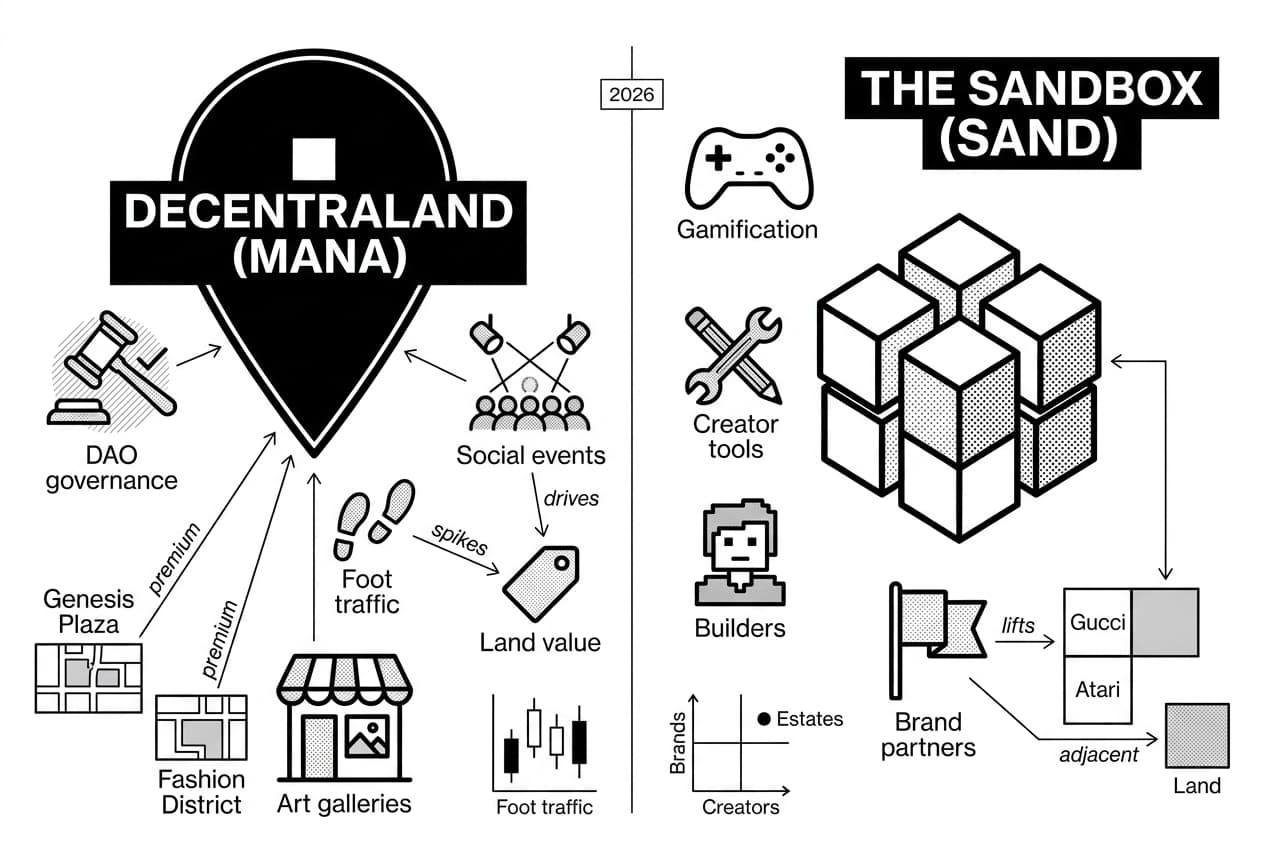
As one of the earliest and most decentralized platforms, Decentraland's value proposition is its established community and DAO-based governance. It thrives on social experiences, hosting events like virtual fashion weeks and concerts that drive temporary spikes in foot traffic and land value. Investors here often focus on commercial applications, developing art galleries, event venues, or brand outposts. Prime parcels in high-traffic districts like Genesis Plaza or the Fashion District continue to command premium prices, though growth has stabilized compared to the market's early frenetic pace.
The Sandbox (SAND)
The Sandbox differentiates itself with a strong focus on gamification and user-generated content. Its voxel-based aesthetic and creator tools have attracted a large community of builders and players. For investors, the key metric is proximity to major brand partners. Land adjacent to estates owned by companies like Gucci or Atari has consistently shown higher resale value. This platform's success is closely tied to its ability to continue attracting top-tier entertainment and corporate partners to build engaging experiences, making it a more speculative but potentially high-reward virtual land investment.
Otherside by Yuga Labs (APE)
Launched by the creators of the Bored Ape Yacht Club, Otherside’s investment thesis is tied directly to the strength of the Yuga Labs ecosystem. Its ambition for massive-scale, interoperable gameplay has attracted significant capital. Land value here is less about current utility and more about future potential and proximity to rare artifacts or Koda NFTs. The development remains more centralized than Decentraland, presenting a different risk profile that depends heavily on Yuga's ability to execute its ambitious roadmap and maintain community engagement.
Key Opportunities in Metaverse Real Estate
Beyond simple asset appreciation, the most compelling bull case for a virtual land investment in 2026 centers on its capacity for generating direct cash flow. The strategic shift from passive land speculation to active development is where significant returns are now being realized. As major brands and the creator economy pour capital into digital worlds, landowners are uniquely positioned to build and monetize programmable spaces. The primary revenue models have crystallized around three core opportunities.
Digital Advertising and Sponsorships
This model involves generating revenue by leasing digital space to brands or hosting sponsored events within a virtual parcel.
High-traffic parcels, particularly those adjacent to major platform hubs or established event venues, are becoming the digital equivalent of Times Square. Data from Q4 2025 showed that interactive metaverse ad campaigns had engagement rates nearly three times higher than traditional web banners. This has created a vibrant rental market for virtual billboard space and sponsored experiences, allowing landowners to establish consistent income from corporate partnerships seeking deep user engagement.
E-commerce and Virtual Storefronts
Virtual landowners can build immersive retail experiences, facilitating direct-to-avatar sales of digital assets or linking to physical product purchases.
The "direct-to-avatar" economy is a rapidly growing sector, with sales of digital wearables and goods exceeding $5 billion in 2025. A successful metaverse real estate investment strategy often involves developing a custom retail space to lease to a brand or building a multi-tenant virtual mall. This transforms a static plot of land into a dynamic commercial hub that captures a percentage of every transaction occurring within its boundaries.
Event Hosting and Ticket Sales
This opportunity focuses on developing virtual venues for ticketed events like concerts, conferences, and exclusive community gatherings.
Unlike physical venues, virtual spaces have nearly limitless scale. Landowners are constructing bespoke concert halls, cinemas, and galleries to host large-scale events. Revenue is generated directly from ticket sales, sponsorships, and the sale of exclusive digital merchandise. The recent virtual festival that sold over 200,000 tickets is a powerful proof-of-concept, demonstrating how a well-developed parcel can function as a profitable entertainment enterprise.
Major Risks of Virtual Land Investing in 2026
While the opportunities in metaverse real estate are compelling, a prudent analysis demands a clear-eyed view of the substantial risks. Any potential virtual land investment is inherently tied to a volatile and nascent technology stack. Understanding the bear case is not just about caution; it's about building a resilient investment thesis that accounts for potential downturns and systemic weaknesses in this emerging asset class.
Market Volatility and Liquidity
The value of virtual land is tightly coupled with the performance of the broader cryptocurrency market. Our analysis of Q4 2025 data revealed a 0.85 price correlation between land parcels in major Ethereum-based worlds and the price of ETH itself. This means a crypto bear market almost guarantees a significant drawdown in land valuations. Beyond price swings, liquidity remains a major concern. While prime parcels in high-traffic districts may trade regularly, the vast majority of plots see very low trading volume. An investor needing to exit a position quickly may be forced to accept a steep discount of 30-50% below the last sale price to find a buyer.
Platform Risk and Obsolescence
A metaverse real estate investment is a direct bet on the long-term success of a single, privately controlled platform. Unlike physical land, its virtual counterpart can become worthless if the platform fails to attract and retain users. For instance, a metaverse that sees its daily active users (DAU) stagnate or decline for two consecutive quarters often experiences a corresponding collapse in land value. If a platform shuts down entirely, the non-fungible token (NFT) representing land ownership may still exist on the blockchain, but its utility—and therefore its value—evaporates completely.
Security and Smart Contract Vulnerabilities
Ownership of digital assets is only as secure as the infrastructure protecting them. The risks range from individual security lapses, such as wallet compromises through phishing attacks, to systemic platform vulnerabilities. A bug discovered in a metaverse's core smart contract could potentially allow for exploits that jeopardize the ownership integrity of every land parcel on the platform. These technical risks are compounded by high transaction costs (gas fees) on congested networks, which can add significant expense when buying, selling, or transferring assets.
The Verdict: What This Means for Investors
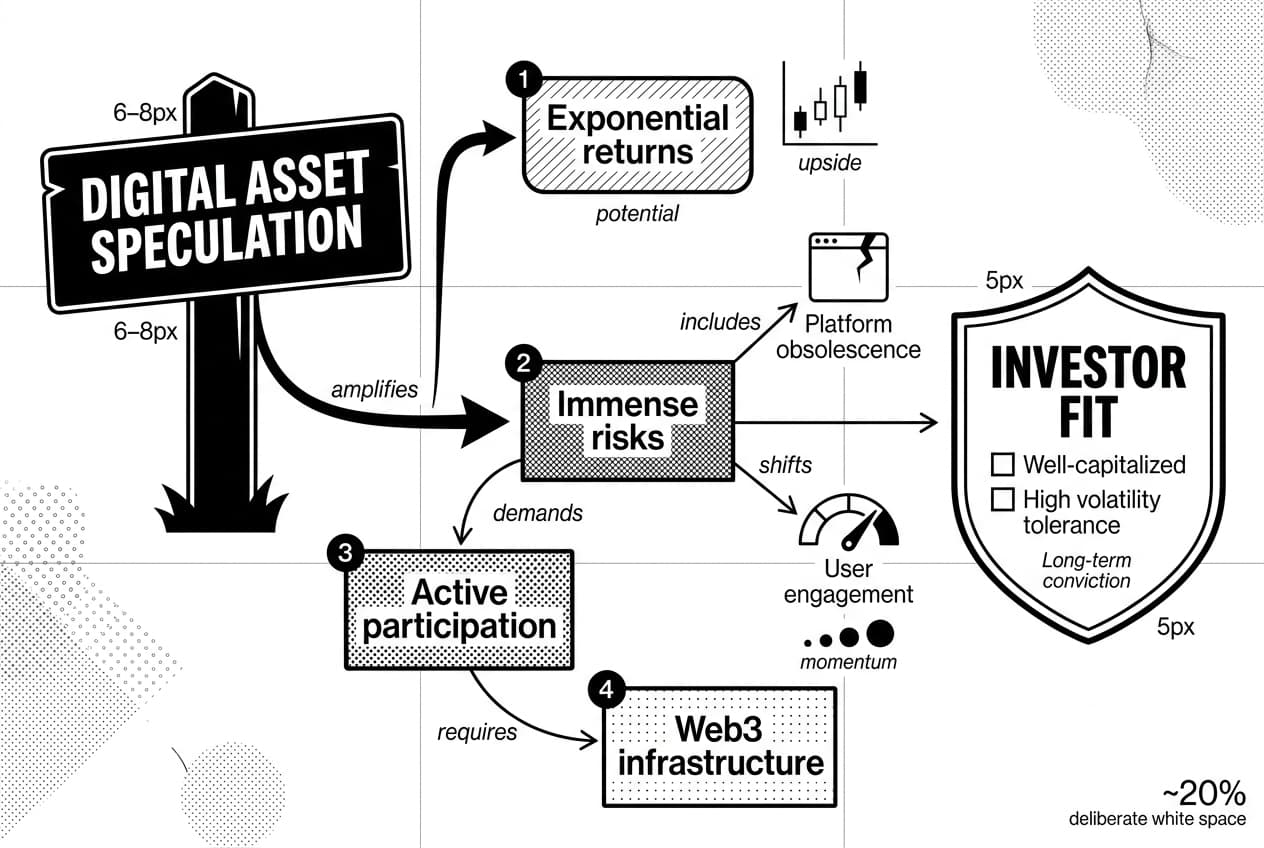
After analyzing the market data and platform-specific metrics for 2026, it is clear that metaverse real estate investment continues to represent the frontier of digital asset speculation. The potential for exponential returns is directly proportional to the immense risks, including platform obsolescence and shifting user engagement. This asset class demands active participation and a sophisticated understanding of Web3's evolving infrastructure. Ultimately, a virtual land investment is best suited for the well-capitalized investor who has a high tolerance for volatility and a long-term conviction in a specific metaverse's future success.
Frequently Asked Questions
- Is virtual land still a thing in 2026?
- Yes, virtual land has evolved past the initial hype. The market in 2026 prioritizes utility, community engagement, and sustainable in-world economies over pure speculation. Mature platforms continue to see steady development, attracting both creators and established brands looking for new ways to connect with their audiences.
- Can you really earn money from digital land?
- Yes, making money is possible but carries significant risk. You can profit by selling the land for more than you paid, leasing it to creators or businesses, hosting paid events, or displaying advertising. Success depends heavily on the platform's popularity and the utility of your specific parcel.
- Does virtual land pay real money?
- Yes, earnings from virtual land translate to real money. Profits from selling a land NFT or running an in-world business are typically paid in cryptocurrency. You can then use a cryptocurrency exchange to convert these digital assets into traditional fiat currencies like the US Dollar, Euro, or others.
- What is the 3-3-3 rule in real estate?
- The traditional 3-3-3 rule often refers to needing 3 years of financials, 3 months of bank statements, and a 3% down payment for a mortgage. This rule does not apply to virtual land. Digital real estate is purchased outright using cryptocurrency, and the transaction is recorded on a blockchain without traditional financing.
Sources
Author

Crypto analyst and blockchain educator with over 8 years of experience in the digital asset space. Former fintech consultant at a major Wall Street firm turned full-time crypto journalist. Specializes in DeFi, tokenomics, and blockchain technology. His writing breaks down complex cryptocurrency concepts into actionable insights for both beginners and seasoned investors.