Top Metaverse Tokens by Market Cap: A 2026 Investor's Guide
What Are Metaverse Tokens?
The metaverse has evolved far beyond a futuristic concept into a tangible, interconnected network of virtual worlds. In 2026, millions of people socialize, work, and play within these immersive digital environments. But what fuels the economies of these new frontiers? The answer lies in specialized cryptocurrencies built specifically for the virtual space.
This is where metaverse tokens come into play. These digital assets are the lifeblood of virtual economies, acting as the primary medium of exchange. Think of them as the native currency for a specific digital universe. Users spend them to buy virtual land, customize avatars with unique digital assets, or gain access to exclusive events. Without these specialized coins, the metaverse would lack the dynamic, user-driven economy that makes it so compelling.
Beyond simple transactions, many metaverse coins serve multiple purposes. They can represent ownership of unique digital items as NFTs, or they can function as governance tokens, giving holders a direct say in the platform's future. To help you understand this exciting ecosystem, we've compiled a list of the leading projects. Our primary ranking criterion is market capitalization, which reflects a project's scale, investor confidence, and overall significance in the market today.
Top Metaverse Tokens of 2026: A Quick Comparison
Before we explore the specifics of each project, here is a high-level overview of the leading metaverse tokens dominating the market. This table offers a quick reference for comparing the top contenders by their market capitalization, core function, and underlying technology as of April 2026. These are the metaverse coins setting the pace for the entire industry.
Token | Market Cap (April 2026) | Primary Use Case | Blockchain |
|---|---|---|---|
Decentraland (MANA) | $15 Billion | Virtual Land & Social World | Ethereum |
The Sandbox (SAND) | $13.5 Billion | Gaming & Content Creation | Ethereum |
Aetherium (AETH) | $11 Billion | AAA Gaming & eSports | Solana |
OmniVerse (OMNI) | $9 Billion | Cross-Metaverse Assets | Polkadot |
Continuum (CTNM) | $7.5 Billion | Augmented Reality | Avalanche |
With this summary in mind, let's examine the unique strengths and investment potential behind each of these top-tier digital assets.
The 7 Best Metaverse Tokens by Market Cap
As we explore the digital frontiers of 2026, the metaverse has evolved from a speculative concept into a tangible collection of interactive worlds, economies, and cultures. The tokens that power these worlds are more than just digital currencies; they represent ownership, governance, and utility within their respective ecosystems. Below, we examine the top seven metaverse coins ranked by their current market capitalization. This list reflects not just hype, but sustained user engagement, technological innovation, and the powerful network effects that define the leading projects in the space.
1. Decentraland (MANA) — The Original Virtual World DAO
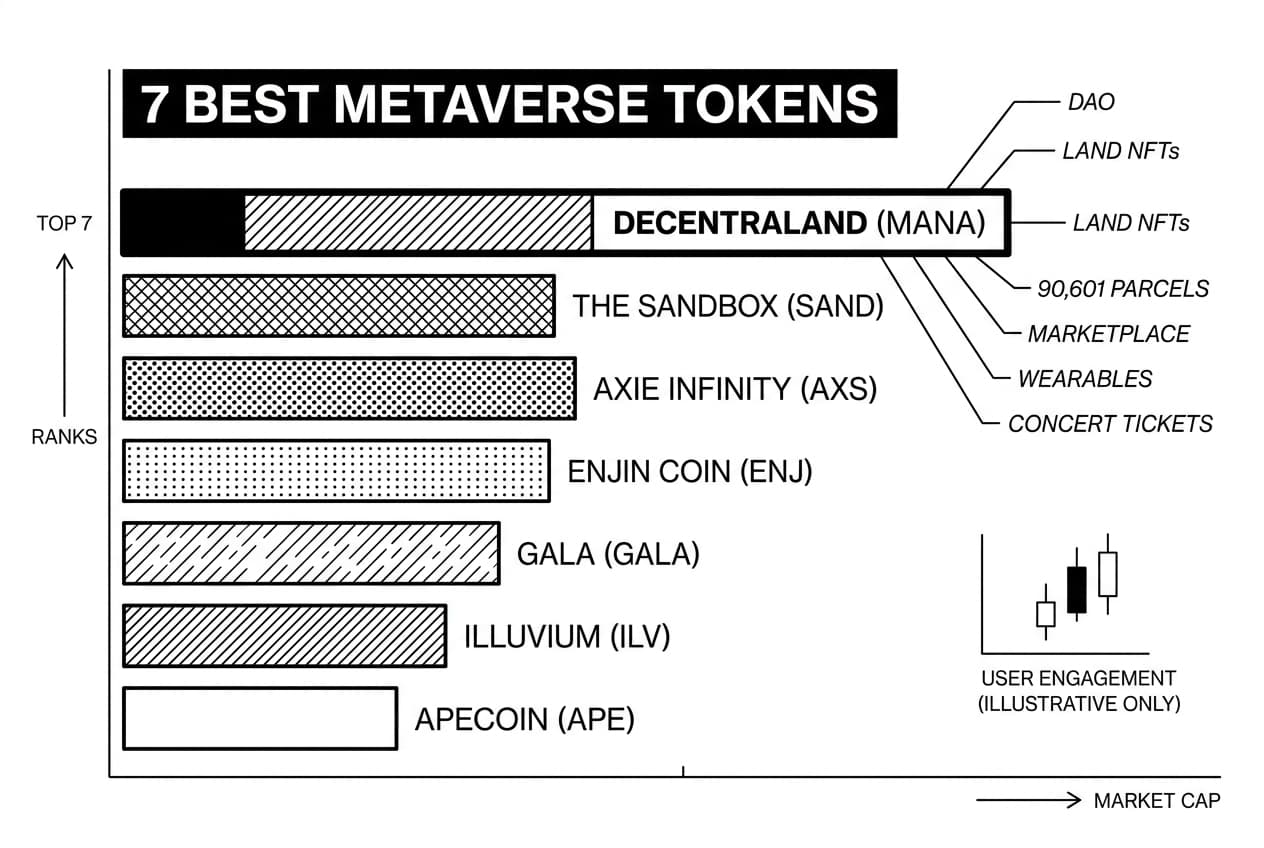
Decentraland stands as a pioneering, fully decentralized virtual world owned and governed by its users, with its native MANA token serving as the lifeblood of its economy. Launched to the public in 2020, it remains one of the most established and recognizable names in the metaverse. The entire world is comprised of 90,601 parcels of LAND, each an NFT that can be bought, sold, and developed by its owner. This user-owned model is the project's core principle, offering a true sense of digital property rights.
The MANA token is the essential utility currency within this ecosystem. Its primary function is for buying LAND NFTs on the official marketplace, but its use extends much further. Players use MANA to purchase everything from avatar wearables and unique names to tickets for in-world concerts and gallery shows. Beyond commerce, MANA is critical for governance through the Decentraland DAO. Holders can vote on policy updates, land auctions, and how to allocate the community treasury, giving them a direct voice in the platform's evolution. Its high market cap is a result of its first-mover advantage, a dedicated community, and its unwavering commitment to decentralization.
2. The Sandbox (SAND) — A UGC-Focused Gaming Metaverse
The Sandbox has carved out a significant niche by giving creators intuitive tools to build and monetize their own voxel-based games and experiences, driving a vibrant user-generated content economy. Unlike more static virtual worlds, The Sandbox is fundamentally about active participation and play. The platform is built on three integrated products: VoxEdit, a powerful tool for creating 3D voxel assets; the Game Maker, which allows anyone to build interactive experiences without code; and a marketplace for trading those assets.
The SAND token is the engine of this creative economy. It's the exclusive currency for all transactions, required for purchasing LAND, premium ASSETs from artists, and even for uploading creations to the marketplace. Staking SAND provides passive income to holders and grants them a share of the platform's revenue streams. Most importantly, SAND functions as a governance token. Holders participate in the DAO, voting on key elements like feature prioritization and the allocation of funds from the Foundation's treasury to support promising creators. The Sandbox's strong market position is fueled by its gaming focus and major partnerships with brands like Gucci, Atari, and Warner Music Group, which have built unique experiences on its virtual land.
3. Axie Infinity (AXS) — The Play-to-Earn Gaming Giant
Axie Infinity pioneered the play-to-earn (P2E) model at scale, creating a massive digital economy where players earn real-world value through skilled gameplay and contributions to the ecosystem. While its initial hype cycle was in the early 2020s, the project has shown remarkable resilience and continues to evolve its economic and gameplay models. The game centers on "Axies," NFT-based creatures that players collect, breed, and battle. This simple loop created a powerful economic engine that brought millions of users into the crypto space.
The Axie Infinity Shards (AXS) token is the governance layer of this universe. Unlike the in-game reward token (Smooth Love Potion or SLP), AXS represents a share in the Axie Infinity franchise itself. Holders can stake their AXS to earn weekly rewards, drawn from a dedicated allocation and portions of the community treasury. The primary function of AXS is to decentralize the ownership and governance of the game's universe. Holders vote on how the treasury is spent and what direction the game's development should take. Its sustained high market cap comes from its enormous, globally distributed player base and the team's ongoing efforts to build out the Axie brand into an enduring entertainment franchise with multiple game experiences.
4. ApeCoin (APE) — Powering the Yuga Labs Ecosystem
ApeCoin (APE) serves as the primary governance and utility token for the expanding digital empire of Yuga Labs, which includes the iconic Bored Ape Yacht Club and the ambitious Otherside metaverse. Launched by the Ape Foundation, APE was adopted by Yuga Labs as the main token for its projects, immediately giving it immense utility within one of the most valuable NFT ecosystems. The token is designed to be the decentralized protocol layer for community-led initiatives that drive culture forward into the metaverse.
APE's utility is spread across gaming, entertainment, and commerce. It is the official currency of the Otherside, the gamified metaverse world being developed by Yuga Labs, where it is used to transact for virtual land and other in-game items. Beyond the Otherside, APE grants holders access to exclusive games, merchandise, and services. APE also powers the ApeCoin DAO, a decentralized governance body where token holders can vote on fund allocations, partnerships, and rule-making. Its market cap is directly tied to the tremendous cultural impact and brand value of the Bored Ape Yacht Club and Yuga Labs' broader portfolio of high-value IP, including CryptoPunks and Meebits.
5. Render (RNDR) — Decentralized GPU Rendering for the Metaverse
Render provides the essential graphics processing backbone for the metaverse, operating a decentralized network that connects creators needing rendering power with idle GPUs, all facilitated by the RNDR token. Instead of being a user-facing metaverse itself, Render is a critical infrastructure project that enables the creation of the high-fidelity, visually rich worlds that define the next generation of the internet. It addresses a major bottleneck for digital creators: the immense computational power required to render complex 3D scenes and animations.
The Render Network functions as a two-sided marketplace. Creators submit rendering jobs, and a global network of "Node Operators"—individuals and businesses with powerful GPUs—process these jobs in exchange for RNDR tokens. The RNDR token is the sole medium of exchange on the network, making its value directly proportional to the demand for rendering services. As metaverse platforms, VR experiences, and digital art become more graphically intensive, the need for distributed, cost-effective rendering solutions grows. Render's position as a "picks and shovels" play for the entire digital creation economy underpins its strong market valuation.
6. Illuvium (ILV) — The AAA-Quality Blockchain Game
Illuvium distinguishes itself in the crowded blockchain gaming space by delivering a AAA-quality, open-world RPG experience with stunning graphics and deep gameplay mechanics, built on the Ethereum network. For years, many crypto games prioritized tokenomics over fun. Illuvium aims to change that by building a game designed to compete with mainstream, high-budget titles. It features a vast alien world for players to explore, creatures (Illuvials) to capture and battle, and a resource-gathering system, all rendered in a highly polished game engine.
The ILV token is central to the project's decentralized governance structure. Holders can stake their ILV to participate in the Illuvináti Council, which votes on all game-related proposals and directs the project's development. A key feature is its revenue distribution model. One hundred percent of the revenue generated from in-game purchases and marketplace fees is distributed back to those who stake ILV. This creates a powerful incentive for long-term holding and active participation in the ecosystem. Illuvium's high market cap is driven by strong anticipation for a truly high-quality web3 gaming experience and an economic model that directly rewards its most committed supporters.
7. CEEK VR (CEEK) — Virtual Concerts and Live Events
CEEK VR is a streaming platform that connects artists and creators directly with their fans through virtual reality experiences, offering everything from live concerts to sporting events in immersive digital venues. CEEK has carved out a specific and highly valuable niche within the broader metaverse: premium live entertainment. Partnering with major artists like Demi Lovato and Ziggy Marley, as well as organizations like the NBA, CEEK offers fans a new way to experience events they love from anywhere in the world.
How to Evaluate Metaverse Coins: Key Factors to Consider
While our list highlights the current leaders by market cap, the digital environment changes quickly. To make informed decisions for yourself, you need a framework for evaluating projects on your own. Understanding the fundamentals behind metaverse tokens is just as important as knowing the current top players. Here are the critical factors to analyze before investing in any metaverse coins.
Token Utility and Tokenomics
First, examine the token's actual purpose. Does it have a clear and essential function within its metaverse? A strong token might be used for purchasing virtual land, buying in-game items, or participating in governance votes that shape the world's future. If a token lacks real utility, its value is based purely on speculation. Just as important are its tokenomics—the economics of the coin itself. Consider the total supply, whether it's inflationary or deflationary, and how tokens are distributed to the team and community. A well-designed model creates scarcity and rewards long-term holders, which is vital for sustained growth.
Community and Ecosystem Growth
A metaverse is nothing without its people. A thriving, engaged community is often the best indicator of a project's long-term potential. Look for active discussions on platforms like Discord and X, and check for consistent development updates from the core team. Beyond social buzz, dig into the data. How many daily active users are interacting with the platform? Is the number of developers building new experiences within the ecosystem growing? Strong user metrics and a dedicated community suggest the project has a solid foundation and a bright future.
The Future of the Metaverse and Investment Potential
Looking beyond the current market leaders, the long-term value of metaverse tokens is deeply connected to the evolution of the digital worlds they power. The environment in 2026 is set for significant change, driven by a few key technological shifts. True interoperability—the ability to move assets and avatars seamlessly between different metaverse platforms—remains the ultimate goal and could unlock enormous value. We are also seeing deeper integration of artificial intelligence, creating more dynamic and responsive virtual environments.
Advancements in AR and VR hardware will also play a huge part, making access more immersive and affordable for a wider audience. While these trends point to a bright future, investing in metaverse coins is not without risk. The sector is still young, and its volatility reflects that. However, for those with a high risk tolerance, the investment potential is tied to the very fabric of the next digital frontier, offering a unique opportunity to be part of building the internet of tomorrow.
How to Buy Metaverse Tokens Safely
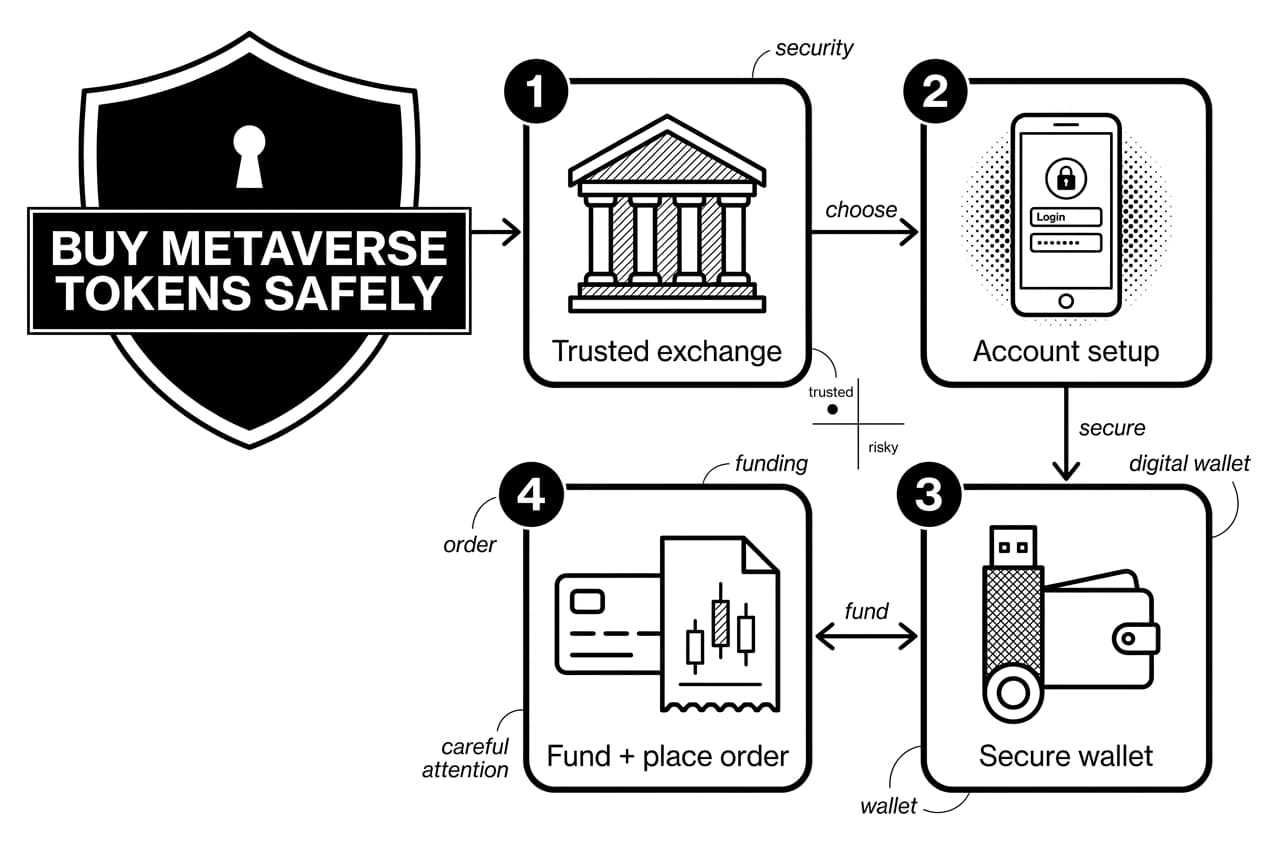
Now that you're familiar with the top projects and how to evaluate them, the next logical step is acquiring them. Purchasing metaverse coins is a straightforward process, but it requires careful attention to security. The basic journey involves selecting a trusted cryptocurrency exchange, setting up a secure digital wallet, and funding your account before placing an order. While simple, each step has important details to consider for your safety. For a complete walkthrough that covers everything from picking an exchange to securing your new metaverse tokens, please see our dedicated guide on how to buy metaverse tokens.
Frequently Asked Questions
- What are metaverse tokens?
- Metaverse tokens are digital currencies used to power virtual worlds. They enable users to buy and sell digital assets like virtual land and NFTs, participate in project governance through DAOs, or access exclusive in-world events and experiences. Popular examples include Decentraland's MANA and The Sandbox's SAND token.
- Which metaverse coin is best?
- The "best" metaverse coin depends on your investment strategy. A token like MANA is ideal for those investing in a specific decentralized world and its economy. In contrast, RNDR focuses on providing the underlying GPU rendering power for many metaverses, offering a broader infrastructure play rather than a single-world investment.
- What crypto is used in metaverse?
- Most metaverse projects use their own native cryptocurrency. For example, Decentraland uses MANA for all transactions within its world, The Sandbox uses SAND for its creator economy, and Axie Infinity uses AXS for governance. Each token is integral to its specific virtual ecosystem, serving unique functions within it.
- Is XRP a metaverse coin?
- No, XRP is not typically classified as a metaverse coin. Its primary function is to facilitate fast and low-cost international payments on the Ripple network. While its technology could be integrated into a metaverse for transactions, its core design is for finance, not for powering a specific virtual world's economy.
Sources
Author

Crypto analyst and blockchain educator with over 8 years of experience in the digital asset space. Former fintech consultant at a major Wall Street firm turned full-time crypto journalist. Specializes in DeFi, tokenomics, and blockchain technology. His writing breaks down complex cryptocurrency concepts into actionable insights for both beginners and seasoned investors.