Stablecoin Primer: Everything You Need to Know (2026)
What You'll Learn in This Stablecoin Primer
Whether you've never bought a single crypto token or you're just tired of nodding along when someone mentions stablecoins, you're in the right place. This guide walks you through everything from the ground up — no prior knowledge required.

By the time you finish, you'll understand what stablecoins are, how they hold their value, which types exist, and — most importantly — how real people and businesses are using them right now for international payments, payroll, and everyday transactions.
Stablecoins are one of the fastest-growing areas of crypto in 2026, quietly moving billions of dollars across borders every day. That growth isn't driven by speculation. It's driven by genuine utility.
Think of this as your practical starting point — a mentor walking beside you, not a textbook talking at you.
Step 1: Understand What a Stablecoin Actually Is
A stablecoin is a type of digital currency built on a blockchain that is designed to maintain a consistent value — typically pegged 1:1 to a fiat currency like the US dollar. Unlike Bitcoin or Ethereum, whose prices can swing wildly within hours, a stablecoin aims to always be worth exactly $1.00 (or whichever currency it tracks), making it practical for everyday financial tasks.
That single quality — predictable value — changes everything. When you know $100 in stablecoins will still be worth $100 tomorrow, you can actually use digital money to pay suppliers, save earnings, or send funds across borders without lying awake worrying about overnight price crashes.
The three names you'll hear most often are USDC (USD Coin), USDT (Tether), and DAI. USDC and USDT are both pegged to the US dollar and backed by real-world reserves. DAI takes a different approach — it's backed by collateralized crypto assets and governed by a decentralized protocol. Each has its own strengths, and you'll get familiar with all of them as this guide progresses.
Stablecoins vs. Regular Cryptocurrencies
Think of Bitcoin or Ethereum as investment assets first and payment tools second. Their prices are driven by speculation, market sentiment, and macroeconomic forces — meaning a payment worth $500 today could be worth $380 by the time it settles. That kind of volatility is exciting for traders but a genuine problem for anyone trying to run a business.
Stablecoins, by contrast, are designed to be boring in the best possible way. Here's how they compare side by side:
- Price stability: Stablecoins hold a fixed peg (e.g., $1.00). Bitcoin can move 10–20% in a single day.
- Primary use case: Stablecoins are built for payments, transfers, and savings. BTC and ETH are primarily speculative or store-of-value assets.
- Business predictability: You can invoice a client in USDC and know exactly what you'll receive. Invoicing in ETH introduces exchange-rate risk for both parties.
- Accounting simplicity: Stable value means straightforward bookkeeping — no need to track cost-basis fluctuations on every transaction.
This is exactly why businesses adopting crypto payments almost always start with stablecoins rather than volatile assets. The math just makes more sense.
Pro Tip: If a vendor or freelancer tells you they "accept crypto," ask specifically whether they accept stablecoins like USDC. Many people say "crypto" when they really mean stablecoins — because those are the ones that work for real commerce.
Stablecoins vs. Traditional Fiat Money
You might be wondering: if a stablecoin is worth $1, why not just use actual dollars in your bank account? It's a fair question, and the answer comes down to what digital dollars can do that paper ones can't.
Your bank account is essentially a promise from a financial institution, operating within specific business hours, geographic restrictions, and processing delays. A stablecoin lives on a blockchain — a global, always-on network that doesn't close for weekends or holidays.
Here's what sets stablecoins apart from holding dollars traditionally:
- 24/7 settlement: You can send USDC at 2 a.m. on a Sunday and it arrives in minutes — no waiting for the next business day.
- Borderless transfers: Sending $5,000 to a contractor in the Philippines costs the same as sending it to someone across the street — typically a fraction of a dollar in network fees.
- Programmability: Stablecoins can be embedded into smart contracts, enabling automatic payments, escrow arrangements, and conditional transfers without a middleman.
- Self-custody option: You can hold stablecoins in your own wallet, giving you direct control over your funds rather than relying on a bank's solvency or policies.
The value mirrors the dollar — but the infrastructure behind it is fundamentally different, and in many cases, far more flexible for modern business needs.
Step 2: Learn the Different Types of Stablecoins
Now that you know what a stablecoin is, the next step is understanding that not all stablecoins work the same way. There are four main types, each using a different method to hold its peg. Knowing the difference helps you choose the right one for your needs — and avoid the ones that carry hidden risks.
Fiat-Backed Stablecoins (USDC, USDT)
This is the simplest model to grasp: for every stablecoin in circulation, there is one real US dollar (or equivalent) sitting in a bank account or short-term treasury reserve. The issuer holds the dollars; you hold the digital token. It's a direct 1:1 relationship.
USDC, issued by Circle, and USDT (Tether), are the two giants here. Together they account for the vast majority of stablecoin volume in 2026. Circle publishes regular third-party attestations of its reserves, which is a big reason businesses trust USDC for payments and treasury operations. Tether has faced more scrutiny over its reserve disclosures historically, though it remains the highest-volume stablecoin globally.
For practical purposes — sending payments, paying international contractors, or holding funds between transactions — fiat-backed stablecoins are where most businesses start and stay.
Crypto-Backed Stablecoins (DAI)
DAI, created by the MakerDAO protocol, takes a different approach. Instead of dollars in a bank, DAI is backed by crypto assets locked in smart contracts. Because crypto prices fluctuate, DAI requires over-collateralization — you might lock $150 worth of ETH to mint $100 worth of DAI.
The decentralized nature of DAI appeals to users who want to avoid relying on a central issuer. That said, the mechanics are more complex, and the peg can come under pressure during sharp market downturns. It's a powerful option, but not the easiest starting point for beginners.
Algorithmic and Commodity-Backed Stablecoins
Algorithmic stablecoins attempt to maintain their peg purely through software — automatically expanding or contracting the token supply based on demand. There are no reserves backing them. In theory it sounds elegant; in practice, the 2022 collapse of TerraUST wiped out tens of billions of dollars and remains a defining cautionary tale for the entire industry.
Commodity-backed stablecoins are pegged to physical assets like gold. PAX Gold (PAXG) is a well-known example, where each token represents one fine troy ounce of gold held in a vault. These serve a niche purpose — hedging against dollar inflation, for instance — but they aren't widely used for everyday payments.
⚠️ Pro Tip: Be very cautious with algorithmic stablecoins. If a project promises a stable price with no collateral backing it, treat that as a red flag. The history here is not kind to investors. Stick to audited, collateral-backed options until you have a deep understanding of the risks involved.
Quick Comparison: The Four Types at a Glance
Fiat-Backed | USDC, USDT | 1:1 reserves held by central issuer | Issuer insolvency or regulatory action |
Algorithmic | TerraUST (defunct) | Supply/demand algorithms, no collateral | Death spiral collapse risk |
In 2026, fiat-backed stablecoins dominate real-world payment use cases by a wide margin. When you see businesses, payment platforms, or freelancers using stablecoins to move money across borders, they're almost always using USDC or USDT. Keep that in mind as you continue through this stablecoin primer — those two names will come up again and again.
Step 3: Understand How Stablecoins Work on the Blockchain
Now that you know what stablecoins are and the different types available, it's time to understand how they actually move. Think of this as getting under the hood — once you see the mechanics, everything else clicks into place.
A helpful way to picture it is a layer cake. The bottom layer is a Layer 1 blockchain — a base network like Ethereum or Solana that records every transaction permanently and securely. Stablecoins sit on top of that layer as tokens: digital assets that follow the blockchain's rules but carry their own value (in this case, pegged to a dollar).
When you send USDC to a supplier overseas, you're not moving money through a bank. You're broadcasting a transaction to a network of computers that verify it and write it permanently into the blockchain's record. This is called on-chain settlement — and it can happen in seconds, at any hour, on any day of the year.
To send or receive stablecoins, you need a crypto wallet. Your wallet doesn't store coins like a physical purse — it stores the private key that proves you control a specific address on the blockchain. MetaMask, Phantom, and Coinbase Wallet are popular options depending on which network you're using.
One cost to watch for is the gas fee — a small charge paid to the network's validators for processing your transaction. Gas fees vary widely depending on which blockchain you choose and how busy the network is at that moment.
Which Blockchains Support Stablecoins?
USDC and USDT don't live on just one network — they operate across several blockchains, and your choice of network directly affects what you pay and how fast your transaction settles.
- Ethereum — The original home of most stablecoins. Highly secure and widely accepted, but gas fees can spike during busy periods, sometimes reaching $5–$20 per transaction.
- Solana — Extremely fast (transactions settle in under a second) with fees often below $0.01. Popular for high-volume payment use cases.
- Tron — Carries the largest share of USDT volume globally, especially in emerging markets. Very low fees, though its decentralization model differs from Ethereum.
- Arbitrum — A Layer 2 network built on top of Ethereum that dramatically reduces gas fees while inheriting Ethereum's security. If you want to understand how that works, read about Layer 2 networks and their security model.
- Base, Polygon, and Avalanche — Additional networks that support stablecoins with low fees and growing adoption among businesses and developers.
The practical takeaway: if you're sending a large payment where security is the priority, Ethereum or Arbitrum are solid choices. If you're making frequent small payments, Solana or Tron will save you noticeably on fees.
Pro Tip: Always confirm which network you're sending on before hitting send. Sending USDC on Ethereum to an address expecting Solana USDC is a common beginner mistake — and in most cases, those funds are lost. You can always verify your stablecoin transaction on a blockchain scanner to confirm it landed correctly.
Understanding this layer cake — base blockchain plus stablecoin token plus the wallet you use — gives you the mental model to make smart decisions every time you transact.
Step 4: Explore the Key Use Cases for Stablecoins
Now that you understand how stablecoins work under the hood, it's time to see them in action. This step walks you through the most important real-world applications — from paying overseas suppliers to earning yield on idle funds. By the end, you'll have a clear picture of why stablecoins have moved from a crypto curiosity to a serious business tool in 2026.
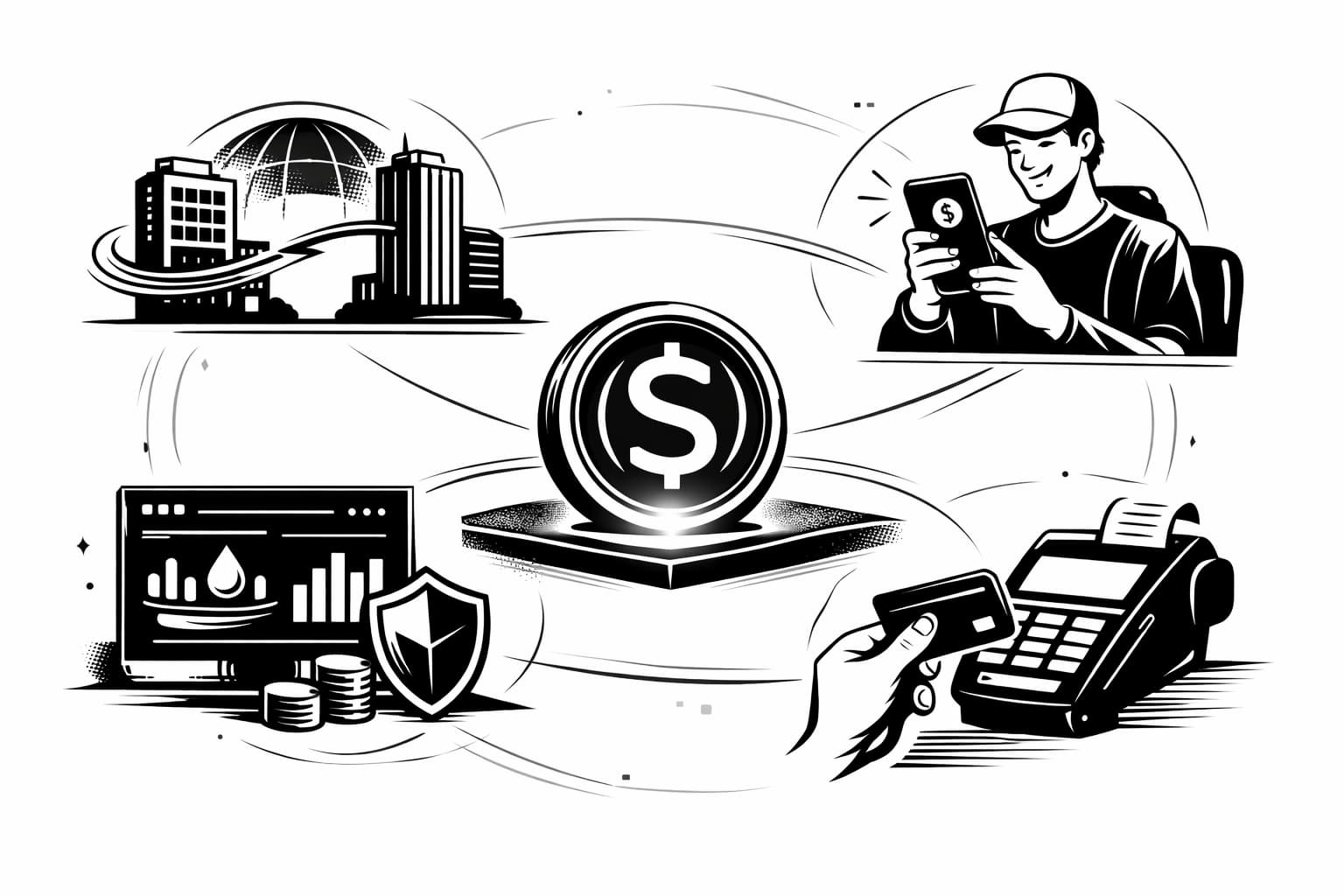
Here's a quick overview of the main stablecoin use cases you'll encounter:
- Cross-border B2B payments and trade settlement — sending value internationally in minutes, not days
- Payroll and gig economy payouts — paying remote workers across borders without currency conversion losses
- DeFi lending and yield — earning returns on stablecoin holdings without crypto price risk
- Liquidity provision — supplying stablecoins to trading pools and earning fees
- Retail and e-commerce payments — accepting payments from global customers at near-zero processing cost
- Treasury management — holding company reserves in digital dollars outside the traditional banking system
Cross-Border B2B Payments and Trade Settlement
If you've ever sent an international wire transfer, you know the frustration. Traditional SWIFT payments travel through a chain of correspondent banks, each taking a cut and adding a delay. A typical business-to-business payment can cost $25–$50 in fees (per World Bank remittance data), lose 1–3% to foreign exchange spreads, and take two to five business days to arrive.
Stablecoins cut through all of that. A business can send USDC from New York to a supplier in Bangkok in under five minutes, paying a transaction fee that's often a fraction of a cent. The recipient gets dollars — not baht that need converting back — directly into a digital wallet. Enterprise stablecoin platforms like Bastion have made this workflow accessible even for companies with no prior crypto experience, handling compliance and custody in the background.
For importers, exporters, and agencies paying international contractors, this isn't a minor upgrade — it's a fundamental shift in how capital moves across borders.
Payroll and Gig Economy Payouts
The global freelance economy is massive, and traditional payroll systems were never designed for it. When a company in Germany pays a developer in Argentina through a standard payroll provider, the developer might wait two weeks and lose 5–8% to conversion fees and intermediary charges.
With stablecoins, payroll becomes near-instant. A company sends USDC on payday — any day, not just the end of the month — and the worker receives it within minutes. They can hold it as a dollar-pegged asset, convert it locally at a rate they choose, or spend it directly.
Pro Tip: Some workers in high-inflation countries actively prefer being paid in USDC because it protects their earnings from local currency depreciation between payday and spending day.
DeFi, Savings, and Yield
Stablecoins also have a home inside decentralized finance protocols. Instead of letting idle USDC sit in a wallet earning nothing, you can deposit it into a lending protocol and earn interest from borrowers — often at rates that outpace traditional savings accounts.
You can also supply stablecoins to liquidity pools in DeFi, earning a share of trading fees generated by the pool. Because you're using stablecoins rather than volatile crypto assets, your principal value stays anchored to the dollar while still generating returns.
This makes stablecoins a practical option for treasury managers and individuals alike who want yield without the stomach-churning price swings of Bitcoin or Ethereum.
Step 5: Compare Stablecoins to Traditional Payment Methods
Now that you understand how stablecoins work and where they get used, it's time to see how they stack up against the payment systems you already know. This comparison is where things get genuinely eye-opening — especially if you've ever sent money internationally and winced at the fees or waited days for it to arrive.
Traditional payment rails like SWIFT, ACH, and PayPal were built for a different era. They work reasonably well within borders, but they struggle with speed, cost, and accessibility the moment you cross one. To understand why, it helps to look at traditional payment infrastructure like FedNow and how even modern upgrades still carry systemic limitations.
Stablecoins were designed from the ground up for a borderless internet. The difference becomes obvious when you lay everything side by side.
Method | Speed | Cost | Geographic Reach | Available 24/7 |
|---|---|---|---|---|
SWIFT | 1–5 business days | $15–$50+ per transfer | 200+ countries, but inconsistent | No |
ACH | 1–3 business days | $0.20–$1.50 per transaction | US only | No |
PayPal | Minutes (domestic); 1–3 days (withdrawal) | 2.9% + fixed fee; FX markups apply | 200 countries; restricted in many | Mostly |
Stablecoins (USDC/USDT) | Seconds to minutes | $0.01–$2.00 depending on network | Global, internet access only required | Yes |
The pattern is hard to miss. For cross-border transfers, stablecoins beat every traditional method on speed and cost — often dramatically. A freelancer in the Philippines receiving payment from a client in Germany doesn't need a bank account, doesn't wait three business days, and doesn't lose 5–8% to fees and exchange rate markups.
That said, stablecoins aren't perfect for every scenario. If your recipient needs cash in hand, that last step of converting stablecoins to local currency still requires an exchange or local off-ramp. That friction is real, though it's shrinking fast as adoption grows.
For businesses making recurring international payments — payroll, supplier invoices, contractor fees — the cost savings alone can be significant over a year. That's not a theoretical benefit. It's a practical one you can act on today.
Step 6: Know the Risks and Common Misconceptions
Now that you understand how stablecoins work and where they shine, it's time to look at the other side of the coin — the risks, the myths, and the ways things can go wrong. Knowing these upfront protects you from costly mistakes.
Three Misconceptions You Should Drop Right Now
"Stablecoins are anonymous." Not quite. Most major stablecoins like USDC and USDT are issued by regulated companies that can freeze accounts and comply with government requests. Your transactions are recorded on a public blockchain. That's not anonymity — it's pseudonymity at best.
"They always hold their peg." They don't. Even well-established stablecoins have briefly lost their $1.00 value during market stress events. Small de-pegs are common; large ones can be catastrophic.
"They're unregulated." Regulation is moving fast in 2026. Issuers in the US, EU, and beyond now face increasingly strict licensing and reserve requirements.
Real Risks You Need to Take Seriously
- Counterparty risk: With centralized stablecoins, you're trusting the issuer to hold real reserves. If that trust breaks down, so does the peg. Learn how to assess the risk of centralized platforms holding your stablecoins before committing large sums.
- Smart contract bugs: Decentralized stablecoins run on code. Exploits and vulnerabilities have drained millions from protocols that looked solid on the surface.
- Regulatory uncertainty: Rules are still evolving. A stablecoin that's fully legal in your country today could face restrictions tomorrow.
⚠️ Warning: Algorithmic Stablecoin Collapses
Algorithmic stablecoins — those that use code and incentive mechanisms instead of real reserves — have a dangerous track record. The 2022 collapse of TerraUSD (UST) wiped out over $40 billion in value in days, according to on-chain data and reporting from CoinGecko and Bloomberg. If a stablecoin's pitch sounds like "it maintains its peg through clever tokenomics," treat it with extreme caution.
Stablecoins vs. CBDCs: Key Differences
People often confuse stablecoins with Central Bank Digital Currencies, or CBDCs. They're very different animals. Stablecoins are issued by private companies — Circle, Tether, MakerDAO — while CBDCs are issued directly by governments and central banks.
That distinction matters more than it might seem. A government-issued CBDC could theoretically be programmed with spending restrictions, expiry dates, or automatic tax deductions. A private stablecoin, for all its risks, doesn't come with those built-in control mechanisms. For a deeper look, read about how CBDCs differ from stablecoins — especially if privacy and financial autonomy matter to you.
In short: stablecoins give you price stability within the crypto ecosystem; CBDCs give governments a new way to digitize — and potentially monitor — national currency.
Step 7: Understand Stablecoin Regulation in 2026
Knowing the rules of the road makes you a smarter user and a more confident business operator. Stablecoin regulation has moved fast — and in 2026, it's more clearly defined than ever before.
The Big Frameworks You Should Know
In the United States, the GENIUS Act established a federal licensing framework for stablecoin issuers. It requires 1:1 reserve backing, regular audits, and registration with federal or state regulators. Translation: the stablecoins you use from compliant issuers now carry real accountability.
Across the Atlantic, the EU's MiCA (Markets in Crypto-Assets) regulation is fully enforced, requiring issuers to hold segregated reserves and obtain operating licenses. Other countries — from Singapore to the UAE — have introduced similar reserve and licensing requirements.
You can explore how these rules evolved by reading about 2026 crypto regulatory updates in detail.
What This Means for You
For everyday users, regulation means greater protection — issuers can't quietly mismanage reserves anymore. For businesses, it means onboarding compliant stablecoins requires some due diligence, like verifying an issuer's licensing status.
Pro Tip: Always check whether a stablecoin issuer is licensed in your jurisdiction before building it into your payment workflow. This single step can save serious legal headaches later.
Increased regulation ultimately signals mainstream legitimacy — and that's good news for long-term adoption.
Next Steps: How to Start Using Stablecoins
You now have a solid foundation — so let's turn that knowledge into action. Here's your clear, step-by-step path to using stablecoins for the first time.

- Set up a wallet. Start by learning how to set up a crypto wallet. MetaMask or Coinbase Wallet are beginner-friendly options.
- Acquire USDC or USDT. Create an account on a reputable exchange like Coinbase or Kraken, complete identity verification, and purchase your first stablecoins.
- Pick your use case. Are you sending international payments, building savings, or exploring DeFi yields? Each path looks slightly different — start with just one.
Pro Tip: Always check which blockchain network you're using before sending funds. Sending on Polygon or Solana costs fractions of a cent, while Ethereum mainnet fees can reach several dollars during busy periods.
If you run a business, explore accepting crypto payments for your business — it's simpler than most people expect in 2026.
Key Takeaways From This Stablecoin Primer
- Stablecoins are price-stable digital currencies backed by real assets or algorithms
- They enable fast, low-cost payments — especially across borders
- Risks exist, but choosing regulated, audited coins reduces them significantly
- The right network choice saves you real money on every transaction
Start small, stay curious, and build confidence one transaction at a time.
Sources
Author

Crypto analyst and blockchain educator with over 8 years of experience in the digital asset space. Former fintech consultant at a major Wall Street firm turned full-time crypto journalist. Specializes in DeFi, tokenomics, and blockchain technology. His writing breaks down complex cryptocurrency concepts into actionable insights for both beginners and seasoned investors.