SEC Crypto News: Landmark 2026 Regulatory Update Explained

SEC Releases Landmark Crypto Interpretation in March 2026
The U.S. Securities and Exchange Commission published a formal interpretive release in March 2026 — designated S7-2026-09 — clarifying how existing federal securities laws apply to a broad range of digital assets. The release affects millions of U.S. crypto holders, exchanges, and token issuers, and carries immediate legal weight because it was issued directly by the Commission rather than through a proposed rulemaking process.
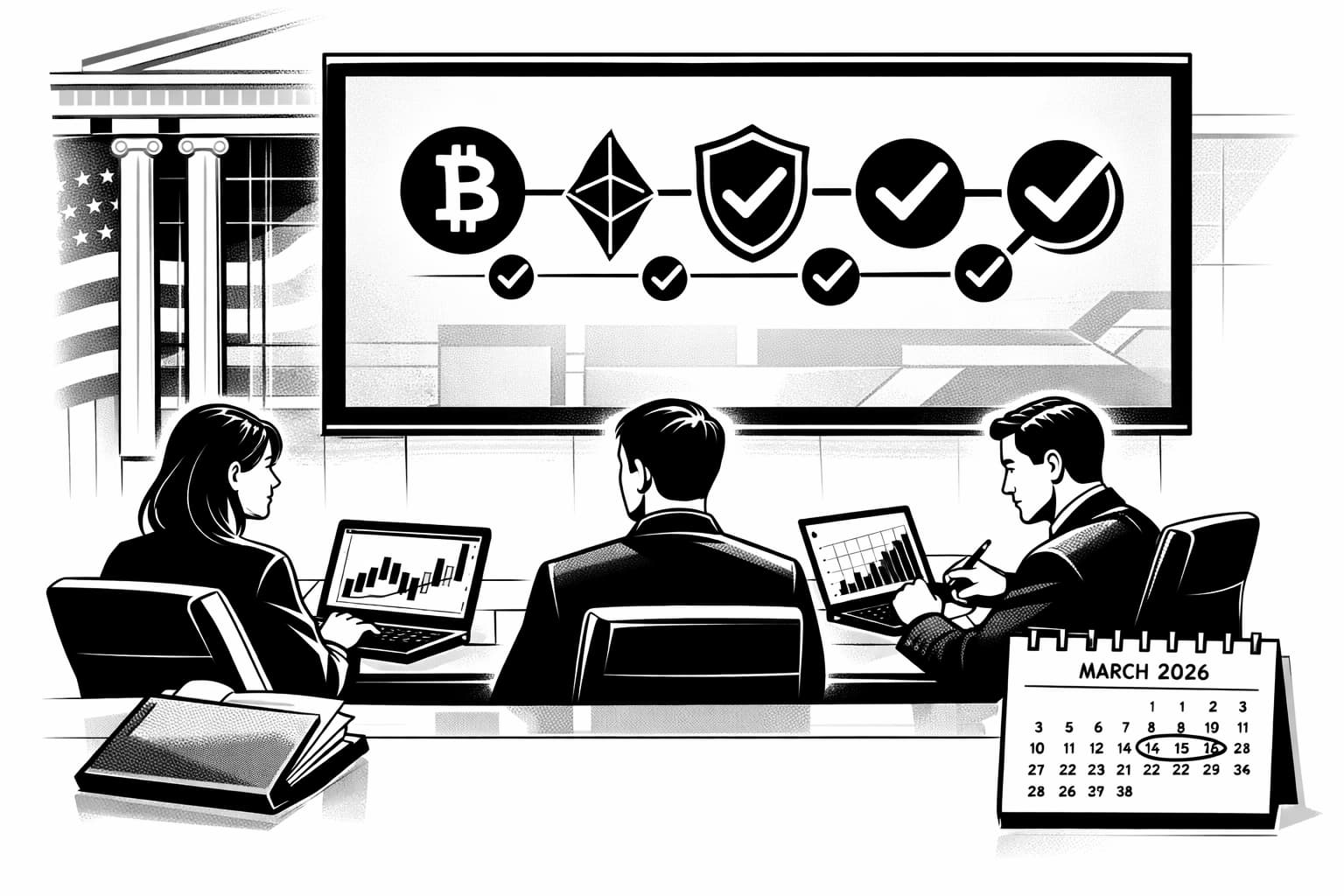
S7-2026-09 redraws the line between digital assets classified as securities and those the SEC considers outside its direct jurisdiction. The interpretation addresses longstanding ambiguity around proof-of-work tokens, staking arrangements, and certain decentralized finance protocols — areas where prior enforcement actions had produced inconsistent outcomes, according to the official SEC release.
SEC Chair Paul Atkins stated the release is intended to "provide clear, workable guidance that investors and industry participants can rely on," according to the Commission's accompanying press statement.
For retail investors, the practical significance is direct: assets you currently hold, trade, or earn yield on may now fall under a different regulatory classification than they did in 2025.
What the SEC's New Interpretation Actually Says
The SEC's March 2026 interpretation states that a crypto asset qualifies as a security when it satisfies all four prongs of the Howey Test — an investment of money, in a common enterprise, with an expectation of profits, derived from the essential managerial efforts of others. Assets lacking that final prong, such as Bitcoin, fall outside securities classification.
The guidance runs to 47 pages. Its operational core clarifies that "representations and promises" made by a token issuer — in a whitepaper, roadmap, or public statement — can satisfy the profit-expectation prong even without a formal contract. The document also defines "managerial efforts" broadly, covering protocol governance, validator incentive structures, and ecosystem grants controlled by a founding team.
The Investment Contract Test Applied to Crypto
Bitcoin (BTC) falls outside the Howey Test's reach because no central party's managerial efforts drive investor returns — a position the agency has held consistently. Ethereum (ETH) receives the same treatment following the network's full transition to proof-of-stake, though the document notes this assessment remains fact-specific.
Solana (SOL), XRP, and Algorand (ALGO) occupy more contested territory. The SEC's analysis points to each network's founding team, foundation grants, and protocol governance as evidence of ongoing essential managerial efforts — a characterization that issuers of all three assets have publicly disputed. The guidance stops short of a definitive ruling on any of them, instead outlining the factual framework regulators will apply case by case.
Token Taxonomy: Security vs. Non-Security Crypto Assets
The interpretation introduces a formal token taxonomy distinguishing security crypto assets from non-security crypto assets. A token issued through a fundraising event, with buyers relying on a team's continued development to generate returns, sits in the security column. A token operating on a fully decentralized network — where no identifiable group's efforts are necessary for value creation — does not.
Crypto Asset Type | SEC Classification (2026) |
|---|---|
Bitcoin (BTC) | Non-security — commodity under CFTC jurisdiction |
Ethereum (ETH) | Non-security — commodity under CFTC jurisdiction |
XRP | Contested — institutional sales under ongoing legal review; programmatic exchange sales not classified as securities per 2023 court ruling |
Solana (SOL) | Unresolved — cited as example of proof-of-stake network with potential managerial effort factors |
Algorand (ALGO) | Unresolved — cited alongside SOL; fact-specific analysis required |
Stablecoins | Separate regulatory lane — oversight assigned under GENIUS Act framework, distinct from SEC and CFTC domains |
The SEC's key finding is that classification is not permanent. A token that launches as a security can migrate to non-security status if the underlying network achieves sufficient decentralization and the original representations and promises tied to the fundraise are no longer operative. The inverse is also possible. Investors tracking this dynamic can find additional context on token classification and tokenomics to understand how these structural factors affect individual holdings.
Mining, Staking, Wrapping, and Airdrops: How the SEC Classifies Each
The SEC's March 2026 interpretation addressed specific crypto activities that millions of retail participants engage in daily. The guidance draws clear distinctions between activities that create a securities relationship and those that do not.
How the SEC Classifies Common Crypto Activities
- Mining: Generally not classified as a securities transaction — miners earn rewards through computational work, not through a passive investment in a common enterprise.
- Staking: Classification depends on structure — self-staking is typically exempt, but third-party staking services may constitute an investment contract if profits are derived from the operator's efforts.
- Wrapping: Treated as a derivative instrument in most cases — the SEC indicated wrapped tokens may trigger securities analysis when the wrapping entity exercises material control over the underlying asset.
- Airdrops: Conditionally exempt — purely gratuitous distributions with no purchase requirement are generally not securities, but airdrops tied to prior investment activity or future protocol obligations face greater scrutiny.
Are Staking Rewards Considered Securities?
The SEC drew a firm line between self-directed staking and pooled staking services. A validator who stakes independently on a proof-of-stake network does not, by that act alone, enter into an investment contract — rewards represent compensation for network participation, not a return on a passive investment.
Third-party staking platforms present a different picture. Where a retail user deposits tokens with a service provider that manages validation and distributes profits, the SEC indicated that arrangement may satisfy the Howey test's "efforts of others" prong. Platforms offering fixed-yield staking products received the most pointed language in the guidance document.
Airdrop Classification Under the New Rules
The SEC's position is that a token airdrop is not automatically a securities distribution. Gratuitous drops to broad, unconnected wallet addresses generally fall outside the definition of an investment contract.
However, the SEC flagged two scenarios that shift the analysis. Airdrops distributed exclusively to prior token purchasers may be viewed as additional consideration tied to an original investment. Distributions that require recipients to complete tasks, lock tokens, or participate in a protocol introduce a contractual element the agency views with heightened scrutiny. Investors seeking practical guidance on airdrop qualification and compliance in 2026 should review both the activity structure and the issuer's disclosure obligations under the new rules.
The clearest takeaway from this sec crypto news: the mechanics of how you receive or earn tokens matter as much as the tokens themselves.
Key Entities Named: XRP, ETH, BTC, and Others
The SEC's March 2026 interpretation explicitly references several major digital assets by name. Bitcoin and Ether receive the most favorable treatment, with the document reaffirming prior staff positions that both assets currently function as commodities rather than securities.

XRP occupies a distinct position. The agency acknowledges the 2023 district court ruling in SEC v. Ripple Labs, which found that programmatic sales of XRP on public exchanges did not constitute securities transactions. The March 2026 interpretation does not reverse that finding, but notes that XRP's status in institutional sales contexts "remains a matter of ongoing legal consideration," per the document's language.
Solana and Algorand are cited as examples in the guidance's discussion of proof-of-stake networks, without a definitive securities classification assigned to either. LBRY is referenced as a prior enforcement precedent where the SEC successfully argued a token sale constituted an unregistered securities offering.
For investors tracking these developments alongside the latest SEC crypto ETF approvals, the named-asset references in this interpretation carry direct portfolio implications.
SEC vs. CFTC: How Jurisdiction Is Divided in 2026
Regulatory authority over crypto remains split between two federal agencies after the March 2026 interpretation. The SEC holds authority over digital assets classified as securities under the Howey test. The Commodity Futures Trading Commission governs commodities and derivatives trading under the Commodity Exchange Act (CEA).
Bitcoin and Ether — both confirmed as non-securities — fall primarily within CFTC jurisdiction when traded as spot commodities or via futures contracts. Tokens that retain investment contract characteristics remain under SEC oversight, subject to registration requirements and disclosure rules.
Stablecoins occupy their own regulatory lane. The GENIUS Act framework, which advanced through Congress in early 2026, assigns stablecoin oversight to a separate federal structure, distinct from both agencies' traditional domains. For a deeper breakdown of how stablecoins are classified under the new rules, the distinctions matter considerably for holders of dollar-pegged assets.
The division still leaves gray areas, particularly for tokens that transition between utility and investment functions. Both agencies have signaled continued coordination, but investors should expect enforcement actions to reflect whichever agency claims primary jurisdiction over a specific asset class.
What This Means for Crypto Investors
The practical consequences of the SEC's March 2026 interpretation are already moving through markets. Exchanges are reviewing token listings against the new classification framework, and assets that fall into the securities category face potential delisting or migration to registered trading venues.
For portfolio management, the clearest near-term action is identifying which tokens you hold are now considered securities under the updated guidance. Securities-classified tokens held on unregistered platforms present real legal and custodial risk — not just for the platforms, but for investors who may lose access if a platform is forced to delist or shut down.
Institutional investors face a parallel compliance burden. Funds holding newly classified securities may need to update disclosures, rebalance allocations, or exit positions within regulatory deadlines. Those exploring tokenized assets should also assess asset tokenization platforms and regulatory exposure carefully, as that sector sits directly in the SEC's expanded oversight zone.
The bottom line: know what you own, where it is held, and how it is now classified.
What's Next: Anticipated SEC Actions and Industry Response
Legal and industry observers expect the SEC to follow up with formal rulemaking proposals within the next six to twelve months, according to analysts tracking the agency's regulatory calendar. Enforcement actions targeting non-compliant exchanges and token issuers are widely anticipated to accelerate in the near term.

Law firm Sidley Austin noted in a client memo that the interpretation "creates immediate compliance obligations for platforms operating in legal gray areas," while Davis Polk cautioned that the document's scope "leaves room for further judicial challenges." Neither firm confirmed specific client actions.
Industry groups including the Blockchain Association and Chamber of Digital Commerce have signaled plans to lobby Congress for legislation that would codify clearer boundaries between SEC and CFTC authority. On Capitol Hill, bipartisan crypto market structure bills are anticipated to gain renewed momentum in mid-2026, though passage remains uncertain.
Frequently Asked Questions
- Is the SEC going to regulate crypto?
- Yes — the SEC actively regulates crypto assets it classifies as securities. The March 2026 release S7-2026-09 formalized the agency's framework for applying U.S. securities laws to crypto markets. This landmark interpretation confirms the SEC's ongoing rulemaking posture and signals continued, structured regulatory oversight for digital asset issuers and trading platforms.
- Is the XRP SEC case finished?
- As of March 2026, SEC v. Ripple has reached a significant resolution, with final rulings issued at the district level and any remaining appeals working through the courts. The 2026 interpretive framework addresses XRP's classification separately. Investors should consult official court records and SEC statements for the most current procedural status.
- Which crypto is SEC approved?
- The SEC does not formally "approve" cryptocurrencies. However, the 2026 token taxonomy guidance indicates Bitcoin and Ethereum are not classified as securities. The SEC has separately approved certain spot crypto ETFs. Approval of an ETF does not equal endorsement of the underlying asset — these are distinct regulatory determinations.
- What is the SEC view on crypto?
- The SEC's definitive position, established in its March 2026 landmark interpretation, is that many crypto assets qualify as securities under the Howey Test and must comply with U.S. securities laws. The agency draws a clear line between security tokens and non-security assets, requiring issuers of the former to register or qualify for an exemption.
Sources
Author

Crypto analyst and blockchain educator with over 8 years of experience in the digital asset space. Former fintech consultant at a major Wall Street firm turned full-time crypto journalist. Specializes in DeFi, tokenomics, and blockchain technology. His writing breaks down complex cryptocurrency concepts into actionable insights for both beginners and seasoned investors.