RareSkills Bootcamp Review: Solidity & ZK Training 2026

RareSkills bootcamp review: Solidity and ZK training 2026
Quick verdict: is RareSkills worth it in 2026?
RareSkills is worth it for mid-to-senior engineers who already write production code and want structured training in advanced Solidity, DeFi security, or zero-knowledge proofs. First-time coders, casual crypto users, and developers still learning basic Solidity should avoid it because the program assumes real code fluency before day one.
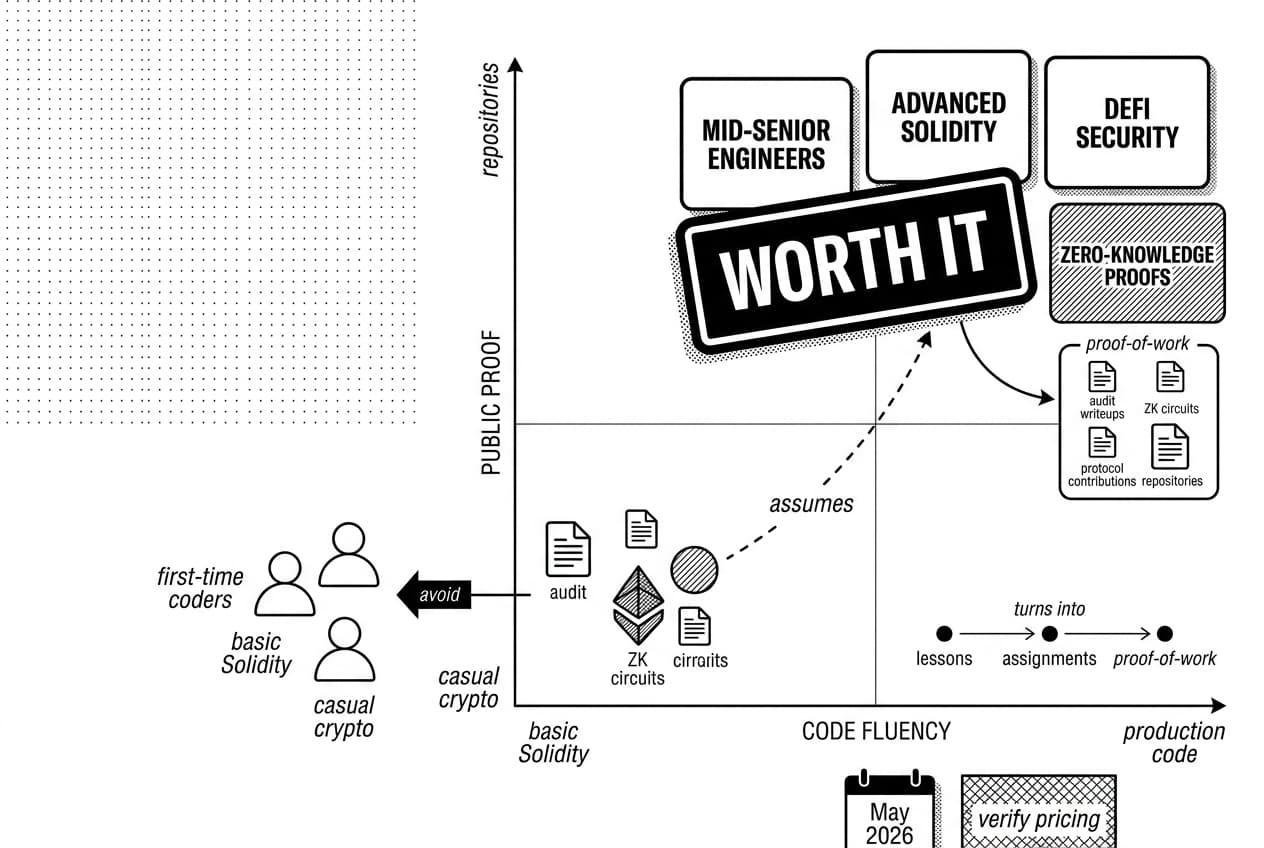
Our review is based on testing RareSkills' free technical lessons, comparing public course pages, reading syllabus-level materials, and benchmarking the program against current Web3 hiring signals as of May 2026. We did not receive paid private cohort dashboard access, so pricing, refund terms, and instructor response times should be verified directly before enrollment.
The short version: RareSkills has genuine technical depth, but it is not a magic career switch. The program only makes sense if you can turn assignments into public proof-of-work: repositories, audit writeups, ZK circuits, or protocol contributions that a hiring team can inspect.
RareSkills overview
RareSkills is a Web3 engineering education platform for developers who already know how to code. It is different from beginner bootcamps that start with variables, HTML, or JavaScript basics. The RareSkills bootcamp starts much closer to EVM internals, gas costs, smart contract attack surfaces, and proof-system math.
RareSkills states that its structured education work began in 2022 (RareSkills, May 2026). Its public catalog focuses on Solidity, smart contract security, DeFi mechanics, and zero-knowledge proof engineering. That positioning matters. The program is not built for general web development careers; it is built for protocol engineering, audit preparation, and ZK-heavy technical roles.
Two outside benchmarks help frame the bar. Vitalik Buterin, co-founder linked via ethereum.org, has repeatedly treated cryptography, rollups, and proof systems as central to Ethereum's technical roadmap. Andreas Antonopoulos, author and educator linked via aantonop.com, is a useful contrast point because his teaching style shows how much foundational literacy matters before advanced crypto concepts make sense. RareSkills sits at the advanced end of that spectrum.
What RareSkills teaches
The curriculum groups into three main areas: Solidity engineering, DeFi security, and zero-knowledge proofs. The Solidity material covers storage layout, memory, calldata, EVM opcodes, assembly with Yul, proxy patterns, and gas optimization. The DeFi material moves into automated market makers, lending systems, liquidation logic, oracle failure modes, and exploit reasoning. The ZK material is the most difficult track because it starts with finite fields, modular arithmetic, elliptic curves, and constraint systems before students write circuits.
This is not a light survey. The best comparison is a technical apprenticeship built around hard problem sets. If you want a quick certificate, RareSkills will feel slow and demanding. If you want to understand why a vault accounting bug, underconstrained circuit, or storage collision creates risk, the curriculum is pointed in the right direction.
Who runs the program?
RareSkills presents itself publicly as a specialized, instructor-led technical education company. Because leadership pages, instructor rosters, and cohort staffing can change, this review avoids relying on unverified individual biographies. Before paying, verify the current legal entity, instructors, admissions contact, and refund authority directly through rareskills.io and your enrollment agreement.
That caution is not a negative mark. It is a buyer-protection step. In advanced Web3 education, the name on the course page matters less than who reviews your code, how fast feedback arrives, and whether assignments create work you can publish.
How the RareSkills bootcamp works
The RareSkills bootcamp is closer to a technical training cohort than a passive video library. Students should expect independent reading, code-heavy assignments, peer discussion, written reasoning, and feedback cycles. The model rewards people who can get stuck, read source code, form a hypothesis, and ask a precise technical question.
Application and onboarding process
RareSkills is not positioned as an open-enrollment beginner school. Public materials indicate that applicants should already have programming experience and enough technical context to discuss why they want the course. As of May 2026 (RareSkills), prospective students should verify whether the current cohort asks for a GitHub profile, prior Solidity work, a written application, or a technical screening step.
In practice, prepare as if the application will test seriousness. A weak application that says only "I want a Web3 job" is less convincing than a GitHub profile with Solidity tests, failed experiments, notes from reading audited contracts, and one short explanation of what you want RareSkills to help you fix.
Prerequisites before applying
Do not apply cold. The skills you should already have before considering the rareskills bootcamp include:
- Programming fluency: You can write, test, and debug non-trivial code in at least one language such as Python, JavaScript, Rust, or Go.
- Solidity basics: You can write and deploy simple contracts, write unit tests, and explain what a mapping, modifier, event, and external call do.
- EVM fundamentals: You understand gas, storage slots, calldata, memory, the call stack, and why bytecode differs from source code.
- DeFi context: You know how AMMs, lending markets, flash loans, liquidations, and oracle feeds work at a system level.
- Math comfort for ZK: You are willing to study modular arithmetic, finite fields, elliptic curves, and polynomial commitments without expecting shortcuts.
The ZK track has the steepest ramp. If algebra and linear reasoning feel foreign, spend several weeks preparing before you pay. RareSkills can teach difficult material, but it cannot compress missing math foundations into a few casual evenings.
Curriculum deep dive: advanced Solidity, DeFi, and ZK
The curriculum is the main reason to consider RareSkills. The program goes beyond beginner Solidity syntax and into how smart contracts behave under gas pressure, upgrade pressure, adversarial liquidity, and cryptographic constraints.
Advanced Solidity plus DeFi syllabus
The Solidity track focuses on how the EVM actually stores, reads, and executes code. Students should expect storage slot packing, memory versus calldata tradeoffs, unchecked arithmetic, custom errors, assembly, event design, and bytecode-level gas analysis. Proxy patterns such as UUPS, transparent proxies, and beacon-style upgrade models are treated as engineering and security problems, not flashcard terms.
Token standards are also practical. ERC-20, ERC-721, ERC-1155, and ERC-4626 matter because they show up in real protocols. ERC-4626 was finalized in April 2022 (Ethereum EIPs), and it remains a useful lens for understanding tokenized vault accounting, share pricing, and integration risk. The DeFi security module connects directly to smart contract security risks such as oracle manipulation, reentrancy, unsafe access control, price manipulation, and liquidation edge cases.
ZK bootcamp syllabus
The ZK track is not a marketing add-on. It starts with the math that makes proof systems work: finite fields, modular arithmetic, elliptic curves, group operations, constraint systems, R1CS, polynomial commitments, SNARKs, and STARKs. From there, students move toward circuit design, proof generation, and on-chain verification.
That content connects to real applications covered in our guide to zero-knowledge proofs and private compute, and it also provides the foundation for advanced ZK applications like zkML. The warning is simple: if you only want to copy Circom templates, this track will feel too theoretical. If you want to reason about why a circuit is sound, the math is the point.
What makes the curriculum advanced?
The main difference is that RareSkills expects students to read docs, inspect repositories, and reason through papers or audits without constant hand-holding. Assignments are built around code-level explanation. You are not only asked to make a contract compile; you are asked to explain storage behavior, gas tradeoffs, attack paths, and proof constraints.
Our working model for evaluating the curriculum is the build-explain-defend framework. A strong assignment should make you build a non-trivial artifact, explain the security or math assumptions behind it, and defend the design under review. That loop produces Web3 developer portfolio projects that are more useful than a certificate image.
Hayden Adams, founder linked via Uniswap, is relevant here because AMM engineering is a reminder that DeFi is not just Solidity syntax. Real protocols combine code, incentives, liquidity math, user behavior, and adversarial execution. RareSkills is strongest when it teaches students to join those pieces.
Key features and learning experience
The learning experience is best understood as depth-first. RareSkills does not try to teach every Web3 topic. It goes deep on the parts that create hiring signal for protocol teams, audit firms, and ZK-focused projects.
Instructor support and feedback
The public pitch emphasizes expert review and difficult assignments. That is valuable because advanced Solidity and ZK self-study breaks down quickly when the bug is conceptual. A reviewer who can explain why a storage collision matters, why a gas saving is unsafe, or why a circuit is underconstrained can save days of blind searching.
Still, this is one of the main items to verify before paying. Ask RareSkills for the current feedback format, expected response time, office-hour schedule, cohort size, code-review depth, and whether support differs by track. Do not assume that a testimonial from a prior cohort describes the current one.
Assignments, code reviews, and proof-of-work
In Web3 hiring, GitHub history often says more than a resume line. A useful RareSkills outcome is not "completed bootcamp." It is a public repository showing a gas-optimized vault, an audit-style vulnerability report, a Foundry test suite, or a working ZK circuit with notes.
The audit-style writing component is especially useful. Security work requires explaining why a pattern is unsafe, how an exploit path works, and what mitigation preserves intended behavior. That skill transfers to public contests, internal protocol reviews, and freelance audit reports.
Our research note: while testing the free RareSkills material, the strongest signal was the density of explanations rather than the site design. Lessons regularly moved from first principles to implementation details. That is a good sign for advanced learners, but it also means weak prerequisites become painful fast.
Andreas Antonopoulos, author and educator linked via aantonop.com, is a useful reference point because his work shows that technical depth lands only when the learner has the base vocabulary. RareSkills assumes that base. If you have fewer than 6 months of serious Solidity practice, start with free projects before entering a paid cohort.
RareSkills pricing, fees, and refund policy
Pricing is the least clear part of the RareSkills evaluation. As of May 2026, RareSkills does not maintain a fixed public tuition table for every cohort-based program on its main public pages. That does not mean the program is overpriced; it means buyers need written terms before paying.
item | what to know in 2026 |
|---|---|
tuition | Not published as a universal fixed price; verify with RareSkills before applying because cost can vary by track and cohort. |
deposit | Verify with RareSkills before applying; ask whether a seat deposit is refundable and when it becomes binding. |
payment plans | Verify with RareSkills before applying; ask whether installments change the total cost. |
refund policy | Verify with RareSkills before applying; get the refund window, partial-refund rule, and deferral rule in writing. |
access duration | Verify with RareSkills before applying; ask whether materials remain available after the cohort ends. |
job support | Not publicly guaranteed; ask whether resume review, recruiter intros, or portfolio review are included. |
notes | RareSkills publishes free articles at $0 cost (RareSkills, May 2026), which is the safest way to test teaching style first. |
What to verify before paying
Before signing an enrollment agreement, ask for these items in writing:
- Total cost: Confirm the all-in tuition and whether taxes, payment fees, or separate charges apply.
- Payment timing: Confirm due dates, late-payment rules, and whether access pauses if a payment is missed.
- Refund window: Confirm the exact day and time when a full or partial refund stops being available.
- Deferral rule: Confirm whether you can move to a later cohort and whether that carries a fee.
- Support scope: Confirm whether code review, office hours, async Q and A, and project review are included.
- Material access: Confirm whether access expires, remains for a fixed term, or stays open indefinitely.
- Career help: Confirm whether job support is formal or informal.
How to think about ROI
The right ROI question is not whether RareSkills is cheap. It is whether the program can help you produce artifacts that raise your earning power. A senior protocol engineer salary range of $180,000 to $300,000 in early 2026 (Web3.Career) makes advanced training financially plausible for the right developer. Security demand also remains real: Immunefi reported more than $1.8 billion lost to hacks and fraud in 2023 (Immunefi, 2023).
Use the three-gate ROI test before enrolling. First, will the program produce a public artifact you can show? Second, does the skill command a measurable premium in the market you are targeting? Third, will the structure make you finish work you would not finish alone? If RareSkills clears all three gates for you, the cost can make sense. If it clears only one, wait.
RareSkills pros and cons
RareSkills is a specialized program with real strengths and real limits. The strengths matter most for advanced engineers. The limits matter most for beginners and anyone who needs guaranteed job placement.
Pros
- Advanced curriculum: The Solidity track goes beyond syntax into EVM storage, opcodes, gas measurement, upgrade patterns, and audit-style reasoning.
- ZK math depth: The ZK track includes finite fields, elliptic curves, constraint systems, proof generation, and verification rather than only high-level summaries.
- Portfolio output: Strong assignments can become public repositories, audit notes, and ZK examples that hiring teams can inspect.
- Security relevance: DeFi modules map to real bug classes such as oracle manipulation, reentrancy, unsafe accounting, and liquidation edge cases.
- Expert-level signal: Completing hard work in this niche signals technical commitment, especially when paired with public code and written explanations.
Cons
- Not beginner-friendly: Students without prior coding and Solidity practice will likely struggle early.
- Pricing opacity: Public pages do not give one fixed tuition number for every cohort, so buyers must ask direct questions.
- Heavy time demand: The program only works if you can reserve serious weekly study and build time.
- No guaranteed placement: RareSkills training does not replace networking, public work, interviews, or protocol experience.
- ZK difficulty: Learners who dislike math may find the ZK material too abstract to justify the cost.
Who is RareSkills for, and who should skip it?
Fit matters more than brand reputation. RareSkills can be a strong choice for the right engineer and a poor purchase for someone who is too early.
Best for
- Experienced Solidity developers: You can write contracts already and want deeper EVM, gas, security, and upgradeability skills.
- Backend engineers entering Web3: You have production software experience and want a structured bridge into protocol engineering.
- Security researchers in training: You want audit-style reasoning, exploit analysis, and better technical writing around findings.
- ZK learners with math patience: You want to understand proof systems rather than only copy circuit templates.
- DeFi protocol builders: You are building AMMs, lending markets, vaults, or liquidation systems and need deeper risk awareness.
Not ideal for
- First-time coders: Learn programming and basic Ethereum development first.
- Casual crypto users: The material is too technical if your goal is only understanding wallets, tokens, or trading apps.
- Students needing constant hand-holding: The program appears better suited to independent problem-solvers.
- Job seekers expecting placement: You still need public work, applications, interviews, and network building.
- Learners avoiding math: The ZK track requires algebraic thinking, not only code copying.
If you are still learning Ethereum fundamentals, start there. RareSkills makes more sense after you can deploy contracts, read audits, and explain common failure modes without relying on a tutorial.
Job outcomes, alumni reviews, and alternatives
RareSkills does not publish a detailed outcomes report with verified placement rates, median salaries, or salary lift by cohort. That lack of a polished outcomes report is a limitation for buyers. It means you should evaluate alumni claims carefully instead of assuming the bootcamp name alone will open doors.
How to evaluate alumni reviews
Ignore vague praise and look for proof. A useful alumni review mentions a shipped project, a public audit contest, a repository, a ZK circuit, a job title, or a specific skill gained. Check whether the reviewer has non-trivial Solidity commits, public writeups, or contest submissions. A GitHub profile with real work is stronger evidence than a five-star quote.
For broader context on where these skills can lead, our guide to jobs in DeFi covers roles across audit firms, protocol teams, research groups, and security contests.
RareSkills versus other Web3 learning options
platform | public cost signal | target level | strongest area | ZK coverage |
|---|---|---|---|---|
RareSkills bootcamp | Not fixed publicly; verify before applying | Intermediate to advanced | Solidity internals, gas, DeFi security, ZK | Yes, math-heavy |
Cyfrin's updraft | Free public courses listed at $0 (Cyfrin, May 2026) | Beginner to intermediate | Smart contract security foundations | Limited compared with RareSkills |
Speedrun ethereum | Free public challenges listed at $0 (Speedrun, May 2026) | Beginner | Hands-on dApp building | No major ZK focus |
RareSkills is not automatically better than free alternatives. It is aimed at a later stage. If you have never built a dApp, start with a free challenge site. If you already understand contracts and want to reason about storage, gas, exploit paths, and proof systems, RareSkills becomes more relevant.
Verdict: should you apply to RareSkills?
Apply to RareSkills if you already write software, understand basic Solidity, and want serious depth in EVM internals, DeFi security, or ZK engineering. The program's value is strongest when you convert assignments into public proof-of-work that helps with audits, protocol roles, research interviews, or freelance consulting.
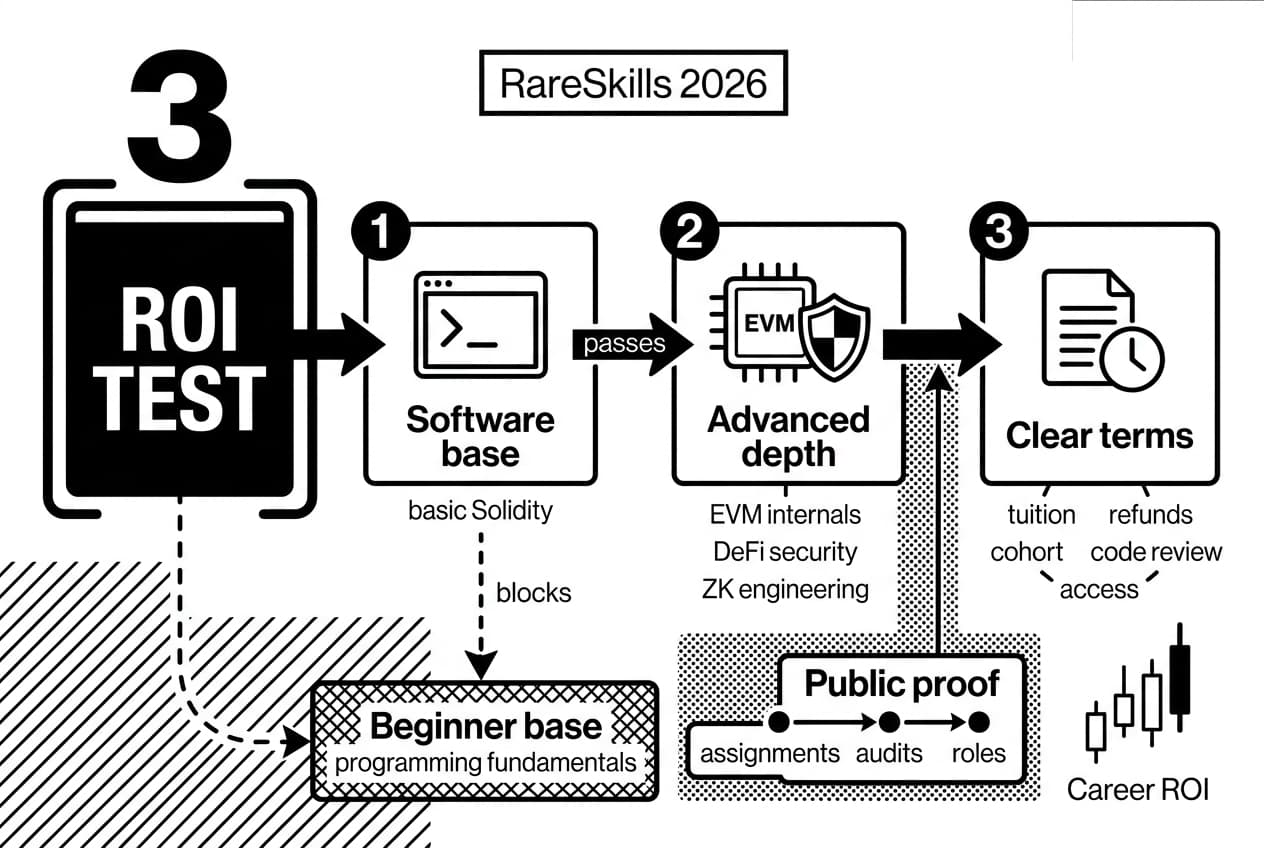
Do not apply if you are still learning programming fundamentals, cannot reserve consistent study hours, or need a school to guarantee employment. RareSkills may accelerate an advanced developer, but it will not replace the missing base for a beginner.
Before paying, verify current tuition, refund terms, cohort format, instructor access, code-review depth, and post-course material access directly with RareSkills. If those terms are clear and you pass the three-gate ROI test, RareSkills is one of the more serious advanced Web3 education options in 2026.
Frequently Asked Questions
- Who is the CEO of RareSkills?
- RareSkills was founded by Jeffrey Scholz, who serves as its lead instructor and CEO. He has a strong background in mathematics, software engineering, and EVM internals. His technical writing on advanced Solidity, gas optimization, and zero-knowledge proofs is widely cited in the Ethereum developer community.
- Are coding bootcamps worth the money?
- Bootcamps are worth it when they teach genuinely scarce skills, offer real instructor feedback, and help you build a verifiable portfolio. They are poor investments if you lack prerequisites, expect guaranteed job placement, or could realistically cover the same material through free resources and disciplined self-study.
- How can I learn Solidity programming?
- Start with JavaScript or Python to grasp programming fundamentals, then study how Ethereum and the EVM work. Learn Solidity syntax, common ERC standards, testing frameworks like Foundry or Hardhat, and basic security patterns. Build small projects, read audited contracts, and consider advanced programs like RareSkills once you have that foundation.
- What is the best online coding bootcamp?
- There is no single best bootcamp for everyone. For general software engineering, prioritize strong job placement rates and fundamentals coverage. For Web3 and Solidity specifically, compare curriculum depth, security content, instructor accessibility, alumni portfolio outcomes, pricing transparency, and refund policies before committing your time and money.
Sources
Author

Crypto analyst and blockchain educator with over 8 years of experience in the digital asset space. Former fintech consultant at a major Wall Street firm turned full-time crypto journalist. Specializes in DeFi, tokenomics, and blockchain technology. His writing breaks down complex cryptocurrency concepts into actionable insights for both beginners and seasoned investors.