Paul Atkins SEC: How the Pro-Crypto Chair Will Shape Policy

Introduction: Who is Paul Atkins and Why Does He Matter for Crypto?
The appointment of Paul Atkins as the new Chairman of the Securities and Exchange Commission marks the most significant regulatory pivot for the digital asset industry in nearly a decade. For investors who have weathered years of legal ambiguity and enforcement actions, this changing of the guard is not just a personnel update; it's a fundamental shift in philosophy. Atkins, a former SEC commissioner and a well-documented advocate for free markets and regulatory clarity, stands in stark contrast to his predecessors. His ascension signals a potential end to the era of regulation-by-enforcement that has long frustrated crypto innovators and institutional capital alike.
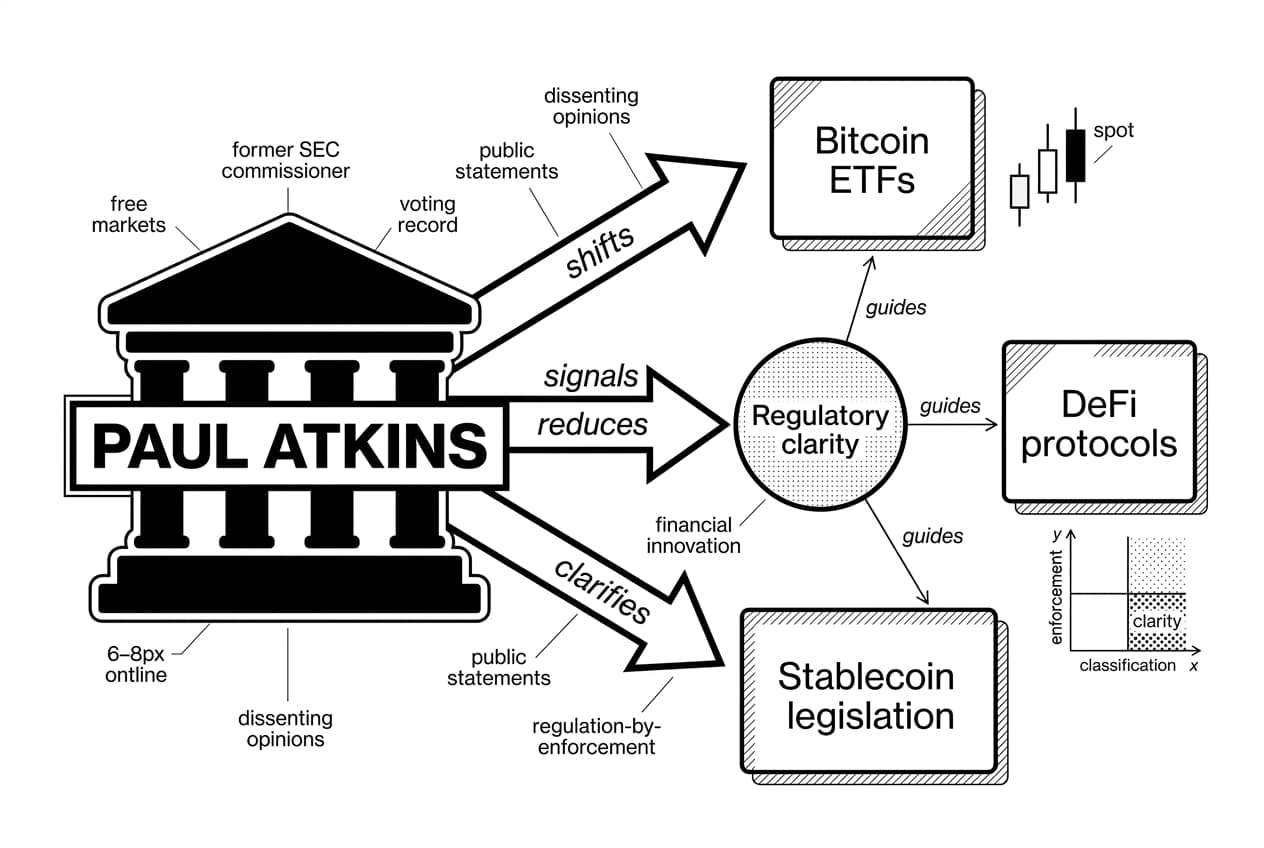
This article moves beyond a simple biography to provide a forward-looking analysis of the Paul Atkins SEC. By dissecting his past voting record, dissenting opinions, and public statements on financial innovation, we can construct a data-driven forecast of his likely policy direction. The core question we aim to answer is this: How will his historically deregulatory stance impact the most pressing issues facing the industry, from the approval of spot Bitcoin ETFs to the legal classification of DeFi protocols? Understanding the new SEC chair crypto framework is essential, as his tenure will likely define the competitive position of the United States in the global digital economy for years to come.
Paul Atkins' Career and Regulatory Philosophy: A Historical Context
To forecast how Paul Atkins might steer the Securities and Exchange Commission in 2026, one must look to his extensive history as both a regulator and a private-sector consultant. His entire career is built upon a consistent philosophical foundation: a deep-seated belief in free-market principles, a rigorous demand for cost-benefit analysis in rulemaking, and a profound skepticism of prescriptive, heavy-handed government intervention. This isn't a new stance adopted for the current political climate; it's the defining feature of his professional life, providing a clear blueprint for his potential actions.
A Commissioner's Legacy: Dissent and Deregulation (2002-2008)
During his first tenure as an SEC Commissioner, Atkins established himself as a principled dissenting voice. He frequently challenged the prevailing regulatory winds of the post-Enron era, arguing that well-intentioned rules often created unintended and costly consequences. A key example was his opposition to certain provisions within the Sarbanes-Oxley Act, where he questioned the economic burden placed on smaller public companies. His voting record from this period shows a clear pattern: a preference for principles-based disclosure over rigid, one-size-fits-all mandates. He consistently advocated for rules that empowered investors with information rather than dictating market outcomes, a philosophy that will almost certainly inform his approach to the novel structures found in digital assets.
Post-SEC Career and Private Sector Perspective
After leaving the Commission in 2008, Atkins co-founded Patomak Global Partners, a consulting firm advising financial institutions on regulatory compliance. This experience gave him a ground-level view of how SEC rules impact business operations, innovation, and capital formation. Through public commentary and congressional testimony over the last decade, he has been a vocal critic of what he views as the regulatory overreach of the Dodd-Frank Act. His work consistently highlights the compliance costs that can stifle competition and harm consumers. This history suggests that under the leadership of Paul Atkins, SEC proposals will face intense scrutiny regarding their real-world economic impact. This established worldview provides a key lens through which to analyze how the new SEC chair crypto policies will likely be formulated, with an emphasis on market efficiency over preventative restriction.
By the Numbers: Quantifying Atkins' Potential Market Impact
To fully grasp the significance of Paul Atkins leading the SEC, we must move beyond policy debates and look at the hard data. The numbers paint a clear picture of a massive, dynamic industry in the United States that has been operating under significant regulatory pressure. The stakes of this leadership change are measured not just in philosophical shifts, but in trillions of dollars of market value and billions in venture investment.
US Crypto Market Snapshot (April 2026)
As of this month, the digital asset market within the US represents a formidable economic force. The total market capitalization of projects and companies domiciled in the US now stands at an estimated $3.5 trillion. Daily trading volumes regularly exceed $150 billion, a figure that rivals some traditional exchanges. Institutional adoption, once a distant dream, is now a reality with 12 approved spot Bitcoin and Ethereum ETFs actively trading, managed by some of Wall Street's largest firms. This existing market infrastructure is poised for significant change under a new regulatory approach.
Venture Capital and Regulatory Headwinds
The previous regulatory climate created measurable capital flight. Data from the last three years shows a troubling trend: US-based crypto startups captured only 28% of global venture capital funding in 2025, a sharp decline from 45% in 2022. This capital didn't disappear; it flowed to more welcoming jurisdictions like Singapore and the UAE. The appointment of a pro-innovation SEC chair crypto enthusiasts support is seen by many as a direct response to this economic drain. Reversing this trend could have wide-ranging effects on the market, similar to how Fed meetings impact crypto prices by setting a new macroeconomic tone.
Atkins on Digital Assets: Analyzing His Stance on Crypto
An examination of Paul Atkins' past commentary, particularly his work with financial policy think tanks, points to a fundamental pivot in the SEC's approach to digital assets. His philosophy suggests a much narrower application of securities laws to crypto, favoring market-based solutions and clear rules over the ambiguous, enforcement-heavy strategy that defined the agency from 2022 to 2025. This shift is the most anticipated change investors expect from a potential Paul Atkins SEC administration.
The Security vs. Commodity Debate
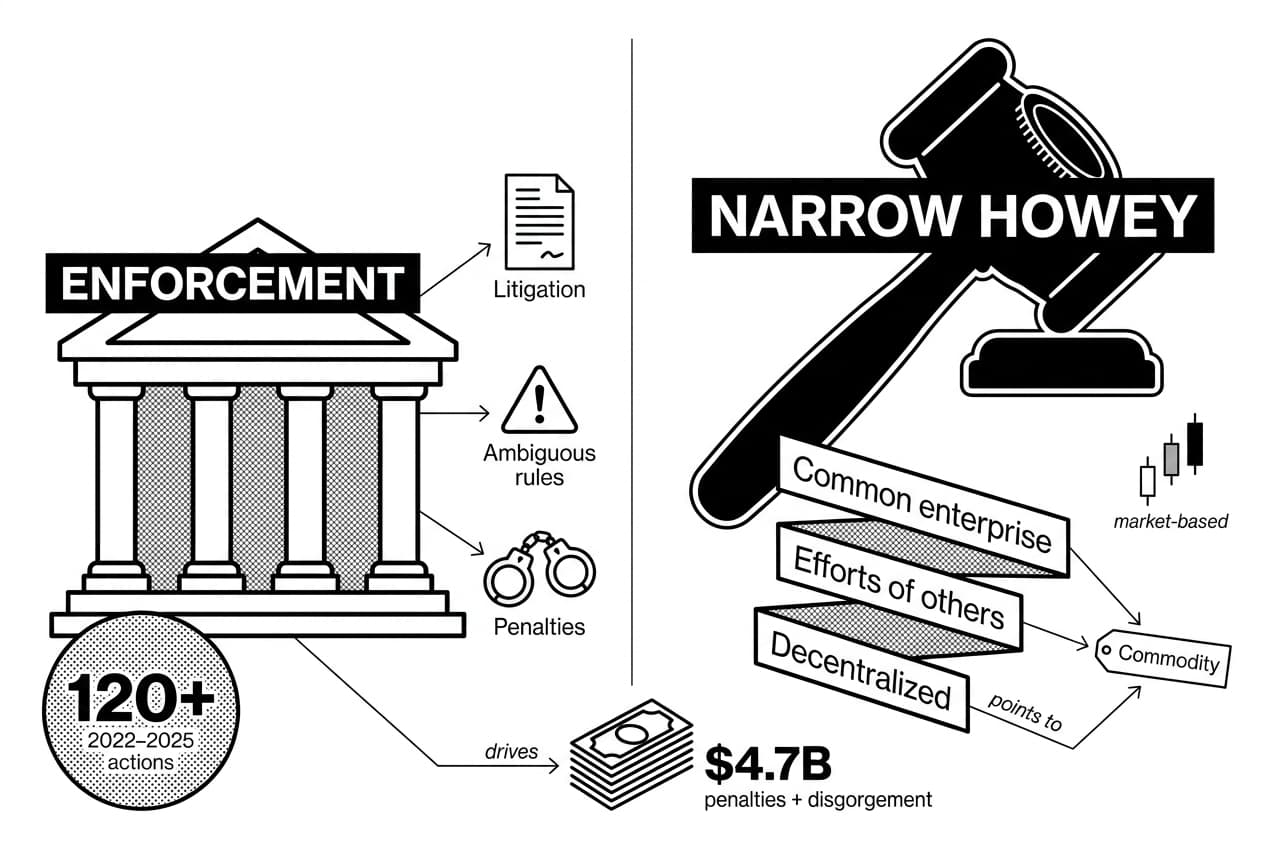
At the core of the past decade's regulatory gridlock has been the Howey Test. Atkins has consistently argued for a more restrained interpretation, contending that many decentralized digital assets do not neatly fit the "common enterprise" or "efforts of others" prongs of the test. This view stands in stark contrast to the previous administration, which operated under the assumption that nearly every digital asset aside from Bitcoin was an unregistered security. His writings suggest he is far more likely to classify established, sufficiently decentralized cryptocurrencies as commodities, placing them outside the SEC's direct jurisdiction.
This perspective could halt, and potentially reverse, the trend of regulation through litigation. For context, the SEC initiated over 120 crypto-related enforcement actions between 2022 and 2025, resulting in approximately $4.7 billion in penalties and disgorgement. An Atkins-led commission would likely focus its resources elsewhere, pursuing clear fraud cases rather than novel applications of 75-year-old securities law.
A Shift from 'Regulation by Enforcement'?
Atkins has been an outspoken critic of "regulation by enforcement," a strategy he views as an inefficient and unfair way to govern an emerging technology. He argues that using lawsuits to establish legal precedent is a poor substitute for clear, prospective rulemaking. As the new sec chair crypto policy will likely reflect, his focus is expected to shift toward establishing transparent guidelines for token issuance, DeFi platform operations, and stablecoin reserve requirements through a formal process.
This approach would likely involve more SEC concept releases, requests for public comment, and direct collaboration with industry participants—a significant departure from the adversarial stance of the past. If this change occurs, it would represent one of the most important de-risking events for the U.S. digital asset market in years. For investors, this means a potential move from a market defined by legal uncertainty to one governed by predictable rules of the road.
The Regulatory Agenda: What to Expect from a Paul Atkins SEC
- Accelerated Crypto ETF Approvals: A green light for spot exchange-traded funds beyond Bitcoin, including Ethereum and other major digital assets, is highly probable.
- Principles-Based DeFi & Stablecoin Rules: Expect a shift away from enforcement-first actions toward establishing a clearer, less restrictive framework for decentralized finance and stablecoins.
- Simplified Corporate Disclosures: Reporting requirements for public companies holding crypto assets are likely to be simplified, reducing regulatory burdens and encouraging institutional adoption.
Analyzing Paul Atkins' extensive record on financial regulation provides a clear roadmap for his likely priorities. For investors and builders in the digital asset space, the shift could be dramatic. These initiatives stem from a core belief in market-driven solutions and technological neutrality. A Paul Atkins SEC would likely aim to encourage innovation by providing regulatory clarity rather than prescriptive roadblocks. This represents a fundamental change from the ambiguity that has characterized the agency's approach for the better part of a decade.
The Future of Spot Crypto ETFs
Following the landmark approval and successful launch of spot Bitcoin ETFs, the market has been anticipating the next wave of product offerings. With over a dozen applications for spot Ether ETFs currently pending as of early 2026, the industry is watching the SEC closely. Atkins has historically argued against the agency picking winners and losers through delayed or biased approval processes. His leadership would almost certainly clear the path for these products, viewing them as a natural market evolution that provides investors with regulated access to a wider range of digital assets. We could see approvals for a basket of top-tier crypto assets in a single product within his first term.
A New Framework for Stablecoins and DeFi
Perhaps the most significant impact from a new SEC chair crypto enthusiasts are watching for is on decentralized finance. Atkins is expected to move away from regulation-by-enforcement, which has created immense uncertainty for DeFi protocols. Instead, he would likely champion a principles-based framework. This could involve creating clear guidelines for what constitutes a security in the context of a DeFi protocol or governance token, providing safe harbors for projects that meet specific decentralization criteria. For the stablecoin market, now surpassing $200 billion in value, he would probably work with Congress and other agencies to establish guardrails focused on reserve transparency and operational integrity, not on stifling their use. This approach fits within the broader government actions on crypto, which are increasingly favoring coordinated rulemaking over isolated enforcement.
Impact on Corporate Crypto Disclosures
For publicly traded companies, accounting for and disclosing digital asset holdings has been a source of frustration. Previous SEC guidance created complex custodial and reporting burdens that many saw as punitive. Atkins, with his focus on reducing unnecessary regulatory weight, is poised to revisit these rules. The expectation is a move toward a more simplified disclosure model that treats digital assets similarly to other intangible or financial assets on a company's balance sheet. This clarification would remove a major barrier for corporations looking to add Bitcoin or other cryptocurrencies to their treasury reserves, potentially unlocking a new wave of institutional investment.
Potential Challenges and Industry Criticisms
Despite widespread industry optimism, Paul Atkins’ tenure as SEC Chair will not be without significant opposition. His market-oriented philosophy invites pushback on several fronts, primarily from Congress, other federal agencies, and investor advocacy groups. Any perceived move toward deregulation will almost certainly face intense scrutiny from key members of the Senate Banking Committee who have historically advocated for stricter oversight of digital assets.
The most potent criticism will center on investor protection. Opponents will argue that a lighter regulatory touch abandons the SEC's core mission, potentially exposing retail participants to greater risks of fraud and market manipulation. After several years of high-profile collapses and scams, this argument carries considerable weight. For a new SEC Chair, crypto regulation presents a difficult balancing act between promoting innovation and safeguarding the interests of investors facing market volatility.
Beyond political headwinds, the Paul Atkins SEC must confront the fundamental mismatch between legacy financial laws and decentralized technology. Critics contend that simply applying securities laws from the 1930s to DeFi protocols or DAOs is an inadequate approach that fails to address the unique systemic risks these technologies introduce. Crafting a workable framework that doesn't stifle innovation while still providing meaningful oversight will be his administration’s most complex and defining challenge.
Key Takeaways: What This Means for Investors and Builders in 2026
The appointment of Paul Atkins to lead the SEC is not merely a personnel change; it represents a fundamental shift in the regulatory philosophy governing digital assets in the United States. His track record and public statements point toward a transition from enforcement-centric policy to a more market-oriented framework. This new direction creates distinct strategic considerations for everyone involved in the crypto ecosystem.
For those operating in this evolving environment, the primary implications are clear:
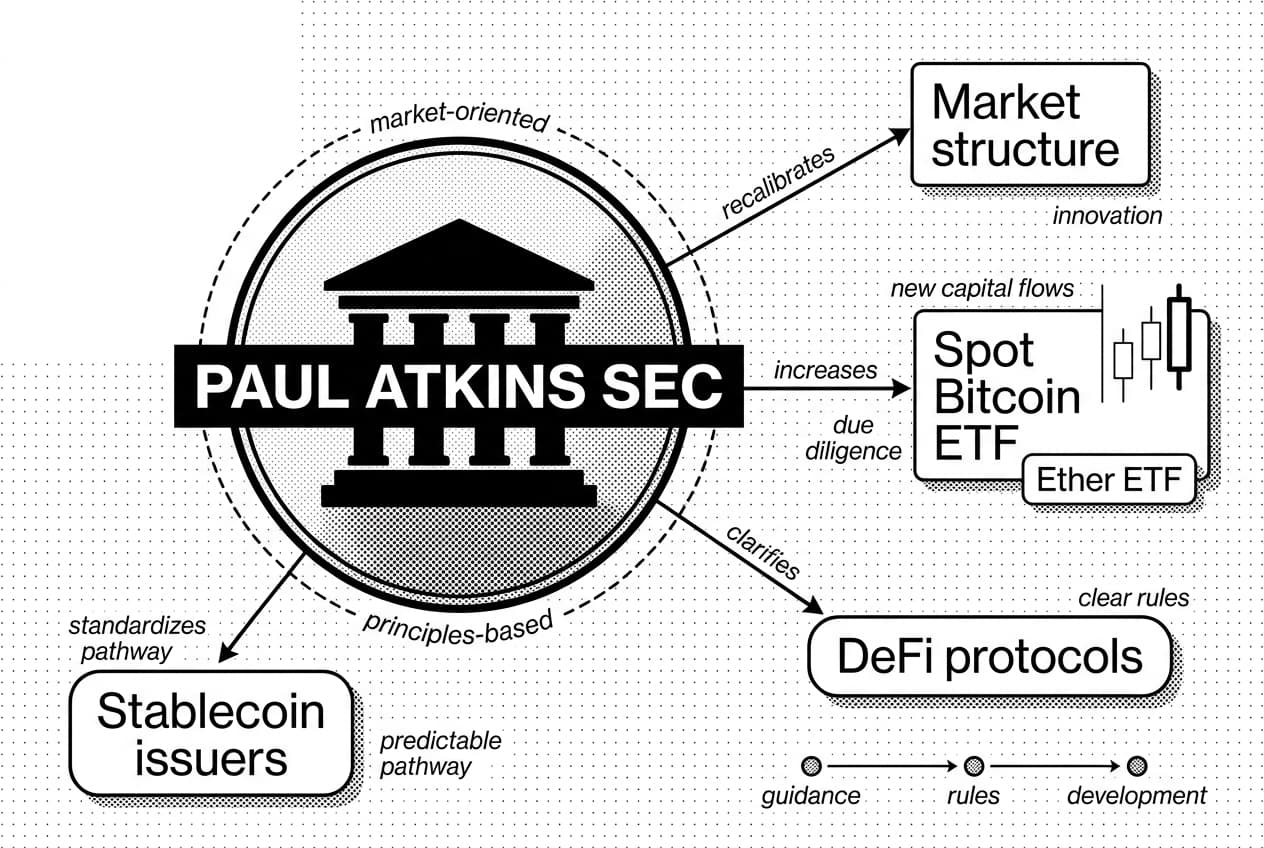
- Investors: The probability of spot Bitcoin and Ether ETF approvals has increased substantially under a Paul Atkins SEC. This could unlock new capital flows, but it also means the commission may take a less prescriptive role in investor protection, placing a greater emphasis on individual due diligence.
- Builders and Companies: The industry can likely expect a more predictable regulatory pathway. Instead of ambiguous guidance, the new leadership is poised to favor clear rules for DeFi protocols and stablecoin issuers. This climate under a pro-innovation sec chair crypto advocate could significantly reduce legal ambiguity and spur domestic development.
- Market Structure: The overall theme is one of recalibration. The focus will likely shift toward establishing principles-based guidelines that allow for innovation, a stark contrast to the prior administration's approach.
Sources
Author

Crypto analyst and blockchain educator with over 8 years of experience in the digital asset space. Former fintech consultant at a major Wall Street firm turned full-time crypto journalist. Specializes in DeFi, tokenomics, and blockchain technology. His writing breaks down complex cryptocurrency concepts into actionable insights for both beginners and seasoned investors.