Custodial vs. Non Custodial Crypto Wallet: 2026 Guide
What is a Crypto Wallet, Really?
Before we compare different types, let's clear up a common misconception. A crypto wallet doesn’t actually store your cryptocurrency like a physical wallet holds cash. Instead, a crypto wallet is a digital tool that manages the keys giving you access to your coins, which always live on the blockchain. Think of it less like a purse and more like a special, secure keychain and address book combined.
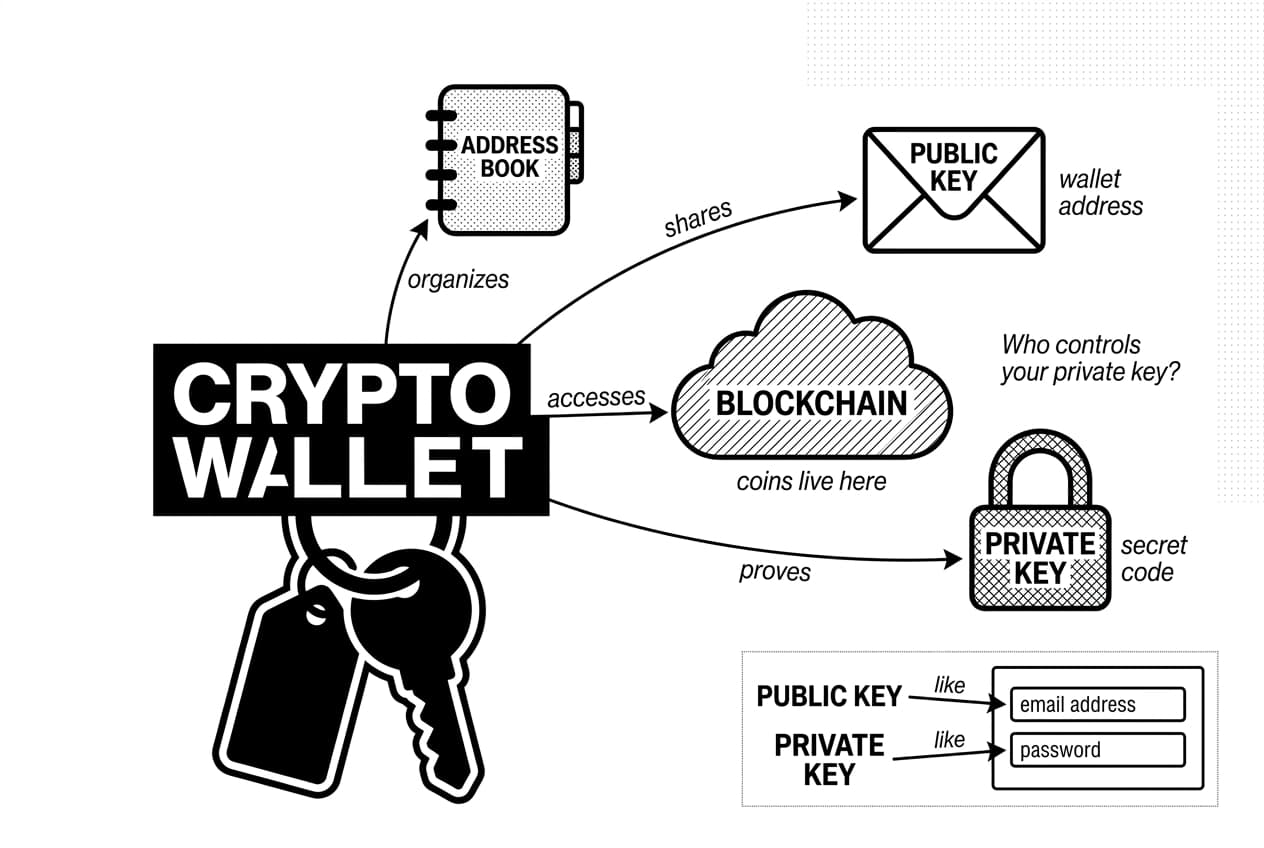
To make this tangible, let's use an analogy you already understand: email. Your public key (often shown as a wallet address) is like your email address. You can share it freely with anyone who wants to send you crypto. Your private key, on the other hand, is like your email password. It's the secret code that proves you own the funds and gives you the power to send crypto from your wallet. You would never share your email password, and you must protect your private key with that same level of seriousness.
Grasping this key-based system is the foundation for choosing the right type of wallet. The entire debate between custodial vs. non-custodial crypto wallets boils down to one simple question: Who holds and controls your private key? Answering that question is the first step in deciding which path is right for you.
What is a Custodial Crypto Wallet?
A custodial crypto wallet is a digital wallet where a third party, like a cryptocurrency exchange, holds and manages your private keys on your behalf. The simplest way to understand this is to compare it to a traditional bank account. You deposit your money, and the bank safeguards it. You access it with a username and password, trusting the bank to protect your funds and give you access when you ask. Most people start their crypto journey with custodial crypto wallets because they are incredibly easy to set up and use, often being built directly into the platforms where they first buy digital assets.
The Appeal of Convenience: Pros of Custodial Wallets
The primary benefit of a custodial wallet is its sheer convenience and user-friendliness. You don't need to worry about the technical details of securing a private key, which is a long, complex code that grants access to your crypto. If you forget your password, there's a simple recovery process, just like with your email or social media accounts. This removes the significant risk of losing your entire crypto fortune due to a lost password or a damaged hard drive, offering a safety net that many newcomers find reassuring.
The Trade-Off for Control: Cons of Custodial Wallets
This convenience, however, comes at a significant cost: control. In the crypto world, there's a popular saying: "not your keys, not your crypto." Since the third party holds the keys, you are trusting them completely. This introduces counterparty risk. If the exchange gets hacked, becomes insolvent, or faces regulatory action, your funds could be at risk. Your account could be frozen without warning, and in a worst-case scenario like a company collapse, you might wonder what happens to your assets. You are ultimately playing by someone else's rules, which is the very thing many people seek to avoid by using cryptocurrency in the first place.
What is a Non-Custodial (Self-Custody) Wallet?
A non-custodial crypto wallet is a type of wallet where you, and only you, hold and control your private keys. This is the digital equivalent of keeping your cash in a personal safe at home rather than in a bank account. With a self custodial crypto wallet, you are truly your own bank. No company or third party has access to your funds; the control rests entirely in your hands. Your private keys are the secret password that proves ownership and authorizes transactions, and in this model, you are the sole keeper of that secret.
This principle of self-sovereignty is a core idea in the world of cryptocurrency. It shifts the power from institutions back to the individual. But as you might guess, this complete control comes with a significant amount of personal responsibility.
Pros of Non-Custodial Wallets
The primary advantage of a non custodial crypto wallet is absolute ownership. Since you hold the keys, no one can freeze your account, block your transactions, or seize your assets without your permission. This makes your funds censorship-resistant, meaning they are protected from interference by banks or governments. Plus, these wallets offer greater privacy. You can often create and use them without submitting personal identification documents, giving you more anonymity than you'd find with custodial services that require identity verification.
Cons of Non-Custodial Wallets
The biggest trade-off for all that control is the burden of security. With a non custodial crypto wallet, you are 100% responsible for keeping your assets safe. There is no customer support hotline to call if you forget your password or get scammed. If you lose your "seed phrase"—a unique 12 or 24-word phrase that acts as your master backup—your cryptocurrency is gone forever. There is no recovery process. This steep learning curve and the unforgiving nature of self-custody can be intimidating for newcomers who are not yet comfortable with managing their own digital security.
Key Differences: Custodial vs. Non-Custodial Wallets at a Glance
Now that we've explored what each type of wallet is, let's put them side-by-side. Seeing the core differences clearly is the best way to determine which approach fits your needs. The choice between custodial and non-custodial options really comes down to a fundamental trade-off between convenience and control.
To make this simple, here is a direct comparison of their most important features.
Feature | Custodial Wallet | Non-Custodial Wallet |
|---|---|---|
Private Key Control | A third party (like an exchange) holds and manages your private keys for you. | You have sole, exclusive control over your private keys. |
Security Responsibility | The service provider is largely responsible for securing the assets. | You are 100% responsible for keeping your keys and assets safe. |
Recovery Process | Typically a simple password or identity verification reset, similar to an email account. | Depends entirely on your secret recovery phrase. If you lose it, your funds are gone forever. |
Ease of Use | Very beginner-friendly, with an experience much like online banking or a trading app. | Requires more learning and personal management. You approve all transactions yourself. |
Privacy | Lower privacy. Most services require identity verification (KYC/AML) to use. | Higher privacy. Your identity is not directly linked to your wallet address. |
The table gives a quick summary, but the implications of these differences are significant. Think of custodial crypto wallets as being similar to a bank account. The bank holds your money, provides security, and can help you regain access if you forget your password. It's convenient and familiar, but you are ultimately trusting a third party with your funds.
A non custodial crypto wallet is more like having physical cash in a personal safe. You have absolute control. No one can freeze your account or prevent you from accessing your funds. This freedom, however, comes with total personal responsibility. If you lose the key to your safe (your secret recovery phrase), there is no customer support line to call. This principle is why it's often called a self custodial crypto wallet—you are your own bank.
Types of Non-Custodial Wallets
Choosing a non custodial crypto wallet means you've decided to be your own bank. But just like you wouldn't store pocket money and your life savings in the same place, not all self-custody wallets are created equal. They fall into different categories based on how they connect to the internet and the level of security they provide. Let's look at the main types.
Software Wallets (Hot Wallets)
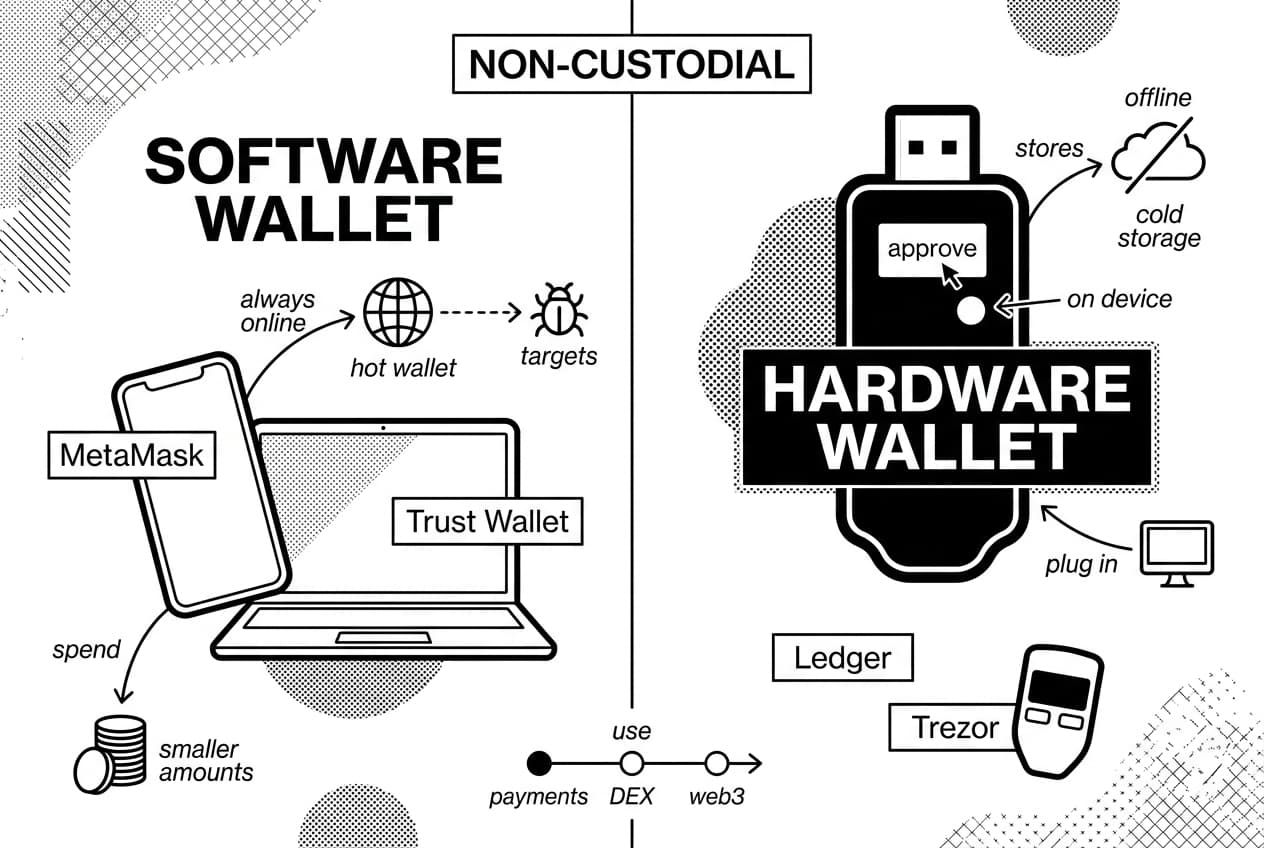
Think of a software wallet like the physical wallet you carry in your pocket or purse. It’s an application that lives on your computer or smartphone, like MetaMask or Trust Wallet. Because these apps are always connected to the internet, they are often called "hot wallets." This constant connection makes them incredibly convenient for everyday activities like making payments, trading on decentralized exchanges, or interacting with web3 applications. However, anything connected to the internet carries a small, inherent risk of being targeted by hackers or malware. They are perfect for managing smaller amounts of crypto that you plan to use regularly.
Hardware Wallets (Cold Wallets)
If a software wallet is your everyday purse, a hardware wallet is your personal, high-security vault. These are small, physical devices—like a specialized USB drive from companies such as Ledger or Trezor—that store your private keys completely offline. This is known as "cold storage." To send funds, you plug the device into your computer, but the critical step of approving the transaction happens on the device itself. Your keys are never exposed to the internet-connected computer. This makes a hardware wallet the gold standard for security and the best choice for storing large amounts of cryptocurrency for the long term. This is the ultimate self custodial crypto wallet for those who prioritize security above all else.
There are also paper wallets, which are simply your public and private keys printed out on a piece of paper. While a very basic form of cold storage, they are fragile and less common today compared to the security and user-friendliness of modern hardware wallets.
How to Choose the Right Wallet for You in 2026
Now that you understand the core differences, the big question remains: which type of wallet is best for you? There's no single correct answer. The right choice depends entirely on your goals, your comfort with technology, and how you plan to interact with your digital assets. Let's break it down by looking at a few common user profiles.
If You're Just Starting Out...
Are you brand new to crypto and just want to buy your first Bitcoin or Ethereum? For most beginners, custodial crypto wallets offer the smoothest entry point. The experience is similar to opening an account with a financial app. You can recover your password if you forget it, and you don't have to worry about managing private keys right away. It's a great way to dip your toes in the water with less responsibility.
If You're an Active Trader or DeFi User...
For those who trade frequently or want to explore the world of decentralized finance (DeFi), a non custodial crypto wallet is almost a necessity. A "hot" wallet, like a browser extension or mobile app, gives you the direct control needed to interact with different platforms and learn how to buy altcoins on decentralized exchanges. You accept the responsibility of securing your keys in exchange for the freedom to explore the crypto ecosystem on your own terms.
If You're a Long-Term Investor (HODLer)...
Do you plan to hold a significant amount of crypto for years to come? If security is your absolute top priority, a hardware wallet—a type of self custodial crypto wallet—is the gold standard. By keeping your private keys completely offline, it provides the strongest protection against online threats. Think of it as your personal digital vault for long-term savings.
Security Best Practices for Your Crypto Wallet
Once you've chosen your wallet, the next critical step is securing it. Think of it this way: you wouldn't leave a pile of cash on your coffee table, and the same care should be applied to your digital assets. Your security habits are just as important as your investment strategy, especially when you need to survive and invest in a downturn. The right approach depends entirely on your wallet type.
Securing a Self Custodial Crypto Wallet
With a non custodial crypto wallet, you are the bank. Your most sacred possession is your seed phrase, also known as a recovery phrase. Never store this digitally—not in a text file, not in an email, and definitely not as a photo on your phone. Write it down on paper or engrave it in metal. Store these physical copies in secure, separate locations, like a fireproof safe at home and another at a trusted family member's house. Remember, anyone with this phrase can access your funds. No legitimate company will ever ask you for it.
Securing Custodial Crypto Wallets
For custodial crypto wallets, security feels more like protecting a traditional online account. Start with a long, strong, and unique password for the service—a password manager can help create and store these for you. The single most important step you can take is to enable Two-Factor Authentication (2FA). Whenever possible, use an authenticator app instead of SMS for 2FA, as it is much more secure. Always be on guard against phishing emails or messages that try to trick you into revealing your login details.
Key Takeaways: Custodial vs. Non-Custodial
As you've seen, the choice between wallet types comes down to a fundamental trade-off. To help you decide, let's distill everything down to the most essential points.
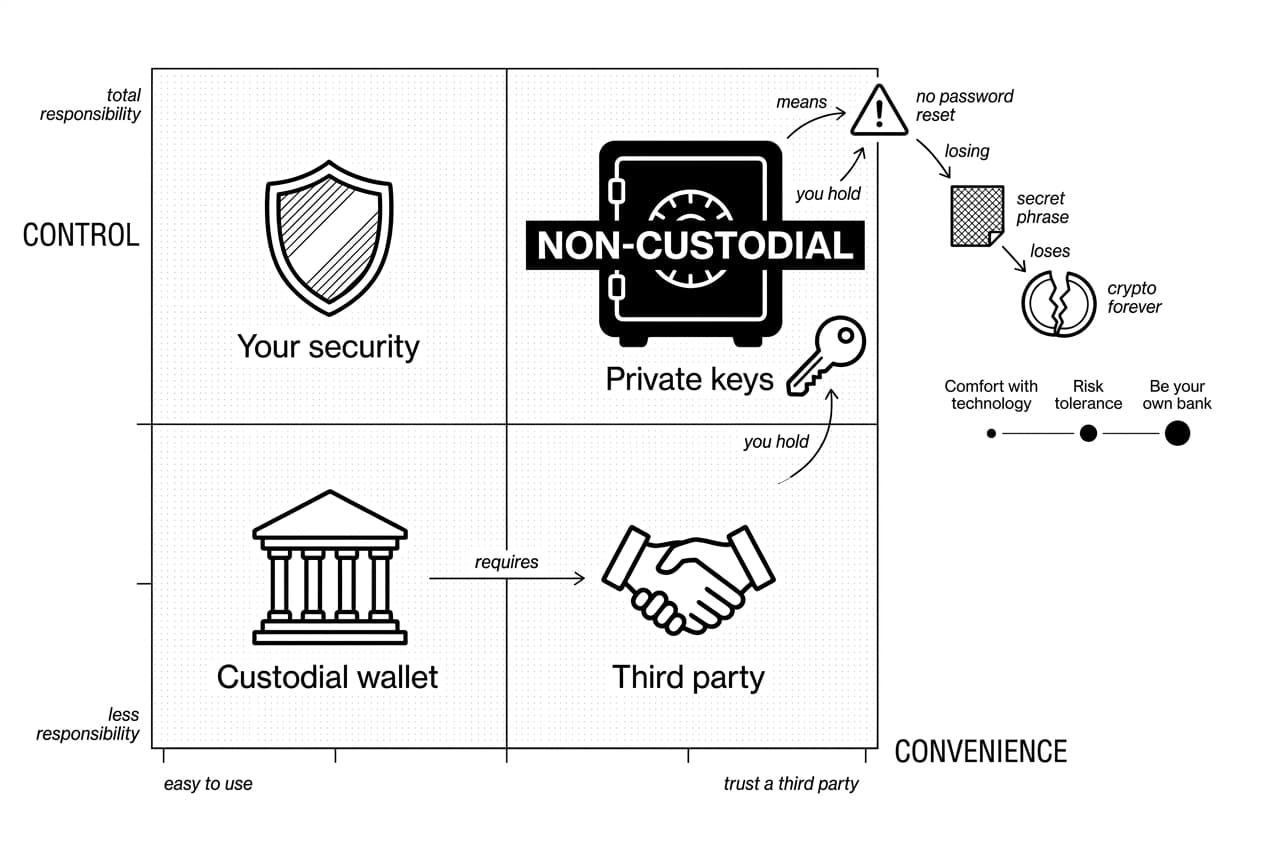
- Custodial crypto wallets prioritize convenience. They function like a bank, managing your keys for you. This makes them easier to use but requires you to trust a third party with your funds.
- A non custodial crypto wallet grants you complete control. You hold your private keys, making you the sole owner and guardian of your digital assets.
- This control brings total responsibility. With a self custodial crypto wallet, losing your secret phrase means losing your crypto forever—there is no password reset or customer support line.
- The right choice depends entirely on your comfort with technology and your willingness to take on the security duties of being your own bank.
Frequently Asked Questions
- What are the risks of a non-custodial wallet?
- The primary risk is your personal responsibility. If you lose your private key or seed phrase, your funds are permanently gone with no recovery option. You are also solely responsible for securing your wallet against malware, phishing attempts, and other scams that could compromise your digital assets.
- Which crypto wallets are custodial?
- Custodial wallets are typically those provided by third-party services like cryptocurrency exchanges. Popular examples include Coinbase, Binance, and Kraken. If a company holds your private keys for you and offers account recovery via email, you are almost certainly using a custodial wallet and trusting them with your funds.
- What is the best self-custodial crypto wallet?
- The "best" wallet depends on your specific needs. For maximum security and long-term storage, hardware wallets like Ledger or Trezor are highly recommended. For frequent transactions and interacting with DeFi applications, software wallets such as MetaMask or Trust Wallet are excellent and very popular choices for their convenience.
- Can I lose my crypto with a custodian?
- Yes, it is possible. While you can recover your account if you forget a password, you face counterparty risk. This means your crypto could be lost if the custodial service is hacked, goes bankrupt, or freezes your account for any reason. You are trusting the custodian to keep your assets safe.
Sources
Author

Crypto analyst and blockchain educator with over 8 years of experience in the digital asset space. Former fintech consultant at a major Wall Street firm turned full-time crypto journalist. Specializes in DeFi, tokenomics, and blockchain technology. His writing breaks down complex cryptocurrency concepts into actionable insights for both beginners and seasoned investors.