Crypto Bankruptcies of 2022: A Complete Timeline & Analysis

Introduction: The Great Unraveling of Crypto in 2022
The year 2022 will be remembered as the moment the digital asset market confronted its own systemic vulnerabilities. Looking back from our vantage point in 2026, it is clear that the string of collapses was not a series of unrelated misfortunes but a single, cascading contagion event. The market learned a hard lesson in financial gravity as unsustainable models and opaque, interconnected balance sheets came undone. This great unraveling exposed the immense counterparty risk that had built up within the centralized finance (CeFi) sector during the bull run, leading directly to the market structure and regulatory scrutiny we see today.

The first domino to fall was the Terra/LUNA ecosystem in May, an algorithmic stablecoin project whose implosion erased over $40 billion in investor capital in a matter of days. This shock was the catalyst, directly leading to the insolvency of the once-mighty hedge fund Three Arrows Capital (3AC), which had significant exposure built on borrowed funds. The failure of 3AC created a credit crisis that quickly spread to its lenders, pulling major firms like Voyager Digital and Celsius Network into a vortex of withdrawals and freezes. This wave of crypto bankruptcies revealed a deeply intertwined system of undercollateralized loans and poor risk management.
This chain reaction culminated in the spectacular failure of the FTX exchange in November 2022, an event that shattered what little trust remained in centralized market actors. This retrospective will not only detail the timeline of these events but also analyze the financial mechanics that linked each collapse. We will trace the flow of capital and risk from one fallen entity to the next, demonstrating how the industry's near-demise became a necessary catalyst for its maturation.
By the Numbers: Quantifying the 2022 Contagion
To grasp the full scope of the 2022 market collapse, we must first look at the sheer scale of the financial destruction. The chain of insolvencies that defined that year wiped out an estimated $2 trillion in market capitalization from the industry's peak. This wasn't just institutional money; millions of individual retail users found their assets frozen on platforms they had been told were safe. The resulting series of crypto bankruptcies revealed a deep-seated fragility built on interconnected liabilities and a profound lack of risk management. The numbers alone tell a staggering story of contagion.
The domino effect began with algorithmic failures and quickly spread through the centralized lending space. Here is a summary of the most significant collapses:
Key 2022 Crypto Bankruptcies:
- Terra/LUNA: The algorithmic stablecoin ecosystem collapsed, erasing over $40 billion in market value in a matter of days.
- Three Arrows Capital: The prominent crypto hedge fund imploded after massive, unhedged bets on LUNA and other ventures went sour.
- Celsius: A centralized lending platform froze withdrawals and filed for bankruptcy due to extreme market conditions and exposure to the contagion.
- Voyager: This crypto broker filed for protection after its significant loan to the now-insolvent Three Arrows Capital defaulted.
- BlockFi: The lender halted withdrawals and sought bankruptcy protection following its heavy financial exposure to FTX.
- FTX: The once-dominant exchange catastrophically failed amid revelations of commingled customer funds and a severe liquidity crisis.
- Genesis: A major institutional lending desk, it was forced into bankruptcy after suffering heavy losses from loans to Three Arrows Capital and Alameda Research.
Key Crypto Bankruptcies at a Glance
This cascade of failures involved massive liabilities, locking up billions in customer and creditor funds for years. The court filings from that period paint a clear picture of the financial black holes these companies left behind.
- Celsius Network: Filed July 13, 2022, with a reported $1.2 billion hole in its balance sheet and estimated liabilities near $5.5 billion.
- Voyager Digital: Filed July 6, 2022, listing over 100,000 creditors and between $1 billion and $10 billion in estimated liabilities.
- BlockFi: Filed November 28, 2022, also citing liabilities in the $1 billion to $10 billion range, largely due to its entanglement with FTX.
- FTX: Filed November 11, 2022, in what became one of the most complex financial implosions, with liabilities eventually estimated to exceed $8 billion.
- Genesis Global Capital: Filed January 19, 2023, revealing it owed over $3.5 billion to its top 50 creditors alone, a direct consequence of the FTX and 3AC collapses.
The Catalyst: How the Terra/LUNA Collapse Ignited the Fire
Looking back from 2026, it's clear that the chain reaction of insolvencies in 2022 did not begin in a vacuum. The initial, violent shockwave originated from a single point of failure: the collapse of the Terra ecosystem. In May 2022, the TerraUSD (UST) stablecoin and its sister token, LUNA, imploded spectacularly, wiping out over $40 billion in market value in a matter of days. This event was not merely a significant loss; it was the specific catalyst that exposed fatal weaknesses in interconnected lending platforms and set the stage for the historic series of crypto bankruptcies that followed.
The Flawed Design of an Algorithmic Stablecoin
At its core, UST’s failure was a failure of design. Unlike fiat-collateralized stablecoins, UST was not backed by dollars in a bank account. Instead, it relied on a delicate arbitrage mechanism with LUNA to maintain its $1.00 peg. This was a textbook algorithmic stablecoin model. In theory, if UST traded below $1.00, traders could buy the discounted UST and swap it for $1.00 worth of newly minted LUNA, pocketing a small profit and pushing the UST price back up. Conversely, if UST traded above $1.00, users could swap $1.00 worth of LUNA for one UST, increasing the stablecoin's supply and bringing its price down.
The system’s stability depended entirely on two factors: sustained market confidence and a stable or rising price for LUNA. The model was inherently fragile because it had no external backstop. When large, coordinated withdrawals began in early May 2022, it triggered a classic digital bank run. As holders rushed to redeem their UST for LUNA, the protocol was forced to mint LUNA at an exponential rate. This hyperinflationary pressure cratered the LUNA price, meaning ever-larger amounts of LUNA were required to redeem each UST. The arbitrage mechanism, designed to be a stabilizing force, became the engine of a death spiral. This catastrophic failure demonstrated how an uncollateralized peg could evaporate, sending shockwaves that would soon topple some of the industry's biggest names.
The First Wave: 3AC, Celsius, & Voyager Digital Go Under
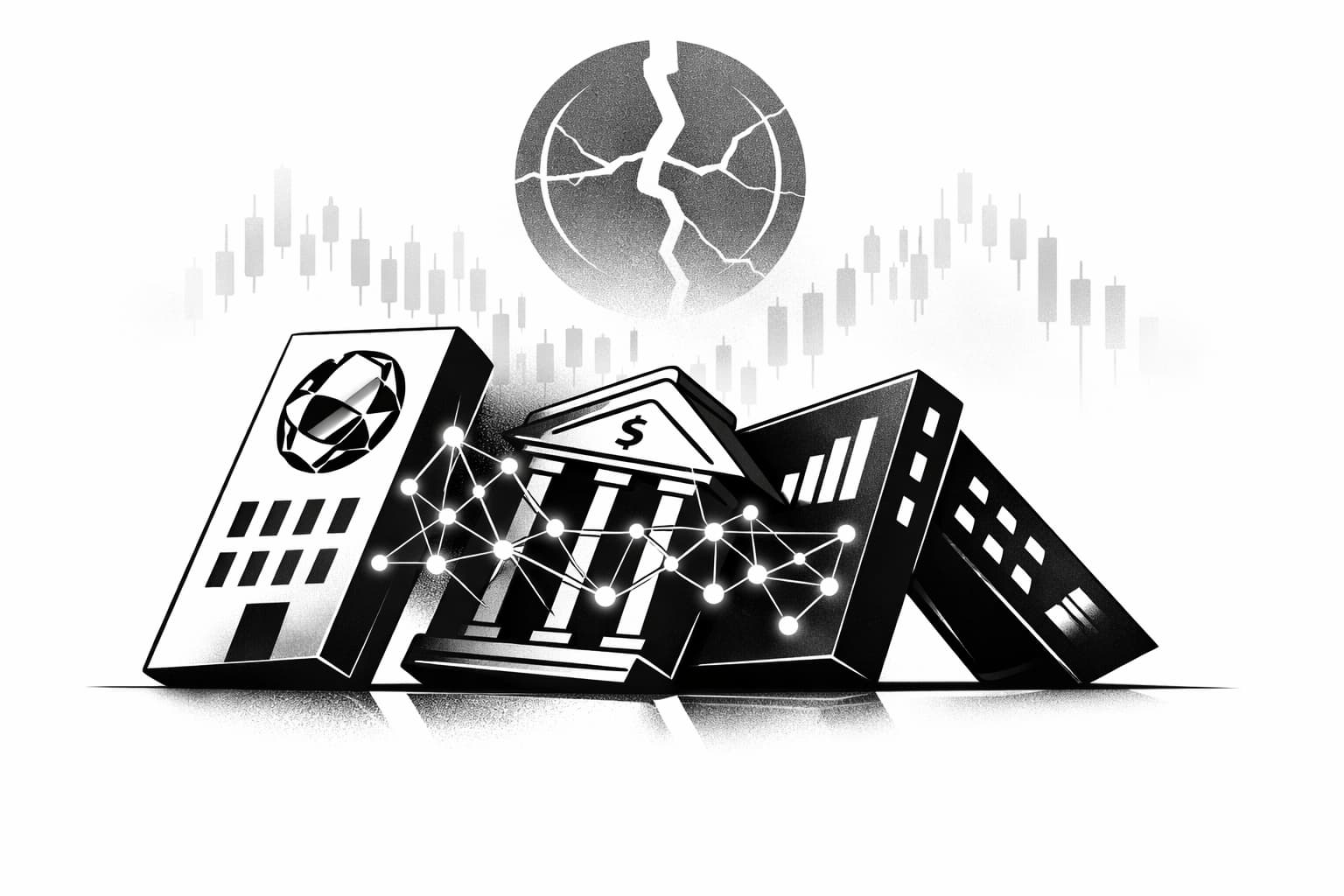
The Terra/LUNA implosion in May 2022 was the initial shock, but the financial contagion that followed revealed the true structural weaknesses within centralized crypto finance. What followed was not a series of isolated incidents, but a tightly linked cascade of failures fueled by opaque balance sheets, extreme levels of borrowing, and a shocking lack of basic risk management. The first three major crypto bankruptcies—Three Arrows Capital (3AC), Celsius, and Voyager Digital—were not just concurrent; they were causally intertwined, with each firm's collapse directly precipitating the next.
Three Arrows Capital (3AC): A Hedge Fund's Hubris
Before its spectacular collapse, Three Arrows Capital was one of the most influential hedge funds in the crypto space, managing an estimated $10 billion in assets at its peak. Their strategy, however, was predicated on a perpetually rising market. The fund took massive, often unhedged, directional positions in various projects, borrowing heavily from across the industry to amplify its bets. Their undoing began with a reported $600 million exposure to the LUNA ecosystem. When Terra collapsed, that position was wiped out almost overnight, creating a catastrophic hole in their balance sheet.
This initial loss triggered a cascade of margin calls from their numerous lenders. Unable to meet these obligations, 3AC faced forced liquidations of its remaining assets into a cratering market, deepening its losses and spreading panic. The fund, once a symbol of crypto's meteoric rise, filed for Chapter 15 bankruptcy on July 1, 2022. Its failure was the first major domino, sending shockwaves directly to the balance sheets of the institutions that had extended them credit with what we now know was insufficient collateral and due diligence.
Celsius Network: The Yield Platform Freeze
Celsius Network built its brand on offering retail users market-beating yields on their crypto deposits. The model was simple on the surface: take in user deposits and lend them out at a higher rate to institutional players like 3AC. The problem was the immense, undisclosed risk on the back end. As one of 3AC's largest creditors, the fund's default dealt a mortal blow to Celsius's financial standing.
Compounding this was a bank run dynamic. As fear spread following Terra's collapse, users rushed to withdraw funds, creating a severe liquidity crisis for Celsius. On June 12, 2022, the company abruptly froze all customer withdrawals, swaps, and transfers, citing "extreme market conditions." This move trapped billions of dollars in user assets and signaled the company's insolvency. A month later, on July 13, Celsius filed for Chapter 11 bankruptcy. Court filings would later reveal a staggering $1.2 billion hole in its balance sheet, exposing a business model that had prioritized growth at the expense of sound financial stewardship.
Voyager Digital: Contagion Claims Another Lender
The link between 3AC and the next major failure, Voyager Digital, was even more direct. Voyager, a publicly traded crypto broker and lender, had extended a loan to 3AC worth over $670 million (consisting of 15,250 BTC and 350 million USDC). Critically, this enormous loan was largely undercollateralized. When 3AC defaulted, that debt became an unrecoverable asset on Voyager’s books, instantly erasing a majority of the lender's capital.
Voyager's leadership initially tried to reassure the market, but the damage was done. The firm issued a notice of default to 3AC on June 27, but it was an empty gesture. With its own liquidity crisis mounting, Voyager followed Celsius's playbook, halting withdrawals on July 1. Just days later, on July 5, it too filed for Chapter 11 bankruptcy protection. The fall of Voyager was a textbook case of contagion, demonstrating how a single, poorly managed counterparty risk could single-handedly destroy a publicly traded company and freeze the assets of over a million customers. This trio of crypto bankruptcies laid bare the industry's shaky foundations long before the year's final, most devastating collapse.
The Main Event: The Shocking Downfall of FTX
While the collapses of Celsius and Three Arrows Capital exposed systemic risks in crypto lending, the implosion of FTX in November 2022 was an event of a different magnitude. This was not merely a case of poor risk management; it was a catastrophic failure of corporate governance and, as subsequent court proceedings revealed, a multi-billion-dollar fraud. The downfall of an exchange once valued at $32 billion, led by a charismatic founder who had become the face of the industry, irrevocably shattered market confidence and triggered the most intense wave of the contagion. The FTX saga stands as the defining event among the 2022 crypto bankruptcies, directly leading to the stringent regulatory frameworks we operate under today.
The final act began on November 2, 2022, with a leaked balance sheet from FTX's sister trading firm, Alameda Research. The report revealed that a staggering portion of Alameda's $14.6 billion in assets was comprised of FTT, the exchange token minted by FTX itself. Of this, $3.66 billion was listed as "unlocked FTT," with another $2.16 billion held as FTT collateral. This revelation set off alarm bells; the solvency of one of crypto's largest trading firms was dependent on an illiquid, self-issued token. The market's reaction was swift. On November 6, rival exchange Binance announced its intention to liquidate its entire FTT position, valued at over $500 million. This was the spark that ignited the bonfire. A bank run on FTX ensued, with users attempting to withdraw billions in a matter of days.
By November 8, the exchange buckled under the pressure, halting withdrawals and tacitly admitting its insolvency. In a move that shocked the industry, CEO Sam Bankman-Fried announced a potential bailout through a non-binding letter of intent for Binance to acquire FTX. For a brief 24-hour period, the market held its breath. The relief was short-lived. On November 9, Binance walked away from the deal, citing the results of their due diligence and reports of mishandled customer funds. With no savior in sight, the end was inevitable. On November 11, 2022, FTX, Alameda Research, and approximately 130 affiliated companies filed for Chapter 11 bankruptcy protection in the United States, leaving an estimated one million creditors and an $8 billion hole in its balance sheet.
Alameda Research and the FTT Token
The relationship between FTX and Alameda was the core of the rot. In a healthy market structure, an exchange and a proprietary trading firm, even with common ownership, should operate at arm's length. This was not the case here. Court filings and analysis from the restructuring team led by John J. Ray III revealed a fatally symbiotic loop. FTX created the FTT token out of thin air. Alameda then used its vast holdings of FTT as collateral to borrow billions in real assets, like stablecoins and Bitcoin, from both FTX itself and third-party lenders. This created a feedback loop of phantom value; the perceived strength of FTX boosted FTT's price, which in turn inflated Alameda's balance sheet, allowing it to take on even more debt. When the market turned and Binance's announced sale crushed the value of FTT, Alameda’s collateral was vaporized, and the entire house of cards collapsed.
The Role of Sam Bankman-Fried (SBF)
Central to the FTX narrative was its founder, Sam Bankman-Fried. Before the collapse, SBF had cultivated an image as a brilliant, altruistic leader—a "white knight" bailing out struggling firms and a sophisticated lobbyist shaping crypto policy in Washington D.C. The reality uncovered during the bankruptcy was a stark contrast. The firm was run with a shocking lack of basic financial controls. There were no accurate books or records, customer funds were commingled with corporate assets and funneled to Alameda to cover trading losses, and corporate funds were used to purchase luxury real estate. Evidence pointed to a secret "backdoor" in FTX's code that allowed Alameda to maintain a massive negative balance without being subject to the exchange's automatic liquidation engine. SBF's public persona of a responsible steward crumbled, replaced by the reality of a reckless operator whose actions directly led to the loss of billions in customer deposits. This blatant malfeasance is what distinguished the fall of FTX from all other crypto bankruptcies of the era.
The Aftershocks: BlockFi, Genesis, and Further Fallout
The implosion of FTX was not the end of the 2022 crisis, but rather the final shockwave that toppled the remaining vulnerable structures. The days and weeks following FTX’s Chapter 11 filing on November 11, 2022, saw the contagion spread to its closest financial partners. This final stage of the collapse revealed just how deeply intertwined these platforms were, with credit lines and loans acting as transmission vectors for financial ruin. The subsequent failures of BlockFi and Genesis marked the grim conclusion to a year defined by interconnected crypto bankruptcies.
BlockFi's Reliance on FTX
BlockFi’s fate was sealed the moment FTX went under. The lending platform, already wounded by a significant bad loan to Three Arrows Capital, had accepted what it portrayed as a lifeline from FTX US earlier in the year: a $400 million revolving credit facility, along with an option for FTX to acquire the company. This deal, intended to stabilize BlockFi, instead became an anchor that dragged it down. Court filings later revealed BlockFi had substantial assets held on the FTX platform, now inaccessible, and significant exposure to Alameda Research through outstanding loans.
With its rescuer now revealed as insolvent and its own assets trapped, BlockFi had no path forward. On November 28, 2022, just 17 days after FTX’s collapse, BlockFi and its eight affiliates filed for Chapter 11 bankruptcy protection. The company cited its "significant exposure to FTX" as the direct cause, stating it had over $355 million in crypto frozen on the platform and a $671 million defaulted loan to Alameda. This dependency demonstrated the fatal flaw in the 2022 CeFi model: bailouts often came from equally compromised players, creating concentrated, systemic risk rather than mitigating it.
Genesis Global Trading Halts Withdrawals
While BlockFi’s collapse was swift, the trouble at Genesis Global Trading signaled a deeper rot within institutional crypto infrastructure. As a major prime brokerage and lender, Genesis was a core liquidity provider for the market. Its lending arm had already sustained massive losses from the 3AC collapse, reporting claims of approximately $1.2 billion. To plug this hole, its parent company, Digital Currency Group (DCG), absorbed the liability via a $1.1 billion promissory note—a temporary fix that merely shifted the problem internally.
The FTX collapse was the final, unbearable blow. Genesis revealed it had $175 million locked in an FTX trading account. More critically, its loan book was heavily exposed to Alameda Research. On November 16, 2022, Genesis Global Capital suspended redemptions and new loan originations, trapping the assets of its own clients, most notably users of the Gemini Earn program. This freeze triggered a public dispute with Gemini and ultimately forced Genesis into its own Chapter 11 bankruptcy in January 2023, dragging its parent DCG into a prolonged financial struggle and marking the end of the great CeFi unwind.
Lessons Learned: How 2022 Reshaped Crypto Regulation & Risk
Looking back from 2026, it is clear that the contagion of 2022 was not merely a market crash; it was the primary catalyst that forced the digital asset industry into a new era of accountability. The chain reaction of crypto bankruptcies directly triggered the two most significant structural shifts we see in the market today: a user-driven demand for radical transparency and a decisive global regulatory response. These events fundamentally altered how capital flows and how investors evaluate counterparty risk.

The Rise of On-Chain Audits and Proof-of-Reserves
The core failure across the collapsed CeFi platforms was financial opacity. Before 2022, users implicitly trusted platforms' balance sheet attestations. The revelation that giants like FTX and Celsius were operating with massive, undisclosed liabilities and misusing customer deposits shattered that model. This created an immediate and powerful demand for verifiable proof. Consequently, Proof-of-Reserves (PoR) protocols, often paired with Merkle tree audits allowing individual users to verify their own balances, evolved from a niche concept to a market standard. As of Q1 2026, data shows that over 80% of centralized exchanges with more than $5 billion in assets provide real-time PoR dashboards, a dramatic increase from less than 10% in early 2022. This shift was not altruistic; it was a survival mechanism in a market that now harshly punishes ambiguity.
Global Regulatory Response
While the market began to self-correct, the sheer scale of retail losses—estimated to be over $50 billion globally across the 2022 collapses—made government intervention a certainty. Regulators worldwide moved to close the loopholes that platforms had exploited. In Europe, the Markets in Crypto-Assets (MiCA) regulation was fast-tracked, with its final form including much stricter provisions for the segregation and protection of client assets. In the United States, the fallout provided the political will for a subsequent regulatory crackdown. This resulted in new SEC guidance that firmly established rules for qualified custodians and effectively prohibited the rehypothecation of retail digital assets, a practice at the heart of several bankruptcies.
For investors in 2026, this reshaped area presents a different set of challenges. The era of chasing unsustainable yields from opaque financial black boxes is definitively over. The primary task today involves carefully assessing CeFi platform risk through a new lens of regulatory compliance, audited reserves, and transparent business models. The painful lessons from 2022 created a more resilient, if more constrained, market structure where verifiable trust is no longer just a feature, but the price of participation.
Frequently Asked Questions
- Why did FTX collapse?
- FTX collapsed due to fraudulent activity and severe mismanagement. The exchange secretly used customer deposits to fund risky bets via its sister firm, Alameda Research. When a report exposed that Alameda's balance sheet was propped up by FTX's own FTT token, it triggered a bank run that revealed the massive shortfall.
- Are we expecting a crypto crash?
- From our 2026 vantage point, the market appears more resilient. The 2022 crashes removed excessive leverage and many irresponsible players from the system. While crypto will always be volatile, stronger regulations and improved risk management protocols have since been implemented, though investors should always remain cautious as inherent risks persist.
- How much did Tom Brady lose in crypto?
- Tom Brady and Gisele Bündchen received equity in FTX as part of their promotional deals, which became worthless after the bankruptcy. Reports suggest their combined holdings were valued around $30 million. This serves as a stark reminder of the risks tied to celebrity-endorsed investments and the importance of independent research.
- What is Eric Trump saying about crypto?
- Commentary on crypto from political and business figures can influence public sentiment but often lacks deep analysis. Rather than focusing on any single opinion, savvy investors should prioritize understanding project fundamentals and implementing a sound risk management strategy before committing any capital to the market, regardless of celebrity or political commentary.
Sources
Author

Crypto analyst and blockchain educator with over 8 years of experience in the digital asset space. Former fintech consultant at a major Wall Street firm turned full-time crypto journalist. Specializes in DeFi, tokenomics, and blockchain technology. His writing breaks down complex cryptocurrency concepts into actionable insights for both beginners and seasoned investors.