Yen Carry Trade & Bitcoin: How JPY Impacts BTC Price in 2026
The Yen's Shadow: How Japan's Monetary Policy is Fueling Bitcoin
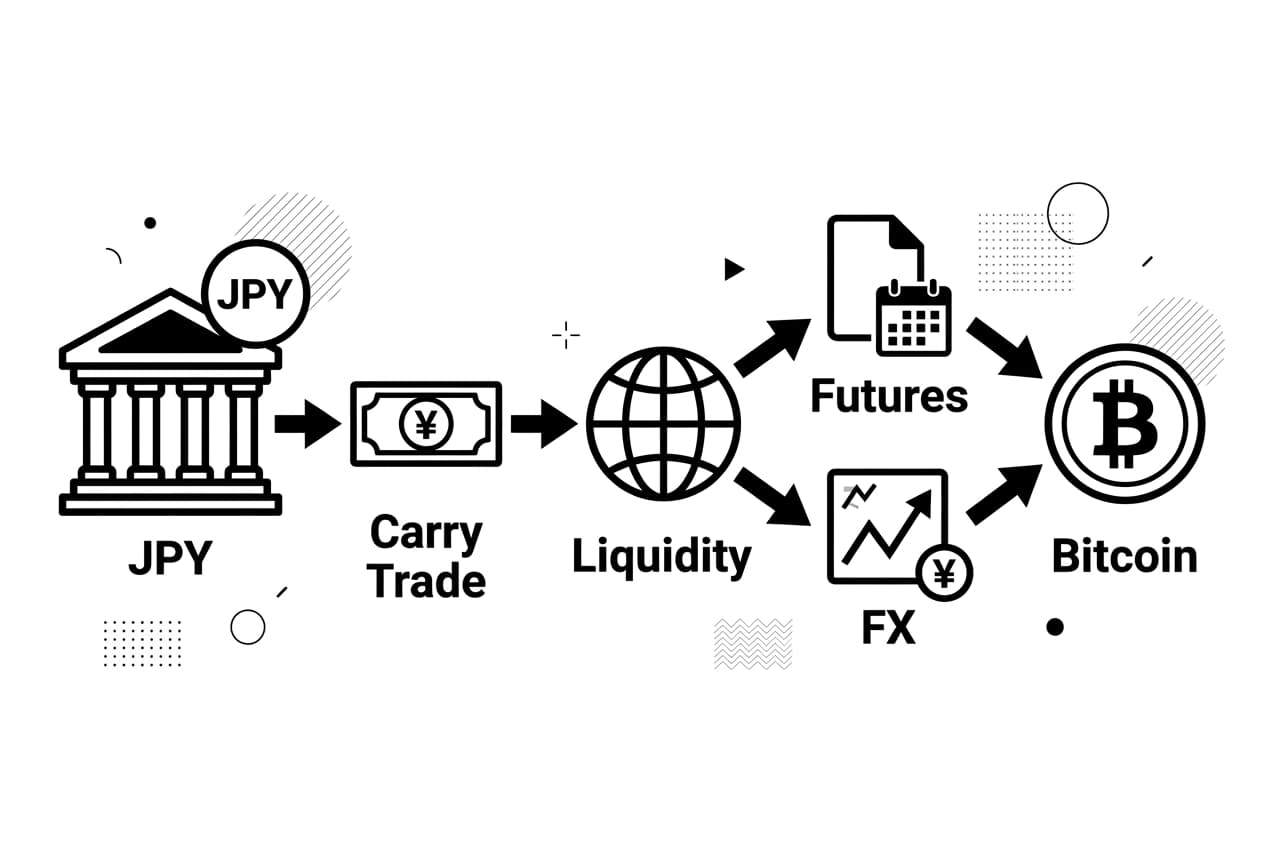
A significant, yet fragile, pillar supporting the crypto market's recent strength is not found in code, but in Tokyo's monetary policy. The massive Japanese yen carry trade bitcoin investors often overlook has become a dominant source of global liquidity. As the Bank of Japan maintains its ultra-low interest rate policy through early 2026, investors are borrowing yen for practically nothing and rotating that capital into higher-yielding assets worldwide, including digital assets.
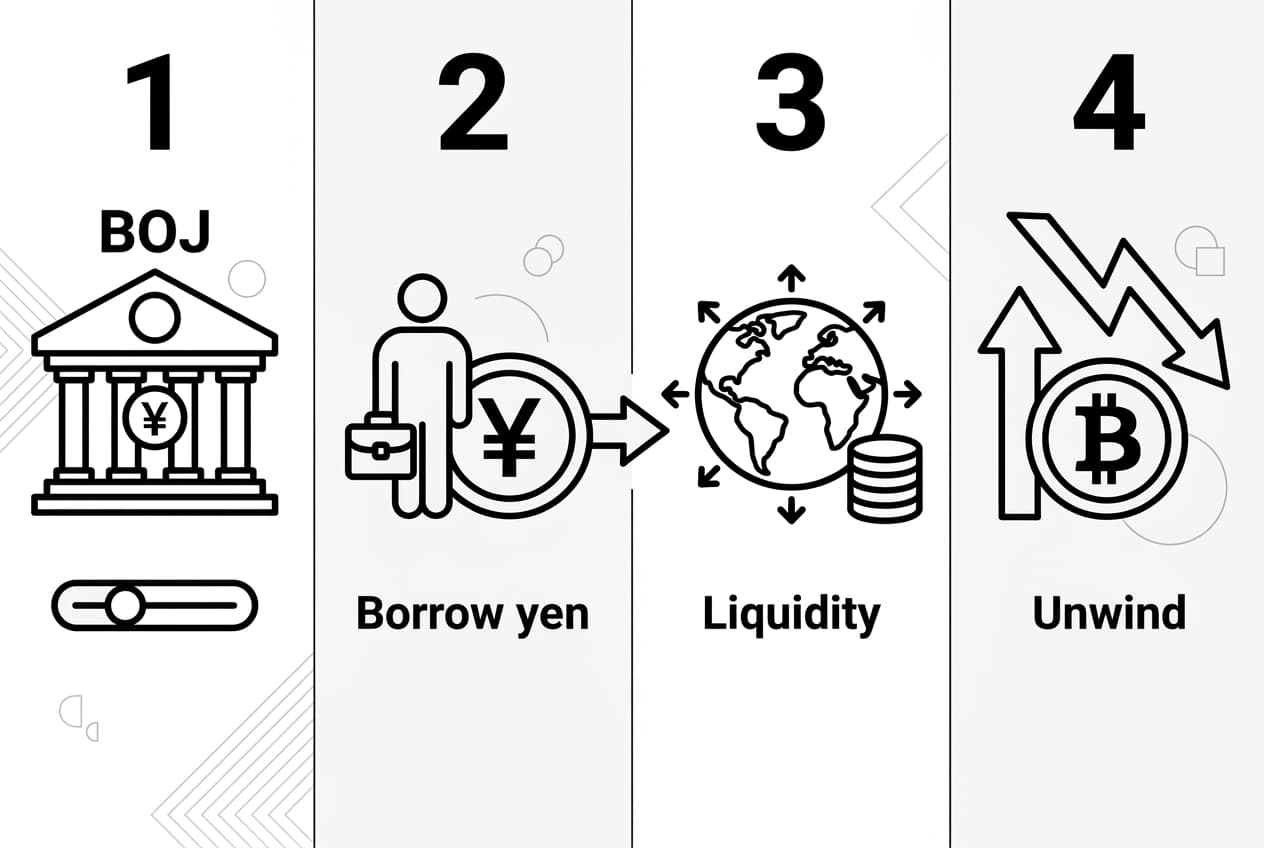
This flow of cheap capital creates a powerful tailwind for assets like Bitcoin, boosting valuations as liquidity floods the system. However, this support is built on a precarious foundation. The very conditions that fuel the carry trade—a wide interest rate differential and low foreign exchange volatility—can reverse with shocking speed. A sudden shift in BOJ policy or a spike in market fear could trigger a rapid unwinding of these trades, representing one of the most potent macro threats to Bitcoin's stability this year.
What is the Yen Carry Trade? A Primer for Crypto Investors
The yen carry trade is a financial strategy where investors borrow Japanese yen at a low-interest rate to fund investments in higher-yielding assets elsewhere in the world. Think of it like taking out a loan with a 0.1% interest rate to put the money into a bond that pays 5%. The profit is the difference, or "spread," between the two rates. For decades, institutional investors and hedge funds have executed this on a massive scale. They borrow billions of yen from Japanese banks, convert it to U.S. dollars or other currencies, and then buy assets like U.S. Treasury bonds that offer a significantly higher return. This simple-sounding maneuver generates enormous liquidity that flows across global markets, searching for yield.
The core mechanics are straightforward, but the scale is what matters. When this trade is popular, it creates a constant demand to sell JPY and buy other currencies, particularly the USD. This capital doesn't just stop at government bonds; it often moves further out on the risk curve into equities and alternative assets. Understanding the dynamics of the yen carry trade is the first step to seeing its potential impact on Bitcoin and the broader digital asset market.
The Key Ingredients: Low Interest Rates and a Weak Yen
Two specific conditions make Japan the perennial source for this trade. First is the Bank of Japan's (BOJ) monetary policy. For over two decades, the BOJ has maintained ultra-low, and at times negative, interest rates to stimulate its economy. As of early 2026, with the BOJ's policy rate still near zero while rates in the U.S. and Europe are substantially higher, Japan remains the world's cheapest place to borrow capital.
The second ingredient is a consistently depreciating yen. When an investor borrows in JPY and invests in USD-denominated assets, a weaker yen is an extra bonus. It means that when they convert their dollar-based profits back to yen to repay the original loan, they need fewer dollars to do so, amplifying their returns. This combination of rock-bottom borrowing costs and a favorable exchange rate trend has made the yen carry trade an enduring and powerful force in global finance.
By the Numbers: The Scale of the JPY Carry Trade in 2026
To understand its influence on digital assets, we must first grasp the sheer magnitude of the capital involved. The data from the first half of 2026 paints a clear picture of a global financial system heavily influenced by capital flows originating from Japan's persistent ultra-low interest rate policy. This isn't a niche strategy; it's a multi-trillion-dollar market force.
Key Metrics as of Q2 2026
- Interest Rate Differential: The Bank of Japan's policy rate holds firm at 0.1%, while the U.S. Federal Reserve maintains its target rate near 4.75%. This creates a compelling 4.65% spread, providing a powerful incentive for institutions to borrow cheaply in yen.
- Exchange Rate Impact: The yen has continued its steady depreciation, trading at approximately 165 JPY to the U.S. dollar. This ongoing weakness enhances the profitability of converting borrowed yen into higher-yielding foreign assets and currencies.
- Estimated Trade Volume: Conservative estimates from Bank for International Settlements (BIS) reports place the total volume of the yen carry trade at over $1.5 trillion, a figure that underscores its systemic importance to global liquidity.
This immense pool of low-cost capital is not confined to traditional FX markets. Instead, it actively seeks higher returns across the asset spectrum. The mechanics of the yen carry trade bitcoin connection emerge from this global search for yield, as a portion of this liquidity finds its way into digital asset markets, impacting price discovery and volatility.
How the Yen Carry Trade Directly and Indirectly Impacts Bitcoin
The vast liquidity generated by Japan's monetary policy doesn't influence Bitcoin's price through a single, obvious route. Instead, the transmission mechanism operates through two distinct channels: one indirect, affecting global market sentiment, and one direct, involving specific trading strategies that integrate Bitcoin into the carry trade ecosystem.
Understanding these two pathways is essential for assessing both the opportunities and the hidden risks connecting foreign exchange markets to digital assets. Here is how the flow of capital makes its way from Tokyo to the Bitcoin market:
Indirect Impact: Global Liquidity and Risk Appetite
The most widespread effect of the yen carry trade is its contribution to global liquidity. When traders borrow yen cheaply and sell it to invest in higher-yielding foreign assets, they inject a massive amount of capital into the global financial system. This broad-based liquidity surge lowers borrowing costs everywhere and encourages investment in assets further out on the risk spectrum. We've seen this play out since late 2024, where periods of yen weakness have correlated strongly with rallies in both the Nasdaq 100 and Bitcoin.
As this wave of capital seeks a home, high-beta assets like Bitcoin become natural beneficiaries. The effect isn't a direct purchase of BTC with borrowed JPY, but rather a general rising tide of "risk-on" sentiment that lifts all boats. When capital is cheap and plentiful, investors are more willing to allocate funds to speculative growth assets, and Bitcoin remains a primary candidate in that category.
Direct Impact: The CME BTC Futures Arbitrage Link
Beyond the general market mood, there is a more concrete, quantifiable connection. Sophisticated traders and hedge funds directly link the yen carry trade bitcoin markets through a basis arbitrage strategy, primarily on regulated platforms like the Chicago Mercantile Exchange (CME). The mechanics are straightforward: a trader borrows JPY at a rate below 1%, converts it to USD, and uses the capital to execute a "cash-and-carry" trade on Bitcoin futures.
This involves buying Bitcoin on the spot market while simultaneously selling a CME Bitcoin futures contract that is trading at a premium. This premium, known as the basis, represents a locked-in, risk-neutral profit. As of Q1 2026, this basis has frequently offered an annualized yield between 8% and 15%. By funding this trade with near-zero-cost yen, traders capture a clean spread, effectively making CME Bitcoin futures a high-yield destination for carry trade capital. This direct flow creates a structural bid for spot Bitcoin and increases open interest on futures exchanges, tightening the link between FX liquidity and crypto market structure.
The Unwinding: What a JPY 'Short Squeeze' Means for Crypto
While the flow of cheap yen has provided a powerful tailwind for global asset prices, its reversal represents one of the most significant systemic risks in the current market. An "unwinding" of the yen carry trade is not a gradual process; it is a rapid and often violent deleveraging event, akin to a global short squeeze on the Japanese yen. When this happens, the abundant liquidity that has propped up risk assets, including Bitcoin, can evaporate in a matter of days or even hours.
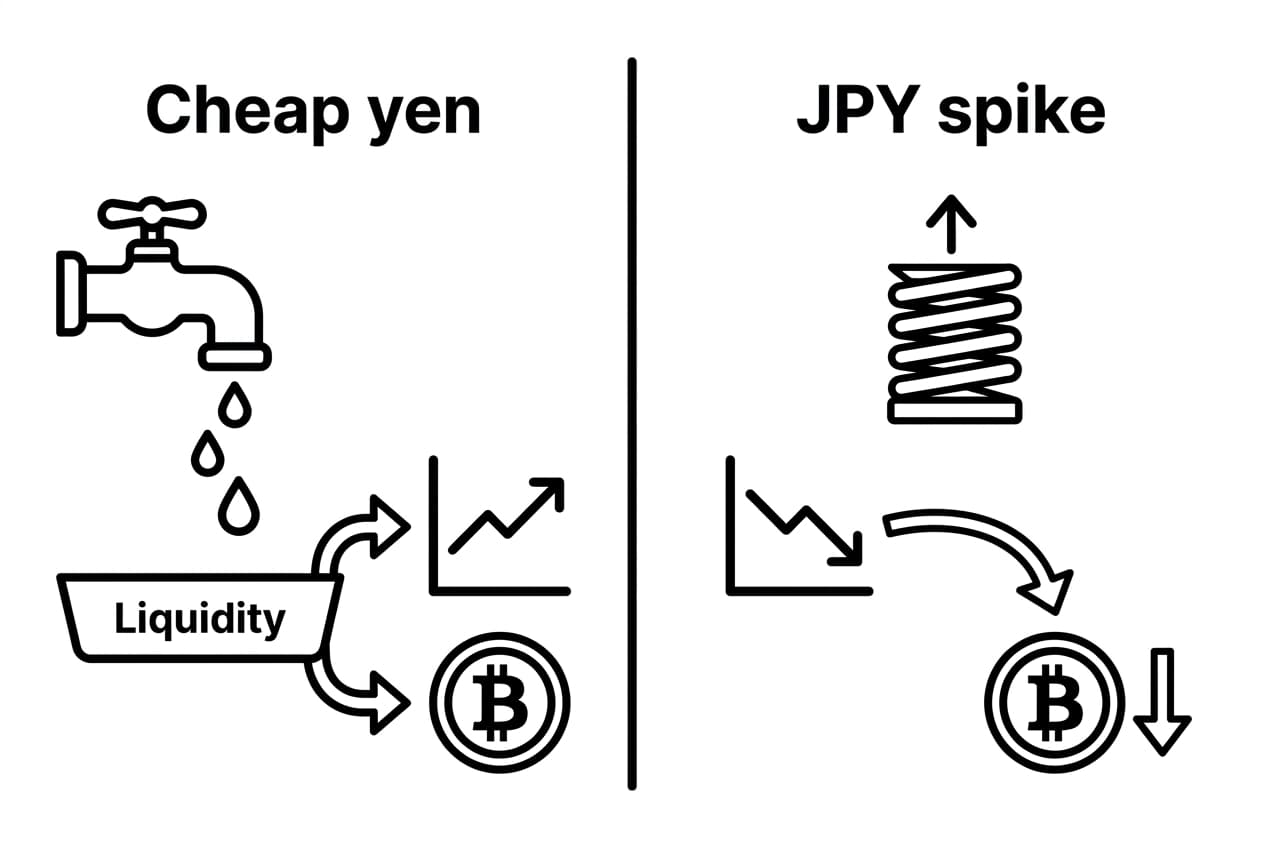
The mechanics of this unwind create a painful domino effect. Traders who borrowed yen to invest elsewhere are forced to sell those assets to buy back JPY and repay their loans. This simultaneous rush to sell assets and buy yen creates a feedback loop: asset prices fall due to selling pressure, while the yen's value spikes from the sudden demand. For a high-beta asset like Bitcoin, which has benefited immensely from this wave of liquidity, the consequences can be severe. It is often one of the first assets sold to meet margin calls during a liquidity crunch.
Potential Triggers for an Unwind in 2026
Several catalysts could spark this deleveraging cascade. Based on current market data and central bank commentary as of Q2 2026, investors should be monitoring these key developments:
- A Bank of Japan Policy Surprise: The most direct trigger remains an unexpected hawkish pivot from the Bank of Japan (BOJ). A sudden interest rate hike or a definitive end to its long-standing yield curve control policy would instantly make the carry trade unprofitable, forcing a mass exodus from the strategy.
- Persistent Domestic Inflation: Japan's core CPI, which has stubbornly remained above the BOJ's 2% target for over a year and registered 2.8% in the latest report, is a constant pressure point. Should this inflation accelerate or prove intractable, it could force the BOJ's hand, compelling a policy tightening that markets are not fully pricing in.
- A Global 'Risk-Off' Shock: A severe global economic downturn or an unforeseen geopolitical event could trigger a widespread flight to safety. In these scenarios, investors aggressively de-risk portfolios, unwinding leveraged trades like the yen carry. It is vital to understand how Bitcoin performs in a downturn; its correlation to equities tends to spike during crises, making it highly vulnerable to the interconnected dynamics of the yen carry trade, bitcoin, and global liquidity shocks.
Historical Context: Japan's Economy and the Birth of the Carry Trade
To fully grasp the connection between the yen carry trade and Bitcoin, we must look back more than three decades. The Japanese yen's current role as the world's primary funding currency is not a recent development but a direct consequence of a profound economic crisis and the extraordinary policy response that followed.
The story begins with the collapse of Japan's spectacular asset price bubble in the early 1990s. This event plunged the nation into a prolonged period of economic stagnation and deflation, famously known as the "lost decades." As prices and wages fell, the Bank of Japan (BoJ) faced a monumental challenge: stimulating an economy where conventional monetary tools were failing. Their response was radical and would reshape global finance for years to come.
In 1999, the BoJ introduced its zero-interest-rate policy (ZIRP), effectively making it free to borrow Japanese yen. While intended to spur domestic investment, this policy had a far greater international impact. Global investors and institutions quickly realized they could borrow yen for virtually nothing and invest the proceeds in higher-yielding assets abroad, from U.S. treasuries to emerging market stocks. This arbitrage was the genesis of the modern yen carry trade.
This historical backdrop is essential for understanding today's market. The BoJ’s multi-decade battle with deflation created the perfect conditions for the yen to become a deep, liquid source of cheap capital. It established a global financial architecture that constantly seeks higher returns, a search that has now extended into the digital asset space. The very existence of the large-scale yen carry trade Bitcoin is built upon this foundation of Japanese economic history.
How Investors Can Monitor Yen Carry Trade Risks
Understanding the risks of a carry trade unwind requires moving beyond Bitcoin-native charts and monitoring a specific set of macroeconomic and market indicators. Proactive analysis of these data points can provide early warnings of shifting liquidity conditions, allowing for more informed risk management. These signals, when viewed in concert, create a dashboard for tracking the stability of the yen carry trade and its potential spillover into digital assets.
To effectively gauge the environment, investors should focus on four primary areas that reflect the health and direction of this global strategy. Watching for correlated moves across these different markets can help identify when the seemingly cheap funding for the yen carry trade bitcoin pipeline is under threat.
Key Macro and Market Indicators
- The USD/JPY Exchange Rate: This is the most direct barometer. A sustained and rapid appreciation of the yen (a falling USD/JPY rate) is the clearest sign that carry trades are being unwound. Traders are buying back yen to repay their low-cost loans, putting upward pressure on the currency.
- Bank of Japan (BoJ) Policy Signals: The entire trade is predicated on the BoJ's ultra-dovish monetary policy. Scrutinize BoJ meeting minutes and governor statements for any hawkish shifts in tone or hints at exiting negative interest rate policy (NIRP). Investors can use dedicated tools to track macro events like these announcements.
- CME Bitcoin Futures Data: Open interest and funding rates on institutional platforms like the CME can act as a proxy for leveraged bets. A combination of a weakening yen and steadily rising open interest may suggest carry trade funds are entering the market. Conversely, a sharp drop could signal deleveraging.
- Global Risk Appetite (VIX Index): The CBOE Volatility Index (VIX) is an important indicator. Carry trades thrive in low-volatility, "risk-on" environments. A sudden spike in the VIX often signals a flight to safety, which is a classic trigger for investors to close out risky carry positions en masse.
Key Takeaways: What the Yen-Bitcoin Link Means for Investors
The connection between Japanese monetary policy and digital assets is no longer a fringe theory. For investors in the 2026 market, understanding this dynamic is a critical component of risk assessment. Here are the essential conclusions from our analysis:

- A Hidden Liquidity Tap: The yen carry trade acts as a major, albeit indirect, source of capital for crypto markets. A cheap yen has consistently fueled speculative appetite in risk-on assets like Bitcoin.
- The Unwinding Risk: A sharp appreciation in the JPY could trigger a rapid unwinding of these trades, pulling liquidity from the market and placing significant downward pressure on Bitcoin's price. This remains a primary tail risk.
- Macro is the New Micro: Monitoring FX markets, specifically USD/JPY volatility, and Bank of Japan policy shifts is now as important as on-chain analysis for serious crypto investors.
- A Conditional Correlation: The relationship between the yen carry trade and Bitcoin is strongest when global risk appetite is high. This link can quickly break down during periods of market stress.
Frequently Asked Questions
- Is there a correlation between Bitcoin and the yen carry trade?
- While not a perfect one-to-one correlation, a strong relationship exists. The yen carry trade boosts global liquidity and appetite for risk assets, which often benefits Bitcoin. Conversely, a sudden unwinding of this trade would likely trigger a liquidity shock, negatively impacting BTC's price alongside other risk assets.
- What happens if the yen carry trade unwinds?
- An unwinding forces traders to rapidly sell risk assets like Bitcoin to buy yen and repay their loans. This sudden sell-off would likely cause a sharp drop in BTC's price, a significant spike in the yen's value, and a broader liquidity crunch across global financial markets affecting all risk-on investments.
- Is the yen carry trade profitable?
- Yes, its profitability is the core reason for its popularity. Traders borrow yen at Japan's near-zero interest rates and invest in higher-yielding assets elsewhere, like U.S. bonds. They profit from this interest rate differential, or "spread," and often use leverage to amplify their returns, making it a highly lucrative strategy.
Sources
Author

Crypto analyst and blockchain educator with over 8 years of experience in the digital asset space. Former fintech consultant at a major Wall Street firm turned full-time crypto journalist. Specializes in DeFi, tokenomics, and blockchain technology. His writing breaks down complex cryptocurrency concepts into actionable insights for both beginners and seasoned investors.