What Are Tokens in AI? A 2026 Guide to LLM vs Crypto Tokens
What Is a Token in AI? A Simple Definition
In artificial intelligence, a token is a piece of text—a word, part of a word, or punctuation—that a large language model (LLM) uses to process and understand information. These tokens are the fundamental building blocks that allow an AI to read, write, and generate human-like language. When you ask an AI a question, it doesn't see sentences; it sees a sequence of these tokens.
So, why does this matter? Think of tokens as the individual LEGO bricks an AI uses to build its understanding and construct a response. Before a model like ChatGPT can answer your prompt, it first breaks your request down into a list of tokens. It then processes these pieces to predict what tokens should come next, effectively building its answer one "brick" at a time. Understanding what are tokens in AI is key to grasping how these powerful systems actually think.
This process, called tokenization, is the first step in nearly every interaction you have with an LLM. From summarizing a document to writing a poem, the model's ability to handle language is entirely dependent on its capacity to work with these small units of meaning. The number of tokens a model can process at once even defines its "memory" or context window, directly impacting the complexity of tasks it can handle.
How AI Tokenization Works: From Words to Numbers
Now that we understand that a token is a fundamental piece of data for an AI, let's explore how they are created. Large language models don't read sentences the way we do. They can't understand words, grammar, or context directly. Instead, they see the world through numbers. The process of converting our human language into these machine-readable numbers is called tokenization.
Think of it like preparing ingredients for a complex recipe. You wouldn't throw a whole carrot into the pot. You'd first wash it, peel it, and chop it into smaller, manageable pieces. A special component of the LLM, called a tokenizer, acts as this chef's knife. It takes a raw sentence and breaks it down into a sequence of tokens that the model can easily digest and analyze.
Common Tokenization Methods
Early approaches might have simply split a sentence by its words, but this method is inefficient. It would create a massive dictionary and struggle with rare words, typos, or different word forms (like "run" vs. "running"). Modern models like those in the GPT family use more sophisticated techniques, such as Byte-Pair Encoding (BPE) or WordPiece. These systems are clever. They learn the most common words and sub-word units from a massive amount of text. As a result, a common word like "and" might become a single token, while a more complex word like "tokenization" might be broken into smaller, more frequent parts like "token" and "ization". This approach is far more flexible and efficient.
An Example of Tokenization
So, what does this look like in practice? Let's take a simple sentence and see how a typical tokenizer might handle it:
Original sentence: "Tokenization is fascinating!"
After being processed by the tokenizer, it might look something like this list of tokens:
Tokenizationisfascinating!
Notice how "Tokenization" and "fascinating" are split into common parts, while the simple word "is" (with a preceding space to mark its position) and the punctuation mark "!" become their own tokens. Each of these tokens is then mapped to a unique number, finally converting our sentence into a format the AI can work with.
The Role of Tokens in LLM Training and Inference
Now that we see how models convert human language into tokens, we can explore where these tokens play their part. The life of a large language model is divided into two main phases, and tokens are the fundamental building blocks for both: training and inference.
First comes the training phase. Imagine feeding a model a library the size of the entire internet. This massive collection of text, from books to websites, is tokenized. The model then analyzes these billions upon billions of tokens to learn statistical patterns. It doesn't understand meaning like a human does; instead, it calculates the probability of which token is likely to follow another. It learns that the token for "hot" often appears near the token for "coffee," and that the sequence of tokens for "happy birthday to" is almost always followed by the token for "you." This intense period of pattern recognition is how the model builds its knowledge.
Then comes the inference phase, which is what happens every time you interact with an AI. When you type a prompt, your words are converted into a sequence of input tokens. The model examines this sequence and then begins its work: predicting the most probable next token. It generates one token, adds it to the sequence, and then re-evaluates to predict the next one. This token-by-token generation continues until it forms a complete sentence or paragraph, giving you a coherent answer. This process allows the model to do everything from answering simple questions to performing complex tasks where AI can be used for tasks like code generation.
Input Tokens vs. Output Tokens
It’s important to distinguish between the two types of tokens used during inference. Input tokens are the pieces of data generated from your prompt—the question you ask or the instruction you give. Output tokens are all the tokens the model generates to create its response. Understanding this difference is practical because most AI services base their pricing on the total token count. Your question, "what are tokens in ai?", becomes the input tokens, and the model's detailed explanation forms the output tokens. The cost of your interaction is calculated based on the sum of both, making prompt efficiency a key skill for managing AI usage costs.
What Is a Crypto Token? A Quick Refresher
Now that we've seen how AI models use tokens as building blocks for language, let's switch gears to a completely different concept that happens to share the same name. A crypto token is a digital asset built on a blockchain that represents ownership, value, or a right to perform an action. Forget about words and numbers for a moment; think of a crypto token more like a digital voucher or a stock certificate.
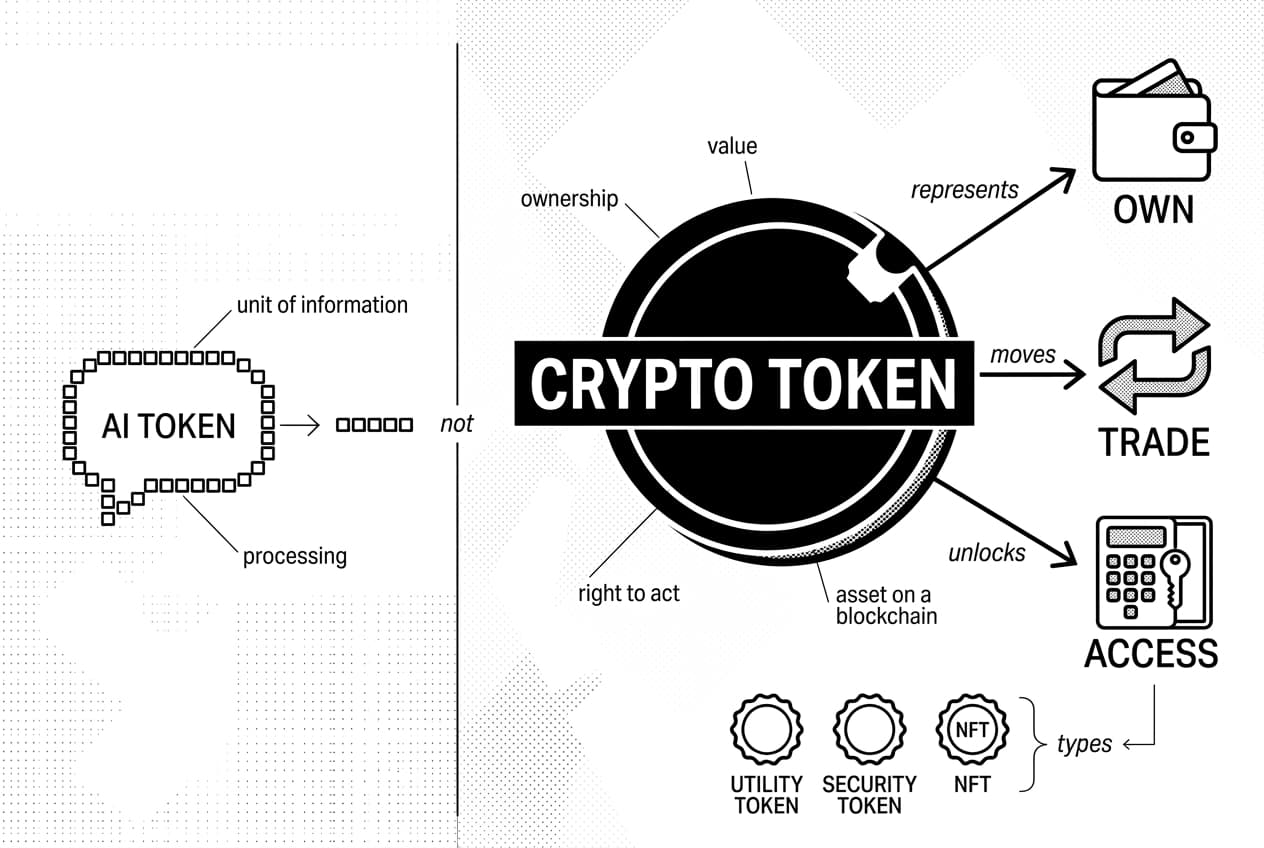
Where an AI token is a unit of information for processing, a crypto token is a unit of value for a network. You can own it, trade it, or use it to interact with a specific application or service. This core difference in purpose is what separates the two worlds so distinctly. It’s the difference between a syllable in a sentence and a coin in your pocket.
This simple idea gives rise to a vast ecosystem of digital assets. For example, utility tokens act like keys to access a service, security tokens can represent a share in a company, and Non-Fungible Tokens (NFTs) prove ownership of a unique digital item. While there are many types of crypto tokens, they all function as assets on a blockchain, not as pieces of data for an algorithm.
AI Tokens vs. Crypto Tokens: Key Differences Explained
Now we arrive at the heart of the matter. While they share the same name, the comparison between an AI token and a crypto token pretty much ends there. Thinking they are similar is like confusing the word "cell" in biology with a "cell" in a spreadsheet. They operate in entirely different worlds for completely different reasons. Let's break down the fundamental distinctions.
Purpose: Processing vs. Value
The primary purpose of a token in AI is processing. It's a unit of information, a piece of a puzzle that a large language model uses to understand and generate text. Think of AI tokens as the individual syllables or words that make up a sentence. They have no inherent financial value; their worth is purely functional, allowing the model to do its job. A crypto token, on the other hand, is built to represent value. It's a digital asset that can signify ownership, grant access to a service, or act as a medium of exchange on a blockchain network. It’s more like a digital coin or a stock certificate.
Context: Closed vs. Open Systems
Another key difference lies in their environment. An AI token exists only within the closed system of its specific model. A token generated for OpenAI's GPT-4 has no meaning or function within Google's Gemini model. It's a proprietary piece of data, specific to the architecture it was designed for. In stark contrast, crypto tokens exist on open, decentralized systems called blockchains. An Ethereum-based token, for instance, can be held by anyone with an Ethereum wallet and sent to anyone else on that global network, all without a central authority.
Tradability: Internal vs. External Markets
Finally, consider how they are exchanged. AI tokens are not traded on public markets. You can't buy a million GPT-4 tokens on an exchange and hold them hoping their value increases. The "cost" of AI tokens is an internal metric for billing—it reflects the amount of computational power you used. It's like paying for electricity by the kilowatt-hour. Crypto tokens are designed for the opposite. They are created to be bought, sold, and traded on external markets, from massive centralized exchanges to decentralized protocols. Their value fluctuates based on public supply and demand, speculation, and the perceived success of their underlying project.
Feature | AI Token | Crypto Token |
|---|---|---|
Primary Purpose | Unit of data for language processing | Unit of value for transactions or assets |
Value | Functional; measures computational cost | Financial; determined by market supply and demand |
Context | Closed system (specific to one AI model) | Open, decentralized system (public blockchain) |
Tradability | Not traded on external markets | Designed to be bought, sold, and traded |
The Economics of AI Tokens: How They Drive Costs
Now that we've separated AI tokens from their crypto counterparts, let's explore a very practical question: why does their count matter so much? The answer is simple: money. In the world of large language models, tokens are the currency of computation. Every token, whether in your prompt or in the model's response, represents a tiny piece of processing work that has a real-world cost.
Think of using an AI service like the OpenAI API as a metered taxi. The moment you submit your request, the meter starts running. The longer and more complex your prompt, the more tokens it consumes. The more detailed and lengthy the AI's answer, the more tokens it generates. Each one adds to your final bill. This cost isn't arbitrary; it reflects the immense computational power needed to process these requests. This work is done on highly specialized hardware, like the powerful GPUs made by companies like NVIDIA, which consume significant amounts of energy. This has also spurred innovation in how we access that power, exploring new models like how decentralized infrastructure powers AI.
Tips to Use Fewer Tokens and Save Money
For both individual users and businesses, managing token consumption is key to controlling costs. Being mindful of what a token is in an LLM can directly impact your spending. Here are some practical strategies to make your AI usage more efficient:
- Be concise with your prompts. Get straight to the point. Instead of writing a long paragraph, try to frame your request as a clear, direct question or command.
- Ask for summarized outputs. If you don't need a 500-word essay, specifically ask the model for a bulleted list, a summary, or a one-paragraph answer.
- Refine your instructions. Providing clear constraints can prevent the model from generating unnecessary text. For example, add "in under 100 words" or "provide only the code" to your prompt.
- Batch similar queries. If you have several related questions, try to combine them into a single, well-structured prompt rather than making multiple separate API calls.
Key Takeaways
Understanding the worlds of artificial intelligence and digital currency requires a clear understanding of their distinct vocabularies. Though they share a name, the concept of a token in each field could not be more different. Here are the essential points to remember:
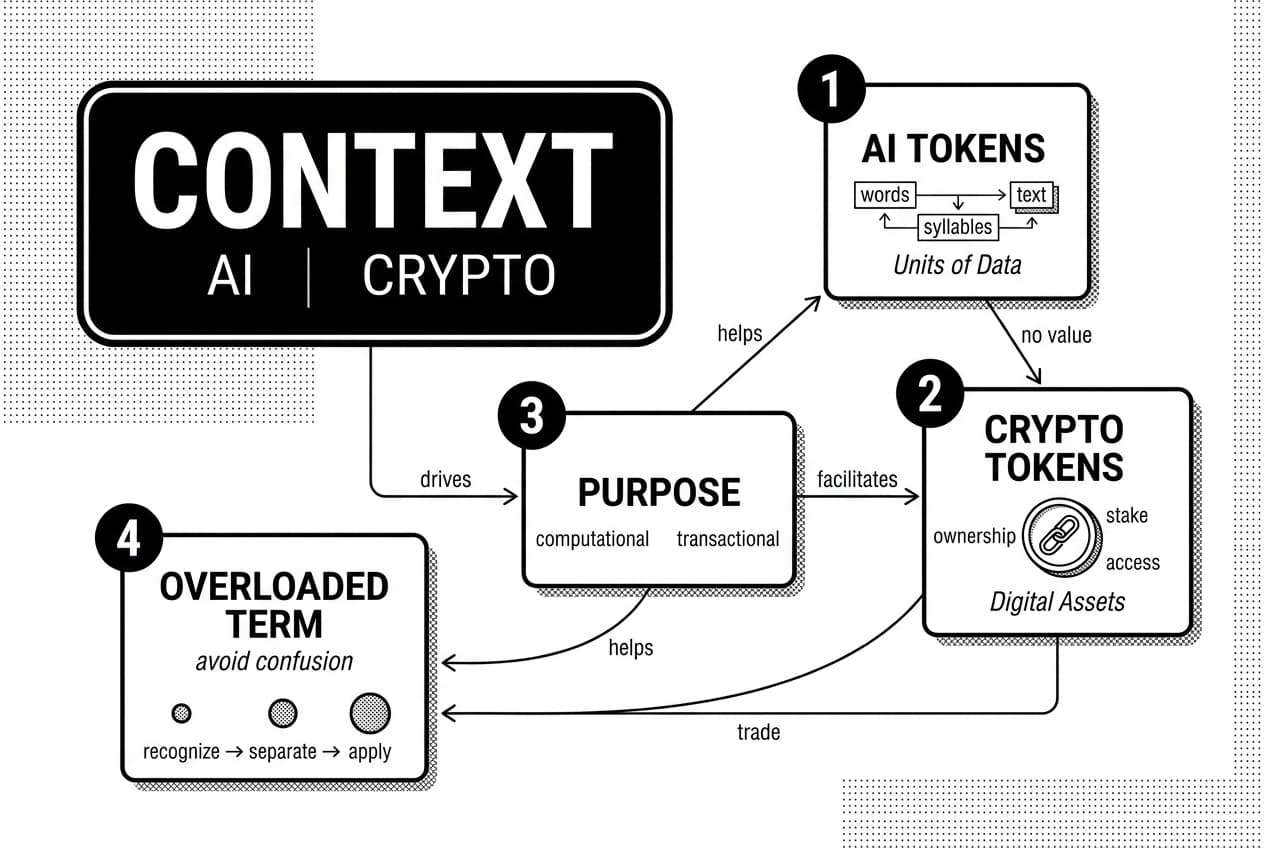
- AI Tokens are Units of Data: When we ask what are tokens in AI, the answer is simple: they are the fundamental pieces of text or data that models like LLMs use to process information. Think of them as the words or syllables a machine reads. They have no direct financial value.
- Crypto Tokens are Digital Assets: A crypto token is a unit of value on a blockchain. It represents ownership, a stake in a project, or access to a service and can be traded on exchanges. Its purpose is primarily economic or functional within its network.
- Purpose is the Key Differentiator: The core distinction lies in their job. A what is a token in LLM context is purely computational—it helps the model work. A crypto token is transactional—it facilitates exchange and interaction on a blockchain.
- Context is Everything: The term "token" is overloaded. One is a building block for machine understanding, while the other is a building block for a decentralized economy. Recognizing the context is the first step to avoiding confusion.
Frequently Asked Questions
- What is an example of a token in LLM?
- Consider the sentence, "Hello world!" An LLM might break this down into three tokens: ['Hello', ' world', '!']. Tokens aren't always whole words; they can be parts of words (sub-words), single characters, or punctuation marks. The specific tokenizer used by the model determines how text is divided.
- How many words is 1,000 tokens?
- There isn't a fixed conversion rate, but a good rule of thumb for English text is that 1,000 tokens equals approximately 750 words. This ratio can change depending on the language's complexity, the specific vocabulary used, and the tokenization method employed by the language model.
- What is considered a token in LLM?
- A token is the fundamental unit of text that a large language model processes. It could be a full word like 'computer', a sub-word like 'ing' in 'thinking', or even just a punctuation mark like a comma. The model's tokenizer is responsible for breaking down a prompt into these specific pieces.
- What are tokens in GPT?
- In GPT models, tokens function just like in any other LLM. They are the fragments of text the model uses to process your prompts and generate its responses. OpenAI offers a public tokenizer tool that lets you see exactly how your own text is broken down into these specific tokens.
Sources
Author

Crypto analyst and blockchain educator with over 8 years of experience in the digital asset space. Former fintech consultant at a major Wall Street firm turned full-time crypto journalist. Specializes in DeFi, tokenomics, and blockchain technology. His writing breaks down complex cryptocurrency concepts into actionable insights for both beginners and seasoned investors.