Dark Liquidity Pools in DeFi: Meaning, Risks & How They Work
Dark Liquidity Pools in DeFi: Meaning, Risks & How They Work
What Are Dark Liquidity Pools?
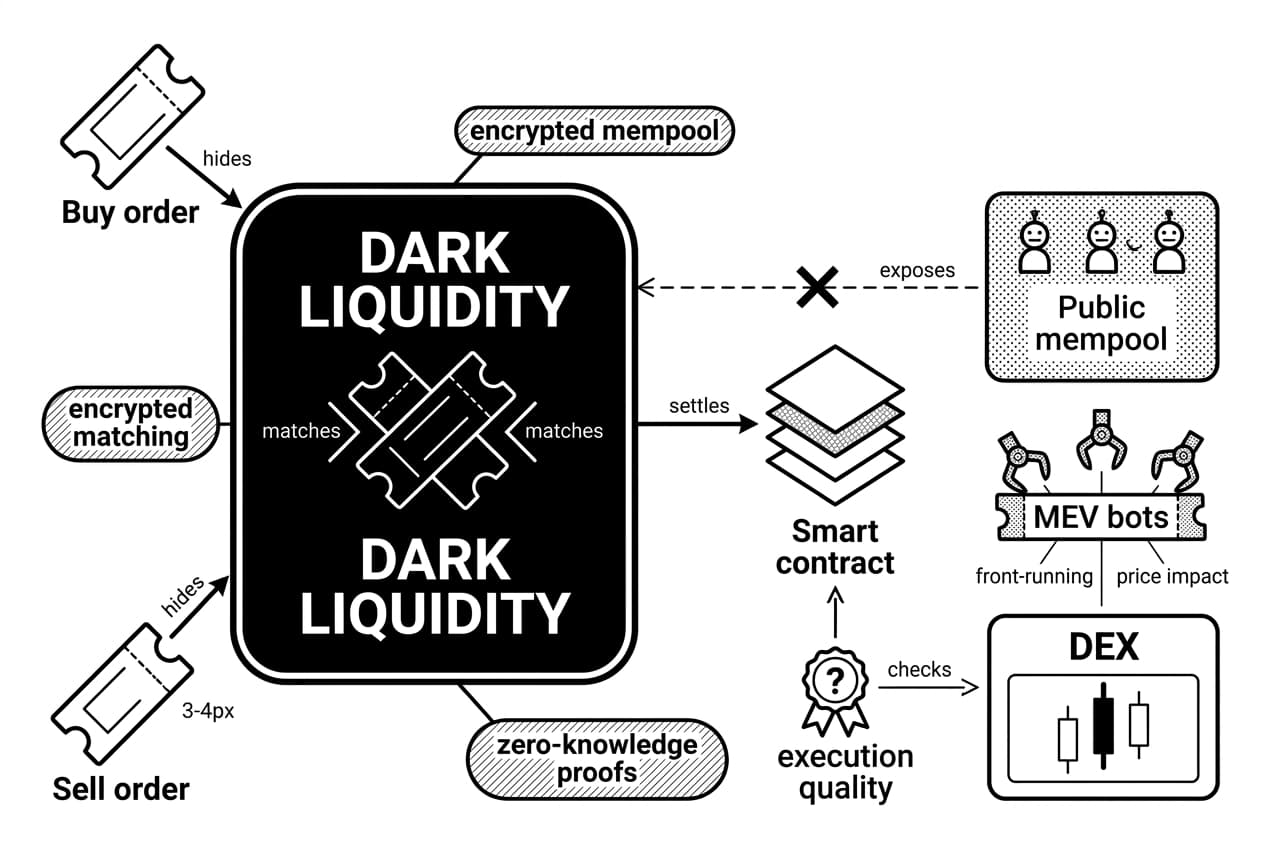
dark liquidity pools are private trading venues or DeFi mechanisms that match buy and sell orders without showing the full order to the public before execution. They help large traders reduce price impact and front-running, but they also make fair execution harder to check.
Why it matters for DeFi users
If you have ever placed a large trade on a decentralized exchange and received a worse price than the preview showed, you have touched the problem dark liquidity pools try to solve. A decentralized exchange, or DEX, is a trading app that runs through blockchain smart contracts instead of a traditional broker. A smart contract is code that moves assets when preset conditions are met.
The core tradeoff is not simply privacy versus transparency. As of March 2026, the harder question is whether DeFi can hide trade intent long enough to reduce maximal extractable value, or MEV, without creating a venue where execution quality cannot be checked. MEV means profit captured by bots, validators, builders, or other actors that reorder, insert, or exclude blockchain transactions. Public blockchains are auditable, but their public waiting rooms can also expose traders before settlement.
For context on the infrastructure side, Sergey Nazarov, Co-founder at Chainlink Labs is closely associated with oracle networks that feed external market prices into smart contracts. Hayden Adams, Founder of Uniswap Labs is closely associated with automated market makers, the public liquidity pools most DeFi users meet first. Those two pieces, public automated liquidity and trusted price data, explain why private execution is both attractive and difficult.
A concrete analogy
A helpful analogy is a large restaurant supply order. If a buyer announces in the dining room that they need every bottle of olive oil in the building, other buyers can react before the purchase is complete. If the buyer sends the order privately to a manager, the final sale can be recorded after the stock is allocated. The private route reduces opportunistic behavior before the transaction, but customers still need a receipt afterward.
Key terms to know before going further
- Liquidity: how easy it is to buy or sell an asset without moving its price too much.
- Order book: a list of pending buy and sell orders, usually showing price and size.
- Automated market maker: a DeFi pool that prices swaps through a formula rather than a human market maker.
- Market impact: the price change caused by your own trade.
- Slippage: the gap between the price shown before a trade and the price received when it executes.
- Front-running: when another trader or bot sees a pending order and trades first to profit from the expected price move.
- Mempool: the public queue where many blockchain transactions wait before a validator includes them in a block.
- Wallet: software or hardware that holds private keys and lets a user approve blockchain transactions.
- Gas fee: the fee paid to have a blockchain transaction processed.
Data capsule: why this market structure exists
- Flashbots launched MEV-Share in May 2023 (Flashbots), showing that private order-flow sharing had moved from theory into Ethereum infrastructure.
- Ethereum MEV extraction tracked by Flashbots had exceeded $680 million in cumulative value by January 2024 (Flashbots), illustrating the cost of exposed transaction ordering.
- The SEC and other regulators charged Barclays and Credit Suisse dark-pool cases with a combined $154.3 million in settlements on January 31, 2016 (SEC), showing that private venues can create conflicts when operators misuse order information.
- DeFi exploit losses exceeded $1.8 billion in 2023, reported in January 2024 (DefiLlama), a reminder that privacy tools do not remove smart contract risk.
A Brief History of Dark Pools Before DeFi
Dark pools did not start in crypto. They developed in traditional markets because large investors needed to trade blocks of shares without revealing the whole order to everyone else first.
From block trades to registered private venues
Pension funds, asset managers, and banks often need to move positions that are too large for a public order book. If a fund posts a large sell order in public, other traders may sell ahead of it and push the price lower before the order finishes. Private venues grew around that problem.
In the United States, many traditional dark pools operate as alternative trading systems. The SEC adopted Regulation ATS in 1998 (SEC), creating a registration and reporting framework for these off-exchange trading venues. The bargain was clear: large traders could reduce market impact, while regulators required reporting and anti-manipulation controls.
Why the idea matters for crypto
Crypto has the same large-order problem, but it adds a new wrinkle. On many public blockchains, a trade is visible before it settles. Bots can watch the mempool, pay higher fees, and place related trades around the user. That is why private order routing, encrypted mempools, batch auctions, and zero-knowledge proofs became part of the DeFi market-structure conversation.
Willy Woo, on-chain analyst is known for studying how transparent blockchain data changes market behavior. That transparency helps analysts audit flows, but it also means sophisticated actors can infer intent faster than ordinary users can react.
How Dark Liquidity Pools Work
Most dark liquidity pools use the same basic sequence, even when their technology differs:
- Submit private order: a trader sends a buy or sell request through an encrypted channel, private relay, or off-chain matching system so the public does not see the full size and direction before execution.
- Match with hidden liquidity: a matching engine or solver looks for a counterparty willing to take the other side without exposing all available orders to the public.
- Price against a reference: the trade is checked against a benchmark such as a midpoint price, an oracle feed, or a time-weighted market price.
- Settle and report the trade: tokens move between wallets or accounts, and the completed trade is recorded on-chain, reported to a venue log, or disclosed through a compliance process.
Here is a simple DeFi example. A treasury wants to swap $1 million of ETH into USDC. ETH is ether, the native asset of Ethereum. USDC is a dollar-linked stablecoin. If the treasury sends that swap through a public DEX pool, bots may see the transaction before it confirms. A private execution route can hide the full trade until a counterparty or solver is ready to settle it.
Matching buyers and sellers privately
The matching engine is the core of a dark pool. It checks whether a buyer and seller can trade at compatible sizes and prices. In a centralized dark pool, that matching engine is usually controlled by a broker or exchange. In DeFi, the matching may happen through encrypted messages, off-chain solvers, a private relay, or smart contracts that reveal only the final settlement.
Minimum fill size matters. If a trader wants to sell $1 million of a token, they may not want a series of tiny fills that reveal the order piece by piece. A dark pool can require a minimum counterparty size so the trade is either filled meaningfully or not filled at all.
Pricing and settlement
Private matching creates a pricing challenge. If the order book is hidden, traders need an honest reference point. A midpoint price, an oracle price, or a batch auction clearing price can help. An oracle is a data service that brings off-chain information, such as asset prices, into a blockchain application. This is why oracle design and private execution often overlap in DeFi discussions.
Settlement is the final transfer. In self-custody DeFi, a user keeps control of assets in their own wallet until a smart contract executes the trade. In a custodial model, a broker or exchange may hold the assets during matching. The first model reduces intermediary risk but increases smart contract risk. The second model can be easier for large institutions, but it asks users to trust the venue.
Reporting after execution
Hiding an order before execution is different from hiding it forever. A well-designed dark liquidity pool should offer post-trade evidence: a settlement transaction, an auditable log, or a cryptographic proof that the trade followed the stated rules. Without that after-the-fact proof, users cannot tell whether they received a fair fill or whether the venue favored another participant.
The Privacy Proof Test
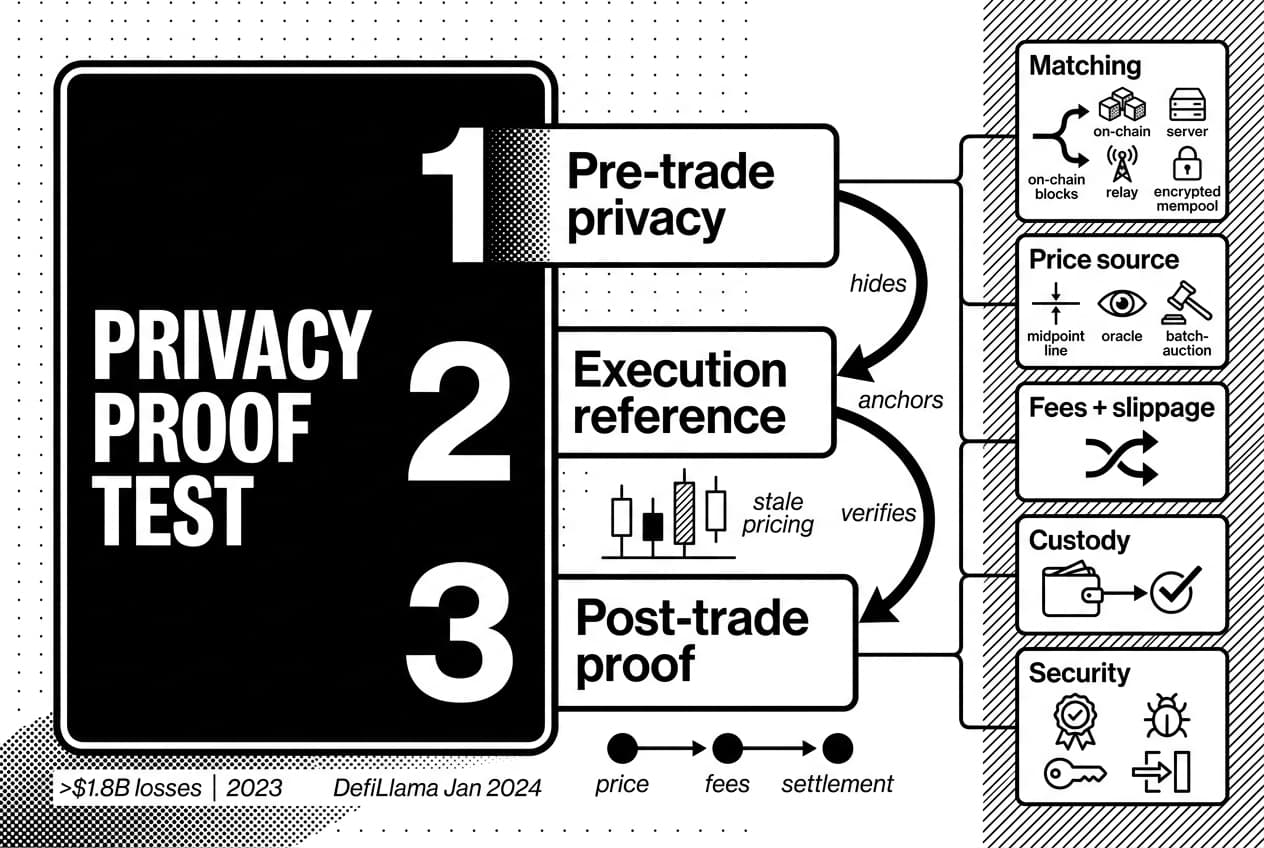
Use this original three-part framework, the Privacy Proof Test, before trusting any dark liquidity pool:
- Pre-trade privacy: does the system hide size, direction, wallet identity, and timing before settlement?
- Execution reference: is the price tied to a public benchmark, oracle, midpoint, or batch clearing rule?
- Post-trade proof: can users verify the final trade, fee, settlement path, and custody assumptions afterward?
A venue that passes only the first part is private but not necessarily fair. A venue that passes all three has a stronger case for reducing MEV without becoming an unverifiable box.
Dark Liquidity Pools in DeFi vs Traditional Finance
The core idea behind dark liquidity pools is similar in both worlds: keep an order hidden before it is done. The mechanics differ sharply because blockchains, brokers, wallets, validators, and smart contracts create different trust assumptions.
The DeFi transparency paradox
Public blockchains are built for auditability. Anyone can inspect historical transactions. That is a strength after settlement, but it can be a weakness before settlement. A pending transaction in a public mempool can reveal trade size, token pair, maximum slippage, and gas fee. Bots can use that information to front-run or sandwich the user.
This is why encrypted mempools can help prevent front-running. An encrypted mempool hides transaction contents until the point where early visibility is less useful to attackers. It does not remove every risk, but it reduces the information leaked before confirmation.
Private execution tools in crypto
DeFi developers use several tools to reduce exposed order flow. An encrypted mempool scrambles transaction data before block inclusion. A private RPC, or remote procedure call endpoint, lets a wallet send a transaction directly to a trusted relay instead of broadcasting it to the public mempool. Batch auctions group many orders and clear them at one price, which can lower the value of jumping ahead of a single order. Intent-based trading lets a user state the desired outcome, then lets solvers compete to fill it. A zero-knowledge proof lets a system prove that a rule was followed without revealing all underlying trade details.
Hayden Adams, Founder of Uniswap Labs is relevant here because public automated market makers made DeFi trading easy to use, while also making slippage and visible routing easier to observe. Private execution tools are partly a response to the limits of fully public routing.
Where centralized exchanges fit
Not all crypto dark liquidity is trust-minimized. Large centralized exchanges and OTC desks, meaning over-the-counter trading desks, match big trades privately before the price appears in a public venue. This looks closer to traditional finance than to a zero-knowledge DeFi system. The main distinction is custody. In an OTC trade, the user often trusts a company. In a DeFi design, the user may trust code, a relay, a solver network, or some mix of all three.
The table below compares the two models:
feature | traditional dark pools | DeFi dark liquidity pools |
|---|---|---|
transparency | orders hidden before execution, with post-trade reporting to regulators or market data systems | orders hidden through encryption, private routing, off-chain matching, or zero-knowledge proofs, with settlement evidence on-chain when designed well |
custody | assets generally held through brokers, custodians, or clearing systems | may use self-custody smart contracts, custodial exchanges, or hybrid models |
settlement | equity settlement in the United States moved to T+1 on May 28, 2024 (SEC) | can settle in one block, one batch, or after an off-chain match is committed on-chain |
regulation | registered venues operate under securities-market rules such as Regulation ATS and related reporting duties | legal treatment varies by jurisdiction, asset type, custody model, sanctions controls, and operator role as of March 2026 |
main risk | venue conflicts, information leakage, weak disclosure, or unfair routing | smart contract bugs, solver favoritism, thin liquidity, incomplete privacy, or weak post-trade proof |
The traditional history matters because it shows that privacy alone does not guarantee fairness. The SEC dark-pool settlements in January 2016 (SEC) centered on disclosures and misuse of client order information. DeFi tries to reduce reliance on an operator, but it can shift risk to code, relays, solvers, or governance keys.
Why Traders Use Dark Liquidity Pools
The appeal is practical: sometimes a trade gets a better result when the market does not see it forming in real time. That can be true for a fund, a market maker, a DAO treasury, or a large individual wallet.
Reducing market impact
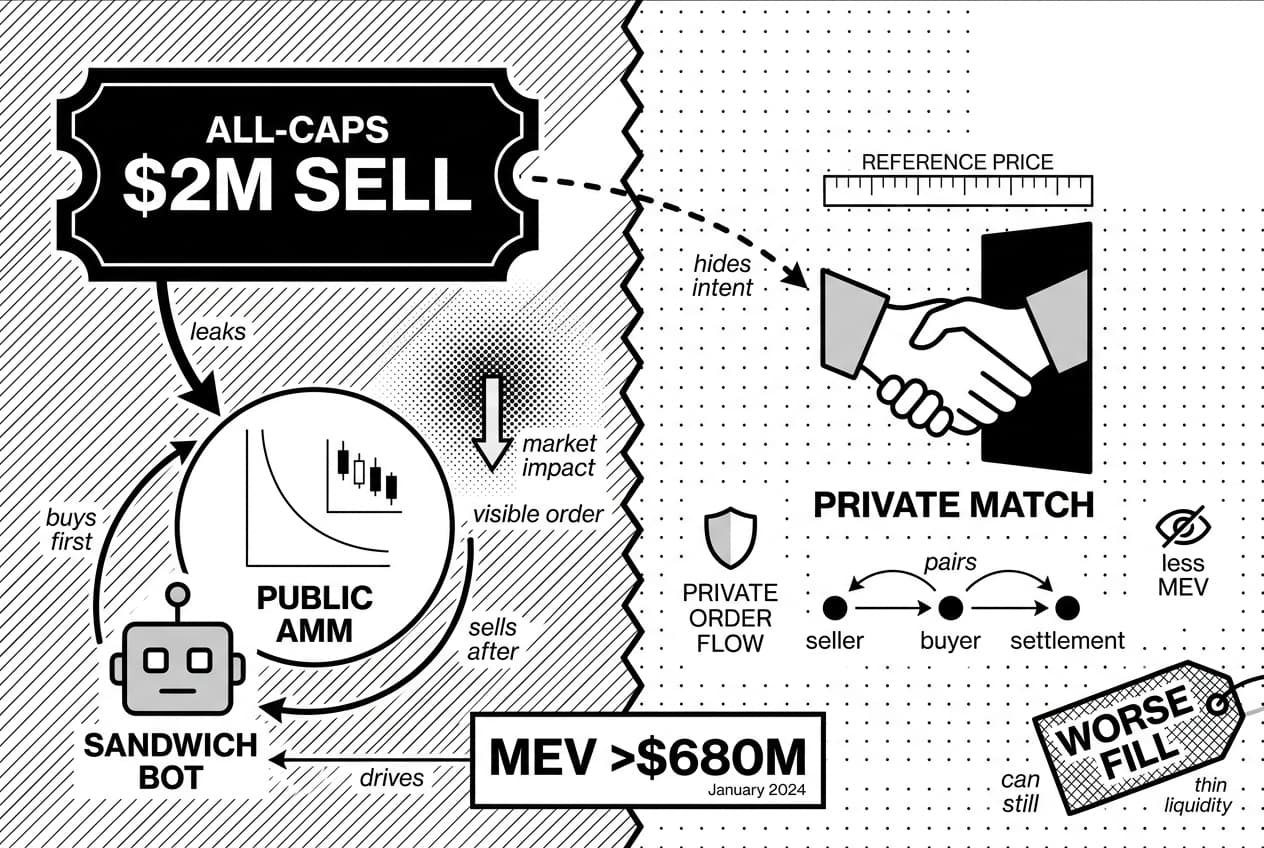
Suppose a trader wants to sell $2 million of a thinly traded token. If the sale hits a public automated market maker all at once, the pool formula may move the price sharply lower. Other traders may also notice the selling pressure and react. A private match can pair the seller with a buyer at a reference price before the public market adjusts to the visible order.
This does not mean the trader always gets a better price. If hidden liquidity is thin, the trader may receive a worse fill than a patient public execution. The benefit is not magic. It is the reduction of information leakage before the trade is complete.
Avoiding front-running and MEV
MEV is a major reason DeFi cares about private execution. A sandwich attack is one common form. A bot sees a pending swap, buys the asset first, lets the user push the price up, then sells after the user. The user receives worse execution, while the bot captures the difference.
Flashbots data showed more than $680 million in cumulative Ethereum MEV by January 2024 (Flashbots). That figure is not limited to dark-pool use cases, but it explains why traders search for ways to hide intent before settlement. Private order flow can reduce the opportunity for bots to react, though MEV can still appear at the solver, builder, or relay layer.
Block trading for institutions and DAOs
A DAO treasury is a pool of assets controlled by a decentralized autonomous organization, usually through token-holder voting or multisignature wallets. If a DAO needs to sell tokens to fund operations, a public sale can pressure its own market. A private block trade can reduce that signaling effect.
Stani Kulechov, Founder and CEO at Aave is relevant because lending protocols, treasury management, and institutional access all depend on execution quality and risk controls. Private liquidity can help larger DeFi participants, but only if the system gives them proof of price, custody, and settlement.
trader type | primary concern | how dark pools may help |
|---|---|---|
large wallet | moving the price against its own order | hides size and direction until settlement |
DAO treasury | selling tokens without alarming the market | matches a block trade privately before settlement |
market maker | revealing hedging strategy | keeps directional flow away from public mempool watchers |
fund or institution | front-running, copy-trading, and compliance review | routes through private matching, private RPC, or audited OTC-style workflows |
The pattern is the visibility-cost tradeoff: every detail a trader reveals before execution can become a cost. Dark liquidity pools reduce that cost, but they add a new duty to verify the venue afterward.
Risks and Criticism: Are Dark Pools Fair?
The fair answer is: sometimes, but not automatically. A dark pool can protect users from front-running, or it can hide bad execution. The design matters.
Transparency versus privacy
Public markets give everyone a shared view of prices. That helps price discovery, which means the market can find a fair price from visible supply and demand. The problem is that on-chain transparency happens before settlement as well as after settlement. A public mempool can turn a user order into a signal for bots.
Dark liquidity pools argue that privacy before execution can be pro-user. Critics answer that hiding flow can weaken price discovery and create unequal access. Both concerns are valid. The best designs separate pre-trade privacy from post-trade accountability.
Adverse selection and stale prices
Adverse selection means you trade against someone who knows more than you do. In a private venue, this risk can grow if one participant sees better information, controls the matching engine, or uses stale reference prices. A stale price is an old price that no longer reflects the live market.
Reference pricing helps, but it must be resistant to manipulation. If a private pool prices against a thin public market, a trader could briefly move that public reference, fill in the dark pool, then let the public price snap back. That is why oracles, time-weighted prices, and clear execution rules matter.
Smart contract and custody risks
DeFi dark liquidity pools have technical risks that traditional venues do not share in the same way:
- Unaudited smart contracts: a bug in matching or settlement code can drain funds quickly.
- Centralized relayers: a relay may fail, censor orders, leak information, or route flow unfairly.
- Admin keys: upgrade keys can let developers change rules after users deposit assets.
- Withdrawal delays: batching or lockups can trap funds during volatile markets.
- Weak privacy claims: a system may hide order size but still leak wallet identity, timing, or token pair.
These risks connect directly to broader smart contract security risks. A private trading system may concentrate custody, matching, pricing, and settlement logic in one place, so users should demand audits and clear failure procedures.
The fairness checklist
Before using a dark pool, ask five questions:
- Can I verify the final price and fee after settlement?
- Does the venue explain how orders are matched?
- Does the venue disclose who can see private order flow?
- What happens if the relay, solver, or matching engine fails?
- Can I withdraw without permission and without hidden lockups?
If those answers are unclear, privacy may be protecting the venue more than the trader.
Are Dark Liquidity Pools Legal in 2026?
The short answer is that legality depends on where the user is, what asset is traded, who controls the system, and whether the venue handles custody or regulated securities.
United States and EU context
In traditional finance, dark pools can be legal when properly registered and supervised. In the United States, many operate as alternative trading systems under SEC rules. In Europe, dark trading is addressed through market-structure rules such as MiFID II. DeFi dark liquidity pools do not fit neatly into those categories because the system may be software, a DAO, a relay network, a centralized interface, or all of them at once.
The questions regulators tend to ask are practical. Does the venue trade securities? Does someone custody client assets? Does an operator route or match orders? Are users screened for sanctions compliance? Is there a party responsible for disclosures? The SEC crypto enforcement history shows how unsettled these questions remain.
Privacy tools are not automatically illegal
Encryption, zero-knowledge proofs, and private routing are not unlawful by themselves. Privacy can protect users from predatory trading and unwanted strategy leakage. The legal risk rises when privacy prevents required controls, such as sanctions screening, market-abuse monitoring, or customer disclosures.
A protocol that screens against OFAC sanctions lists, accessed March 2026 (U.S. Treasury) and keeps auditable post-trade records looks different from a venue built to avoid oversight. The privacy tools and crypto regulation debate has made one point clearer: the technology and the way it is operated are separate legal questions.
- Registration matters: a venue may need registration if it performs regulated exchange, broker, or intermediary functions.
- Sanctions exposure matters: privacy does not excuse prohibited transactions with blocked parties.
- Custody matters: holding user assets creates different duties from non-custodial settlement.
- Jurisdiction matters: a design that is acceptable in one country may create legal risk in another.
Key Takeaways on Dark Liquidity Pools
- Definition: dark liquidity pools hide order details before execution so large trades do not broadcast intent to the whole market.
- Main DeFi use case: they can reduce front-running, sandwich attacks, and market impact for large swaps or block trades.
- Core tradeoff: pre-trade privacy is useful only if users still get post-trade proof of price, fees, custody, and settlement.
- Main risks: weak execution disclosure, stale pricing, smart contract bugs, relay trust, sanctions exposure, and unclear regulation.
- Best evaluation tool: apply the Privacy Proof Test: pre-trade privacy, execution reference, and post-trade proof.
Private liquidity is a tool, not a promise. It can protect traders from exposed order flow, but it should never ask users to give up the ability to verify what happened.
What to remember before using one
Before routing a trade through a dark liquidity pool, use this practical checklist:
- Execution method: is matching on-chain, off-chain, through a private relay, or through an encrypted mempool?
- Price source: is the fill tied to a midpoint, oracle, batch auction, or another reference?
- Fees: compare total fees, spread, and slippage against a public DEX route.
- Custody: do you keep control of assets until settlement, or does a venue hold them?
- Security: check audits, bug bounties, admin keys, and withdrawal rules. DeFi exploit losses exceeded $1.8 billion in 2023, reported in January 2024 (DefiLlama).
- Post-trade evidence: confirm that you can verify the settlement transaction, price, and fee afterward.
- Legal context: check local rules, especially for securities, sanctions, custody, and reporting obligations.
Frequently Asked Questions
- What is a dark pool of liquidity?
- A dark pool is a private trading venue where buy and sell orders are not publicly visible before execution. Institutions use them to move large positions without telegraphing intent to the market. In DeFi, similar concepts use privacy technology to shield order details and prevent front-running, though completed trades may still be reported or settled on-chain afterward.
- What is an example of a dark pool?
- In traditional finance, a regulated alternative trading system handling large institutional block trades is a classic example. In DeFi, a comparable setup might involve an encrypted order flow where a large ETH swap is matched privately and only revealed after execution — shielding the trade from bots without relying on a centralized exchange.
- Are dark pools legal?
- Dark pools are legal in many jurisdictions when properly registered, supervised, and operated within market conduct rules. DeFi dark pools are more complicated — legality depends on securities classifications, sanctions compliance, operator control over the venue, custody arrangements, and disclosure obligations. Anyone building or using these systems should get jurisdiction-specific legal guidance.
- Do dark pools still exist?
- Yes, dark pools remain active in traditional finance, handling a significant share of institutional order flow. Crypto has developed its own private execution methods alongside them. By 2026, the central debate has shifted from whether dark pools exist to how much transparency, auditability, and regulatory oversight they should be required to maintain.
Sources
Author

Crypto analyst and blockchain educator with over 8 years of experience in the digital asset space. Former fintech consultant at a major Wall Street firm turned full-time crypto journalist. Specializes in DeFi, tokenomics, and blockchain technology. His writing breaks down complex cryptocurrency concepts into actionable insights for both beginners and seasoned investors.